
The Hunger That Has No Name
You got what you wanted. Sit with that for a moment. The promotion came through, the relationship settled into something warm and reliable, the apartment finally looks the way you imagined it would when you were younger and hungrier and certain that arrangement would fix something. And yet here you are, at eleven o’clock on a Tuesday, standing in front of an open refrigerator not because you are hungry but because some current running beneath your skin demands satisfaction and you cannot identify its source. You close the refrigerator. You open it again. You are not looking for food.

This is not depression. It is not ingratitude, and it is not a symptom of anything your doctor would recognize. It is something older and more structural, something that preceded your personality and will outlast your preferences. It is the sensation of being driven forward by a force that has no destination, no face, no name you were ever taught in school. The philosophers who noticed it earliest were mostly ignored or misread or conveniently postponed until a graduate seminar that most people never take.
Arthur Schopenhauer published The World as Will and Representation in 1818, at twenty-nine years old, convinced he had written something that would detonate the philosophical tradition. It was largely ignored for decades. The book sold so poorly that the first print run sat in warehouses, and Schopenhauer watched Hegel absorb all the oxygen in German intellectual life with what he considered catastrophic philosophical fraud. He called Hegel a charlatan in terms that were neither polite nor metaphorical. He was right about the book, even if the timing was wrong.
What he had written was not a consolation and not a system in the sense his contemporaries expected. It was a diagnosis. The central claim is deceptively simple and almost impossible to fully accept: beneath the world as it appears to you, behind every object you perceive and every thought you think, there is a single blind force that Schopenhauer calls the Will. Not will in the sense of conscious intention, not the will you exercise when you choose a meal or make a promise. The Will with a capital letter, impersonal and relentless, has no goal. It does not want anything specific. It simply strives, perpetually, without rest, without arrival.
Kant had argued that the thing-in-itself, the reality behind appearances, was permanently unknowable. Schopenhauer took that structure and made a move that was either brilliant or scandalous depending on your position: he claimed we do have access to the thing-in-itself, not through pure reason but through the body. When you feel hunger, desire, the push of sexual drive, the restless ache that sends you to the refrigerator at eleven on a Tuesday, you are not interpreting reality from the outside. You are feeling reality from the inside. You are the Will, briefly wearing a face.
This is where the recognition hits, and it hits physically. Because you have felt this. Not as philosophy but as texture. The way desire, the moment it is satisfied, immediately reconstitutes itself around a new object. The way every arrival immediately becomes a departure toward the next thing you need. Freud would later describe something adjacent in his concept of the drives, and the neuroscientist Jaak Panksepp would spend decades mapping the SEEKING system in the brain, a dopaminergic circuit that generates wanting independent of any specific object. But Schopenhauer was not working from neuroscience. He was working from the radical honesty of noticing what it actually feels like to be alive.
The Will is not a metaphor for ambition. It is not a poetic device. Schopenhauer means it literally: the same force that pushes a plant toward light, that drives the blind mechanical collision of matter, that vibrates in the involuntary beating of your heart, is the same force that makes you scroll through your phone at midnight searching for something you cannot name. There is no hierarchy in this. The universe does not want you to flourish. It simply wants, and you are one of its instruments.
Don Barry: A Quixotic Exploration
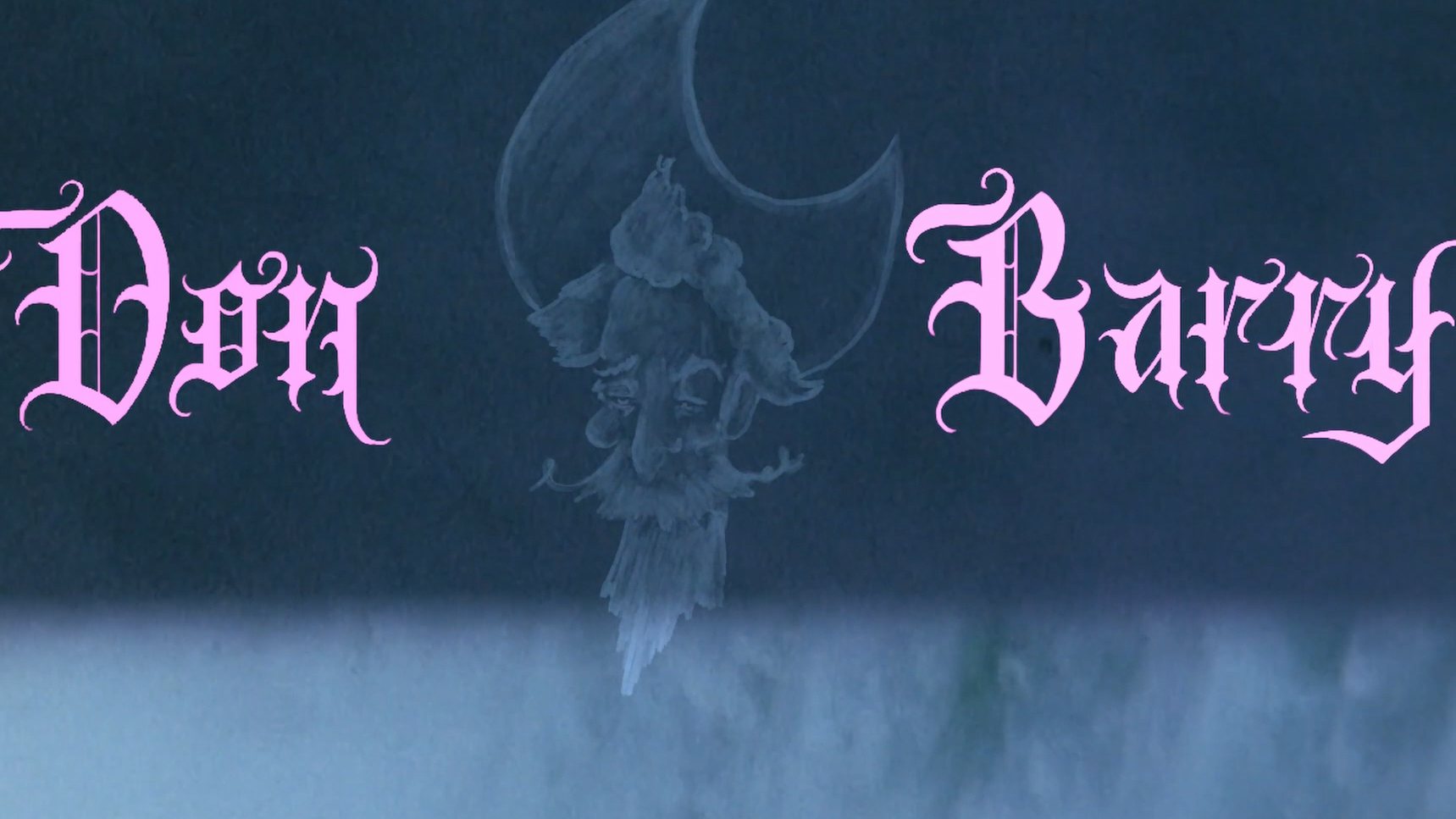
Docufiction, Experimental, by Paul Smart, Mexico, 2026.
Don Barry: A Quixotic Exploration is a debut feature that places the biography of an eighty-year-old experimental filmmaker and artist, Barry Gerson, within the metanarrative of Miguel de Cervantes’ Don Quixote. Don Barry was filmed in the city of Guanajuato during the 51st edition of the Cervantino Festival, as well as during the vibrant Day of the Dead celebrations held in the city’s UNESCO-listed tunnels. The film honors the director’s long friendship with artist Barry Gerson, drawing inspiration from Cervantes’ Don Quixote. Paul Smart’s directorial choices create something new that celebrates life and goes beyond conventional storytelling. A search for magic in our real lives. A moving film about the meaning of life, art, and death. Not to be missed.
Paul Smart is a proud outsider filmmaker with a long history of film screenings. In the 1980s, he emerged in New York’s vibrant youth art scene, working in theater production and later filmmaking, before retreating to rural upstate New York, in the Catskill Mountains, where he made a living writing and screening independent films in old parish halls for rural audiences, many of whom had never seen a film.
LANGUAGE: English
SUBTITLES: Spanish, French, German, Portuguese
The Puppeteer Behind the Curtain
There is a moment — you may have lived it, or you may live it still without having named it — when you look at your own hands doing something familiar and feel, for just a fraction of a second, that they belong to someone else. Not a crisis, not a breakdown. Just a hairline fracture in the ordinary. A man sits at his desk on a Tuesday morning, opening the same software he has opened for eleven years, and his fingers move across the keyboard with a competence so complete it has become mechanical, and he watches them — genuinely watches them, as if from a slight distance — and something cold passes through him. Not dissatisfaction. Something more precise than that. The sensation that the hands know what they are doing and he, whatever he is, is merely present.
Schopenhauer would have recognized this instantly. He would have said: you have accidentally seen through the veil.
The veil is what he borrowed and sharpened from Hindu philosophy — the Maya of the Upanishads, the cosmic illusion that presents the world as a stable, intelligible surface of objects and causes and identities. What we call reality, in Schopenhauer’s architecture, is Representation: the world as it appears to a perceiving subject, organized through the forms of space, time, and causality. This is the world we navigate, the world we plan inside, the world where careers are built and families are raised and routines calcify into something indistinguishable from fate. It is coherent. It is even beautiful, in its way. And it is, at its foundation, a kind of performance staged for consciousness.
Kant had already cut this open. In the Critique of Pure Reason, published in 1781, he argued that we never encounter things as they are in themselves — the Ding an sich, the thing-in-itself — but only as they are filtered through the a priori structures of our perception. Space and time are not features of reality; they are the lenses through which the mind processes it. The noumenon — the thing as it truly is, beneath all appearance — remains permanently inaccessible. Kant drew the border and then, with characteristic philosophical caution, refused to cross it. Beyond the border: silence. Respectful, disciplined silence.
Schopenhauer crossed it. This is the move that changes everything, the move that makes The World as Will and Representation, published in its first edition in 1818, something more than a brilliant elaboration of Kantian epistemology. He looked at the thing-in-itself and said: I know what it is. Not through abstract reasoning, not through inference — but through the one place where we encounter reality from the inside rather than the outside. The body. When you lift your arm, you experience two things simultaneously: from the outside, a physical event in space and time; from the inside, an act of will. These are not two separate events. They are the same event seen from two directions. And this interior dimension — this blind, urgent, wordless force that moves the body — is not something your body has. It is something your body is. And not only your body.
This is the vertigo. Schopenhauer extends the inference outward, relentlessly. The same force that moves your hand through familiar gestures on a Tuesday morning is the force that drives the plant toward light, the river toward the sea, the planet in its orbit. Will — his name for the thing-in-itself — is not a human faculty. It is not even biological. It is the single, undivided, purposeless striving that underlies all phenomena, wearing the costume of individuality, wearing the costume of time, wearing the costume of intention. It has no goal because it is itself the condition of all goals. It does not want anything in particular. It simply wants, absolutely and without remainder.
The man watching his own hands is not having a philosophical crisis. He is briefly, accidentally, glimpsing the puppeteer — the force that has always moved him, that called itself his ambition, his love, his reason, his choice.

Desire as Architecture of Suffering
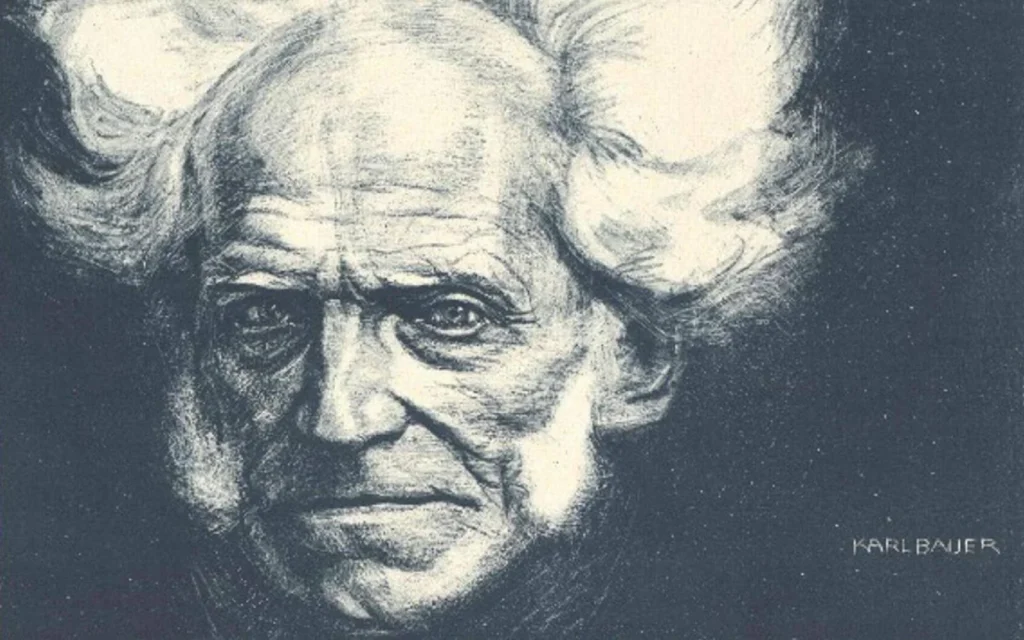
The promotion comes through on a Tuesday, and before the notification has finished loading, something in you has already moved on. Not forward — that would imply momentum — but sideways, into the next want, the one that was waiting just behind this one like a passenger on a crowded platform. You read the email twice. You feel what you expected to feel, but it lasts perhaps four seconds, and then it becomes simply a fact about you, inert, like knowing your own shoe size.
Schopenhauer understood this mechanism with a precision that most psychologists would not reach until a century after his death. In the first volume of The World as Will and Representation, published in 1818, he writes that willing is essentially suffering: every want is a deficiency, a pain with a specific shape, and when it is satisfied the pain ceases — but it does not become pleasure so much as it becomes silence, and silence, it turns out, is almost immediately unbearable. “Thus between desiring and attaining,” he writes, “all human life flows on throughout as a rule.” The structure he describes is not cyclical in the comfortable, rhythmic way. It is more like a ratchet: once the desire is gone, you cannot go back to the state before you wanted it. You can only generate a new desire, or sit in the hollow between, which he calls boredom, and which he considers an affliction as real as any bodily pain.
There is a woman standing at the window of an apartment she spent seven years dreaming about. The view is exactly as she imagined. The light in the afternoon comes through the glass at the angle she had pictured in at least a hundred idle moments during commutes and bad meetings and the long middle of ordinary nights. She got it. And she is standing at the window and she is already wondering whether the neighborhood will change, whether the upstairs neighbors will be loud, whether she made the right choice, whether there is a better apartment three streets away that she hasn’t seen. The moment of arrival has already receded behind her like a shoreline. She cannot live inside the achievement because the part of her that achieves things has already oriented itself toward whatever comes next. She is not ungrateful. She is not neurotic. She is simply human, operating according to the architecture Schopenhauer mapped.
Philip Brickman and Donald Campbell named this architecture in 1971, in a paper that introduced the concept of the hedonic treadmill into psychological literature. Their central argument was that humans rapidly adapt to changes in circumstance — to wealth, to loss, to achievement — and return to a relatively stable baseline of subjective well-being. The famous follow-up study comparing lottery winners to paraplegic accident victims found that within a year, neither group’s reported happiness differed dramatically from the other’s. The implication is not that circumstances don’t matter at all, but that they matter far less than desire insists they will. We spend years building toward conditions we believe will satisfy us, and the satisfaction, when it arrives, has a half-life measured in days.
Neuroscience has since confirmed what Schopenhauer articulated philosophically. The dopamine system, it turns out, is not a reward system in any simple sense. It fires most intensely in anticipation — in the gap between wanting and getting — and diminishes precisely at the moment of acquisition. The neurologist Wolfram Schultz’s work on dopamine prediction errors demonstrated that the brain codes desire as expectation, and expectation as a chemical state that cannot survive its own fulfillment. You are neurologically wired to want what you don’t have more intensely than you can ever want what you do. The instrument designed to motivate you toward goals is also designed to make those goals feel smaller once reached.
This is not a flaw. Or it is a flaw so fundamental that calling it one changes nothing. The woman at the window is already searching real estate listings on her phone without quite deciding to.
The Lost Poet
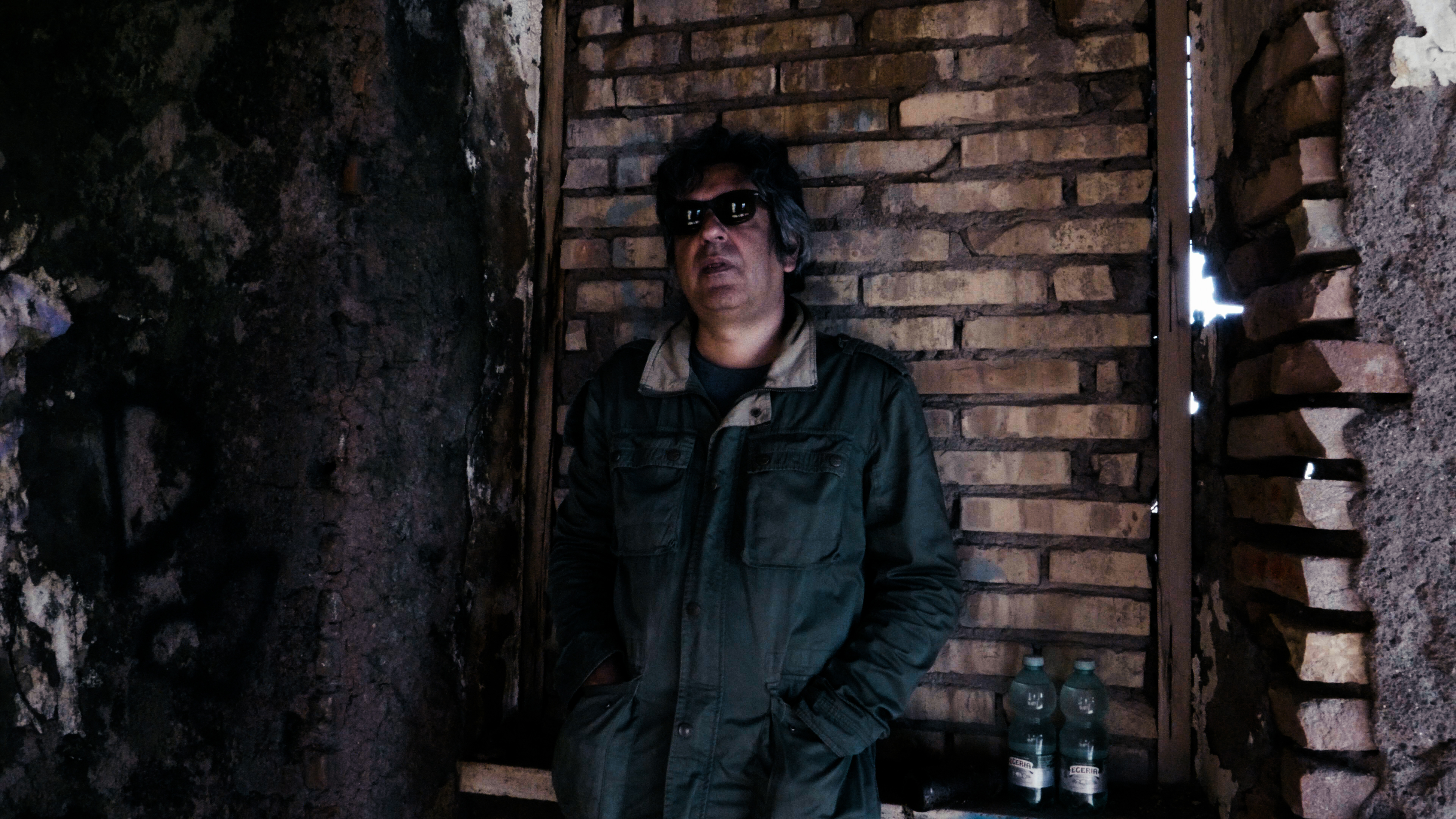
Drama, by Fabio Del Greco, Italy, 2024.
Dante Mezzadri wants to see an old friend, nicknamed the Iguana, whom he has lost sight of for many years, and who has managed to turn their shared youthful passion for poetry into a job, becoming a famous writer and poet. The man escapes from his bourgeois life and his wife to live homeless on the Roman coast, printing and trying to sell his poetry collections. At night he sleeps in a park of old carnival floats, inside a papier-mâché tank, and waits for the opportunity to meet his old friend, who however never shows up for appointments in the places they frequented when they were young, now in ruins. Dante's poetry books do not interest anyone and to support himself he is forced to "change product": he starts selling the infamous "cannibal pill" on behalf of young drug dealers, a new drug that sells like hot cakes and causes sensory and consumerist ecstasy. However, he realizes that this powerful drug is very dangerous for those who take it, he comes into conflict with his ethical conscience and throws all the pills into the sea. However, the dealers want to collect their money.
Shot over a period of 2 years, the film is a reflection on the cultural and artistic rubble of the society in which the protagonist lives, in an increasingly mechanized, consumerist and arid world. Dante Mezzadri is yet another human being who has renounced his inspiration and his creativity, but unlike many he is not willing to give his life to a system that distances him from his true identity. The physical world around him, however, seems constructed in such a way that it seems impossible to escape from this "invisible cage". The enthusiasm of the people he meets is ignited only by sensory gratification, by unreal visions of personal affirmation and success, by "metaverses" that offer an escape into an illusory and destructive reality. The poet's house on the coast, where he met with his friends as a young man, is just a pile of abandoned rubble. What happened to all those who wanted to become poets and ended up becoming something else? Are there internal forces with which that house can be "rebuilt"?
LANGUAGE: Italian
SUBTITLES: English, Spanish, French, German, Portuguese
The Will in Other Bodies
You are standing across a room from someone and something shifts in the atmosphere before you have spoken a word. There is a recognition that feels ancient, a pull that arrives before thought, before reason has time to file its objections. You become convinced, with a certainty that feels like revelation, that this particular person, out of all the persons who have ever existed or will exist, is the one your life has been moving toward. The feeling is so specific, so singular, so saturated with the texture of the irreplaceable, that it seems impossible it could be anything other than the most personal thing that has ever happened to you.
Schopenhauer would like a quiet word.
What you are experiencing, he argues in the fourth book of The World as Will and Representation, is not the most personal thing that has ever happened to you. It is the least. It is the Will operating through you at its most impersonal, most ruthless, and most elaborately theatrical. The sexual impulse, which he calls the focus of the will-to-live, is the masterpiece of its deception — the point at which the Will clothes its blind, species-level imperatives in the most exquisite individual costumes. You believe you are choosing. You believe the particularity of this face, this voice, this way of tilting the head is a matter of your own discernment. What you are actually doing is executing a calculation so ancient it predates consciousness itself: the Will is seeking its optimal continuation, and it has dressed that biological arithmetic in the language of the soul.
He calls this the genius of the species, and the phrase is not metaphorical. It is a force that thinks through you, not with you. The precise configuration of attraction — why her and not her, why now and not before — corresponds, Schopenhauer claims, to a kind of complementarity of characteristics that the species requires for its next iteration. Your beloved is not chosen by you. She is assembled for you by a mechanism that cares nothing for your happiness and everything for the pregnancy it is engineering.
Think of two people in the early hours of a love that still feels like discovery. They sit across from each other in a kitchen at two in the morning and they are speaking in that particular register that only new love generates — confessional, electric, every sentence feeling like it is being said for the first time in human history. He looks at her and thinks: I have never met anyone like this. She thinks the same. The certainty between them is so complete it has the quality of fate. And it is fate — only not theirs. The camera, if you allowed it to pull back slowly enough, would reveal two bodies performing a script billions of years in the drafting, their faces luminous with sincerity, their freedom absolute on the surface and nonexistent at the root.
Freud arrived at his theory of the unconscious through a convergence of clinical observation and philosophical inheritance he was famously reluctant to fully acknowledge. The debt is historically documented — Ernest Jones noted it, and scholars from Henri Ellenberger to Paul-Laurent Assoun have mapped it in careful detail. Freud admitted late in his life that he had deliberately avoided reading Schopenhauer for years so that his own ideas might develop independently, a confession that only confirms how close the parallel ran. The id, the pleasure principle, the death drive — these are Schopenhauerian structures wearing the vocabulary of medicine. The Will became the unconscious; the denial of the Will became repression; the ascetic saints of the fourth book became, in Freud’s translation, the neurotic.
Nietzsche inherited the same architecture and then tried to demolish the landlord. His will to power was a direct answer to Schopenhauer’s will-to-live — not a refutation but a transformation, an attempt to redirect the same blind force toward affirmation rather than extinction. But the structure of the argument, the primacy of a non-rational driving force beneath the surface of consciousness, remained entirely Schopenhauerian. You can rearrange the furniture, but you are still in the same house.
Aesthetics as the Only Escape Hatch
There is a moment, and you have lived it, when the music does something to you that no argument ever could. Not the pleasant background hum of something familiar, but the real collision — when a melody catches you somewhere beneath the ribcage and the person you were thirty seconds ago, the one with the unpaid bill, the unanswered message, the low-grade hum of wanting and worrying, simply stops existing. You are not happy in that moment. You are not sad. You are not anything that requires the pronoun “I” to function. The wanting has gone quiet.
Schopenhauer built an entire chamber of his philosophy around that moment and called it, with characteristic precision, aesthetic contemplation. In the third book of The World as Will and Representation, published in its first edition in 1818, he argues that the aesthetic experience is the only state in waking life where the Will releases its grip on the subject. Normally, every act of knowing is contaminated by interest — you perceive the world through the filter of what you need, fear, want, or intend to avoid. The Will uses cognition as its instrument, its mirror, its servant. But in genuine aesthetic contemplation, something ruptures. The subject momentarily ceases to be a particular individual with a history and an appetite, and becomes instead what Schopenhauer calls a pure will-less subject of knowing — a kind of clean transparency through which the Platonic Idea of the object shines without distortion. You do not look at the music or the painting or the landscape. You become the looking.
Someone sits in a darkened hall. On the stage before him, a woman is singing something almost too slow to hold together, each phrase suspended longer than comfort allows, and then resolved — but not in the direction you expected, never in the direction you expected. His own life has been a study in unresolved phrases. He has written manuscripts that feel like half-built cathedrals. He has loved people who did not return in the form he needed. But here, now, none of that is a problem. It is not solved. It is not consoled. It is simply not present. He is not there either, not entirely. What remains is a kind of impersonal witnessing, an ear without a body attached.
This was Richard Wagner‘s experience when he encountered Schopenhauer in 1854, through a copy given to him by the poet Georg Herwegh, and the encounter was not intellectual — it was recognitive, almost violent. Wagner read The World as Will and Representation four times in immediate succession. He wrote to Franz Liszt that this was the greatest philosophical gift his life had produced. And then, over the following years, he restructured everything he believed about music’s function. The result was Tristan und Isolde, which premiered in Munich in 1865 and which remains perhaps the most sustained artistic attempt in Western history to hold the listener inside that state of dissolved individuality Schopenhauer described. The harmonic language of the opera is built precisely on deferral, on the refusal to resolve, because resolution would mean the return of the ordinary desiring subject, and Wagner wanted to keep you gone as long as possible.
But the paradox Schopenhauer himself acknowledged is ruthless. The liberation is genuine and the liberation is temporary. The Will does not die during aesthetic contemplation — it sleeps, very lightly, and it wakes the moment the curtain comes down. You walk out of the hall and the cold air hits you and you remember the unpaid bill, the unanswered message, the body that is hungry or tired or quietly aging. The wanting floods back in like water finding its level. Aesthetic experience is not a cure. It is not even a treatment. It is, in Schopenhauer’s own framing, a brief suspension of the sentence — not a pardon, not a commutation, just the few seconds between the judge’s last word and the moment the guards move toward you.
The music was real. The dissolution was real. And neither of them lasted.
A vision curated by a filmmaker, not an algorithm
In this video I explain our vision
Asceticism, Compassion, and the Refusal to Play

There is a man you know — or knew, before he became difficult to explain at dinner parties — who simply stopped. Not dramatically, not with a manifesto. He stopped pursuing the promotion he had been angling toward for three years. He gave away a significant portion of what he owned. He became quieter at gatherings, not sullen but genuinely uninterested in the transactions that pass for conversation among people who are still very much in the game. And what struck you, what perhaps still strikes you, is how profoundly uncomfortable his stillness made everyone around him. Not his suffering — his peace.
Schopenhauer would have recognized the phenomenon immediately. In the final movement of The World as Will and Representation, published in its complete form in 1844, he arrives at what he considers the only honest conclusion available to a mind that has genuinely understood what existence is. If the Will is blind, insatiable, and self-consuming, if every satisfaction is merely a temporary suppression of a want that will return wearing a different face, then the one authentic response is not to play the game more cleverly but to withdraw consent from the game entirely. He calls this denial of the will-to-live, and he is careful — almost anxiously so — to distinguish it from suicide. Suicide, he argues, is not a refusal of the Will but a surrender to it. The person who kills themselves is overwhelmed by circumstances, defeated by the particular conditions of their wanting. They destroy the body while the Will itself, the wanting as such, remains philosophically intact. The ascetic does something far more radical and far more difficult: they continue to live while systematically refusing to feed the appetite.
This is not a comfortable position, and Schopenhauer never pretends it is. He draws on Hindu and Buddhist traditions, on Christian mysticism, on the lives of saints who struck his contemporaries as lunatics, as wasted potential, as people who had somehow failed to understand what life was for. The philosopher Emil Cioran, writing more than a century later, would describe a similar logic when he argued that the only true freedom is the freedom to be indifferent to one’s own continuation — a thought that sounds like despair until you sit with it long enough to notice that it might also be release.
Alongside asceticism, Schopenhauer places compassion — Mitleid, literally suffering-with — as the singular foundation of genuine ethics. Not duty, not rational law, not the categorical imperatives that Kant had built his moral architecture upon. Compassion alone, because compassion is the only moment in which the illusion of separateness briefly collapses, in which you recognize that the Will driving the other person’s hunger, fear, and grief is identical in kind to the Will driving yours. The man who stops and gives and withdraws is not, in Schopenhauer’s framework, broken. He is the only person in the room who has clearly seen what the room is.
What unsettles the observer is not the observed person’s failure. It is the implicit accusation contained in their stillness. Every life that refuses to accumulate, to compete, to perform appetite on schedule, holds up a mirror to those who are still running. And the reflection is not flattering. The discomfort you feel watching someone disengage from the race is not concern for them. It is the momentary, vertiginous suspicion that the race itself might be optional.
And yet — and here the structure of the argument folds back on itself with almost cruel precision — the aspiration to deny the Will is itself a form of wanting. The desire to be free of desire is still desire. Schopenhauer knew this. He spent his later years in Frankfurt, bourgeois and meticulous, attached to his poodles, to his reputation, to the long-delayed recognition that finally came to him in his seventies. The philosopher who mapped the prison most completely may have been no closer to the door than anyone else, which is perhaps the most honest thing a philosopher has ever inadvertently confessed.
🌀 The Will, The Void, and The Search for Meaning
Schopenhauer’s The World as Will and Representation dives into the blind, relentless force driving all existence, questioning whether consciousness can ever transcend its own suffering. The works gathered here extend that inquiry across existentialism, absurdism, and depth psychology, tracing the same restless question through different centuries and minds.
Camus’s Myth of Sisyphus: The Absurd Explained
Camus’s Myth of Sisyphus confronts the absurd with a defiance that echoes Schopenhauer’s diagnosis of existence as fundamentally irrational and painful. Where Schopenhauer counsels aesthetic withdrawal and ascetic denial, Camus insists on revolt and passionate engagement with life despite its meaninglessness. Both thinkers circle the same abyss, arriving at strikingly different shores.
GO TO THE SELECTION: Camus’s Myth of Sisyphus: The Absurd Explained
Camus’s The Stranger: Meaning and Analysis
In The Stranger, Meursault embodies the indifferent universe that Schopenhauer identified as the blind Will stripped of any moral teleology. Camus transforms philosophical pessimism into literary flesh, showing how a man alienated from social meaning navigates the void without metaphysical consolation. Reading it alongside Schopenhauer reveals how existentialist fiction owes a deep, often unacknowledged debt to German idealist pessimism.
GO TO THE SELECTION: Camus’s The Stranger: Meaning and Analysis
Frankl’s Man’s Search for Meaning: Analysis
Viktor Frankl‘s engagement with meaning in Man's Search for Meaning can be read as a direct existential response to the Schopenhauerian claim that life is inherently purposeless suffering. Frankl argues that even in the most extreme conditions of dehumanization, the will to meaning can transform suffering into a bearable and even ennobling experience. His logotherapy stands as one of the most powerful counter-arguments to Schopenhauer’s resignation.
GO TO THE SELECTION: Frankl’s Man’s Search for Meaning: Analysis
Jungian Individuation and the Great Work
Jung’s concept of individuation shares a surprising kinship with Schopenhauer’s notion that the Will can become conscious of itself through the individual subject. In alchemical symbolism Jung found a symbolic language for the inner transformation that Schopenhauer glimpsed in aesthetic and ascetic experience. This article explores how the Great Work of Jungian psychology is, at its core, a confrontation with the same irrational ground of being Schopenhauer called Will.
GO TO THE SELECTION: Jungian Individuation and the Great Work
Explore the Cinema of Ideas on Indiecinema
If these philosophical labyrinths stir something in you, Indiecinema is the streaming platform where thought meets image. Discover independent films that dare to ask the questions mainstream cinema refuses to touch — from existentialist drama to visionary metaphysical cinema, all in one place.
👉 EXPLORE THE CATALOG: Watch Indie Films in Streaming
A vision curated by a filmmaker, not an algorithm
In this video I explain our vision

