
The Alarm Goes Off Before You’ve Decided Who You Are
You are already reaching for your phone before your eyes have fully opened. The motion is not a decision — it is a reflex, a groove worn so deep into the muscle memory of your mornings that calling it a choice would be a kind of flattery. The screen fills with numbers: steps not yet taken, messages demanding response, a calendar that begins its jurisdiction over your body before your body has had the chance to remember it belongs to you. You sit up. You do not sit up because you have considered sitting up. You sit up because the infrastructure of your life has been engineered to make lying down feel like failure.

This is not laziness overcome. This is not discipline earned through suffering and eventually internalized as virtue. Something stranger is happening here, something that neither the self-help industry nor its critics have been entirely honest about. The productivity rituals that now structure the first forty-five minutes of millions of mornings — the cold water, the journal, the protein, the inbox scan performed with the focused urgency of a surgeon — were never chosen in any meaningful sense. They were absorbed. They arrived through podcasts and feeds and the ambient social pressure of watching other people perform their optimization publicly, until the performance became indistinguishable from necessity. The body learned what success was supposed to look like before the mind had any say in the matter.
Pierre Bourdieu spent much of his working life — particularly in the decade that produced Outline of a Theory of Practice in 1972 — trying to describe exactly this mechanism: the way that social structures inscribe themselves into the body as posture, reflex, appetite, and disgust, producing what he called the habitus. The habitus is not ideology in the traditional sense. You cannot argue someone out of it with better information, because it does not live in the register of belief. It lives in the hinge of the jaw, in the tightening of the chest when a morning runs too slow, in the specific quality of unease that descends on a Sunday afternoon when nothing productive has been accomplished. The feeling is not metaphorical. It is physiological. And it was installed without your consent, largely before you were old enough to recognize that installation was occurring.
What makes this particular moment historically unusual is the scale and the speed. Earlier societies had rigorous performance cultures — the Calvinist work ethic that Max Weber traced in 1905 through the accounting books of Protestant merchants created its own terrifying architecture of self-surveillance — but those systems operated on a generational timescale, transmitted through family, church, and visible community. What exists now travels faster and leaves fewer fingerprints. A twenty-three-year-old in Jakarta and a thirty-one-year-old in Stockholm and a nineteen-year-old in Lagos can absorb the same success mythology within the same week, through the same interfaces, calibrated by the same algorithmic reward structures, and each of them will experience the resulting anxiety as something purely personal, as evidence of their own individual inadequacy rather than as a shared cultural transmission.
The loneliness of that misreading is not incidental. It is the condition under which the whole system reproduces itself most efficiently. When you believe the pressure is coming from inside you — from your own ambition, your own standards, your own fear of wasting the one life you have been given — you do not look for its source. You look for better strategies to manage it. You buy the planner. You adjust the morning routine. You wake up earlier, which means the alarm goes off before you’ve decided who you are, and the day begins already in debt, already behind, already measured against a standard that arrived before you did and will remain standing long after you have stopped asking where it came from.
Return to Planet Underground

Drama, Thriller, by Gideon Homes, Netherlands, 2025.
A former underground techno DJ working in a large and famous law firm delves into the dark side of society. With one eye on the past and one on the future, he stirs up the ashes of the true underground. The demand of society to function superficially and deliver top performance increasingly clashes with the protagonist's questioning of his own life reality and the values of his past. After being employed for almost six years and being a respected employee, Tyrel falls ill. On top of that, he witnesses a fraud within the company and asks to leave. But the illness creates a complex situation in which his employer starts playing a game of chess with Tyrel.
In "Return To Planet Underground", director Gideon Homes gives the audience a gripping insight into the Dutch underground techno scene, offering a gripping drama set in a dark world, full of intense moments and touching human tragedies. This film is not just a visual feast; it is a gripping exploration that immerses viewers in the lives of its protagonists. Set to a backdrop of thumping techno beats, "Return To Planet Underground" takes audiences on a rollercoaster ride through the highs and lows of human desires, drug-fueled escapades, societal pressures and the pursuit of perfectionism. Drawing inspiration from iconic films such as Trainspotting, Berlin Calling and Human Traffic, Gideon Homes' work stands out for its unique stylistic devices and unconventional storylines. Based on real events and personal experiences, "Return To Planet Underground" faced numerous lawsuits before finally conquering audiences around the world. Prepare yourself for an immersive dive into a world where music, morality and the human spirit collide.
LANGUAGE: English, Dutch
SUBTITLES: Spanish, French, German, Portuguese
The Protestant Ledger That Never Closed
You have probably never thought of your resume as a confession, but that is exactly what it is. Every line on it is a declaration of worthiness, a proof submitted to an invisible tribunal that has been judging you since long before you were born. The anxiety you feel when it sits one achievement short of what you imagined it should be is not ambition. It is the oldest form of guilt the Western world knows how to produce.
Max Weber saw the mechanism clearly in 1905, when he published The Protestant Ethic and the Spirit of Capitalism and traced the strange genealogy connecting Calvinist theology to the compulsive bookkeeping of modern economic life. His argument was deceptively simple and permanently unsettling: the Reformation did not free the European self from the tyranny of divine judgment. It privatized that judgment. Calvin’s doctrine of predestination meant that salvation was already decided, fixed before birth, invisible and non-negotiable. What followed from this was a psychological catastrophe of the first order. If you cannot earn grace, and if grace is the only thing that matters, then how do you live inside that uncertainty without going insane? The answer the Calvinist communities developed, Weber argued, was to read worldly success as a sign. Not a cause of salvation, but a symptom of it. The man who prospered was, perhaps, one of the elect. The man who failed was, perhaps, not.
What is extraordinary about this is not the theology but the migration. The specific doctrinal scaffolding collapsed over centuries, but the emotional architecture it built remained standing and was simply redecorated. By the time the language of election had faded from polite conversation, the habit of reading professional achievement as moral evidence had already been installed so deeply into Western culture that it no longer required any religious justification. Productivity became its own catechism. The ledger stayed open even after everyone had stopped believing in the ledger-keeper.
This is what makes the contemporary obsession so difficult to argue against from the inside. It does not present itself as a theology. It presents itself as common sense, as meritocracy, as the neutral observation that effort produces results and results produce worth. The philosopher Charles Taylor, in his 1989 work Sources of the Self, described how modernity inherited a fierce moral seriousness from its Protestant roots while systematically dismantling the metaphysical framework that had originally given that seriousness its meaning. What remained was the intensity without the explanation — a demand for self-justification that floated free of any coherent account of what exactly one was supposed to be justifying oneself to.
The guilt did not disappear. It was reassigned. Where the Puritan trembled before the possibility of damnation, the contemporary professional trembles before the possibility of wasted potential. The language shifted from sin to underperformance, from repentance to optimization, from the confessional to the productivity system. But the phenomenology — the specific texture of the anxiety, the restlessness, the sense that one is always slightly behind in a race whose finish line keeps moving — that remained structurally identical. Sociologist Hartmut Rosa, writing in Social Acceleration in 2013, documented how modern Western subjects experience time not as abundance but as permanent scarcity, as though there is never enough of it to accomplish the justification that seems perpetually required.
The cruelty embedded in this inheritance is precise. A theology of grace, however brutal in its predestinarian logic, at least acknowledged that the individual was not the final author of their own worth. Something outside the self did the deciding. The secular version removed that acknowledgment while keeping the demand. It told the self that it was now free and then handed it a set of scales on which it must weigh itself, forever, with no external reference point and no possibility of a verdict that finally holds.

When the Market Learned to Speak in the First Person

You are standing in front of a bathroom mirror at six in the morning, rehearsing your elevator pitch to no one. Not because someone told you to. Because it feels urgent, almost biological, like hunger.
The architecture of that urgency was built across a decade. Between 1979 and 1989, two governments on opposite sides of the Atlantic systematically dismantled the conceptual wall between the citizen and the economic actor. Margaret Thatcher‘s privatization programs — British Telecom in 1984, British Gas in 1986, water utilities in 1989 — were not merely fiscal maneuvers. They were pedagogical events. Each one taught the population a grammar in which public goods were inefficiencies and the self was a portfolio. Ronald Reagan‘s simultaneous demolition of progressive taxation and collective bargaining structures performed the same instruction on American soil. What emerged was not just a policy regime but an anthropological proposition: that the human being is, at base, a unit of capital seeking return on investment.
Michel Foucault, lecturing at the Collège de France in 1978 and 1979 — lectures published as The Birth of Biopolitics — identified something his contemporaries largely missed. Neoliberalism was not simply an economic doctrine. It was a technology for producing a new kind of subject, what he called homo economicus reloaded: a person who relates to themselves as an enterprise, who treats every decision as an investment, every relationship as a potential asset or liability. Foucault saw this coming before most of the policy architecture was even fully assembled. What he could not have anticipated was the velocity at which digital infrastructure would accelerate the process three decades later.
By 2010, the smartphone had turned the theory into lived metabolism. The personal brand — a concept Gary Vaynerchuk and his generation did not invent but industrialized — became the name for what Foucault had described abstractly. You were no longer a person with a job. You were a media company that happened to have a body. LinkedIn’s user base crossed 100 million that year. Instagram launched. The platforms did not create the ideology; they gave it a nervous system, a distribution channel, a dopamine loop. The hustle was no longer a subculture. It was a default setting.
What makes this machinery so difficult to see from inside it is that it speaks entirely in the vocabulary of liberation. It does not say: you must optimize yourself for market extraction. It says: unlock your potential. It does not say: your worth is contingent on productivity. It says: invest in yourself. The sociologist Luc Boltanski and economist Eve Chiapello documented this grammatical inversion in The New Spirit of Capitalism, published in 1999, arguing that late capitalism absorbed the language of the 1968 counter-culture — authenticity, self-expression, autonomy — and redeployed it as management ideology. The rebellion became the product. The hunger for meaning became the engine of compliance.
This is why hustle culture does not feel like coercion. It feels like identity. The person who wakes before dawn to build their side project is not obeying a market command in any conscious sense. They are being themselves. They are living their values. The structural imperative has been fully metabolized, converted from external pressure into internal character. Philip Mirowski‘s Never Let a Serious Crisis Go to Waste, published in 2013, traces how neoliberal thought achieved something no previous ideology quite managed: it made its own reproduction feel like personal growth.
A Better Life
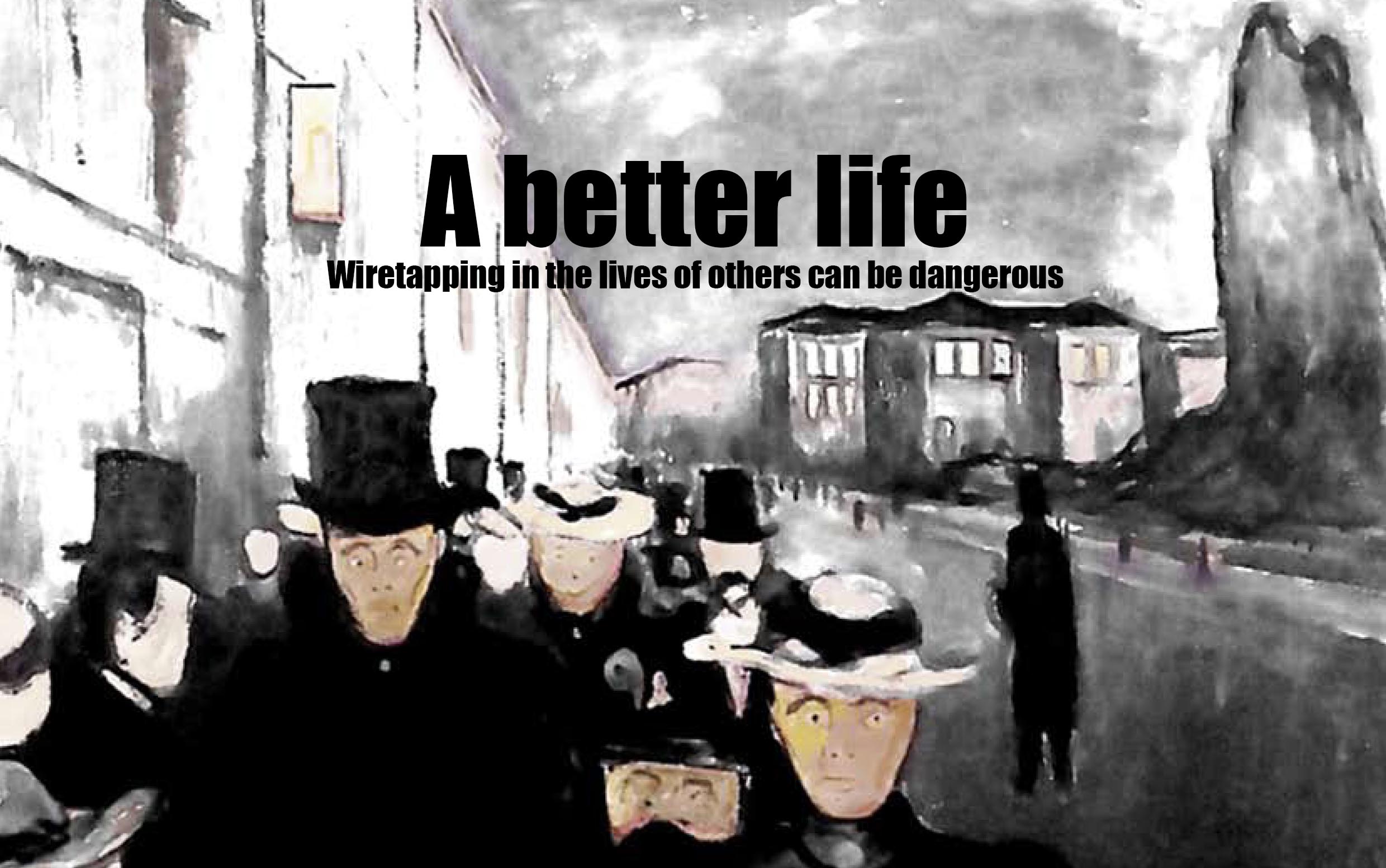
Drama, thriller, by Fabio Del Greco, Italy, 2007.
Rome: Andrea Casadei is a young investigator specializing in audio wiretapping who conducts investigations commissioned by husbands betrayed by their wives, or by parents worried about what their children are doing outside the home. But what interests him most is understanding the human soul, listening to casual conversations in the streets, knowing what people think. He often meets in Piazza Navona with his friend Gigi, a frustrated street artist obsessed with success at all costs, with whom he shares a passion for wiretapping. Shocked by the mystery of the disappearance of Ciccio Simpatia, another street artist common friend, Andrea decides to abandon the commissioned works to seek a better life and reflect on his own and others' existence. He will meet the actress Marina and with a bug he will slowly enter her life until he discovers her most unthinkable secrets. The film deals with an important theme of contemporary Western society: the lack of love. The mysterious and tormented figure of Marina is reflected in a gloomy and soulless Rome.
Director Fabio Del Greco declared about his film: "Perhaps this film is a reflection on the art of observing, of listening, in short, of what one does when one leaves the real world to tell about it. Perhaps he wants to talk about the subtle relationship between the mirages of success touted by today's society, power and the most authentic human relationships.A 'dark cloud' hangs over the city: it is engulfing everyone in a sort of indistinct, uniform mass, where everyone thinks the same things, where everyone they are more alone. Where is the truest part that makes us unique? Maybe you can try to intercept it only secretly."
LANGUAGE: Italian
SUBTITLES: English, Spanish, French, German, Portuguese, Dutch.
The Metrics That Swallowed the Thing Being Measured
You downloaded the app on a Tuesday in October, probably because someone you respect mentioned it in passing, and within seventy-two hours you had logged your sleep cycles, your heart rate variability, your hydration, your mood on a scale of one to ten, your steps, your focus sessions, and the precise macronutrient breakdown of a meal you had genuinely enjoyed before you started entering it into a database. By Thursday, you were no longer eating the meal. You were producing data about it.
This is not a trivial drift. It is a structural substitution that operates beneath the threshold of conscious decision, and it has a name, though the name rarely travels outside economics departments. In 1975, the British economist Charles Goodhart formulated what became known as Goodhart’s Law: when a measure becomes a target, it ceases to be a good measure. He was describing monetary policy, the way central banks would corrupt their own instruments the moment they began optimizing for them. But the principle exposed something far older than central banking — a cognitive trap embedded in any system that mistakes the map for the territory it was drawn to represent.
What makes the contemporary moment historically specific is the sheer industrial scale at which this substitution is now being sold back to people as self-knowledge. The global wellness industry exceeded $4.5 trillion in annual revenue by the early 2020s, a figure that includes not only fitness trackers and sleep monitors but the entire apparatus of quantified self-improvement: coaching platforms, mindfulness applications, continuous glucose monitors worn by people with no metabolic disorder, productivity systems that ask you to rate the quality of your own attention before you have finished having it. The sociologist Deborah Lupton, in her 2016 work The Quantified Self, documented how these technologies do not passively record experience — they actively restructure it, training users to perceive their inner states as valid only once externalized into legible numerical form. The feeling that you slept well becomes suspect until the device confirms it.
There is something philosophically violent in this, though the violence arrives wrapped in the language of empowerment and personal optimization. William Davies, in The Happiness Industry published in 2015, traced the genealogy of this impulse back through Bentham’s felicific calculus and early twentieth-century industrial psychology, showing how the desire to measure human wellbeing has always been inseparable from the desire to manage and extract from it. The wellness dashboard is not a neutral mirror. It is a governance technology that turns the subject into both the administrator and the administrated, simultaneously the factory and the output report.
What disappears in this arrangement is not efficiency but texture — the irreducible grain of experience that refuses numerical encoding. The psychologist Mihaly Csikszentmihalyi spent decades studying optimal human experience, and the defining characteristic of what he called flow states was precisely the dissolution of self-monitoring: people in deep absorption reported not a heightened awareness of their performance metrics but a complete suspension of the evaluative gaze. The tracked life is structurally incompatible with this kind of presence because tracking requires the continuous maintenance of a witnessing perspective, a second self standing outside the experience and annotating it in real time.
And yet the industry depends on convincing you that the annotation is the point, that the graph of your mood across thirty days tells you something about yourself that thirty days of living could not. This is the deepest substitution: not simply that the measure replaces the thing measured, but that the accumulated record of a life comes to feel more real, more substantial, more permanently yours than the life that generated it.
A Man Stares at His Own Résumé at His Father’s Funeral
He stands at the edge of the open grave, October light falling flat across the grass, and somewhere inside the arithmetic of that moment — his father’s body below the earth, the priest speaking words no one is fully hearing — he begins to count. Not the years. Not the memories. He counts the promotions. The salary jumps. The title on his current business card. He does not choose to do this. It simply happens, the way the mind reaches for solid ground when the floor has disappeared beneath it, and what it finds solid, what it finds real and weight-bearing, is the list of things he has achieved. He is forty-four years old and standing at his father’s funeral and the only story he can tell himself that makes him feel like a person who deserves to still be alive is the one written on his résumé.
This is not a failure of character. It is the logical endpoint of a culture that has spent fifty years systematically dismantling every framework for human value except the productive one. When Zygmunt Bauman described what he called liquid modernity in his 2000 work of the same name, he was pointing at something precise: the dissolution of stable identities rooted in community, tradition, or faith, and their replacement by identities that must be constantly earned, constantly performed, constantly updated. The self becomes a project. And projects are evaluated. They succeed or they fail. They have metrics. In a world where the soul has been replaced by the portfolio, grief is not an experience that happens to you — it is an interruption you must eventually justify in terms of what you managed to accomplish before and after it.
What makes this colonization so complete is that it does not arrive through coercion. No authority commands the man at the graveside to think about his career. The architecture of contemporary selfhood has simply been constructed in such a way that professional identity is the load-bearing wall. Philip Rieff saw part of this coming in 1966 when he argued in The Triumph of the Therapeutic that Western culture had shifted from a moral order organized around duty and sacred obligation toward one organized around personal well-being and self-optimization. What he perhaps did not fully anticipate was the speed with which self-optimization would be absorbed into market logic, until the language of therapy and the language of productivity became nearly indistinguishable — both promising you a better version of yourself, both measuring that version against an external standard of performance.
The psychic consequence is a specific kind of homelessness. Grief, love, failure, aging — these are experiences that require a self capable of dwelling in states that cannot be optimized. They require what the philosopher Gabriel Marcel distinguished as being, as opposed to having: an orientation toward existence that is not transactional, not acquisitive, not legible in terms of gain or loss. But the man at the grave has been trained, across four decades, to live almost entirely in the register of having. He has accumulated credentials, positions, recognitions. He does not know how to simply be a son who has lost his father, because that experience offers him nothing to count, nothing to display, nothing that would hold up under the evaluative gaze he has so thoroughly internalized that he can no longer locate where the culture ends and he begins.
The funeral ends. People move toward cars. Someone touches his arm and says something about strength. He nods. On the drive home he will think, briefly, about a conference call he has on Monday, and the thought will arrive with something close to relief, because the conference call is a problem he knows how to be inside of. The father is not.
A vision curated by a filmmaker, not an algorithm
In this video I explain our vision
Rank, Shame, and the Invisible Tribunal

You are already performing. Not metaphorically — literally. The way you angled your laptop screen in the coffee shop so the person beside you might catch a glimpse of what you were working on. The way you mentioned the project casually, with studied nonchalance, in a conversation where no one asked. The performance began before you were conscious of it, which is precisely what makes it so difficult to name.
Erving Goffman argued in The Presentation of Self in Everyday Life that social life is not a space where selves express themselves but a stage on which they construct themselves through the management of impressions. Published in 1959, the book made a claim that still unsettles: there is no backstage self waiting to emerge. There is only the performance, layered across contexts, adjusted for each audience, and the terror of the moment when the mask slips. What Goffman called “impression management” was not a description of dishonest people. It was a description of everyone, operating inside a system where reputation is not incidental to survival but constitutive of it.
The machinery has not simply continued since 1959 — it has been industrialized. Sociologist Shamus Khan, in his 2011 ethnography Privilege: The Making of an Adolescent Elite at St. Paul’s School, documented something that complicates the older story of meritocracy. The elite he studied had abandoned the stiff, inherited markers of status — the closed clubs, the genealogical pride, the explicit exclusions. In their place had appeared something more insidious: an ideology of ease. The new elite performed their superiority through the appearance of effortlessness, through comfort with everything, through a kind of omnivorous confidence that made privilege look like personality. Success no longer declared itself. It implied itself, through posture and diction and the specific relaxation of someone who has never had to be nervous.
What this means for everyone who grew up outside those rooms is that the game’s rules were changed without announcement. The old markers of status could at least be identified and, in theory, acquired. The new ones — ease, fluency, comfort across registers — are learned in early childhood or they are not learned at all, and their absence is felt not as social disadvantage but as personal deficiency. The person who feels clumsy at a certain table, who stumbles over a reference, who laughs a half-second too late, does not think: this is a class dynamic. They think: something is wrong with me.
This is where rank becomes shame, and shame becomes the engine of striving. The sociologist Thomas Scheff, building on the work of Helen Lewis in the 1970s, identified shame as the social emotion par excellence — not guilt, which is about what you have done, but shame, which is about what you are. Shame, crucially, does not require a witness. It internalizes the tribunal. By the time adulthood is reached, most people are carrying an imaginary panel of judges whose verdicts they anticipate constantly, adjusting their choices to avoid the sentence of ordinariness before it can be pronounced.
The terror of being perceived as ordinary is not the same as the desire to be extraordinary. It is a defensive posture, not an aspiring one, and the distinction matters enormously. Desire can be satisfied, redirected, outgrown. Terror has no endpoint. The person who succeeds in order to escape the verdict of mediocrity does not find, upon succeeding, that the tribunal dissolves. The judges simply raise their standards, recede further, and begin scoring dimensions of performance that had not previously existed. Each achievement becomes not a destination but a new minimum threshold beneath which shame waits.
The invisible tribunal is not other people. It is the part of yourself that learned to see yourself through the eyes of a room you may never have entered, judging yourself by standards you did not choose, for an audience that never actually asked this of you.
The Failure Industry and Its Perfect Paradox
You are sitting in a darkened auditorium, watching someone cry on a stage with a red circle behind them. The audience is leaning forward. The speaker has just described bankruptcy, divorce, the year they lost everything — and the room is electrified not by grief but by something closer to appetite. What the crowd is consuming is not suffering. It is suffering successfully performed. The distinction is everything, and nobody in the room is allowed to notice it.
The vulnerability memoir emerged as a cultural form in the early 2000s and metastasized across the following two decades into one of publishing’s most reliable profit centers. Brené Brown’s research at the University of Houston, which produced Daring Greatly in 2012, was legitimate social science before it became a brand architecture. Her finding that vulnerability correlates with human connection was true and useful. What the culture did with it was transform vulnerability into a technique — a deliverable, a mode of personal marketing that requires the appearance of openness while structuring that openness with the precision of a product launch. By the time a failure story reaches a stage, a book deal, or a monetized podcast, it has passed through so many editorial filters that what remains is not the experience of failing but its most photogenic and instructive residue.
The startup post-mortem is perhaps the purest expression of this logic. Silicon Valley developed a genre — the “failure essay” published on Medium or delivered at conferences like FailCon, which ran from 2009 onward — in which founders narrated their collapsed companies with analytical detachment and forward-looking lessons. The form looks like honesty. It functions as a resume entry. The founder who can narrate failure fluently signals emotional intelligence, adaptability, and a kind of executive self-awareness that makes them more fundable, not less. Failure, processed correctly, becomes an asset class. This means the evaluative system does not suspend itself in the face of defeat — it simply reclassifies the input and continues running.
What this machinery produces is a total closure of the space outside evaluation. If success is rewarded and curated failure is also rewarded, then the only unacceptable position is silence — the person who failed and said nothing, who did not extract lessons, who did not metabolize the wreckage into content. Pierre Bourdieu wrote in Distinction, published in 1979, that every cultural field produces its own logic of legitimate participation, and that exclusion operates not through force but through the inability to speak the field’s native language. The failure industry has extended that logic: even your worst moments must be spoken in the correct register, or they do not count as legitimate experience.
This produces a subtle but disabling anxiety in people who have genuinely suffered without narrative. The person who was fired and did not recover cleanly, who went through something that left no lessons worth sharing, who cannot locate the growth arc in their own history — that person finds no mirror in the culture of productive failure. They are not tragic. They are simply illegible. And illegibility, in an attention economy, is its own form of social death.
There is a man — not fictional, but composite enough to be anyone — who spent four years building something that failed for reasons that were partly his fault and partly random, who emerged without insight, without a better version of himself, who is simply older and more cautious. He does not have a TED talk. He does not have a post-mortem essay. He has the experience itself, unprocessed, sitting in him like sediment. The culture has no use for him. Not because his failure was too large, but because he refused — or was unable — to turn it into performance. And in that refusal, or that incapacity, something true about failure remains intact, preserved precisely by its uselessness to the machinery that would otherwise consume it.
What Remains When the Scaffolding Is Removed

You wake one morning and the calendar is empty. Not because you failed — because you succeeded, fully, completely, and the architecture of pursuit that organized every hour of the previous decade has simply dissolved. There is no next milestone. The inbox is quiet. The award sits on a shelf gathering a fine, indifferent layer of dust. And you discover, with something close to vertigo, that you do not know what you are when nothing is demanding you perform it.
Viktor Frankl observed in Man's Search for Meaning, published in 1946 and drawn from his survival inside the Nazi concentration camp system, that human beings can endure almost any condition of suffering if they possess a sense of purpose — but that the inverse crisis, the crisis of a life suddenly emptied of demanded meaning, produces a particular and devastating form of collapse he called the existential vacuum. He was not writing about leisure. He was writing about the terrifying freedom that arrives when the external structure organizing a life is forcibly removed. What he could not have fully anticipated was that the same vacuum would be manufactured voluntarily, at scale, by cultures that train people from childhood to locate the entire architecture of meaning in a sequence of external achievements — each one erasing the last, each one requiring the next.
Byung-Chul Han’s 2010 work The Burnout Society names the late form of this trap with unusual precision. He argues that contemporary Western subjects are not oppressed in the classical sense — they are not broken by external prohibitions or by an authority commanding submission. They break themselves, willingly, inside what he calls the achievement-society, a system that replaces the disciplinary command “you must” with the apparently liberating imperative “you can.” The result is a self that experiences its own exhaustion as personal failure rather than structural consequence. The burnout individual does not blame the system. The burnout individual blames their own insufficient will, their insufficient hunger, their insufficient drive — and then attempts to recover not in order to rest, but in order to return to the same mode of production at higher intensity. There is no outside to exit toward. The cage is built from the inside.
What Han exposes, and what the entire therapeutic apparatus of productivity culture carefully avoids naming, is that the achiever-self is not a self in any philosophically coherent sense. It is a function. It is a role that has colonized interiority so thoroughly that when the role is suspended — by illness, by loss, by the simple mechanical completion of a goal — the person inside the role discovers there is no independent infrastructure beneath it. Identity, in this architecture, is not something you have. It is something you are perpetually constructing through performance, and the moment the performance pauses, the identity goes dark like a screen when the power cuts.
Cultures with different organizing principles have historically offered alternative containers — religious practice, community obligation, craft lineages, the slow cyclical rhythms of agricultural or contemplative life — not as superior solutions but as different distributions of the weight of meaning, structures that did not concentrate everything into individual achievement and therefore did not produce this specific form of collapse. The contemporary West dismantled most of those containers during the eighteenth and nineteenth centuries and replaced them with the productive self as the primary unit of social value. That replacement was not inevitable. It was a decision, made by specific economic and political actors, that has since calcified into something that feels like nature.
The honest question, then — the one that contemporary success culture is structurally incapable of asking — is not how to recover the drive, not how to rebuild motivation after burnout, not how to optimize rest in service of future performance. The honest question is what kind of human being you actually are when every scaffolding of external validation has been stripped away, and whether what remains is enough to constitute a life worth the name.
🌀 Chasing Shadows: The Labyrinth of Modern Ambition
The obsession with success in contemporary culture mirrors an ancient and universal human anxiety: the fear of being lost, of circling endlessly without arrival. Literature and philosophy have long mapped this inner maze, from Borges’ infinite corridors to Beckett’s paralyzing wait. These works remind us that the pursuit of achievement can become its own form of entrapment.
Jorge Luis Borges and the Labyrinth of Identity
Borges explored the labyrinth not merely as a physical structure but as a metaphor for the self caught in relentless pursuit of meaning and recognition. His characters wander through infinite corridors that mirror the modern professional’s endless chase for validation and status. In a culture that equates identity with achievement, Borges’ labyrinths feel startlingly contemporary.
GO TO THE SELECTION: Jorge Luis Borges and the Labyrinth of Identity
Jorge Luis Borges: Life and Works
Borges spent his life constructing literary architectures that exposed the absurdity of human ambition and the illusion of mastery over knowledge. His biography reveals a man deeply aware of how society’s expectations can trap the individual in cycles of striving and self-doubt. Understanding his life illuminates why his themes of circularity and futility resonate so powerfully in today’s success-obsessed world.
GO TO THE SELECTION: Jorge Luis Borges: Life and Works
Waiting for Godot by Beckett: Analysis
Beckett’s ‘Waiting for Godot’ is perhaps the most devastating literary portrait of ambition deferred and purpose dissolved into endless expectation. The two protagonists wait for a salvation or success that never arrives, reflecting the paralysis many feel when external validation becomes the sole measure of worth. The play strips away every illusion of progress, leaving only the raw, uncomfortable truth of the human condition.
GO TO THE SELECTION: Waiting for Godot by Beckett: Analysis
The Journey as Metaphor in Literature
The journey as literary metaphor captures perfectly the contemporary fixation on reaching a destination — a career peak, a social milestone, an ideal self. Yet literature consistently reveals that the obsessive pursuit of arrival empties the traveler of the very qualities that made the journey worthwhile. This tension between movement and meaning lies at the heart of our modern anxiety around success.
GO TO THE SELECTION: Le Voyage comme Métaphore en Littérature
Discover More on Indiecinema
These literary explorations of ambition, identity, and the endless maze of modern striving find their cinematic echo in independent film. On Indiecinema, our streaming platform curates bold, boundary-pushing works that dare to question the myths of success and self-fulfillment. Join us and explore a cinema that truly challenges the way we see ourselves and the world we chase.
👉 EXPLORE THE CATALOG: Watch Indie Films in Streaming
A vision curated by a filmmaker, not an algorithm
In this video I explain our vision

