
The Body Before the Page
You are at a dinner party in Paris, sometime in the 1880s, and the chandelier above the table costs more than a schoolteacher earns in a year. The wine is being discussed with a seriousness that would be appropriate for surgery. The woman to your left is laughing at something a man said, but her laugh is timed too perfectly, arriving exactly where a laugh should arrive, which means it isn’t a laugh at all but a signal — a small flag planted in the social terrain to mark alliance, to confirm hierarchy, to say I belong here without ever having to say anything so naked. You watch this. You feel the gap between what is happening and what is being said about what is happening. Nobody names the gap. The evening proceeds.

This is the Paris that made Guy de Maupassant, and more importantly, this is the pressure that made his prose. Born in 1850 in Normandy, raised between the rough Atlantic coast and the drawing rooms of bourgeois ambition, he arrived in Paris carrying a double inheritance: the peasant’s unillusioned eye for what things actually cost, and the social climber’s encyclopedic knowledge of performance. These are not comfortable possessions to hold simultaneously. They produce in a person a kind of permanent internal dissonance — the ability to participate in a scene while watching it from outside, to smile while cataloguing exactly what the smile is purchasing.
His apprenticeship under Gustave Flaubert, who was a close friend of his mother and who supervised Maupassant’s writing through most of the 1870s, was not a gentle mentorship. Flaubert believed, with almost violent conviction, that there was one exact word for every thing and every feeling, and that finding any other word was not merely imprecision but a form of moral failure. He made Maupassant write and rewrite, observe and re-observe, sit in front of a tree until he could describe that tree in a way that would distinguish it from every other tree that had ever existed. This is an extraordinary demand, and what it does to a young writer is not simply technical — it rewires the nervous system. It teaches the eye to distrust the first thing it sees, because the first thing is always the conventional thing, the inherited description, the socially agreed-upon version of the object.
What Flaubert gave him, in other words, was not style but suspicion. The entire architecture of Maupassant’s short fiction — and he would publish nearly three hundred stories between 1880 and 1891, along with six novels — rests on this refusal to accept the presented surface of a situation. The famous “Boule de Suif,” published in 1880 as part of the collective volume Les Soirées de Médan alongside work by Zola and other naturalists, announced this with a ferocity that no one in French letters was quite prepared for. The story watched respectable people consume a prostitute’s generosity and then punish her for having been generous, and it did so without raising its voice once. The outrage was structural, embedded in the cold precision of the observation. You felt accused without ever being addressed directly.
There is something almost physiological about how Maupassant wrote. His sentences arrive in the body before they arrive in the mind. He understood, years before any clinical vocabulary existed for it, that class is not primarily an economic condition but a somatic one — it lives in how you hold a fork, when you laugh, how quickly you look away from something that embarrasses you. The dinner party you sat through at the beginning of this was not a social occasion. It was a performance of a social occasion, and everyone present understood the difference and no one would ever admit to understanding it.
Crazy World
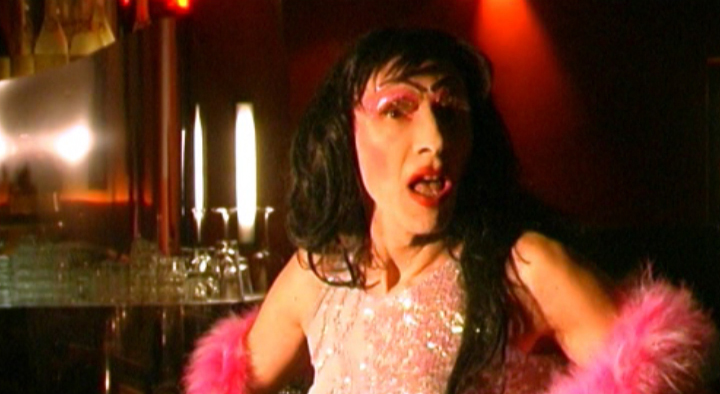
Drama, thriller, by Fabio Del Greco, Italy, 2010.
Luca is poor and works, precariously, as a waiter. He lives a problematic relationship with his girlfriend, and his life is full of doubts. One day Luca meets Chiara, a friend who had studied philosophy with him at university. She has realized her dream of opening a night and is now well-off. Luca leaves everything behind and starts a relationship with Chiara. He manages the nightclub with her and, thanks to the cocaine and call girls sold to politicians, he gets out of his hard economic situation. But Chiara does not manage to obtain the contract for an old furnace, so she blackmails Saverio, a member of the Parliament. Chiara owns a video in which Saverio has sexual intercourse with a transsexual.
LANGUAGE: Italian
SUBTITLES: English, French, Spanish, German, Dutch, Portuguese.
A Mind Forged in Contradiction
You grow up in a house where language is treated as something dangerous. Not forbidden, exactly, but handled with the same wariness your mother reserves for the neighbors, for the clergy, for anyone who might misread a gesture or inflate a confidence into a scandal. Laure de Maupassant read Flaubert before her son could read at all, and she understood, with the particular intelligence of someone who would never be allowed to publish, that literature was power — and that power, mishandled, destroyed you. This was Normandy in the 1850s, provincial and watchful, where bourgeois families measured their dignity in silences and where a woman’s intellectual life was a private combustion with nowhere to go. She directed it at her son.
What this produces in a child is not inspiration. It produces a divided attention, a sensitivity trained to read surfaces for what they conceal, an instinct for the gap between what people say and what they mean that becomes, over time, indistinguishable from contempt. Guy de Maupassant was born in 1850 and spent his childhood absorbing Normandy’s particular social grammar: the peasant who defers and resents, the notary who smiles and extracts, the widow who mourns publicly and calculates privately. He did not invent these figures. He transcribed them from a landscape that had been teaching him their logic since before he understood it as literature.
Gustave Flaubert enters the story not as a liberator but as a disciplinarian, which is a harder gift to receive. The two men were connected through Laure, who had known Flaubert in youth, and by 1872 the apprenticeship was formalized and rigorous in ways that would have broken a less stubborn student. Flaubert’s method was essentially one of enforced inadequacy: the young Maupassant would submit work and Flaubert would return it not with corrections but with questions that rendered the entire effort visible in its failures. What exactly do you mean by this word? Have you looked at this tree, this woman, this cart long enough to describe it as no one else could? The doctrine embedded in these questions was the one Flaubert had staked his own career on — that the right word, le mot juste, was not a stylistic preference but a moral obligation, and that approximation was a form of lying.
Nearly a decade passed before Maupassant published anything of consequence. The silence was not voluntary in the way that artistic retreat is sometimes romanticized; it was imposed, structural, the result of an education that made him distrust every sentence he wrote. What accumulates during that kind of enforced patience is not wisdom, exactly, but a specific quality of coldness — a writer who has spent years watching his own impulses with suspicion does not emerge hungry for self-expression. He emerges skeptical of it. When “Boule de Suif” appeared in 1880 as part of the collective volume Les Soirées de Médan, the story’s authority was inseparable from its refusal of sentiment: a woman is used and discarded by people who consider themselves her moral superiors, and the narrative watches this happen with a clarity that does not flinch and does not editorialize. There is no rescue. There is no lesson offered to the reader as consolation.
The bourgeois origins matter here in a way that goes beyond sociology. Maupassant did not write about the Norman peasantry or the Parisian petite bourgeoisie from outside, with the anthropologist’s comfortable distance. He had been formed inside their logic, had felt the particular shame of a household that needed to appear more than it was, had watched his mother’s intelligence bend itself around the constraints of a world that would not accommodate it directly. That proximity gave his fiction its specific temperature: not warm, not cold, but the exact degree at which you can no longer tell the difference.

Flaubert’s Discipline and Its Hidden Cost
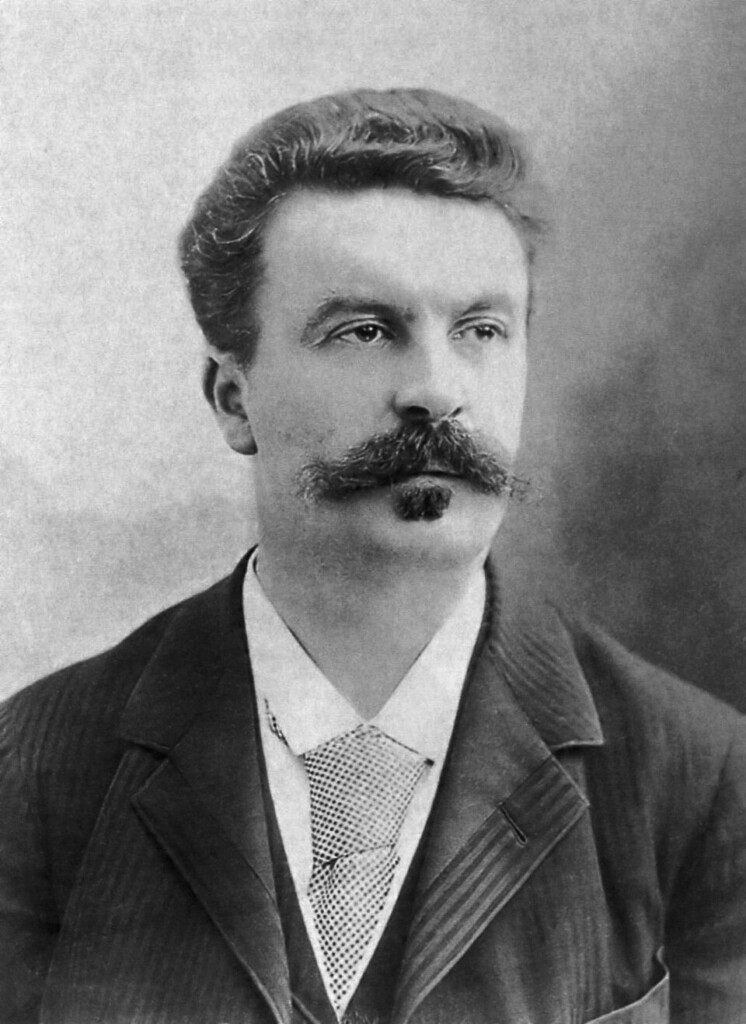
You sit down to write a sentence, and your first instinct is to feel something — to let the sentence bend toward your pity, your contempt, your need to be understood. Flaubert would have crossed it out. Not because the feeling was wrong, but because feeling, worn openly on the surface of prose, is a form of weakness, a writer bribing the reader for sympathy rather than earning it through precision. When the young Maupassant arrived in Croisset in the early 1870s, barely past twenty, he was submitting to one of the most rigorous literary apprenticeships in the history of French letters — and it would quietly hollow him out in ways neither man could have predicted.
Flaubert’s method was not a style so much as an epistemology. The doctrine of le mot juste — the one exact word, not its cousin, not its approximation — was not merely an aesthetic preference. It was a moral position about the relationship between language and reality, a refusal to let imprecision stand as a substitute for truth. Flaubert had spent years, famously, on a single sentence, pacing the gardens at Croisset shouting prose at the trees to test whether it could survive being heard aloud. He told Maupassant that any writer could describe a fire or a tree, but that only a real writer could distinguish one fire from every other fire that had ever burned, one tree from every other tree that had stood in that particular quality of light. Observation was not a talent — it was a discipline, a violence done to the lazy eye.
What this produced in Maupassant was not neutrality. The misreading of Flaubertian restraint as emotional detachment is one of the more persistent errors in the reception of the Naturalist tradition. When you train a writer to suppress the authorial voice, to refuse the comfort of moral commentary, to deny the reader the relief of the narrator stepping forward and saying what to feel — you do not produce a cold writer. You produce a writer whose judgment has gone underground, where it becomes structural, architectural, lethal. Maupassant’s narrators do not condemn his characters. They simply arrange the light so that the reader watches them destroy themselves under optimal conditions.
The peasants in his Norman stories are not victims of a sympathetic narrator’s grief — they are specimens observed with the precision of someone who grew up among them and never forgave them their smallness, their avarice, their brutal indifference to beauty. The bourgeois men and women of Paris are not satirized; they are rendered with a fidelity so total that the satire becomes invisible, absorbed into the surface of things. This is what Flaubert gave him: not a technique for describing the world fairly, but a technique for punishing it without appearing to raise a hand.
There is a cost to this. By 1880, when Boule de Suif appeared in the collection Les Soirées de Médan — the manifesto volume of Naturalism that Zola had organized around himself and five other writers — Maupassant was celebrated immediately as a master of the form. The story, in which a prostitute’s generosity is consumed and discarded by the respectable citizens she has saved, demonstrates the method at its coldest: no authorial outrage, no redemptive sentiment, only the mechanical precision of social hypocrisy observed to its conclusion. But the very control that made the story devastating also sealed something off inside the writing. The prose could no longer afford ambivalence. It had been trained out of uncertainty.
Flaubert died that same year, and Maupassant was left with an instrument perfected for a task — the surgical removal of illusion — that he would spend the rest of his working life performing on himself as much as on the world outside.
The Short Story as a Social Autopsy
You are reading a story by Maupassant and somewhere around the third page you realize the ending has already happened — you just weren’t watching closely enough when it did.
That sensation is not accidental. It is the entire argument. The compression of the nouvelle, the refusal of the long arc, the sudden cut at the end that leaves a residue rather than a resolution — these are not stylistic preferences but epistemological positions. Maupassant chose the short form because he believed, with a conviction bordering on pathology, that human life does not build toward anything. It simply occurs, and then it stops, and whatever meaning you extract from it you brought with you. The form enacts the philosophy: nothing is withheld because nothing was ever there to withhold.
Walter Benjamin, writing in 1936 in “The Storyteller,” diagnosed a transformation in how human beings transmit experience — arguing that the rise of the novel and then information culture had severed the connective tissue between living and telling, replacing wisdom with data and communal memory with isolated consumption. What Benjamin mourned in that essay was precisely what Maupassant’s era was dismantling in real time: the older form of the tale, embedded in shared life, passed between bodies, carrying the weight of collective survival. But Maupassant did something stranger than simply abandoning that tradition. He weaponized its corpse. He kept the brevity, the single incident, the close attention to gesture and weather and the texture of a room — all the furniture of the oral tale — and gutted them of any redemptive function. His stories look like fables that forgot the moral. They possess the shape of transmitted wisdom and the content of terminal futility.
This is why the ordinary, in his hands, becomes more violent than any melodrama. A woman discovers after her husband’s death that the necklace she spent fourteen years repaying was a cheap imitation. A clerk stares at a colleague’s apartment window every evening for years and never speaks to her. A farmer’s family watches its patriarch deteriorate and discusses, with genuine practicality, when it would be convenient for him to die. There is no villain in these stories, no exceptional cruelty, no pathological exception. The horror is structural. It lives inside the normal rhythms of work, marriage, thrift, and social ambition — which means it cannot be escaped by better choices or a more enlightened sensibility. You are already inside it.
Revelation in Maupassant always arrives at a moment when it can no longer be used. This is the mechanism his compressed form perfects: the final lines do not open anything, they close what the reader had kept tentatively ajar. Information surfaces at the exact point where it becomes consequentially useless, where the life that would have been altered by knowing it has already been fully spent. Aristotle’s concept of anagnorisis — recognition arriving at the catastrophe’s hinge — took for granted that recognition, however late, transforms. Maupassant strips that transformation away. His characters recognize something and then simply continue existing with the recognition lodged inside them like a splinter that will never surface.
What makes this philosophically serious rather than merely cynical is that Maupassant refuses to aestheticize suffering. The stories are short because he is not interested in the suffering itself — in its texture, its depth psychology, its spiritual meaning. He is interested in its distribution. The short form is a sociological instrument: it takes a cross-section, holds it up to the light, and shows you who bears the weight of ordinary life and who does not, and how perfectly the two groups manage to never quite see each other. The compression is not pessimism dressed as technique. It is precision. And precision, aimed at the right material, is its own form of outrage.
Women, Class, and the Economy of Illusion
You are a woman in Paris in 1884, and you have just borrowed a diamond necklace to wear to a ministry ball because you cannot attend as yourself — only as a version of yourself the room will accept. You know, without anyone having told you explicitly, that your value in that room is not separable from what you appear to own. The catastrophe that follows is not the loss of the necklace. The catastrophe is the system you were already living inside before you ever fastened the clasp.
Maupassant understood that what his culture called femininity was not a natural condition but a managed performance executed under economic duress. Mathilde Loisel in “La Parure” does not borrow the necklace out of vanity alone — she borrows it because the alternative, appearing as a minor civil servant’s wife among people of standing, is social annihilation. The performance is mandatory. The props must be sourced. The ten years of poverty she and her husband endure afterward to repay a debt for a piece of costume jewelry is the system’s final joke: the necklace was fake, but the debt it generated was real. Appearance had a higher credit rating than reality.
Erving Goffman would not publish his analysis of social performance until 1959, but he was essentially providing the theoretical vocabulary for a world Maupassant had already rendered in exacting narrative detail three-quarters of a century earlier. Goffman’s insight in “The Presentation of Self in Everyday Life” was that social life is structured dramaturgically — that individuals manage impressions, maintain frontstage performances, and conceal backstage truths. What Goffman described as a universal human condition, Maupassant recognized was not equally distributed. The burden of impression management fell with crushing asymmetry on women, and specifically on women whose class position was unstable, whose survival depended on being legible to men with more capital.
“Une Vie,” published in 1883, extends this diagnosis across an entire lifetime rather than a single night. Jeanne Le Perthuis des Vauds enters marriage with the reasonable expectation that the romantic world her upbringing promised her corresponds to something real. It does not. Her husband Julien is not a partner but an administrator of her diminishment, systematically stripping away her illusions, her money, her dignity, and her capacity to conceive of herself as anything other than a function within his arrangements. What makes the novel devastating rather than merely sad is Maupassant’s refusal to treat Jeanne’s situation as personal misfortune. The institutions surrounding her — marriage, property law, the Catholic moral framework governing female sexuality and obedience — are not backdrop. They are the mechanism. Julien does not invent her subordination; he simply operates it.
This is what separates Maupassant from the sentimental novelists of his moment. He was not writing about unhappy women. He was mapping a system of production in which femininity itself was the manufactured product — assembled through education, dress, manners, and emotional performance, and then exchanged in a marriage market where women had no pricing power. The naturalist tradition he inherited from Zola gave him the analytical instinct, but where Zola tended toward the panoramic and the grotesque, Maupassant worked in miniature, finding the systemic inside the intimate. A borrowed necklace. A wedding night. A provincial afternoon. The compression made it more precise, not less devastating.
What sociology eventually named — the performance of gender, the management of symbolic capital, the way class anxiety is routed through the body and its presentation — Maupassant had already rendered as lived texture in his fiction. He was not ahead of his time in some heroic sense. He was simply paying attention to what the women around him were actually doing to survive, and he had the discipline not to sentimentalize the cost.
A vision curated by a filmmaker, not an algorithm
In this video I explain our vision
The Peasant, the Soldier, and the Hypocrite

You are sitting in a stagecoach somewhere between Rouen and Le Havre in the winter of 1870, and the warmth you feel is coming from a woman everyone at the table despises. She has offered her food — cold chicken, wine, pâté — to strangers who took it without thanks and will spend the remainder of the journey manufacturing reasons to look away from her. Her name is Elisabeth Rousset. She is a prostitute. She is also, at this particular moment in Maupassant’s “Boule de Suif,” the only person in the carriage who behaves with anything resembling moral integrity.
The story appeared in 1880 in the collection “Les Soirées de Médan,” assembled by Zola and his circle as a corrective to the sentimental war literature that had colonized French publishing in the decade since the Prussian defeat. Maupassant was twenty-nine. What he produced was not a war story in any conventional sense — it was a dissection of the social performance that substitutes for patriotism when actual sacrifice is required. The respectable passengers, the manufacturer, the wine merchant, the nuns, the count and countess, first pressure Boule de Suif to sleep with the Prussian officer who has detained their coach, invoking duty and necessity and the good of the group. When she complies, destroying something private in herself to liberate people who never valued her, they eat their own food without offering her any and spend the rest of the journey treating her with renewed contempt. The nation, in miniature, consumes its most vulnerable and calls the transaction honor.
Ernest Renan delivered his lecture “Qu’est-ce qu’une nation?” at the Sorbonne in 1882, two years after “Boule de Suif” was published, and the coincidence is not accidental — it is structural. Renan’s central argument was that a nation is defined less by shared blood or language than by a collective act of memory selectively maintained through an equally collective act of forgetting. “L’oubli,” he wrote, “et je dirai même l’erreur historique, sont un facteur essentiel de la création d’une nation.” Forgetting, and even historical error, are essential to the creation of a nation. The Franco-Prussian War had been a catastrophe — seventy thousand French dead, the humiliation of Sedan, the capture of Napoleon III, the Commune and its massacre — and the Third Republic was being built, consciously and urgently, on a mythology of resilience that required smoothing over who had actually suffered and who had actually collaborated.
Maupassant refused the smoothing. Story after story from this period — “Mademoiselle Fifi,” “Deux Amis,” “L’Aventure de Walter Schnaffs” — returns to the occupation with the same cold insistence on showing what the commemorative version omits. In “Mademoiselle Fifi,” it is again a prostitute who acts where soldiers and civilians have not, killing a Prussian officer who has insulted France in ways that the respectable men around her tolerated without protest. Maupassant does not make her a saint. He makes her a fact. The irony is precise and merciless: the bodies the Republic will later celebrate in bronze are not the bodies that actually bled.
This is not cynicism in the literary sense — it is something more disturbing, because it operates from inside the emotional logic of patriotism rather than against it. Maupassant understood, with a clarity his contemporaries largely refused, that the soldiers who died at Sedan in September 1870 did not die for the idea of France as it would later be retrospectively constructed. They died in confusion, in incompetence, in a war declared by an emperor whose regime their deaths would help to end. The mythology that followed was not a tribute to them. It was a replacement of them.
Syphilis, Madness, and the Unreliable Mind
You are reading a story about a man who sees himself in a mirror and finds the reflection a fraction of a second late. Not distorted — delayed. The face is his, the posture is his, but something in the sequencing has broken, and now he cannot be certain whether the glass is showing him what is or what was, or whether the distinction, which he has always taken for granted, has any meaning at all. This is not metaphor. This is the literal phenomenological emergency that Maupassant recorded in “Le Horla” in 1887, and the horror of it is not that a monster exists but that the narrator’s instruments of verification have failed him at the exact moment he needs them most.
Maupassant contracted syphilis almost certainly in the late 1870s, during the period when his productivity was at its most ferocious and his confidence in the material world at its most absolute. For years the disease moved silently through his neurology, and he continued writing with the precision of a surgeon — the flat declarative sentences, the refusal of ornament, the faith that accurate observation faithfully transcribed would constitute truth. That faith was not naive. It was methodologically grounded in the naturalist doctrine he had absorbed through Flaubert and reinforced through Zola, a doctrine that positioned the writer as a kind of scientist of human behavior, reliable precisely because dispassionate. The syphilitic spirochete does not negotiate with methodology.
By the mid-1880s the neurological symptoms had become impossible to ignore — migraines so severe he described them as detonations inside the skull, visual disturbances, episodes of what he called “dédoublement,” the sensation of watching himself from outside his own body. He consulted the neurologist Philippe Pinel’s successors at the Salpêtrière, the same institution where Jean-Martin Charcot was staging his famous Tuesday lectures on hysteria, attended by a young Freud who was taking notes that would reshape the entire Western conception of the mind. Maupassant was not a patient of Charcot’s, but he moved through the same intellectual atmosphere, a Paris in which the reliability of perception had suddenly become a clinical question rather than a philosophical one. What the mind reported, it was now understood, was not necessarily what existed.
The philosophical stakes of this biographical fact are enormous and almost never adequately confronted. Maupassant’s entire literary apparatus — the compressed short story, the limited omniscient narrator who observes without editorializing, the surface of things rendered with maximum fidelity — depended on an implicit epistemological contract: that the perceiving subject is stable, that sensation transmits accurately, that the gap between world and representation can be closed by sufficient attentiveness. Neurosyphilis dissolved that contract at the cellular level. The writer who had spent two decades insisting that reality was accessible suddenly inhabited a nervous system that was generating its own competing reality, and he was professional enough, and honest enough, and perhaps desperate enough, to write about it directly rather than retreat into the safely allegorical.
“Le Horla” is therefore not a ghost story and not a psychological case study but a piece of epistemological fiction, a narrative that asks what happens to a mind committed to empirical method when the empirical apparatus itself becomes untrustworthy. The narrator does not simply go mad — he goes mad while continuing to reason, which is infinitely more disturbing, because his logic remains intact even as his data corrupts. He tests his perceptions, applies skeptical protocols, eliminates hypotheses, and arrives nonetheless at conclusions that cannot be shared with anyone who still trusts their senses. In 1882, five years before “Le Horla,” Friedrich Nietzsche published “The Gay Science” and declared the death of God — meaning the collapse of the external guarantee of truth. Maupassant arrived at a structurally identical position not through philosophy but through pathology, from the inside, without the consolation of having chosen the crisis.
He attempted suicide in January 1892 with a letter knife, was committed to the private asylum of Dr. Esprit Blanche in Passy, and died there in July 1893, forty-two years old, his capacity for language largely gone.
What the Mirror Cannot Show
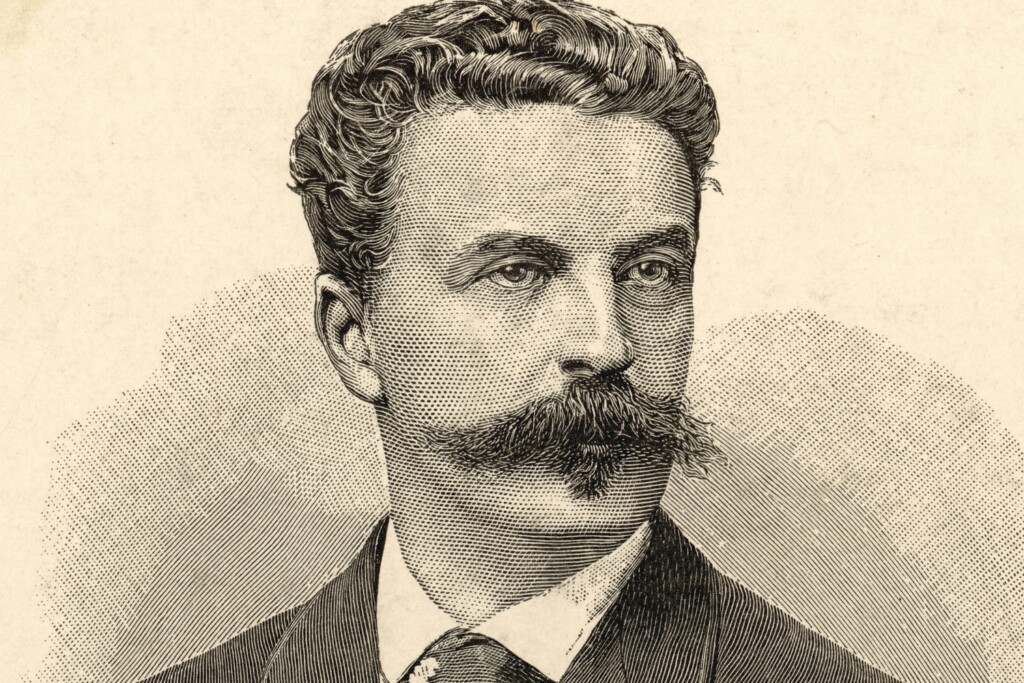
You close the book and the feeling is not relief. It is something closer to having been watched — not the comfortable surveillance of a narrator who explains and interprets, but the cold attention of someone who saw exactly what you were doing and chose to write it down without asking permission. The story was perhaps forty pages. It may have been about a clerk, a woman hiding her poverty behind borrowed jewels, a man who spent his entire life paying off a debt that turned out to be unnecessary. The specifics almost do not matter. What matters is that you recognized something in the mechanics of that life — the small vanity, the irreversible choice made in a single unguarded moment — and the story offered you no distance from which to observe it safely. There was no moral scaffolding. There was only the fact, rendered with a precision that felt almost surgical, and then silence.
That silence is where Maupassant actually lives, and it is precisely what the academic and cultural apparatus built around him has spent over a century trying to fill. He entered French school curricula in the early twentieth century as a craftsman of the short story, a master of economy, an exemplar of clarity and structure. These are accurate descriptions and they are also a form of burial. To teach a writer as a technician is to redirect attention from what the technique is doing toward how it does it, which is exactly the kind of maneuver a culture performs on writers who, if read directly, would cause too much discomfort to the institutions doing the teaching. The Naturalist label helped here as well — Émile Zola had already provided critics with a theoretical frame, the idea of the writer as a scientist of social conditions, and Maupassant was folded into that frame even though his relationship to it was always ambivalent, always slightly wrong for the category.
What the Naturalist designation quietly suppresses is the degree to which his fiction is not actually about social conditions at all, but about the absolute intractability of the self. Sociological reading finds in his peasants and bureaucrats evidence of class structure, economic determinism, the machinery of nineteenth-century French society. And those elements are present, accurately observed. But the engine of his cruelty runs on something that sociology cannot fully account for: the fact that his characters are imprisoned not only by their circumstances but by their own perception, their own desires, the stories they cannot stop telling themselves about who they are. Pierre Janet, writing on psychological automatisms in 1889, the same decade in which Maupassant was producing his most concentrated work, described the dissociation between conscious intention and compulsive behavior in terms that read almost like a clinical commentary on the fiction. The man who returns to the same degrading relationship, the woman who performs a social role that is slowly consuming her — these figures are not primarily victims of a system. They are victims of their own inability to see themselves from the outside, which is precisely the view Maupassant provides the reader and withholds from the character.
The literary tourism that has grown around Normandy, around the landscapes he described with such attentive coldness, completes the domestication by converting the geography of his discomfort into scenery. A coastline becomes picturesque. A village becomes charming. The social contempt embedded in his descriptions of provincial life, the barely concealed horror at the repetitions of human mediocrity, becomes local color. What is lost in that conversion is not a political argument or a philosophical position but something more fundamental: the specific quality of attention he brought to human beings, which was neither empathetic nor contemptuous but something far more unsettling — the attention of a mind that had looked directly at the gap between what people believe about themselves and what they actually are, and had decided that the most honest thing to do was to show it exactly as it appeared, without flinching and without mercy.
🖋️ Realism, Society, and the French Literary World
Guy de Maupassant stands at the heart of French literary realism, a tradition obsessed with social ambition, class struggle, and the hidden mechanics of human desire. Exploring the authors and works that shaped his world reveals how nineteenth-century French literature became an unrivaled mirror of modern life.
Stendhal and Social Climbing: The Red and the Black
Stendhal‘s The Red and the Black is one of the foundational texts of French realism, tracing the ruthless social ascent of Julien Sorel through a world ruled by hypocrisy and ambition. Like Maupassant, Stendhal dissects the gap between appearances and inner reality with surgical precision. This article explores how the novel became a manifesto of psychological realism and social critique.
GO TO THE SELECTION: Stendhal and Social Climbing: The Red and the Black
Honoré de Balzac and Ambition: Père Goriot
Honoré de Balzac‘s Père Goriot is a cornerstone of the Comédie Humaine, presenting Paris as a battlefield where money, family, and ambition collide in merciless ways. Maupassant inherited from Balzac the art of sketching a complete social world through sharply observed characters and ruthless narrative economy. This analysis examines how Balzac’s vision of ambition and sacrifice continues to resonate across generations.
GO TO THE SELECTION: Honoré de Balzac and Ambition: Père Goriot
De Roberto’s The Viceroys: Analysis
Federico De Roberto‘s The Viceroys offers a southern Italian counterpart to the great French realist tradition, portraying a noble family’s decline across generations with cold, unflinching irony. The novel shares with Maupassant’s fiction a deep skepticism about human progress and the persistence of power structures beneath the surface of change. This article provides a close reading of the novel’s themes of corruption, inheritance, and historical disillusionment.
GO TO THE SELECTION: De Roberto’s The Viceroys: Analysis
Annie Ernaux: Life and Works
Annie Ernaux‘s work carries the legacy of French realist literature into the contemporary era, using autobiographical material to expose the weight of class, gender, and social shame. Her stripped-down prose and commitment to honest social portraiture echo the naturalist impulse that animated Maupassant’s best short stories. This article traces her life and the literary project that earned her the Nobel Prize in Literature.
GO TO THE SELECTION: Annie Ernaux: Life and Works
Discover Literature Through Independent Cinema on Indiecinema
The great themes of French realism — desire, ambition, illusion, and social cruelty — have always found a natural home on screen. On Indiecinema you can explore independent films that carry this literary spirit forward, telling stories of human complexity with the same unsparing honesty that defined Maupassant’s art.
👉 EXPLORE THE CATALOG: Watch Indie Films in Streaming
A vision curated by a filmmaker, not an algorithm
In this video I explain our vision

