
The Garret Where Glory Was Supposed to Live
The paper burns faster than you expect. That is the first thing nobody tells you about burning your own work to stay warm — not the symbolism of it, not the tragic poetry of creation feeding its own destruction, but the simple, stupid physics of it: paper is poor fuel. It gives a burst of heat, a minute of orange light against the frost on the windowpane, and then it is ash and you are cold again and the manuscript is gone. Henri Murger knew this not as metaphor but as arithmetic. Winter in Paris in the 1840s, a sixth-floor garret on the Left Bank, and the choice between keeping what you wrote and keeping your fingers functional enough to write something else. He chose warmth. He chose it repeatedly.

This is where the story actually begins, before the operas and the stage adaptations and the tourists who would later come to Montmartre looking for picturesque poverty as though it were a landscape feature. Before Puccini. Before the mythology calcified into something comfortable and sellable. There is a young man in a room so cold that ink freezes in the well, and he is making a practical decision that history will later dress in velvet and call romantic sacrifice.
Murger was born in 1822, the son of a concierge and part-time tailor in Paris, and the distance between that origin and the literary circles he desperately wanted to enter was not merely social but atmospheric — a difference in the very air people breathed, the cadence of their sentences, the ease with which they occupied space in a room. He had no university, no family connections, no allowance. What he had was proximity: Paris itself, that impossible city which has always made the nearness of beauty and the inaccessibility of comfort its central cruelty. He could see the life he wanted from the street. He simply could not afford the entrance.
The sociologist Pierre Bourdieu, in his landmark 1992 work “The Rules of Art,” described the literary field of nineteenth-century France as a space where symbolic capital and economic capital stood in almost perfect inverse relation — where the prestige of artistic purity was constructed precisely against the logic of the market, and where the price of that prestige was paid in actual hunger by the young and the unknown while the established collected both kinds of reward. Murger did not have Bourdieu’s vocabulary, but he lived the mechanism with his body. The cold was not incidental to his artistic formation. It was structural.
What is harder to hold onto, once the mythology takes over, is how ordinary and grinding the actual experience was. Not noble suffering. Not the suffering that teaches or refines or produces the kind of character that retrospective biographies celebrate. Just the dull, repetitive indignity of not having enough — of borrowing from friends who had slightly more than nothing to give, of pawning an overcoat in October because the rent was due, of retrieving it in April when the worst was over, of knowing you would pawn it again. The critic and historian Jerrold Seigel, in his 1986 study “Bohemian Paris,” documented how Murger and his circle — the loose group of writers, painters, and musicians who would become the models for his characters — cycled through the same addresses, the same pawnshops, the same creditors, year after year throughout the 1840s. It was not a phase. It was a system.
And yet something happened in that room with the burning manuscripts and the freezing ink. Not transcendence — that is too easy a word, too convenient a resolution. Something more uncomfortable than transcendence: the slow, almost involuntary transformation of a life being lived into material that could be written. Murger looked at what was happening to him and around him, and instead of simply enduring it, he began to watch it. That watching would eventually cost him something he had not anticipated paying.
The Lost Poet
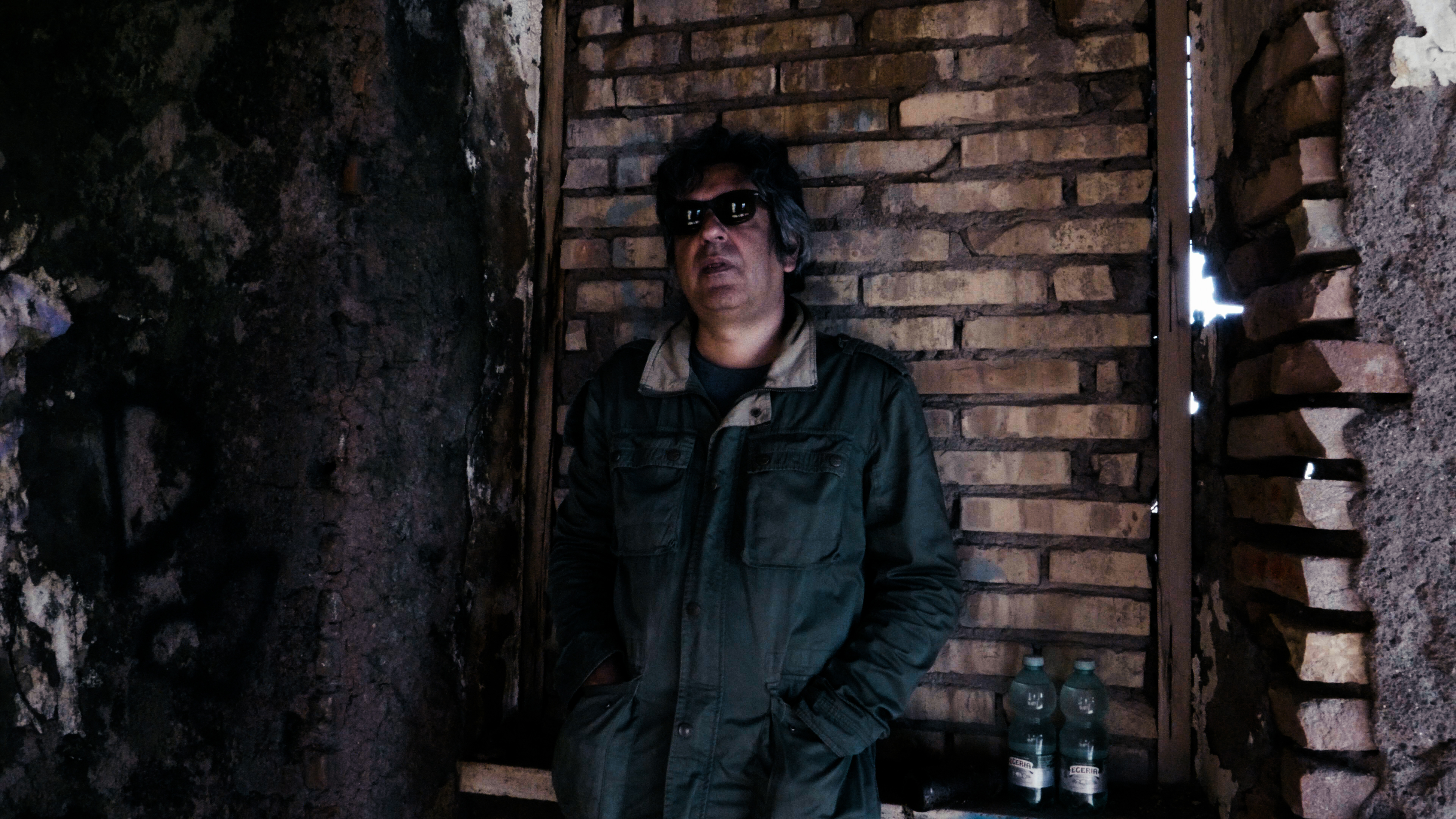
Drama, by Fabio Del Greco, Italy, 2024.
Dante Mezzadri wants to see an old friend, nicknamed the Iguana, whom he has lost sight of for many years, and who has managed to turn their shared youthful passion for poetry into a job, becoming a famous writer and poet. The man escapes from his bourgeois life and his wife to live homeless on the Roman coast, printing and trying to sell his poetry collections. At night he sleeps in a park of old carnival floats, inside a papier-mâché tank, and waits for the opportunity to meet his old friend, who however never shows up for appointments in the places they frequented when they were young, now in ruins. Dante's poetry books do not interest anyone and to support himself he is forced to "change product": he starts selling the infamous "cannibal pill" on behalf of young drug dealers, a new drug that sells like hot cakes and causes sensory and consumerist ecstasy. However, he realizes that this powerful drug is very dangerous for those who take it, he comes into conflict with his ethical conscience and throws all the pills into the sea. However, the dealers want to collect their money.
Shot over a period of 2 years, the film is a reflection on the cultural and artistic rubble of the society in which the protagonist lives, in an increasingly mechanized, consumerist and arid world. Dante Mezzadri is yet another human being who has renounced his inspiration and his creativity, but unlike many he is not willing to give his life to a system that distances him from his true identity. The physical world around him, however, seems constructed in such a way that it seems impossible to escape from this "invisible cage". The enthusiasm of the people he meets is ignited only by sensory gratification, by unreal visions of personal affirmation and success, by "metaverses" that offer an escape into an illusory and destructive reality. The poet's house on the coast, where he met with his friends as a young man, is just a pile of abandoned rubble. What happened to all those who wanted to become poets and ended up becoming something else? Are there internal forces with which that house can be "rebuilt"?
LANGUAGE: Italian
SUBTITLES: English, Spanish, French, German, Portuguese
Henri Murger and the Making of a Useful Myth
He was born in 1822 in a building on the rue Saint-Denis, in the kind of Paris that does not appear in paintings — the Paris of narrow staircases, of concierges who double as tailors between tenants, of boys who grow up with ink-stained fingers not because anyone gave them books but because they stole them from wherever they could find them. His father managed the building, stitched garments, kept the ledger. Henri Murger grew up watching the city from below, from the ground floor, from the threshold between the world of those who make art and the world of those who sweep up after it.
He never formally studied anything. What he learned, he assembled from scraps — from borrowed volumes, from conversations overheard in cafés he could barely afford to enter, from the manuscripts of friends who had slightly more and slightly less than he did. He became a writer the way the destitute become anything: through sheer insistence against a reality that offered no invitation. By his early twenties he had found his way into the loose orbit of what Parisian literary culture called the Water Drinkers, a circle of young artists and poets who turned poverty into an aesthetic program because there was nothing else available to turn it into.
Between 1845 and 1849, he published a series of sketches in Le Corsaire, a small-circulation Parisian literary gazette that provided him almost no income and considerable notoriety within a very narrow world. These sketches — fragmented, episodic, tender without being sentimental, at least in their earliest forms — depicted the daily life of young artists living on the margins of the city’s economy: the delayed rent, the improvised dinners, the love affairs conducted in cold rooms, the manuscripts that circulated without ever quite arriving. The work caught something real, or at least something that felt real to the people living it. In 1849, he and Théodore Barrière adapted the material for the stage, and the play succeeded in ways the sketches alone never could have — theater brought the myth to an audience that wanted to see poverty performed, which is a very different thing from wanting to experience it. Then in 1851 came the novel, Scènes de la vie de bohème, which consolidated and softened and shaped the raw material into something that could travel, something that could be exported, something that could be translated and staged and eventually transformed by Puccini in 1896 into an opera that would be heard by millions who had never read a line Murger wrote.
What the myth required was exactly what Murger provided: a poverty that was picturesque, a suffering that was temporary by implication, a youth that justified everything because it was understood to be a phase before the real life began. The sociologist César Graña, writing in his 1964 study Bohemian versus Bourgeois, identified this as the central ideological function of the bohemian narrative — it preserved the fantasy of artistic freedom while neutralizing any genuine critique of the economic structures that made that freedom so brutal in practice. Murger’s characters are always on the verge of arrival, which means the system that keeps them poor is never really indicted. The dream does the work of the alibi.
And then there is the fact that will not let you look away from it: Murger died in 1861, at thirty-eight years old, in a charity hospital. He died destitute, exhausted, his body already broken years before the end came. The man who had written the foundational text of artistic romanticism, who had given a generation the vocabulary with which to aestheticize their own precarity, died in exactly the kind of institution his myth had made it seem unnecessary to fear.

What Bohemia Actually Was — and Who It Excluded
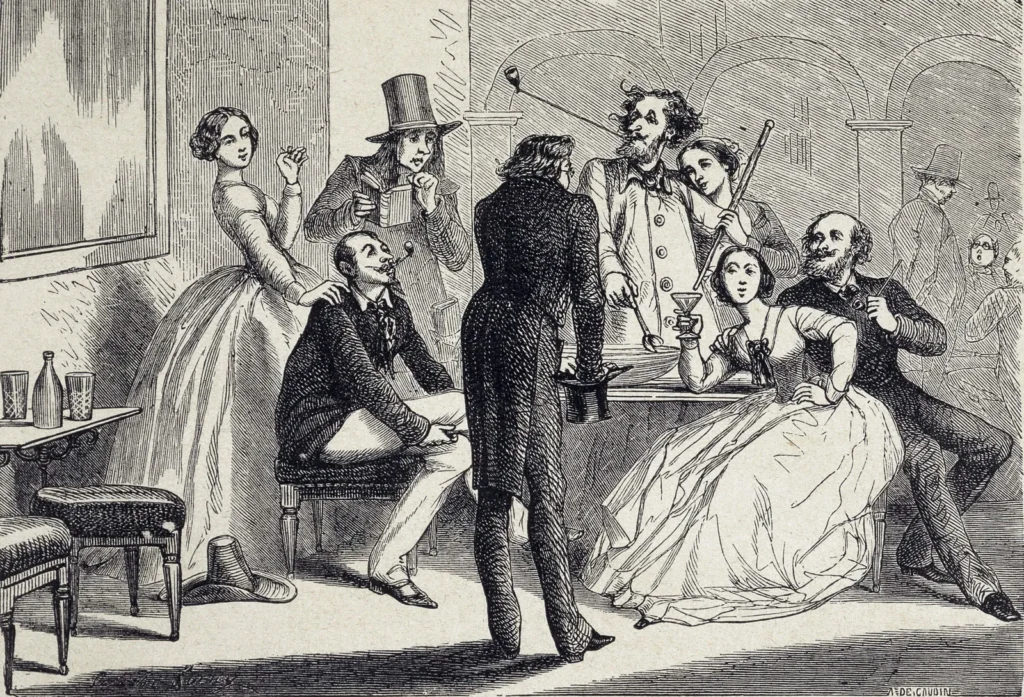
The garret was cold, but it was chosen. That distinction matters more than anything else about the myth that grew around it. When you voluntarily inhabit poverty — when you know, somewhere beneath the performance of deprivation, that there is a family home to return to, a provincial bourgeois father who disapproves but will eventually relent, a class origin that can be reassumed like a coat left in a cloakroom — then the cold is aesthetic. It is costume. It is the very thing that makes the adventure legible as adventure rather than as destitution.
Jerrold Seigel, in his meticulous excavation of bohemian Paris published in 1986, made an argument that was devastating precisely because it was so calm: bohemia was not the outside of bourgeois society but its internal margin, its necessary shadow. It could not exist without bourgeoisie to define itself against, could not sustain its self-image without the middle class’s fascinated gaze, could not even survive economically without eventually selling its productions back to the very world it claimed to reject. The relationship was not opposition. It was symbiosis dressed as rebellion. The bohemian needed the bourgeois to feel like a bohemian. The bourgeois needed the bohemian to feel like there was something more alive than his ledgers and his respectability. Each one was the other’s fantasy of what they were not.
T.J. Clark pushed this further in his own 1984 study of Haussmann’s Paris and the painters who tried to make sense of what modernity was doing to human bodies and public space. What he found, beneath the romance of the marginal artist, was a geography of exclusion operating with quiet efficiency. The cafés, the ateliers, the legendary gatherings in rooms smelling of turpentine and cheap tobacco — these spaces had invisible entry requirements that had nothing to do with talent and everything to do with gender, class origin, and the particular freedom that comes from knowing failure is not final.
Think of a woman who arrives in the Latin Quarter in the 1840s with exactly the same hunger for artistic life as the men around her. She has no atelier she can rent without a male guarantor. She cannot sit in the café alone without her presence being read as a profession rather than an intention. The art schools that would give her technical formation are closed, or open only to women in separate classes with reduced curricula. If she is poor, her poverty is not picturesque — it is simply dangerous, because the city’s systems of exploitation know exactly how to metabolize a young woman without resources. If she is beautiful, she becomes a muse, which is to say she becomes raw material. If she is not beautiful, she becomes invisible. Murger’s own Scènes de la vie de bohème, published serially beginning in 1845 and collected in 1851, contains women — Mimi, Musette — but they exist in the text as weather exists in a landscape painting: essential to the atmosphere, irrelevant to the agency. They arrive, they warm the scene, they die or they leave. The men continue.
This was not Murger’s personal cruelty. It was the structure of the world he was faithfully, if unwittingly, transcribing. The bohemia he described was a homosocial republic of self-invention whose founding premise was that you could reinvent yourself only if you already had a self substantial enough to be the subject of reinvention — which is to say, only if you were already someone the culture recognized as having an interior life worth the gamble. Women in that world were not bohemians. They were the environment in which bohemianism happened to men.
The romance survived because it was never really about freedom. It was about a very specific and historically located version of masculine license, which is the most durable kind — the kind that never needs to announce what it is excluding because the exclusion is already built into the walls.
Murger’s Characters and the Theater of Voluntary Suffering
There is a particular kind of exhaustion that comes not from working too hard but from performing too consistently. You know it: the fatigue of maintaining a version of yourself that others have come to expect, the quiet cost of never being allowed to drop the pose. Rodolphe knows this exhaustion intimately, even if he would never name it that way. He writes in an unheated room and calls it freedom. He misses meals and translates the hunger into artistic purity. He is cold, genuinely cold, and somewhere beneath the irony and the wit and the endless café conversation, he dreams of a warm apartment with regular walls and a salary that arrives on the first of every month. Murger does not hide this. He puts it on the page with startling directness, and then the reader moves on, because the myth is more comfortable than the admission.
Erving Goffman, writing in 1959 in The Presentation of Self in Everyday Life, described social life as a theater of managed impressions, where individuals construct and maintain a front — a strategic assembly of appearance, manner, and setting — designed to control how others perceive them. The performance is not necessarily dishonest, Goffman argued, but it is always purposive. It exists to produce a particular effect in a particular audience. What makes Murger’s bohemians so structurally interesting is that their audience is themselves as much as anyone else. The poverty is not merely endured; it is curated. Marcel does not simply own a failed painting he cannot sell — he owns the same painting for years, dragging it from exhibition to exhibition, renaming it, repainting portions, keeping it perpetually in circulation because the circulating painting is the proof of something, the evidence of a life devoted to something beyond commerce. The painting that never sells is the painting that remains pure. This is not stupidity. This is identity management of a very sophisticated order.
Musette understands the system from a different angle, which is why she is the most lucid figure in the entire cycle. She moves between bohemian poverty and bourgeois comfort with a fluency that the male characters find simultaneously fascinating and morally suspect. She does not pretend that love and money are unrelated. She does not perform indifference to material security while secretly craving it. She simply moves, and in moving she exposes the bad faith of those who stay still and call their stasis a choice. The men resent her for this. Her honesty functions as an accusation.
Mimi is more tragic precisely because she internalizes the performance more completely. The illness that will eventually kill her becomes, within the social logic of the Latin Quarter, a kind of credential. Fragility aestheticized is still fragility. What Murger shows, whether or not he fully intended to, is a young woman whose actual physical suffering gets absorbed into a collective narrative about romantic intensity, about the beauty of lives lived at the edge. The theater of voluntary suffering requires, at some point, a body that actually suffers. The performance and the reality collapse into each other, and no one in the room quite knows how to separate them anymore.
This is the trap that Goffman’s framework illuminates with uncomfortable precision: once the performance becomes the identity, the performer loses access to any self that exists outside of it. Rodolphe cannot admit he wants the warm apartment without ceasing to be Rodolphe. Marcel cannot sell the painting without selling the painter. The bohemian pose began as a strategic response to material conditions — young artists with no money and no connections finding dignity through aesthetic self-definition — and calcified, over years of repetition, into something that could no longer be removed without leaving nothing underneath. The terror this conceals is not the terror of poverty. It is the terror of being ordinary, which in the economy of the Latin Quarter was the one thing that could not be survived.
Puccini’s Opera and the Industrialization of Bohemian Sentiment
There is a moment in the opera house when Mimì begins to die and the music swells in exactly the way you knew it would, and you feel your throat tighten, and the person beside you presses a handkerchief to their eyes, and the whole gilded room exhales together in collective grief that costs nothing and asks nothing and ends precisely when the curtain falls. You go home to your heated apartment. You sleep well. You have been moved.
This is what Turin witnessed on the first of February, 1896, when a twenty-eight-year-old conductor named Arturo Toscanini raised his baton and Puccini’s opera entered the world. The audience reception was, by contemporary accounts, mixed — uncertain, even slightly cold — which tells you something important: the machinery had not yet been fully calibrated. Within a decade it would be. Within two decades, La Bohème would become one of the most performed operas in the Western repertoire, a permanent fixture in the emotional furniture of bourgeois culture, the tragedy of the garret transformed into something you could schedule between dinner and a carriage ride home.
Walter Benjamin, writing in 1935 in his essay on the work of art in the age of mechanical reproduction, described how the aura of an artwork — its singularity, its embeddedness in a specific time, place, and risk — dissolves when that artwork becomes reproducible, distributable, consumable on demand. He was writing about photography and film, but the logic applies with surgical precision to what Puccini accomplished with Murger’s material. The poverty Murger had lived, the cold he had genuinely endured, the friends he had watched die in rooms that smelled of damp plaster and boiled turnips — all of this had already been processed once, distilled into the anecdote and the vignette, softened at the edges by retrospective romance. Puccini processed it a second time. What emerged was not tragedy but the sensation of tragedy, delivered with perfect technical reliability, reproducible every night, in every major opera house, for paying audiences who needed to feel something without being changed by it.
The woman dying on the stage is luminous. Her voice does not crack or fail the way a real dying voice fails. She does not smell of fever or soiled linen. Her poverty is aestheticized into a kind of charming insufficiency — the cold garret, the single candle, the girlish cough that somehow never makes her ugly. You watch her and you weep, and your weeping is real, and your tears are real, but what you are weeping for is a version of suffering that has been made safe for consumption. The sociologist Eva Illouz, in her analysis of emotional capitalism, describes precisely this mechanism: how modern culture does not suppress emotion but industrializes it, packages it, sells it back as a commodity that simultaneously satisfies and perpetuates the need. You pay for the ticket. You receive the grief. You leave replenished.
This is the deep irony that Murger could not have foreseen and that Puccini perhaps did not care to examine. The bohemian myth was born as a reproach to bourgeois comfort, a refusal of the upholstered life, a celebration of those who chose art over security and paid for it in actual suffering. By the time it reached the opera house it had become the bourgeoisie’s favorite story about itself — its capacity for feeling, its sensitivity, its willingness to weep over beauty and loss. The very class that had made the garret necessary was now purchasing tickets to mourn it, and finding in that mourning a confirmation of their own refinement rather than an indictment of their complicity.
Murger had already begun this transformation in his own lifetime, softening the rawness of his journals into publishable sentiment. Puccini completed it. What had once been a wound became a melody you could hum on the way home.
A vision curated by a filmmaker, not an algorithm
In this video I explain our vision
The Artist’s Suffering as Cultural Capital

There is a moment, somewhere in the middle of a life spent at the edge of survival, when suffering stops being something that happens to you and starts being something you perform. Not consciously, not cynically — that is the cruelest part. A man refuses a steady position, declines a commission that would require him to compromise, stays in the cold room because leaving it would somehow betray the work. He is not being noble. He is obeying an economy he never chose but has completely internalized, one that tells him his pain is the proof of his seriousness.
Pierre Bourdieu spent years anatomizing exactly this mechanism. In The Rules of Art, published in 1992, he argued that the literary and artistic field operates according to an inverted economy, one in which commercial success functions as a mark of suspicion and material deprivation as a certificate of authenticity. The artist who suffers is, within this logic, the artist who has not sold out, and therefore the artist whose work can be trusted. Suffering becomes what Bourdieu called symbolic capital — not money, but something that converts into legitimacy, prestige, the right to be taken seriously. The tragedy is that this capital is accumulated through the body, through health destroyed, through years eaten by cold and hunger and anxiety, and it pays dividends only posthumously, or only to those who survive long enough to be celebrated for having endured.
Murger did not survive long enough. He died in 1861, at forty-one, his body exhausted by decades of exactly the conditions he had made famous. And then something extraordinary happened to his biography: it was read backward, through the lens of his work, and the suffering became evidence. The poverty he had actually lived, the genuine desperation of those years in the Latin Quarter, was retroactively transformed into the source of his authenticity. He had earned his art by paying with his flesh. The market, the critics, the cultural memory — all of them rewarded him for this, but only once he was no longer present to spend the reward.
This is the mechanism that persists. The starving artist myth does not survive because it is true or because it produces better work. It survives because it is useful — useful to a market that needs to distinguish authentic cultural production from mere commerce, useful to institutions that can celebrate suffering artists without paying living ones, useful to a system that extracts enormous value from creative labor while justifying the extraction through a romantic vocabulary of vocation and sacrifice. When a gallery celebrates the difficult life of a painter who died broke, it is not paying tribute to the artist. It is laundering the very conditions that killed him into cultural prestige that now belongs to someone else.
The man who destroys his health because health feels like compromise is not making a free choice. He is executing a script written long before him, one that Murger helped codify but did not invent. He wakes up coughing and tells himself this is the price of seriousness. He turns down the work that would pay because the work that would pay would require him to be legible to an audience he has decided to despise. He confuses precarity with purity, and the culture around him confirms this confusion at every turn — celebrates the artists who suffered, ignores the ones who simply got on with the practical business of living while working.
Bourdieu saw this clearly: the field produces dispositions, habits of the body and mind, that make artists complicit in their own exploitation. They are not duped from outside. They dupe themselves from inside, using a vocabulary of authenticity and integrity that was constructed precisely to make their exploitation feel like freedom. Murger’s Scenes of Bohemian Life did not create this vocabulary, but it gave it a grammar, a cast of characters, a melody so seductive that generations of artists would hum it all the way to their own ruin.
Mimi’s Death and the Women Who Were Never Romanticized
She coughs into a handkerchief and the men around her continue their argument about aesthetics. This is not a metaphor. This is the structural condition of her existence in that world — her body deteriorating in real time while the conversation moves on to other things, to verses, to ambitions, to the next bottle of something cheap and warming. She is present the way furniture is present: noticed when useful, mourned when gone.
Mimi dies at roughly twenty-two. Murger gives her a death scene of considerable literary tenderness, which is precisely the problem. The tenderness lands on the corpse and never quite reaches the living woman. What killed her was not heartbreak or the metaphysical weight of beauty too fragile for this world. What killed her was poverty, cold, and the complete absence of any medical infrastructure that might have intervened in the tuberculosis consuming her lungs. In mid-nineteenth century Paris, working-class women died of this disease at rates that contemporary public health records document with a kind of bureaucratic indifference that is itself a form of violence. The Hôtel-Dieu received them. The paupers’ wards received them. The statistics received them. The literature received them only once they could be made to mean something for someone else’s story.
Christine Stansell, in her work on women in bohemian communities, makes an argument that cuts through the romantic gauze with the precision of someone who has actually read the primary sources. The bohemian myth, she demonstrates, required female sacrifice as one of its operating conditions. Women provided the domestic labor that freed men to be artists. They provided the emotional labor that sustained male creative identity through its inevitable crises. They provided, when they died young and beautifully, the grief that gave male art its necessary weight. And all of this was called love. The calling of it love was not incidental. It was load-bearing. Remove the word love and you are left with an arrangement that looks uncomfortably like exploitation wearing a velvet jacket.
There is a moment in which a woman’s physical dissolution is filmed in close-up — her face, her thinning frame, the specific geography of her suffering — and the camera lingers with what presents itself as devotion. But the camera never once asks what she wanted. It never grants her an interior. It grants her an appearance of interiority, which is different: the slightly parted lips, the eyes that seem to hold something unspoken, the suggestion of depth that remains permanently, structurally unplumbed. She exists to be looked at in her diminishment. The looking is offered as love. You watch this and feel something, and what you feel is real, and what produced that feeling is a mechanism you were never invited to inspect.
Musette is the other pole of the same trap. Where Mimi is the devoted, dissolving beloved, Musette is the free spirit, the one who leaves, the one who chooses pleasure over constancy. She is punished for this narratively in a dozen small ways, made slightly ridiculous, slightly untrustworthy, the cautionary version of femininity that exists to make Mimi’s sacrifice look like a choice rather than a sentence. Between them, they cover the available territory: you give everything and die loved, or you keep something for yourself and die unserious. The text never notices it has constructed a closed system.
Simone de Beauvoir described in 1949 how the figure of the bohemian woman was consistently absorbed into the myth of male creative freedom rather than recognized as a subject of freedom herself. The artist’s muse, the grisette, the working girl with poetic sensibility — these were categories that named women in relation to male projects. Mimi’s tuberculosis was not poetic. It was the predictable outcome of being a seamstress in inadequate housing with no money and no one whose primary concern was her survival.
The Bohemian Trap That Never Closed
The neighborhood is called something like “the creative quarter” now. There are exposed brick walls and artisanal coffee and a mural commissioned by the municipal development authority depicting a young woman with paint-stained hands gazing at a horizon. The rents are three times what they were a decade ago, when actual painters lived there and could barely afford them. The mythology of poverty and creative freedom has become the most reliable engine of gentrification ever invented, and the people being displaced by the aesthetic of bohemianism are, almost invariably, the last surviving bohemians.
This is the trap Murger sprung in 1851, though he almost certainly did not intend it, and it has never closed. What he published as a semi-ironic, semi-tender portrait of young men failing beautifully in the Latin Quarter became, through Puccini’s operatic transfiguration and a century and a half of repetition, the founding document of a mythology so durable that capitalism eventually learned to wear it as a uniform. Luc Boltanski and Eve Chiapello mapped this absorption with clinical precision in their 1999 study of how managerial culture, facing the artistic and social critiques of 1968, did not defeat those critiques but digested them. The language of authenticity, creativity, passion, freedom from hierarchy, rejection of the rigid and the conformist — everything that once made bohemianism a refusal of the market — was reconstituted as the market’s most seductive sales pitch. You are not an employee, you are a creator. You are not working for a corporation, you are pursuing your vision. The garret became a “collaborative workspace.” The poverty became “bootstrapping.” The tuberculosis became burnout, which is now a personal brand.
What Boltanski and Chiapello called the “projective city” — the new capitalist ideal of the flexible, networked, permanently self-reinventing individual — is Murger’s Rodolphe with a LinkedIn profile. The bohemian who scorned bourgeois stability and lived project to project, passion to passion, has become the ideal worker of the platform economy, the freelancer who owns their precarity as freedom, the creative professional who is too invested in their own mythology to demand a pension. The absorption is so complete that the critique has become structurally impossible: you cannot reject the system by becoming an artist, because becoming an artist is now the system’s preferred mode of self-reproduction.
And yet we keep finding it beautiful. That is the question that sits at the center of all of this, the one that does not resolve into an argument. You know, at some level, that Mimi’s death is a theatrical construction, that the garret was never as photogenic as it appears when Puccini lights it from within, that the young woman coughing beautifully in the final act is performing a poverty that killed real people without an audience, without a score, without anyone weeping at the appropriate moment. You know that the startup founder invoking his passion is reciting a script written by people who needed him to work eighty hours a week without overtime. You know that the “bohemian neighborhood” was a working-class neighborhood before the murals arrived.
You know all of this, and you still feel something when the music swells. You still find the image of the young artist in the cold room with a single candle and an unfinished manuscript somehow more honest, more real, more fully alive than the alternative. Murger built that feeling into the culture’s foundation in 1851, and a hundred and seventy years of capitalism have only reinforced it, because nothing sells a system more reliably than the beautiful image of refusing it, and nothing makes a cage more comfortable than the conviction that choosing to live inside it is the most radical act of all.
🎭 Bohemia, Art, and the Poetry of Marginal Life
Henri Murger’s Scènes de la vie de bohème captured the restless, impoverished world of artists and dreamers in nineteenth-century Paris, giving birth to a cultural myth that would echo through literature, opera, and cinema for generations. To understand Murger’s universe more deeply, it helps to explore the broader constellation of poetic rebels, cursed artists, and radical aesthetics that shaped the bohemian imagination.
The Cursed Poet: History and Figures
The figure of the ‘cursed poet’ — the maudit living on the margins of society, consumed by art and excess — is central to understanding the bohemian world that Murger immortalized. This article traces the history of poetic damnation from Villon to Rimbaud, exploring how social exclusion and artistic genius became inseparable in the modern imagination. It provides essential context for the romantic mythology of poverty and creativity that Murger helped to define.
GO TO THE SELECTION: The Cursed Poet: History and Figures
Paul Verlaine: Life and Works
Paul Verlaine was one of the most emblematic cursed poets of nineteenth-century France, living the very bohemian existence that Murger had described in his sketches of Parisian artistic life. His biography traces a path of taverns, scandal, and extraordinary lyrical beauty, moving through the same cultural landscape that gave Murger’s characters their historical grounding. Exploring Verlaine’s life illuminates the real human cost and transcendent creativity that bohemianism both celebrated and consumed.
GO TO THE SELECTION: Paul Verlaine: Life and Works
Masterpieces of Rebellion and Counterculture Cinema
The spirit of rebellion and counterculture that animated Murger’s bohemian artists found new cinematic expression in the twentieth century through films that challenged social norms and artistic conventions. This curated selection of masterpieces traces how the bohemian ideal — living outside bourgeois society for the sake of authentic creative expression — transformed into a powerful cinematic language. It offers a visual and narrative bridge between Murger’s literary world and the countercultural imagination of modern cinema.
GO TO THE SELECTION: Masterpieces of Rebellion and Counterculture Cinema
Poetic Symbolism: History and Main Authors
Poetic symbolism emerged directly from the bohemian cultural ferment of nineteenth-century Paris, drawing on the same circles of marginalized artists and passionate dreamers that populated Murger’s scenes. This article reconstructs the history of a movement that transformed personal suffering and social alienation into a radical aesthetic program, with authors such as Baudelaire, Verlaine, and Mallarmé at its center. Understanding symbolism helps to situate Murger’s work within the broader arc of French artistic modernity.
GO TO THE SELECTION: Poetic Symbolism: History and Main Authors
Discover Bohemian Cinema on Indiecinema
If Murger’s world of artists, dreamers, and beautiful failures has stirred something in you, Indiecinema is where that feeling finds its moving image. Our streaming platform gathers the most daring, poetic, and independent films that carry the bohemian spirit into the twenty-first century — films that refuse comfort and embrace truth. Step inside and explore a cinema that, like Murger’s heroes, lives only for art.
👉 EXPLORE THE CATALOG: Watch Indie Films in Streaming
A vision curated by a filmmaker, not an algorithm
In this video I explain our vision

