
The Drunk in the Gutter and the Saint on the Page
You have seen him before. Not in a museum, not in a biography with gilt lettering on the spine — you have seen him on a Tuesday morning, outside a café that opens too early for respectable people, slumped against the wall with his coat buttoned wrong and his eyes carrying something that does not belong to ordinary defeat. There is a particular quality to that kind of ruin, something that stops you mid-stride, because it does not look like simple collapse. It looks like someone who once knew exactly where everything was and then, by a series of choices that felt inevitable at the time, arrived here, on this pavement, at this hour, with that expression. You look away. Most people do.

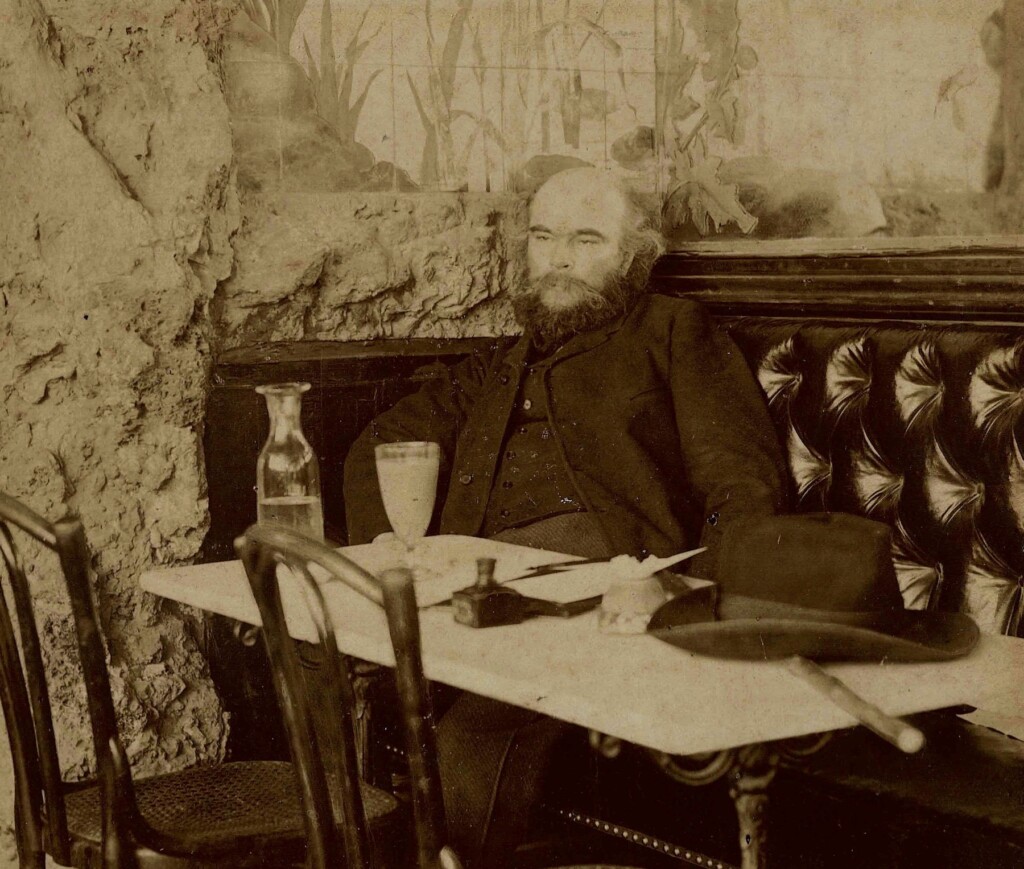
Paul Verlaine spent the last decades of his life being that man. He was carried out of Parisian cafés, nursed through hospitalizations for gout and alcoholism and the accumulated wreckage of a body treated as an afterthought, passed between two women — a former prostitute named Eugénie Krantz and a woman named Philomène Boudin — who each claimed some portion of his dissolving existence. He died in January 1896 in a rented room on the rue Descartes, fifty-one years old, having spent his final years in a poverty so complete that the Mercure de France and other admirers had to organize something close to charity disguised as literary support just to keep him alive. The same literary establishment that would, within years of his death, install him as the prince of French poetry, the patron saint of the Symbolist movement, the ghost behind an entire century of lyric possibility.
This is the first thing you need to sit with, because it is not a coincidence and it is not an irony to be quickly resolved. It is the structure itself. The French Third Republic that watched Verlaine beg and stumble and lose was the same cultural formation that would later claim him as heritage, as proof of national artistic greatness, as the face on the commemorative edition. Émile Durkheim, writing in the 1890s about the social mechanisms by which communities define themselves through exclusion and inclusion, understood that the deviant and the sacred occupy positions that are structurally related, not opposed. What a society expels, it often later consecrates — but always after the person in question has been sufficiently emptied by the expulsion. You do not get to be a saint while you are still capable of embarrassing anyone.
Verlaine had been embarrassing people since 1873, when he fired a pistol at Arthur Rimbaud in a Brussels hotel room and was sentenced to two years in prison in Belgium. The scandal was layered: the drinking, the violence, the nature of the relationship itself, which everyone understood and no one said plainly. He had abandoned his wife Mathilde Mauté and their infant son. He had converted dramatically to Catholicism in prison and published Sagesse in 1881, a collection of devotional poetry of such genuine spiritual intensity that critics did not know whether to take the conversion seriously or treat it as one more Verlaine performance. The answer, which is uncomfortable, is that it was both, and that this doubleness is not hypocrisy but something far more interesting and far harder to forgive: sincerity that does not stabilize into consistency.
What you recognize in him, if you are honest, is not the genius or the degradation separately. It is the impossibility of separating them. The poems arrived from the same source as the disasters. The music in the verse — that liquid, half-dissolved musicality that would teach an entire generation of poets that language could do what he did with it — came from the same refusal of solid ground that made him incapable of remaining a husband, a father, a sober man on a morning that asked nothing of him except to stay.
The Lost Poet
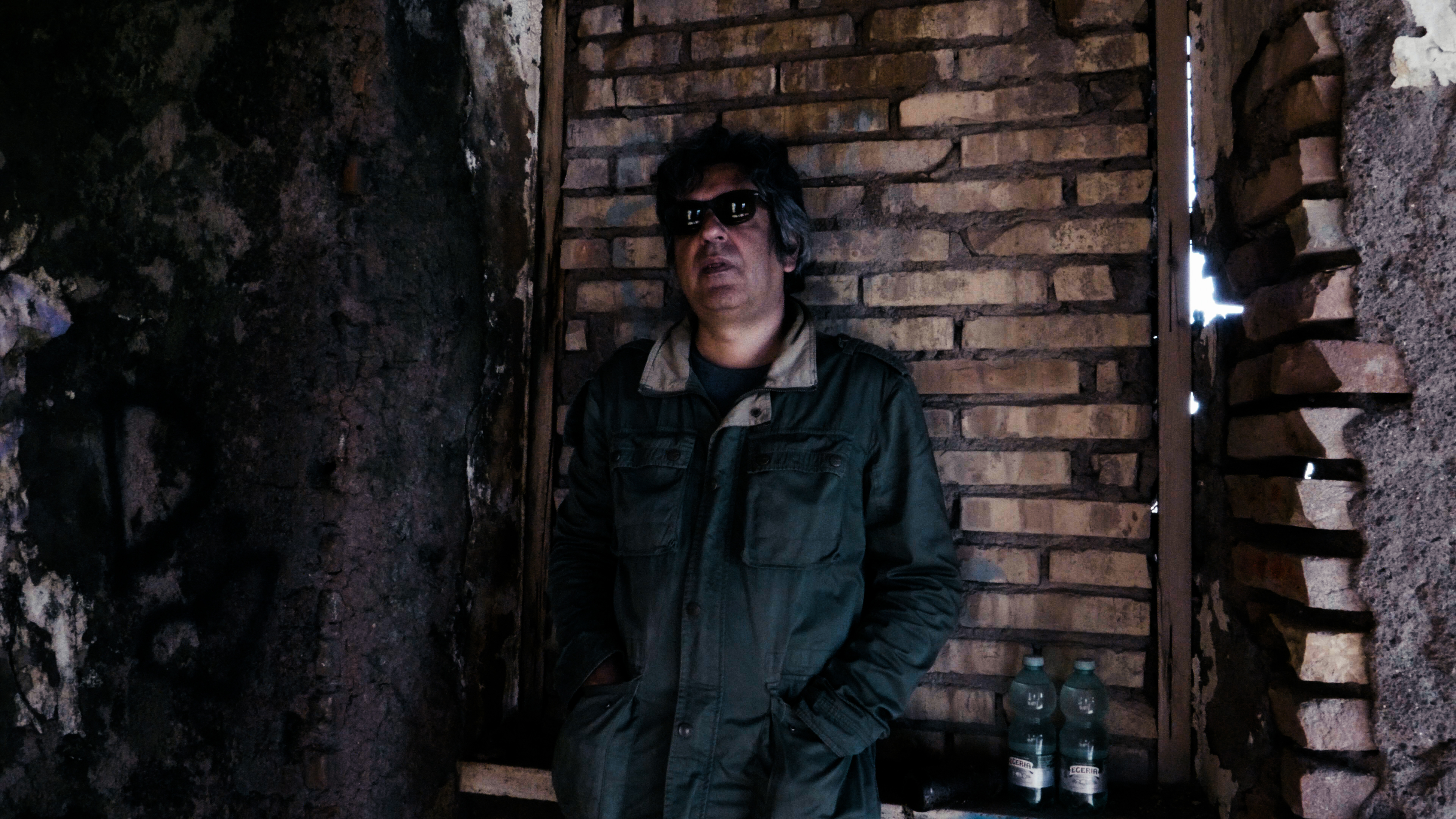
Drama, by Fabio Del Greco, Italy, 2024.
Dante Mezzadri wants to see an old friend, nicknamed the Iguana, whom he has lost sight of for many years, and who has managed to turn their shared youthful passion for poetry into a job, becoming a famous writer and poet. The man escapes from his bourgeois life and his wife to live homeless on the Roman coast, printing and trying to sell his poetry collections. At night he sleeps in a park of old carnival floats, inside a papier-mâché tank, and waits for the opportunity to meet his old friend, who however never shows up for appointments in the places they frequented when they were young, now in ruins. Dante's poetry books do not interest anyone and to support himself he is forced to "change product": he starts selling the infamous "cannibal pill" on behalf of young drug dealers, a new drug that sells like hot cakes and causes sensory and consumerist ecstasy. However, he realizes that this powerful drug is very dangerous for those who take it, he comes into conflict with his ethical conscience and throws all the pills into the sea. However, the dealers want to collect their money.
Shot over a period of 2 years, the film is a reflection on the cultural and artistic rubble of the society in which the protagonist lives, in an increasingly mechanized, consumerist and arid world. Dante Mezzadri is yet another human being who has renounced his inspiration and his creativity, but unlike many he is not willing to give his life to a system that distances him from his true identity. The physical world around him, however, seems constructed in such a way that it seems impossible to escape from this "invisible cage". The enthusiasm of the people he meets is ignited only by sensory gratification, by unreal visions of personal affirmation and success, by "metaverses" that offer an escape into an illusory and destructive reality. The poet's house on the coast, where he met with his friends as a young man, is just a pile of abandoned rubble. What happened to all those who wanted to become poets and ended up becoming something else? Are there internal forces with which that house can be "rebuilt"?
LANGUAGE: Italian
SUBTITLES: English, Spanish, French, German, Portuguese
A Child Made of Glass: The Early Years in Metz and Paris
He was born on March 30, 1844, in Metz, a garrison city on the northeastern edge of France where the air tasted of military order and Protestant discipline, and from the very first years of his life something in him refused to harden. His mother, Élisa-Julie-Josèphe-Stéphanie Dehée, had lost three pregnancies before Paul arrived, and she preserved the fetuses in glass jars, which she kept. This is not a metaphor. The jars were real, the preservation was literal, and the child who finally survived grew up in a household where loss had already been enshrined before he drew his first breath. You do not emerge unscathed from being the living answer to a series of dead questions.
The family moved to Paris in 1851, when Paul was seven, and the city received him the way it receives all provincial children of sensitivity: with indifference sharp enough to cut. His father, a military captain, was steady and somewhat distant in the manner of men who have learned to organize their emotions into ranks. His mother turned her surviving son into something between a treasure and a relic. She adored him with the particular ferocity of someone who has already learned what it costs to lose. Donald Winnicott, writing a century later in his 1960 paper “Ego Distortion in Terms of True and False Self,” described the dynamic with clinical precision: when a mother’s love is suffused with anxiety, the child learns to perform a self that satisfies her need for reassurance rather than express the self that actually exists inside him. The False Self, Winnicott argued, is not deception. It is survival. It is the elegant, adaptive mask that a hypersensitive child constructs when the world of close relationships feels simultaneously indispensable and unsafe.
Verlaine was that child with near-perfect fidelity. Overprotected, physically unremarkable, possessed of a face he himself would later describe as simian and monstrous, he discovered early that the interior life was the only territory where he could not be outranked or outrun. He was reading voraciously by adolescence, writing verses in secret, feeding on Hugo and Baudelaire with the desperate appetite of someone who has found, for the first time, a language that fits the shape of what they feel. At the Lycée Bonaparte in Paris, he was not exceptional in any conventionally legible way. He was, however, porous. Everything entered him without filtration. This is both the wound and the instrument, exactly as Winnicott’s framework implies, because the same permeability that leaves you defenseless before cruelty leaves you defenseless before beauty, and in poetry, that second kind of defenselessness is the entire point.
By his late teens he was already circulating in the minor literary societies that clustered around the edges of Parnassian ambition, that mid-century movement which believed poetry could achieve the cool perfection of sculpture, all surface tension and formal control. Verlaine admired the Parnassians and imitated them and could never fully become one, because his nervous system was constitutionally opposed to coolness. What came out when he wrote was always slightly trembling, slightly damp, slightly too close to the body to pass as marble.
Winnicott believed the False Self, if not eventually dismantled, imprisons the True Self in a condition of permanent latency, alive but not living. What is remarkable about Verlaine’s early formation is that the glass enclosure his mother built around him did not produce silence. It produced pressure. And pressure, when the container is made of something as fragile as a gifted child’s need to be real, does not hold indefinitely. It accumulates. The years in Metz and Paris were years of accumulation, of a self forming in conditions that were both generative and quietly catastrophic, and the poetry that would eventually emerge from that formation would carry both inheritances, sometimes in the same line.

The Parnassians and the Lie of Marble
There is a kind of room you have entered at least once in your life — a salon, a literary gathering, a seminar — where the air itself seems to have been curated. Every word spoken lands with deliberate weight. Nobody laughs unless the laughter is elegant. The conversation is rigorous, polished, and faintly suffocating, and you feel, somewhere beneath your ribs, that the beauty on display costs something no one is willing to name.
This was the Parnassian circle that received the young Verlaine in the mid-1860s, a movement consecrated to the ideal of art impervious to emotion, carved like marble, impenetrable to the trembling of the hand that made it. Théophile Gautier had articulated the doctrine with aristocratic coldness: the work must resist the human, must outlast the man, must stand in the world like a statue rather than bleed like a wound. Leconte de Lisle refined this into a theology of form. The poem was not a confession but a monument. Feeling was a vulgarity to be sublimated or suppressed entirely.
Verlaine arrived at this table in 1866 with his first collection, Poèmes saturniens, and the world received it as a Parnassian document. It had the correct posture. The sonnets were controlled, the mythological references impeccable, the architecture of each stanza as intentional as a cornice. Critics nodded approvingly. Here was a young poet who understood that craft was dignity. What they did not hear — or heard and chose not to name — was the sound running underneath the marble, something liquid and uncontainable, a music that had no business being there if the doctrine were truly observed.
Roland Barthes, writing in 1953 in Le Degré zéro de l’écriture, described a condition in literature where form becomes ideology — where the choice of style is not neutral but the imposition of a whole worldview, a set of values masquerading as aesthetic preference. The Parnassian ideal was precisely this: the marble surface was not just a technique, it was a claim about what mattered, about which emotions deserved articulation, about whose interiority was worth preserving. Perfection as politics. The chisel as exclusion.
What Verlaine was doing, whether he fully understood it at the time or not, was something Barthes would have recognized as a kind of infiltration — not a frontal assault on the doctrine but a slow dissolution from within. The music of the Poèmes saturniens is not decorative. It is structural, and it is subversive. The famous “Chanson d’automne” does not describe melancholy; it enacts it, sonically, in the long open vowels and the falling rhythms that make the poem feel less like a text being read and more like a mood arriving in the body unbidden. The poem does not argue for grief. It simply produces it, the way a particular quality of afternoon light in October produces it, without asking your permission.
By 1869, with Fêtes galantes, the infiltration had become almost brazen. The collection takes its imagery from the world of Watteau — commedia dell’arte figures, masked revelers, garden parties at dusk — and uses this decorative surface to pass something genuinely disturbing through the customs of taste. There is a melancholy in those poems that has no Parnassian precedent, because it is not noble melancholy, not the sculpted grief of the ancients. It is intimate, unresolved, slightly ridiculous, the sadness of someone who knows the party will end and finds himself unable to pretend otherwise. The mask is there, but it is slipping, and Verlaine knew it, and he let it slip, and that was the entirety of his betrayal of the school that had welcomed him.
What the Parnassians had built was a room where you were never supposed to feel cold. Verlaine left the windows open.
Mathilde, the Bourgeois Dream, and Its Collapse
There is a moment in a marriage when you look across the breakfast table and realize you are performing a role so well that even you have forgotten the actor inside it. The coffee cup raised at the same angle every morning, the predictable tenderness, the careful management of silences — all of it assembled into something that resembles a life but functions more like a costume. Verlaine knew this moment. He arrived at it faster than most, and with more violence.
He was twenty-five when he married Mathilde Mauté in 1870, and everything about the choice was legible as ambition of a particular kind — not professional ambition, but the social ambition of a man who wants to become someone else entirely. Mathilde was sixteen, bourgeois, gentle, the daughter of a notary. She represented an ordered world that Verlaine had circled with longing and contempt in equal measure. The wedding was an attempt to step inside that world permanently, to let its walls hold him. He was, at the time, already a poet of recognized talent, his Fêtes galantes published in 1869 to genuine admiration. But talent had not given him stillness. He hoped Mathilde might.
Simone de Beauvoir, writing in The Second Sex in 1949, dismantled with surgical precision the mythology that marriage is fundamentally a private emotional arrangement. It is, she argued, a social institution that converts erotic attachment into economic and symbolic contract, and in doing so assigns the woman the role of mirror — reflecting back to the man the image of stability, legitimacy, normalcy he needs in order to function in the world. The man does not marry a person. He marries an identity. What he calls love is frequently the relief of finally having somewhere to put himself.
Verlaine put himself into the marriage with the desperation of someone who genuinely believed the architecture would hold. The poems he wrote during this period, collected partly in La Bonne Chanson in 1870 — a sequence composed as a courtship offering to Mathilde herself — are not insincere, but they are something stranger than sincerity: they are self-hypnosis. The tenderness in those verses is real, and so is the violence of the effort required to sustain it. You can hear a man convincing himself line by line.
Think of someone who has built an entire domestic life around the image of who they were supposed to become — the dinners prepared, the furniture chosen, the social calendar maintained — and who wakes one morning with the physical sensation that the house is not theirs. Not metaphorically. Physically. The walls belong to someone else’s idea of them. The effort required to keep performing has quietly hollowed out the space where the self used to live. This is not a crisis of character. It is the predictable outcome of what Erik Erikson, in Identity and the Life Cycle published in 1959, called identity foreclosure — the adoption of an identity before the self has had the chance to test its own contours against reality.
Rimbaud arrived in September 1871, summoned by a letter, and the marriage did not so much collapse as reveal that it had already been a ruin. What Rimbaud offered was not simply passion or poetic electricity, though it was both of those things with terrifying intensity. He offered Verlaine the particular cruelty of being seen without the costume on. That is not always a kindness. Sometimes it is a demolition.
Mathilde would endure escalating violence — documented in court proceedings, visible in her own memoir published decades later — and in 1874 she obtained a legal separation. The bourgeois dream had not just failed. It had turned on the person who had offered it most faithfully.
What it costs to build a life around a borrowed identity is not always paid by the borrower first.
Rimbaud: The One Who Arrives and Destroys Everything
There is a letter that arrives and does not ask permission. It arrives and rearranges the furniture, breaks the mirrors, throws open windows that were never meant to face the wind. In September 1871, a seventeen-year-old from Charleville sent Paul Verlaine a sheaf of poems along with a note, and Verlaine — already married, already suffocating inside the decorative cage of bourgeois respectability, already drinking more than was polite to mention — wrote back immediately. Come. And something that had been waiting underground for years finally found its mouth.
You have to understand what Verlaine was before Rimbaud arrived, because the mythology of corruption requires a victim, and Verlaine has been cast in that role so many times that the casting itself has become the lie. He was twenty-seven, celebrated, living in the apartment of his in-laws with a pregnant wife, producing verse that was admired for its musicality and its delicate emotional shading. He was also, by every available account, a man at war with himself in ways that decorum had no language for. The violence was already there. The self-destruction was already there. What Rimbaud brought was not a match thrown into a dry room. It was more like someone who walks in and names the fire that has been burning for years without a name.
Georges Bataille argued in his 1957 work Erotism: Death and Sensuality that transgression does not negate the prohibition it crosses — it completes it, charges it, makes it luminous. The rule and its violation exist in a circuit that neither can break unilaterally. Verlaine had spent years constructing prohibitions: the good marriage, the literary reputation, the careful prosody, the managed melancholy. Rimbaud did not destroy these things so much as he made them vibrate at a frequency that exposed what they were always concealing. A man who did not want to be saved.
There is a scene that belongs to this kind of love — or whatever word survives the wreckage once love has been stripped of its pastoral associations. Two people in a small room, one of them reading aloud from something that should not exist yet, something that reads like the inside of a seizure rendered in syntax so precise it becomes unbearable. The listener stops breathing. Not metaphorically. The room changes temperature. This is not seduction in any conventional register. It is the far more frightening act of being truly seen by someone who does not require you to be comprehensible. The recognition that arrives not as warmth but as exposure.
They left Paris together and moved through London and Brussels in a haze of absinthe, creative fury, and mutual devastation. Rimbaud was writing what would become the Illuminations and A Season in Hell. Verlaine was writing Romances sans paroles, some of the purest lyric poetry in the French language, poems so transparent they seem to have no wall between the emotion and the word. The proximity was productive and catastrophic simultaneously, which is the only honest description of certain kinds of intimacy.
Think of a man who has decided to leave, who has packed his bag, who has announced his departure down a corridor to someone who cannot let him go — and then the shot, and then the blood, and then the trial, and then two years in Mons Prison for Verlaine. Brussels, July 1873. A revolver. Two bullets. One found Rimbaud’s wrist. It is the most legible act of Verlaine’s entire existence, which is precisely why reducing it to scandal misses everything. It was the gesture of someone who had finally located the thing he could not survive losing, and could not survive keeping.
Rimbaud left for Africa shortly after. He was nineteen. He never wrote another poem. And Verlaine spent the remaining twenty-two years of his life explaining something that had no explanation.
A vision curated by a filmmaker, not an algorithm
In this video I explain our vision
The Shot in Brussels and the Grammar of Catastrophe

There is a moment when the hand moves before the mind has finished its argument. You have been drinking since morning, the hotel room smells of cheap tobacco and something older, something like the particular sourness of two people who have destroyed each other so many times they no longer distinguish destruction from intimacy. The gun is in your hand. Then it is not a metaphor anymore.
On the tenth of July, 1873, in a Brussels hotel room on the Rue des Brasseurs, Paul Verlaine fired twice at Arthur Rimbaud. The first bullet struck the younger man’s left wrist. The second missed. Rimbaud, nineteen years old, bleeding and already composing himself into legend, chose to press charges. Verlaine was arrested within hours. He was sentenced to two years of hard labor at the prison of Mons, a punishment that the court lengthened — with breathtaking institutional candor — after doctors examined him for signs of sodomy. The crime was not only the gun. The crime was also the body.
Michel Foucault, writing in Discipline and Punish in 1975, argued that the prison does not primarily punish the act but manufactures the soul — that incarceration is a technology for producing a certain kind of interiority, a subject broken and re-formed around surveillance, guilt, and the rhythms of institutional time. The cells at Mons were doing exactly that work on Verlaine between 1873 and 1875. What the administration wanted to produce was penitence. What it accidentally produced instead was Romances sans paroles.
The collection had already been sketched in the wandering months before the shooting — in trains across Belgium and England, in the strange domestic fever of two poets living like catastrophe made flesh. But the final form, published in 1874 while Verlaine was still incarcerated, carries the prison inside its syntax. Not as subject matter. As structure. The poems refuse resolution the way a wound refuses to close when you keep opening it to see if it has healed. There is no arc of redemption in these pages, no movement from suffering toward meaning. What there is instead is perception stripped of narrative purpose — rain on a window, a distant carillon, the smell of cut grass that arrives without permission and undoes everything.
This is not the aesthetics of defeat. It is something more precise and more disturbing. Verlaine had understood, somewhere in the machinery of his catastrophe, that the redemptive narrative is a lie the culture tells itself to make suffering legible and therefore manageable. The poem “Il pleure dans mon coeur” does not explain the weeping. It does not locate its cause. It simply insists on the phenomenon with the accuracy of a clinical observer who has chosen to observe himself. The grief exists. It has no object. This is not a confession. It is a formal position.
Paul Celan would later understand something structurally similar about language under extreme pressure — that it does not expand to contain experience but contracts, becomes mineral, refuses the consolations of eloquence. Verlaine arrived at this compression not through theory but through the specific material conditions of a body confined, a friendship incinerated, a reputation publicly destroyed. The biographical catastrophe and the formal innovation are not separate events. They are the same event written in two different registers.
What the two years in Mons produced, against all institutional intention, was a poet who had lost his fear of incompleteness. Foucault’s surveillance produces subjects who internalize the warden’s gaze. But Verlaine internalized something else entirely — the gaze of the poem itself, which asks nothing of coherence, which permits the image to exist without the scaffolding of meaning. You can read this as liberation. You can also read it as a man who has stopped believing that resolution is available to him.
God, Absinthe, and the Impossibility of Choosing
There is a particular kind of man who kneels at the altar on Sunday morning and is found, by Sunday evening, in a corner of some smoke-thick café with a glass of green liquid dissolving his remorse. You might be tempted to call this hypocrisy. William James would not. In The Varieties of Religious Experience, published in 1902, James argues with quiet ferocity that religious life is not a destination but a weather system — turbulent, reversible, constitutively unstable — and that the soul most genuinely seized by faith is often the one least capable of maintaining it as a settled condition. He calls these figures the “twice-born”: those who cannot access belief without first passing through disintegration, and who must disintegrate again before they can return to belief. Verlaine did not read James, but he lived the argument from the inside with a thoroughness no philosopher could have scripted.
Sagesse appeared in 1881, written mostly during his imprisonment at Mons, and it is among the most genuinely felt Catholic poetry in the French language — not the decorative Catholicism of someone performing piety for a drawing room, but the raw contrition of a man who had fired a pistol at the person he loved most and spent two years in a cell understanding what he had done. The poems breathe like a man who has stopped drowning and cannot quite believe in air. The famous sonnet sequence addressed to God has the grammatical intimacy of a letter written to someone you have wronged so badly that formality would be obscene. This is not literature constructed to demonstrate faith. It is faith demonstrating itself through the only instrument available, which happened to be a man constitutionally unsuited to holding still.
And then the absinthe came back. Not as a lapse, not as a failure of will in any simple sense, but as the other pole of the same needle that swung toward God. He returned to Paris, to the Latin Quarter, to the hospital wards of the Hôpital Broussais and later the Hôpital Saint-Louis, to a succession of young lovers and café tables, to the erotic poems he gathered under the deliberately scandalous title Parallèlement in 1889 — a title that announces the simultaneity rather than the sequence of his contradictions. The sacred and the carnal were not taking turns. They were running alongside each other, as the title insists, neither canceling the other out.
What the moralizing reader wants is a narrative of failure: the poet converted, then fell, then was lost. What the evidence actually shows is something far less comfortable and far more interesting. Verlaine returned to religious themes throughout the 1880s and 1890s, even as he was drinking himself toward his death in January 1896, even as he was cycling through the cheap furnished rooms of the fifth arrondissement with a small inheritance from his mother that he spent almost immediately. He wrote liturgical verse while running a fever in a public ward. He confessed and drank and confessed again, not because the confession meant nothing but because it meant everything and was still not sufficient to reorganize a self that had never been organized to begin with.
James writes that the divided self — what he calls the “heterogeneous personality” — is not a defective version of the unified self but a different species of consciousness entirely, one for which conversion can only ever be temporary because no single orientation can contain the whole of what it experiences. Verlaine was that species. His oscillations between God and absinthe, between contrition and desire, between the hospital chapel and the street, were not the signs of a theology abandoned but of a theology practiced with the kind of honesty that decency usually prevents. He could not choose because both were true, and he was, despite everything, constitutionally incapable of lying about what was true.
What the Music Was Actually Saying
There is a poem that reads like a manifesto written by someone who has already abandoned every rule he is about to propose. It was composed in 1874, in the aftermath of the gunshot, the prison cell, the collapse of everything — and it would not see print for another eight years, as though even its author needed time to understand what he had said. Music above everything else, it declares. Not the heavy machinery of argument, not the fist of the explicit statement, but the thing that trembles between words before meaning solidifies. De la musique avant toute chose. The line arrives not as a prescription but as a confession, the way a man who has survived a catastrophe might describe what the catastrophe taught him about silence.
What Verlaine was theorizing in that poem — and theory is perhaps too cold a word for what reads more like a wound finding its shape — was the primacy of suggestion over declaration. The idea that language at its most powerful is the language that stops just short of saying the thing, that leaves the reader holding an impression the way you hold a dream in the first seconds of waking, before it drains away. Walter Pater, writing in 1873 in “The Renaissance,” had already articulated the philosophical framework: all art constantly aspires towards the condition of music, because in music form and content are inseparable, because music does not represent experience, it is experience, immediate and untranslatable. Verlaine was not illustrating Pater’s thesis. He was living it, which is an entirely different order of proof.
The technical instruments of this aspiration are everywhere in his verse. The preference for odd-numbered syllables — the nine-syllable line, the eleven — because they resist the comfortable caesura, the expected pause, the rhetorical breath that tells you where a thought begins and ends. Imprecision made precise, nuance made into form. The conjunctions and prepositions that carry emotional weight without announcing it. The way his vowels open and close like something breathing. These are not ornamental choices. They are the architecture of a consciousness that had learned, through the most violent of educations, that the stated truth is almost always a lie, and that what is real exists in the register just below statement.
And here is where the question becomes genuinely uncomfortable, where it refuses the comfort of either answer. Paul Verlaine was a man who beat his wife, who shot his lover, who drank himself across two decades of decline, who spent time in prison, who died in 1896 in poverty, passed between the houses of women who pitied him and cheap hotels that tolerated him. He was also the man who wrote “Il pleure dans mon coeur” and “Clair de lune” and “Chanson d’automne” — poems that achieve something so precisely calibrated to the frequency of interior human experience that they have outlasted nearly everything his century produced. The question is not whether suffering produces art. That is too simple, and the evidence against it is everywhere: most suffering produces nothing except more suffering. The question is whether the particular sensitivity that makes a person capable of this kind of beauty is inseparable from the particular fractures that made him incapable of ordinary life.
William James, in “The Varieties of Religious Experience” from 1902, noted that the same psychological constitution that opens a person to ecstatic perception also leaves them catastrophically vulnerable to the abyss — that the membrane between revelation and devastation is, in certain natures, vanishingly thin. Verlaine does not confirm this thesis. He simply is it, embodied and irrefutable, a life in which the music and the wreckage are not cause and effect but the same event, perceived from two different angles, neither of which cancels the other out.
🎭 Voices of the Decadent Soul: Poets and Visionaries
Paul Verlaine’s turbulent life and musically charged verse did not emerge in a vacuum — they drew from and fed into a broader current of artistic and philosophical restlessness. These related articles trace the intellectual and creative world that surrounded and echoed Verlaine’s singular voice.
Johann Wolfgang von Goethe: Life and Works
Johann Wolfgang von Goethe stands as one of the towering figures whose literary ambition and exploration of inner transformation deeply influenced French Symbolist poets, including Verlaine. His fusion of lyrical intensity with philosophical depth created a template for artists seeking to reconcile beauty, suffering, and meaning. Understanding Goethe’s life and works illuminates the broader European literary climate in which Verlaine’s own poetics took shape.
GO TO THE SELECTION: Johann Wolfgang von Goethe: Life and Works
Montaigne: Life and Essays
Michel de Montaigne invented a form of introspective writing that placed the self — fragmented, contradictory, and alive — at the center of literary expression. This radical subjectivity resonates strongly with Verlaine’s confessional lyricism and his insistence on vulnerability as poetic substance. Reading Montaigne alongside Verlaine reveals a long tradition of writers who turned their own restless interiority into enduring art.
GO TO THE SELECTION: Montaigne: Life and Essays
Albert Camus: Life and Philosophical Thought
Albert Camus, like Verlaine, was a writer haunted by the tension between beauty and despair, between the longing for meaning and the silence of the universe. His philosophical confrontation with the absurd echoes the melancholic resignation that runs through Verlaine’s most celebrated poems. Exploring Camus’s life and thought opens a deeper dialogue between French literary sensibility and the existential undercurrents already present in Symbolist verse.
GO TO THE SELECTION: Albert Camus: Life and Philosophical Thought
Virginia Woolf: Life and Works
Virginia Woolf‘s exploration of language as a fluid, rhythmic, and emotionally charged medium places her in surprising kinship with Verlaine’s own musicality and dissolution of rigid poetic form. Both writers pushed against conventional structure in search of something more honest and interior. Woolf’s life and works offer a compelling parallel to Verlaine’s quest to capture the evasive textures of feeling in literary form.
GO TO THE SELECTION: Virginia Woolf: Life and Works
Discover the Poetry of Independent Cinema on Indiecinema
Just as Verlaine sought to dissolve boundaries between music, emotion, and verse, independent cinema has always pushed against the edges of conventional storytelling. On Indiecinema streaming, you will find films that share that same restless spirit — works that dare to be fragile, strange, and luminously human. Dive in and let yourself be moved.
👉 EXPLORE THE CATALOG: Watch Indie Films in Streaming
A vision curated by a filmmaker, not an algorithm
In this video I explain our vision

