
The Moment Before the Word
You are standing in a room full of people who are laughing, and you cannot explain why you feel like you are drowning. Not metaphorically — you are searching, right now, for the sentence that would make another human being understand what is happening inside you, and the sentence does not exist. You reach for words and find only approximations. You say “I feel strange” or “I don’t know, something’s off” and watch the other person nod with the polite vacancy of someone who has already moved on. The word has failed you. Not because you are inarticulate, but because the word was never built to carry what you needed it to carry.

This is not a modern problem. It is not a symptom of living in an age of distraction or digital superficiality. It is the oldest wound in human consciousness — the gap between what burns inside and what language can hold without spilling. Every civilization that has ever tried to think carefully about the mind has eventually arrived at the same uncomfortable discovery: experience is not made of words. Words come after. They arrive late, like ambulances to an accident that has already happened, and what they find on the scene is never quite what was there before they showed up.
William James, writing in 1890 in his Principles of Psychology, gave this phenomenon a name that has since been softened almost to the point of uselessness: the “stream of consciousness.” What he actually meant was radical and still disturbing — that mental life is continuous, non-discrete, and fundamentally resistant to the segmentation that language imposes on it. You cannot cut a river into sentences. You cannot stop the current and label each drop. Yet this is precisely what ordinary language attempts to do, every time you open your mouth to say how you feel.
Stéphane Mallarmé understood this with a specificity that bordered on physical pain. He spent years — decades — trying to write a poem that would not merely describe an experience but would enact it, would make language behave the way the mind actually behaves before rational grammar domesticates it. The poem was called Le Livre, the Book, and he never finished it. He died in 1898 having produced fragments, notes, typographic experiments in which the spacing of words on a page was meant to carry meaning that the words themselves could not. The failure was not his. It was language’s.
But here is what most accounts of literary history prefer not to say directly: Symbolism was not primarily a literary movement. It was a crisis response. It emerged in France in the second half of the nineteenth century — crystallizing around the 1880s, formally announced in Jean Moréas’s manifesto published in Le Figaro on September 18, 1886 — not because a group of poets decided to try something stylistically new, but because the existing tools of expression had broken under the weight of what European consciousness was attempting to feel. Industrialization had reorganized time and space. Darwin had reorganized the human animal’s relationship to meaning. Positivism had declared that only the measurable was real. And inside all of this, human beings were still standing in rooms, still drowning without a word for it.
The Symbolists did not try to repair language. That would have been the Realist project — finding more precise nouns, more accurate adjectives, better maps of a territory that keeps shifting. Instead, they proposed something almost reckless: that the territory is not mappable, that the interior life can only be suggested, approached obliquely, evoked the way a shadow evokes a body without ever being the body. The symbol, in their hands, was not a code to be deciphered. It was a door left deliberately ajar, in a house where the lights are always slightly wrong.
The Lost Poet
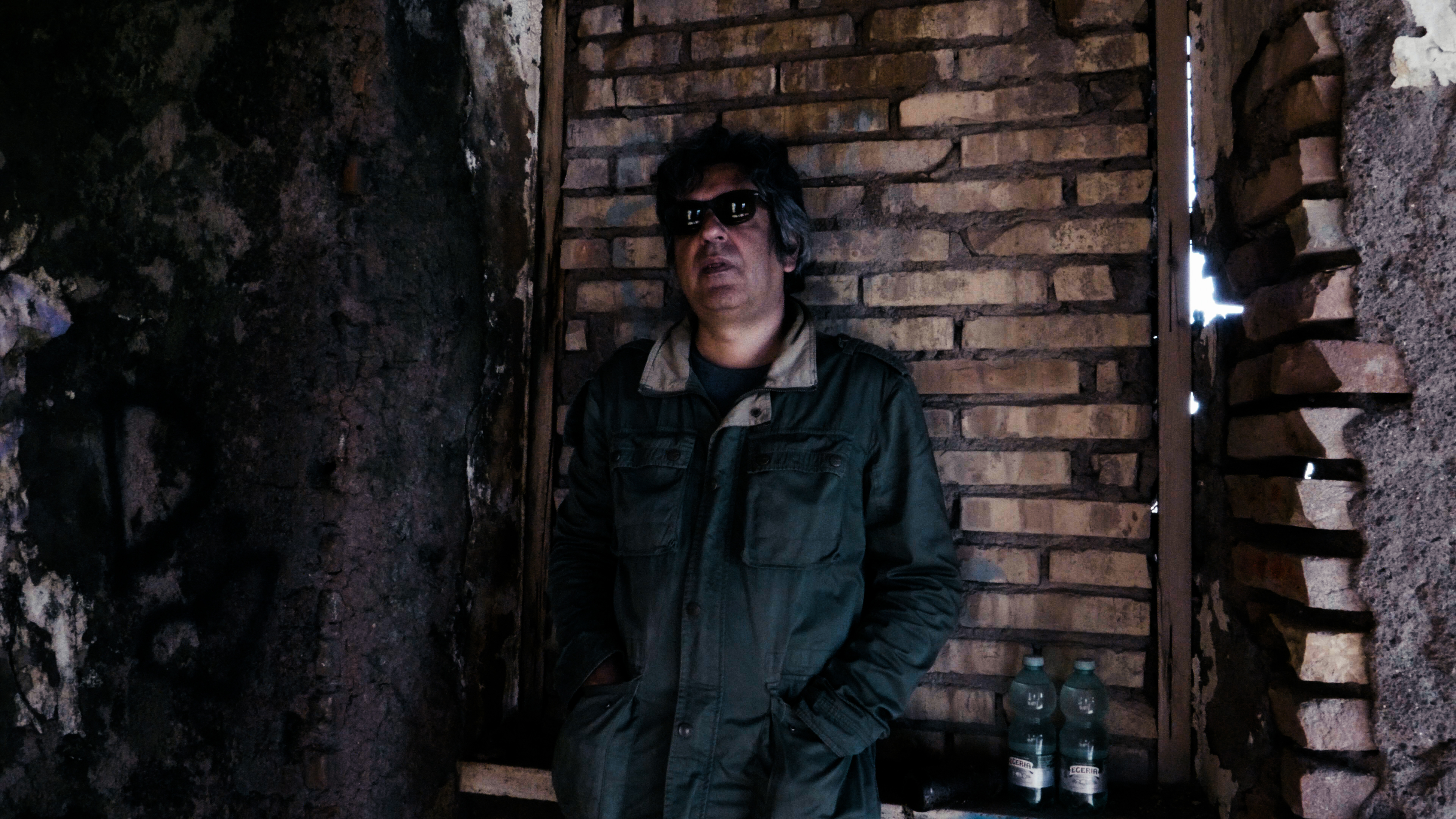
Drama, by Fabio Del Greco, Italy, 2024.
Dante Mezzadri wants to see an old friend, nicknamed the Iguana, whom he has lost sight of for many years, and who has managed to turn their shared youthful passion for poetry into a job, becoming a famous writer and poet. The man escapes from his bourgeois life and his wife to live homeless on the Roman coast, printing and trying to sell his poetry collections. At night he sleeps in a park of old carnival floats, inside a papier-mâché tank, and waits for the opportunity to meet his old friend, who however never shows up for appointments in the places they frequented when they were young, now in ruins. Dante's poetry books do not interest anyone and to support himself he is forced to "change product": he starts selling the infamous "cannibal pill" on behalf of young drug dealers, a new drug that sells like hot cakes and causes sensory and consumerist ecstasy. However, he realizes that this powerful drug is very dangerous for those who take it, he comes into conflict with his ethical conscience and throws all the pills into the sea. However, the dealers want to collect their money.
Shot over a period of 2 years, the film is a reflection on the cultural and artistic rubble of the society in which the protagonist lives, in an increasingly mechanized, consumerist and arid world. Dante Mezzadri is yet another human being who has renounced his inspiration and his creativity, but unlike many he is not willing to give his life to a system that distances him from his true identity. The physical world around him, however, seems constructed in such a way that it seems impossible to escape from this "invisible cage". The enthusiasm of the people he meets is ignited only by sensory gratification, by unreal visions of personal affirmation and success, by "metaverses" that offer an escape into an illusory and destructive reality. The poet's house on the coast, where he met with his friends as a young man, is just a pile of abandoned rubble. What happened to all those who wanted to become poets and ended up becoming something else? Are there internal forces with which that house can be "rebuilt"?
LANGUAGE: Italian
SUBTITLES: English, Spanish, French, German, Portuguese
A Century Cracking Open
There is a specific quality to the noise a factory makes at night, heard from a distance, when you cannot see the machinery but only feel the low, persistent vibration moving through the ground beneath your feet. It is not loud enough to be frightening, but it is constant enough to be maddening — a hum that belongs to no natural world you were born into, a sound that tells you something has changed irrevocably and that no one asked your permission.
This is the sensory atmosphere in which European poetry began to fracture in the second half of the nineteenth century. It was not a literary crisis. It was a civilizational one, dressed in literary clothes. The Industrial Revolution had been accelerating since the 1760s, but by the 1870s and 1880s its transformations had reached a kind of saturation point — not merely in economics or urban architecture, but in the texture of consciousness itself. Cities had doubled and tripled in population within a single generation. The countryside that had fed Romantic imagery with its silences and its gods was being swallowed. The peasant who once moved in rhythm with seasons and soil was now a factory worker moving in rhythm with a machine that did not know his name.
Into this atmosphere Friedrich Nietzsche published The Gay Science in 1882, and the words he placed in the mouth of a madman running through a marketplace with a lantern at noon — God is dead, God remains dead, and we have killed him — were not a philosophical provocation so much as an accurate description of what millions of people were already experiencing without language to name it. The transcendent scaffolding that had held Western meaning together for centuries had been quietly dismantled. Not by atheism as a doctrine, but by the daily experience of a world that no longer behaved as if it were watched, sustained, or loved by anything beyond itself. Nietzsche was not announcing a future. He was diagnosing a present that most people were too frightened to look at directly.
The Romantic poets had believed in symbols too, but in a fundamentally different way. For Wordsworth, for Keats, for the German Romantics gathered around Novalis and Friedrich Schlegel, the natural world was legible — charged with spiritual meaning that the sensitive soul could decipher. The mountain spoke. The nightingale carried grief that was also beauty. There was a correspondence between inner life and outer world, and the poet’s task was to transcribe it. This faith, which seems naive only in retrospect, required a certain stability in the structure of reality. It required that the world hold still long enough to be read.
By 1870, the world had stopped holding still. The Franco-Prussian War shattered French national confidence with a speed and brutality that left Paris in a state of collective trauma. The Paris Commune of 1871, crushed within weeks, left behind not only thousands of dead but a profound disillusionment with political idealism. Progress, that great nineteenth-century religion, had shown its other face — the face of the Gatling gun, of mass displacement, of children working fourteen-hour days in textile mills. The philosopher Auguste Comte had promised a positivist paradise in which science would replace superstition and social harmony would follow from rational organization. What arrived instead was something far more vertiginous: a world that was rationally organized and yet felt utterly meaningless.
This is the precise historical pressure that produced Symbolism — not as an aesthetic fashion, not as a club of eccentric poets writing in Parisian cafés, but as a desperate and rigorous attempt to find a language adequate to a world that had lost its grammar. When the surface of things becomes untrustworthy, when the visible no longer leads reliably toward the true, the poet does not stop speaking. He begins to speak differently, searching for the resonance beneath the word, the shadow behind the image, the music that survives the collapse of meaning.

What the Symbol Actually Does
There is a moment when you hear a piece of music and something in your chest shifts before you have any idea what the piece is about. Not sadness exactly, not joy, but a readiness for both, a kind of trembling openness you did not invite. You did not decode the music. You did not translate its notes into a concept and then feel the concept. The feeling arrived first, ahead of any interpretation, the way weather arrives before you have named the season.
That is the difference. And it matters more than most discussions of poetry ever admit.
When a poet writes that death is a long sleep, they are constructing an allegory. The terms are exchangeable, the mapping is clean, the meaning exists independently of the image and merely borrows it for transport. You could strip the metaphor away and still possess the idea intact. The image is a vehicle, nothing more, a taxi that drops off its passenger and drives away. Even the more sophisticated rhetorical metaphor, which insists on likeness rather than identity, still operates on a logic of substitution: A stands for B, feel free to use either. Both allegory and metaphor assume that meaning precedes the form and simply dresses itself in language. The form is costume.
Ernst Cassirer spent the better part of his intellectual life arguing that this assumption is catastrophic, not merely wrong but foundational in its wrongness. In the three volumes of the Philosophie der symbolischen Formen, published between 1923 and 1929, Cassirer proposed that the human mind does not first perceive reality and then symbolize it. Symbolization is perception. Language, myth, art, science: these are not secondary representations of a world that exists fully formed before them. They are the modes through which a world becomes available to consciousness at all. The symbol, in this framework, does not carry meaning across from one territory to another. It generates the territory itself.
This is precisely what Baudelaire had intuited seventy years earlier, in language far less systematic but no less precise. The poem called Correspondances, published in Les Fleurs du Mal in 1857, does not describe a universe of hidden meanings waiting to be decoded by a sufficiently sensitive reader. It describes a universe in which sensations, colors, sounds, and perfumes are already in conversation with each other at a level beneath cognition, where the senses cross and mingle before the intellect arrives to sort and label them. The symbol, for Baudelaire, is not a sign pointing elsewhere. It is a site of convergence, a place where the outer world and the inner world touch without dissolving into each other.
You stand in a room and smell something, wood polish perhaps, or a particular soap, and suddenly an entire texture of feeling is present that you cannot attribute to any single memory. It is not nostalgia in the sentimental sense. It is closer to the experience of being briefly inhabited by a version of yourself that time had seemed to seal off. The smell did not represent something. It enacted a return, performed a presence. That is closer to what the Symbolist symbol does than any definition involving reference or resemblance.
The ornament, by contrast, is the symbol gutted of this enacting power and kept alive for decoration. A rose on a greeting card, an anchor on a sailor’s forearm, a dove above the word peace: these have retained the visual form of symbolic objects but surrendered the capacity to open anything. They function as signals, instantly legible and immediately closed. The reading takes no time because nothing is produced in the reading. You recognize, you confirm, you move on.
What the Symbolists were after was the opposite of that efficiency. They wanted a language in which the encounter with the word costs you something, changes the pressure in the room, leaves you in a state you cannot quite close.
Baudelaire’s Wound
There is a moment, familiar to anyone who has walked alone through a city after midnight, when the street stops being a street. The neon bleeding onto wet asphalt, the figure hunched in a doorway, the smell of something rotting beneath something sweet — all of it collapses into a single, undeniable sensation: that the city is not outside you. It is the inventory of everything you have tried not to become. You keep walking anyway. You cannot stop looking.
This is where Baudelaire lived. Not metaphorically — existentially, constitutionally, as a matter of daily practice and daily ruin. When Les Fleurs du Mal appeared in 1857, the French government prosecuted it for obscenity and public morality offenses within two months of publication. Six poems were suppressed by court order, and Baudelaire was fined three hundred francs. The scandal was real, the legal machinery was real, and so was the wound the book opened in French literary culture — a wound that has never entirely closed, because it named something that polite discourse had agreed to leave unnamed: that beauty and corruption are not opposites. They are the same substance, seen from different angles of the light.
What made the trial absurd, and what makes it revealing, is that the prosecution was essentially correct about what Baudelaire was doing. He was not writing about flowers as decoration. He was writing about the way a particular kind of seeing — attentive, merciless, sensually awake — transforms every surface of modern life into a sign of its own decomposition. Spleen and ideal, he called the poles, and the genius of the construction is that he refused to choose between them. The ideal is not the escape from spleen. The ideal is what makes spleen unbearable, because you can see what you are losing while you lose it.
Walter Benjamin spent the last decade of his life trying to understand why this mattered so enormously, and his unfinished Arcades Project, assembled through the 1930s and surviving him only because Hannah Arendt smuggled the manuscript out of Paris in 1940, is essentially a long meditation on the question. Benjamin’s central figure is the flâneur — the urban wanderer who moves through the city not as a consumer or a commoner but as a reader. For the flâneur, the city is a forest of signs, in Baudelaire’s own phrase from Correspondances, where every object resonates with every other, where the material world is a text that encodes something about the psychic condition of the civilization that produced it. The department store window and the prostitute’s gaze and the gas lamp and the decomposing building and the fashionable hat: none of these are simply what they appear to be. They are symptoms. They are confessions.
There is a scene that lives in the memory like something you witnessed yourself. A man descending into the city at night, watching the faces that pass him, each one briefly illuminated by a shop light or a match flame, and in each face he sees not another person but a version of his own dissolution. The recognition is not comfortable. It is the recognition of someone who has looked too long into something true. He does not turn away, because turning away would be the greater dishonesty.
This is the posture Baudelaire invented for modern poetry: the refusal to aestheticize suffering by placing it at a safe distance, combined with the refusal to simply document it without transformation. The wound in the title is not a metaphor for artistic difficulty. It is the actual condition of consciousness in an industrializing city, aware of its own fragmentation, unwilling to pretend that fragmentation is merely ugliness rather than also, precisely, the only available form of the sublime.
Benjamin understood this as the founding gesture of literary modernity. Baudelaire did not lament the loss of transcendence. He found transcendence inside the decay itself, which is either the most honest thing a poet has ever done, or the most dangerous.
Verlaine, Rimbaud, Mallarmé: Three Ways to Dissolve
There is a moment when you realize that the sentence you just wrote is too clean. It says exactly what you meant, which is precisely the problem. Something in the clarity feels like a betrayal, like a room with no shadows. That unease is the beginning of everything.
Verlaine arrived at poetry the way water arrives at a wound — not to clean it, but to find the shape of it. His famous injunction, “de la musique avant toute chose,” music before everything else, was not an aesthetic preference. It was a confession of defeat before the tyranny of meaning. In his “Art poétique” of 1874, he demanded verse that hesitates, that rhymes without insisting, that keeps something undecided between syllables. What critics called musicality was in fact a form of surrender — not to chaos, but to the resonance between things that logic cannot name. You have heard this in a minor key played in an empty apartment after someone has left. You did not need to understand it. That was the point.
Rimbaud went further and went faster, which is its own form of violence. His theory of the systematic derangement of all the senses, laid out in his letters of May 1871 when he was sixteen years old, was not a metaphor. It was a program, nearly clinical in its ambition: exhaust every perception until the self cracks open and something else speaks through it. He called the poet a thief of fire, a voyant, someone who sees not by looking but by destroying what the eye expects. And then, at twenty-one, he stopped. There is a man who burns his notebooks in the courtyard of a house on the edge of a city, not in anger but with the focused patience of someone completing a task. He watches the pages curl and does not look away. This is not failure. This is the only honest conclusion to a project that was always also a self-immolation. After his last collection, Rimbaud sailed for Africa, traded coffee and possibly weapons, and never wrote another poem. Arthur Rimbaud, born in Charleville in 1854, died in Marseille in 1891 of bone cancer. The silence of his last two decades is itself a text that no one has finished reading.
Then there is Mallarmé, who did something stranger still. A woman hums a melody in a corridor, not quite audible, not quite silence, and no one passing can tell whether she is happy or mourning or simply present in a register beyond those categories. Mallarmé’s “Un Coup de Dés Jamais N’Abolira le Hasard,” published in 1897, is that corridor. The poem refuses to complete a single syntactic gesture without interrupting itself, dispersing its words across the white space of the page as if the silence between them carries equal weight with the language. This was not obscurity as ornament. It was a structural claim: that meaning is not carried by words alone but by the force field between them, by what the page withholds. Jacques Derrida, writing nearly a century later, would describe this as the trace, the presence of what is absent, but Mallarmé had already written it into the architecture of a poem before deconstruction had a name.
Three men, three different answers to the same unbearable question: what do you do when language is not large enough for what you need it to hold? Verlaine learned to make it sing past its own precision. Rimbaud ruptured it from the inside and then left it bleeding on the ground. Mallarmé arranged the wreckage on a white page and called the arrangement the poem.
What they share is not a school, not a movement, not even a period. What they share is the refusal to let the sentence arrive safely at its destination.
A vision curated by a filmmaker, not an algorithm
In this video I explain our vision
The Symbolism That Crossed Borders
There is a particular kind of stubbornness in the person who refuses the world as it presents itself — who looks at a street, a conversation, a political border, and insists that none of it is the whole story. This stubbornness wore different faces depending on where it appeared, but it recognized itself across distances, the way a certain quality of light looks the same in photographs taken on opposite sides of the earth.
In Ireland, the refusal was almost geopolitical before it was aesthetic. To write in the Symbolist mode there meant reaching past the language of the colonizer and past the flat empiricism that had come packaged with British dominion — the same empiricism that measured land, catalogued resources, and administered famine with bureaucratic precision. Yeats built his mystical system not as an eccentricity but as a counterweight. His elaborate architecture of gyres and phases and lunar cycles, codified in A Vision in 1925, was his answer to a world that believed only in what could be weighed. The Celtic twilight he evoked was not nostalgia; it was a political act disguised as a séance. When he wrote of a woman walking with the wind in her hair and eternity in her voice, he was not describing a dream. He was insisting that Ireland had an inner life that no Ordnance Survey map could contain.
Move east across the continent and the same insistence arrives in a different key. In the German-speaking world, the question was not colonization but metaphysical vacancy — what happens to human beings when God has genuinely left, not just retreated, but absented himself so thoroughly that even grief at his absence becomes impossible. Rilke stood at the edge of that vacancy and heard, or claimed to hear, something vast and inhuman call back. The angels of the Duino Elegies, completed in 1922 after a decade of silence and two world wars pressing against their composition, are not consoling figures. They are terrifying precisely because they do not need us. “Beauty is nothing but the beginning of terror,” he wrote, and he meant it structurally, as a diagnosis of what happens when you strip symbolism of any comfortable theology and leave it exposed to pure existence. His angels carry meaning the way a cliff carries wind — indifferently, immensely, without concern for whoever happens to be standing at the edge.
And then Russia, where Symbolism arrived in the 1890s and immediately found itself in conversation with catastrophe. Blok and Bely wrote in a country where the revolutionary pressure building beneath the surface was not metaphor — it was historical fact accumulating toward 1917 like water behind a dam. Blok’s long poem The Twelve, written in January 1918 in a state he described as almost trance-like, placed twelve Red Guards marching through a blizzard with, at their head, a ghostly figure of Christ. The image horrified both religious conservatives and committed Bolsheviks, which is precisely the mark of a symbol working correctly — it refuses to resolve into ideology. Bely’s novel Petersburg, published in its first form in 1913, dissolved the city itself into a hallucination of geometry and dread, the rational grid of streets becoming a symbol of imperial consciousness eating itself alive. The surface of the city, so carefully planned by Peter the Great as a monument to European rationalism, became in Bely’s hands the very image of what happens when a civilization mistakes its own scaffolding for reality.
What traveled across these borders was not a style but a conviction: that the visible world is always a translation of something that resists direct statement, and that the poet’s task is to hold open the gap between the translation and the original — to stand in that gap and refuse to let either side collapse into the other.
The Social Trap Hidden Inside the Aesthetic
There is a particular kind of dinner party where someone says something deliberately obscure and the room divides, instantly and silently, into those who nod and those who smile too quickly because they didn’t understand but cannot afford to say so. The obscurity is not accidental. It is the point. It performs a sorting function that no one announces but everyone feels.
Symbolism operated on exactly this mechanism. For all its genuine rebellion against bourgeois materialism, its insistence that poetry should suggest rather than state, evoke rather than explain, created an aesthetic that was structurally inaccessible to anyone who hadn’t spent years absorbing the right references, the right mythologies, the right mystical vocabularies. Pierre Bourdieu, in his 1979 work Distinction, identified with clinical precision how cultural capital functions as a form of social currency that masquerades as natural sensitivity. What looks like taste is inherited position. What feels like intuition is accumulated privilege. The Symbolist claim that only certain souls possessed the receptivity to hear the music beneath language was not merely a poetic conceit. It was a gate with a very specific lock.
The movement that declared itself the enemy of the crowd did not ask who exactly counted as the crowd and who was exempted. Mallarmé’s famous statement that poetry should not be democratic was spoken as a defense of difficulty, but difficulty is never neutral. It requires leisure to cultivate, education to decode, and a social network that rewards its mastery. The working man who could not afford to spend three evenings deciphering a Mallarmé sonnet was not excluded because he lacked soul. He was excluded because he lacked time, and time is never evenly distributed.
Women suffered a different and more insidious exclusion. The feminine appeared everywhere in Symbolist imagery — as the sphinx, the fatal beauty, the pale sibyl, the voiceless vessel of transcendence — while actual women who wrote were systematically absorbed into the margins or erased entirely. Poets like Renée Vivien, whose work carried genuine Symbolist depth and formal rigor, or Luisa Giaconi in Italy, whose single posthumous collection barely survived obscurity, wrote in full possession of the movement’s tools and were nonetheless treated as peripheral phenomena. The feminine was worshipped as a symbol precisely when it could be controlled as one. A woman who spoke for herself rather than serving as the occasion for a man’s metaphysics disrupted the entire apparatus.
Then there is the slide into occultism and nationalism, which is perhaps the most uncomfortable thread to follow. The hunger for hidden correspondences, for an order beneath the visible, for blood-memory and ancestral soil, shared more than a family resemblance with some of the darker political imaginaries emerging across Europe in the same decades. This is not to say that Symbolism caused anything, or that the poets were responsible for what others built with adjacent bricks. But the mystical nationalism that animated certain strands of the movement — the idea that a particular language, a particular landscape, a particular ethnic temperament had privileged access to the ineffable — translated with disturbing ease into frameworks that had nothing aesthetic about them. The Irish Literary Revival borrowed Symbolist tools for purposes that were explicitly political. Russian Symbolism produced figures who slid between cosmological ecstasy and proto-fascist mysticism with an agility that should give any honest reader pause.
None of this cancels the poems. It doesn’t dissolve the genuine beauty of what Verlaine heard in his own vowels, or what Rilke touched in his own silences. But it asks you to notice the difference between a movement that wanted to free the spirit and a movement that wanted to free certain spirits while making the exclusion feel like metaphysics. The trick works best when it looks like transcendence.
The Symbol That Never Closed
There is a moment you may recognize: you are standing in a room, holding something small — a photograph, a coffee cup, a piece of fabric — and for a few seconds it seems to contain everything. Not metaphorically. Literally. The weight of years, of loss, of desire, of the person you thought you would become by now, all of it condensed into an object you could fit in your palm. And then the moment passes, and the object is just an object again, and you are left with the strange embarrassment of having believed, however briefly, that matter could speak.
This is the Symbolist experience, and it did not end in 1900.
What Mallarmé called the suggestion of the ineffable, what Verlaine encoded into the musicality of sound rather than the logic of syntax, what Maeterlinck staged in the silences between characters who could not say what they felt — all of this survived the death of the movement as a historical school and migrated into every visual language the twentieth and twenty-first centuries produced. It did not disappear. It changed address. When a man stands in a half-lit corridor staring at a door he will not open, the camera holding on his face for seconds longer than narrative logic requires, you are watching Symbolism at work. When an advertisement for a luxury perfume offers you nothing but amber light, a woman turning away, and a fragment of music that suggests arrival without ever naming a destination, you are watching Symbolism at work. When you curate your own social media presence through a mood board of images — a certain quality of morning light, a worn-out book spine, an empty train platform — you are, whether you know it or not, attempting the same operation Gustave Moreau attempted in oil on canvas in the 1870s: the construction of an inner life made legible through chosen images, the self as symbol.
Walter Benjamin, writing about the allegorical imagination in his 1928 study of the German mourning play, came close to naming what Symbolism was actually defending against: the terror of direct statement, the violence of the literal. The symbol, for Benjamin, always carries within it the trace of its own failure to mean completely — and this is precisely its power. It holds open a space that no proposition can occupy. Paul Ricoeur, decades later, would call this the surplus of meaning, the excess that every genuine symbol generates beyond what any single interpretation can exhaust. The Symbolists were not being evasive or obscure out of aristocratic contempt for clarity. They were being honest about the structure of meaning itself, which always exceeds what we can say about it.
This is why the impulse persists. Not because artists and advertisers and ordinary people constructing their digital selves are consciously following Baudelaire or Rimbaud, but because the problem those poets were addressing has not been solved. Language still fails at the border of the most important experiences. The grief that will not become a sentence. The joy that collapses the moment you try to explain it. The recognition — in another person, in a landscape, in a piece of music — that something is being communicated that cannot survive translation into statement.
Someone stands at a window at the end of an afternoon, watching light move across a surface, and the particular quality of that light means something enormous, and there are no words for what it means, and there have never been words for what it means, and the entire history of Symbolist poetry is the record of people who refused to pretend otherwise, who spent their lives and sometimes destroyed them in the attempt to build, from language itself, something that could hold what language was never designed to carry — and who left us, in that attempt, not answers, but the most precise maps we have of the territory where answers run out.
🌿 Symbol, Image, and the Language of the Invisible
Poetic symbolism does not exist in isolation: it emerges from a vast conversation between literature, visual art, philosophy, and spiritual tradition. The articles below trace the hidden threads that connect symbolic language to broader currents of human thought and creativity.
Vanitas in Art: Symbolism and Meaning
The vanitas tradition in painting is one of the most concentrated expressions of symbolic thought in Western art, translating metaphysical anxiety into visible objects — skulls, candles, wilting flowers. Like the Symbolist poets, vanitas artists sought to make the invisible palpable through carefully chosen imagery. Understanding this tradition illuminates the deep roots of symbolic visual language that poets would later transpose into verse.
GO TO THE SELECTION: Vanitas in Art: Symbolism and Meaning
Memento Mori: History and Meaning
Memento mori is not merely a moral reminder but a fully developed symbolic system that permeated literature, art, and philosophy across centuries. Its obsessive return to the imagery of death anticipates the Symbolist preoccupation with transcendence, decay, and the beyond. Tracing its history reveals how mortality became one of the most generative poetic symbols in Western culture.
GO TO THE SELECTION: Memento Mori: History and Meaning
Alchemy in Literature: From Dante to Goethe
Alchemy and literature share a profound symbolic vocabulary, and this article explores how authors from Dante to Goethe employed alchemical imagery to convey spiritual transformation. The Symbolist poets inherited this tradition, using the language of transmutation to speak of the soul’s inner journey. Recognizing these alchemical echoes enriches the reading of Symbolist texts considerably.
GO TO THE SELECTION: Alchemy in Literature: From Dante to Goethe
Christian Iconography: History and Symbolism
Christian iconography developed one of history’s most elaborate symbolic systems, assigning precise spiritual meanings to colors, figures, gestures, and objects. The Symbolist movement drew heavily from this reservoir of sacred imagery, often reinterpreting it in secular or mystical terms. Examining the history of Christian symbolism provides an essential background for understanding the deeper layers of Symbolist poetry.
GO TO THE SELECTION: Christian Iconography: History and Symbolism
Discover the Cinema of the Soul on Indiecinema
The same symbolic depth that defines Symbolist poetry lives on in independent cinema, where directors use image and metaphor to explore what language alone cannot say. On Indiecinema you will find a curated selection of films that speak the language of the invisible — films that breathe, dream, and resonate long after the screen goes dark. Let your exploration continue there.
👉 EXPLORE THE CATALOG: Watch Indie Films in Streaming
A vision curated by a filmmaker, not an algorithm
In this video I explain our vision

