
The King Who Performs Kingship
You are standing in front of people who are frightened, and you know something they do not know: that the words forming in your mouth right now are not the product of belief but of necessity. You feel the gap between what you are about to say and what you actually think, and you cross it anyway, because the alternative is silence, and silence is the one luxury a leader cannot afford. The speech begins. Their faces change. Something that was not there a moment ago assembles itself in the room, and you have made it out of almost nothing — rhythm, eye contact, the strategic pause, the lowered voice before the crescendo. They will follow you now into something terrible, and they will call the feeling inside their chests courage.

Shakespeare understood this transaction with a precision that no political theorist of his age could match, partly because he was working in a medium that forced him to show the machinery. When Henry V stands before Agincourt on October 25, 1415, and delivers what history has packaged as one of the great rallying cries of the English-speaking world, the audience in the Globe Theatre in 1599 was watching a man perform sincerity rather than feel it. The distinction is not cynical — it is the entire point. The St. Crispin’s Day speech is not evidence of Henry’s greatness; it is a clinical demonstration of how greatness is manufactured under pressure, in real time, for a specific audience that needs to be converted before dawn.
The speech is rhetorically perfect in the way that a trap is perfect. Henry opens by offering his men the chance to leave — “he which hath no stomach to this fight, let him depart” — a gesture of magnanimity so theatrical it functions as its opposite. No soldier in a medieval army could walk away from a battlefield on the eve of engagement without social destruction, and Henry knows this. The offer costs him nothing while producing an effect of extraordinary generosity. It reframes coercion as choice, conscription as voluntary brotherhood. By the time he reaches the famous passage about “we few, we happy few, we band of brothers,” the audience has already been moved through a sequence of rhetorical positions designed to make refusal psychologically impossible.
The philosopher J.L. Austin, writing in How to Do Things with Words in 1962, described a class of utterances he called performatives — statements that do not describe reality but actively constitute it. Henry’s speech is performative in this technical sense: it does not report on the band of brothers, it creates them. The men standing in that field are cold, outnumbered, far from home, and not particularly interested in dying for a dynastic claim. The speech does not change the military reality. It changes what the men believe about themselves, and that change is enough to alter the outcome.
What makes Shakespeare’s treatment genuinely unsettling is that he never lets the audience forget the gap between the person speaking and the role being performed. In the scene immediately before Agincourt, Henry walks in disguise among his troops and encounters their fear, their resentment, their perfectly reasonable suspicion that kings send other men’s bodies into the mathematics of war while preserving their own. He engages these doubts not as Henry but as a nobody, because Henry cannot afford to hear them as himself. The disguise is not humility — it is research. He is gathering intelligence about his own legitimacy crisis, then going back to write the speech that will paper over exactly what he has just heard.
This is the structural irony that Shakespeare plants at the center of the play and then refuses to resolve: the speech works precisely because it is constructed rather than spontaneous, because Henry has already heard the counterargument and built his rhetoric around burying it.
Bruto
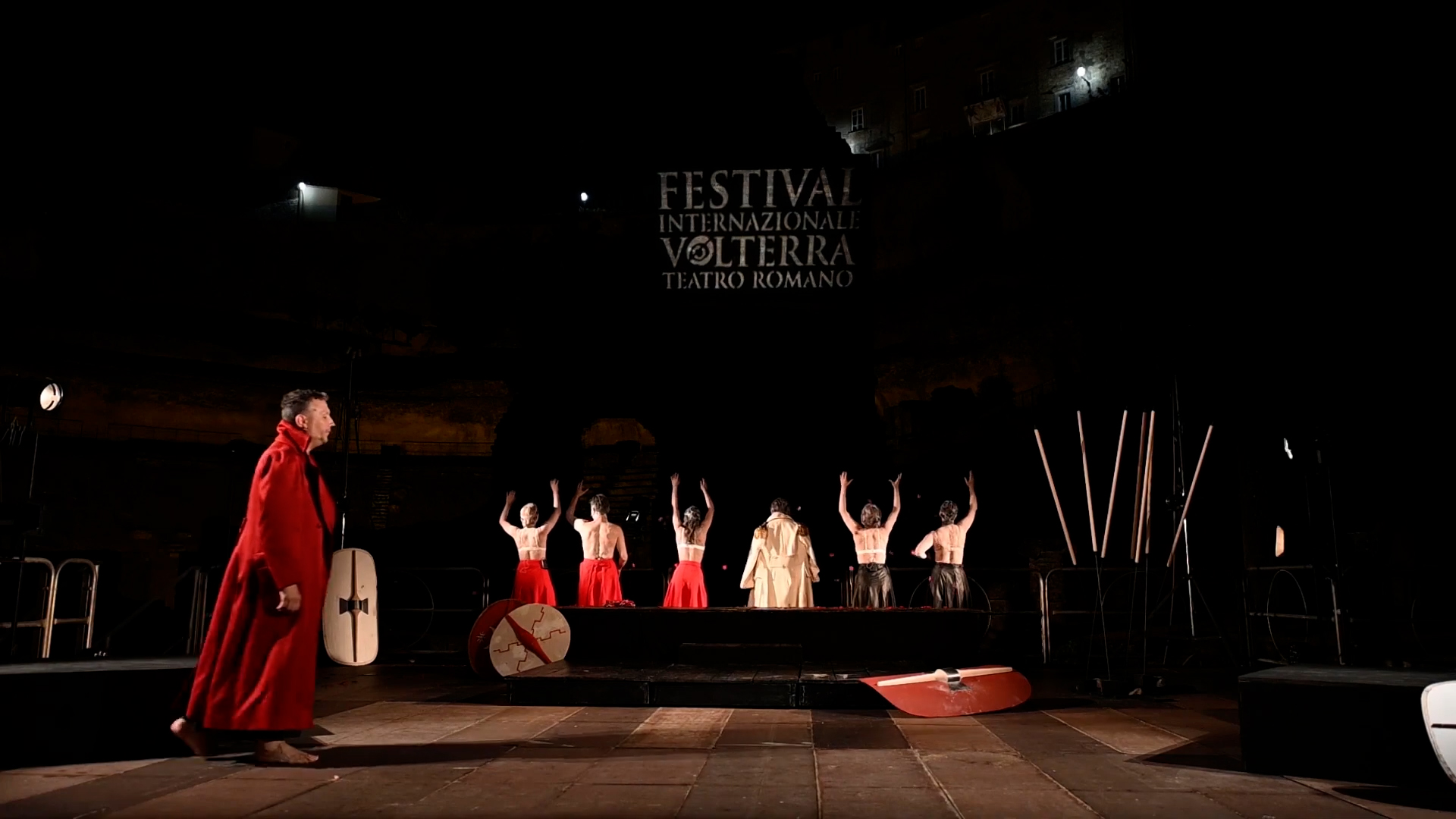
Theatrical show, by Nicola Fano e Simon Domenico Migliorini, Italy, 2022
The protagonist is Brutus, the celebrated instigator, along with Cassius, of the conspiracy of the Ides of March in 44 B.C., the assassin of Caesar. He enters the stage calling loudly for Cassius, his alter ego: we find ourselves in Philippi, where both conspirators have already fought and lost against the troops of Marcus Antonius, who has become the guarantor of justice towards Caesar and Rome. The story written in books materializes on stage with the words of Shakespeare, infinite, immortal, eternal words. The spectator listens, a symbolic battlefield and dead bodies appear before him, on which Brutus, defeated, wounded, almost dying, crawls and invokes and looks around bewildered, shocked at the appearance of the ghost of Caesar.
Brutus is Simone Migliorini, who speaks, moans, shouts, modulates those phrases of Shakespearean tragedy and makes them his own, as they have been generated, also in the adaptation from Shakespeare's "Julius Caesar" by the playwright Nicola Fano, who worked on the text focusing on the most controversial figure, that of the leader of the conspirators, the assassin of Caesar, specifically for Migliorini, who has studied and deepened the text and characters. But here Brutus, as the show unfolds, also becomes Macbeth, also Henry V, both tyrants, both assassins, soldiers, courageous or cowardly, great or infamous, in a flow of words and famous phrases, spoken, planted, recited, whispered, shouted by Simone Migliorini who with this performance confirms himself as a high-level interpreter. What strikes is the protagonist's ability to transform himself, from time to time, from Brutus into other characters, even into Marcus Antonius. A change of costume is enough for him, on stage. And it is here that Brutus looks into Antony's eyes and Antony scrutinizes Brutus, doubled by the same actor in a virtuosity that is extremely congenial to him. The actor is capable of being, at the same time, the one who kills and the one who exalts the killed; the one who is prey to doubts and remorse but is proud of his love for Rome and its freedom, and the one who exalts and celebrates the slain Caesar before the people, holding his will in his hand, in the famous Oration that has always been the flagship of the greatest actors.
LANGUAGE: Italian
SUBTITLES: English, Spanish, French, German, Portuguese
War as Moral Laundering
You are standing in the throne room of a kingdom your father stole, wearing a crown hammered from usurpation, and the court is watching your hands for signs of tremor. This is the situation Henry V inherits before a single French soldier has died. Henry IV seized the English crown in 1399 by deposing Richard II, a man who was subsequently murdered — the exact circumstances suppressed with the kind of institutional discretion that empires have always extended to convenient deaths. The son steps into the father’s stain not as an accessory but as the living architecture of its continuation, and every decision he makes occurs within that inherited guilt.
What war offers — and what no domestic policy can replicate — is the alchemical promise of transformation through collective violence. Shakespeare understands this mechanism with uncomfortable precision. Henry’s bishops open the play by spending nearly a hundred lines constructing a theological and legal case for the French campaign, a performance of justification so elaborate that it announces its own anxiety. When legitimacy is genuinely secure, it does not require this volume of argument. The Salic law debate in Act One, Scene Two, is not legal scholarship — it is the sound of a man persuading himself that what he is about to do was already required of him.
The historical Agincourt of October 25, 1415, produced a military outcome so disproportionate that contemporaries reached immediately for the supernatural to explain it. French casualties are estimated by most historians at somewhere between five and six thousand men killed, including a significant portion of the aristocratic leadership who had insisted on fighting in full armor on rain-softened ground. English dead numbered fewer than five hundred, possibly considerably fewer, depending on the chronicle consulted. These figures entered European memory not merely as a battle outcome but as a kind of cosmic verdict — the numbers themselves seemed to argue that God had weighed the competing claims and rendered judgment. Henry V inherits this interpretation and wears it like a second coronation.
What the arithmetic actually reflected was a catastrophic failure of French tactical command, the lethal disadvantage of cavalry advancing through churned mud toward disciplined English longbowmen deployed on compressed terrain. Military historians from John Keegan onward have documented how the physical conditions of the battlefield — the weight of plate armor, the narrowing of the field between two woodlands, the psychological fragility of an overconfident nobility — produced the slaughter rather than any divine preference. But tactical reality and moral narrative operate on entirely separate tracks, and by 1415 Henry understood which track his dynasty needed to be on.
Shakespeare gives Henry the St. Crispin’s Day speech not as a celebration of war but as a piece of political theater performed for the benefit of men who are about to risk dying for someone else’s dynastic problem. The famous lines about brothers and gentlemen and remembered wounds — “We few, we happy few, we band of brothers” — are delivered to an army that has marched from Harfleur in deteriorating conditions, weakened by dysentery, outnumbered by estimates ranging from three to one to six to one depending on the source. The speech works because it offers the soldiers a form of imaginary equity: you may not inherit land, but you will inherit the story. Henry is not democratizing glory — he is temporarily lending it as collateral.
The deeper transaction is that Agincourt’s survivors returned to an England where the question of how the Lancastrian crown was originally obtained became, for a generation, genuinely difficult to raise in polite company. Military triumph had not resolved the moral question; it had simply rendered the question socially unspeakable. Debt does not disappear when the debtor becomes powerful enough that the creditor stops calling. It moves underground, where it accumulates interest in forms that balance sheets were never designed to measure.

The Archbishop's Calculation
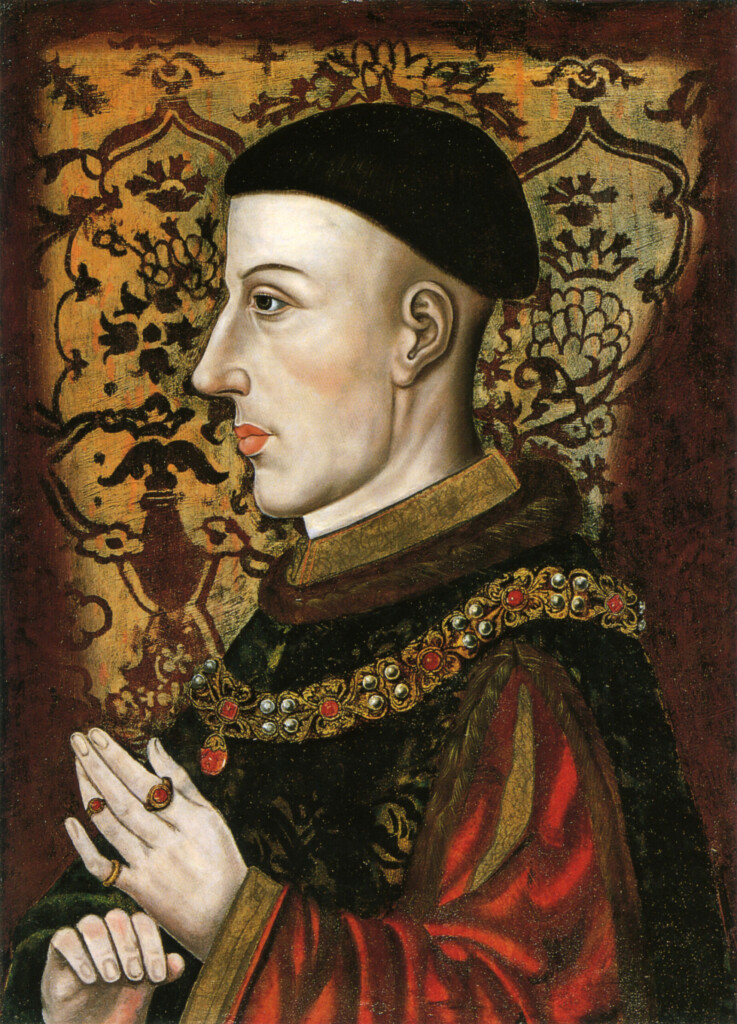
You are watching two men in robes save themselves, and they are doing it so gracefully that you almost miss it. The Archbishop of Canterbury and the Bishop of Ely open the play not with prayer but with arithmetic. Canterbury explains, with the precision of a treasury clerk, that a bill currently before Parliament would strip the Church of England of more than half its temporal possessions — lands, revenues, properties accumulated over centuries of institutional accumulation. The numbers are not metaphorical. The bill in question, first introduced under Henry IV and now revived, would redirect to the crown and to the poor what the Church had quietly absorbed since the Norman settlement. Canterbury’s solution is elegant in the way that only self-serving solutions can be when dressed in sufficient ceremony: redirect the young king’s ambition toward France, furnish him with a legal pretext so formidable that the parliamentary threat dissolves in the noise of war, and offer Church money to finance the campaign. The deal is struck before Henry V appears on stage. What follows in the public scenes is theatre designed to ratify a decision already made in private.
Michel Foucault, writing in Discipline and Punish in 1975, traced the mechanism by which power does not simply prohibit or coerce but produces knowledge — produces the very categories through which a situation is seen, named, and judged. The insight that matters here is not the famous diagram of the panopticon but the subtler argument about institutional discourse: that the most durable forms of control operate not through force but through the construction of legitimate vocabularies. Canterbury does not threaten Henry. He teaches him. He delivers a genealogical argument spanning several minutes of stage time, tracing through Salic law the legal basis for the English claim to the French throne, performing scholarship so dense that it functions as a kind of overwhelming — not persuasion but saturation. By the time Henry asks his famous question, “May I with right and conscience make this claim?”, the architecture of the answer has already been built around him. He is standing inside a structure he believes he chose to enter.
What makes this particularly precise as a portrait of institutional self-interest is that Canterbury is not lying. The Salic law argument, however contorted, draws on genuine historical precedent. Edward III’s claim through Isabella of France was real. The genealogical line Canterbury traces existed. This is exactly the point: institutional power rarely operates through fabrication. It operates through selection — choosing which truths to emphasize, which precedents to foreground, which silences to maintain. The Church says nothing about its own financial exposure. It says nothing about the parliamentary bill that has motivated this entire audience. It speaks only of history, of divine right, of English glory, of the king’s sacred obligation. Every word is technically defensible and collectively a manipulation so thorough it would be invisible if Shakespeare had not placed the private conversation before the public one.
This structural decision — showing us the backstage before the performance — is the sharpest dramaturgical move in the play’s first act, and it contaminates everything that follows. Once you have seen Canterbury and Ely calculating, you cannot unhear that calculation beneath the subsequent solemn declarations. The Archbishop’s later sermon-length justification of the war, delivered to Henry in full court, becomes something closer to a product demonstration. The theology is real. The history is real. The sincerity is entirely absent, and yet sincerity was never the point of the argument. Arguments of this kind are not designed to be sincere. They are designed to be irrefutable, because an irrefutable argument produces the same political outcome as a sincere one while costing the speaker nothing in conscience.
The Church survives the reign of Henry V. The bill never passes.
The Common Soldier's Invisible Ledger
You pull your cloak tighter and walk among men who do not know your name. They are warming their hands at a fire that will be cold before dawn, and one of them says, without looking up, that he thinks the king is just another man — afraid, probably, like the rest of them — and that if the cause is not good, the king will have a heavy reckoning to make at the last judgment for all the legs and arms and heads chopped off in battle. You are the king. You say nothing that reveals it.
That scene in the fourth act of Henry V has the quiet quality of an ambush. Shakespeare places his monarch in disguise not to humanize him in some easy populist gesture, but to expose him to a form of moral accounting he cannot legislate away. Williams, Bates, and Court are not comic figures, not relief — they are ordinary soldiers who speak the language of consequence. Williams in particular presses the question with a precision that Henry’s rhetoric cannot absorb: if the king’s cause be wrong, then every man who dies in it dies with the guilt of the king’s quarrel on his soul, and that is no small thing to answer for. Henry’s response is long, philosophical, and ultimately evasive — he shifts the burden of individual sin onto the individual soldier, arguing that the king cannot be responsible for the secret spiritual state of each man who dies in his service. It is a position with real theological grounding, drawn from the just war tradition that Henry would have inherited through church doctrine. It is also a dodge.
Paul Fussell, writing in 1975 in The Great War and Modern Memory, identified something that cuts directly backward into Shakespeare’s century: that there exists in the literature produced around war a systematic pressure to convert experience into meaning, to transfigure mass death into something that justifies the social order that produced it. The soldiers at Agincourt who lose limbs and die of dysentery and drown in mud are not transfigured. Williams does not speak in verse. His speech has the flat grammatical texture of someone who has thought about something practical for a long time and arrived at a conclusion nobody around him wants to hear aloud.
What Shakespeare does here, and what is so difficult to reconcile with the play’s rousing surfaces, is that he gives Williams the argument and Henry the crown. The king wins the debate rhetorically but only by exercising a power the debate itself was questioning. When Henry later reveals himself and Williams tries to press the glove quarrel — the small token of their nighttime dispute — Henry gifts him a glove filled with crowns and calls it settled. Money ends the argument. The shilling, not the logic, is what closes Williams’s mouth. That is not a triumphant scene if you follow it carefully; it is a demonstration of how power forecloses dissent without ever refuting it.
The exchange matters beyond this play because Shakespeare was writing in 1599 into a culture that had no language of soldiers’ trauma, no formal category for what we now clinically call the psychological cost of combat, and yet Williams articulates something close to it — a dread not of death itself but of meaningless death, of dying for a king’s ambition dressed up as a kingdom’s honor. That fear has no resolution in the play. Henry moves on. The army moves on. Agincourt is won. But Williams’s question does not get answered; it gets purchased. And the distinction between those two things is exactly the kind of gap that a play can open without being obligated to close, because the theater, unlike the crown, has no power to fill it with coins.
Language as Conquest Before Combat
You are sitting in a darkened theater when the Chorus asks you to piece out imperfections with your thoughts, to supply the horses, to think the men into armies. The request sounds humble. It is not. What has just happened is that the play has conscripted your imagination before the first soldier has laced a boot, and Henry will spend the next five acts doing the same thing to every person unfortunate enough to stand within earshot of him.
The linguistic violence begins before Agincourt, before the fleet even launches. Henry’s claim to France is delivered not as naked aggression but as a genealogical argument, a sentence so long and so densely branched that its object — invasion — disappears inside its subordinate clauses. The Archbishop of Canterbury’s speech in Act One, tracing the Salic law’s alleged inapplicability across forty-three lines of knotted legal inheritance, functions precisely as rhetoric is supposed to function at its most sophisticated: it makes the conclusion feel like it arrived from the facts themselves rather than from the will of the man who commissioned the argument. Henry does not say he wants France. He says France is already his. The difference between those two sentences is the entire history of imperialism.
Benedict Anderson, writing in Imagined Communities in 1983, argued that nations are not ancient organisms but recent inventions, communities conjured into existence through shared acts of reading, and most powerfully through the standardization of vernacular languages into print. What Anderson tracked across the eighteenth and nineteenth centuries, Shakespeare dramatizes with disturbing precision two hundred years earlier: the moment when language stops being a medium of communication and becomes a territory of power. To speak a nation into existence is to make certain deaths feel like homecomings. The soldiers who die at Agincourt do not die for a king’s dynastic claim — that framing would expose the transaction too nakedly. They die for England, a word that Henry has spent the entire play charging with emotional voltage until it detonates on cue.
The French lesson between Catherine and her lady-in-waiting, wedged into Act Three like a piece of comic relief, is doing something far more unsettling than it appears. Catherine is learning the English words for hand, fingers, nails, elbow — the vocabulary of the body, the most intimate lexicon there is. She is being taught to name herself in the language of the man who is coming to own her. That scene precedes by only a few pages Henry’s actual proposal, which he delivers in broken, performatively clumsy French, presenting his linguistic incompetence as sincerity, as if a man who commands armies cannot command conjugations. The asymmetry is structural: she must learn his language to survive; he performs ignorance of hers as a form of dominance.
What makes this machinery so durable across six centuries is that it does not feel like machinery. It feels like character. Henry’s famous speech on the eve of Agincourt — the band of brothers, the feast of Crispian, the names worn into the tongue — succeeds because it converts military hierarchy into fictive kinship. Every man who survives becomes a brother, which is to say, every man who does not survive was already a member of a family he never chose. The speech does not promise victory. It promises meaning. And meaning, as anyone who has watched soldiers go willingly into catastrophic odds can confirm, is a more powerful recruitment tool than any wage or coercion.
The English language itself becomes the prize by the final act, the thing that will survive regardless of who dies carrying it forward. Henry’s English expands to absorb French territory, French Catherine, French legitimacy — not through the sword alone but through the sentence that preceded the sword and told everyone what the sword was for.
A vision curated by a filmmaker, not an algorithm
In this video I explain our vision
The Execution of Bardolph and the Limits of Loyalty

You are standing in a field outside Harfleur, and a man you once drank with — a man who laughed at your jokes, who covered for you, who was loyal in the only language the poor know how to speak — is being hanged for stealing a pyx from a church. You do not intervene. You do not look away out of grief. You look away because the optics of mercy would cost you more than the optics of justice.
The execution of Bardolph is the play’s cruelest scene not because it is brutal but because Henry makes it clean. He announces it in the flattest possible syntax: he has heard there is a soldier to be executed for pillaging, and the order stands. No hesitation, no private aside to the audience, no moment where the mask slips. Shakespeare gives Henry nothing that would allow us to read him as secretly tortured. The torture, if it exists at all, has already been performed — on himself, years before this moment, in the long interior surgery required to become the kind of man who could give that order without flinching. The executions at Agincourt do not represent a moral failure. They represent a moral completion.
Niccolò Machiavelli, writing in The Prince roughly a century before this play was performed at the Globe, described the prince’s core problem as one of reputation management rather than virtue. A ruler who appears merciful will be loved, but a ruler who is merciful will be destroyed. The crucial move — and the one that defines Henry — is the distinction between appearing to feel and actually feeling. Machiavelli was not advocating cruelty; he was describing the structural demand that power places on whoever holds it. Henry V is, among other things, a dramatic proof of this theorem. And what makes it devastating rather than merely instructive is that Shakespeare shows us the cost paid not by the state but by the individual human being who consumes himself to become its instrument.
The sentimental reading of the Hal-to-Henry arc asks us to believe in moral maturation — the prodigal son who wasted his youth and then rose, chastened and serious, to greatness. That reading requires us to treat Bardolph’s death as a sign of Henry’s new seriousness, his rejection of the chaotic, lawless world of the Boar’s Head. But this is precisely the lie the play refuses to fully tell. Hal’s time among Falstaff and Bardolph and Pistol was not a moral failure he needed to correct. It was his education in the actual texture of human beings — their need, their humor, their fragility, the specific way they construct dignity out of nothing. The execution of Bardolph does not demonstrate that Henry has grown beyond that world. It demonstrates that he has weaponized his knowledge of it. He knows exactly what Bardolph is worth as a human being, and that knowledge makes him more dangerous, not less, because he can set it aside with full awareness of what he is setting aside.
Sociologist Erving Goffman, in The Presentation of Self in Everyday Life, published in 1959, argued that all social interaction is performance — that we manage impressions, play roles, suppress what does not serve the scene we are staging. But Goffman was describing ordinary human sociality. What Henry enacts is something structurally different: not the suppression of an authentic self for social convenience, but the deliberate destruction of the conditions that would allow an authentic self to exist at all. By the time he hangs Bardolph, there is no private Henry who secretly grieves. The private Henry was the first casualty of the crown, and nobody mourned him, because the whole architecture of monarchical mythology depends on the story that the crown creates a man rather than destroys one.
Feminist Erasure in the Marriage Scene
You are watching a man learn how to want something he has already taken. Henry stands before Katherine in Act 5, his armies resting on French soil they will never leave, and performs the grammar of courtship with the fluency of a conqueror who understands that the final signature on a treaty must look like a kiss. He stumbles through French. He calls himself a plain soldier. He asks, with the confidence of someone who has never been refused anything that mattered, whether she could love him. The scene has been read for centuries as charming, as the warrior king made tender by a woman’s presence. What it actually is takes longer to see.
Joan Kelly-Gadol, writing in 1977 in her essay “Did Women Have a Renaissance?”, asked a question so obvious it had somehow never been formally posed: did the cultural and political transformations celebrated as liberation for European men correspond to any equivalent expansion of freedom for women? Her answer, constructed from careful examination of Castiglione’s Courtier, from property records, from the narrowing of women’s roles in civic and guild life between the twelfth and seventeenth centuries, was unambiguous. The Renaissance, as periodized and glorified, was not a renaissance for women. It was, in many respects, a regression — a tightening of the boundaries around female autonomy dressed in the aesthetic vocabulary of flourishing. The courtly love tradition that had given noblewomen at least a nominal position of erotic authority was replaced by a new ideal: the chaste, silent, domestically confined woman who embodied male virtue by reflecting it. Kelly-Gadol’s insight was not merely historical. It was structural. The moments that look most like progress in the cultural record often mark the consolidation of a different kind of enclosure.
Katherine’s English lesson in Act 3, long before Henry ever speaks to her, is where the real choreography of the final scene begins. She rehearses the words of the body — hand, fingers, nails, arm, elbow — with her lady Alice, and when she reaches the words that sound, in English, like French obscenities, she laughs and refuses to say them publicly. Critics have called this scene comic, a moment of feminine lightness in a play thick with military weight. But what Katherine is actually doing in that scene is attempting to inhabit a language she knows will be used to possess her. She is learning the vocabulary of her own annexation. By the time Henry woos her in Act 5, her linguistic disorientation is not incidental to the scene’s meaning — it is the scene’s meaning. She cannot fully consent in English because she does not fully possess English. She cannot fully refuse in French because France, politically, no longer fully exists as a space of refusal.
Henry’s declaration that he speaks no French and she speaks no English, delivered as though this is an endearing symmetry between equals, conceals the radical asymmetry beneath it. He is the one whose language is expanding across the continent. Her linguistic confusion is not a shared condition but a preview of absorption. The treaty being signed at Troyes in May 1420 — the historical document that underwrites every word of this scene — transferred the French crown to Henry’s heirs, required Charles VI to disinherit his own son, and made Katherine’s body the biological instrument of dynastic transfer. Shakespeare does not hide this. He places the political terms of the treaty in the mouth of the Duke of Burgundy in the same act, pages before the wooing begins, so that an attentive audience cannot pretend they do not know what Henry’s courtship is for.
What the play refuses to give Katherine is any interiority that survives contact with Henry’s will. She asks questions. She deflects. She says it is not the fashion for maids to kiss before they are married. But her resistance has no ground beneath it, no political or linguistic territory from which it could actually hold.
The Chorus as the State's Own Apologist
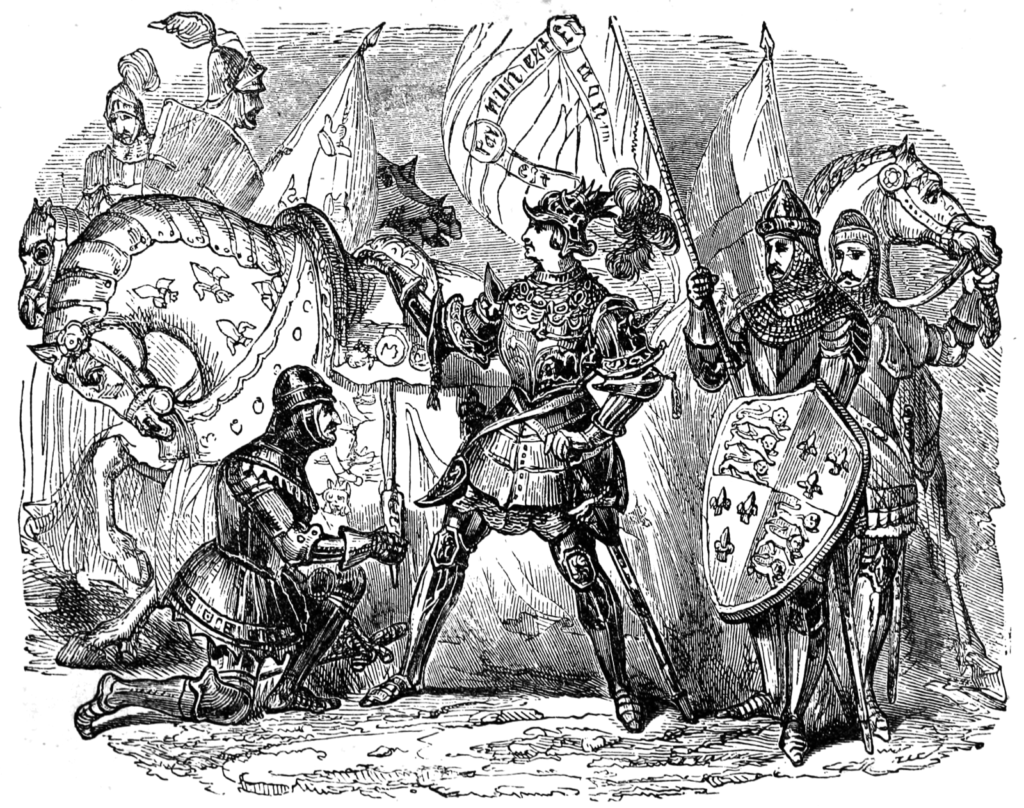
You are watching a man apologize for what you are about to see before you have even seen it. He stands at the edge of the stage, gestures toward the bare wooden planks behind him, and tells you, with elaborate rhetorical humility, that none of this is sufficient. The armies are too small. The horses are imaginary. The ocean crossing that defined a generation has been compressed into minutes. He begs your indulgence and invites your imagination to fill the gaps that the theater cannot. It is a disarming gesture, seemingly modest, seemingly honest — and it is one of the most sophisticated acts of ideological manipulation in the English literary tradition.
The Chorus in Henry V does not merely frame the play. It performs a specific cultural function that Roland Barthes identified with surgical precision in Mythologies, published in 1957, when he described how myth operates not by lying but by naturalizing. Myth, Barthes argued, takes history — contingent, constructed, violently assembled — and transforms it into nature, into the given, into what simply is. The Chorus enacts this transformation live, in real time, in front of an audience that applauds the very mechanism being used to shape their perception. When the Chorus calls Henry a “warlike Harry” and implores the audience to imagine him “like himself” — striding across the fields of France with divine purpose — it is not describing a king. It is manufacturing one, and then handing the audience the tools to complete the manufacture themselves, making them complicit, making them co-authors of the myth they will subsequently believe.
What makes this structurally remarkable is the confession embedded in the machinery. Every apology for the stage’s inadequacy is also an admission that the real events require something more than reality to be properly felt. The Chorus says: what actually happened was so magnificent that no representation can contain it. But read that sentence from the other direction and it says something far more uncomfortable: the actual events, stripped of rhetorical amplification, might not produce the emotion being demanded of you. Epic propaganda has always contained this structural secret. The Aeneid’s first line — “arma virumque cano,” I sing of arms and the man — announces not a chronicle but a performance, not documentation but confected glory. Virgil was writing in 19 BCE under Augustus, commissioned, however indirectly, by the very imperial project his poem was meant to glorify. The form announces its own insufficiency precisely to forestall the question of whether the content deserves its frame.
There is a particular psychology operating in audiences that accept this framing willingly. The sociologist Erving Goffman, in Frame Analysis published in 1974, described how human beings actively participate in the construction of the social reality they then experience as objective. The Chorus exploits this. By asking the audience to imagine, to supplement, to elevate the meager stage into something worthy of the events, it recruits their imaginative labor into the service of the play’s politics. You have worked to make Henry magnificent. You have supplied the horses he does not have. You have built the fleet out of nothing. The investment of imagination creates emotional ownership, and emotional ownership forecloses critical distance.
Every culture that has ever needed its citizens to believe in a founding violence — a necessary war, a providential conquest, a king whose will is indistinguishable from God’s — has required exactly this: a narrator who stands at the edge of the spectacle, gestures at its inadequacy, and then asks you to make it real inside your own mind. Shakespeare did not invent this mechanism. He staged it so completely and with such structural transparency that the play becomes, among other things, an anatomy of how nations teach their citizens to feel proud of what should make them grieve.
⚔️ Power, Leadership, and the Weight of the Crown
Shakespeare’s Henry V raises timeless questions about political power, moral responsibility, and the cost of leadership. These themes echo across literature, philosophy, and history, revealing how rulers justify war, manipulate public opinion, and construct their own legitimacy. The following articles trace the same labyrinth of power through different centuries and minds.
Shakespeare’s Richard III: Meaning and Analysis
Shakespeare’s Richard III is the dark mirror to Henry V, offering a portrait of a ruler who seizes power through deception, manipulation, and ruthless ambition. Where Henry frames conquest as a moral and patriotic duty, Richard strips away all pretense and reveals the naked will to dominate. Reading both plays together illuminates Shakespeare’s complex and unflinching vision of political power.
GO TO THE SELECTION: Shakespeare’s Richard III: Meaning and Analysis
Machiavelli’s The Prince: Meaning and Analysis
Machiavelli's The Prince is perhaps the most famous political text ever written, and it shares with Henry V a cold-eyed examination of how rulers must balance virtue with necessity. Machiavelli argues that a prince must know when to be a lion and when to be a fox, a tension Shakespeare dramatizes brilliantly through Henry’s contradictory public and private selves. Together, these works form a foundational dialogue on the ethics and pragmatics of political leadership.
GO TO THE SELECTION: Machiavelli’s The Prince: Meaning and Analysis
Banal Evil and Radical Evil: Kant and Arendt
Hannah Arendt‘s distinction between banal evil and radical evil offers a powerful philosophical lens through which to reread Henry V’s famous speeches before Agincourt. Arendt shows how ordinary men commit extraordinary violence when they stop thinking critically about the orders they follow and the ideologies they serve. Henry’s charismatic rhetoric, which inspires soldiers to die for a king’s ambition, raises uncomfortable questions about complicity and moral blindness.
GO TO THE SELECTION: Banal Evil and Radical Evil: Kant and Arendt
Betrayal as a Theme in World Literature
Betrayal is one of the central dramatic engines of Henry V, from the Cambridge conspiracy to Henry’s rejection of Falstaff’s world and all it represented. This article explores how betrayal functions as a universal theme in world literature, revealing the fragile bonds of loyalty that hold communities, friendships, and nations together. Understanding betrayal as a literary and human phenomenon deepens our appreciation of the moral ambiguities Shakespeare weaves throughout the play.
GO TO THE SELECTION: Betrayal as a Theme in World Literature
Discover the Cinema of Power and Conscience on Indiecinema
If Shakespeare’s exploration of leadership, war, and moral complexity has moved you, Indiecinema’s streaming catalog offers a rich selection of independent and auteur films that grapple with the same urgent questions. From political thrillers to intimate dramas of conscience, you will find films that challenge, provoke, and illuminate the human condition. Join us on Indiecinema and let independent cinema be your guide through the labyrinth.
👉 EXPLORE THE CATALOG: Watch Indie Films in Streaming
A vision curated by a filmmaker, not an algorithm
In this video I explain our vision

