
The Postcard as Erasure
You arrive with the best intentions. The guidebook is folded in your jacket pocket, the hotel was chosen for its proximity to everything, and you step out onto cobblestones that have been pressure-washed to a cinematic cleanliness that real cobblestones never quite achieve. A fiddle is playing somewhere — you can hear it before you can see the source — and when you round the corner into Temple Bar the sound resolves into a pub window, warm amber light spilling out, a sign for Guinness that has been distressed to look old in exactly the way that old things never look old. You order a pint because the ritual demands it. You photograph the pint because the ritual demands that too. And somewhere in the gap between lifting the glass and lowering it, Dublin has already happened to you — a controlled, pre-assembled Dublin that you walked into like a stage set, never realizing the performance had begun before you crossed the threshold.

Tourism infrastructure does not open a city. It replaces one. This is not a cynical observation about commerce — it is a structural fact about how cities under sustained tourist pressure reorganize themselves around the image they are expected to produce. The geographer David Harvey, writing on urban capital and spatial transformation in his 1989 work “The Urban Experience,” described how cities increasingly manufacture what he called “spectacle environments” — zones designed not for habitation but for consumption, where the physical space becomes indistinguishable from its own promotional material. Temple Bar is a near-perfect specimen of this phenomenon: the district was not accidentally charming but was deliberately curated through the 1990s Cultural Quarter initiative, a government-backed regeneration project that spent over 40 million pounds Irish transforming a derelict area into what planners explicitly called a “cultural tourism product.” The cobblestones are real. The intention behind their preservation is branding.
What the tourist consumes in these environments is not a culture but a culture’s self-caricature — the distilled residue of identity markers that survive the translation into legibility for outsiders. The Irish writer Fintan O’Toole, in his 1994 collection “Black Hole, Green Card,” identified this dynamic with particular sharpness, arguing that Irishness as an exported commodity had become a kind of performance of loss, a staged authenticity built precisely on the imagery of poverty, tradition, and rural simplicity that modernizing Ireland was simultaneously abandoning. The fiddle music you hear in Temple Bar arrives without its history of suppression, without the Penal Laws that drove Irish culture underground, without the decades when speaking Irish publicly was a political act. It arrives scrubbed clean of its own conditions of survival, packaged as warmth rather than resistance.
The deeper mechanism is one of displacement, not decoration. When a neighborhood becomes a tourist zone, its prior inhabitants — the people who animated its actual culture — are not preserved within the frame. They are gradually pressed outward by rising rents, replaced by businesses that serve visitors rather than residents, until the neighborhood exists almost entirely as a service environment for people who are passing through. A 2019 report by Dublin City Council documented that the number of residential properties in the city center converted to short-term tourist lettings had increased by over 300 percent in the preceding four years, accelerating a hollowing process that left the streets populated during the day and functionally uninhabited at night by anyone who actually lived there. The city becomes a theater with no permanent cast.
What you cannot photograph in Temple Bar is the city that was displaced to produce it. The families that lived where the tourist bars now stand. The informal economies. The working-class texture of a port district that smelled of the Liffey and not of heritage. These are not romantic losses — they are structural ones, and their absence from the postcard is not an oversight but the entire point.
Urban Traffik
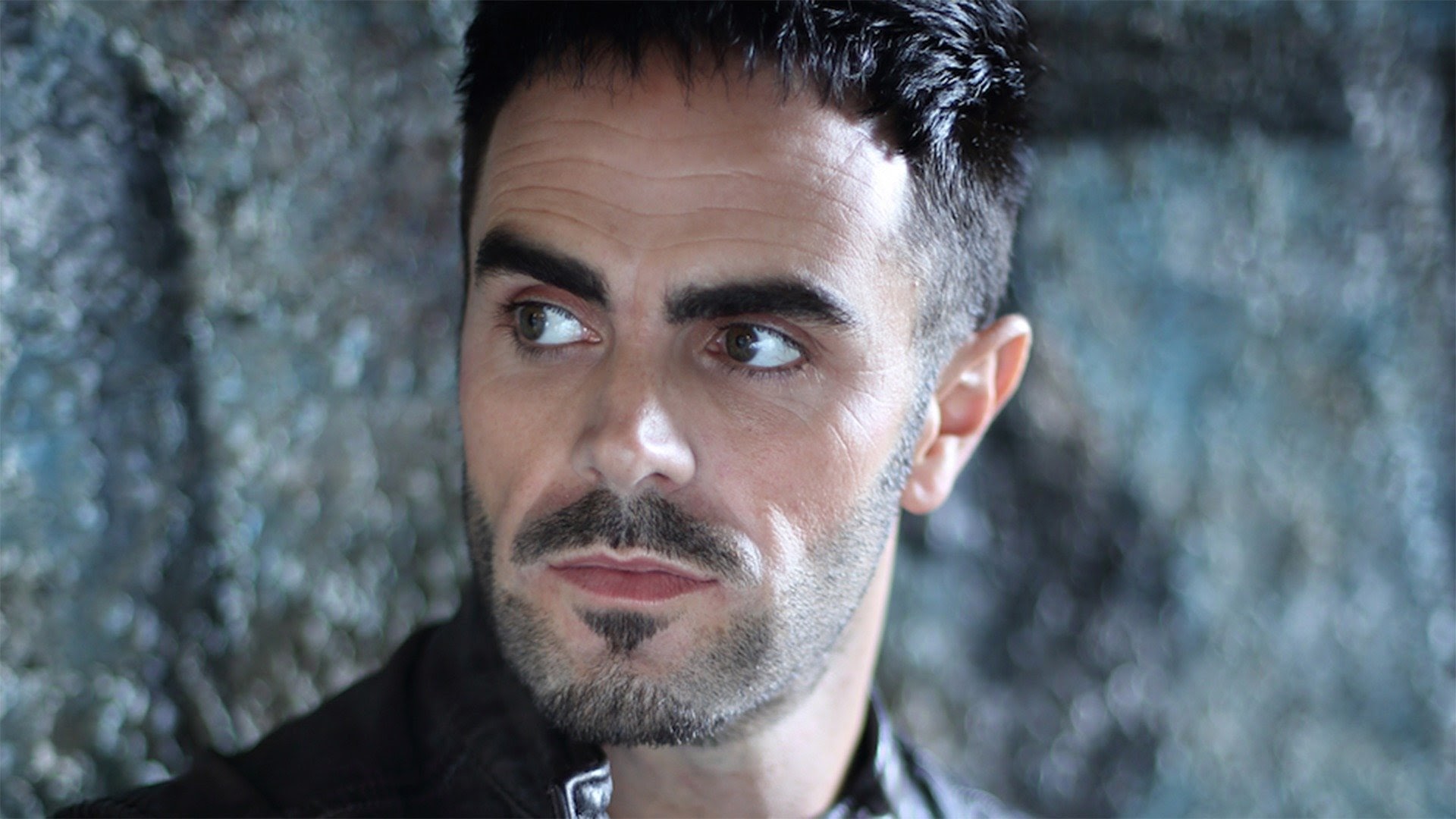
Thriller, by Jason Figgis, United States, 2017.
In the heart of a dark and hidden Dublin, Adam appears to be a kind-hearted man when he offers shelter to Sue, a lonely and vulnerable young woman who has just arrived in the city. The reality, however, is far more tragic: Adam serves as bait for a ruthless human trafficking ring led by the cold and calculating Dan and managed by his partner, Alex. Their chilling scheme is simple: lure defenseless young women and sell them into the international sex trade. But this seemingly perfect criminal enterprise is about to unravel. As disturbing family secrets linking Dan to Adam's sister come to light, and Adam desperately tries to break free from a brutal world he can no longer endure, the lives of everyone involved spiral into uncontrollable violence.
Directed by acclaimed independent filmmaker Jason Figgis, Urban Traffik leaves horror behind to embrace the raw, tense, and hyper-realistic territory of urban crime drama, recalling the visceral intensity of British cult films such as London to Brighton. The film's greatest strength lies in its outstanding performances: thanks to its razor-sharp screenplay, the cast succeeds in making viewers empathize even with its darkest and most morally ambiguous characters. Visually, the film is a noir gem. Alan Rogers' striking cinematography captures Dublin's hidden and ghostly side, transforming neglected alleyways and bare interiors into landscapes of palpable despair. Avoiding easy moralizing, Urban Traffik offers a hypnotic, intimate, and uncompromising look at the inner workings of organized crime.
LANGUAGE: English
SUBTITLES: Spanish, French, German, Portuguese
The Archaeology of Forgetting
You walk past a gap in the streetscape on Gardiner Street and your eye registers nothing — just a car park, a patch of tarmac interrupted by weeds pushing through the joints, the kind of urban wound so common it has become invisible through repetition. What your eye does not register is the grammar of erasure that produced it, the deliberate sequence of decisions that transformed a living building into an absence so normalized that absence itself stopped feeling like loss.
Dublin’s Georgian terraces were not simply left to decay. By 1914, the city’s tenement districts — concentrated along the north inner city’s once-elegant streets — housed approximately 87,000 people in conditions that a 1913 housing inquiry described as among the worst in Europe, with families of seven and eight occupying single rooms in buildings designed a century earlier for Protestant merchant aristocracy. The paradox was architectural and ideological simultaneously: the very grandeur of Georgian Dublin was the grandeur of the Ascendancy, of English colonial settlement at its most confident and formal, and so the buildings that housed the poorest Catholic poor were also the buildings that most visibly embodied Protestant Anglo-Irish dominance. When independent Ireland began demolishing them across the middle decades of the twentieth century, it performed two acts at once — slum clearance and a kind of retroactive revenge against a built heritage that felt borrowed, imposed, not quite belonging to the nation that had survived into sovereignty.
Roy Foster, in his 1988 work Modern Ireland: 1600-1972, traced with uncomfortable precision the way Irish nationalist memory required selective construction rather than wholesale recovery. The past that independent Ireland chose to inhabit was Gaelic, rural, Catholic, and ancient — a past located in the West, in the Irish language, in the landscape of Connaught rather than in the Georgian brick of Dublin 1. This meant that the city’s most architecturally significant inheritance was also its most ideologically inconvenient one. The Dublin Corporation’s successive slum clearance programs from the 1930s onward operated within this framework, and the demolitions they licensed were not merely practical responses to housing crises but choices about which layers of the city deserved to persist into the future.
What replaced the tenements was, in many cases, nothing at all for years — and then eventually the functionalist housing blocks of Ballymun, completed in the late 1960s, seven towers named after 1916 leaders rising from a site eight kilometers north of the city center, placing the poor at a careful distance from the civic imagination. The naming was the most honest thing about the project: it admitted that national mythology and social abandonment could occupy the same architectural gesture without contradiction. The towers were demolished between 2004 and 2015, a lifespan of roughly forty years, shorter than many of the Georgian structures they were built to replace in the symbolic economy of Irish progress.
What makes this archaeology genuinely difficult is that the forgetting was not cynical in the way that individual deception is cynical. The planners, the politicians, the priests who blessed the new estates believed they were building modernity for people who had been denied it. The violence of the erasure was encoded in good intentions, in the honest conviction that the past — the Georgian past, the colonial past, the tenement past — was a wound rather than an inheritance. Sigmund Freud‘s distinction between mourning and melancholia, articulated in his 1917 essay, describes two responses to loss: mourning processes the object until it can be released; melancholia incorporates the lost object into the self so completely that the self no longer recognizes it as foreign. A city that demolishes its own history does not mourn the loss — it metabolizes it, until the absence becomes structural, until the gap on Gardiner Street registers as ordinary ground rather than as the outline of something that once held human weight, human noise, human rooms stacked with people who left no monument except the negative space where their walls used to be.

What the Liffey Knows
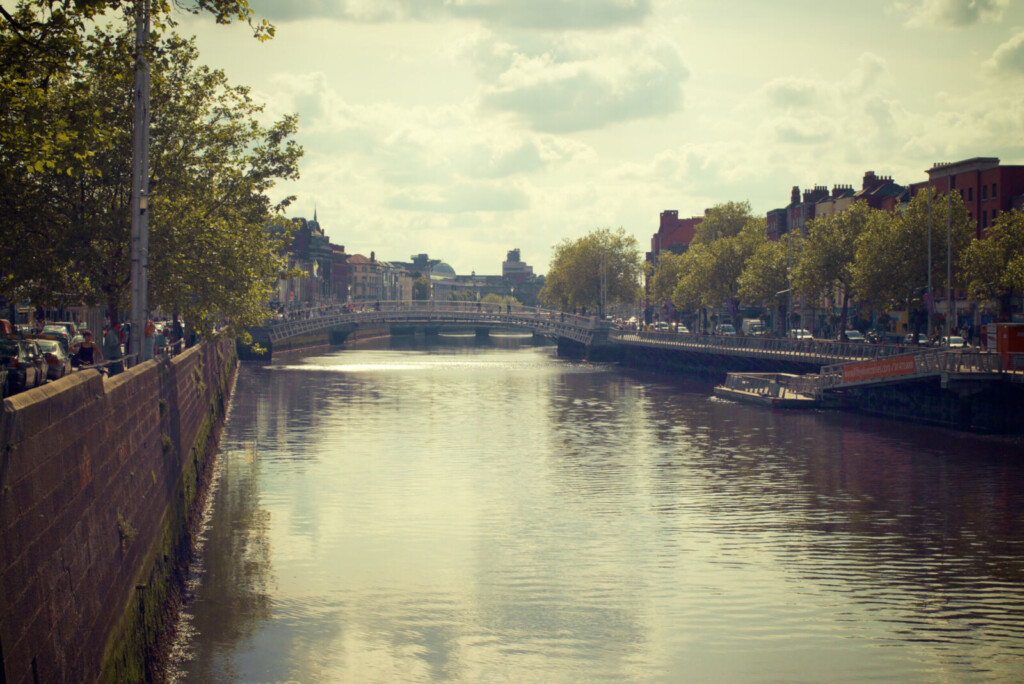
You cross the Liffey on O’Connell Bridge and something shifts that you cannot name at first. It is not the architecture, not the light, not even the smell of the river below, brown and indifferent as history. It is the way people read you before you open your mouth, and then, once you do, the way they finish the calculation they already started.
The river is not a geographic accident. It is a verdict delivered in 1922 and never appealed. When the Irish Free State consolidated itself after partition, the energies of respectability and investment did not distribute evenly across the capital they had inherited. The southside accumulated them. Ballsbridge, Donnybrook, Rathgar — these became the addresses where the new Catholic professional class performed its arrival into consequence, and the northside, already carrying the wounds of the 1916 Rising’s aftermath and the tenement catastrophes documented in reports as early as 1914, became the remainder. The city divided itself along a river the way the island had divided itself along a border, and both divisions were sold to the people living within them as natural, inevitable, merely geographical.
Pierre Bourdieu, writing in Distinction in 1979, argued that taste is not a personal preference but a social weapon — that the way you speak, the music you allow yourself to enjoy, the posture your body assumes in a restaurant, are all encoded evidence of where capital has flowed through your life and where it has been withheld. What he called habitus is precisely the mechanism the Liffey enforces. The northside accent, flattened vowels and clipped consonants, does not signal geography in the mind of the southside interviewer — it signals an entire archive of presumed deficiency, inherited passivity, educational underperformance. The accent arrives before the sentence is finished and the sentence is then judged through what the accent has already deposited.
This is not anecdote. A 2019 study from University College Dublin’s School of Sociology demonstrated that identical CVs submitted with northside versus southside postal codes received statistically different callback rates from employers located in the city’s commercial districts, most of which cluster south of the river. The CV did not change. The name did not change. The postcode changed, and the postcode spoke in an accent the employer had never consciously decided to hear.
What makes Dublin’s topology particularly resistant to examination is that it has been absorbed into comedy. The northside-southside divide is the subject of sketch shows, novelty mugs, pub arguments held with affectionate venom. This comedic frame is not innocent. Humor is the container Irish culture historically constructed for truths it could not afford to examine politically — a tradition that predates the state itself, rooted in centuries of navigating what could and could not be said in proximity to power. When the geography of inequality becomes a punchline, it stops being a policy failure and starts being a personality. The city’s structural wound becomes its most marketable quirk.
James Joyce understood the Liffey as a character before urban sociologists had the language to describe what it represented. In Ulysses, published in 1922 — the same year the Free State exhaled into existence — the river runs through the text not as backdrop but as circulatory system, carrying the city’s debris and its intimacies in equal measure. Leopold Bloom walks a Dublin that is already divided by invisible coordinates of class and religion, and the walk itself is the argument: that the city does not contain its inhabitants so much as it produces them, shapes the perimeter of what they can imagine wanting. To walk a certain street in 1904 was to wear a probability on your back about what your life would cost and what it would be permitted to mean.
The postcards do not show the river as verdict. They show it at golden hour, flattering and still, with the Ha’penny Bridge arching above it like a promise that both banks are equally beloved.
Cathnafola - A Paranormal Investigation
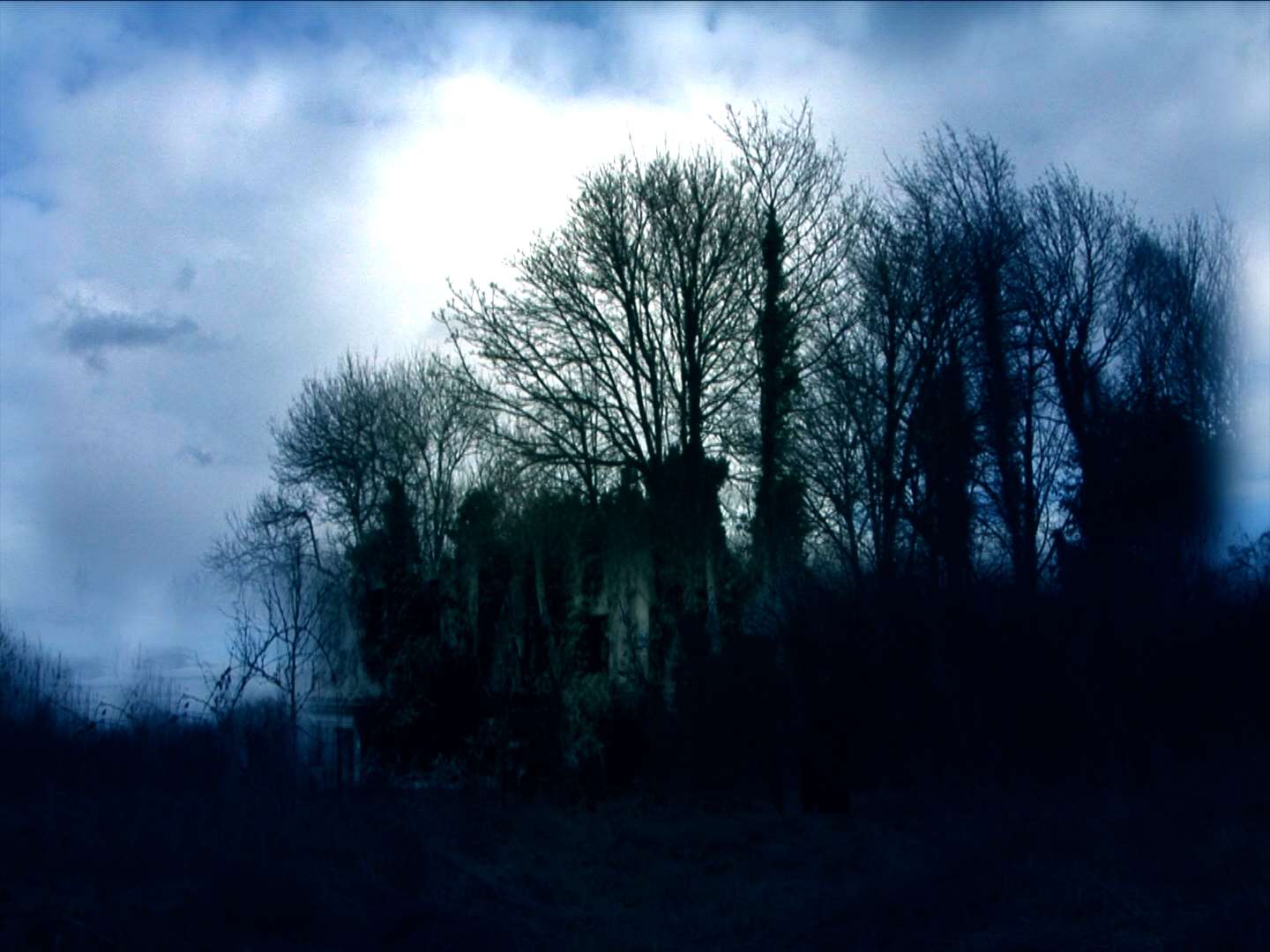
Documentary, horror, by Jason Figgis, USA, 2014.
In "Cathnafola", everything begins when renowned paranormal investigator Chris Halton of Haunted Earth UK receives footage filmed by three teenagers at the ruins of Cathnafola House in Ireland. Determined to unearth the truth behind the location’s bloody past, Halton embarks on a nighttime exploration of the infamous ruins—and soon uncovers terrifying and disturbing revelations.
LANGUAGE: English
SUBTITLES: Spanish, French, German, Portuguese
The Literature That Imprisons
You have walked into a bookshop on Dawson Street and watched a tourist hold up a copy of Ulysses with the reverence normally reserved for relics, and you have noticed, without quite naming it, that the person behind the counter looked briefly like someone who had been told their house is a museum.
There is a particular violence in being made mythological while still alive. James Joyce published Ulysses in 1922, and the city he mapped with such surgical precision was the Dublin of June 16, 1904 — a city of tram routes, specific pubs, the particular smell of the Liffey at low tide, a social architecture built on British colonial administration and Catholic guilt operating in close, suffocating proximity. That city no longer exists in any material sense. The tenements are gone, the empire is gone, the trams have been rebuilt from scratch, and the Catholic Church has undergone a moral collapse so total that its authority now registers as historical rather than ambient. And yet the literary coordinates of 1904 remain the dominant navigational system through which Dublin is understood, marketed, and ultimately flattened into something consumable. Bloomsday is celebrated annually on June 16th, with thousands of people in Edwardian dress retracing steps through a city that has been rebuilt around them, performing a kind of temporal cosplay that treats living geography as sacred ground for a dead man’s fiction.
The canonization of a writer does not merely honor them. It arrests the culture around the moment of their greatest work and demands that everything subsequent measure itself against that arrested moment. Samuel Beckett, writing from Paris in the 1950s with Molloy and Waiting for Godot, was already fleeing exactly this — the suffocating gravitational pull of an Irish literary identity that required suffering, landscape, and a particular relationship to silence to be considered authentic. Beckett refused the postcard. He stripped his prose down to pure negation, and the international critical establishment rewarded him with a Nobel Prize in 1969, which was then promptly used to claim him back as Irish, to press him into the same amber he had spent his entire career refusing. The escape becomes part of the trap.
Seamus Deane understood this with a clarity that feels almost unbearable. Reading in the Dark, published in 1996, is not primarily about politics or history — it is about what happens to a person when the stories told about them, by their family, their community, their national tradition, precede them so completely that their actual experience can never quite catch up to the narrative already waiting. The boy at the center of that novel inherits a version of the past that he did not choose and cannot verify, and the inheritance functions not as gift but as slow suffocation. The violence Deane identifies is not the violence of bombs or borders. It is the violence of a story so fully formed that reality must deform itself to fit inside it.
This is what Dublin’s literary canonization actually does to Dublin. It does not celebrate the city. It prescribes it. A writer publishing fiction set in contemporary Dublin who does not engage with the Joycean inheritance is considered somehow provincial, unserious, lacking in cultural self-awareness. A writer who engages with it too directly is accused of being derivative. The inheritance is inescapable and impossible, a double bind constructed entirely from reverence. Roddy Doyle recognized this when he set his Barrytown trilogy not in the Georgian south side but in the working-class north, in a Dublin that Joyce’s cartography had largely treated as peripheral — and the critical establishment’s initial resistance was not merely aesthetic. It was territorial. Someone had walked onto the museum floor and started rearranging the furniture.
The question no one in the bookshop on Dawson Street ever seems to ask is what it costs the person behind the counter to smile at the relic every single day.
The Celtic Tiger's Ghost Limb
You see him most clearly on a Tuesday, around half ten in the morning, standing on a pavement that cost more per square meter to lay than a teacher’s monthly salary. He is wearing a jacket that still fits well, shoes that still hold a polish, and he is looking at a building he once walked into with the kind of confidence that felt, at the time, like a natural law. The glass façade reflects the Liffey sky back at him, grey and noncommittal. Half the floors are dark.
The Celtic Tiger was not merely an economic event. It was an identity technology — a machine for producing a new kind of Irish selfhood that had no precedent in the culture’s own grammar. For centuries, the available story had been one of departure, scarcity, and the particular dignity that comes from surviving both. What arrived between roughly 1995 and 2007 was a counter-narrative so violent in its reversal that it required people to become different people almost overnight. GDP growth averaging nine percent annually through the late 1990s, property prices in Dublin tripling within a decade, cranes so dense over the Docklands skyline that locals joked the crane had become the national bird. The man outside the glass building did not merely earn money during those years. He metabolized the boom as proof of something about himself.
David Harvey, in The Limits to Capital and later in A Brief History of Neoliberalism, describes what he calls the spatial fix — the tendency of capital, when it encounters falling returns in one arena, to displace its contradictions into the built environment, into property, into the fabrication of new urban landscapes that absorb surplus investment and defer crisis rather than resolve it. What Dublin’s Docklands became through the 1990s and early 2000s was an almost textbook enactment of this mechanism: a former industrial wasteland remade into glass towers, corporate headquarters, luxury apartments, all financed not by productive surplus but by debt that was itself secured against the rising value of the very buildings being constructed. The circularity was not hidden. It was celebrated.
When the architecture finally confessed its arithmetic, it did so at a scale that the Irish state could not absorb alone. The 2010 bailout — €85 billion, administered jointly by the IMF, the European Central Bank, and the European Commission — was the moment the borrowed future presented its invoice. But the more precise wound was not fiscal. It was ontological. A generation had structured its sense of adult competence, its self-respect, its understanding of what Ireland was becoming, around prosperity that turned out to be a form of collective forward borrowing against an asset bubble with no productive foundation beneath it. When Harvey writes that capital accumulation through credit expansion is always a bet on the future that the future is not obligated to honor, he is describing a financial mechanism, but he is also, without intending it, describing what happens to the person who bet his identity on the same terms.
Phantom limb syndrome, as neurologists have documented it since Silas Weir Mitchell named it in 1871, involves the brain continuing to send signals to a limb that no longer exists, receiving pain from an absence. The Irish relationship to Tiger-era prosperity has exactly this structure. The infrastructure remains — the glass buildings, the cobbled squares, the IFSC corridor — but it is infrastructure built for a body of economic activity that was always partly spectral. The man in the polished shoes is not nostalgic for wealth exactly. He is in pain from a selfhood that the boom constructed and the crash amputated without anesthetic, leaving the neural pathways intact, still firing, still waiting for a response from something that is no longer there to answer.
A vision curated by a filmmaker, not an algorithm
In this video I explain our vision
Catholicism After the Church

You voted yes, and when the result came in you cried — not because you had won something abstract, but because something that had pressed on your chest since childhood had, for a moment, lifted. That is a real experience. It happened in living rooms and pub corners and hospital waiting rooms across Dublin on the evening of May 22, 2015. But the question worth sitting with, once the crying stops, is whether the weight was dismantled or simply redistributed.
Tom Inglis spent years mapping what he called the Church’s moral monopoly — the argument laid out across his 1987 work and extended into the cultural sociology that followed — showing how the Catholic Church in Ireland did not merely govern behaviour but manufactured the very interior architecture through which Irish people experienced themselves as good or bad, clean or contaminated. The confessional was not a booth; it was a technology for producing a self that required constant surveillance, constant reckoning, constant performance before an invisible but omnipresent audience. What Inglis understood, and what the celebratory readings of 2015 and 2018 have largely avoided, is that you do not dismantle an architecture of shame by changing the law. You relocate it.
The Church’s grip on Irish civic life was already fracturing long before the referenda — the Murphy Report of 2009, the Ryan Report the same year, the systematic exposure of Magdalene Laundries through the McAleese inquiry of 2013, each one a document of institutional violence so methodical it required a bureaucracy. What collapsed was institutional authority. What did not collapse was the underlying grammar of moral performance, the deep Irish habit of watching how one is seen by the community and calibrating one’s visible self accordingly. The Church had trained that reflex for over a century. It did not die because the trainer was discredited.
What emerged in the years following the referenda was a public culture in Dublin — visible in workplaces, in media, in the social architecture of online speech — organized around a different but structurally familiar demand: the performance of correct values before a collective gaze. The content changed; the logic did not. Where once the question was whether you had attended mass, the operative question became whether you had spoken correctly, positioned yourself visibly on the right side, demonstrated your virtue through the appropriate public gestures. Guilt, under the old dispensation, was produced by transgression against a divine code. Shame, under the new one, is produced by insufficient visibility of compliance. The mechanism is recognizable to anyone who ever examined their conscience before a priest and found themselves calculating not what they actually felt but what the correct answer was.
This is not an argument against repealing the Eighth Amendment or extending civil marriage. Those were genuine and necessary ruptures with specific cruelties encoded in law. But the sociological reading that frames them as evidence of a secular, liberalized Ireland emerging from Catholic shadow misses something structural. Secularization in the Irish context has not produced a culture comfortable with private moral ambiguity; it has produced a culture that demands public moral legibility. The pressure is not lighter — it is differently directed, and in some ways harder to navigate precisely because it presents itself as freedom.
What the Church gave its subjects, alongside everything it took, was at least a codified grammar of transgression and repair. Confession had a structure: sin, contrition, absolution, penance. The sequence was legible, the endpoint defined. The secular orthodoxy of public virtue offers no equivalent absolution. There is no ritual through which one’s demonstrated impurity can be formally processed and discharged. The performance must simply continue, indefinitely, under conditions that shift without announcement, judged by a congregation whose criteria you cannot fully read in advance and who reserve the right to revise them retroactively.
The Housing Crisis as Philosophical Condition
You are standing in a city that contains you without including you, and the distinction is not bureaucratic — it is existential. Dublin in 2023 shelters roughly 12,000 people with no fixed home, a figure the government releases quarterly with the measured calm of someone reading a weather report, as though the weather were not people. The average rent in the capital has crossed €2,100 per month, a threshold that erases entire categories of human being from the possibility of ordinary life — not from the margins of the city, but from its geographical center, from the streets they grew up on, from the parishes where their grandparents are buried.
Hannah Arendt, writing in The Origins of Totalitarianism in 1951, identified statelessness not as the loss of legal citizenship but as the loss of a community willing to guarantee any rights whatsoever. The stateless person is not someone outside the law — they are someone for whom the law has become irrelevant because no structure takes responsibility for their existence. What Dublin has produced is a domestic, architectural version of this condition: people who hold Irish passports, pay Irish taxes when they can, speak the language, know the history, and yet exist in a city that has quietly decided they are not part of its future. They are present without belonging, visible without being seen.
The mechanism by which a city expels its own inhabitants without technically removing them is worth examining without flinching. It does not happen through decree. It happens through the patient accumulation of planning decisions, tax incentive schemes, and the reclassification of housing as an asset class rather than infrastructure. Between 2012 and 2020, a series of Irish legislative interventions — the Real Estate Investment Trust framework introduced in the Finance Act of 2013, the later acceleration of institutional landlord activity through NAMA asset disposals — transferred enormous quantities of urban housing stock from the domain of homes into the domain of yield-generating instruments. The city did not change its face. It changed its logic.
There is a particular cruelty in the fact that Dublin looks, from the outside, like a city in flourishing health. The tech campuses along the Grand Canal Dock, the refurbished Georgian terraces, the proliferating brunch menus and natural wine bars — these are not fake. They are real prosperity, genuinely experienced by the people living inside them. But prosperity that is structurally predicated on the exclusion of others is not simply unequally distributed. It is a prosperity that requires the exclusion in order to function. The high rents are not an unfortunate side effect of success — they are the product being sold.
To be expelled from a city you never technically left requires a specific kind of psychological endurance that has no public language yet. The person sleeping in emergency accommodation in Phibsborough is not a refugee from Dublin. They are Dublin — formed by it, embedded in it, unable to exist anywhere else with equivalent density of personal meaning. And yet the city’s economic grammar has written them out of its operating syntax. Georg Simmel, in his 1903 essay “The Metropolis and Mental Life,” described the urban dweller as someone who develops a protective blasé attitude to survive the sensory and relational overload of city life. What he did not account for was the person for whom the city’s overload is not stimulus but threat — for whom every storefront and every rent listing is not noise to be filtered but evidence of a sentence already passed.
The question of who a city is for has never been answered by its architecture or its rhetoric. It is answered by the price it places on the right to remain inside it, and by how casually that price is allowed to rise until certain answers become impossible.
Belonging Without Permission
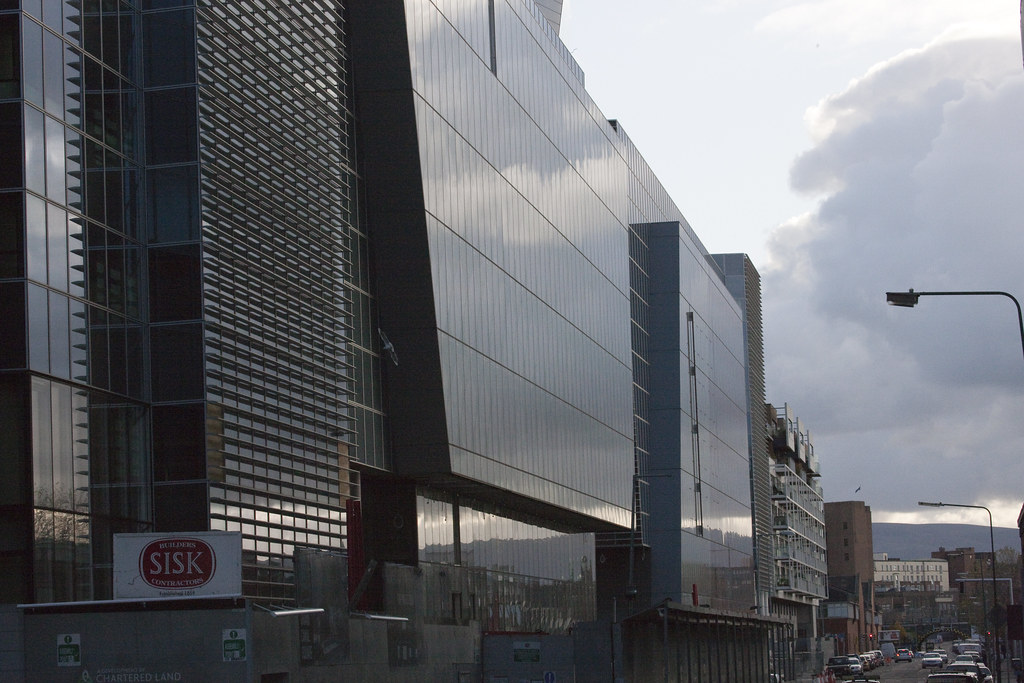
You are standing on Parnell Street on a Tuesday afternoon, and the languages arriving at your ears — Tagalog, Yoruba, Mandarin, Brazilian Portuguese, the clipped vowels of Polish — do not feel like tourism. They feel like residency. They feel like someone decided to stay.
Dublin spent roughly two centuries perfecting the art of producing people for elsewhere. The Famine of the 1840s removed approximately one million dead and one million emigrants within five years; by 1900, more Irish-born people lived in American cities than in Ireland itself. This was not merely demography — it became theology. Exile was metabolized into identity, grief into pride, departure into a founding myth so total that Irish-American culture, Irish-Australian culture, the entire global diaspora organized itself around the wound of having been pushed off the island. The leaving was the story. Return was always elsewhere’s problem.
What nobody adequately prepared for was the inversion. Between 1996 and 2006, Ireland’s foreign-born population tripled, driven first by the Celtic Tiger’s appetite for labor and then by the gravitational pull of an English-speaking EU capital. The 2022 census recorded over 200 nationalities resident in the Republic, with approximately 15% of the population born outside Ireland — a figure that, placed against the country’s historical self-image, constitutes something close to a civilizational paradox. The nation that defined itself by the people it lost is now being redefined by the people it kept.
The philosopher Charles Taylor, in his 1994 work on the politics of recognition, argued that identity is fundamentally dialogical — that the self is not constructed in isolation but through encounters with others who may refuse to reflect back what we expect to see. Irish identity, forged in opposition to British colonial erasure, then hardened through emigration and the Catholic state’s cultural monopoly, never had to be genuinely dialogical in Taylor’s sense. It spoke to itself, mourned to itself, celebrated to itself. The new Dublin forces a different grammar on that conversation, one where the other party has not read the script and is under no obligation to learn it.
What tends to happen in cities facing this kind of demographic velocity is that the host culture reaches for its heritage apparatus — the museums, the accent, the mythology — as a container capable of absorbing plurality without being altered by it. Dublin is not immune. The surface can be generous: the tourist infrastructure celebrates Joyce and Beckett, the pub performs warmth as a civic religion, and the phrase “sure you’re practically Irish now” is deployed with genuine affection as the highest form of welcome. But inclusion on those terms is inclusion into a pre-formed narrative, a costume fitting rather than a constitutional renegotiation.
The more honest confrontation is happening in spaces the postcards do not reach. It is in the Garda recruit from Lagos navigating a force whose institutional culture was shaped entirely by post-colonial Catholic nationalism. It is in the Nigerian-Irish teenager in Blanchardstown who speaks Dublin slang with perfect fluency and still gets asked where she is really from, the adverb doing the work that law and social policy would rather not do. It is in the Brazilian evangelical congregations meeting in converted commercial units in Clondalkin, practicing a Christianity far more fervent than the collapsed Irish version it technically shares a name with, and claiming belonging without asking permission from any heritage board.
Seamus Heaney once described Ireland as a place where the ground itself was memory, where to dig was to uncover the layered sediment of what had been lost. The question Dublin now lives inside is whether a city can expand whose ground counts as memory, whose loss qualifies as foundational, or whether belonging will always be rationed through a culture that learned, in two centuries of exile, to treat displacement as identity’s necessary precondition — and finds itself, for the first time, structurally unable to offer it.
🌀 Hidden Layers: Cities, Identity, and the Invisible
Dublin, like all great cities, carries within it a secret geography — a layered world of memory, contradiction, and unspoken life that no postcard can capture. These articles explore the invisible architecture beneath visible cultures, tracing the underground currents of literature, place, and identity that shape who we are and where we belong.
Contemporary Ireland in Culture and Literature
Contemporary Ireland in culture and literature is a field rich with tension between tradition and rapid modernity, between a deeply rooted past and a rapidly changing present. This article explores how Irish writers and artists have grappled with questions of identity, belonging, and the weight of history in a nation still negotiating its own image. It is essential reading for anyone wishing to understand the invisible forces that shape Dublin beyond its tourist-facing facade.
GO TO THE SELECTION: Contemporary Ireland in Culture and Literature
Situationist Psychogeography: The City as Lived Space
Situationist psychogeography offers one of the most powerful tools for reading a city beneath its official surface, turning aimless urban wandering into an act of radical discovery. Developed by Guy Debord and the Situationist International, this practice reveals how cities are designed to control movement and desire — and how drifting through them can subvert that control. Dublin’s hidden layers become visible precisely through this lens of deliberate, poetic disorientation.
GO TO THE SELECTION: Situationist Psychogeography: The City as Lived Space
Genius Loci: When Places Have a Soul
The concept of Genius Loci — the spirit of a place — speaks directly to what makes certain cities feel irreducibly themselves, charged with an atmosphere that resists definition. This article explores how particular locations accumulate memory, emotion, and meaning over centuries, becoming more than the sum of their stones and streets. Dublin’s oldest quarters, its canal banks and forgotten courtyards, are saturated with exactly this kind of invisible presence.
GO TO THE SELECTION: Genius Loci: When Places Have a Soul
The Flâneur: From Baudelaire to Benjamin
The figure of the flâneur — that attentive, unhurried observer of urban life — is one of the great literary and philosophical gifts for understanding what a city truly is beneath its performed identity. From Baudelaire’s Parisian boulevards to Benjamin’s arcades, the flâneur teaches us to read the city as a text full of erasures and marginalia. Wandering through Dublin’s lesser-known streets with this gaze transforms the ordinary into the profound.
GO TO THE SELECTION: The Flâneur: From Baudelaire to Benjamin
Explore the Invisible on Indiecinema
If these hidden layers of Dublin and the cities of the imagination have sparked your curiosity, Indiecinema is where that curiosity finds its natural home. Our streaming platform gathers independent films that dare to look beneath the surface — of places, of people, of cultures — with the same honest, unmediated gaze this essay invites. Come and discover cinema that sees what the postcards never show.
👉 EXPLORE THE CATALOG: Watch Indie Films in Streaming
A vision curated by a filmmaker, not an algorithm
In this video I explain our vision

