
The Architecture of Collective Denial
You are standing in a supermarket aisle, reaching for something you do not need, and the fluorescent light above you has been humming the same frequency since 1987. The cart in front of you is piloted by a woman checking her phone. A child is negotiating loudly for a cereal box with a cartoon mascot whose brand has outlasted three recessions. Nothing about this moment suggests that it could be the ten-thousandth-to-last scene of its kind. Nothing is designed to.

That design is not accidental. The entire architecture of ordinary life is constructed around what the sociologist Anthony Giddens called “ontological security” — the background hum of assumption that the world will persist in roughly its current form long enough for your plans to matter. In “The Consequences of Modernity,” published in 1990, Giddens argued that modern institutions function partly as anxiety-management systems, shielding individuals from what he called “existential questions” — among them, the fragility of collective existence itself. The supermarket, the mortgage, the school calendar, the retirement fund: these are not just economic instruments. They are epistemological ones. They encode the premise of continuity into daily practice so thoroughly that questioning it begins to feel not just uncomfortable but cognitively illegitimate, like doubting the floor beneath your feet while you are standing on it.
What this means, structurally, is that human extinction is not primarily a scientific problem or even a philosophical one. It is first and foremost a narrative category that organized society has a deep institutional interest in suppressing — not through censorship, which would at least acknowledge the threat, but through something more elegant: the systematic absence of a genre. We have stories about individual death in quantities beyond counting. We have war narratives, plague narratives, collapse narratives. But the genuine extinction narrative — the one in which humanity ends not as dramatic climax but as quiet cessation, a species that simply stopped — has no stable home in the cultural imagination. It gets rerouted, almost automatically, into survival stories. Someone always makes it. A remnant, a seed vault, a signal still broadcasting into empty space. The extinction is always interrupted at the last possible moment by the narrative need for witness.
The philosopher Thomas Nagel, in his 1979 essay “Mortal Questions,” drew a distinction between the badness of death for the individual who dies and the conceptual strangeness of a world in which there is no longer anyone for whom anything is bad. The second scenario, he noted, resists ordinary moral grammar. You cannot mourn something when there is no one left to perform the mourning. This is not merely a logical curiosity — it is the precise reason extinction slides off the mind like water off glass. The imagination requires a survivor to function. Every time you try to picture the end of the human story, the picture installs a hidden camera, and you are always the one holding it.
This cognitive reflex is doing serious cultural work. Between 1945 and 1962, the United States government spent an estimated $500 billion in today’s dollars on civil defense infrastructure — fallout shelters, emergency broadcast systems, evacuation routes — not to prepare citizens for annihilation but to make annihilation feel manageable, survivable, a problem with a procedure attached to it. The shelter was never really about surviving the bomb. It was about preserving the psychological category of survival itself, keeping it grammatically available even under conditions designed to erase it. The doctrine of Mutually Assured Destruction was, among other things, a narrative doctrine: it converted the possibility of extinction into a deterrence story, a standoff with a protagonist and a tension that could theoretically be resolved.
What gets lost in that conversion is the raw, structureless reality that the story is designed to domesticate.
The Sands
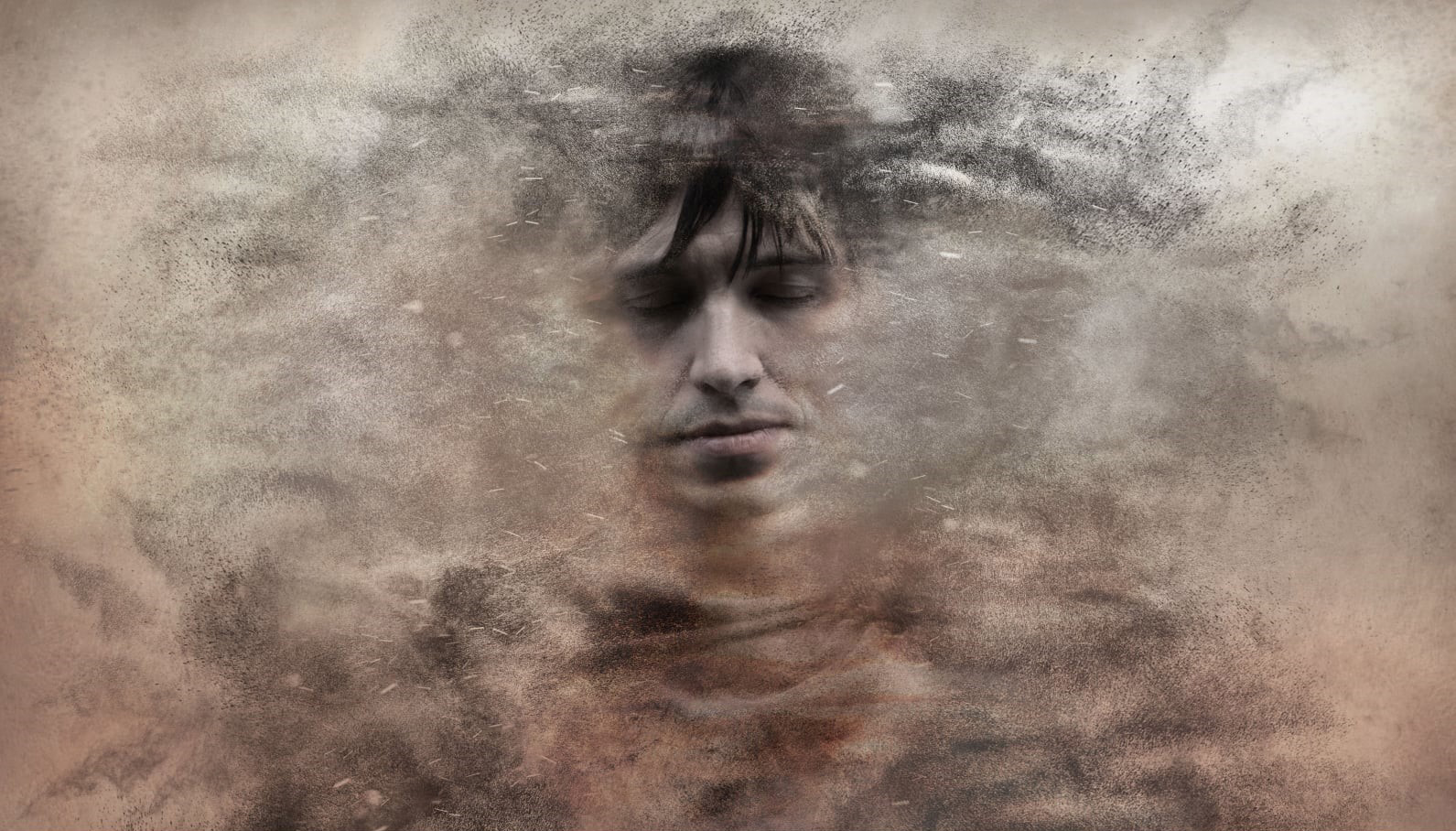
Science fiction, by Noah Paganotto, Argentina, 2022.
In an undetermined location on planet Earth, in an unknown time, Zoilo lives with his family in a wasteland surrounded by ruins. They live uprooted, without mothers, knowing that pregnancy for women is synonymous with death. For them there is only one collective routine; keep the fire alive. Only Zoilo escapes this logic, observing, intrigued, details that others do not see and therefore do not appreciate. Zoilo's personal search for answers will increase the differences with his relatives, increasingly revealing an empty world of interiority.
Avant-garde film that burns slowly in the first part and then reveals in the second the profound conflicts of a family prisoner of archaic beliefs. It is a dystopian and visionary work, with wonderful photography and images of rare power that allow us to grasp the depth of the story and its poetic potential. The faces of the actors, especially the protagonist boy, are perfect. The Sands metaphorically represents the world we live in: an alienated society, where what keeps us alive is demonized and blamed for death. In opposition to the fast pace of the typical mainstream film, The Sands is a meditative journey into the depths of images. The film was shot in natural environments in the city of Necochea, Buenos Aires province, Argentina.
LANGUAGE: Spanish
SUBTITLES: English, Spanish, French, German, Portuguese
Extinction as Historical Norm, Survival as Anomaly
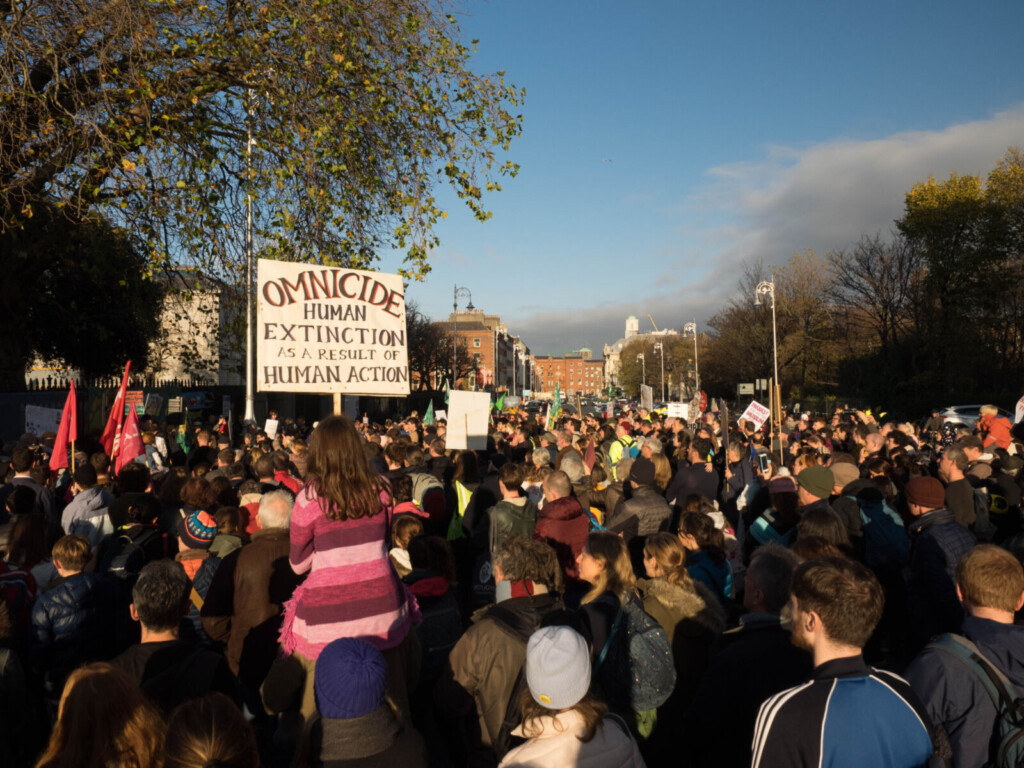
You already know that you will die. What you have never quite accepted is that your species will too, and that this is not a tragedy written in the future tense but a statistical verdict already underway.
Of the roughly four billion species that have emerged on this planet since complex life began, approximately 3.996 billion are gone. That number is not a metaphor or a rhetorical flourish — it is the working estimate biologists use when calculating extinction rates, and it means that survival, far from being life’s default condition, is an extraordinary deviation from the norm. The overwhelming tendency of living things is to vanish. Persistence is the exception that demands explanation; extinction requires none.
Ernst Mayr, whose 1963 synthesis Animal Species and Evolution remains one of the most rigorous treatments of speciation and longevity, calculated that the average lifespan of a vertebrate species runs somewhere between one and ten million years. Homo sapiens, in its anatomically modern form, has existed for roughly 300,000 years. By Mayr’s measure, we are not ancient — we are adolescent, still well within the window during which most species disappear before leaving any lasting mark on the fossil record. What feels to us like a long and storied history is, in geological time, barely a clearing of the throat.
The intimacy of that vulnerability becomes almost unbearable when pressed to its specific moment. Around 74,000 years ago, a supervolcanic eruption at what is now Lake Toba in Sumatra ejected an estimated 2,800 cubic kilometers of material into the atmosphere. The resulting volcanic winter — a stratospheric ash veil that may have dropped global temperatures by ten to fifteen degrees Celsius for years — pushed the ancestral human population through a bottleneck so severe that genetic evidence suggests the entire breeding population of Homo sapiens may have contracted to somewhere between 3,000 and 10,000 individuals. The whole of human potential, every subsequent civilization, every language and theorem and act of cruelty and tenderness that would follow, was threaded through a population smaller than a mid-sized university campus. There was no guarantee of the other side. The species did not survive because it was meant to; it survived because the bottleneck happened to leave enough people in enough geographically dispersed pockets that the thread did not snap. Luck is the word that scientific decorum resists, but it is the accurate one.
What Toba exposes is not human resilience but the fiction that resilience and continuation are synonymous. The populations that died during that volcanic winter did not lack resilience — they simply encountered a threshold their biology could not survive. The survivors were not stronger or smarter or more deserving. They were elsewhere, or slightly less exposed, or happened to inhabit ecosystems where some food chain held. Selection at that scale does not reward virtue; it rewards position. The lesson the event carries is not one of triumph but of radical contingency — the sense that the thread of human existence has been taut and nearly cut more than once, and that the tension has never fully relaxed.
Genetic bottlenecks of this severity leave marks that can be read in living populations today. The relative lack of genetic diversity in humans compared to other great apes — chimpanzees, for instance, show greater genetic variation within a single population than exists across the entire human species — is the molecular record of near-extinction. We carry the scar of that narrowing in our DNA without knowing it, walking around with the biological signature of a catastrophe our ancestors barely escaped, treating our continuation as though it were the natural order of things rather than its most implausible outcome.

The Myth of Continuity and Its Ideological Functions
You are sitting in a waiting room that has no exit, and the magazines on the table are all dated next year. This is not a metaphor for anxiety — it is the precise structural condition of how Western civilization has organized its relationship to time. The future is already furnished. Someone has already placed the chairs, chosen the reading material, decided what you will be waiting for. The only thing missing is the appointment itself.
Hesiod, writing somewhere around 700 BCE in Works and Days, gave the ancient Greeks a sequence of declining ages — gold, silver, bronze, heroic, iron — not to describe collapse but to anchor human suffering within a cosmic grammar. If the world is getting worse according to a plan, then deterioration is not chaos: it is narrative. The violence of the iron age does not threaten intelligibility; it confirms it. What looks like eschatological honesty is, at the structural level, a machine for psychological containment. The end, when it arrives in such frameworks, is never truly an end — it is a transition, a threshold, a passage into whatever the myth requires next. Extinction is smuggled out through the back door of mythology before it can sit down and be examined.
The Enlightenment performed the same operation with a different vocabulary. Where Hesiod had ages, the philosophes had progress. Condorcet, writing his Sketch for a Historical Picture of the Progress of the Human Mind in 1794 while hiding from the revolutionary tribunal that would eventually kill him, described humanity advancing through ten epochs toward a future of indefinite perfectibility. The irony of the biographical circumstance is almost too obvious to mention, except that it illuminates something essential: the man most personally endangered by historical rupture was simultaneously the most committed to the idea that history does not rupture. Progress discourse does not emerge from security — it emerges from terror of the alternative. The narrative of continuity is constructed precisely at the moment when continuity is most in question.
Reinhart Koselleck, in Futures Past, published in German in 1979, introduced the distinction between the space of experience and the horizon of expectation to describe how modernity restructured temporal consciousness. In pre-modern societies, the future was expected to resemble the past — agriculture, plague, dynasty, repetition. The horizon of expectation sat close to the shore of lived experience. What modernity did, with increasing ferocity from the late eighteenth century onward, was push that horizon outward until it became a vanishing point — always visible, always receding, never arrived at. The future became not a place one enters but a direction one perpetually faces. Within this temporal architecture, extinction cannot be thought, because extinction would require the horizon to simply stop existing. And a horizon that stops existing is not a horizon — it is a wall, and the entire edifice of modern subjectivity is built on the premise that walls of this kind do not appear.
This is not a failure of imagination in the clinical sense. It is an ideological achievement. The colonization of the future as an infinite corridor of becoming serves specific political and economic functions: it makes the present always provisional, always a means rather than an end, always a step toward a justification that remains permanently deferred. Capital requires this structure as much as eschatology does. An economy premised on perpetual growth and a theology premised on eventual redemption share the same grammatical skeleton — a present that derives its meaning from a future that must never fully arrive, because the moment it arrives, the present loses its status as instrument and becomes simply what it is.
When a civilization cannot think the end of itself without immediately converting that thought into a narrative of transition, of rebirth, of lesson learned and applied, it has not conquered the fear of extinction — it has merely ensured that the fear never has to be faced directly.
Survival Instinct as Cultural Construct, Not Biological Bedrock

You have been told, your entire conscious life, that survival is what you are for. Not metaphorically — literally, biologically, at the level of cellular instruction. The story goes that every anxiety you feel, every aggression you perform, every wall you build between yourself and strangers is the ancient organism inside you running its original code. Evolutionary psychology made a religion of this claim, and like most religions, it discouraged examination of its own foundations.
The naturalistic fallacy operates here with particular elegance: because a behavior is widespread, it must be rooted in nature; because it is rooted in nature, it must be correct, or at least inevitable. But the history of cultures that have chosen ritual self-sacrifice, collective martyrdom, or deliberate demographic restraint as their organizing principles exposes the formula as circular. What gets called instinct is almost always a cultural production dressed in biological costume — enforced by shame, reward, and the slow violence of being made to feel aberrant when you do not conform.
Ernest Becker spent the last years of his life dying of cancer while finishing the argument that would win the Pulitzer Prize in 1974, the year after his death. His central claim in The Denial of Death was not that humans fear dying — that would have been obvious — but that the entire architecture of civilization, its monuments, its religions, its heroic narratives, its legal systems, is a collective mechanism for managing the terror of annihilation. The pyramids are not engineering achievements. They are anxiety management. Every institution that promises legacy, continuity, symbolic immortality, is a prosthetic against the knowledge that the body ends. Becker was not consoling anyone with this. He was showing that what we call culture is, at its foundation, a sustained hallucination maintained by consensus.
What Becker did not fully trace — because the political climate of the early 1970s offered different available data — is the precise mechanism by which collective extinction anxiety gets displaced rather than resolved. Terror management theory, developed by Jeff Greenberg, Sheldon Solomon, and Tom Pyszczynski through a series of empirical studies beginning in the 1980s, demonstrated experimentally that when subjects are reminded of their own mortality, they become measurably more hostile toward people who hold different worldviews. The mortality salience paradigm, tested across dozens of cultures and hundreds of studies, showed that death-awareness does not produce reflection or solidarity. It produces tribalism. The structural vulnerability — the fact of biological finitude, the fact that no group survives indefinitely — remains completely untouched. What changes is the intensity of persecution directed at whatever figure has been designated as the carrier of contamination.
This is why pandemic narratives, war propaganda, and xenophobic rhetoric share an identical grammatical structure regardless of the century that produces them. The Black Death of the fourteenth century killed between 30 and 60 percent of Europe’s population and generated not collective humility but a wave of pogroms against Jewish communities across the continent, as if identifying a responsible party could somehow reorganize the biological chaos. The actual pathogen — Yersinia pestis, indifferent to confession and ethnic origin — continued its work while the persecution proceeded. The displacement was total, and it was functional: it gave the surviving population a narrative of agency over what was, in structural terms, completely beyond their control.
What this reveals is not human weakness but the specific trap of a mind evolved for local causality being dropped into systemic catastrophe. The brain that can track a predator across a forest floor, that can read social hierarchy through micro-expressions, has no native instrument for processing species-level risk distributed across time. So it reaches for the nearest available enemy and assigns to that figure the full weight of a terror it cannot otherwise metabolize — and in doing so, it mistakes the act of targeting for the act of surviving.
The Stories We Tell Instead of the Truth
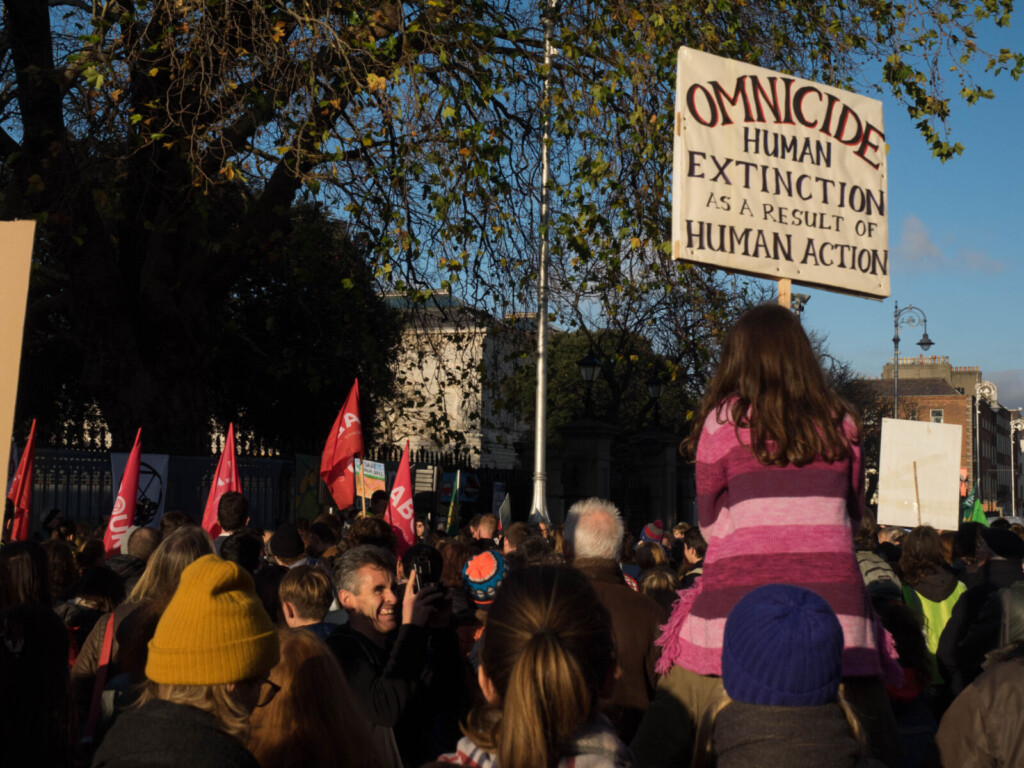
You are watching a newscaster describe the end of a coastline. She does not raise her voice. The camera cuts between satellite imagery and her face with the same editorial rhythm it would use for a traffic report, and somewhere in that rhythmic alternation lives the most sophisticated survival mechanism civilization has ever produced — not bunkers, not seed vaults, not international accords, but the grammar of broadcast calm, the passive voice as existential sedative. “Entire communities have been displaced.” Not by anyone. Not toward anything. The verb absorbs the catastrophe and releases only its shadow.
Walter Benjamin argued in 1936 that the storyteller was already dying, replaced by the novelist who writes in isolation for readers who consume in isolation, and that this privatization of narrative was inseparable from a new relationship to death — specifically, the removal of death from public experience. The dying had been moved into hospitals, the grieving into private rooms, and the story that once transmitted communal wisdom through the proximity of mortality had been replaced by something that needed no such proximity. The novel gave you meaning from a safe distance. What Benjamin could not have anticipated is how thoroughly that logic would colonize the very genres that appear to confront extinction directly — the disaster film, the apocalyptic novel, the speculative television series that runs for six seasons because enough people need to watch civilization collapse from a couch to justify the advertising revenue.
The paradox is structural, not accidental. A narrative of extinction that you consume voluntarily, in sequence, with a score designed to modulate your cortisol and a runtime engineered to end before your discomfort becomes intolerable, has already made a foundational promise: you will survive this story. The form itself is the ideology. You are not being shown what extinction feels like. You are being shown a version of extinction that has been processed through every convention of narrative survivability — the protagonist who endures, the small group that holds, the final image that suggests continuity even in ruin. Psychologists studying what Paul Slovic in 2007 called “psychic numbing” found that the human capacity for moral and emotional response collapses not in the absence of information but in its excess, when numbers exceed the threshold at which individual imagination can operate. Fiction steps into that gap not to restore feeling but to substitute a manageable surrogate — grief for a character rather than reckoning with a scale.
This is what inoculation actually means in the medical sense: a controlled exposure that trains the immune system to recognize and neutralize the threat before it arrives at full force. The apocalyptic imagination in contemporary culture functions identically. It introduces just enough of the unthinkable to generate catharsis — Aristotle’s term, famously, for the purging of emotions the audience cannot safely hold — and that catharsis is then metabolized as resolution. You feel something. You close the book or end the episode. The feeling has been spent. The threat has been, at the neurological level of response, addressed. Nothing has changed in the world, but something has changed in your nervous system’s relationship to the possibility of nothing changing, and that subtle recalibration is precisely what the myth of survival requires to perpetuate itself across generations.
The stories we tell about the end of our species are not preparations for that end. They are the precise mechanism by which we avoid preparing. Every extinction narrative that resolves, even in ambiguity, trains the audience to expect resolution — and expectation, once installed deeply enough, becomes indistinguishable from certainty, which is the oldest and most durable form of denial that human culture has ever managed to make feel like wisdom.
A vision curated by a filmmaker, not an algorithm
In this video I explain our vision
🌍 When the World Ends: Myths, Fears and Human Survival
The idea of human extinction is not merely a scientific hypothesis — it is one of the deepest mythological and philosophical obsessions of our species. From post-apocalyptic literature to pandemic narratives, from Hobbesian nightmares to the collapse of civilization, these articles explore the cultural, psychological and philosophical frameworks through which humanity has always imagined its own end.
The Post-Apocalyptic World in Contemporary Culture
The post-apocalyptic world has become one of the most fertile imaginative territories in contemporary culture, reflecting our collective anxieties about extinction, collapse and rebirth. This article traces the cultural history of post-apocalyptic narratives and examines how they function as mirrors of societal fears, from nuclear annihilation to ecological catastrophe. Understanding this genre means understanding the survival myth at its most raw and unfiltered.
GO TO THE SELECTION: The Post-Apocalyptic World in Contemporary Culture
The Pandemic in Science Fiction: History and Symbolism
Long before COVID-19, science fiction had been rehearsing the end of humanity through pandemic scenarios, mapping in fictional form the fragility of civilization and the terror of biological extinction. This article explores how the pandemic has functioned as a recurring symbol in speculative literature and cinema, revealing deep-seated anxieties about collective vulnerability and the limits of human control. The survival myth finds one of its most visceral expressions precisely in the figure of the unstoppable contagion.
GO TO THE SELECTION: The Pandemic in Science Fiction: History and Symbolism
Albert Camus and the Plague: Collective Evil as Metaphor
Albert Camus transformed the plague into a philosophical allegory of collective evil, mortality and the absurd human condition, making La Peste one of the most powerful meditations on mass extinction ever written. This article examines how Camus used epidemic catastrophe not merely as dramatic backdrop but as a lens through which to interrogate solidarity, denial and the will to survive. His vision remains a foundational text for anyone seeking to understand the cultural and existential dimensions of the survival myth.
GO TO THE SELECTION: Albert Camus and the Plague: Collective Evil as Metaphor
Thomas Hobbes and the State of Nature: When Man Is Enemy to Man
Thomas Hobbes imagined humanity in its natural state as a war of all against all — a vision of primordial extinction risk rooted not in nature but in human nature itself. This article explores Hobbes’s radical political philosophy and his conception of the state of nature as a place of perpetual violence and death, where survival depends entirely on the surrender of individual freedom to collective order. His thought resonates powerfully with contemporary narratives of human extinction and the fragile structures we build to prevent it.
GO TO THE SELECTION: Thomas Hobbes and the State of Nature: When Man Is Enemy to Man
Explore the End of the World Through Independent Cinema
If these reflections on survival, extinction and the fragility of civilization have stirred something in you, Indiecinema is the place to go deeper. On our streaming platform you will find independent and art-house films that dare to confront the darkest and most essential questions about what it means to be human — and what we risk losing. Join us and discover a cinema that does not look away.
👉 EXPLORE THE CATALOG: Watch Indie Films in Streaming
A vision curated by a filmmaker, not an algorithm
In this video I explain our vision

