
The Traffic Jam That Reveals Everything
You are sitting in your car on a Thursday afternoon, not thinking about anything in particular — a grocery list, maybe, or whether you remembered to reply to that email — when the driver ahead of you cuts across two lanes without signaling and takes the parking space you have been waiting for with your blinker on for forty seconds. Forty seconds is not a long time in any other context. It is an eternity when someone is watching you wait and takes the thing anyway. You feel it before you think it: a heat that starts somewhere below the sternum and moves upward, something old and unscheduled arriving in your chest cavity like an uninvited guest who clearly knows the layout of the house.

What happens next is the interesting part. Not the honking, not the window rolled down, not the words exchanged that neither party will be proud of later. What is interesting is the speed of it — how quickly the entire social contract, that invisible architecture of mutual restraint that makes cities function and strangers coexist, simply evaporates. No one decided to abandon civilization. No memo was circulated. The man who got out of that car is, in all likelihood, a person who holds doors open, tips adequately, and volunteers his opinion on violence only to condemn it. And yet here he is, leaning forward with his jaw set, performing a kind of territorial display that would not look out of place in a documentary about animals competing for resources on an African plain. The parking space was never really about the parking space.
This is not a failure of character. That is the first thing to understand, and it is also the most destabilizing one. What erupted in that moment was not an exception to normal human behavior but a glimpse of its substrate — the layer underneath the pleasant social surface that most people never examine because daily life is engineered, more or less successfully, to keep it submerged. The engineering is the achievement. The layer is the baseline.
Thomas Hobbes understood this in 1651 with a clarity that his contemporaries found obscene. In Leviathan, written during the catastrophic rupture of the English Civil War while Hobbes was living in exile in Paris watching his country consume itself, he described the natural condition of mankind as a war of every man against every man. Not a war in the theatrical sense — armies, declarations, front lines — but something more pervasive and more honest: a condition in which the absence of enforced authority makes every human being simultaneously a predator and potential prey. His contemporaries accused him of cynicism. They were wrong. Cynicism requires disappointment, a gap between expectation and reality. Hobbes had no such gap. He simply looked at what human beings actually do when the structures that constrain them are removed, and he described it without flinching.
What made Leviathan shocking was not the darkness of its vision but the precision of its logic. Hobbes was not lamenting human nature. He was diagnosing a structural problem. In the state of nature, he argued, life is solitary, poor, nasty, brutish, and short — not because human beings are evil in some theological sense, but because in a condition of genuine equality, where no one is so much stronger than everyone else that domination is guaranteed, the rational move is always preemptive aggression. You do not wait to be attacked. You attack first. And because everyone knows this, everyone is always already preparing to attack first. The logic is airtight and the outcome is catastrophic, and it requires no malice whatsoever — only the ordinary human combination of self-interest and intelligence operating in an environment without enforceable rules.
The parking lot did not create the man who stepped out of that car with violence in his posture. It simply removed, briefly and locally, the conditions that usually keep him from being fully himself.
Children Of A Darker Dawn
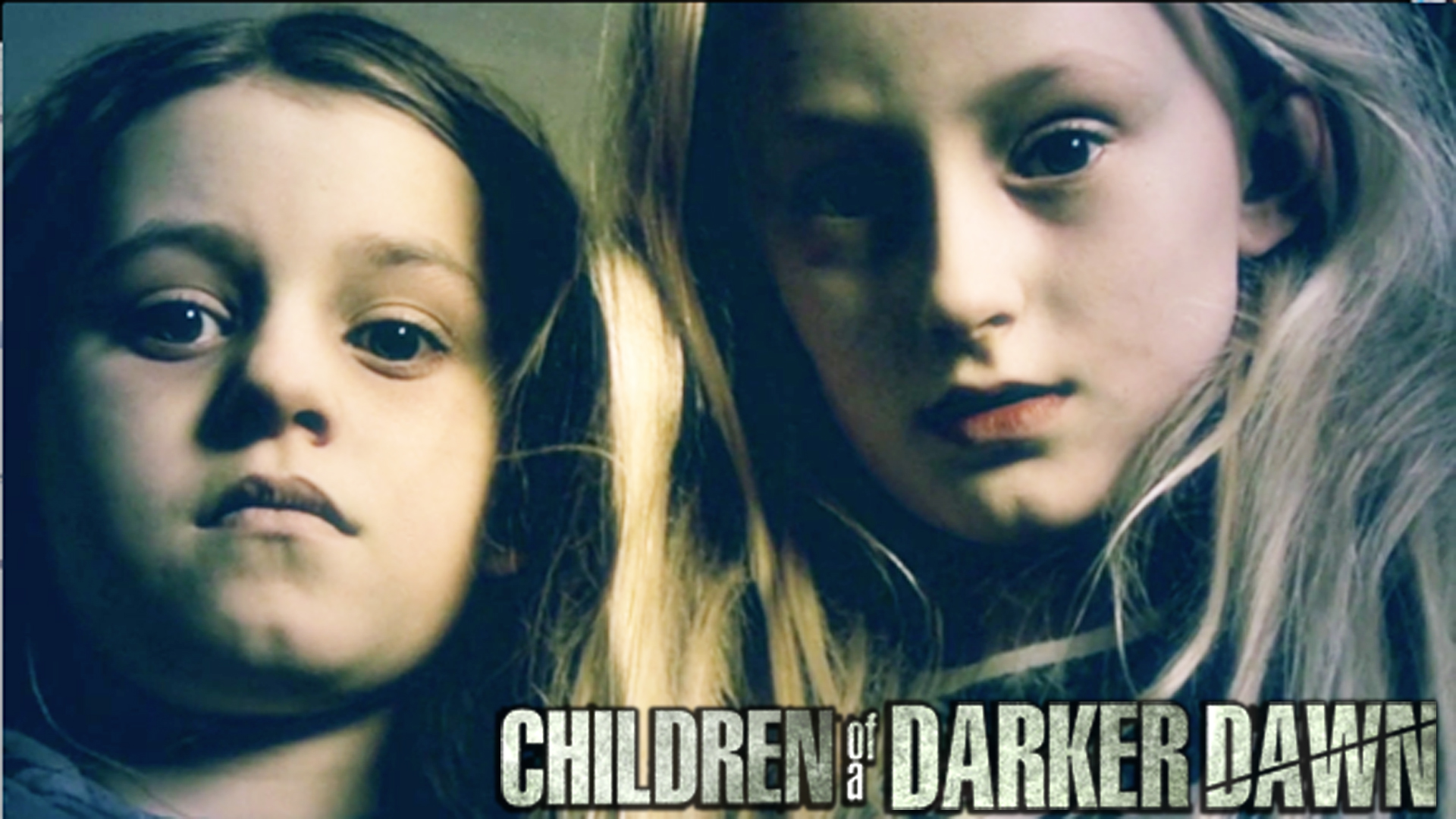
Drama, horror, sci-fi, by Jason Figgis, United States, 2012.
In a post-apocalyptic Ireland, a pandemic has wiped out the adult population, struck down by a mutant strain of flu that turns them paranoid and violent before killing them. Nine months later, the surviving children wander through abandoned buildings in search of food and shelter. Among them are Evie and her younger sister Fran, trying to survive while avoiding potentially dangerous groups of kids. Their only comfort is The Railway Children, the book their mother used to read to them. The arrival of Alice, a girl who has escaped from a gang led by her sister Kate, changes their path. After being betrayed by the gang, Evie decides to confront them, triggering a series of events that will lead to tensions and conflicts within the group.
The film, directed by Jason Figgis with limited resources but great sensitivity, is a post-apocalyptic drama that goes beyond horror, focusing on grief and the emotional fragility of its characters. The tone is somber, marked by melancholy, disturbing flashbacks, and unstable relationships. Though it recalls films like 28 Days Later, The Road, or Lord of the Flies, Children of a Darker Dawn finds its own voice through strong character development and powerful performances from its young cast.
LANGUAGE: English
SUBTITLES: Spanish, French, German, Portuguese
A Man Writing in Exile Who Understood Power
You are reading a man who watched his country eat itself alive and had the presence of mind — or perhaps the cold detachment born of terror — to take notes.
Thomas Hobbes was born in 1588, the year the Spanish Armada threatened to shatter England’s sense of invincibility. His mother, according to accounts he gave later in life, went into premature labor upon hearing the news of the fleet’s approach. He claimed, with the kind of dark wit that never quite left him, that fear and he were born twins. It is tempting to read that as literary embellishment. It is more honest to read it as biography.
By 1640, Hobbes was fifty-two years old, a tutor to aristocratic families, a man of considerable intellectual reputation but no institutional power. He had been circulating a manuscript called The Elements of Law among members of parliament, a text arguing that sovereign authority must be absolute and indivisible. When parliament turned against the king and the ground beneath the English ruling class began to crack, Hobbes did not wait to see what would happen next. He fled to Paris, the first, he later wrote, of all those who ran. There is something instructive in that admission — not cowardice exactly, but a kind of brutal lucidity about consequences that most of his contemporaries were still pretending would not arrive.
He stayed in Paris for eleven years. During that time, England did not descend metaphorically into chaos — it descended literally. Charles I was tried and beheaded in January 1649, an event so structurally unprecedented in European political experience that even those who opposed the king were shaken by what they had done. The Civil War killed an estimated 200,000 people in a country of roughly five million. Proportionally, that exceeds the casualties England sustained in the First World War. Hobbes was not theorizing about instability. He was watching it operate at scale, from across the Channel, surrounded by exiled royalists who were themselves evidence that authority could vanish overnight.
Leviathan appeared in 1651, and its opening pages do something that purely academic philosophy rarely does: they smell of emergency. The famous description of natural life as solitary, poor, nasty, brutish, and short was not a thought experiment Hobbes constructed to test a logical premise. It was a description he arrived at by watching men who had shared a civilization, a church, a king, and a legal tradition discover that none of those things were strong enough to prevent them from killing one another over questions of sovereignty and scripture. The theory came from the experience of watching every institution that was supposed to prevent violence fail to prevent violence.
What makes this exile significant is not the suffering it produced in Hobbes personally — he was reasonably comfortable in Paris, embedded in intellectual circles, even employed briefly as mathematics tutor to the future Charles II. What makes it significant is what exile does to the mind’s relationship with certainty. A man who has never lost his country tends to treat its structures as permanent features of reality rather than fragile arrangements held together by collective agreement and force. Hobbes lost his country at fifty-two. He watched its parliament execute its king. He understood, in a way that philosophers writing from inside stable institutions cannot fully understand, that order is not the natural state of human affairs. It is an achievement, and a precarious one, always one miscalculation away from the condition it was built to prevent.
His contemporaries accused him of atheism, of cynicism, of producing a philosophy that justified tyranny. They were not entirely wrong about any of those charges. But they were asking the wrong question. The right question is not whether Hobbes approved of what he described — it is whether what he described was accurate.

What 'Nasty, Brutish, and Short' Actually Means
You have almost certainly misquoted Hobbes without realizing it. Most people who invoke the phrase remember it as a description of primitive man, of some pre-social brute living in caves and grunting at shadows — and that misreading is so deeply embedded in popular usage that correcting it feels almost pedantic. But the correction matters enormously, because Hobbes was not making an anthropological claim about the past. He was making a structural claim about the present, about any present, about what underlies every moment of organized social life like a fault line beneath a city that has never experienced an earthquake.
The full passage from Leviathan, published in 1651, reads: “No arts; no letters; no society; and which is worst of all, continual fear, and danger of violent death; and the life of man, solitary, poor, nasty, brutish, and short.” The phrase is not the culmination of a portrait of savagery. It is the endpoint of a logical argument about what follows necessarily when there is no common power to keep men in awe. Hobbes was a mathematician at heart — he admired Euclid with the reverence other men reserved for scripture — and he built his political philosophy the way a geometer builds a proof: from definitions and axioms toward unavoidable conclusions. The state of nature was his thought experiment, his reduction to first principles. Strip away courts, contracts, armies, and shared expectations of enforcement, and what remains? Not innocence. Not freedom. A particular kind of terror.
Bellum omnium contra omnes — the war of all against all — is where that logic terminates, and it is crucial to understand what Hobbes meant by war. He was not describing open combat as a constant condition. He was describing something more insidious: a permanent state of readiness for combat, a mutual orientation of suspicion so total that cooperation becomes irrational. In Chapter 13 of Leviathan, he writes that war consists “not in battle only, or the act of fighting; but in a tract of time, wherein the will to contend by battle is sufficiently known.” The weather analogy he uses is precise: a stormy day is not forty-eight hours of continuous rainfall, but forty-eight hours during which rain is always possible and you organize your behavior accordingly. The state of nature is that weather. It does not require bodies in the street. It requires only the reasonable expectation that violence is always a live option, and that no one has any enforceable reason to choose otherwise.
This is where the moral dimension collapses, and where most readers lose the thread. Hobbes was not saying that men in the state of nature are evil. He was saying they are rational. In a world without enforceable agreements, it is not wickedness that drives you to betray your neighbor before he betrays you — it is calculation. The pre-emptive strike is not a moral failure; it is the only logically coherent response to genuine uncertainty about another person’s intentions when defection carries no institutional cost. The famous trio of causes Hobbes identifies — competition, diffidence, and glory — are not vices. Competition is the pursuit of necessary goods. Diffidence is reasonable anticipation of what others will do when they also pursue necessary goods. Glory is the demand to be taken seriously as an agent, which is not vanity but self-preservation by another name.
What makes the phrase “nasty, brutish, and short” land so hard when you read it in context is precisely that it describes no jungle. It describes the Argentine financial collapse of 2001, when neighbors who had shared streets for decades stopped trusting each other’s word on anything denominated in pesos. It describes every neighborhood where policing has evaporated and private security is unaffordable, not because the residents became savage, but because the institutional architecture that made cooperation rational dissolved overnight.
The Anthropological Trap: Rousseau and the Noble Savage Myth
You have heard the counter-argument before, probably delivered with a kind of quiet moral certainty, as though it were not an argument at all but simply the truth that decent people had finally gotten around to acknowledging. Natural man, left untouched by property, hierarchy, and the corrupting machinery of social institutions, was gentle. Curious. Essentially peaceable. Jean-Jacques Rousseau made this claim with extraordinary literary force in his Discourse on the Origin of Inequality in 1755, constructing a portrait of pre-social humanity as a solitary, self-sufficient creature whose amour de soi — a mild, inward love of self — generated no conflict because it generated no comparison. It was civilization, with its mirrors and its markets, that taught human beings to measure themselves against one another and to hate what they saw.
The seduction of this vision is not difficult to understand. Rousseau was writing in a society that had perfected the art of making misery look like natural order, where aristocratic privilege dressed itself in the language of divine necessity and the poor were told that their suffering was cosmically arranged. To propose that all of this was artificial, reversible, a historical accident rather than a metaphysical decree — that was not merely philosophy. It was oxygen. And yet the intellectual generosity we owe to a thinker’s political courage cannot extend to shielding his empirical claims from examination. The noble savage was not a historical figure. He was a therapeutic fiction, a photographic negative of the eighteenth-century Parisian bourgeois, constructed precisely to make that bourgeois feel guilty. The primitive world Rousseau described had never been observed, excavated, or measured. It had been imagined from a distance, which is precisely the condition that makes imagination so dangerous.
When archaeologists and anthropologists finally turned systematic attention to the actual evidence of prehistoric human behavior, what they found was not Eden scarred by a few unfortunate incidents. Lawrence Keeley, in his 1996 study War Before Civilization, assembled decades of skeletal analysis, village fortification data, and ethnographic records from societies that had remained relatively isolated from state structures, and the numbers were not gentle. Among the prehistoric sites he examined, the proportion of individuals showing traumatic skeletal injuries consistent with interpersonal violence ran dramatically higher than anything recorded in the twentieth century’s most industrialized wars. Some archaeological sites from the Neolithic period in Europe and the American Midwest revealed that entire communities had been massacred — men, women, children — their remains scattered in patterns that could not be explained by accident or predation. Keeley’s estimate, drawing across multiple pre-state populations, was that annual war death rates in many prehistoric societies hovered between 0.5 and 1 percent of total population per year. To place that in proportion: the combined death toll of the two World Wars, the Holocaust, and every major conflict of the twentieth century, expressed as a percentage of the global population during those years, falls below that figure.
What this does to Rousseau’s thesis is not refute it partially — it dismantles the anthropological scaffolding on which the whole structure rests. The fiction of original innocence was always doing political work rather than descriptive work, and the distinction matters because the consequences of accepting it uncritically are themselves political. If violence is purely a product of institutions, then institutions alone can redeem us, and the question of what human beings are capable of in the absence of constraint can be permanently deferred. This deferral is comfortable. It means never having to sit with the more disturbing possibility that the capacity for organized cruelty is not a bug installed by civilization but something far older, carried in the body across centuries of darkness that left marks in bone before it left marks in text.
The romantic inversion did not merely misread history. It created a template for misreading it repeatedly, generation after generation, each time a new unspoiled people appeared on the horizon of European imagination, available to be loaded with the projections of those who needed innocence to exist somewhere in the world, even if it had to be invented.
Cooperation as a Calculated Bet, Not an Instinct
You are sitting across from someone you will never see again. The transaction is clean, the stakes are real, and you both know the rules: betray, and you walk away with more; cooperate, and you split what’s available. The calculus here is not moral — it is mechanical. Every instinct you have been told is generosity, every reflex you have been told is kindness, reduces in this moment to a single cold variable: what does the other person expect you to do, and what happens to you if they’re wrong?
Robert Axelrod understood that the prisoner’s dilemma was not a thought experiment. It was a diagnostic. In 1980, before publishing The Evolution of Cooperation in 1984, he ran a tournament — an actual computational competition in which game theorists from around the world submitted strategies to play iterated rounds of the dilemma against each other. The results collapsed several decades of assumptions at once. The winning strategy, submitted by Anatol Rapoport, was called Tit for Tat: cooperate on the first move, then mirror whatever your opponent did in the previous round. No forgiveness for defection beyond one round. No exploitation of cooperation. The simplest program in the tournament won every time, not because it was generous, but because it was legible and retaliatory in equal measure.
What Axelrod had demonstrated — and what makes his findings genuinely uncomfortable — is that cooperation emerges not from trust but from the shadow of the future. The technical term he used was the “shadow of the future”: the longer the expected duration of an interaction, the more rational it becomes to cooperate, because defection now forecloses gains later. Remove the expectation of future interaction, and the entire architecture of mutual restraint evaporates. This is not a metaphor. It is arithmetic. When the probability that two players will meet again drops below a calculable threshold, defection becomes the dominant strategy regardless of what either party “wants.” Morality does not enter the equation. Only time horizon does.
This reframes an enormous portion of what societies call civilization. The norms of reciprocity embedded in markets, in legal contracts, in diplomatic treaties — none of them reflect a human capacity for altruism. They reflect the engineering of conditions under which self-interest and collective benefit temporarily coincide. Ancient Rome institutionalized hospitality — the concept of hospitium — not because Romans were generous toward strangers, but because trade routes depended on predictable behavior across encounters that would recur. Medieval guilds enforced quality standards not because craftsmen were proud, but because reputation was a repeated-game asset. Every moral vocabulary humanity has developed to describe cooperation is, at its structural base, a language for encoding the expectation of future consequence.
The fragility here is the part no one likes to acknowledge. Axelrod’s model requires three conditions simultaneously: repeated interaction, memory of prior behavior, and the credible possibility of retaliation. Eliminate any single one and the equilibrium dissolves. Anonymity destroys the first. Institutional amnesia — corporate restructuring, political transitions, the death of witnesses — destroys the second. Power asymmetry, when one party is too large or too protected to face meaningful retaliation, destroys the third. Contemporary digital economies have engineered environments in which all three conditions are selectively neutralized: platform companies interact with millions of anonymous users, carry no obligation of institutional memory toward them, and face regulatory regimes too slow and too captured to constitute genuine threat. The math Axelrod described in 1984 predicts precisely what happens next, and it has been happening in plain sight.
There is a particular cruelty in the gap between how cooperation feels from the inside and what it actually is. When you hold a door open for a stranger, when you honor a promise that no one would have caught you breaking, you experience something that feels like virtue — warm, slightly elevating, briefly reassuring about the species. What you are actually doing is running an ancient social algorithm that only functions because enough other people around you are also running it, because the environment has been structured, usually by coercion at some prior historical moment, to make defection costly enough to avoid.
A vision curated by a filmmaker, not an algorithm
In this video I explain our vision
The Sovereign as Necessary Monster

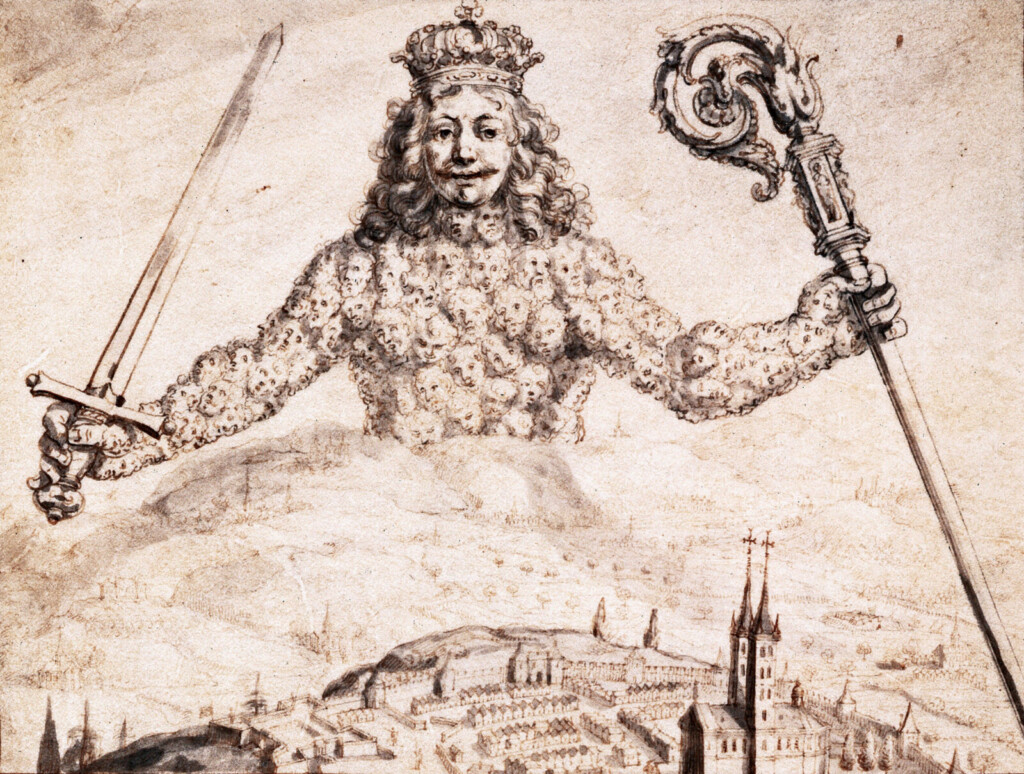
You sign the contract not because you trust the sovereign, but because you are more afraid of everyone else. This is the cold arithmetic at the heart of Leviathan, published in 1651, and Hobbes never pretended otherwise. The sovereign he imagined was not a benevolent administrator, not a philosopher-king tempered by wisdom and restraint. It was a monster by design — a single artificial body assembled from the surrendered wills of terrified individuals, granted a power so absolute that no subject could lawfully resist it without dissolving the very structure that kept them alive. The creature on the book’s famous frontispiece says everything: a giant composed of hundreds of tiny human figures, holding a sword in one hand and a bishop’s staff in the other, looming over a peaceful landscape that exists only because the giant looms. Remove the giant and what remains is not freedom. What remains is the war.
The paradox Hobbes erected here is structurally elegant and morally uncomfortable in equal measure. Liberty, within his framework, is not the absence of external power over you — it is the silence of the law. You are free to do precisely what the sovereign has not yet forbidden, and nothing more. This is not a flaw in the system; it is the system’s load-bearing wall. Subjects retain no pre-political rights that could be wielded against the sovereign’s will. Even the right to self-defense, which Hobbes grudgingly preserves as inalienable, cannot be invoked to challenge sovereign authority in any organized or collective way. The contract transfers everything upward. What remains below is obedience dressed as peace, and Hobbes considered this a bargain well worth taking.
Philip Pettit, writing in Republicanism in 1997, identified exactly why this bargain should disturb us even when it appears to be working. Pettit drew a sharp distinction between two conceptions of unfreedom: interference and domination. Hobbes’s sovereign, when silent, does not interfere — and so by Hobbes’s own definition, the subject in that moment is free. But Pettit observed that the capacity for interference, held permanently over a person’s life without constraint or accountability, constitutes domination regardless of whether the sword is being actively swung. The master who never beats the slave is still a master. The Hobbesian citizen living under a sovereign that happens to be lenient is not free — they are merely unharmed, and the difference between those two states is precisely the difference between a life and a managed existence.
What makes this more than an academic quarrel is that most contemporary states are built on architectures that quietly resolve this tension in Hobbes’s favor rather than Pettit’s. Emergency powers legislation, executive orders that bypass legislative deliberation, surveillance infrastructures assembled after 2001 and never fully dismantled — these are not aberrations from liberal democratic norms. They are the Hobbesian substrate showing through the wallpaper. The sovereign’s capacity to dominate is preserved even when the sovereign is constitutionally clothed, because the capacity itself is never surrendered. Citizens vote, petition, litigate, and protest, and yet the structure that permits each of those activities also reserves the right to suspend them under conditions it defines unilaterally. Hobbes did not design this. He simply described what it requires to make collective life stable when human beings are treated as fundamentally ungovernable without overwhelming force overhead.
The Leviathan endures not because anyone particularly loves it but because dismantling it requires trusting that others will do the same, simultaneously, without defection — which is precisely the problem the Leviathan was built to solve. Every critique of sovereign overreach that fails to account for what fills the vacuum left behind has not yet escaped Hobbes’s gravitational field; it has merely refused to look down.
When the Leviathan Becomes the Predator
You have followed the rules, paid your taxes, updated your documents, stood in the right lines, and signed the right forms. You have done everything a citizen is supposed to do. And then one morning the state simply decides you are not one.
This is not a metaphor. Between 1935 and 1938, the Nazi regime systematically dismantled the legal personhood of Jewish Germans through a cascade of legislation — the Nuremberg Laws, the Reich Citizenship Law, the ordinances stripping professional licenses, property rights, and finally the right to bear a name recognized by civil registry. What Hannah Arendt identified in The Origins of Totalitarianism, published in 1951, was not simply an atrocity but a specific procedural logic: legal annihilation always preceded physical annihilation. The body was destroyed after the person had already been erased from the architecture of rights. This sequence was not incidental. It was structural.
Hobbes imagined the Leviathan as the only force capable of lifting human beings out of the war of all against all. The sovereign’s absolute power was justified precisely because it replaced the terror of the pre-political void with the security of law. What Arendt exposed is the possibility that sovereignty can run this mechanism in reverse — that a state can take a person who exists inside the legal order and methodically push them back through the threshold, stripping protections one statute at a time, until the individual stands again in something functionally identical to the state of nature Hobbes described: no rights enforceable against others, no recourse, no standing, no law that applies to them in their favor. The stateless person, Arendt wrote, had lost not a specific right but the right to have rights — the most elementary of political conditions.
What makes this inversion so disorienting is that it operates through the instruments of legality rather than against them. The decrees are signed, the offices are stamped, the files are properly maintained. There is no lawlessness visible from within the bureaucratic apparatus itself. The machinery of the state continues to function with administrative precision — which means the violence it produces carries the form of legitimacy even as it evacuates legitimacy’s content. Arendt’s most disturbing observation was not that totalitarian states broke the law but that they rewrote it continuously, ensuring that whatever they did to targeted populations remained, at every moment, technically legal by the standards they had themselves established.
This is the point at which Hobbes’s own architecture collapses under its own weight. He had argued that there could be no injustice in the state of nature because injustice requires law, and law requires a sovereign. The sovereign, therefore, could not itself commit injustice — or at least had no external tribunal before which it could be held accountable. He was not naive about this; he understood it as the price of order. But the price contains a hidden clause: the same logical structure that protects the population from each other also, under specific historical conditions, enables the sovereign to turn the apparatus of protection into the apparatus of persecution without ever formally departing from its own constitutional self-image.
The camps Arendt analyzed were not located outside the state — they were administered by it, staffed by civil servants, supplied by logistics chains, documented in triplicate. The people inside them had not been expelled from civilization into some external wilderness. They had been reclassified internally, processed through a legal category that withdrew the protections of personhood while retaining the coercive reach of sovereignty over their bodies. They were subject to the state’s power without being subjects of its law — which is precisely the condition Hobbes described as existing before the covenant, except that here it was manufactured deliberately, inside history, by the very institution whose entire justification was that it had made such a condition impossible.
The Invisible War Operating Right Now
You check your health insurance policy the morning after a diagnosis, and for the first time you read the exclusion clauses with the attention they always deserved. The language is precise, almost elegant in its efficiency — every loophole architected by a legal team whose singular purpose was to ensure the contract protects one party against the other. This is not a failure of civilization. It is civilization operating exactly as designed, with the strong determining the terms under which the weak may survive.
Hobbes believed the sovereign would end the war of all against all. What he did not fully reckon with — or perhaps he did, and simply declined to say so plainly — is that the sovereign and the combatants are frequently the same entity wearing different clothes. The International Monetary Fund has disbursed conditional loans since 1944 that functionally transfer legislative authority from elected governments to unelected creditors. By 2023, over ninety countries were operating under IMF structural adjustment frameworks, each one containing provisions that constrain public spending on health, education, and labor protections. The mechanism is not violence. It is contract — which is to say, it is the most sophisticated form of domination ever invented, because it requires the dominated to sign.
Labor markets do not operate through open coercion. They operate through the quiet coercion of asymmetry: the employer knows the full range of wages offered across candidates, the salary bands for every internal position, and the actuarial probability that a given worker will accept less if the offer is delayed past a certain psychological threshold. The applicant knows almost none of this. In 2016, Princeton economists Anne Case and Angus Deaton published findings on what they called “deaths of despair” — mortality spikes among working-class Americans driven not by war or plague but by the slow metabolic violence of economic redundancy. The body keeps the score of a competition it was never told it had entered.
Geopolitics abandoned the pretense of Hobbesian honesty sometime in the twentieth century, replacing declared conflict with what strategists now term “gray zone warfare” — the use of sanctions, cyberattacks, proxy financing, and disinformation campaigns to achieve the outcomes of war without triggering its legal definitions. Russia’s interference in the 2016 American electoral cycle, documented across seventeen separate intelligence assessments, was not an act of war by any treaty standard. Neither was the documented destabilization of Libyan state infrastructure through competing Gulf-state proxy militias between 2014 and 2020. The state of nature does not need an absence of institutions — it needs only institutions that cannot enforce anything against actors powerful enough to ignore them.
Inside the corporate information economy, the asymmetry reaches a granularity Hobbes could not have imagined. Meta held internal research in 2021 demonstrating that its Instagram platform worsened body image and depression in teenage girls, then withheld it from the public and from regulators for years while continuing to optimize engagement algorithms. The knowledge gap between institution and individual in that moment was not metaphorically violent — it was the operational definition of predation: one party with complete information about harm, another party absorbing the harm without access to the information that would allow them to resist it.
What makes this particular form of the war invisible is not complexity but familiarity. People do not experience their health insurer, their mortgage lender, or their social media platform as adversaries because the relationship is mediated by convenience, by habit, by the low-grade dependency that accumulates before anyone notices it has arrived. Hobbes thought fear would be legible — that men would feel the threat and respond to it rationally. He did not fully account for the threat that arrives wearing the interface of a service, asking only for your attention, your data, your signature on a terms-of-service agreement that forty-nine out of fifty people will never read, and which was written by people who were counting on exactly that.
⚔️ Power, Fear, and the War of All Against All
Thomas Hobbes built his political philosophy on a single, terrifying premise: without authority, human life collapses into violence and chaos. To fully understand this vision, it helps to explore the thinkers, texts, and ideas that share its gravitational field — from sovereign power and social contracts to the psychology of domination and the fragile architecture of order.
Hobbes’s Leviathan: Meaning and Analysis
Hobbes's Leviathan is the foundational text of modern political philosophy, arguing that only an absolute sovereign can rescue humanity from its own destructive nature. This analysis breaks down the work’s central arguments — the social contract, natural law, and the transfer of rights — with clarity and depth. Reading it alongside the broader context of Hobbes’s thought reveals just how radical and enduring his vision remains.
GO TO THE SELECTION: Hobbes’s Leviathan: Meaning and Analysis
Thomas Hobbes: Life and Political Thought
Before the Leviathan, there was the man: a thinker shaped by civil war, exile, and the collapse of political certainty. This profile of Thomas Hobbes traces his life and the historical pressures that forged his uncompromising view of human nature and sovereign authority. Understanding the biography illuminates why Hobbes refused to sentimentalize humanity or politics.
GO TO THE SELECTION: Thomas Hobbes: Life and Political Thought
Rousseau and Nature: The Noble Savage
Where Hobbes saw savagery at the heart of nature, Rousseau saw innocence corrupted by civilization — a direct and explosive philosophical counterpoint. This article explores Rousseau’s concept of the noble savage and his belief that society, not human nature, is the true source of moral degradation. The tension between these two visions remains one of the most productive fault lines in Western political thought.
GO TO THE SELECTION: Rousseau and Nature: The Noble Savage
The Psychology of Power: History and Theory
The psychology of power asks what happens to individuals when authority is placed in their hands — and the answers are as disturbing as anything Hobbes imagined. This article surveys the history and theory of power as a psychological force, drawing on experiments, philosophy, and political history to map its seductions and corruptions. It forms an essential complement to any reading of Hobbesian sovereignty.
GO TO THE SELECTION: The Psychology of Power: History and Theory
Discover the Cinema of Ideas on Indiecinema
If these philosophical frontiers have stirred something in you, Indiecinema is the streaming platform where thought and image converge. Explore independent and auteur films that wrestle with power, fear, freedom, and the human condition — the questions Hobbes raised are still alive on screen.
👉 EXPLORE THE CATALOG: Watch Indie Films in Streaming
A vision curated by a filmmaker, not an algorithm
In this video I explain our vision

