
The Rubble We Keep Returning To
You are watching the end of the world from a couch. The room is warm. There is a drink within reach. Outside, cars pass at regular intervals, and somewhere in the building above you someone is running a dishwasher, and the sound of ordinary life cycling through its ordinary machinery is so constant and so unremarkable that you have stopped hearing it entirely. On the screen in front of you, ash is falling on a city that was once a city. Figures move through it with the specific kind of slowness that belongs to people who have nowhere urgent to be because urgency itself has been abolished. You watch them for hours. You go to bed. You come back the next evening and watch more.

There is something almost embarrassing about this ritual, if you look at it directly. A species that has, by most measurable accounts, constructed the most materially comfortable epoch in its history — longer lifespans, lower rates of violent death than any century prior, the largest reduction in absolute poverty ever recorded across a single generation between 1990 and 2015 — has developed an almost compulsive appetite for imagining it all reduced to cinders. The genre did not arrive quietly. It metastasized. Between 2005 and 2020, the number of post-apocalyptic novels, films, and prestige television series released annually in the English-speaking world increased by a factor that market analysts struggled to categorize as anything other than a cultural emergency of its own. Shelves that once held westerns now hold ruins. The frontier has been replaced by the aftermath.
What is strange is not the darkness of the material. Human beings have always told stories about catastrophe, and the oldest texts we possess — the Epic of Gilgamesh, the flood narratives scattered across Mesopotamian and Vedic traditions — are in some sense disaster literature, survivalist literature, the first recorded attempts to ask what a person owes the future when the present has been annihilated. What is strange is the specific texture of the contemporary obsession: the way it tends not toward tragedy in the classical sense, where suffering produces recognition and recognition produces something that resembles wisdom, but toward atmosphere. Toward the aesthetic pleasure of rubble itself. The genre has developed a visual grammar so refined, so internally consistent — the overgrown highway, the rusted shopping cart, the vine creeping through the cracked window of a building that once sold phones or shoes or insurance — that audiences can read it the way they read any beloved landscape. With comfort. With the relaxation of the familiar.
Susan Sontag noticed something adjacent to this when she wrote in 1965 about the imagination of disaster, arguing that science fiction catastrophe films of that era offered not critique but permission — permission to enjoy the destruction of the recognizable world under the protective cover of moral seriousness. She was writing about creature features and nuclear anxieties, but the mechanism she identified has only deepened since. The protective cover has become more sophisticated. The moral seriousness is now embedded in the production values themselves, in the muted color grading and the literary pacing and the careful attention to grief, so that the audience never has to ask whether their enjoyment of the collapse is itself worth examining.
What the genre refuses to acknowledge, and what its most devoted consumers rarely surface to consider, is that the destroyed world being mourned on screen is almost always recognizably the present one, dressed in decay. The grief being performed is not for a future that might be lost. It is for a present that already feels, to a significant portion of its inhabitants, like something that cannot be held together much longer — a structure they occupy but do not quite believe in, the way you can live in a building and still notice, quietly, that something in the foundation has shifted.
Children Of A Darker Dawn
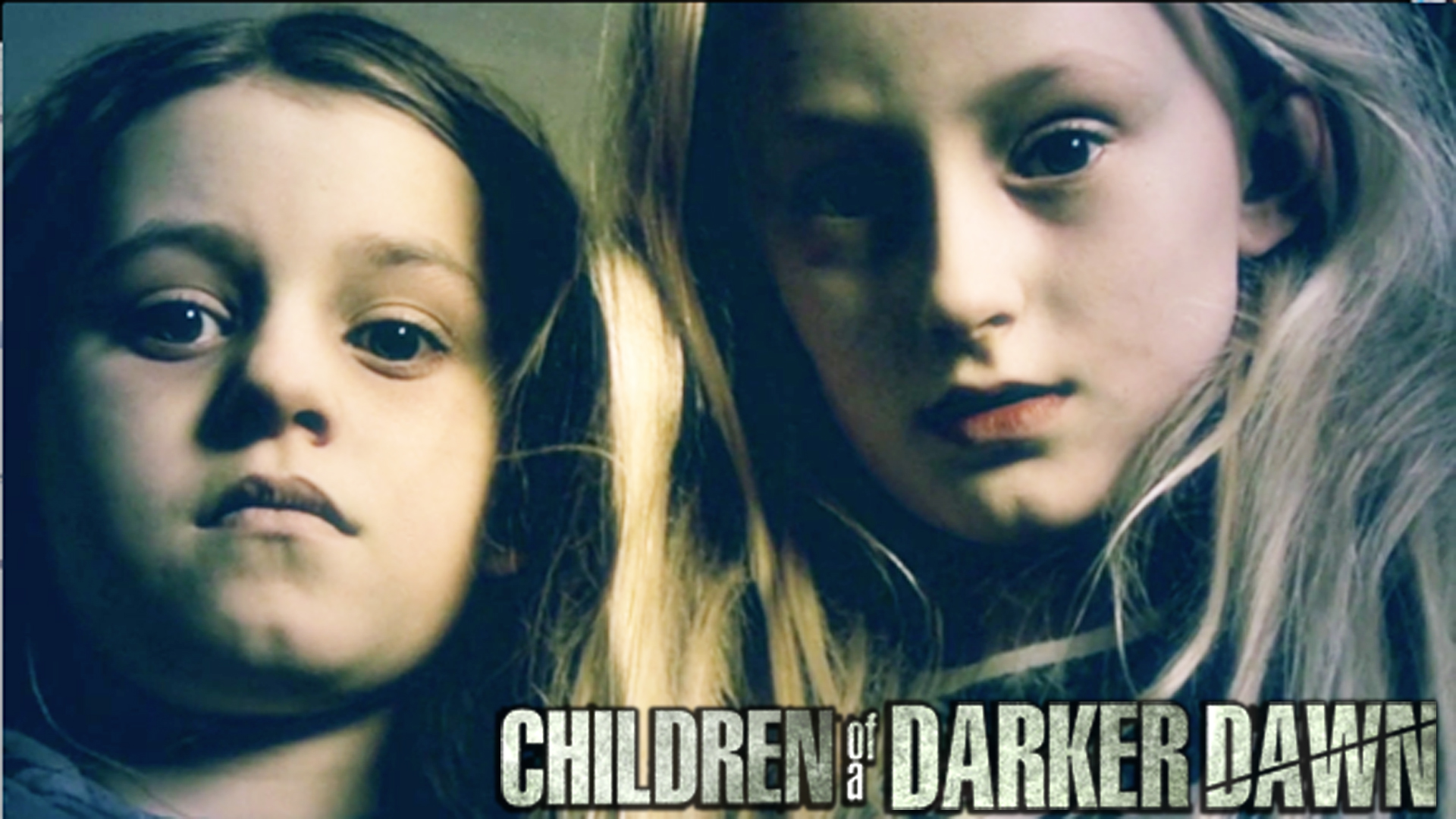
Drama, horror, sci-fi, by Jason Figgis, United States, 2012.
In a post-apocalyptic Ireland, a pandemic has wiped out the adult population, struck down by a mutant strain of flu that turns them paranoid and violent before killing them. Nine months later, the surviving children wander through abandoned buildings in search of food and shelter. Among them are Evie and her younger sister Fran, trying to survive while avoiding potentially dangerous groups of kids. Their only comfort is The Railway Children, the book their mother used to read to them. The arrival of Alice, a girl who has escaped from a gang led by her sister Kate, changes their path. After being betrayed by the gang, Evie decides to confront them, triggering a series of events that will lead to tensions and conflicts within the group.
The film, directed by Jason Figgis with limited resources but great sensitivity, is a post-apocalyptic drama that goes beyond horror, focusing on grief and the emotional fragility of its characters. The tone is somber, marked by melancholy, disturbing flashbacks, and unstable relationships. Though it recalls films like 28 Days Later, The Road, or Lord of the Flies, Children of a Darker Dawn finds its own voice through strong character development and powerful performances from its young cast.
LANGUAGE: English
SUBTITLES: Spanish, French, German, Portuguese
Why Ruin Porn Is a Confession
You have probably stood in a checkout line, fluorescent light humming overhead, watching the conveyor belt carry someone else’s groceries forward, and felt — for just a fraction of a second — the violent wish that none of it existed anymore. Not the person, not yourself, but the whole arrangement: the belt, the light, the implicit contract that you will show up tomorrow and do this again. That wish is not depression. It is something colder and more precise, and contemporary culture has been feeding it industrially since roughly 2003.
The surge in post-apocalyptic narratives that began in the early years of this century and accelerated sharply after the 2008 financial collapse was not, as critics initially assumed, a symptom of collective anxiety. Anxiety wants resolution. What these narratives offered instead was something structurally opposite: the permanent suspension of the obligation to fix things. When civilization is already ash, no one can reasonably ask you to file a report, service a debt, or pretend that the institutional machinery still deserves your maintenance. The rubble is not a warning. It is a relief.
Georg Simmel, writing in 1911 in his essay on ruins, observed that a collapsed structure achieves a kind of aesthetic peace precisely because nature has reclaimed what culture had violently organized. The ruin is, in his reading, a reconciliation. What he could not have anticipated is that this reconciliation would become mass entertainment — that audiences in the millions would pay to watch cities dissolve, grids fail, governments evaporate, because the watching itself functions as a controlled release of something they are not permitted to say in daylight. The fantasy is not survival. It is permission.
The 2008 collapse matters here as a pressure point rather than a cause. What the financial crisis did was make legible something that had been accumulating for decades: the suspicion that the system was not occasionally malfunctioning but constitutively fraudulent, held together by enforcement rather than legitimacy. Between 2008 and 2012, global post-apocalyptic media output measurably spiked — publishing data from that period shows dystopian fiction capturing a larger share of the young adult market than at any previous point in recorded sales history, while film production in the genre nearly doubled relative to the previous decade. This was not the culture processing trauma. It was the culture finding a grammar for a desire that had no other socially acceptable form.
Slavoj Zizek‘s argument in The Sublime Object of Ideology — that ideology functions most powerfully not when people believe in it but when they act as if they do, even while privately knowing it is false — maps almost surgically onto this dynamic. The audience watching a city burn onscreen has not abandoned the ideology of progress and maintenance. They go home, pay their bills, answer their emails. But for two hours they inhabited a world where the pretense had collapsed, where no one could be held responsible for upkeep because there was nothing left to keep. The fantasy and the compliance coexist. That is precisely what makes the fantasy so necessary.
By 2020, with institutions visibly strained across multiple simultaneous crises, the aesthetic reached something close to saturation — but saturation did not dilute the desire, it normalized it. A genre that once signaled countercultural unease had become prime-time comfort viewing, recommended by algorithms to people eating dinner. The ruin had been domesticated, which should register as stranger than it does: a civilization consuming images of its own destruction as a form of relaxation is not displaying pathology. It is displaying honesty about what maintenance actually costs, expressed in the only register that does not trigger social consequence.
What that cost accumulates into, over decades of quietly competent performance in a system you have privately written off, is a kind of slow interior bankruptcy that the apocalypse imagery names without ever being asked to account for.

Susan Sontag's Photographs and the Aesthetics of Collapse

You are scrolling, and the rubble looks familiar. Not because you have seen this city before, but because you have seen rubble before — in newspapers, in aid organization campaigns, in the grainy satellite images that accompany ceasefire announcements. The collapsed apartment block on your screen is fictional. The grammar that makes it feel real is not.
Susan Sontag spent the last years of her life working through a problem that most people preferred not to name: that photographs of atrocity do not necessarily produce empathy, and may in fact produce something closer to its opposite. In “Regarding the Pain of Others,” published in 2003, she dismantled the liberal assumption that exposure to suffering generates moral response. What prolonged exposure actually generates, she argued, is a peculiar form of aesthetic literacy — the viewer learns to read the image, to recognize its composition, to feel the weight of it as weight, without that weight connecting to any specific political demand. The image becomes a kind of cultural currency, circulating as evidence of seriousness rather than as a trigger for action.
Post-apocalyptic visual culture has absorbed this grammar wholesale, and the absorption is not accidental. When production designers build sets of devastated cities, they are consulting the same visual archive that documentary photographers have spent a century filling. The cracked concrete, the exposed rebar, the ash-colored sky, the single figure walking through emptiness — these are not invented symbols. They are borrowed directly from images of Hiroshima in 1945, from the Dresden photographs taken after February 1945, from the Lebanese civil war coverage of the 1970s and 1980s, from images of Sarajevo under siege between 1992 and 1996. The fictional frame does not erase the borrowed authority. It launders it. The devastation arrives pre-loaded with moral gravity, and that gravity functions as a substitute for the political content that documentary suffering originally carried.
What Sontag identified in the photograph — the way aesthetic reception crowds out political cognition — operates with even less resistance in the fictional register. At least the documentary photograph maintains an accusatory relationship with a specific cause, a specific perpetrator, a specific moment in history where intervention was still theoretically possible. The post-apocalyptic image arrives after all of that. The catastrophe has already happened. The perpetrators are diffuse or mythological. There is no government to pressure, no policy to change, no vote to cast. The viewer is invited to feel the full weight of civilizational ruin while being structurally protected from any obligation to prevent it. This is not a side effect of the genre. It is its deepest structural feature.
The philosopher Elaine Scarry, writing in “The Body in Pain” in 1985, observed that intense pain destroys language — it reduces the sufferer to a pre-linguistic state while simultaneously making the pain invisible to anyone not experiencing it. Something analogous happens to political urgency when it passes through the aesthetics of collapse. The urgency is rendered visible, even beautiful, but in the process it loses the specific referent that would make it actionable. You feel something. You feel it sincerely. And that sincere feeling circulates inside the fictional world, never finding an exit toward the actual.
There is a particular kind of audience member who watches a city burn on screen and experiences what they genuinely believe to be political consciousness. They feel the injustice of systemic failure. They feel grief for what human civilization might lose. They leave the theater or close the laptop carrying that grief as a form of identity, a signal of their capacity for moral seriousness. Sontag would have recognized the mechanism immediately. The image has done its work — not the work of awakening, but the far more comfortable work of substitution, offering the sensation of confronting catastrophe in place of the far more difficult and specific labor of confronting what is actually producing it.
The Survivor as the Last Liberal Subject
You are alone in the supermarket. The shelves are half-stripped, the fluorescent lights flicker above canned goods no one has claimed yet, and for the first time in your adult life, no one is watching you. No social contract, no supervisor, no ambient judgment of strangers. You take what you need. And something in you — something you would never confess at a dinner table — feels like freedom.
This is the secret engine of the survivor fantasy, and it has almost nothing to do with catastrophe. It has everything to do with the exhaustion of being a social creature. The post-apocalyptic lone survivor is not a figure of mourning for civilization; he is civilization’s revenge fantasy against itself, the ultimate expression of what Thomas Hobbes described in Leviathan in 1651 as the state of nature — that condition of “war of every man against every man” which Hobbes presented as a nightmare to be escaped at all costs. Contemporary culture has performed an extraordinary reversal: it has taken Hobbes’s cautionary architecture and rebuilt it as a theme park. The state of nature is no longer the abyss that makes political order necessary. It is the destination.
What makes this reversal so structurally elegant is that it arrives dressed in the vocabulary of virtue. The survivor does not want power over others; he simply wants to endure. He repairs engines, reads weather patterns, hunts without waste, moves through landscapes with a competence that modern life has systematically made impossible to develop. John Locke‘s Second Treatise of Government, published in 1689, proposed that legitimate property derived from the mixing of one’s labor with the earth — a philosophical position that sounded progressive in 1689 and has since been absorbed entirely into bourgeois mythology. The survivor enacts this myth at its most literal: he deserves what he has because he made it, built it, killed it himself. Every institution that redistributed, regulated, or mediated has been wiped clean, and what remains is the Lockean fantasy of the self-sufficient man whose sovereignty over his small patch of scorched earth needs no justification beyond his own continued existence.
The psychological literature on what Erich Fromm called the “escape from freedom” — developed at length in his 1941 book of the same name — is useful here, but not quite sufficient. Fromm argued that modern individuals, overwhelmed by the burden of radical self-determination, flee toward authoritarian structures that relieve them of choice. The survivor narrative does something more complicated: it removes the authoritarian structure while simultaneously removing the terrifying openness of genuine freedom. There is no bureaucracy to submit to, but there is also no blank slate of unlimited possibility. Survival itself becomes the authority — an authority so total, so biological, so beyond argument that it cannot be questioned or resented. The survivor is the freest man alive, and he is also the most completely governed, because every decision is already made for him by the bare fact that he must not die.
This is why the survivor archetype so reliably reinstates precisely the social hierarchies it appears to dissolve. Studies of post-disaster communities — Rebecca Solnit’s archival work in A Paradise Built in Hell, published in 2009, drawing on disasters from the 1906 San Francisco earthquake to Hurricane Katrina — document something the fiction almost never acknowledges: that actual collapse produces spontaneous mutual aid, collective improvisation, radical generosity between strangers. The lone competent male who emerges from ruins with a plan and a weapon is not a sociological observation. He is a prior ideology wearing the costume of necessity, an Enlightenment subject who has been waiting, underneath every social arrangement, for the moment when the arrangement finally falls away and reveals him — singular, legible, justified.
A Woman Trades Insulin for Bullets in Year Three
She has six vials left, maybe eight weeks of life if she stretches them with careful rationing. The man across the cracked parking lot asphalt has ammunition, clean water, and a working generator. The negotiation takes forty seconds. She walks away with bullets she cannot use alone and the knowledge that the insulin goes faster when she’s under stress, which is always now. The fiction calls this a trade. The fiction calls this survival. What it is, in fact, is a privatization of the body narrated as adventure.
Post-apocalyptic storytelling has spent forty years constructing a very specific emotional grammar around the collapse of medical infrastructure. The insulin runs out. The dialysis machine breaks. The antibiotics are looted. These events arrive in the narrative with the weight of weather — catastrophic, impersonal, and unchallengeable. The audience learns to grieve them the way one grieves an earthquake. But insulin did not become scarce in the United States because of fictional collapse. It became scarce in the actual world because of deliberate pricing architecture. In 2019, one in four American diabetics reported rationing insulin due to cost. The pharmaceutical mechanisms that produced that statistic were not asteroids. They were quarterly earnings targets.
Michel Foucault‘s lectures at the Collège de France between 1978 and 1979, later compiled as The Birth of Biopolitics, traced the moment when liberal governance stopped thinking about populations in terms of rights and started thinking about them in terms of market rationality. The body becomes a unit of investment. Health becomes a return on human capital. What Foucault identified as a nascent ideological structure in the late 1970s has since matured into the default operating logic of entire health systems — and post-apocalyptic fiction has absorbed that logic so completely that it can no longer imagine medicine existing outside a market transaction, even when the market itself is rubble.
The barter scene does something more insidious than dramatizing scarcity. It makes the audience an accomplice in a particular form of amnesia. To watch the woman trade insulin for bullets and feel the tragedy of her situation is to accept, on some pre-reflective level, that this is what medicine looks like when civilization fails. But Paul Starr documented in The Social Transformation of American Medicine, published in 1982, the decades-long political campaign by organized medicine to prevent public health infrastructure from being built in the United States in the first place — to ensure that medicine remained a private transaction long before any apocalypse arrived. The woman in the parking lot is not a vision of the future. She is a heightened portrait of a structure that already existed.
There is also a gender dimension that the fiction handles without ever naming it. Women are disproportionately represented in post-apocalyptic narratives as medical caretakers — the ones who remember which plants treat infection, who ration the last of the morphine, who negotiate for pharmaceuticals they cannot produce themselves. This is not realism. It is the projection of an existing labor arrangement onto a survival fantasy. The unpaid and invisible health labor that women perform in peacetime economies gets aestheticized in collapse fiction as a form of heroism, which is the oldest mechanism for making exploited labor appear to be a vocation. The apocalypse did not assign her this role. The world before the apocalypse did, and the fiction simply carries the arrangement forward into the ruins without questioning it.
What these narratives cannot afford to ask — because asking it would dissolve their entire emotional architecture — is why the insulin was always already a commodity. The tragedy of the barter economy depends entirely on the audience never examining the pre-collapse economy that made medicine extractable, ownable, and tradeable in the first place. The rubble is doing enormous ideological work precisely because it looks like it has destroyed all the evidence.
A vision curated by a filmmaker, not an algorithm
In this video I explain our vision
Fredric Jameson's Horizon and the Unthinkable Alternative

You have rehearsed the end of the world so many times that it no longer frightens you. You know the sequence: the silence after the last broadcast, the supermarket stripped to its metal bones, the small group moving through rubble, deciding who leads, who eats, who stays behind. You have absorbed this sequence as a kind of grammar, and like all grammar, it now operates beneath conscious thought, shaping what you can say before you open your mouth.
Fredric Jameson wrote in 2003, in “Future City,” that it seems easier to imagine the thoroughgoing deterioration of the earth and of nature than the breakdown of late capitalism. He meant it as a diagnostic, a symptom to be analyzed. What he could not fully anticipate was the degree to which the culture industry would metabolize that symptom and sell it back as entertainment, accelerating the very process he described. By the time his observation had circulated widely enough to become a talking point, the post-apocalyptic genre had already industrialized the imagination of collapse so thoroughly that the observation itself began to feel like a description of something fixed, a permanent feature of mind rather than a historical deformation of it.
The mechanism is not propaganda in any crude sense. It operates through substitution. Every hour a reader or viewer spends calculating survival logistics — water sources, coalition dynamics, the ethics of violence against the desperate stranger — is an hour not spent imagining the institutional architecture of a different world. The genre does not forbid utopian thought; it simply fills the available cognitive space with problems whose scale feels urgent and human, problems of the body, of loyalty, of immediate consequence, while systemic alternatives remain abstract, distant, slightly embarrassing to even formulate. Raymond Williams, writing in “Marxism and Literature” in 1977, called this the saturation of the thinkable — the way a dominant culture does not need to prohibit alternatives so much as ensure they never achieve the density and emotional texture that would make them feel real.
What post-apocalyptic fiction achieves, with extraordinary efficiency, is the emotional texturizing of collapse while leaving the emotional texturizing of transformation almost entirely undone. A burned city feels more real than a redesigned economy because the genre has given you the ash, the smell, the specific weight of grief, while the redesigned economy exists only as slogan or academic paper. The asymmetry is not accidental. The market for detailed, affectively rich accounts of how things fall apart is enormous; the market for equally detailed, equally embodied accounts of how different systems of organizing collective life might actually feel from the inside has never found a comparable audience, and the genre has ratified that asymmetry as though it were a law of nature rather than a commercial and ideological preference.
There is a woman in a collapsed government building somewhere in Eastern Europe, circa 2047 in the logic of a dozen different narratives, and she is making a decision about seed distribution that will determine which settlement survives the winter. The scene is vivid, morally serious, emotionally demanding. But the question it never asks — the question the genre has trained you not to ask — is why the institutional infrastructure that might have prevented the collapse was never built, never sustained, never defended as worth defending. The scene arrives after the deletion of politics. It presents the aftermath as the only available terrain for human seriousness.
Ernst Bloch spent his career, most densely in “The Principle of Hope” published between 1954 and 1959, arguing that utopian impulses survive inside apparently non-utopian cultural forms, encoded in wish-images and daydreams that point beyond their immediate surface. The post-apocalyptic genre tests that argument at its limit, because it is a form that has learned to absorb the energy of longing and redirect it entirely toward the reconstitution of what existed before — not something better, not something different, but the familiar made available again after sufficient suffering has been demonstrated.
The Historical Precedent That Fiction Keeps Erasing
You have probably never stood in the ruins of Ugarit, but if you had, you would find something that no post-apocalyptic film has ever managed to depict honestly: the evidence of people packing their belongings in organized fashion, loading carts, leaving together. The Bronze Age collapse, which unfolded between roughly 1200 and 1150 BCE, erased an entire Mediterranean system of interconnected palace economies — the Mycenaean Greeks, the Hittite empire, the coastal cities of the Levant — with a speed that still baffles archaeologists. What the clay tablets and excavated storage jars reveal is not a carnival of mutual slaughter but something far more disquieting to our inherited imagination: coordinated departure, shared logistics, communities that managed collective survival under conditions of total systemic failure.
The war-of-all-against-all is a philosophical invention, not a historical observation. Thomas Hobbes constructed his vision of natural human savagery in 1651 while living comfortably in Paris, having fled an English Civil War he chose not to endure alongside the people actually surviving it. His “state of nature” was a thought experiment dressed as anthropology, and it has functioned ever since as a permission slip — a way to pre-justify hierarchical control by insisting that without it, humans revert to predatory chaos. What is remarkable is not that this idea existed, but that it migrated wholesale into entertainment and became the default grammar of imagined catastrophe, displacing centuries of contrary evidence that was always sitting there in the historical record, unglamorous and uncinematic.
When the Western Roman Empire fragmented across the fifth century — a process formally marked by the deposition of Romulus Augustulus in 476 CE but actually unfolding across generations — the populations living through it did not experience a sudden descent into feral competition. They adapted. They reorganized around local strongmen, around bishops, around guild structures and monastic networks. The scholar Bryan Ward-Perkins, in his 2005 work The Fall of Rome and the End of Civilization, documents genuine material decline — the disappearance of mass-produced pottery, the shrinking of cattle bone size indicating nutritional regression — but this decline was generational, not apocalyptic in the cinematic sense, and it was navigated through the thickening of social bonds rather than their dissolution. People became more dependent on each other, not less.
Rebecca Solnit spent years compiling what might be the most unsettling counterargument to popular apocalyptic imagination ever assembled from empirical sources. In A Paradise Built in Hell, published in 2009, she examined the San Francisco earthquake of 1906, the Halifax explosion of 1917, the Mexico City earthquake of 1985, the September 11 attacks, and Hurricane Katrina, drawing on survivor testimony, municipal records, and sociological fieldwork to reach a conclusion that feels almost offensive in its simplicity: disasters tend to produce joy. Not despite the suffering, but alongside it. People who have lost everything frequently describe the period immediately following catastrophe as among the most meaningful of their lives — characterized by radical generosity, the dissolution of ordinary social hierarchies, and an acute sense of communal purpose that everyday life systematically suppresses. The looting and violence that media coverage treats as inevitable are, in the documented record, statistically marginal and often exaggerated by authorities whose primary concern is the restoration of order rather than the welfare of survivors.
What fiction has done with this material is not merely distort it. It has performed an active ideological service by making the Hobbesian scenario feel self-evident, biologically inevitable, the thing that would happen if the structures of civilization were removed — as though those structures exist to protect us from ourselves rather than, as the historical record persistently suggests, to manage the distribution of resources in ways that produce the scarcity and competition they then claim to be containing.
What the Genre Refuses to Show
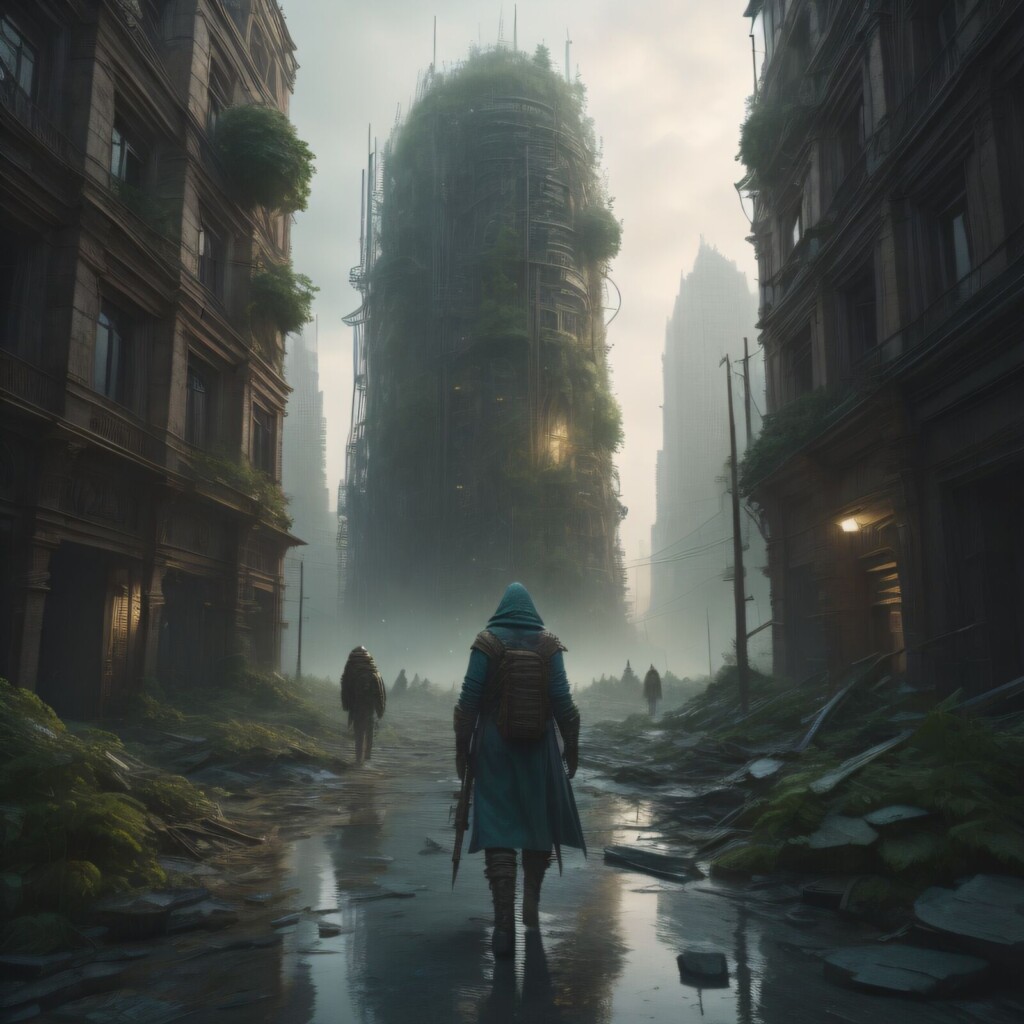
You have watched, in one form or another, a character stand at the edge of a ruined city and stare at the horizon — and the camera lingers there, on that silhouette against the ash, as if the standing itself were the achievement.
The genre is obsessed with survival as a terminal condition. It constructs elaborate grammars of scarcity, violence, and endurance, then stops precisely at the threshold where something harder would have to begin. What post-apocalyptic narrative consistently refuses to dramatize is the morning after the morning after — not the first fire lit in the ruins, but the third consecutive meeting where survivors argue about water allocation and someone walks out in anger and has to be brought back. The genre will follow a lone wanderer across five hundred miles of irradiated wasteland but loses all narrative appetite the moment the question becomes: how do you write a constitution when half the room doesn’t trust the other half and everyone has a different memory of what destroyed the world in the first place?
This is not an aesthetic accident. Max Weber, in his 1919 lecture “Politics as a Vocation,” drew the distinction between the ethics of conviction and the ethics of responsibility — the first driven by moral purity, the second by the unglamorous obligation to account for consequences within imperfect systems. Post-apocalyptic fiction is almost exclusively a literature of conviction. Its heroes act from instinct, loyalty, and raw will. They are almost never administrators, mediators, or the kind of people who spend six hours debating whether a new community’s decision-making process should be consensus-based or representative. Those people, Weber understood, carry the actual weight of political life — and they are almost entirely invisible in the genre.
What fills the space where institutions should be is almost always a single charismatic figure: the warlord, the prophet, the reluctant leader who discovers his natural authority in crisis. Robert Michels documented this tendency in 1911 in “Political Parties,” calling it the iron law of oligarchy — the structural drift of every collective organization toward concentrated authority, regardless of its founding ideals. Post-apocalyptic fiction doesn’t critique this drift. It celebrates it. The strongman is not a warning; he is the protagonist. The genre renders centralized, personal power as the only legible response to collapse, which means it has already decided, before the story opens, that horizontal reconstruction is either impossible or unworthy of imagination.
Rebecca Solnit’s 2009 work “A Paradise Built in Hell” documented something the genre has almost no interest in: the extraordinary social solidarity that emerges in the immediate aftermath of real disasters. The San Francisco earthquake of 1906, the Halifax explosion of 1917, the Mexico City earthquake of 1985 — each produced spontaneous mutual aid networks, collective kitchens, improvised governance structures built not on domination but on proximity and shared need. These moments are historically dense, emotionally complex, and narratively rich. They are also nearly absent from the cultural imagination of what collapse looks like, because they require the audience to believe that ordinary people, without a chosen one to follow, are capable of building something worth having.
The silence is ideological in the precise sense — not a conspiracy but a horizon, the boundary of what a culture can picture as desirable. When a genre systematically refuses to render a certain future as imaginable, it trains its audience to find that future unthinkable, and eventually to find its absence natural. The post-apocalyptic canon does not merely reflect a pessimism about institutions; it actively reproduces the conditions for that pessimism by never once showing what it would look like to do the slow, unglamorous, argument-filled work of rebuilding trust between strangers who have every reason not to extend it — and who do it anyway, imperfectly, without a hero to follow.
🌍 When the World Ends: Culture, Survival, and Ruins
The post-apocalyptic imagination is not merely a genre convention — it is a mirror held up to contemporary anxieties about civilization, power, and what it means to remain human after collapse. From dystopian surveillance to the philosophy of ruins, these articles trace the cultural roots of our fascination with the end of the world.
Orwell’s 1984: Big Brother and Total Surveillance
George Orwell‘s 1984 remains one of the most chilling blueprints for post-apocalyptic governance, imagining a society rebuilt on total control, propaganda, and the erasure of memory. The novel anticipates the surveillance culture that haunts contemporary dystopian fiction, from The Road to Station Eleven. Big Brother is not merely a character — he is the architecture of every totalitarian wasteland that comes after.
GO TO THE SELECTION: Orwell’s 1984: Big Brother and Total Surveillance
Huxley’s Brave New World: Meaning and Analysis
Aldous Huxley‘s Brave New World offers a post-collapse scenario that is perhaps more unsettling than Orwell’s: a world not destroyed by violence but sedated into submission through pleasure, conditioning, and the abolition of meaning. This vision resonates deeply with post-apocalyptic narratives that question whether technological comfort is itself a form of civilizational ruin. Huxley forces us to ask what exactly we are trying to rebuild — and whether it was ever worth saving.
GO TO THE SELECTION: Huxley’s Brave New World: Meaning and Analysis
Spengler’s The Decline of the West: Analysis
Oswald Spengler‘s monumental work The Decline of the West provides one of the most influential philosophical frameworks for understanding civilizational collapse, arguing that cultures follow organic cycles of birth, flourishing, and inevitable decay. His vision of history as a series of dying worlds prefigures the aesthetic and moral landscape of post-apocalyptic storytelling. In Spengler, the apocalypse is not an event but a long, slow cultural twilight.
GO TO THE SELECTION: Spengler’s The Decline of the West: Analysis
Ruins in Photography: The Fascination of Time That Devours
The photography of ruins captures something essential about the post-apocalyptic imagination: the beauty and melancholy of time devouring what human hands once built. Ruin photography transforms abandoned factories, collapsed houses, and overgrown cities into visual meditations on fragility, hubris, and the persistence of nature. These images are the still frames of every post-apocalyptic film — the world after the credits have already rolled.
GO TO THE SELECTION: Ruins in Photography: The Fascination of Time That Devours
Discover the Cinema That Dares to Imagine the End
If these themes ignite your curiosity, Indiecinema streaming is home to a curated selection of independent and visionary films that explore collapse, survival, and the reinvention of the human. Step beyond the mainstream and discover the cinema that asks the hardest questions — only on Indiecinema.
👉 EXPLORE THE CATALOG: Watch Indie Films in Streaming
A vision curated by a filmmaker, not an algorithm
In this video I explain our vision

