
The Body Before the Doctrine
You are sixteen hours into a shift that began before the city had light, and your hands have stopped belonging to you. They move — pulling, feeding wire into the machine, pulling again — but the sensation ended sometime around the fourth hour, replaced by a dull current that travels up to the elbow and dissolves there. The foreman walks the floor every twenty minutes. You do not look up when you hear his boots. Looking up costs something you cannot afford.

This is northern Italy in 1882, and the textile mills of Milan’s Porta Ticinese district are running at maximum capacity because the unified Italian state needs to prove itself industrially viable, and that proof is extracted directly from the tissue of the people feeding its machines. The average working day in these factories runs between twelve and sixteen hours depending on the season, the order volume, and the particular appetite of whoever owns the building. Children work alongside adults — the census of 1881 recorded over a hundred thousand minors employed in Italian manufacturing — and the wage structure is designed so that a single income cannot sustain a family, which guarantees that multiple bodies from the same household will sell themselves to the same floor. This is not a failure of the system. It is the system working exactly as intended.
What matters here, before any pamphlet gets written, before any German theorist gets translated and passed around in a back room, is that the body knows. It knows before consciousness articulates the injustice. It knows in the spine after the fourteenth hour, in the inflammation of the wrists, in the persistent cough from cotton fiber suspended in unventilated air. The physiologist Angelo Mosso documented fatigue systematically in his 1891 work La Fatica, measuring the muscular degradation of Turinese workers with instruments he built himself, and what his data showed was that the human organism under these conditions does not simply tire — it begins to consume itself, breaking down protein reserves, shortening recovery curves, aging at an accelerated biological rate. The factory was not a place where workers spent their time. It was a place where workers spent themselves.
What organizes people first is not solidarity as an idea but pain as a shared frequency. The early mutual aid societies that proliferated in the industrial north during the 1850s and 1860s — the Società di Mutuo Soccorso, of which there were already over four hundred registered in Piedmont alone by 1862 — were not the product of ideological conversion. They were the product of the recognition that illness, injury, and death were arriving with a regularity that individual families could not absorb. A man loses three fingers to a mechanical loom. His wife takes in washing. The children eat less. The neighbor, who watched this happen, understands without reading a word of political theory that the next maimed body could be his, and that no one standing above him in the building’s hierarchy will intervene. What forms is not a movement. Not yet. What forms is a collective instinct for self-preservation, the same biological logic that makes wounded animals crowd together.
The Italian state in this period is barely two decades old, assembled from disparate kingdoms, duchies, and papal territories through a unification process completed in 1871, and its labor legislation is essentially nonexistent. The Albertine Statute of 1848, which served as the constitutional backbone of the new kingdom, guaranteed property rights with extraordinary precision while saying nothing coherent about the conditions under which human beings could be forced to operate machines. This was not an oversight. Liberal jurisprudence of the period operated on the philosophical premise that the worker and the employer met as free and equal contracting parties, a fiction so grotesque that it required active intellectual effort to maintain — and the Italian ruling class maintained it with considerable dedication, because the alternative was admitting that the foundation of industrial accumulation was coercion dressed in the language of consent.
Mutual Aid as Insurgent Infrastructure
You are sitting in a dim room in Turin, 1857, surrounded by men who smell of iron filings and tallow, and you are signing your name to a document that says: if you fall, we catch you. No priest brokered this covenant. No employer authorized it. The state did not recognize it as anything more than a fraternal club, which is precisely why it was dangerous.
The Società di Mutuo Soccorso proliferated across the Italian peninsula in the decades before unification with a speed that confounds any narrative in which organized labor begins with the factory and the union hall. By 1862, there were over four hundred of these societies operating in Piedmont alone, with combined memberships that the historian Stefano Musso has estimated in the tens of thousands — artisans, printers, hat-makers, coopers, men whose trades were still anchored to the guild world even as industrial capitalism was beginning to dissolve that world beneath their feet. They pooled small weekly contributions to cover illness, injury, death, the sudden absence of a wage that stood between a family and the street. The mechanism was modest. The premise underneath it was not.
What the mutual aid society did, structurally, was refuse a foundational axiom of bourgeois political economy: that poverty is the failure of the individual, that the man who cannot feed his children has made some private error of character or providence. Ricardo had framed wages as the outcome of natural law. Malthus had consecrated misery as the arithmetic of population. The men in that Turin room were not reading Ricardo, but they were contradicting him every time they voted to pay a sick member’s rent — they were insisting, in practice, that the suffering of one was a collective problem requiring a collective answer, which is a political claim even when it wears the clothes of charity.
Carlo Cattaneo never described himself as a socialist. He was a Milanese intellectual, a federalist, a man whose primary obsession was the emancipation of Italian civic life from the despotic centralism he saw encoded in both Austrian rule and in the Piedmontese model of unification that Cavour was engineering. But his 1858 writings on self-governing communes, particularly in the journal Il Politecnico, articulated something that made horizontal solidarity intellectually legible before it had a Marxist vocabulary: the idea that the primary unit of freedom is not the individual standing before the state, but the association of equals that governs its own affairs. Cattaneo’s federalism was a theory of distributed power, and what the mutual aid societies were building, without knowing they were building anything theoretical, was exactly that — power distributed so finely across a network of ordinary men that no single authority could locate its center to extinguish it.
This is why the ruling classes of the pre-unified states treated these societies with an unease disproportionate to their apparent harmlessness. They gave out bread. They paid doctors. They buried their dead. And yet the Piedmontese interior ministry kept detailed surveillance files on the larger ones, because officials understood, at some instinctive administrative level, that an institution which teaches men to trust each other laterally — rather than vertically, toward a patron, a priest, a padrone — is training them in something that will eventually become inconvenient. The habit of horizontal trust is the precondition for every other form of collective action. You cannot build a strike without it. You cannot sustain a union without it. You cannot hold a political organization together under repression without the muscle memory of mutual obligation that these societies were encoding into working-class culture years before the First International held its inaugural meeting in London in 1864.
Marx would arrive. The factory system would scale. The vocabulary of class struggle would sharpen into something with edges. But the infrastructure it required had already been quietly assembled by men who thought they were only keeping each other alive.

The Biennio Rosso and the Limits of Spontaneity

You walk into the factory on a Tuesday morning in September 1920 and the gates are already closed from the inside. The foreman is gone. In his place, a worker you have known for eleven years is holding a ledger and making decisions about production schedules. The machines are running. The orders are being filled. The capitalist has been, for all practical purposes, made redundant, and nobody has fired a single shot.
This was not a metaphor and not an isolated incident. Between 1919 and 1920, roughly 600,000 workers across northern Italy — concentrated most densely in the metalworking plants of Turin and Milan — occupied their factories and attempted to manage them as autonomous productive units. The movement had its own internal logic: worker councils had been forming in FIAT and Lancia plants since early 1919, drawing energy from a combination of wartime exhaustion, inflationary collapse, and the gravitational pull of what had just happened in Russia two years prior. These were not mobs. They maintained production, organized technical committees, and in some cases improved output. The Piedmontese industrialists sat in their drawing rooms calculating how long their liquidity could hold.
What collapsed the Biennio Rosso was not the lockout that eventually followed, nor the squadrismo that would coalesce into fascism within eighteen months. Those were the instruments of termination, not its cause. The cause was internal and structural, and it was named with clinical precision by a twenty-nine-year-old Sardinian journalist writing in a small Turin weekly called L’Ordine Nuovo. Antonio Gramsci, in a series of articles published between 1919 and 1920, argued that the factory councils were genuine organs of proletarian self-governance but that they existed in a vacuum. They had seized economic space without possessing what he would later theorize, from a prison cell in the 1930s, as hegemony — the capacity to generate consent, to build institutions, to transform the cultural and intellectual assumptions of a society rather than simply interrupting its productive routines.
The distinction Gramsci drew was between a class that had taken power over things and a class that had not yet constructed the apparatus to take power over meanings. A factory council could decide how many axles to manufacture in a given week. It could not, by itself, rewrite the relationship between the Northern industrial worker and the Southern peasant, who remained largely unmobilized and whose support would have been necessary for any national political project. It could not dissolve the institutional loyalty of the army, the judiciary, or the Catholic Church, whose social authority over millions of Italians was not diminished by the fact that a turbine hall in Turin was being run by a committee. Gramsci was not despairing about this — he was diagnosing it.
The Italian Socialist Party, which should have been the political organ capable of converting factory momentum into durable counter-power, did neither. It observed. Its leadership was divided between maximalists who believed capitalism would collapse under its own contradictions without needing to be pushed, and reformists who feared that pushing too hard would produce exactly the reaction it eventually did produce. By the time the occupation movement needed a political spine, the PSI offered only a theoretical discussion. The workers who had managed production for weeks returned to work under conditions barely distinguishable from those they had left.
There is something almost unbearable about the precision of that failure, because the material conditions were in some ways more favorable than they would ever be again. Industrial production had concentrated thousands of workers in single sites. Wartime had already created habits of collective organization and sacrifice. The employers were genuinely frightened. And yet the moment dissolved — not because the workers lacked courage or competence, but because spontaneous seizure of economic function, however disciplined, cannot substitute for the patient construction of institutions that reshape what ordinary people understand as possible, legitimate, and permanent.
Fascism as a Labor Relations Settlement
You are sitting in a factory in Turin in 1921, and the man across the table from you is not a politician. He is a manufacturer, and he has just watched his workers occupy his plant for twenty-six days, run it themselves, elect their own internal commissions, and demonstrate — to his face — that the machinery did not require him. What he feels is not wounded patriotism. It is something older and more precise: the terror of disposability.
The Biennio Rosso, the two red years of 1919 and 1920, produced something Italian liberalism had no framework to process. Roughly half a million workers across the northern industrial triangle had demonstrated a capacity for autonomous self-organization that exceeded anything the moderate socialist leadership had anticipated or, crucially, desired. Giovanni Giolitti, the architect of liberal Italy’s accommodation politics, attempted negotiation and failed to contain what the factory councils represented — not a demand for higher wages but a claim on productive power itself. The liberal state did not fall because it was weak. It stepped aside because it had no answer to a question it had never expected to be asked so directly.
Fascism answered it. The answer came not first in ideology but in financing. Between 1920 and 1922, the major industrial associations of Lombardy and Piedmont — Confindustria, formalized in 1910 and reorganized precisely in this period — transferred substantial funds to the fasci di combattimento. The agrarian squadrismo that burned labor halls and murdered union organizers in the Po Valley was not a spontaneous eruption of veterans’ resentment. It was a priced service. Angelo Tasca documented this systematically in his 1938 study Nascita e avvento del fascismo, written in exile with the cold precision of someone who had no reason left to be polite about it. The violence was targeted: not at parliamentary institutions, not at the monarchy, not at the church, but at the capillary network of labor organization — the Chambers of Labor, the cooperative federations, the mutual aid societies that had taken forty years to build.
The juridical settlement came in 1926 with the Rocco Law, named after Alfredo Rocco, a nationalist jurist whose intellectual genealogy runs directly through the anti-socialist corporatism of the early twentieth century. The law abolished free trade unions and replaced them with state-recognized syndicates incorporated into the corporatist apparatus — bodies that could not strike, could not independently negotiate, and whose leadership was subject to government approval. What this produced was not the elimination of the labor relationship but its radical asymmetry: capital retained its organizational autonomy inside Confindustria while workers were processed through a state structure designed, in Rocco’s own language from his 1925 speech to the Chamber of Deputies, to “overcome class conflict by subordinating it to the national interest.” The national interest, in this grammar, meant the prerogatives of production.
Benedetto Croce voted against the Rocco Law and spent the Fascist decades as Italy’s most visible liberal dissident, a position that history has been too generous in rewarding. His framework — Fascism as a “parenthesis,” an irrational interruption of Italy’s liberal progress — required that the industrialists who financed the squads be treated as victims of a political pathology rather than as rational actors managing a labor crisis. Croce’s idealism, his insistence that history moves through the progressive development of freedom as a spiritual force, made it structurally impossible for him to see Fascism as a solution, because solutions imply problems, and the problem here was a working class that had briefly held power and been told, by coordinated violence and juridical architecture, that it had never been entitled to it.
What the corporatist settlement buried was not simply union rights but the institutional memory of a different possible arrangement — the knowledge, lived and organizational, that workers had demonstrated in those occupied factories, that production could be directed without the people who owned it.
The Cold War Split and the CGIL Fracture
You are sitting in a union hall in Turin in the autumn of 1948, and the man beside you is no longer your comrade. He is a Catholic, and you are a communist, and somewhere between those two words the shared memory of strikes, of factory occupations, of partisan fighting in the hills above the city has been quietly dissolved. You did not choose this. It was chosen for you, with a precision you will only begin to understand decades later.
The fracture of the Confederazione Generale Italiana del Lavoro into three separate federations between 1948 and 1950 is routinely narrated as a story of ideological incompatibility — as though workers spontaneously discovered that their doctrinal differences were too vast to sustain a single organization. The historical record is considerably less innocent. The American Federation of Labor, directed in its international operations by Jay Lovestone, a former Communist Party member turned ferocious anti-communist, had been funneling money and strategic guidance into Italian labor politics since 1944. When the Marshall Plan was formally launched in 1948, it came with explicit labor conditions: American aid was linked to the expectation that recipient countries would restructure their union movements away from communist influence. The Italian state, desperate for reconstruction capital, was not in a position to refuse. The CISL, born from the Christian Democratic faction that walked out of the CGIL in 1948, received direct financial support from American sources, a fact documented by historians including Federico Romero in his 1989 study of American labor diplomacy in postwar Europe.
The Vatican’s intervention operated through a different register but toward the same structural end. Pope Pius XII had already framed Italian communism as a theological emergency, and the Church’s organizational infrastructure — parish networks, Catholic Action, the Democrazia Cristiana itself — became the delivery mechanism for a message that made union membership a question of spiritual allegiance rather than economic interest. A worker who joined the CGIL was not merely making a tactical choice about collective bargaining; he was, within this framework, placing himself outside the community of the faithful. The UIL, smaller and nominally social-democratic, completed the tripartite structure, ensuring that even non-Catholic dissent from communist-led unionism had an institutional home that further diluted class solidarity.
Gino Germani, the Italian-Argentine sociologist whose Struttura Sociale dell’Italia (1955) remains one of the sharpest diagnostics of postwar Italian society, offered a framework for understanding what had actually happened. Germani’s work on political cleavages demonstrated that in societies undergoing rapid and traumatic modernization, identity attachments rooted in religion, region, and historical memory consistently overpower rational calculations of material interest. Anti-communism in postwar Italy was not a position workers arrived at by analyzing their wages and conditions; it was a pre-cognitive loyalty, a tribal marker inherited from the wreckage of fascism and the terror of civil war. Workers in the Veneto who had watched partisan violence up close did not need economic arguments to distrust the CGIL. They needed to belong to something that was not that, and the CISL gave them a container for an emotion that predated any theory.
What this engineered pluralism accomplished, in practical terms, was the permanent weakening of Italian labor’s negotiating position at precisely the moment when the economic miracle of the 1950s was generating industrial profits at an extraordinary rate. Between 1950 and 1963, Italian GDP grew at an average annual rate above five percent, a transformation built substantially on low labor costs and a workforce whose capacity for unified resistance had been architecturally dismantled. The division was not a consequence of ideological freedom; it was the price exacted for dollars, and the workers paid it with their wages while the language used to justify it spoke exclusively of democracy and faith, two words that have rarely been deployed with such geometric coldness in the service of someone else’s interests.
A vision curated by a filmmaker, not an algorithm
In this video I explain our vision
The Hot Autumn and the Refusal of Work

You are on the line and the line has not stopped since 4:47 this morning. The body knows the rhythm before the mind does — left hand, bolt, right hand, torque, advance three feet, repeat — and somewhere between the four-hundredth and four-hundred-and-first repetition, something in you goes quiet in a way that is not peace. You came from Calabria at nineteen with a cousin’s address folded inside your shoe, and Torino received you the way a machine receives raw material: without ceremony, without curiosity, without the faintest interest in what you carried inside. But it is the autumn of 1969, and this morning someone stopped. Not because of injury, not because of a supervisor’s whistle. He simply stopped, and three men next to him stopped with him, and then the line itself — the great indifferent line — had no choice but to stop too.
What happened at Mirafiori between the summer of 1969 and the following spring cannot be understood as a labor dispute in any conventional sense. It was not a negotiation over wages that happened to become confrontational. It was the discovery, repeated daily across dozens of departments and thousands of workers, that the refusal of cooperation was itself a form of power — perhaps the most fundamental form, because it did not request anything from anyone. The wildcat strikes spreading through the FIAT plants that year involved more than 300,000 workers across northern Italy in coordinated and spontaneous actions that no union had planned and no leadership had authorized. The factory councils that emerged from the shop floors — the consigli di fabbrica — were not representative bodies in the parliamentary sense. They were the floor itself speaking, organized around the unit of production rather than the category of trade.
Mario Tronti had published Operai e Capitale in 1966, and its core provocation was philosophically precise and historically scandalous in equal measure: the working class is not the passive object of capitalist accumulation but its necessary and antagonistic subject. Capital does not simply exploit labor — it depends on labor’s cooperation to function at all, which means that labor’s withdrawal of cooperation is not a disruption of the system but an exposure of the system’s structural vulnerability. This inverted the entire tradition of socialist victimology. The worker was not a martyr waiting for emancipation from outside. The worker was the force that capital could not do without, which meant the worker held a weapon that required no army, no vanguard party, no theory of historical stages — only the organized willingness to stop.
For the young man from Calabria on that assembly line, the political theory arrived not as text but as sensation. He had been told, implicitly and explicitly, that his value was located entirely in his compliance — that to be a good worker in the north was to erase the south from his body, to work without complaint, to be grateful for the noise and the cold and the foreman’s contempt. The moment he understood that his refusal carried the same weight as the refusal of the man beside him — the man from Turin, the man from Sicily, the man whose dialect he could not follow — the hierarchy of origins dissolved into something horizontal and immediate. Collective power did not require that he become someone else. It required only that he remain present and refuse in concert.
What the Hot Autumn produced structurally was not a revolution but something arguably more disorienting for capital: a generation of workers who no longer believed that productivity was a neutral obligation. The Statuto dei Lavoratori, passed in May 1970, encoded into law a set of protections — against arbitrary dismissal, for union presence inside the factory, for assembly rights on company time — that would have been legally unthinkable a decade earlier. Law followed force, as it almost always does, with a delay designed to look like deliberation.
The Wage as Epistemology
You have spent years calculating what you are worth, and the number has always come back as an hourly rate.
Not a measure of your attention span, not a record of what you have built or destroyed or imagined, but a wage — a figure that arrived through negotiation, collective or otherwise, and then quietly became the grammar through which you understood your own usefulness. André Gorz diagnosed this with a precision that still feels uncomfortable: in his 1980 Farewell to the Working Class, he argued that the wage relation does not merely describe a labor market transaction, it produces a subject. The worker who fights for higher wages is not resisting capitalism — he is deepening his dependency on the only framework that makes his demands legible. To ask for more within the wage relation is to confirm that the wage relation is the correct measure of human life.
Italy offers one of the cleanest case studies for watching this confirmation happen through law rather than violence. The Statuto dei Lavoratori, passed on May 20, 1970, under Labor Minister Giacomo Brodolini and finalized after his death by Carlo Donat-Cattin, was the legislative crystallization of everything the Hot Autumn had demanded. It guaranteed the right to organize inside factories, prohibited employer surveillance, established reinstatement as the remedy for unjust dismissal under Article 18, and gave workers a legal vocabulary for dignity that had not previously existed in Italian civil society. It was, by any standard, a genuine expansion of rights. And it was also, structurally, a massive act of institutionalization — a translation of insurgent energy into a form the state could recognize, manage, and slowly make permanent.
What the Statuto did not do, and was never designed to do, was question the wage as the organizing premise of that dignity. The law protected workers who had wages, in workplaces where wages were paid, within contracts that a union could certify. The dignity it codified was the dignity of the wage earner specifically, which meant that the enormous population of informal workers, agricultural day laborers, domestic workers — disproportionately women and migrants — existed in a legal penumbra the Statuto did not illuminate. Rights expanded at the center and the margin stayed dark. This is not an accident of oversight but a structural feature of any legal framework that takes the employment relation as its foundational unit: it must exclude everything that doesn’t fit the form.
The Italian Communist Party understood this tension but could not resolve it. Palmiro Togliatti’s via italiana al socialismo — the strategic commitment to winning power through parliamentary institutions rather than rupture — meant that the PCI consistently channeled workers’ demands into forms the republic could absorb. When Enrico Berlinguer developed the compromesso storico after 1973, proposing a governing alliance with the Christian Democrats, he was not betraying the working class so much as following the internal logic of a politics that had always treated the wage relation as the foundation of democratic participation rather than one of its obstacles. The party that most represented Italian workers also most reliably translated their energy into institutional form.
What gets lost in that translation is not just militancy but a certain kind of knowledge. Michel Foucault noted in his 1978-79 lectures at the Collège de France, published as The Birth of Biopolitics, that neoliberal thought reconfigures the worker as human capital — an investor in themselves whose wages are the return on that investment. The Italian case shows the earlier move: before the worker can be recast as investor, they must first be fully constituted as wage earner, their worth made unthinkable outside that register. The Statuto did not cause this — the factory system had been doing it for a century — but law, when it arrives to protect you inside a structure, also tells you that the structure is where you belong.
Precarity as Historical Amnesia
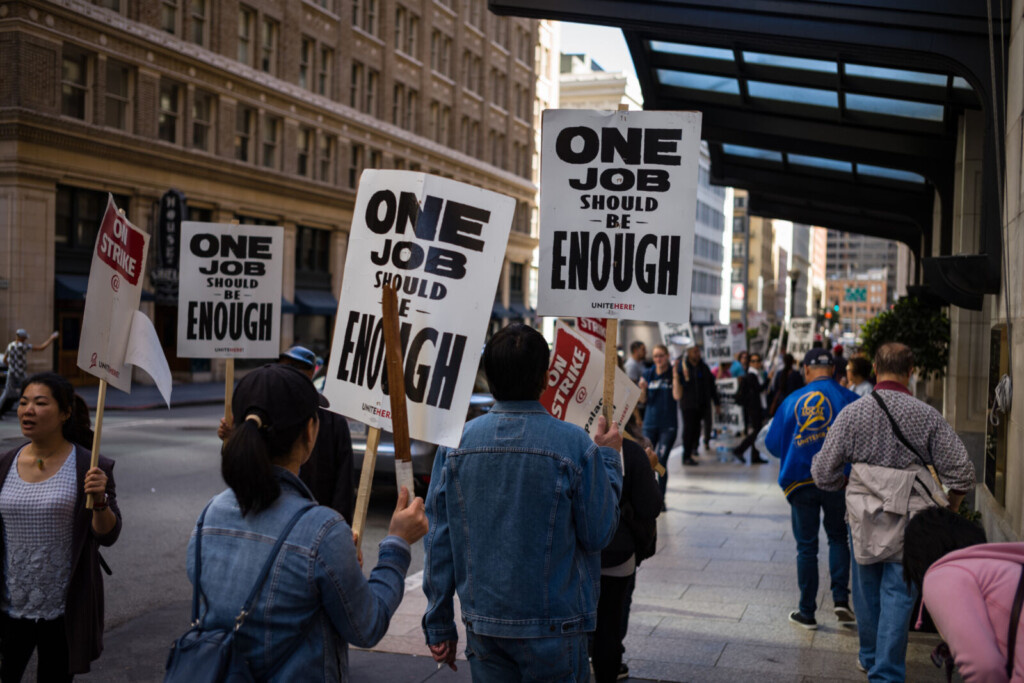
You sign the contract on a Tuesday morning, in a glass office that smells of printer toner and ambition, and the word they use is “opportunity.” Flexible hours, they say. Project-based. A chance to prove yourself in a dynamic environment. No one in that room mentions the word precarity, because precarity, in the vocabulary of the early 2000s Italian labor market, had been laundered into something aspirational, something that belonged to the future rather than to a regression so complete it had circled back past the postwar settlements and landed somewhere near the piecework arrangements of the 1920s.
The Pacchetto Treu of 1997 and the Legge Biagi of 2003 were not violent ruptures. That is precisely what made them so effective. They arrived dressed in the language of European convergence, of competitiveness, of unlocking a labor market described as rigid — rigid being the pejorative assigned to any system in which workers had managed to accumulate leverage. The word modernization did the heaviest ideological lifting, because modernization carries within it an implicit accusation: that whoever resists it is provincial, nostalgic, afraid of the future. What the framing suppressed was that the protections being dismantled — stable contracts, restrictions on arbitrary dismissal, contributions to pension continuity — had not been designed by enlightened legislators in a mood of generosity. They had been extracted, over decades, through strikes that paralyzed whole industrial sectors, through occupations that left factory managers sleeping in their cars, through a bargaining power that only existed because workers had been willing to make production stop.
Pierre Nora, writing in the 1980s in the opening volumes of Les Lieux de Mémoire, described a particular civilizational shift: the moment when living memory — transmitted through bodies, practices, rituals of conflict — gives way to archived memory, institutionalized and inert. The distinction he drew was not sentimental. A lieu de mémoire, a site of memory, emerges precisely when the community that once embodied a tradition is no longer there to animate it, so the trace is preserved in a monument or a date while the living knowledge bleeds out. Italian labor institutions underwent exactly this transformation. The statute of workers’ rights encoded in the Statuto dei Lavoratori of 1970 was a lieu de mémoire long before it was formally revised — a document that still bore the names of the battles that produced it, while the generation capable of feeling those battles as lived inheritance was being succeeded by one for which the text was simply background noise, a legal artifact of uncertain origin.
What the reforms of the late 1990s and early 2000s accomplished, beyond their measurable economic effects, was a severance of genealogy. A worker hired on a co.co.co contract, a collaborazione coordinata e continuativa, had technically entered the world of Italian labor law. The forms were present. The terminology gestured toward a system of protections. But the substance had been hollowed in a way that was nearly impossible to contest, because the contestation required knowing what the original fullness had looked like, and that knowledge was no longer transmitted anywhere — not in schools, not in workplaces drained of union density, not in a public discourse that had reclassified collective memory of labor struggle as ideological residue unfit for a post-ideological age.
A generation raised on flexibility did not simply lack job security. It lacked the cognitive framework to identify insecurity as a political condition rather than a personal one, to recognize that the exhaustion of the gig economy had a history and therefore, in principle, an alternative. The forgetting was not accidental, and it was not innocent, because a working class that cannot read its own past cannot locate itself inside a story that is still being written.
✊ Labor, Power, and the Struggle for Dignity
The history of the Italian labor movement is inseparable from the broader European story of class conflict, social transformation, and the fight for workers’ rights. These related articles trace the ideological, economic, and human roots of that struggle — from the philosophy of exploitation to the literature of resistance.
Balestrini’s We Want Everything: Analysis
Nanni Balestrini‘s novel We Want Everything is a raw, first-person account of the factory worker experience during Italy’s Hot Autumn of 1969, when mass strikes shook the industrial north. The book captures the rage and collective consciousness of assembly-line workers who refused to be reduced to mere instruments of production. It remains one of the most powerful literary documents of the Italian labor movement.
GO TO THE SELECTION: Balestrini’s We Want Everything: Analysis
Karl Marx and Alienation: Economic and Philosophical Manuscripts
Karl Marx’s concept of alienation, developed in his Economic and Philosophical Manuscripts, provides the philosophical backbone for understanding why workers organize and resist. Marx argued that industrial labor estranges workers from the product of their work, from the act of production itself, and ultimately from their own humanity. This theoretical framework has shaped every major labor movement in modern history, including Italy’s.
GO TO THE SELECTION: Karl Marx and Alienation: Economic and Philosophical Manuscripts
Guy Standing’s The Precariat: Analysis
Guy Standing’s The Precariat introduced a landmark concept for understanding the fragmentation of contemporary labor: a new social class defined by chronic insecurity, flexible contracts, and the erosion of workers’ rights. The book reads as both a sociological diagnosis and a political warning, directly relevant to understanding how the gains of twentieth-century labor movements have been systematically dismantled. Standing’s analysis connects historical struggles to present-day working conditions.
GO TO THE SELECTION: Guy Standing’s The Precariat: Analysis
Discover the Cinema of Resistance on Indiecinema
If the history of labor and social struggle moves you, Indiecinema is your destination for independent films that give voice to the marginalized, the organized, and the defiant. Stream documentaries, political dramas, and auteur cinema that dig beneath the surface of power — because great cinema, like great strikes, changes how you see the world.
👉 EXPLORE THE CATALOG: Watch Indie Films in Streaming
A vision curated by a filmmaker, not an algorithm
In this video I explain our vision

