
The Woman at the Well
You see her before you understand what you are seeing. Something at the edge of the corridor, low to the ground, moving in a way that does not correspond to any motion a body should make. The hair is black and wet and it falls across her face in ropes, and the white of her burial garment catches no light because there is no light for it to catch, only the particular darkness of a space that should be familiar to you and suddenly is not. Your legs have already decided. Your chest has already tightened into a knot that language cannot reach. This is not fear in the way you use that word when a car cuts across your lane. This is something older and more structural, something that precedes your personality and your opinions and your specific biography. Your body knows this figure. It has always known her.

What arrests you is not the supernatural element. It is the recognition. Somewhere beneath the panic, beneath the involuntary retreat of your nervous system, there is a horrible sense of familiarity — not that you have seen her before, but that she was always going to be here, that this encounter was written into the architecture of the place long before you arrived. The woman with wet hair dragging herself toward you across a floor does not feel like an intrusion into reality. She feels like a correction of it. As though reality had been, until this moment, slightly false.
The figure of the onryō in Japanese cultural history is not a ghost in the Western sense — not a soul confused about its own death, not an unfinished conscience wandering toward resolution. She is something far more precise and far more dangerous: she is a woman who died in a state of violent emotional extremity — jealousy, grief, betrayal — and whose passion was so total that it refused to be extinguished by the mere fact of her body ceasing to function. The word itself, onryō, compounds the characters for “grudge” or “resentment” and “spirit,” and the specificity of that compound matters enormously. Not a ghost of loss. A ghost of grievance. The distinction is not rhetorical. It carries the entire weight of what she is and what she wants.
Her formal appearance in Japanese literary culture predates the printed page. The Heian period, stretching from 794 to 1185, produced the conditions in which she crystallized as a cultural figure. Court society during those centuries was governed by extraordinary restrictions on women — their movement, their speech, their capacity to act on their own suffering. Aristocratic women lived behind screens, communicated through intermediaries, depended entirely on the emotional constancy of men who were structurally permitted to abandon them. The literature of this period, including Murasaki Shikibu’s The Tale of Genji completed around 1021, is saturated with the spiritual violence of female jealousy — not as pathology but as the only form of agency available to women whose love had nowhere legitimate to go. Lady Rokujō in that text does not send her spirit out to torment her rival deliberately. Her passion leaves her body while she sleeps, compelled by a grief she cannot consciously express, and destroys the object of her jealousy with a completeness her waking self would never have permitted herself.
That detail — the unconscious departure of the vengeful spirit from the living body — is not a decorative flourish. It is a structural confession embedded in the culture’s own mythology: that what a woman is forbidden to express does not therefore disappear. It accumulates. It finds its own exit. And the exit it finds tends to be catastrophic in precise proportion to the length of time the accumulation was denied.
Ugetsu
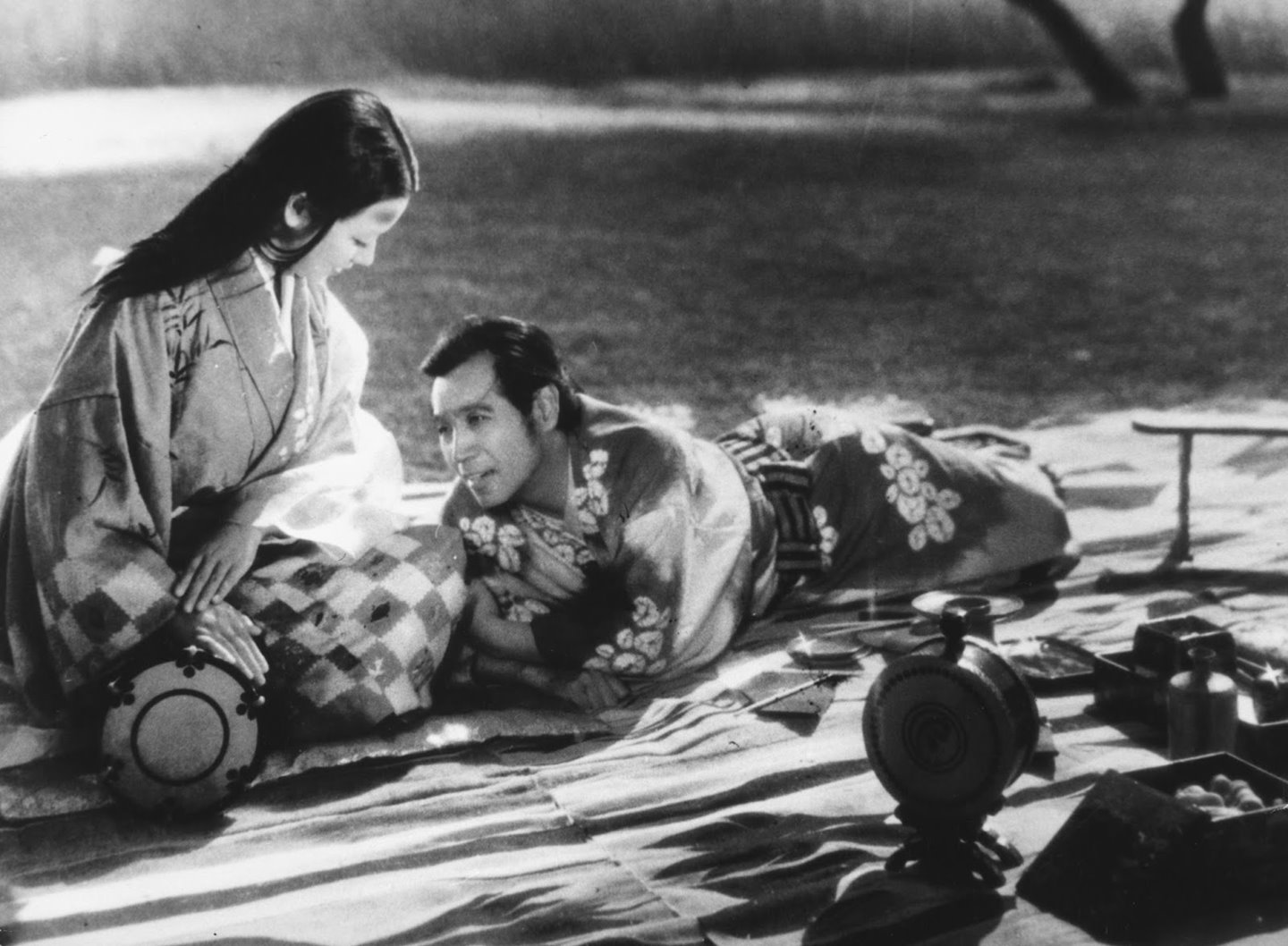
Drama, fantasy, by Kenji Mizoguchi, Japan, 1953.
Japan, late 16th century: the potter Genjurō and his brother Tobei live with their wives Miyagi and Ohama in a village in the Omi region; Genjurō, convinced that he can earn a lot of money by selling his goods in the nearby city, goes to the county of Omizo with Tobei, who joins him with the sole purpose of being able to become a samurai. Back home with a good income, the two work hard to make even more money; Tobei, increasingly obsessed with the ambition of becoming a samurai, needs the money to buy an armor and a spear while Genjurō, overcome by greed, tries to cook a batch of crockery with his brother in just one night. Legend and innovation of cinematic language, a wonderful world next to a brutal and cruel world. Mystery film that opens a discourse with the invisible planes of existence, ghosts and forays into the fantastic, made by Kenji Mizoguchi in a Japan still frozen by the two atomic bombs dropped on Hiroshima and Nagasaki. Fundamental work by Mizoguchi, recognized as one of the greatest expressions of the Seventh Art. A lofty lesson in directing that creates wonder with a dramatic tale of greed and lust for possession. A woman who is a tempting demon and a wife abandoned to a fate of war and misery, Mizoguchi uses the camera to enter "another world".
Food for thought
According to ancient Eastern traditions there are other non-physical planes beyond the physical plane. The etheric plane envelops the physical body, gives it vital energy and acts as an intermediary with the higher levels. Beyond the etheric plane there is the astral plane where entities may exist that have not been able to resign themselves to the loss of their body and wander in search of sensations. They are what are commonly referred to as "ghosts". These entities are looking for bodies that have unbalanced etheric planes to "hook up" to in order to experience sense satisfaction through them.
LANGUAGE: Japanese
SUBTITLES: English, Spanish, French, German, Portuguese
Grief as a Structural Offense
You die wrongly, and something in the fabric of things refuses to accept it. Not your soul exactly — something more structural, like a load-bearing wall that was removed without anyone accounting for the weight it held. The house does not collapse immediately. It waits.
The onryō does not emerge from wickedness. It emerges from a specific kind of historical wound: the wound of a grievance that was legitimate, recognized by everyone present, and nevertheless completely without legal or social remedy. To understand what produces this figure, you have to look squarely at the architecture of Heian-period Japan — roughly 794 to 1185 — not as a distant aesthetic paradise of poetry and incense, but as a system in which women of the aristocratic class existed in a condition of sophisticated, highly decorated captivity. They were educated, sometimes brilliantly so. They wrote literature of lasting psychological complexity. And they had almost no standing as subjects under the ritsuryō code, the imported Chinese legal framework that organized Japanese governance from the seventh century onward. Under this system, women could not hold office, could not inherit land independently in any stable sense, and had no formal mechanism for addressing abandonment, which was effectively the dominant form of marital dissolution available to men. A husband who stopped visiting simply stopped visiting. There was no word for what happened to the woman left behind, because the law had not bothered to name it.
What the law refuses to name, culture is forced to process by other means. Murasaki Shikibu understood this in the early eleventh century when she built, inside The Tale of Genji, a figure that the text itself barely dares to look at directly — Lady Rokujō, a woman of extraordinary refinement whose suppressed jealousy detaches from her body during sleep and destroys the people she cannot consciously bring herself to harm. The detail that commands attention is not the supernatural mechanism but its logic: the rage is real, the cause is legitimate, and the woman has absolutely no sanctioned outlet for it. Her living spirit becomes monstrous precisely because her waking self was required to be impeccable. The violence does not come from a failure of character. It comes from an excess of enforced composure.
This is what distinguishes the onryō from the generic ghost of malevolence found across other traditions. The European specter, in its dominant forms, tends to haunt because of unfinished business — a secret, a treasure, an oath. The onryō haunts because of an unacknowledged injustice, and more specifically, because the social system that produced the injustice also produced the condition of its invisibility. Scholars like Noriko Reider, writing on Japanese supernatural fiction, have documented the degree to which the vengeful female spirit in classical texts is almost always traceable to a relational betrayal — abandonment, polygynous neglect, the casual reassignment of a man’s attention — that was not only legal but sometimes socially expected. The betrayal was not aberrant. It was the norm. Which means the grief it produced was also normative, chronic, and completely unspeakable.
There is something precise happening in that structure. When a society systematically produces suffering while simultaneously providing no legitimate language for that suffering to enter public discourse, it creates a pressure that has to go somewhere. The ghost is where it goes. She is not a symbol of evil. She is the return of a claim that was filed and immediately destroyed. Her hair is loose because mourning was not permitted. Her robes are white because she never finished dying properly — which is to say, she never finished being wronged. The Heian imagination did not invent her out of fear of the supernatural. It invented her out of an accurate, if unconscious, understanding that a system which generates invisible wounds will eventually be asked to account for them by something that cannot be ignored, cannot be appeased with ritual courtesy, and does not accept the jurisdiction of the code that erased her.

What the Meiji State Needed to Forget
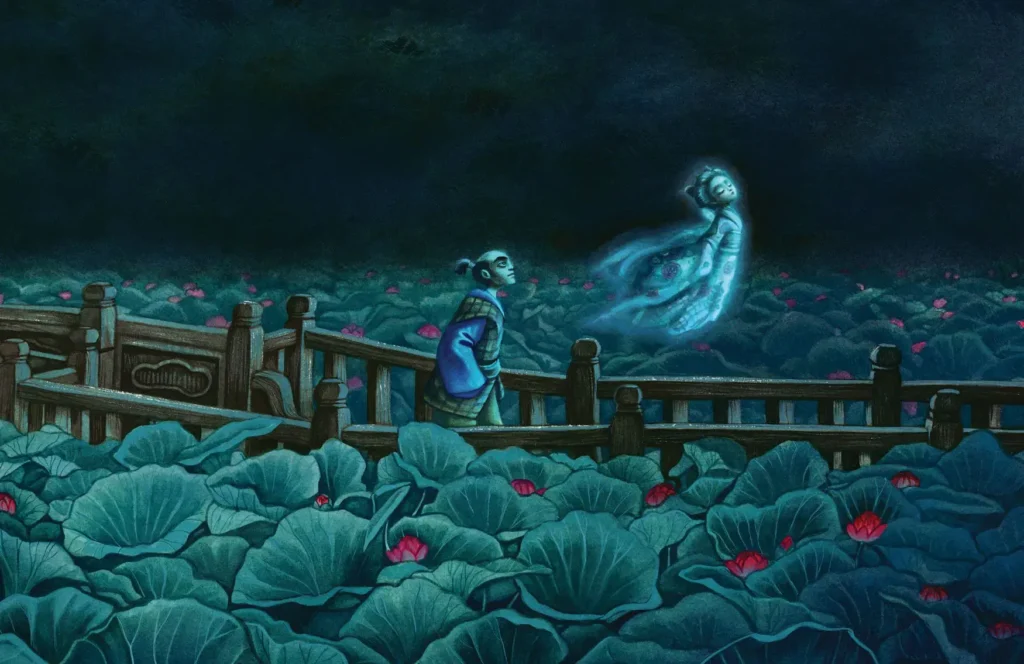
You are standing in a museum somewhere in Tokyo, probably Ueno, probably on a Tuesday when the school groups have left and the galleries go quiet. Behind glass, a woodblock print from the late Edo period shows a woman mid-dissolution — her lower body already vapor, her hair a catastrophe of black ink, her eyes fixed on something the artist has left outside the frame. The placard beside it uses the word “folklore.” It is a careful word.
The Meiji Restoration of 1868 was not simply a political event. It was a total semiotic reorganization of Japanese life, an attempt to build a modern nation-state rapidly enough to survive Western imperial pressure, and it required, as all such projects do, a rigorous sorting of what would be carried forward and what would be reclassified. Shintoism was elevated into state ideology; Buddhism was violently separated from it in the early years of the haibutsu kishaku movement; Western legal codes were imported and adapted. What happened to the ghost was subtler and more revealing. She was not abolished. She was archived.
The ethnographer Yanagita Kunio published his landmark Tono Monogatari in 1910, and the gesture embedded in that act of collection was already a transformation. To record a belief as folklore is to simultaneously honor it and bury it — to say: this is what the people once thought, which means, by implication, this is not what the people currently think. The oral becomes textual, the living becomes specimen. What had circulated as genuine terror in Edo-period commoner culture — the onryō as a real threat requiring real ritual management — was now a cultural artifact, interesting precisely because it was receding.
But the deeper necessity behind this reclassification was political in a sense that historiography has been slow to name. The Meiji state constructed an idealized femininity encoded in the concept of ryōsai kenbo, the “good wife, wise mother,” a figure of total domestic absorption who existed to produce loyal subjects for the emperor. This figure had no rage. She was not permitted it structurally, not because rage was thought impossible in women, but because its possibility had to be continuously disavowed. A culture that still circulated vivid narratives of women returning from death to punish neglect and betrayal was a culture that had not fully convinced itself of its own ideology. The ghost was an argument the state could not answer, so it reclassified the argument as poetry.
The philosopher Ueno Chizuko, writing much later in Nationalism and Gender in 1998, traced the way modern Japanese national identity was built on a gendered contract that women were enrolled in without consent. What she documented in the twentieth century was, structurally, the consolidation of a process begun in the Meiji decades, when the feminine body became simultaneously the symbolic heart of national purity and the site most aggressively policed by new civil codes stripping women of property rights, restricting divorce, and binding them legally to the household register. Rage at such conditions did not disappear. It found the only territory still available to it: the supernatural.
This is the paradox that the museum placard cannot afford to name. The more efficiently a society suppresses the legitimate grievances of the women inside it, the more culturally productive the figure of the vengeful female ghost becomes, because she carries the load of everything the legal and social order has declared inadmissible. She is not a relic of pre-modern irrationality. She is the precise measure of what modernity decided it could not afford to hear said plainly. The Meiji state needed her defused because she was not frightening in spite of being fictional — she was frightening because everyone in the room knew, without being able to say so, exactly what she was angry about.
Freud Never Met Yūrei
You are sitting with someone you wronged years ago — not in a dream, not in memory, but across a table, in ordinary light, and they are saying nothing. The silence does not feel psychological. It feels structural, like a crack running through the floor of the room itself, something that was always there beneath the furniture and the pleasantries and the accumulated normalcy of your shared history.
Sigmund Freud coined the term unheimlich in his 1919 essay “The Uncanny” to describe the particular dread that arises when something familiar becomes strange, when the domestic turns threatening, when the home — heim — betrays its own promise of safety. His central argument was that this feeling is not a response to something genuinely external but rather the return of repressed material: desires, fears, and traumas that the psyche has worked hard to bury come back wearing the mask of the supernatural. The ghost, in this framework, is always ultimately about the individual unconscious. It is your ghost, your repression, your buried content rising through the floorboards of your own interior architecture.
This is a remarkably powerful reading, and it explains a great deal — except for what it was never designed to explain. The onryō in Japanese tradition does not haunt individuals because those individuals have repressed something. It haunts them because a specific injustice was committed, and that injustice has not been addressed by the community that witnessed or enabled it. The difference is not subtle. One model locates the problem inside the self. The other locates it in the space between people, in the arrangement of social obligations, hierarchies, and silences that a group chooses to maintain.
The sociologist Émile Durkheim argued in “The Elementary Forms of Religious Life” in 1912 that the sacred is always a collective production — it does not arise from individual psychology but from the rituals, prohibitions, and shared intensities that bind a community together. When a wronged woman becomes onryō, her transformation is not a private psychological event. It is a social verdict. The community has already registered the wrong at the level of its deepest structuring categories; the ghost is merely that registration taking visible form, insisting on being read.
Ruth Benedict’s work in “The Chrysanthemum and the Sword,” published in 1946, drew a now-contested but still illuminating distinction between guilt cultures and shame cultures — the former organizing moral life around internal conscience, the latter around external judgment and relational standing. The distinction has been heavily criticized for its rigidity, but it points toward something real about the architecture of transgression in pre-modern Japanese social life: the wound was never only the individual’s to carry. It belonged to the relationship, the household, the clan, the court. When Lady Rokujō in “The Tale of Genji,” written by Murasaki Shikibu in the early eleventh century, sends her living spirit out to destroy the women who have displaced her in Genji’s attention, she is not acting from a purely personal wound. She is enacting a verdict about status, recognition, and the failure of an entire social system to honor what it owed her.
Western psychoanalysis, even at its most sophisticated, tends to treat social structures as secondary formations — as the context in which individual psychology plays out, not as the primary site of the wound itself. Jacques Lacan‘s rereading of Freud introduced the symbolic order as a structuring force, but the clinic remained the arena of resolution: you go inward, you speak, you rearrange your relationship to the signifier. The onryō tradition offers no such individualized exit. There is no couch. There are only rituals of appeasement that require the community to acknowledge, collectively and publicly, what it did — or what it permitted to be done in its name.
The Pollution Logic of Female Emotion
You are standing at the threshold of a shrine, and there is a sign you almost walk past — small, weathered, half-hidden by the kind of casual permanence that makes exclusion invisible. It says you cannot enter. Not you specifically. Women. Women during certain days, women who have recently given birth, women still inside the raw window of mourning. You read it and feel something you cannot immediately name, because the logic behind it is not presented as cruelty. It is presented as hygiene.
Kegare is the Shinto concept usually translated as ritual impurity, but the translation flattens it almost beyond recognition. Kegare is not dirt. It is not moral failure. It is something closer to ontological overflow — a state in which the boundaries of the self have become porous, in which the interior has leaked outward and contaminated the field of the sacred. The scholar Emiko Ohnuki-Tierney, in her 1984 work Illness and Culture in Contemporary Japan, traced how kegare functioned less as a religious doctrine and more as a social grammar, organizing bodies and their proximity to power. What made her analysis quietly devastating was the observation that the categories most consistently assigned kegare were not random. They clustered around female biology with a precision that could not be accidental.
Menstruation, in classical Shinto logic, was kegare not because blood itself was impure but because it signaled an interior event that had become visible, a rupture in the sealed surface of the body. The same logic applied to childbirth, which produced the double impurity of maternal blood and the boundary-crossing of new life entering the world. Grief, particularly the intense, demonstrative grief expected of women as primary mourners in Japanese funeral culture, also registered as kegare — the emotion itself treated as a substance that leaked from the grieving person and required containment. What these three states share is not irrationality. They share intensity. They are conditions in which feeling reaches a pitch that becomes undeniable to others, that cannot be politely absorbed into the background of social functioning.
The historian Anne Walthall, writing on peasant women in Edo-period Japan, documented how the material consequences of this logic were encoded into agricultural and domestic calendars. Women were excluded from certain rice planting rituals during menstruation, their touch theorized as capable of destroying the sacred contract between human labor and divine abundance. The spiritual quarantine was also a labor quarantine, a social quarantine, and the metaphysical explanation ensured it felt unchallengeable. You cannot argue with ontology. You cannot petition the structure of being itself.
What the kegare system accomplished, with extraordinary efficiency, was the reclassification of female emotional life as a category problem rather than a human one. Grief did not need to be witnessed — it needed to be managed. Anger did not need to be addressed — it needed to be neutralized before it spread. The onryō emerges precisely at the point where this neutralization fails, where the quarantine breaks down, where grief or rage has been sealed inside a woman’s body and left to accumulate in the absence of any legitimate outlet. The ghost is not the opposite of kegare logic. She is its consequence. She is what kegare produces when it works too well — when it succeeds in repressing the emotional event so completely that the event survives the body that contained it.
Sigmund Freud‘s 1917 essay “Mourning and Melancholia” drew a clinical distinction between grief that moves through its stages and grief that turns inward, becomes chronic, begins to consume the self from inside. He was writing about pathology, but he was inadvertently describing the structural condition imposed on Japanese women by centuries of spiritual protocol, a condition in which the healthy externalization of loss had been designated as pollution requiring ritual management rather than human response requiring human witness.
A vision curated by a filmmaker, not an algorithm
In this video I explain our vision
A Stage Designed to Produce Ghosts

You are sitting at a table where your name has not been spoken in forty minutes. The conversation moves around you like water around a stone — practical, purposeful, entirely indifferent to your presence. Someone passes a document across the wood surface without making eye contact. Someone else laughs at something you did not say. Your stillness, which began as patience, has calcified into something they will later describe, if pressed, as coldness. You have not left. You have not raised your voice. You have simply remained, and your remaining has become, in the architecture of that room, a kind of accusation.
This is not a ghost story. This is how ghost stories are made.
The onryō does not emerge from nowhere. She arrives from a very specific sociological laboratory: the household structured by the Confucian ethics imported from Tang Dynasty China and codified in Japan across the Heian period, formalized further under Tokugawa governance through documents like the seventeenth-century Onna Daigaku, a conduct manual attributed to Kaibara Ekken that instructed women to regard obedience as their entire moral universe. The text is explicit — a wife’s will is to be dissolved into her husband’s household, her desires categorized as secondary, her grievances as illegitimate. What the manual could not account for is that dissolved things do not disappear. They saturate the material they enter.
When Sigmund Freud wrote about the uncanny in 1919, he identified a particular dread: the terror of encountering something familiar in an unfamiliar form, something that was repressed returning in a shape that feels alien and threatening. The mechanism he described is not metaphysical. It is the logic of suppression itself — push something underground, and it will find another exit. The cultural suppression of women’s interiority across centuries of Japanese institutional life did not produce docile interiors. It produced a precise imaginative figure whose power is directly proportional to how completely she was silenced in life.
Kabuki theater made this architecture visible with remarkable clarity. The techniques developed around female ghost roles — the actors trained in the art of moving without appearing to move, of expressing fury through absolute stillness, of letting the eyes communicate what the body refuses to perform — were not arbitrary aesthetic choices. They were observations. The theatrical form was documenting something that domestic life had already rehearsed daily, transferring the lived posture of the suppressed woman into a register where it could be safely witnessed as spectacle. Art does not invent its monsters; it photographs them with a longer exposure.
The horror economy surrounding the onryō also reveals an inversion that rarely gets named directly: the figure that culture designates as the source of danger is invariably the figure to whom danger was first done. Yotsuya Kaidan, performed in Edo in 1825, and which remains one of the most frequently revived works in the kabuki repertoire, structures its terror entirely around a woman poisoned by her husband, her beauty destroyed, her body discarded — and then places the audience’s dread entirely in her returned vengeance rather than in the original act. The poison is backstory. The haunting is the crisis. This redistribution of moral weight is not accidental; it is the cultural machinery revealing its own priority system.
What the woman at the table shares with the figure in the theatrical canon is not supernatural quality. It is structural position. Both inhabit spaces organized to make their full presence illegible. Both are read as absence or as threat rather than as persons with a coherent interior. The tradition of the vengeful ghost did not emerge because Japanese culture had an unusual relationship with the supernatural. It emerged because the conditions for producing a very specific kind of human suffering were systematically maintained, and the imagination required somewhere to put what the social order refused to hold.
Horror as the Only Available Testimony
You are standing in a darkened theater in Edo-period Japan, watching a woman’s face dissolve into something unrecognizable, and the audience around you does not look away. They lean in. This is not spectacle for its own sake — something is being confessed here, something that cannot be said in daylight, in court, in the public square, and so it must be said like this, through contorted flesh and extinguished lanterns, through the grammar of dread.
Noriko Reider, in her meticulous excavations of the kaidan tradition, makes an argument that should unsettle anyone who has ever dismissed ghost stories as mere entertainment. In Japanese Tales of Mystery and Imagination and in her broader scholarly work on supernatural narrative, Reider demonstrates that the kaidan genre — those carefully structured tales of strange happenings, vengeful apparitions, and inexplicable visitations — operated as a form of juridical testimony for people who had been structurally excluded from all legitimate forms of recourse. The ghost story was not an escape from social reality. It was the only socially legible form in which social reality could be indicted.
Consider what this means for the mechanics of evidence itself. In Tokugawa Japan, rigid status hierarchies governed not only who could own property or walk through which gate, but who could speak, to whom, and with what degree of credibility. A woman abandoned by a husband who had taken a wealthier concubine had no legal standing to name her suffering as injustice. A servant tortured by a master who feared exposure had no forum in which her experience counted as fact. The formal institutions of testimony — courts, councils, written petition — were architected to exclude precisely the people most likely to be wronged. What remained available to them was the uncanny. The ghost, in this framework, is not a failure of rationality but an adaptation to a system that had made rational address impossible.
This produces a genuinely strange epistemological situation: terror becomes the most reliable genre of truth-telling available to a given culture. Reider’s analysis pushes against the comfortable assumption, absorbed from Enlightenment historiography, that emotional or supernatural modes of expression are pre-rational residues waiting to be replaced by more sophisticated instruments. What if, instead, they are sophisticated instruments — precisely calibrated to operate where systematic power has deliberately closed every other channel? The onryō’s wail is not inarticulate. It is the most articulate thing a silenced person can produce within the constraints placed upon them.
The year 1825, when Tsuruya Nanboku IV staged Tōkaidō Yotsuya Kaidan before packed audiences in Edo, is instructive not as a cultural landmark but as a social event. Audiences recognized Oiwa. Not as a specific woman, but as a type they had witnessed produced by their own world — women discarded when they became inconvenient, disfigured by the very substances of domestic life, denied the language of grievance. The theater made visible what the administrative record systematically omitted. No official document named what was happening to women in households across the city. The ghost story named it nightly, before hundreds of witnesses, and called it by its oldest and most primal name: injustice so severe it ruptures the boundary between living and dead.
What Reider’s framework exposes is something about the relationship between terror and credibility that modern audiences have not fully reckoned with. We tend to assume that fear is what a story produces in its audience, and testimony is what a witness produces in a court. But the kaidan collapses this distinction by creating a situation in which the audience is the court, and fear is precisely the mechanism by which evidence is admitted. You cannot disbelieve what makes your body respond before your mind has finished processing it. The ghost bypasses the rational filters through which inconvenient testimony is usually screened out and deposited directly into the nervous system of everyone present, demanding acknowledgment at a level where denial becomes physiologically costly.
The Living Who Refuse to Be Appeased
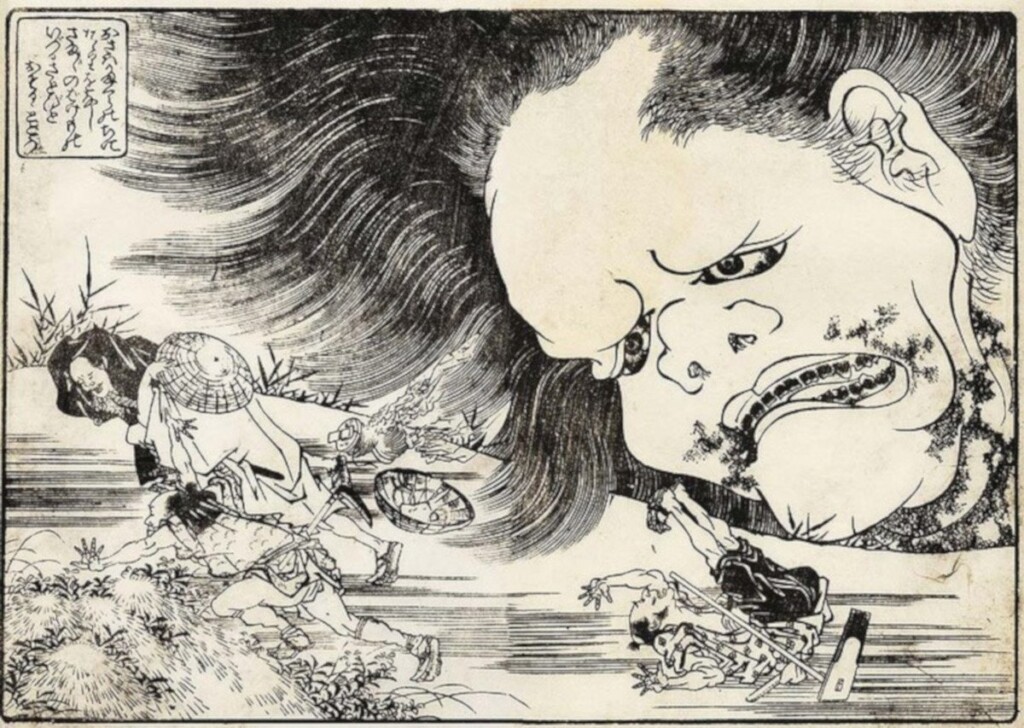
You have probably sat across from someone whose grievance you could not quite meet — not because it was illegitimate, but because meeting it fully would have required you to become someone who had not done what you did. The conversation ended. The person remained.
The onryō was never really a supernatural category. It was a diagnostic one. What the Heian court named as spirit possession and what the Edo stage dramatized as feminine fury descending through white robes and unbound hair was, at its structural core, a society’s attempt to classify the consequences of its own refusals. The ghost appeared precisely where acknowledgment had been withheld — not as metaphor, but as social logic made visible. Societies that cannot absorb certain forms of complaint have always needed a container for what that complaint becomes over time, and in Japan that container was given a name, a costume, and a ritual protocol designed not to address the wound but to manage the haunting.
What is remarkable is how precisely that same structure replicates itself in contemporary institutions. Legal systems across the world maintain formal channels for grievance that are architecturally designed to exhaust the plaintiff before resolution — not through malice, necessarily, but through the compounded weight of procedural delay, evidentiary thresholds calibrated against the kinds of harm that leave no physical record, and the quiet institutional preference for closure over truth. Judith Herman, in her 1992 work Trauma and Recovery, observed that the perpetuation of traumatic harm depends on secrecy and silence, and that social systems frequently become accomplices to that silence not by defending wrongdoers explicitly but by making the sustained articulation of harm so costly that most people eventually stop. The woman who does not stop — who returns to the same corridor, the same office, the same family table with the same unresolved claim — is not behaving irrationally. She is behaving like someone who has not yet been heard. But she is experienced, by those around her, as a haunting.
There is a specific discomfort that attaches to female anger that has outlived its occasion, that has not been softened by time or therapeutic reframing or the eventual success of a life built around the wound. Simone de Beauvoir noted in The Second Sex that one of the privileges assigned to the dominant position is the right to determine when a grievance has been sufficiently aired — to declare, in effect, that the past is over. The person who refuses that declaration is then characterized not as someone still inside an unresolved injustice but as someone pathologically attached to their own suffering. This is the modern vocabulary for what the Muromachi period called possession: a medicalization of persistence, a way of framing refusal to be appeased as a symptom rather than a response.
Familial structures are perhaps the sharpest contemporary theater for this dynamic. The family member who continues to name what happened — to a parent, at a table, in the presence of siblings who have chosen a different accommodation with the past — becomes the disruptive element, the one whose very insistence on clarity is experienced as aggression. The family reaches, collectively, for the ritual equivalent of the mizuko kuyō ceremony or the Buddhist appeasement rite: the apology that is performed without accountability, the acknowledgment that is structured to close the subject rather than open it, the hug that is meant to signal that it is now, finally, over.
The onryō’s persistence was never about vengeance in the simple sense. It was about the impossibility of moving through a world that has not acknowledged what it did. The contemporary discomfort with unresolvable anger is not a cultural evolution beyond that framework — it is the same framework, running without the mythology that once made its mechanics legible.
👻 Spirits, Shadows, and the Weight of the Unresolved
The onryō haunts Japanese culture as a figure of unfinished grief, betrayal, and memory that refuses to dissolve. To understand this archetype more deeply, it helps to explore the broader territories of the supernatural, the uncanny, and the literary tradition of ghosts and doubles that spans cultures and centuries.
Venetian Legends and Ghosts of the Lagoon
Venice has long been a city of shadows, water, and restless spirits, and its legendary ghosts share with the onryō a quality of melancholic persistence. This article explores the haunted folklore of the Venetian lagoon, where the boundary between the living and the dead has always felt dangerously thin. Reading it alongside the Japanese tradition reveals how coastal and liminal spaces seem universally prone to housing unquiet souls.
GO TO THE SELECTION: Venetian Legends and Ghosts of the Lagoon
The Literary Fantastic: Todorov and the Theory of the Fantastic
Tzvetan Todorov‘s foundational theory of the fantastic offers the critical tools needed to understand why ghost narratives like that of the onryō produce such lasting unease. His concept of hesitation — the reader’s suspension between a natural and supernatural explanation — maps perfectly onto the ambiguity that defines vengeful spirit lore. This article provides the theoretical framework to read supernatural cultural phenomena with rigorous literary precision.
GO TO THE SELECTION: The Literary Fantastic: Todorov and the Theory of the Fantastic
The Double in Literature: From Dostoevsky to Stevenson
The figure of the double in Western literature, from Dostoevsky’s tortured shadow-selves to Stevenson’s Hyde, mirrors the onryō’s function as an externalized projection of suppressed psychological torment. This article traces how the shadow-self emerges across cultures as a warning about denied emotion and moral debt. The parallels with Japanese vengeful ghost mythology are striking and illuminating.
GO TO THE SELECTION: The Double in Literature: From Dostoevsky to Stevenson
Must-see Movies about the Afterlife
Cinema has long been fascinated by what lies beyond death, and many of the most powerful films in this tradition draw directly from traditions like the onryō to stage questions about guilt, memory, and unfinished business. This curated selection of must-see afterlife films maps the emotional and spiritual terrain that haunted Japanese culture has so profoundly influenced worldwide. It is an essential companion for anyone moved by the ghost as a figure of unresolved longing.
GO TO THE SELECTION: Must-see Movies about the Afterlife
Discover the Cinema of the Invisible on Indiecinema
If the world of onryō and haunted imagination speaks to you, Indiecinema streaming is home to a rich selection of independent films that explore death, memory, grief, and the supernatural with the depth and courage that mainstream cinema rarely allows. From Japanese horror to European dark fantasy and avant-garde ghost stories, our catalog invites you to sit with the unresolved and let cinema do what only the best art can — make the invisible visible.
👉 EXPLORE THE CATALOG: Watch Indie Films in Streaming
A vision curated by a filmmaker, not an algorithm
In this video I explain our vision

