
The Performance of Loyalty as Political Weapon
You have rehearsed this scene without knowing it — the moment someone invokes your name in a room you were not in, wrapping their own ambition in the fabric of your reputation, speaking on your behalf without your consent, and calling it loyalty.

Shakespeare built Julius Caesar on exactly this mechanism, and he built it with a precision that most political theorists would envy. The play, first performed in 1599 at the newly opened Globe Theatre, arrives at a moment when Elizabethan England was itself convulsed by anxieties about succession, tyranny, and the difference between a ruler’s symbolic body and their mortal one. Shakespeare understood that the most dangerous political act is not violence — it is the framing of violence as sacrifice.
Brutus is the engine of this argument. He is constructed, from his very first scene, as a man whose public virtue has become a kind of currency that other people spend without asking him. Cassius does not recruit Brutus by appealing to his ambition — Brutus, by his own account, has none. He recruits him by appealing to his self-image. “Since Cassius first did whet me against Caesar,” Brutus admits in Act II, “I have not slept.” That insomnia is diagnostic. It is what happens when a person begins to suspect that the image of themselves they have carefully maintained may not survive contact with the action being asked of them. Cassius knows this, which is why he plants letters — forged public letters, crafted to look like the voice of Rome itself — addressed to Brutus, urging him to act. The manipulation is not subtle. What is subtle is how completely Brutus chooses not to see it.
The philosopher Hannah Arendt, writing in The Origins of Totalitarianism in 1951, identified a structural tendency in political movements to transform private moral language into public legitimating tools — to take words like honor, duty, and sacrifice and drain them of their original ethical content until they function purely as rhetorical levers. Shakespeare dramatizes this process in real time. When Brutus speaks of “the general good” in Act II, scene i, he is not lying exactly — but he is using moral vocabulary to close off moral inquiry. The phrase does not open an ethical question. It settles one, preemptively, before the doubt can surface.
What makes this more than a study in ancient Roman politics is its mapping onto a universal architecture of institutional betrayal. In 1513, Machiavelli completed The Prince — a text that Shakespeare would likely have encountered indirectly through translations and court discourse — and one of its central observations is that men judge more by appearances than by contact with reality, because most people encounter power at a distance and have no instrument to measure it except the language it uses about itself. The conspirators understand this. They are not confused about what they are doing. They are managing how it will be perceived, and they recruit Brutus precisely because his name performs the moral work their actions cannot perform on their own. Without Brutus, the assassination is a faction killing a rival. With him, it becomes a civic act.
Cassius never pretends otherwise to himself, which is why his scenes carry a different texture — faster, more oblique, sharper in their psychology. He is not performing for his own conscience. He is performing for Brutus’s, and in doing so he reveals something about how power actually moves through language rather than through force. The sword that kills Caesar is almost incidental. The linguistic architecture built before the murder — the framing, the enrollment of virtue, the forged consensus — that is where the real work happens, and that work is finished before the Ides of March even arrive.
Bruto
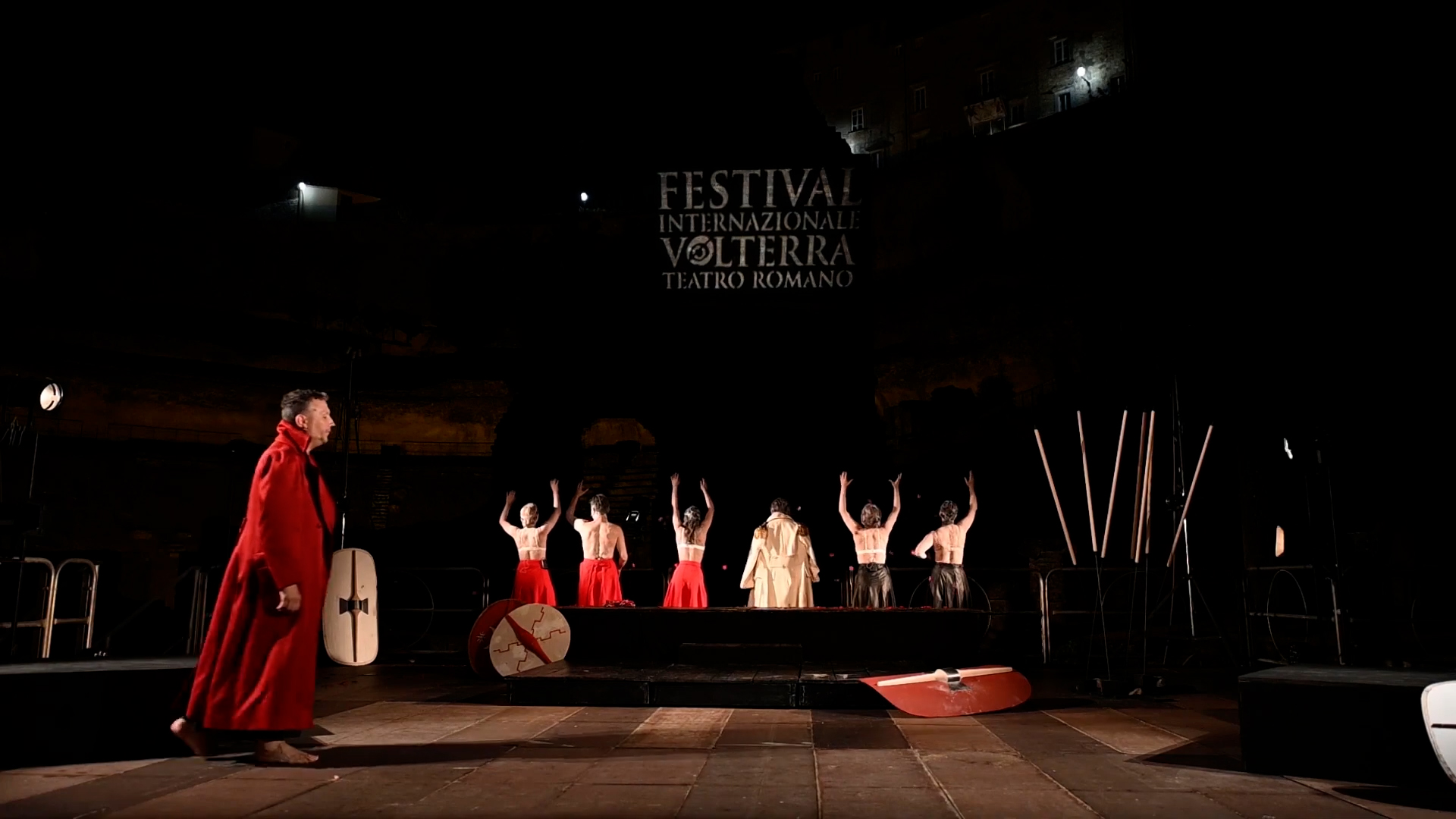
Theatrical show, by Nicola Fano e Simon Domenico Migliorini, Italy, 2022
The protagonist is Brutus, the celebrated instigator, along with Cassius, of the conspiracy of the Ides of March in 44 B.C., the assassin of Caesar. He enters the stage calling loudly for Cassius, his alter ego: we find ourselves in Philippi, where both conspirators have already fought and lost against the troops of Marcus Antonius, who has become the guarantor of justice towards Caesar and Rome. The story written in books materializes on stage with the words of Shakespeare, infinite, immortal, eternal words. The spectator listens, a symbolic battlefield and dead bodies appear before him, on which Brutus, defeated, wounded, almost dying, crawls and invokes and looks around bewildered, shocked at the appearance of the ghost of Caesar.
Brutus is Simone Migliorini, who speaks, moans, shouts, modulates those phrases of Shakespearean tragedy and makes them his own, as they have been generated, also in the adaptation from Shakespeare's "Julius Caesar" by the playwright Nicola Fano, who worked on the text focusing on the most controversial figure, that of the leader of the conspirators, the assassin of Caesar, specifically for Migliorini, who has studied and deepened the text and characters. But here Brutus, as the show unfolds, also becomes Macbeth, also Henry V, both tyrants, both assassins, soldiers, courageous or cowardly, great or infamous, in a flow of words and famous phrases, spoken, planted, recited, whispered, shouted by Simone Migliorini who with this performance confirms himself as a high-level interpreter. What strikes is the protagonist's ability to transform himself, from time to time, from Brutus into other characters, even into Marcus Antonius. A change of costume is enough for him, on stage. And it is here that Brutus looks into Antony's eyes and Antony scrutinizes Brutus, doubled by the same actor in a virtuosity that is extremely congenial to him. The actor is capable of being, at the same time, the one who kills and the one who exalts the killed; the one who is prey to doubts and remorse but is proud of his love for Rome and its freedom, and the one who exalts and celebrates the slain Caesar before the people, holding his will in his hand, in the famous Oration that has always been the flagship of the greatest actors.
LANGUAGE: Italian
SUBTITLES: English, Spanish, French, German, Portuguese
Rhetoric, Crowd Psychology, and the Manufacture of Consent
You have probably never noticed the moment it happens — the precise sentence where you stop thinking and start feeling, where the argument dissolves into pulse. It arrives before you can name it, which is exactly the point.
When Mark Antony mounts the Roman pulpit in Act III and opens with the words “Friends, Romans, countrymen,” he is not making an argument. He is performing a seduction, and the distinction matters enormously. The crowd before him has just watched Brutus deliver a geometrically logical case for Caesar’s murder — clean, reasoned, entirely in prose — and they accepted it completely. They were ready to go home satisfied. What Antony does in the following minutes is not refute Brutus. He dismantles the very cognitive scaffolding that made Brutus’s case coherent.
Gustave Le Bon, writing in his 1895 study Psychologie des foules, described the crowd not as a collection of individuals but as a single organism governed by contagion, suggestibility, and what he called the “law of the mental unity of crowds.” The individual submerged in a crowd, Le Bon observed, acquires a sense of invincible power that permits yielding to instincts he would otherwise have suppressed. Shakespeare dramatizes this mechanism with surgical precision four centuries before Le Bon named it. Antony does not appeal to Roman citizens as reasoning agents. He addresses them as a body, calling them “friends” three times in the opening line alone, invoking kinship before a single fact has been offered.
The repetition of “Brutus is an honorable man” functions in the play exactly as Le Bon’s theory of affirmation would predict: a statement repeated without proof accumulates the emotional weight of demonstrated truth. By the fourth iteration, the phrase has curdled from endorsement into indictment — not because Antony ever contradicts it logically, but because rhythm has outpaced cognition. The audience knows before they can articulate knowing. This is not persuasion by evidence. It is persuasion by cadence, and it exposes something deeply uncomfortable about the relationship between language and political power: that the form of speech can reverse the content of a previous speech without ever engaging its substance.
What makes the scene genuinely disturbing rather than merely clever is the introduction of Caesar’s will. Antony brandishes the document, refuses to read it, insists the crowd would be inflamed if they heard what Caesar had bequeathed them — and in doing so guarantees that every mind in the Forum projects onto that unread parchment its own private fantasy of generosity. Jacques Ellul, in his 1962 Propagandes, identified this technique as one of the foundational operations of modern propaganda: the withheld revelation that generates more emotional energy than any disclosure could. The crowd’s imagination does the propagandist’s work for him. Antony never lies. He never needs to.
By the time he descends from the pulpit to stand among the people, touching Caesar’s wounds, naming them one by one as if performing a liturgy, the transformation is complete. The men who minutes earlier would have applauded Brutus’s virtue are now crying for blood. Shakespeare does not present this as the mob’s stupidity. He presents it as the mob’s humanity — which is the more disturbing accusation. The citizens are not manipulated because they are ignorant. They are manipulated because they are social, because belonging and grief and generosity toward the dead are biological drives older than any republic.
What the play refuses to let you do is watch from outside this dynamic. The audience in the Globe Theatre, the reader on a bus in 2024, occupies a position structurally identical to the Roman crowd — receiving the same oration, subject to the same rhythms, moved by the same theatrical machinery. The difference between Antony’s audience and yours is not intelligence or education.

Republicanism as Mythology: The Roman Ideal and Its Illusions
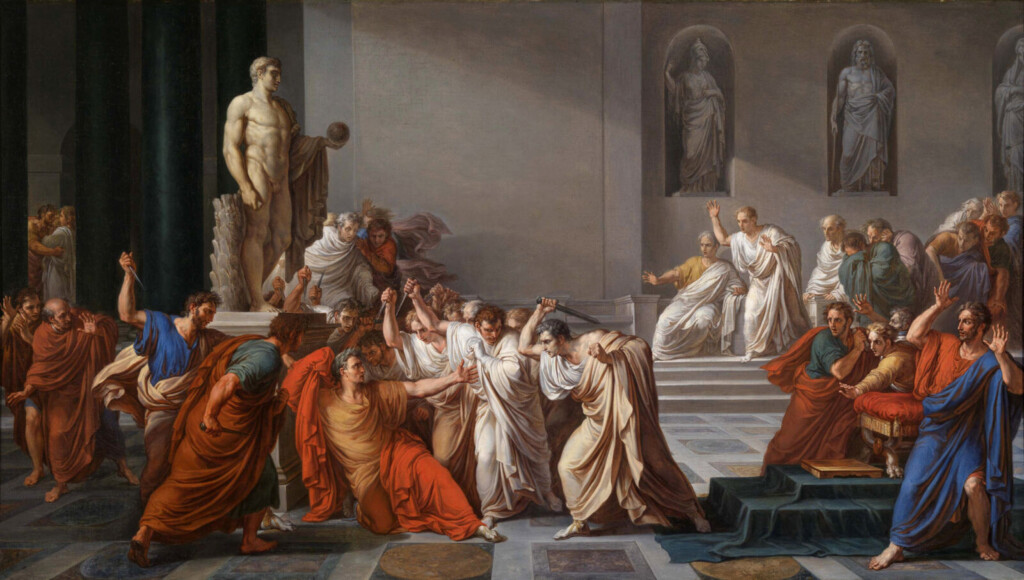
You have stood in a room where everyone agreed on something, and the agreement itself felt like proof. Not proof of the thing being agreed upon — proof that agreement was possible, that shared belief could hold a ceiling over the chaos beneath. That room is every scene in Julius Caesar where the word “Rome” is spoken like a prayer.
The conspirators do not kill Caesar because they have calculated the institutional consequences of his rule. They kill him because they have inherited a vocabulary — republic, liberty, tyranny, the people — and that vocabulary carries its own gravitational pull. Brutus is not a political theorist. He is a man who has been handed a language so charged with historical meaning that it does almost all his thinking for him. When he tells himself in his orchard soliloquy that Caesar “would be crowned,” the conditional tense does the work of a verdict. The republic becomes the name of whatever must be defended, and defense becomes whatever Brutus decides to do.
Hannah Arendt, in On Revolution published in 1963, identified something essential about the Roman model: the founders of the American republic, and every subsequent generation that invoked Rome, were not imitating a system so much as performing a myth of origin. The Republic was never a stable democracy — it was an oligarchic machine organized around senatorial families, patronage networks, and the managed exclusion of the plebeian majority from real power. By 44 BCE, when Caesar died on the Ides of March, the Senate had already spent a century failing to contain the structural contradictions of a city-state governing a continental empire. The “republic” Brutus defends had been functionally dying for generations before Caesar provided a convenient face for its collapse.
Shakespeare knows this, and the play knows this even when its characters do not. The Forum scene turns the question of republican legitimacy into a contest between two rhetorical performances, and the crowd — the very populus in whose name the assassination was committed — shifts allegiance based on theatrical skill, on Antony’s timing, his pauses, his production of a blood-soaked cloak. The republic is revealed not as a system of participatory governance but as a story that whoever tells it best gets to claim. Brutus speaks in prose to prove his plainness; Antony speaks in verse and wins. The form of the speech is the argument.
What makes the play structurally unsettling rather than merely tragic is that it refuses to supply any character who actually understands the republic as a mechanism rather than a symbol. Cassius comes closest — he is motivated less by idealism than by personal resentment and competitive pride — but even he frames his grievances in the inherited language of Roman virtue. The absence of any genuine political thought within the play’s republican faction is not a flaw in Shakespeare’s construction. It is the point. The play stages republicanism as a belief system that functions precisely because it does not require examination, because its invocation produces emotion strong enough to substitute for analysis.
Cicero appears in the play only briefly, which is its own kind of historical commentary. The man who spent a career articulating the philosophical foundations of the res publica — in De Re Publica, in the Philippics — is sidelined, dismissed by Casca as someone who would “never follow anything / That other men begin.” The republic’s most rigorous intellectual defender is excluded from the conspiracy because real philosophical examination of what the republic meant would have paralyzed the action entirely. Violence requires certainty, and certainty requires that the myth remain unexamined.
There is a particular kind of political violence that wraps itself so completely in the language of collective values that it becomes impossible to argue against without appearing to endorse what it opposes. The conspirators have built that trap perfectly — and they are the first ones caught inside it.
Ambition, Diagnosis, and the Politics of Naming
You have probably used the word “ambitious” as though it were a neutral observation, a simple description of someone who wants more than they currently have. In the Senate chamber on the Ides of March, the conspirators use it the same way, with the same confidence that a label carries its own evidence. Brutus tells the crowd at the funeral that Caesar was ambitious, and the crowd nods, because the word arrives already loaded — not with proof, but with the weight of prior accusation. The diagnosis precedes the crime. The execution precedes the trial. And the audience, watching from the outside, is left in the strange position of having witnessed nothing that would justify the charge, only characters insisting the charge justifies itself.
Hannah Arendt argued in The Origins of Totalitarianism, published in 1951, that one of the most effective instruments of political control is not force but vocabulary — specifically, the creation of categories so totalizing that to question them is already to place yourself inside them. When you ask “but was Caesar actually ambitious?” you have already accepted the framework in which ambition is the relevant and damning criterion. The question legitimizes the tribunal. The word works not by describing a reality but by producing one: once Caesar is named ambitious, every gesture he made, every crown he refused, every tear he wept over his fallen enemies, becomes retrospectively interpretable as performance, as the mask ambition wears when it knows it is being watched. The naming does not follow the evidence. The naming generates the evidence, retroactively, by telling you how to read everything you have already seen.
What makes this so unsettling in Shakespeare’s construction is that the play gives you Cassius first. Before Caesar speaks a single word about power, before any act of governance or tyranny is dramatized, Cassius is already at work in Brutus’s ear, reading portents, interpreting silences, converting a man’s physical weakness into metaphysical unfitness for authority. In Act One, Scene Two, Cassius describes Caesar nearly drowning in the Tiber, his body shaking with fever in Spain, crying out “as a sick girl” — and the rhetorical aim is precise: to make Caesar’s body the evidence of his soul’s overreach. This is the diagnostic move Arendt identified as political rather than medical, the transformation of a person into a category of danger that must be managed before it expresses itself. The threat is always described as imminent, never yet materialized, which is precisely why it cannot be debated on the basis of actual events.
Cicero, whose historical execution under Mark Antony in 43 BCE came just a year after the assassination Shakespeare dramatizes, wrote in the Philippics that political language decays fastest when it is used to justify preemptive violence — when the vocabulary of virtue becomes the alibi for elimination. Shakespeare almost certainly knew Plutarch’s Lives, his primary source, but the Ciceronian echo runs underneath the play like a current: the men who kill in the name of the republic will find the republic turned against them by the very rhetorical mechanisms they deployed. Mark Antony does not refute the charge of ambition in his funeral oration. He repeats it, ironically, until the word collapses under its own weight — “Brutus says he was ambitious, and Brutus is an honourable man” — and what Antony understands, and what Brutus catastrophically does not, is that a label only holds as long as no one openly performs the act of labeling. Once the crowd hears the word repeated as a formula, they begin to hear the formula, not the meaning.
The Roman crowd in Act Three shifts not because Antony gives them facts but because he gives them the experience of watching a word being used as a weapon, which is not the same as watching a weapon being used.
The Conspiracy as Mirror of the State It Claims to Oppose
You are invited to a meeting you did not call, in a room where the agenda was already decided before you arrived. Someone hands you a role — liberator, patriot, defender of the republic — and you accept it because the alternative is to admit that the room itself was the trap. This is how Brutus enters the conspiracy, and this is how most political actors enter every coalition that flatters them with the language of principle.
What the play refuses to sentimentalize is the structural fact that the conspirators, from the moment they begin organizing in secret, have already replicated the architecture of the power they claim to oppose. They meet at night, in whispers, behind the faces of friendship. They exclude Cicero not on political grounds but because Cassius judges him too independent, too likely to refuse subordination. They debate whether to kill Antony alongside Caesar and resolve the question not through democratic deliberation but through Brutus’s unilateral veto. The hierarchy is not abolished — it is simply inverted, with a new figure at its apex who happens to call himself a servant of the people. Michel Foucault argued in Discipline and Punish, published in 1975, that power is not a possession held by individuals but a relation reproduced through practices, institutions, and the very gestures of resistance. The conspirators embody this with brutal precision: their resistance is itself a disciplinary act, organized through exclusion, secrecy, rank, and the management of bodies — in this case, one specific body, on one specific day, in a location chosen for maximum symbolic resonance.
The Forum speech that follows the assassination is where this structural irony becomes catastrophic. Brutus believes that the truth, stated plainly, will be self-evident to the crowd. He is operating under a classical republican assumption — the one Aristotle embedded in the Rhetoric — that citizens, given correct information, will reason toward correct conclusions. But the crowd does not reason. It performs. It responds to cadence, repetition, emotional spectacle. Antony understands this not because he is cynical but because he has correctly read what the republic already is, beneath its ceremonial language. The citizens who shout “let him be Caesar” after Brutus’s speech — offering Brutus the very title of the man just murdered — are not confused. They are revealing that the form of power they recognize, the only one that feels real to them, is monarchical. The republic was always an idea held by a small, educated elite who mistook their own category for a universal.
There is a term in political sociology — elite circulation, formalized by Vilfredo Pareto in the early twentieth century — that describes how revolutions do not redistribute power so much as rotate who holds it. The lions replace the foxes, or the foxes replace the lions, and the mass at the base remains structurally identical in its relationship to those above. Shakespeare stages this process in real time. Caesar falls; within days, Rome is governed by a triumvirate exercising precisely the consolidated authority the Senate feared in one man, now distributed across three men who will shortly go to war with each other. The republic is not restored. It is not even genuinely contested. It simply changes personnel while deepening the logic of centralized, personal, violent sovereignty that Caesar represented.
What makes the play genuinely disturbing rather than merely tragic is that the conspirators are not hypocrites in any simple sense. Brutus believes every word he says. His sincerity is not a disguise for ambition — it is something more dangerous: a complete failure to perceive that good intentions do not alter the structural effects of one’s actions, that the machine you operate shapes the outcome regardless of the purity of the hand on the lever.
A vision curated by a filmmaker, not an algorithm
In this video I explain our vision
Caesar's Body and the Semiotics of Sovereign Power

You are standing at the edge of a crowd in the Roman Forum, and the body is already doing work before anyone speaks. The conspirators have not yet wiped their blades clean, and yet the corpse of Julius Caesar has ceased to belong to the man who occupied it. It has become a document, and every faction in the city is about to offer a competing translation.
Ernst Kantorowicz, writing in 1957 in “The King’s Two Bodies,” traced a theological jurisprudence that had quietly governed European political thought since the medieval canonists: the sovereign possesses a natural body, corruptible and mortal, and a second body that is purely political, abstract, incapable of dying. The genius of Shakespeare’s Forum scene is that it dramatizes exactly the moment when these two bodies are violently disaggregated and then fought over. Brutus and Antony do not argue about what Caesar did in life. They argue about what his wounds mean now, which is to say they argue about which of them inherits the political body while the natural one cools on the stone.
Brutus moves first and makes the wound speak in the grammar of tyrannicide. Each puncture, in his framework, is a mouth that says the same word: freedom. His rhetorical strategy depends on the body remaining still, figuratively and physically, because a static corpse is an object that can be assigned a single, stable meaning. He keeps Caesar supine in the imagination of the crowd, a finished thing whose significance has been settled by the act of killing itself. What Brutus does not understand, and what Antony understands with an almost clinical precision, is that a body shown is a body opened to reinterpretation.
When Antony descends to the physical, when he lifts the mantle and points to each wound by name, calling one the unkindest cut, he is not making an emotional appeal tacked onto a political argument. He is performing a counter-semiosis. The wounds that Brutus coded as political punctuation marks — full stops on the sentence of tyranny — Antony recodes as evidence of violation, of intimate betrayal, of the rupture between a man who loved and the men who received that love. The body becomes illegible as a symbol of liberation and legible instead as a crime scene. This is not rhetoric in the shallow sense. It is a contest over who controls the archive.
Roland Barthes, in “Mythologies” published in 1957, described mythology as a second-order semiological system in which a sign that already carries meaning is seized and made to carry a different, ideologically motivated meaning instead. Caesar’s corpse passes through exactly this process in real time, before the crowd’s eyes and with the crowd as both audience and prize. The first sign — dead body of a powerful man — arrives carrying the meaning Brutus has assigned it. Antony’s genius is to grab that sign and stuff it with different content without appearing to do so, which is why he insists, three times, that he comes to bury Caesar and not to praise him. The denial is the operation.
What makes this more than a lesson in oratory is what it reveals about sovereign power’s relationship to its own material substrate. Political authority has always required a body to be legible: a throne to be sat upon, a hand to be kissed, a head to be crowned or severed. The moment that body is removed, authority does not dissolve. It becomes an inheritance dispute conducted through the management of symbols. Rome does not lose its hunger for a sovereign when Caesar falls. It transfers that hunger immediately onto the competing claims of the men who can most convincingly claim to speak for what the body meant, which is why the play does not end with the assassination but accelerates into civil war — because the political body has no grave, only a succession of containers still fighting to be chosen.
Fate, Agency, and the Stoic Trap
You have made a decision you were proud of, and then watched it destroy everything it was meant to protect. Not because the decision was wrong in isolation, but because the framework that produced it kept producing more decisions in the same mold, each one logically consistent with the last, each one more catastrophically mistimed than the previous.
Brutus operates inside a Stoic architecture so thoroughly internalized that it has become indistinguishable from his perception of reality. This is not a peripheral detail about his character — it is the mechanism that drives every consequential mistake he makes after the Ides of March. The Stoic tradition he embodies, stretching from Zeno of Citium through Epictetus and Marcus Aurelius, holds that virtue is the only true good, that external events are indifferent to moral value, and that the wise person achieves freedom by aligning the will with reason rather than with circumstance. Within this framework, consistency is not merely a preference. It is the proof of moral integrity. The moment you adjust your principles to accommodate political pressure or emotional contingency, you have already lost what matters most.
What this produces in a practical crisis is a man who cannot read the room, because reading the room feels like betrayal. When Cassius argues that Antony must die alongside Caesar, Brutus refuses on grounds that seem philosophically admirable: the conspiracy must not appear excessive, the cause must stand on its own moral clarity. But this is not strategic thinking — it is ethical aesthetics. He is managing the appearance of virtue rather than assessing the actual danger Antony represents, and he cannot see the difference because his framework has pre-collapsed that distinction.
Cicero, who understood both Stoicism and Roman politics with a precision Brutus never quite achieved, wrote in De Officiis around 44 BC — the same year as the assassination — that the conflict between honestum and utile, between what is morally fine and what is practically useful, is rarely as clean as philosophers wish. Cicero distrusted the Stoic tendency to resolve this tension by simply declaring utility irrelevant. Brutus enacts exactly this resolution, and Cicero’s skepticism turns out to be prophetic rather than merely theoretical.
Then comes the forum, and what happens there is not simply that Antony is cleverer. It is that Brutus genuinely believes the citizens will respond to logical argument delivered with moral seriousness, because this is how he himself responds to argument. The Stoic sage is not supposed to be moved by passion, and Brutus has internalized this ideal so completely that he cannot model an audience that operates differently. He speaks in prose — measured, rational, dignified — and then leaves, because staying to hear Antony would imply he does not trust his own argument, which would imply doubt, which his ethical self-image cannot accommodate. He exits the scene because the Stoic script requires confidence, not because confidence is warranted.
The decision to march toward Philippi against Cassius’s tactical judgment carries the same signature. Cassius wants to wait, to let Antony and Octavian exhaust their supply lines, to use time and geography as weapons. Brutus overrides him with an argument about the tide of human affairs — that there is a moment at which the current runs favorable, and that delay means letting the current turn. It sounds like an insight. It sounds, in fact, like wisdom. But it is the Stoic demand for decisive action dressed in the language of opportunity, and the specific moment Brutus judges as favorable is the moment his army is most psychologically vulnerable, still grieving Portia, still unsettled by the ghost that appeared the night before.
He marches toward a battle he loses because waiting would have required him to inhabit uncertainty without a governing principle to stand on.
History as Theatrical Recursion: Shakespeare Writing Rome Writing Power
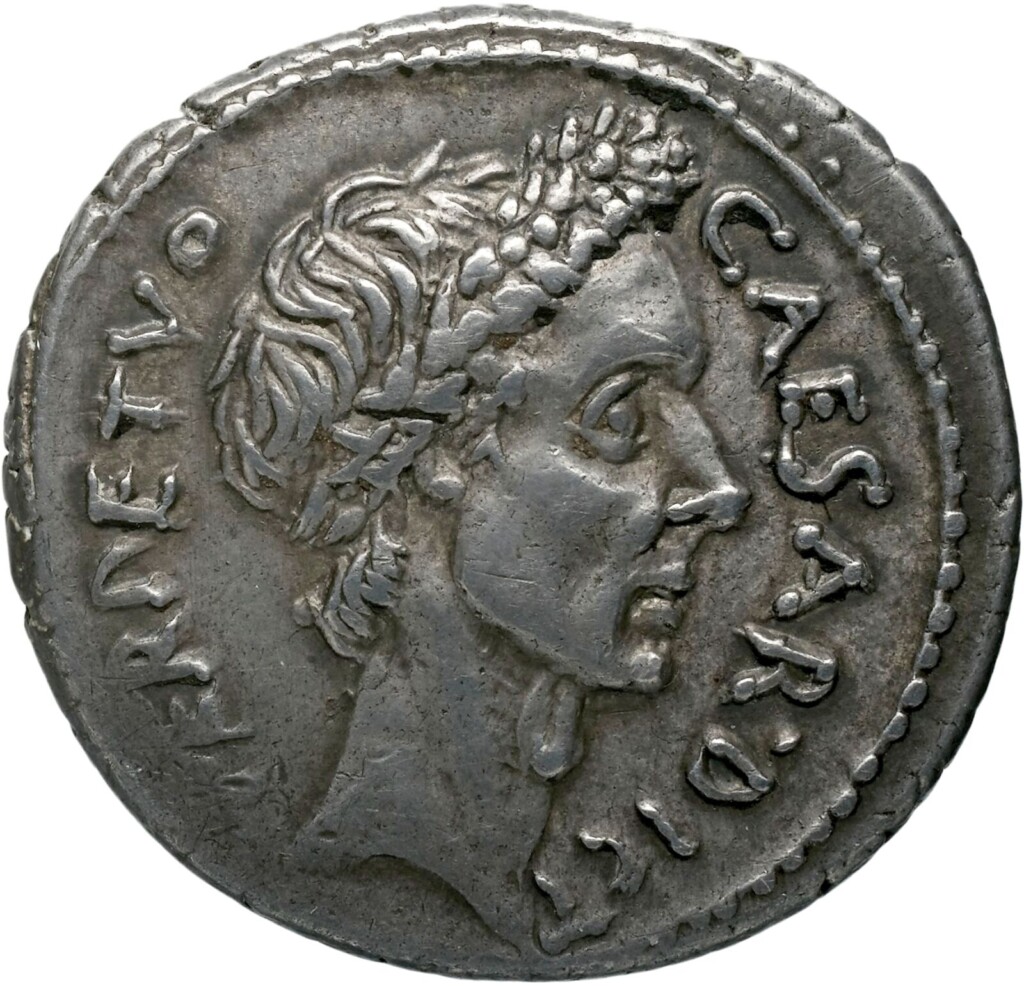
You are standing in the Globe Theatre in 1599, pressed into a crowd that smells of river water and sawdust, watching men in togas speak lines about daggers and destiny, and somewhere in the architecture of that moment is a recursion so vertiginous it should make the floor dissolve beneath you: the actors performing Romans are performing Romans who were themselves performing for history.
The conspirators at the Capitol do not simply kill Caesar. Cassius, in the immediate aftermath of the assassination, turns to his companions and announces that the scene they have just enacted will be performed again by actors in states not yet born, in languages not yet spoken. Shakespeare gives him this speech in Act III, and it is one of the most unsettling intrusions of meta-consciousness in the entire canon, because Cassius is not merely a character expressing pride — he is a character who understands himself as a character, an agent who grasps that the meaning of his action lies entirely outside the action itself, in the imagined reception of a future audience he will never meet. He is not responding to Rome. He is addressing posterity. This is not dramatic irony in the conventional sense, where the audience knows more than the figure onstage. Here, the figure onstage knows exactly as much as the audience does, and the knowledge destroys the boundary between the two.
What Shakespeare exposes through this collapse is something the historian J.G.A. Pocock identified across centuries of republican thought: that political actors in traditions shaped by Rome never understood themselves as simply governing in the present. They understood themselves as inhabiting a narrative that would be judged by a tribunal of the future, and this meant that their actual decisions were always partly theatrical constructions, shaped not by the immediate problem but by the legacy they intended to leave. Plutarch, whose Lives provided Shakespeare almost everything he needed for the play, was himself already engaged in this project — converting political lives into moral exempla for readers who would never have voted in a Roman election but would nonetheless absorb Roman categories for thinking about virtue, ambition, and betrayal. By 1599, Shakespeare was writing a play about men who were already legends when Plutarch wrote about them, staging a version of a text that was itself a version of a life that had already been refracted through centuries of republican mythology. Each layer believed it was recovering something essential. Each layer was adding a costume.
The ideological weight carried by this recursion falls hardest on Brutus, because he is the figure most catastrophically deceived by his own performance. He stages himself as the heir to Lucius Junius Brutus, the founder who expelled the Tarquin kings and refused to exempt his own sons from execution when they conspired against the republic — a story Brutus references explicitly, understanding his lineage as an obligation rather than a privilege. This ancestry is not background detail. It is the mechanism by which Brutus converts a political calculation into a moral necessity, borrowing the weight of prior legend to make his present action feel inevitable. Yet the republic he believed he was restoring had already been hollowed out by the very structural forces that produced Caesar. His performance of ancient virtue arrived at a stage where the drama had changed genres entirely, and the audience he imagined — a future Rome of free citizens grateful for their liberty — never materialized.
What endures, then, is not the meaning the conspirators intended to bequeath but the play itself, which refuses to deliver that meaning cleanly to anyone. Shakespeare’s Rome is a machine for producing interpretations that cancel each other, a theater in which every actor believes himself the protagonist of a tragedy with moral clarity, and the audience across four centuries has kept returning not because the play resolves its questions but because it so precisely mirrors the condition of any political moment in which people act for history while history is still being written under their feet.
🎭 Power, Betrayal, and the Weight of History
Shakespeare’s Julius Caesar is a timeless meditation on political ambition, moral compromise, and the fragility of republics. To fully grasp its resonance, it helps to explore the broader cultural and intellectual currents that shaped its themes — from Machiavellian power politics to the tragic psychology of great men undone by their own contradictions.
Machiavelli’s The Prince: Meaning and Analysis
Machiavelli's The Prince remains the foundational text for understanding how power is acquired, maintained, and lost — themes that pulse through every scene of Julius Caesar. Shakespeare’s Brutus and Cassius enact, almost involuntarily, the cold calculations Machiavelli described decades earlier. Reading the two works together reveals how Renaissance political thought penetrated even the English stage.
GO TO THE SELECTION: Machiavelli’s The Prince: Meaning and Analysis
Shakespeare’s Richard III: Meaning and Analysis
Shakespeare’s Richard III offers the darkest counterpart to Julius Caesar, presenting a tyrant who seizes power through manipulation and murder rather than dying at the hands of liberators. Where Caesar is mythologized in death, Richard is consumed by his own villainy while still alive. Together, the two plays form a diptych on the moral abyss at the heart of political ambition.
GO TO THE SELECTION: Shakespeare’s Richard III: Meaning and Analysis
Niccolò Machiavelli: Life and Political Thought
Niccolò Machiavelli‘s life and thought provide the essential political-philosophical backdrop against which Shakespeare’s Roman tragedies gain their sharpest meaning. His analysis of fortune, virtue, and the uses of fear illuminates why Brutus fails and why Caesar’s ghost endures. Understanding Machiavelli is indispensable for any serious reader of Shakespeare’s histories and tragedies.
GO TO THE SELECTION: Niccolò Machiavelli: Life and Political Thought
Betrayal as a Theme in World Literature
Betrayal is one of the oldest and most devastating themes in world literature, and Julius Caesar places it at the very center of its dramatic architecture. The wound inflicted by Brutus carries a weight entirely different from those of the other conspirators, transforming a political assassination into a deeply personal tragedy. This article traces how the betrayal motif has shaped literary and cultural imagination across centuries.
GO TO THE SELECTION: Betrayal as a Theme in World Literature
Discover the Cinema That Dares to Ask the Same Questions
If Shakespeare’s exploration of power, conscience, and betrayal moves you, Indiecinema offers a curated streaming selection of independent films that wrestle with the same eternal dilemmas — stories told outside the mainstream, with the courage and depth that great literature has always demanded. Explore the catalog and find your next film that truly makes you think.
👉 EXPLORE THE CATALOG: Watch Indie Films in Streaming
A vision curated by a filmmaker, not an algorithm
In this video I explain our vision

