
The Manufactured Gaze and Its Willing Subjects
You are sitting in the dark and something happens to your body before your mind catches up. The woman on screen moves through a doorway and the light finds her in a way that seems accidental, almost careless, as if the camera simply happened to be there. Your breath adjusts. You feel what you are certain is desire, or recognition, or some private mixture of the two that belongs entirely to you. This is precisely what you were engineered to feel, and the engineering began years before you were born.

Kim Novak arrived at Columbia Pictures in 1953 at the age of twenty, a former refrigerator salesgirl from Chicago whom Harry Cohn acquired with the specific intention of replacing Rita Hayworth, who had committed the unforgivable studio sin of marrying without permission. What Cohn needed was not a woman but a surface, and Novak’s particular quality of surface — that strange blond opacity, neither warm nor cold, that seemed to absorb light rather than reflect it — was exactly the material his technicians required. She was not discovered. She was manufactured, which is different only in the degree of honesty involved.
The Technicolor process used during this period was not a neutral recording of reality. It was a set of chemical and optical decisions made primarily by Eastman Kodak and refined through contracts between the studios and their laboratory suppliers, decisions that privileged certain skin tones over others, that rendered platinum blond hair as an almost phosphorescent halo, that made particular shades of lavender and grey — the colors Novak was costumed in almost obsessively — vibrate against each other in ways that produced a measurable physiological response in audiences. Roland Barthes, writing in Mythologies in 1957, the same year Novak appeared in both Vertigo and Pal Joey, observed that mass culture does not present ideology as ideology but as nature, as something simply there, self-evident, requiring no explanation. The palette of 1950s Hollywood was ideology rendered in light.
Laura Mulvey’s 1975 essay Visual Pleasure and Narrative Cinema introduced the concept of the male gaze not as metaphor but as mechanism — a structural feature of classical Hollywood editing in which the camera’s movements, its cuts and its holds, systematically position the female body as object of contemplation for an assumed male spectator. What Mulvey’s argument clarifies, and what gets lost when the theory is reduced to a slogan, is that this gaze was not incidental to the films but constitutive of them, baked into the decisions made at the level of the frame. When the camera lingers on Novak’s face for three seconds rather than one, that extra two seconds is a commercial and ideological calculation, not an aesthetic accident.
The lighting contracts themselves are worth examining. Columbia employed a small group of cinematographers who worked almost exclusively on the studio’s major productions, and their work with Novak followed protocols so precise they might as well have been medical. Low-key front lighting to eliminate the slight asymmetry in her features. Diffusion filters calibrated to her specific complexion. The so-called “woman’s light” — a term used without irony in studio documentation of the period — deployed to produce what was understood internally as the quality of dreaming. Audiences received this as intimacy. They were receiving a technical specification.
None of this diminishes what happens in the dark. The response is real even when its causes are constructed, which is the central unresolved problem of all aesthetic experience and most human relationships. What it does is relocate the origin of the feeling, shift it from the interior life of the viewer to the exterior machinery of an industry that had spent thirty years studying exactly what combinations of light, color, movement, and proportion would make a body in a seat produce revenue. Your desire was the product. You were the market being tested.
Vertigo, Control, and the Woman Redesigned
You are watching a man reconstruct a woman from memory. He chooses her clothes, her hair, her walk, the precise angle at which she holds her chin. She complies, not because she is weak, but because the alternative — being nobody to him — feels worse than being his invention. When the transformation is complete, he is moved almost to tears. He has not fallen in love with her. He has fallen in love with his own capacity to create.
Alfred Hitchcock released that film in 1958, and what critics spent decades calling his masterpiece was also his most unguarded admission. The architecture of the story — a man who cannot desire a woman until she has been rebuilt to match a dead woman’s image — was not a psychological aberration dressed up as thriller. It was a precise diagram of the studio system’s relationship to its female stars, rendered in Technicolor and presented as romance. Kim Novak played both women: the original and the copy, the raw material and the finished product. She did not have to reach far for the emotional truth of that double position. She had been living it.
Laura Mulvey’s 1975 essay “Visual Pleasure and Narrative Cinema” introduced the concept of the male gaze not as metaphor but as structural mechanism — the way classical Hollywood cinema positioned the camera, and therefore the viewer, as an inherently masculine subject whose pleasure derived from controlling and fetishizing the female image. Mulvey drew heavily on psychoanalytic theory to argue that the woman on screen functions as spectacle rather than agent, her narrative purpose being to be looked at rather than to look. What made the argument so corrosive was that it didn’t accuse individual directors of malice. It described a grammar, a syntax of power so deeply embedded in the conventions of filmmaking that audiences absorbed it without noticing they were being trained.
Novak arrived at Columbia Pictures in 1954, where Harry Cohn had already made a specialty of manufacturing desire. He looked at her and reportedly said she was raw but workable. The studio changed her name — she had been Marilyn Pauline Novak, which Cohn considered unmarketable — dressed her in a signature lavender palette calculated to differentiate her from the blonde bombshell Columbia already owned in Rita Hayworth, and deployed her in roles designed to test public appetite before investing further. She was not an actress being developed. She was a product being market-tested. The violence of this process was invisible precisely because it was institutional, wrapped in the language of opportunity and career guidance and the mythology of stardom as transformation.
What Mulvey identified as cinematic structure was, for Novak, biographical fact. The camera’s obsessive circling of her face, the costuming that turned her body into an argument about male longing, the plots that reduced her interiority to a surface that men could project onto — none of this required the director to be consciously cruel. Cruelty was not the point. Efficiency was. The system produced desire efficiently by producing women whose identities had been streamlined into desirability, which meant stripping away whatever made them complicated, resistant, privately themselves. Novak has spoken in interviews about the persistent feeling during her peak years that she was watching herself from somewhere slightly outside her own body, unable to locate the boundary between what she genuinely was and what had been installed in her place.
The film that made her an icon was therefore not using her as a symbol. It was using her as a document. When the camera lingers on her face mid-transformation, when it watches a man’s satisfaction at remaking a woman who is standing right in front of him, it is not critiquing the gaze. It is exercising it, with an honesty so complete it circles back around to something almost unbearable to name.

The Studio as Apparatus of Transformation
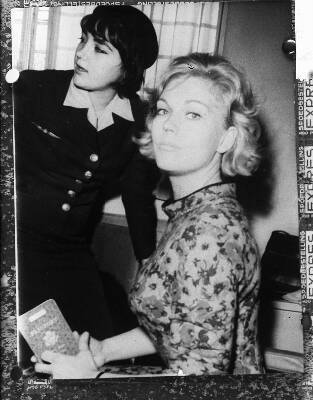
You are handed a new name the way a factory stamps a serial number onto a part — not to identify you, but to make you interchangeable, reproducible, sellable. Marilyn Pauline Novak arrived at Columbia Pictures in 1954 as a refrigerator demonstrator from Chicago, and Harry Cohn looked at her the way a craftsman looks at raw material: something to be shaped, smoothed, and rendered legible to an audience that had not yet been told what it wanted. The name Kim was chosen because it was short enough to fit on a marquee and empty enough to hold whatever fantasy the studio decided to pour into it. One syllable. No history. No ethnicity you could pin down, no neighborhood, no grandmother. Just a sound that the mouth could produce without effort, the verbal equivalent of a blank screen.
Guy Debord, writing in 1967 in “The Society of the Spectacle,” argued that modern capitalism does not simply sell objects — it sells representations of life, images so thoroughly mediated that the lived experience they pretend to reflect has already been replaced by the image itself. The star system is one of the purest expressions of this logic. What Columbia manufactured was not a woman with a talent for performance; it was a surface, a two-dimensional projection onto which paying audiences could cast their desires, their anxieties, their unarticulated longings. The person behind the surface is structurally irrelevant to this process — which is precisely what makes the process so brutal for the person who happens to occupy it.
Cohn’s methods were not exceptional; they were systematic. He required Novak to bleach her hair to a shade of platinum that no natural body produces, imposed a strict weight regime monitored by studio physicians, and arranged for her to be photographed exclusively in ways that emphasized the constructed geometry of her appearance — the wide-set eyes, the particular architecture of her cheekbones — rather than anything that might suggest interiority. The studio’s publicity machine generated biographical material so relentlessly edited that the real Chicago upbringing, the real parents, the real economic precarity that had brought her to Los Angeles, were simply erased. What replaced them was a mythology: the discovery, the natural grace, the effortless emergence of a star. Effortlessness is always the most labor-intensive product of any apparatus.
What the studio understood, and what Debord’s framework helps make visible, is that the spectacle functions most efficiently when the audience believes it is seeing something spontaneous. The industrial manufacture of Kim Novak had to be invisible for Kim Novak to work as a commodity. This required not just controlling her image but controlling her self-perception, persuading her that the constructed persona was, in some deeper sense, who she actually was. Psychologists studying identity formation — Erik Erikson‘s work on the self as a narrative construction comes to mind here — have noted how thoroughly external categorization can colonize interior life, especially when it arrives with the full institutional weight of a major studio, a contract, a salary, and the implicit threat that the alternative is anonymity.
The violence of this transformation was not physical, though Cohn’s behavior toward Novak was documented as coercive and at times openly threatening. The violence was ontological: a systematic dismantling of the person’s right to author her own meaning. And yet this dismantling was presented, culturally and contractually, as opportunity — as the gift of visibility, of being seen. The paradox embedded in that gift is that the more thoroughly you are seen as the image the studio has manufactured, the more completely the person doing the seeing has no access to you at all. To become a spectacle is to achieve a form of radical invisibility dressed as its exact opposite, and the audience applauding in the dark has no idea it is applauding an absence.
Blonde as Cultural Shorthand
You are standing in a drugstore in 1956, and the woman on the magazine cover does not look at you. She looks slightly past you, into a space you cannot see, her hair the color of something bleached out of existence — not white, not yellow, but a shade engineered to suggest both at once. You feel something. You do not know yet that what you feel has been manufactured.
The blonde in postwar American culture was never primarily a hair color. It was a compressed ideology, a way of condensing several contradictory desires into a single visual sign that could be processed in under a second. Roland Barthes, writing in Mythologies in 1957, described how modern culture transforms history into nature — how what is constructed over decades of deliberate social pressure appears to the observer as simply the way things are. The platinum blonde was precisely this kind of myth: a convergence of anxieties about femininity, national identity, and sexual availability that had been slow-cooked through the Depression, the war years, and the strange euphoric terror of early Cold War prosperity, then presented as the face of the American woman.
The economics underneath were not subtle. By the mid-1950s, the American cosmetics industry was generating over one billion dollars annually, with hair products representing the fastest-growing segment of that market. The postwar domestic ideal required women to perform a very specific version of femininity — available enough to be desired, composed enough not to destabilize, luminous enough to reflect the prosperity that American capitalism was insisting on as proof of its own righteousness. The blonde was the visual shorthand for a woman who had consented to all of this without appearing to have agreed to anything.
Kim Novak’s particular shade was not an accident of genetics. It was crafted by Columbia Pictures under Harry Cohn with a deliberateness that bordered on clinical. The studio positioned her coloring against the red brick and shadow of her working-class Chicago origins — a woman scraped clean of her own history and presented as an aspiration rather than a person. What made this specific construction so culturally potent was that it did not feel artificial. It felt inevitable, which is precisely how ideological operations succeed. Simone de Beauvoir had noted in The Second Sex in 1949 that femininity is not born but manufactured through a thousand daily pressures, each invisible on its own, devastating in aggregate.
The danger encoded in the blonde archetype ran parallel to its promise of purity, and this tension was not incidental. It was load-bearing. A woman who looked that composed, that luminous, that scrubbed of particularity, produced a specific kind of male anxiety — the fear that something was being withheld, that the surface concealed a will, that the compliance was theatrical. This is why blondness in cinema kept sliding into suspicion: Grace Kelly‘s frigidity, Lana Turner‘s courtroom shadow, the recurring sense that the most beautiful women in American films were also the most dangerous. The culture needed the threat in order to justify the control.
What Novak carried in her particular iteration of this was something the studio did not script and could not fully contain: a visible reluctance. There are photographs from the late 1950s in which she looks at the camera with an expression that sits precisely between submission and contempt, and the ambiguity is not coy — it is structural. She embodied the archetype while simultaneously failing to fully become it, which made her fascinating in a way that pure compliance never generates. The myth needed believers. Novak seemed, at moments, to be attending her own mythology as an unconvinced guest.
The postwar American self-image needed a face that promised renewal without rupture, desire without disorder, a femininity so polished it could serve as evidence that the country had won something worth winning.
Resistance Without a Language
She stopped answering the phone. Not gradually, not as a calculated move studied in advance, but in the way a person simply ceases to perform a gesture that has become unbearable — abruptly, without announcement, the way you might stop eating a food that once made you sick. The house in Oregon came later, the paintings earlier, but the phone was the first withdrawal, and nobody in the industry knew what to call it because the industry had no category for a star who did not want to be a star on the industry’s terms.
Erving Goffman published “The Presentation of Self in Everyday Life” in 1959, the same year Novak was navigating the aftermath of her most visible screen roles, and his central argument lands with uncomfortable precision on her situation: that social life is a theatrical performance, that every individual plays to a front-stage audience while maintaining a backstage self, and that the entire system depends on tacit consent from all participants. What Goffman did not fully address — what he perhaps could not address within the sociological framework he was building — is what happens when one party to that contract discovers they never agreed to its terms, that the signature was forged somewhere in the machinery of fame before they had the conceptual tools to refuse it.
Novak had taken painting seriously since her early twenties, and there is something structurally significant in that choice that goes beyond mere hobby or escape. Painting is a discipline of attention directed inward and then projected outward through a medium you control entirely. The canvas does not have expectations of your face. It does not require your body to hold a particular posture for a particular kind of male gaze. It does not cast you and then recast you and then replace you when the version it created no longer sells tickets. The shift from screen to canvas was not a retreat from expression — it was a pursuit of expression through a form that did not weaponize the self against itself.
What made her discomfort so historically legible, in retrospect, is precisely what made it invisible at the time: there was no cultural vocabulary available in the late 1950s to describe what she was experiencing as anything other than ingratitude or instability. Second-wave feminism had not yet produced its theoretical infrastructure. Betty Friedan would not publish “The Feminine Mystique” until 1963, and even that text, for all its rupturing force, spoke primarily to suburban domesticity rather than the specific machinery of the entertainment industry’s manufacture of femininity. Novak was living inside a problem that would not be named for another decade, and the absence of language for something does not make it less real — it makes it more isolating, because the person experiencing it cannot even construct a coherent account of their own suffering.
The rural Oregon move in later life has been read as eccentricity, as self-exile, as a kind of romantic primitivism. What it actually resembles, when you examine it without the frame the press built around it, is the logical endpoint of a long argument Novak had been making without words. The landscape there does not perform. The animals do not require her to be legible. The critics writing about her withdrawal consistently treated it as a story about a career ending, which is the only narrative frame Hollywood offers for a woman who stops cooperating — the career ending is her punishment, her failure, the proof that she needed the machine more than the machine needed her. The possibility that the withdrawal was a form of integrity, that it required more courage than anything she had done on screen, arrived late in the discourse and never fully displaced the original story.
What a culture cannot name, it tends to pathologize, and what it pathologizes, it eventually forgets — unless someone later decides the silence itself was the argument.
A vision curated by a filmmaker, not an algorithm
In this video I explain our vision
The Nostalgia Industry and Its Retroactive Myths

You have watched a film you have never seen before, yet somehow you know it — the color temperature, the orchestral swell at the moment of recognition, the way the camera lingers on a face as though the face itself were a form of argument. Something in you settles, like a body finding a chair it was made for. That sensation of homecoming is not memory. It is a product.
Pierre Nora, writing in the first volume of Les Lieux de mémoire in 1984, drew a distinction that most people who invoke him promptly ignore: he was not celebrating the sites of memory he catalogued, he was mourning the conditions that made their construction necessary. A lieu de mémoire arises precisely because living memory has died. When a community no longer carries a past in its daily practice, its gestures, its speech, it builds a monument — and the monument is always a substitution, never a continuation. The archive replaces the grandmother. The retrospective replaces the conversation that was never passed down.
What is called golden-age Hollywood today was not recognized as a coherent cultural category by the people who lived inside it. Studio executives in 1958 did not speak of a golden age; they spoke of a business under siege from television, from European art cinema, from the collapse of the block-booking system that the 1948 Paramount Decree had dismantled. The performers working those sets understood themselves as industrial laborers under contract, often interchangeable in the eyes of management, subject to loan-outs, option clauses, and suspension without pay. The golden age was not a self-description. It was a retroactive frame, and the economics of that frame have a precise birth date.
When home video cassette distribution reached mass penetration across American households in the early 1980s, studios faced an inventory problem: they owned vast libraries of footage that had been written off as exhausted product. The solution was to repackage the past as prestige. Turner Broadcasting’s acquisition of the MGM library in 1986 for approximately 1.5 billion dollars was not a cultural act; it was a content-extraction operation that accidentally generated an aesthetic ideology. Films that had been forgotten, dismissed, or simply unavailable became curated classics once they could be sold in cardboard sleeves with gold lettering. The category of classic cinema was, in large part, a home video marketing category that gradually colonized critical vocabulary.
What was selected for that canonization followed patterns that had nothing to do with artistic quality assessed across the full breadth of what was produced. The films that became classics were those that photographed well on cathode-ray tubes, that featured stars whose faces had achieved sufficient secondary celebrity through gossip and biography to drive rental decisions, and that reinforced the particular fantasy of American competence and glamour that the Reagan cultural moment was actively manufacturing as national mythology. Films that complicated that image — the melodramas of frustrated desire, the noirs ending in institutional defeat, the stories of women destroyed by the very machinery of visibility — were selectively absorbed into the canon in ways that softened their edges.
Kim Novak’s particular position in this process is clarifying precisely because she resisted absorption gracefully. The films in which she appeared that entered heaviest rotation in the revival circuit were those in which her strangeness could be read as romanticism, her dissociation as mystery, her fundamental refusal of the camera’s demand as a form of depth. What was actually a survival strategy — the maintenance of interior distance as a defense against an industry that had literally renamed her, reshaped her, and marketed her body as a commodity called Kim Novak when she had been born Marilyn Pauline Novak — got translated by the nostalgia apparatus into the very quality that made her timeless.
The monument was built not over an empty site but over something that was demolished while the woman it concerned was still standing in the rubble.
What the Audience Needed Her to Be
You have sat in the dark and watched a woman become whatever the room required. Not her room — yours. The theater itself was a kind of pressure system, and what it needed in the middle years of the 1950s was not a personality but a surface, something luminous enough to receive the projected anxieties of a culture that had just survived one catastrophe and was quietly manufacturing another.
The sociological data from that decade is almost clinical in its precision. By 1956, roughly 60 percent of American women between the ages of twenty and twenty-four were married, a rate that would not be matched again in the twentieth century. The median age of first marriage for women had dropped to twenty years old. These numbers are not merely demographic curiosities — they describe a society performing normalcy with the fervor of a religious ritual, a country that had converted domestic containment into the primary evidence of psychological health. William H. Whyte published The Organization Man in 1956, documenting how suburban conformity had become not a pressure applied from outside but a value internalized so completely that deviation felt like personal failure. The man in that analysis needed his household to be stable, legible, reassuring — which meant the woman at the center of it needed to be the same.
What cinema offered was the controlled experiment. A woman on screen could be dangerous without being dangerous, transgressive without cost, available in the imagination without disrupting the actual domestic architecture. The cultural theorist Laura Mulvey, writing in 1975 in her essay “Visual Pleasure and Narrative Cinema,” argued that classical Hollywood structured female presence through the male gaze as a way of managing the anxiety that female difference produced — not by eliminating the threat but by aestheticizing it, by converting what disturbed into what attracted. Novak’s particular quality of stillness, that famous detachment, was not a performance choice in any simple sense. It was a mirror surface that gave back whatever fear or longing was brought to it.
The gender anxiety of the 1950s had specific textures that contemporary readings sometimes flatten. It was not simply the anxiety of men over women, but a more recursive terror — the suspicion that the roles being performed on both sides of the domestic threshold were hollow, that the cheerful competence required of wives and the confident provider identity required of husbands were costumes worn over a vacuum. Betty Friedan would name this in 1963, but the distress it named had been accumulating since at least the late 1940s, when women who had worked in factories and managed households alone during the war were systematically returned to a dependency that felt, to many of them, like a kind of amputation. The woman on screen who seemed just beyond grasp, who never quite arrived into full domestic legibility, was not a fantasy of liberation — she was a fantasy of explanation. Perhaps the flatness inside the marriage was not structural. Perhaps there was a woman somewhere who contained actual mystery, and the failure was only one of proximity.
A performer becomes a cultural symptom when the qualities attributed to her exceed anything she could have produced through intention. Novak gave interviews. She spoke plainly about her working-class Chicago origins, her discomfort with the star machinery, her genuine uncertainty about her own abilities. None of that information modified the myth, because the myth was not constructed from the material she provided. It was constructed from a need that predated her, a slot in the culture’s emotional architecture that required a specific shape of woman — passive enough to be controlled, beautiful enough to justify the fixation, unreachable enough to sustain the longing indefinitely without resolution. She fit the slot not because of any extraordinary personal quality but because the slot had been cut, precisely, in her approximate dimensions, years before she arrived in Hollywood.
The Unresolved Remainder

You are watching an old photograph of her — not a film still, not a promotional shot, but something candid, taken between setups on a location shoot sometime in the late 1950s. She is not performing. Her gaze moves slightly off-axis, toward something outside the frame, and in that small deflection something resists you entirely. You cannot name what it is. You cannot metabolize it. It just sits there, looking back from whatever edge she was already standing on.
Roland Barthes, writing in Camera Lucida in 1980, distinguished between the studium of a photograph — its legible cultural content, the information it delivers — and the punctum, that detail which wounds without announcing itself, which rises unbidden from the image and punctures the composed surface of meaning. The punctum cannot be produced deliberately; a photographer who aims for it destroys it. It is what escapes intention, what the apparatus of meaning-making failed to fully capture. Most stars of classical Hollywood exist entirely within the studium. Their images are saturated with legibility: the glamour, the studio lighting, the semiotic architecture of desire and aspiration doing exactly what it was designed to do. What is strange about Kim Novak is that her image contains a remainder. Something in it refuses to complete the transaction.
This is not the same as saying she was a great actress in the conventional sense, or that she overcame the system, or that she secretly subverted it — each of those framings would reinstall her inside a narrative of heroic legibility. The disturbance in her presence is more fundamental and harder to locate than any of those stories would require. It operates below the threshold of interpretation. Sociologist Erving Goffman, whose 1959 work The Presentation of Self in Everyday Life dissected performance as the continuous management of impressions, observed that what terrifies most people about social interaction is the moment the performance slips — not fails, but slips, revealing a gap between the managed surface and whatever is underneath it. Novak’s screen presence, at its most acute, produces precisely that sensation in the viewer without the narrative having earned it through plot mechanics. The gap opens without warning, in gestures that seem slightly mistimed, in silences that last a beat too long.
What complicates any clean account of this is the impossibility of knowing whether that strangeness was hers or was manufactured as a variant of her containment — a slightly exotic flavor of feminine mystery that the studio could market as depth while controlling its every expression. The history of cultural industry, as Theodor Adorno and Max Horkheimer argued in Dialectic of Enlightenment in 1944, is partly the history of pseudo-individuation: the system generates apparent exceptions to its own homogeneity in order to make the homogeneity more palatable. A star who seems to exceed the formula is often the formula’s most sophisticated product. Novak may have been exactly that. Or she may not have been. The evidence does not settle the question, and the discomfort of that unresolved state is part of what continues to press against the viewer decades after the films have stopped circulating widely.
What persists, finally, is not her biography, not her victimization at the hands of the studio apparatus, not even the specific films, but a quality of presence that was never fully made sense of by anyone who encountered it — including, by her own account in later interviews, Novak herself. She described not quite understanding what the camera was seeing in her, which is either profound honesty or a performance of humility, and the fact that both readings remain equally available is not a failure of interpretation but its truest result, the place where the question about her and the question about cinema and the question about what we want from another human face finally become the same question.
🎬 The Golden Age of American Cinema and Its Icons
Kim Novak embodies the mysterious allure and psychological depth that defined classic American cinema, captivating audiences with her luminous screen presence and complex portrayals. Exploring her legacy means diving into a broader world of Hollywood’s golden era, where stars, directors, and genres shaped a cultural mythology that endures to this day.
Edward G. Robinson and classic American cinema
Edward G. Robinson carved his place in Hollywood history as one of the most compelling and versatile actors of the classic American cinema era. His intense screen presence and ability to inhabit morally complex characters made him a cornerstone of the gangster film genre and beyond. Exploring his legacy offers an essential window into the cultural and artistic richness of golden-age Hollywood.
GO TO THE SELECTION: Edward G. Robinson and classic American cinema
John Huston and the art of irregular cinema
John Huston stands as one of the most singular and daring voices in American cinema history, consistently defying studio conventions to pursue raw, unconventional storytelling. From The Maltese Falcon to The African Queen, his films explore human ambition, failure, and resilience with unflinching honesty. His directorial vision remains a touchstone for understanding the rebellious undercurrent within classic Hollywood.
GO TO THE SELECTION: John Huston and the art of irregular cinema
Humphrey Bogart and the face of American cinema
Humphrey Bogart‘s weathered face and world-weary charisma became the very face of American cinema during its most mythological period. His roles in noir classics cemented an archetype of masculinity defined by moral ambiguity, cynicism, and hidden tenderness. Understanding Bogart means understanding the emotional and cultural landscape that nurtured stars like Kim Novak.
GO TO THE SELECTION: Humphrey Bogart and the face of American cinema
Psychoanalysis and cinema: when the couch becomes the screen
The relationship between psychoanalysis and cinema is nowhere more vivid than in the classic Hollywood films of the 1940s and 1950s, where directors like Alfred Hitchcock used the silver screen to explore desire, obsession, and the unconscious mind. Kim Novak herself became a central figure in this intersection, most notably in Vertigo, a film that reads as a pure psychoanalytic fable. This article explores how Freudian and Jungian ideas shaped the narratives and visual language of an entire cinematic era.
GO TO THE SELECTION: Psychoanalysis and cinema: when the couch becomes the screen
Discover Classic and Independent Cinema on Indiecinema
If the allure of golden-age Hollywood and the psychology of its iconic stars has sparked your curiosity, Indiecinema is your destination for deeper cinematic journeys. Our streaming platform brings together independent films, rare gems, and thought-provoking documentaries that explore cinema’s most fascinating histories and personalities. Join us and keep the spirit of great storytelling alive.
👉 EXPLORE THE CATALOG: Watch Indie Films in Streaming
A vision curated by a filmmaker, not an algorithm
In this video I explain our vision

