
The Tyranny of the Calendar
You are standing in front of a mirror on the morning of a birthday that ends in zero, and something in your chest tightens before you have named the feeling. It is not vanity. It is not even fear of death, exactly. It is the sensation of being measured by something you never agreed to — a ruler pressed against your spine by hands you cannot see, marking increments that carry verdict inside them. Forty. Fifty. Sixty. Each number arrives not as a description but as a judgment, and the anxiety you feel is the tax levied by a system of temporal accounting you absorbed so early it feels like biology.

It is not biology. It is architecture — and relatively recent architecture at that.
The ancient Egyptians organized existence around the inundation of the Nile, a rhythm that swelled and receded, deposited silt and withdrew, made fertile and demanded patience. Their calendar was not a corridor stretching from birth toward death but a wheel turning through known stations. The dead were not behind the living — they were in a parallel country that the living would enter and exit cyclically through ritual and dream. Time was not consumed; it was inhabited repeatedly. This is not a romantic primitive fantasy. It is visible in the structure of their funerary texts, in the way the Book of the Dead positions transformation as perpetual rather than terminal, in the astronomical precision they used to track not progress but return.
Across the Atlantic, the Maya Long Count calendar — which Western commentators catastrophized into an apocalypse narrative for the year 2012 — was in fact a description of nested cycles: the 260-day tzolk’in, the 365-day haab’, and larger periods of 144,000 days called bak’tuns cycling within still larger eons. A Long Count date did not place you on a line stretching toward an end. It placed you at the intersection of multiple spirals, each with its own logic and tempo. A human life was not an arrow fired through duration. It was a chord struck inside a larger musical structure that did not require completion to mean something.
What displaced this understanding in the West was not enlightenment but administration. The Gregorian calendar, standardized by papal decree in 1582, was not primarily a philosophical document — it was a managerial one, designed to synchronize tax collection, liturgical observance, and agricultural obligation across geographically dispersed populations. Once duration became a bureaucratic grid, the human being placed inside it became a unit moving along that grid in one direction only, accumulating years the way a ledger accumulates debits. The Protestant Reformation compounded this by sanctifying productivity as moral evidence — Max Weber traced this in The Protestant Ethic and the Spirit of Capitalism in 1905, showing how salvation anxiety transmuted into the compulsion to demonstrate worth through measurable output across measurable time. You were not living. You were accounting for yourself.
By the nineteenth century this accounting had colonized childhood, adulthood, and old age into defined developmental stages carrying social contracts. You were supposed to have achieved certain things by certain numbers, and failure to meet these thresholds was not bad luck but personal inadequacy. Erik Erikson‘s eight stages of psychosocial development, introduced in Childhood and Society in 1950, though clinically nuanced, arrived into a culture already primed to read human life as a sequence of boxes requiring ticks. The map became the territory. People began experiencing their own existence as a performance review against a schedule they had not written.
The cruelty embedded here is quiet and almost invisible. It is not that time passes — every culture has always known that it does. It is that Western modernity converted passing time into a form of moral arithmetic, where each year not optimally used represents a subtraction from a finite account, and where the mirror on the morning of a birthday reflects not your face but your balance.
Days Blows by in a Moment
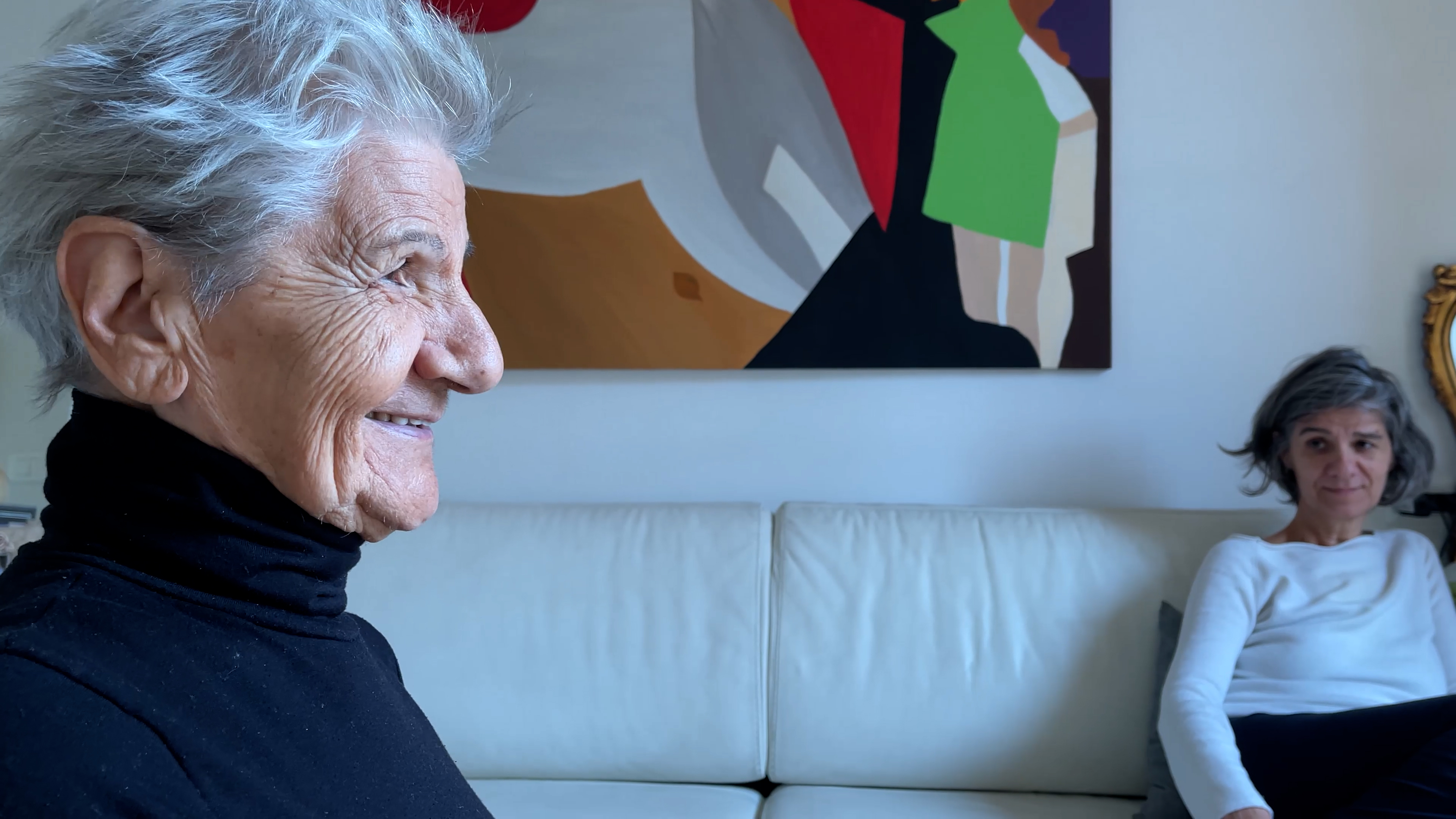
Documentary, by Cristiana Donghi, Italy, 2022.
Ancilla is 86 years old. Two years ago, she moved in with her daughter Emanuela at the pandemic's beginning. Ancilla is slowly losing her memory. He does not remember what she had for lunch, she only remembers events from the past, perhaps only because she has been repeating them for years. Emanuela takes care of her, day after day she wakes her up, prepares her food, washes her, dresses her, and accompanies her a couple of days a week to the hospice and does physiotherapy. This is one of the few contacts with the rest of the world she has left. Ancilla has another child, Mauro, who has been living in London since he left looking for a job. She hasn’t seen him for two years. Daily routines always repeat themselves and change only with the changing seasons. The mother's memories slowly introduce us to Ancilla, her past, the life she lived and that transported her here. Melancholy moments alternate with funny ones and those where patience reaches its limits. Ancilla's sympathy brings a light, fresh breeze into the lives of those around her and allows them to see everything in a way where even the most ominous clouds are blown away momentarily by a breath of wind.
LANGUAGE: Italian
SUBTITLES: English, Spanish, French, German, Portuguese
Borrowed Metaphors, Borrowed Lives

You are thirty-four years old and you feel late. Not late for anything specific — no appointment, no flight — just late in some ambient, sourceless way that lives behind the sternum and surfaces most often on Sunday afternoons or at the birthday parties of people younger than you. You cannot name where this feeling came from. That is precisely the problem.
The grammar of seasons as a grammar of human life is not a discovery. It is an inheritance, and like most inheritances, it arrived before you could refuse it. Shakespeare’s sonnets — written between 1592 and 1609, circulated in manuscript among an elite readership before their unauthorized publication — are among the most efficient delivery mechanisms ever devised for this particular idea. Sonnet 73 gives you the bare ruined choirs, the yellow leaves, the twilight fading in the west, and by the third quatrain you have absorbed a complete theology: that life moves from fullness to diminishment, from green to grey, from abundance to cold. The sonnet does not argue this. It sings it. And what is sung enters the body through a different door than what is argued, bypassing the critical faculty almost entirely.
What the Romantic poets did in the early nineteenth century was democratize and intensify this inherited structure. Keats writing in 1819, dying at twenty-five and already constructing himself as autumn — “Season of mists and mellow fruitfulness” — was not simply describing the English countryside. He was producing a cultural template so persuasive that it would, two centuries later, shape how a thirty-four-year-old software engineer in Seoul or a forty-two-year-old nurse in São Paulo privately narrates the arc of their existence. The reach of that template is empirically measurable in the language people use: a 2016 study of self-reported life satisfaction across forty-six countries by Hannes Schwandt at Princeton found that people systematically overestimate how good their future will feel and underestimate how good their present feels, a distortion that clusters most violently in the late twenties and early thirties — precisely the hinge point where the seasonal metaphor demands that something decisive should already have bloomed.
The European agrarian calendar that underlies all of this was never universal. It assumed a northern hemisphere, a temperate climate, a harvest economy in which the distinction between growth and dormancy was literally a matter of survival. It assumed, in other words, a very specific body in a very specific landscape. For the Yoruba conceptual universe, time was not a linear progression through seasonal stages but a cyclical force tied to ancestral return. For many Indigenous communities across the Americas, aging carried no implicit narrative of decline — elders were not winter figures but accumulators of relational density, held differently by the community rather than diminished within it. These were not primitive alternatives to the Shakespearean model. They were coherent, internally consistent grammars of duration, and they were largely overwritten.
What replaced them — through colonial education, through the global export of European literary culture, through the universalization of the Gregorian calendar and its attendant birthdays and anniversaries — was a single story told as though it were nature. And when a story is told as though it were nature, the people who fail to fit it do not experience themselves as inhabiting a different story. They experience themselves as failing at reality. The shame that accumulates at forty around a life that has not produced the expected harvest, or at sixty around an energy that refuses to become wisdom, is not a private psychological event. It is the structural consequence of inheriting a metaphor designed for a specific agrarian crisis and then discovering, too late, that you have organized your expectations around it as though it were law.

The Industrial Body and the Scheduled Soul
You are handed a schedule the moment you are born, and for most of your life you will mistake it for a heartbeat.
Erik Erikson published his model of the eight stages of psychosocial development in 1950, in “Childhood and Society,” and the architecture of that model quietly assumed something no one thought to question: that human life unfolds in a sequence of discrete, identifiable phases, each with its own crisis to resolve, each arriving on something resembling a schedule. Erikson was a brilliant observer of individual psychological drama, but his framework arrived in the same century that invented the standardized retirement age, the marriage window, and the career peak — and the convergence was not coincidental. The industrial economy needed bodies that could be sorted, deployed, and then gracefully retired, and it found in developmental psychology a vocabulary that made that sorting feel like nature rather than policy.
The retirement age of 65 was not discovered in the body. It was calculated. Otto von Bismarck introduced the first state pension scheme in Germany in 1889, originally set at 70, then lowered to 65 — at a time when average life expectancy in Prussia hovered around 45. The number was chosen precisely because most workers would never reach it. What began as a fiscal mechanism for industrial Prussia migrated, through the Social Security Act of 1935 in the United States, into the cultural marrow of the twentieth century. By the 1950s, 65 had become less a policy number and more a biological landmark, a moment when the body was understood to have completed its productive arc and entered a final, quieter phase. The calendar had been mistaken for the organism.
Marriage windows followed the same logic. Sociologists studying cohort data from the 1940s and 1950s found that the median age of first marriage in the United States dropped to 20 for women and 23 for men — not because human emotional readiness peaked at those ages, but because the postwar economy rewarded domesticity, housing policy subsidized the nuclear family, and corporate culture assumed a man’s productive identity required a stable household. The “right time” to marry was engineered by tax codes and mortgage structures, then absorbed into the language of natural maturation. Women who delayed were not late — they were deviant, measured against a standard that had been assembled in a boardroom.
What made this particularly durable was the way industrial time colonized inner experience. The sociologist Tamara Hareven, writing in the 1970s and 1980s about what she called “family time” and “industrial time,” showed how factory schedules and urban wage labor gradually dismantled the older, more fluid rhythms of agrarian life — where a man of 50 might begin a new trade, where a woman past childbearing might expand into community authority — and replaced them with a single, linear narrative of productivity followed by decline. The body had not changed. The story told about the body had changed, and the body eventually learned to perform that story, to feel its rhythms as its own.
Erikson’s stages, read against this historical backdrop, begin to look less like a map of universal human development and more like a portrait of a particular kind of subject: the mid-century Western worker, moving through institutions in sequence, arriving at generativity in middle age and integrity in old age because the institutions around him were structured to produce exactly that trajectory. The crisis of identity in adolescence was real — but it was real in part because industrial schooling had created adolescence as a holding zone between childhood dependence and adult labor, a category that barely existed before the late nineteenth century. The psychological stage was downstream of the economic invention.
What you feel as your inner clock is, in many of its rhythms, someone else’s ledger.
What Ripeness Actually Costs

She has memorized the specific silence that falls when she enters a room where younger people are already talking. It is not hostile. It is something worse — accommodating, a half-second pause before the conversation resumes at a slightly different angle, tilted just enough to exclude her without requiring anyone to acknowledge the exclusion. Decades of reading people, of surviving things that would disassemble most of those present, and what she receives in return is the particular courtesy reserved for furniture that everyone agrees is valuable but no one quite knows where to put.
Simone de Beauvoir published La Vieillesse in 1970, translated into English as The Coming of Age, and the book was received the way a difficult truth is received when a society has already decided to be polite about it — acknowledged, praised in the appropriate journals, and then carefully set aside. She argued, with the same unflinching materialism she brought to the condition of women, that old age is not a philosophical category or a spiritual threshold but a class relation, that the treatment of the elderly in Western industrial societies reveals the precise mechanism by which capitalism disposes of human beings once they cease to generate surplus value. The book sold. It was discussed. It changed almost nothing structurally, because the societies it described had no interest in confronting the possibility that reverence for elders is largely ceremonial, a ritual that costs nothing and demands nothing and leaves the underlying architecture of disposal completely intact.
The architecture operates through a kind of temporal condescension that masquerades as warmth. The elder is asked to share a memory, a lesson, a piece of hard-won insight, and the request itself is the trap — because the moment the knowledge is offered, it is categorized as retrospective, belonging to a world that no longer exists, interesting in the way that antique tools are interesting: worthy of being displayed, entirely unfit for use. What looks like an invitation to contribute is actually a form of quarantine. The knowledge gets preserved in amber precisely so it cannot contaminate the present.
There is a structural reason this happens that goes beyond individual bad faith. By 1970, the average life expectancy in France had reached approximately 72 years, up from roughly 45 at the turn of the century. The speed of that change meant that societies were for the first time producing large populations of people whose formative experiences had occurred in conditions that no longer existed technologically, economically, or socially. Industrial modernity had solved the problem of early death and created, almost accidentally, a new problem it had no ideological framework to address: what to do with people who had lived long enough to remember that things could be otherwise. The comfortable solution was mythologization — transform the elder’s experience into wisdom, wisdom into a decorative category, and the decorative into the harmless.
De Beauvoir was specifically furious about the conspiracy of silence she identified between the young and the old, a mutual agreement not to look directly at what is actually happening. The young do not look because looking would mean acknowledging that they are already on the same trajectory, that their own accumulation is already moving toward the same destination. The old often do not look because the pain of seeing clearly how thoroughly they have been reclassified — from person to symbol, from agent to archive — is a pain that daily life cannot absorb without breaking something necessary. What both sides protect, in their different ways, is the fiction that ripeness is rewarded, that the seasons of a life build toward something that the world will actually receive.
What the woman in that room has spent years slowly understanding is that the world does not receive it.
The Season That Has No Name

You are forty-three years old and you have just decided, with the calm certainty of someone who has stopped apologizing, to begin the thing you were always supposed to have begun at twenty-two. The people around you do not celebrate this. They smile, yes, but behind the smile there is something else — a faint, almost imperceptible contraction, as if your decision has introduced a cold draft into a room everyone had agreed to keep warm.
The discomfort your late beginning produces in others is rarely about envy, though it wears envy’s face convincingly. What it actually threatens is far more load-bearing than anyone’s private ambitions. The seasonal metaphor — spring for youth, summer for ambition, autumn for harvest, winter for decline — is not merely a poetic convenience. It is a social contract, unwritten and therefore unbreakable, by which people organize their tolerance for one another’s choices. When Penelope Fitzgerald published her first novel at sixty, or when Toni Morrison completed The Bluest Eye at thirty-nine after years of editing other people’s genius, the cultural machinery had no clean category for them. It processed them as exceptions, which is the politest way a system has of saying: we see you, but we are not changing the map.
Sociologist Émile Durkheim spent decades documenting how societies manufacture what he called “collective representations” — shared symbolic structures that are not descriptions of reality but prescriptions for it. The seasonal life is one of the most durable of these representations, precisely because it borrows its authority from nature, from something that appears unchosen and therefore unchallengeable. But nature does not actually organize human development into four clean chapters. Erik Erikson‘s eight stages of psychosocial development, outlined in Childhood and Society in 1950, were never meant as a timetable — Erikson was explicit that the stages could compress, expand, or arrive in unexpected sequences. What happened instead was that popular culture extracted the sequence and discarded the flexibility, because flexibility is threatening and sequence is manageable.
The person who grieves early — who loses a parent at nine, a partner at thirty-one, who sits with the specific exhaustion of someone who has already visited winter and returned — carries a knowledge the seasonal myth cannot accommodate. Not because grief is unspeakable, but because early grief breaks the logic of accumulation on which the myth depends: the idea that you earn sorrow by first earning joy, that loss is a late-stage event, that depth is the reward for duration. Simone de Beauvoir wrote in A Very Easy Death, her 1964 account of her mother’s dying, that she was unprepared for the rawness of it despite her age, despite her philosophy, despite everything she had theorized about mortality. What she was admitting, between the lines, was that no amount of sequential living insulates you from the moments that arrive outside their assigned chapter.
There is a particular violence in demanding that a life be legible. When someone refuses seasonal logic — not out of rebellion but simply because their experience arrived in the wrong order, or took too long, or skipped the designated chapters entirely — what they expose is that the map was always a collective hallucination maintained by mutual agreement. The hostility they encounter is not about their failure to conform; it is about what their existence forces everyone else to briefly consider: that the sequence was never inevitable, that the comfort of living on schedule was borrowed from a story rather than drawn from life, and that somewhere beneath the organized progression of seasons, there is a more honest and more terrifying truth — that time does not move through us in chapters, but all at once, indifferent to the names we gave the weather.
A vision curated by a filmmaker, not an algorithm
In this video I explain our vision
🍂 The River of Time: Memory, Loss, and Becoming
Time is never merely a measurement — it is a landscape we inhabit, a story written in seasons, losses, and transformations. The articles gathered here explore how human beings have tried to make sense of passing time through philosophy, literature, and the deep grammar of the psyche. Each piece offers a different lens through which the great metaphor of the seasons reveals its hidden truth.
Mono no Aware: The Melancholy of Things in Japanese Culture
Mono no Aware — the bittersweet awareness of impermanence — is perhaps the most precise philosophical name ever given to the sensation of watching a season end. Japanese aesthetics built an entire cultural identity around the gentle grief of things that pass, from cherry blossoms to aging faces. This article explores how this concept became a lens through which literature, poetry, and art transformed transience into a form of beauty.
GO TO THE SELECTION: Mono no Aware: The Melancholy of Things in Japanese Culture
Proust’s In Search of Lost Time: Analysis
Proust’s monumental novel is the most sustained literary meditation on time ever written, a cathedral constructed entirely from the material of memory and loss. Through the famous involuntary memory — a madeleine dipped in tea — the narrator discovers that the past is not dead but suspended, waiting to be retrieved through sensation. This analysis guides the reader through the architecture of a work that transforms the passing of seasons into an act of resurrection.
GO TO THE SELECTION: Proust’s In Search of Lost Time: Analysis
Ernaux’s The Years: Analysis
Annie Ernaux‘s ‘The Years’ is a collective autobiography built around the erosion of time, tracing decades of French life through shared images, habits, and forgotten faces. Ernaux refuses the illusion of a stable self, showing instead how identity is assembled and disassembled by the passing of seasons — personal, historical, and cultural. The book stands as one of the most original literary responses to the question of what remains when time has taken everything.
GO TO THE SELECTION: Ernaux’s The Years: Analysis
Grief and the Processing of Loss
Grief is the emotional shadow cast by time’s most irreversible movement — the moment something beloved is gone beyond return. This article examines how human beings process loss, drawing on psychology, cultural ritual, and the strange, non-linear rhythms of mourning that refuse to obey the calendar. Understanding grief is, in the deepest sense, understanding what it means to live inside time rather than above it.
GO TO THE SELECTION: Grief and the Processing of Loss
Discover Films That Feel the Weight of Time on Indiecinema
If these reflections on time, memory, and the seasons of life have stirred something in you, independent cinema offers some of the most honest and poetic explorations of these themes ever put on screen. On Indiecinema you will find a curated selection of films that dare to look at passing time without flinching — stories where autumn light and fading voices carry the full weight of what it means to be human. Stream them now and let cinema do what only cinema can.
👉 EXPLORE THE CATALOG: Watch Indie Films in Streaming
A vision curated by a filmmaker, not an algorithm
In this video I explain our vision

