
The Laboratory at Two in the Morning
The cold gets into your fingers before you notice it. You are bent over something that matters more than sleep, more than food, more than the opinion of the people who stopped believing in you three years ago, and the cold is simply the price of admission to this particular room, this particular night, this particular obsession that has no name yet because the thing you are chasing does not have a name yet. The candle or the lamp throws shadows that move when you move. The smell is sharp, almost alive — sulfur and something metallic, something that coats the back of your throat and stays there. Your back aches in a way that has become so familiar it no longer registers as pain, only as presence, the body’s quiet annotation on what the mind is doing to it. You do not stop. Stopping would mean returning to a world that has very specific ideas about where you belong, and those ideas have nothing to do with this room, this night, this thing you are reaching for in the dark.

This is not a story about genius. Genius is the word the world uses after the fact, the retroactive explanation it applies to justify what it could not accommodate while it was happening. What we are actually talking about is something far more uncomfortable: a person who looked at the role she had been handed — the role of decorative intelligence, of woman permitted to observe but not to conclude, of Eastern European tolerated but not trusted — and simply refused it. Not dramatically. Not with a manifesto. With work. With the kind of work that happens at two in the morning in a space that is too cold and smells like something slowly killing you, because that is the only time and the only space that belongs entirely to you.
There is a shed, barely insulated, in Paris, sometime in the late 1890s. A woman works there for hours that blur into other hours. The floor is dirt. There is no proper ventilation. The substance she is processing — tonnes of pitchblende ore, the residue after uranium has been extracted, the part everyone else threw away — requires physical labor that would exhaust a much larger body than hers. She stirs boiling material in a cast-iron pot. She carries loads. She does this because she has reasoned, with extraordinary precision, that the discarded residue must contain something that no one has yet isolated, something that would explain measurements that did not fit the existing models. She has no guarantee. She has a hypothesis and a refusal to abandon it, which are not the same thing as certainty but are, under certain conditions, more powerful.
The philosopher Gaston Bachelard wrote, in his 1938 work “La Formation de l’esprit scientifique,” that the scientific mind must form itself against the grain of what is most natural and immediate, that knowledge is always won against comfort, against habit, against the seduction of what already seems obvious. He was describing an epistemological principle, but he was also, without knowing it, describing this woman in this shed, in this cold, at this hour. The epistemological obstacle Bachelard was most interested in was not ignorance but familiarity — the way things that seem self-evident become walls inside which thought stops moving. She had no such walls. Or rather, she had been so thoroughly excluded from the comfortable rooms where scientific self-evidence was produced that she arrived at her questions without the accumulated assumptions of belonging.
This is what the world does to those it refuses to accommodate: sometimes, accidentally, it makes them see more clearly. Not because suffering is instructive — that is a lie the comfortable tell themselves — but because the view from outside the room is different from the view inside it. And she was always, in every room she entered, slightly outside it.
Eve of the Irises
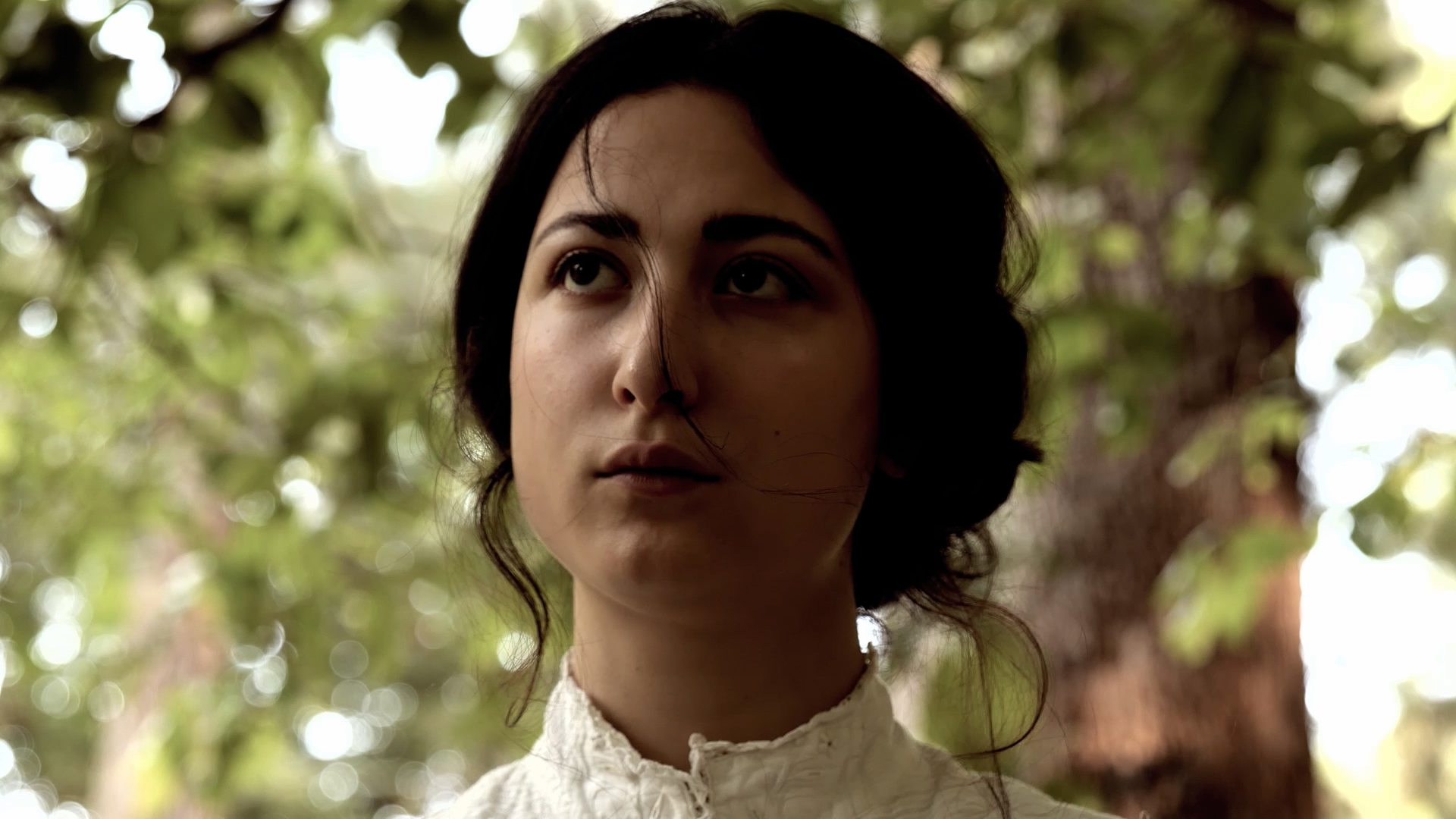
Documentary, by Isabel Russinova, Rodolfo Martinelli Carraresi, Italy, 2026
Eva of the Irises is a historical biographical docu-film about the scientist Eva Mameli Calvino, a botanist and pioneer of environmentalism in Italy, mother of the writer Italo, born in Sassari in 1886. The film, based on a multidisciplinary approach that combines several genres—such as theatre, documentary, cinema, and research—moves between memories, reflections on life, as well as the goals and missions the scholar still wished to achieve.
The multifaceted artistic sensibility of Isabel Russinova is expressed across many fields, from writing to acting, from directing to civic engagement, and finds one of its highest expressions in the docu-film Eva of the Irises, created with Rodolfo Martinelli Carraresi. The film blends scientific rigor and poetic refinement to portray the extraordinary figure of the botanist Eva Mameli Calvino, mother of Italo Calvino but above all an independent protagonist of 20th-century scientific culture. It is told through a combination of archival materials, interviews, and evocative staging capable of elegantly and profoundly conveying her intense human and professional story.
LANGUAGE: Italian
SUBTITLES: English, Spanish, French, Portuguese
A Woman Arrives with the Wrong Name
She arrives in Paris in November 1891 with almost nothing: a folding chair, a small table, a mattress so thin it barely separates her from the floor. The attic room on the Rue Flatters is so cold in winter that the water in her washbasin freezes overnight. She eats chocolate and radishes because she cannot afford coal and food at the same time. She chooses coal. She is twenty-four years old, she speaks French with a Slavic accent that marks every syllable she utters in a lecture hall, and her name — the name her mother gave her, the name that carries the entire weight of a suppressed culture — is Maria Sklodowska. A Polish name. An unpronounceable name, in the ears of Paris. A name that signals, before she has opened a single textbook, that she does not fully belong here.
So she becomes Marie. Marie Curie, eventually. A name the French tongue can hold without effort.
This is not a minor detail of biography. It is the mechanism itself, exposed in plain light. Erving Goffman, writing in Stigma: Notes on the Management of Spoiled Identity in 1963, described with clinical precision the process by which individuals whose social identity fails to match the unmarked norm learn to manage their visibility — to pass, to cover, to translate themselves into forms the dominant institution can process without discomfort. The cost of that translation, Goffman noted, is not simply personal. It is structural. The institution does not change. The person does. And the change is rarely reversible.
Maria becomes Marie. The transformation is not liberation. It is the price of admission.
What the Sorbonne of 1891 was built for is not hard to read. Women had been formally admitted to French universities only a decade earlier, and even then their presence was tolerated as an anomaly rather than welcomed as a correction. Foreign women were a category the system had simply not prepared itself to encounter. Maria Sklodowska carried two disqualifying marks simultaneously: her gender and her origin. To survive — not to thrive, simply to survive inside the walls of an institution that produced knowledge while remaining largely indifferent to who was permitted to produce it — she had to render one of those marks invisible. The accent could not be erased. The name could be.
Think about what that costs, not in sentiment but in cognition. To pass is to sustain a permanent internal split between the self you are and the self you perform. The psychoanalyst D.W. Winnicott, in his work on the false self, described this division as something that begins as an adaptive strategy and ends, if maintained long enough, as a kind of psychic occupation. The performed self gradually colonizes the authentic one. You no longer know with certainty which version of you is speaking. Maria or Marie. Sklodowska or Curie. The woman who grew up under Russian imperial censorship, hiding Polish books behind German covers, or the woman who would stand before the Swedish Academy in Stockholm in 1911 and accept a Nobel Prize in chemistry — the second Nobel Prize she would receive, still the only person in history to win the award in two separate sciences.
There is a scene that belongs to those early Parisian years: a young woman sitting in the back of a lecture hall, writing notes in two languages at once because the French scientific vocabulary has no equivalent in the Polish she thinks in when she is tired or frightened. No one around her notices. She has learned to be invisible in precisely the right way — present enough to learn, absent enough not to threaten. This is the arithmetic of belonging when belonging was never designed to include you. You optimize your legibility to the institution. You pay with pieces of yourself that no prize, however prestigious, will ever be able to return.

What Science Refused to See
There is a moment that stays with you long after you have heard it described. A woman walks into a room full of men who have already decided, before she opens her mouth, that the discovery does not quite belong to her. The applause is polite. The recognition is provisional. The door through which she entered will not remain open. You have probably been in a version of that room yourself, or watched someone else navigate it with a composure that cost more than anyone in the audience could calculate.
Marie Curie won the Nobel Prize in Physics in 1903, shared with her husband Pierre and with Henri Becquerel. Eight years later, in 1911, she won it again, this time in Chemistry, alone, for the isolation of radium and polonium. She remains the only person in history to have won Nobel Prizes in two different scientific disciplines. By any rational measure, this is not the profile of an anomaly. It is the profile of a defining scientific mind of the century. And yet the institutions that were supposed to receive her kept finding reasons to hold the door.
The Académie des Sciences vote in 1911 is one of those historical facts that lands like a fist. She lost by two votes. The campaign against her admission had been explicit, organized, and in certain corners openly ugly, mixing misogyny with xenophobia in proportions that the French press of the time did not bother to disguise. She was a woman. She was Polish. She was a widow who had, by then, been publicly accused of an affair with a colleague, and the scandal was weaponized against her scientific credibility with a speed and efficiency that revealed exactly how thin the veneer of meritocratic objectivity had always been. The Académie would not admit a woman as a full member until Marguerite Perey in 1962, more than fifty years later.
Simone de Beauvoir, writing in 1949 in The Second Sex, gave a name to the structural logic underneath these episodes. She argued that woman is defined within patriarchal culture not as a subject but as the Other, the term that anchors man’s identity precisely by being excluded from it. This is not a description of personal animosity. It is a description of a system that requires the Other to exist in order to function, a system that will absorb exceptional individuals only when it can use them to reinforce the rule, never when they threaten to dissolve it. Curie’s achievements were not invisible. They were seen, registered, and then systematically reinterpreted as exceptional in the sense of exceptional to the category, not as evidence that the category itself was wrong.
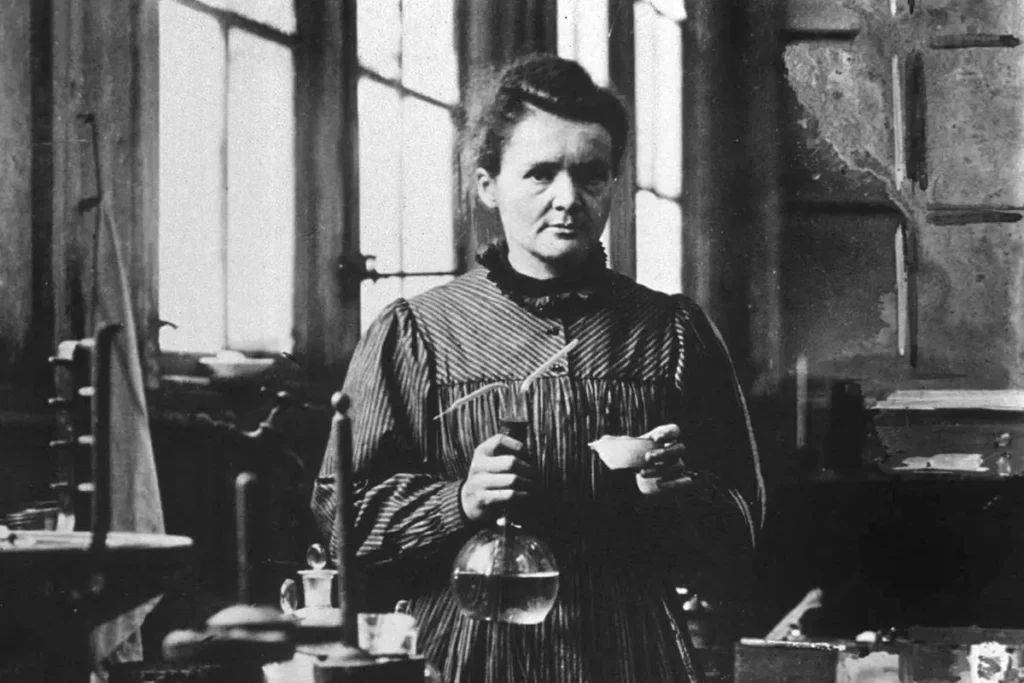
She was denied independent laboratory access for years at the École de Physique et de Chimie Industrielles, working in conditions that a male colleague of equivalent standing would never have been asked to accept. The shed where she and Pierre conducted much of their early research has been described by visitors of the period as damp, poorly ventilated, barely functional. The German chemist Wilhelm Ostwald called it a cross between a stable and a potato cellar. She worked in it for years. Not because she had no other choice in the absolute sense, but because the choices available to her had been engineered to be narrowing.
What makes this particularly difficult to look at directly is the way the exclusion was never total. She was admitted to the Royal Institution in London, as a guest, while Pierre lectured. She received the Nobel. She was celebrated in newspapers across the world. The system did not erase her. It something worse: it acknowledged her with one hand while withholding with the other, producing a kind of conditional visibility that requires the recipient to keep performing gratitude for scraps of recognition that should never have been rationed in the first place.
Pierre and the Myth of the Equal Partnership
There is a particular kind of erasure that arrives dressed as devotion. You have seen it, perhaps without naming it: the woman who speaks and the man beside her who is heard. The idea that exits her mouth and lands in the room only after it has passed through his. Not because he steals it, necessarily. Because the room is built that way, acoustically arranged so that certain voices carry and others simply don’t reach the walls.
Marie and Pierre married in July 1895, and history has spent over a century celebrating what it calls one of the great intellectual partnerships of modern science. The word “partnership” is doing enormous work in that sentence. It implies equivalence, mutuality, a shared ledger. It makes the story romantic, safe, digestible. It transforms a woman of ferocious and solitary genius into half of something, which is tidier, more socially acceptable, less destabilizing than the full picture.
Historian Helena Pycior, in her meticulous research on the Curie laboratory, documented something that the romantic narrative consistently smooths over: the systematic ambiguity in how credit was assigned in their joint publications, and how that ambiguity resolved itself almost invariably in Pierre’s favor in the minds of the scientific establishment. When papers were signed by both, the convention of the era — and of most eras — placed male authority at the interpretive center. When correspondence arrived at the laboratory addressed to “Monsieur Curie,” it was not a clerical error. It was a structural assumption. Pierre himself, to his genuine credit, pushed back against this in several documented instances, insisting on Marie’s primacy in the work on radioactivity. And yet insisting that a woman deserves credit is itself a symptom of the system that requires the insistence in the first place.
Think of what it means to watch your own discovery need a male endorsement to exist fully in the world. Marie had identified the phenomenon she called radioactivity — the term itself was hers — had isolated polonium and radium, had built the experimental framework with her own hands, in a damp and freezing shed that gave her radiation poisoning she would carry for the rest of her life. Pierre joined the research later, redirecting his own considerable work to collaborate with her. This was not common. It was, in fact, remarkable. And it was also, in the grammar of the era, what made the work legible. A woman doing science alone was a curiosity, possibly a scandal. A husband and wife doing science together was a story the culture knew how to tell.
Simone de Beauvoir, writing in 1949 in The Second Sex, described how women are defined not as autonomous subjects but as relative beings, always in relation to something else — a father, a husband, a function. Marie’s genius, which was absolute and individual and brutally earned, became narratively tethered to Pierre the moment she married him. Not because she was diminished by love, but because the world could only metabolize her through the frame of the couple. The love story became the container that made her acceptable. And containers, by definition, have walls.
There is a scene that stays with you: a woman sitting across from journalists, answering questions about her work with precision and confidence, and watching the next day’s newspaper attribute the central discovery to her husband, with her name following his like a polite afterthought. She says nothing publicly. What would she say? The structure is not malicious. It is simply the way the acoustics work in every room she enters.
Pycior’s work makes clear that this was not incidental. The distribution of credit in the Curie laboratory reflected broader patterns in how collaborative science was narrated when one collaborator was a woman. The partnership, however genuine in its affection and intellectual substance, operated inside a world that had already decided who the scientist was.
Radioactivity and the Violence of Discovery
The notebooks are still radioactive. You cannot hold them without signing a waiver. They sit in lead-lined boxes in the Bibliothèque nationale de France, and they will remain dangerous for another fifteen hundred years. This is not a metaphor. The contamination is literal, molecular, lodged in the paper itself — a residue of decades of handling substances that no one yet understood could unmake living tissue as methodically as they unmade the atom.
In 1898, working in a converted shed with a leaking roof and no proper ventilation, Marie Curie isolated two new elements. The first she named polonium, after a country that did not officially exist — Poland had been partitioned among three empires since 1795, erased from maps, forbidden its own language in public schools. To name an element after an occupied nation was not sentiment. It was a political act dressed in the language of science, a refusal of erasure so quiet it passed through the gatekeepers of the Paris Academy of Sciences without triggering alarm. The second element, radium, followed in December of that same year. She coined the term radioactivity herself, a word that entered the scientific lexicon as a neutral descriptor but carried within it the seeds of an entirely new understanding of matter — that atoms were not stable, fixed, eternal units of reality, but things that decayed, that emitted, that bled energy outward across time without any external cause.
The physical cost began immediately and accumulated without pause. She carried test tubes of radioactive isotopes in her coat pockets. She stored them in her desk drawer. She described the faint blue glow of the substances at night as beautiful. Her fingers were chronically cracked and burned. Her bone marrow was being destroyed by invisible particles she could not see or feel, damage that would not manifest in full until decades later, when her blood counts began to collapse irreversibly. Aplastic anemia, the diagnosis eventually came: the failure of the body to produce new blood cells, the slow interior erasure of the biological machinery of survival. The illness that killed her in 1934 had been written into her body continuously since the late 1890s, inscribed through every hour of unshielded work.
Georges Bataille, writing in “La Part maudite” in 1949, argued that the deepest human acts are not those of accumulation but of expenditure — the sovereign gesture that gives without return, that burns the self not in error but in the full commitment to something beyond utility. He was describing economies and rituals, sacrificial acts, the burning of excess that cultures perform at their limits. But the concept cuts across domains with uncomfortable precision. There is a kind of knowledge that cannot be purchased cheaply, that demands the researcher pay in the currency of the body, that converts human tissue into data across years of unrecoverable exposure. Marie Curie did not choose martyrdom. She chose science, which in that historical moment meant choosing a form of slow self-annihilation without yet possessing the vocabulary to name what was happening.
The expenditure was not symbolic. It was absorbed into her chromosomes, into the walls of that shed in the rue Lhomond, into the pages of the laboratory notebooks her hands touched daily. When she won the Nobel Prize in Chemistry in 1911 — already having won the Prize in Physics in 1903, making her the first person to win in two separate scientific disciplines — the Swedish Academy was honoring discoveries whose true cost was still invisibly accumulating in her marrow. The world celebrated the radiance. It could not yet see what the radiance was doing to the woman holding it.
What she gave, she could not take back. The expenditure was total and continuous, and the thing produced — the knowledge, the new map of matter — belonged immediately to everyone except her.
A vision curated by a filmmaker, not an algorithm
In this video I explain our vision
The Scandal as Social Symptom

There is a particular kind of fury that a society reserves not for those who fail, but for those who succeed too visibly while belonging to the wrong category. You have seen it operating in smaller registers — the colleague who gets promoted and suddenly becomes too ambitious, too cold, too something that was never mentioned when they were still safely below. Scale that mechanism to its most extreme expression and you arrive at Paris in the autumn of 1911, when the most celebrated scientist alive became, overnight, a national disgrace.
Marie Curie was fifty-four years old, a widow of four years, and she was in love with Paul Langevin, a physicist, a married man, and a man who was by all accounts miserable in that marriage. The affair was neither secret nor scandalous in the circles that knew them. It was a relationship between two adults, two scientists, two people living in the aftermath of grief and loneliness respectively. What transformed it into a public catastrophe was not the fact of the affair but the identity of the woman inside it.
The French press did not attack Curie as a woman who had made a moral error. They attacked her as a foreigner, a Jew in their imagination though she was not one, a temptress who had seduced a French man away from his rightful French family. Le Journal ran the stolen letters. Other papers amplified them. The language deployed was not the language of personal morality. It was the language of contamination. She was described as an element of disorder introduced into a stable national body. The xenophobia was naked and deliberate. Her Polish origin, which had been tolerated as picturesque exoticism during her years of triumph, became suddenly evidence of an essential alien quality, a foreignness that had always been dangerous and was now proven so.
Hannah Arendt, writing decades later in The Origins of Totalitarianism published in 1951, described with surgical precision the double bind of what she called the parvenu — the outsider who attempts to assimilate, who succeeds by the rules of the dominant culture, who earns every credential, and who discovers that success itself becomes the unforgivable transgression. The pariah who stays invisible is tolerated. The parvenu who rises is never forgiven, because their rise threatens the implicit premise that the hierarchy was natural to begin with. Curie had won two Nobel Prizes by 1911, a distinction no other person had achieved. She had done everything right by every measure that Western scientific culture claimed to value. And so when the opportunity arose to bring her down, the instruments deployed were not arguments about her science. They were the oldest weapons available: her body, her foreignness, her sexual life.
The Nobel Committee in Stockholm actually contacted her that autumn and suggested she might consider not attending the ceremony. She refused. She went to Stockholm and she received the prize. It was not a moment of triumph as the word is usually understood. It was something harder and more essential — a refusal to grant the punishing crowd the satisfaction of her absence.
What the scandal reveals about 1911 France, and about every society that has produced its equivalent, is not that such places are cruel to their outsiders. It is that they are specifically, structurally, almost aesthetically cruel to those outsiders who succeed on the culture’s own terms. The failure confirms the hierarchy. The success destabilizes it. And destabilization must be punished not with argument but with humiliation, because argument would require acknowledging that the hierarchy was a choice rather than a fact.
The letters printed in the newspapers were private. The woman who wrote them had earned, by any honest accounting, the right to a private life. The question the press never asked, because it could not afford to, was what it meant that her privacy had to be destroyed at precisely the moment her achievement could no longer be denied.
The Nobel They Could Not Take Back
The letter from the Swedish Academy arrived in the same weeks as the newspapers were printing her name alongside Langevin’s, and there is something almost unbearable in that simultaneity — the highest scientific recognition in the world delivered into hands that the world was simultaneously declaring unclean. The Nobel Committee for Chemistry awarded her the prize in 1911 for the isolation of pure radium and polonium, for the determination of radium’s atomic weight, for the entire architecture of understanding she had built around these elements. It was, by any measure, an unprecedented act. No human being before her had won Nobel Prizes in two different scientific disciplines. No one has done so since. The uniqueness was so absolute it should have silenced argument. It did not silence anything.
What it did instead was produce a particular kind of institutional discomfort that reveals itself only in retrospect, once you know where to look. Svante Arrhenius, one of the Nobel Committee’s most influential figures, wrote to her privately before the ceremony suggesting she might consider not attending, given the circumstances of the scandal. The phrasing was courteous. The message was not. What he was proposing, beneath the diplomatic surface, was that she separate herself from her own prize — that she allow the honor to exist without the embarrassment of her presence, her body, her female biography inserting itself into a moment that science preferred to keep clean and abstract. She refused. She traveled to Stockholm. She delivered her Nobel lecture on December 11, 1911, and it was methodical, precise, and completely devastating in its confidence.
Harriet Zuckerman, in her 1977 study of Nobel laureates, documented what she called the “Matthew effect” in science — the tendency for recognition to accumulate toward those already recognized, leaving foundational contributions invisible when they come from the structurally marginal. Curie is the great exception to this pattern, and yet her exceptionalism was never allowed to simply be exceptional. Each time she broke a ceiling, the broken ceiling was reframed as evidence of something troubling — an overreach, an anomaly, a disruption of natural order. The second Nobel did not confirm her place in science. It deepened the anxiety about what her place meant.
The chemistry prize was partly designed to give her sole credit, to correct the persistent misreading that her work had always been Pierre’s. This was its own kind of institutional guilt translated into recognition. Pierre had died in 1906, struck by a horse-drawn cart on a Paris street, and in the years following his death it became clear, through her continued discoveries and through the documented record of their shared notebooks, that the intellectual engine of their collaboration had never been only his. The second Nobel was in some sense the committee catching up to what the evidence had always shown. But catching up, in institutions, rarely looks like grace. It looked instead like a prize delivered at the worst possible moment, creating the impression — which some seized immediately — that the honor was somehow excessive, that one Nobel was already more than could be reasonably expected from a woman, and two constituted a kind of greedy accumulation, almost an indecency.
There is a scene she carried inside herself after Stockholm, not visible in any photograph or official account: returning from the ceremony, ill — she would be hospitalized for much of 1912, her kidneys failing under the accumulated strain of years of radiation exposure and the psychic weight of a year that had tried to unmake her — and still the work continued. Letters, measurements, the laboratory correspondence that never stopped. The prize sat in its physical form somewhere in her apartment on the Île Saint-Louis. The science continued existing independent of whether anyone thought she deserved it, which is perhaps the only argument she ever needed to make, and never once condescended to articulate.
What the Body Knew That History Forgot
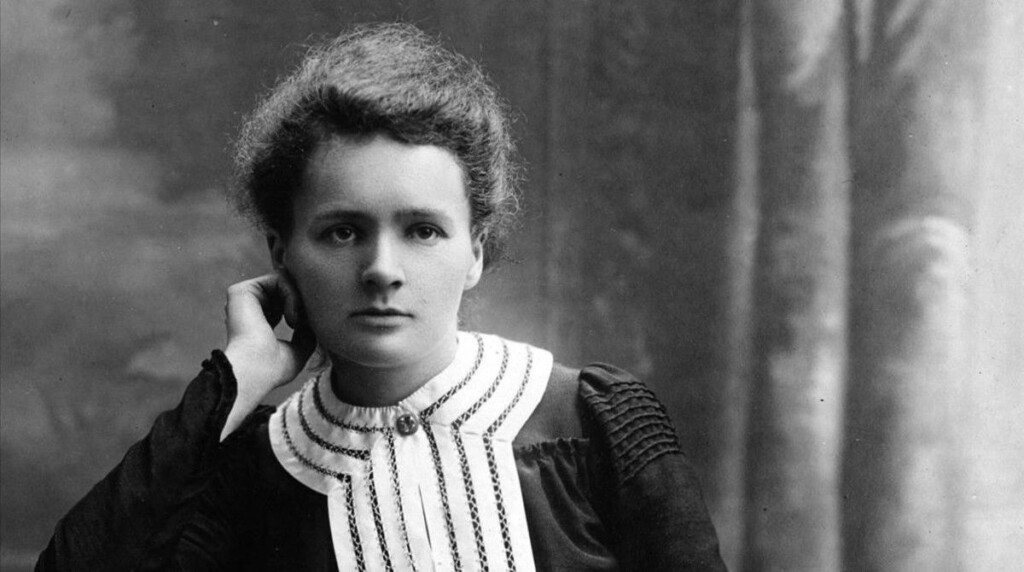
She died in the summer of 1934, in a sanatorium in the Savoy Alps, her bone marrow destroyed by decades of exposure to what she had spent her life measuring, isolating, naming. The diagnosis was aplastic anemia. Her blood had simply stopped making itself. The doctors who attended her noted that her fingers were marked by deep lesions that would not heal, that her eyes were clouded, that she had difficulty swallowing. Her body had been absorbing ionizing radiation since before the turn of the century, long before anyone understood what that meant for living tissue, long before the word “radioactivity” existed anywhere outside her own laboratory notebooks. She had coined the term herself, in 1898, and spent the following thirty-six years inside the phenomenon it described.
There is a particular kind of knowledge the body accumulates that the mind cannot yet articulate. The body knows first. It registers damage before the language for that damage has been invented, before the instruments capable of measuring it have been built, before the institutions responsible for preventing it have been imagined. Marie Curie’s body knew, in ways her science could not yet confirm, what proximity to polonium and radium does to living cells. She carried test tubes of radioactive isotopes in her coat pockets. She stored them in her desk drawer. She worked in poorly ventilated sheds with no protective equipment because protective equipment did not yet conceptually exist in the form she would have needed it. The knowledge arrived in the body long before it arrived anywhere else.
What remains of her intimate world is stored in the Bibliothèque nationale de France in lead-lined boxes. Her personal notebooks, her letters, her cookbooks, the scientific journals she annotated by hand — all of it emits radiation at levels that require anyone who wishes to consult them to sign a liability waiver and don protective gear. The half-life of radium-226, which permeated everything she touched in those years, is approximately 1,600 years. This means that her handwriting, the pressure of her pen on paper, the particular curl of her signature, will remain dangerous to touch for longer than the entire span of recorded Western history from the fall of Rome to this sentence. The notebooks are not merely documents. They are living evidence of a body’s encounter with forces it helped the world understand and that the world has not yet finished metabolizing.
Susan Sontag, writing in Illness as Metaphor in 1978, argued that societies have always used the sick body as a surface for projection, as a canvas onto which they paint whatever moral or cultural anxieties they cannot address directly. The body of the scientist who died from her own discoveries is an almost unbearably concentrated version of this. It refuses the comfort of metaphor. It insists on being literal. The damage is measurable. The notebooks prove it. And yet the image of Marie Curie that circulates most freely in the world — on posters, in children’s books, in commemorative stamps, in the soft-focus hagiographies that appear whenever institutions require a woman to represent the idea of scientific achievement — is perfectly safe. Perfectly touchable. Perfectly available for whatever lesson someone needs her to illustrate.
Her notebooks cannot be touched without protection. Her image can be touched by anyone, used by anyone, simplified by anyone, made to mean whatever a particular moment requires. The archive that carries the actual trace of her life, the paper that absorbed what her hands released, sits in lead and silence, inaccessible without ceremony and risk. What was most real about her remains the most dangerous thing she left behind, and what has been made most visible is what cost the least to reproduce.
🔬 Science, Discovery, and the Pursuit of Knowledge
Marie Curie’s life was defined by relentless curiosity, scientific rigor, and the courage to push beyond the boundaries of her era. The following articles explore figures and ideas that share that same spirit of inquiry — from naturalists who rewrote our understanding of life to ecologists who dared to challenge industrial progress. Each story is a thread in the vast tapestry of human knowledge.
Rachel Carson: Life and Works
Like Marie Curie, Rachel Carson was a woman who faced institutional resistance while pursuing scientific truth with unwavering determination. Her work bridged the gap between laboratory science and public consciousness, forcing society to reckon with the environmental consequences of modern progress. This article explores the life of a scientist whose courage changed the world as profoundly as any laboratory discovery.
GO TO THE SELECTION: Rachel Carson: Life and Works
Gregor Mendel: Life and Works
Gregor Mendel‘s meticulous experiments with pea plants laid the genetic foundations that would later illuminate the very structure of life studied by scientists like Curie. Working in near obscurity, he discovered laws of heredity that were only recognized long after his death, much like many revolutionary scientific contributions. His story is a meditation on patience, precision, and the slow triumph of truth.
GO TO THE SELECTION: Gregor Mendel: Life and Works
Charles Darwin: Life and Works
Charles Darwin, like Marie Curie, overturned centuries of received wisdom through disciplined observation and the willingness to follow evidence wherever it led. His theory of natural selection remains one of the most consequential intellectual achievements in human history, reshaping biology, philosophy, and even theology. This article traces the life of a thinker whose ideas continue to reverberate across every corner of modern science.
GO TO THE SELECTION: Charles Darwin: Life and Works
Nikola Tesla: the Genius That Power Could Not Afford
Nikola Tesla shared with Marie Curie a visionary relationship with the invisible forces of nature — electricity, radiation, and energy — that most of their contemporaries could barely imagine. Both scientists labored in the face of skepticism and institutional opposition, driven by a sense of mission that transcended personal ambition. This article examines the life of a genius whose contributions were as enormous as the forces he sought to harness.
GO TO THE SELECTION: Nikola Tesla: the Genius That Power Could Not Afford
Discover Independent Cinema on Indiecinema
If the lives of great scientists and thinkers inspire you to see the world differently, independent cinema offers that same transformative power. On Indiecinema, you will find a curated streaming selection of films that challenge, provoke, and illuminate — stories told outside the mainstream that dare to ask the questions that matter most. Explore our catalog and let independent cinema expand your horizon.
👉 EXPLORE THE CATALOG: Watch Indie Films in Streaming
A vision curated by a filmmaker, not an algorithm
In this video I explain our vision

