
The Morning You Already Know
The alarm goes off at the same time it always does. You already know this before you open your eyes — not because you checked the clock, but because your body has memorized the exact weight of the darkness at this hour, the particular quality of silence just before the world begins its noise. You reach for your phone with the same arm, the same motion, in the same half-second of unconsciousness that precedes the full arrival of waking. The screen lights your face. You put it down. You pick it up again.

The coffee machine starts because you set it the night before, which means you made this decision for yourself hours ago, a version of you that no longer quite exists preparing the morning for a version of you that hasn’t arrived yet. The sound it makes is the sound every morning makes. You stand in the kitchen in a posture you would not be able to describe if someone asked you to, your weight distributed across your feet in a way that is entirely automatic, your eyes aimed at nothing in particular while the coffee drips. You are not thinking. You are not quite present. You are doing something that could more accurately be described as waiting — though for what, you could not say.
There is a moment, somewhere between the second sip of coffee and the decision to shower, where something almost surfaces. Not a thought, exactly. More like a question that doesn’t yet have words. A brief interruption in the otherwise seamless flow of doing-what-comes-next. It passes. You shower, you dress, you check your phone again. The sequence reasserts itself.
The commute has its own grammar. If you take the train, you know which car to board so that when you arrive you will be closest to the exit. You have calculated this, at some point in the past, and now you do it without calculating — your feet carry you to the right spot on the platform with the quiet efficiency of a body that has decided not to bother the mind with such details. Around you, other people perform their own versions of this same economy of motion. Earphones in. Eyes on screens or windows. Faces set to a particular neutral expression that is neither relaxed nor tense, but something in between that doesn’t have a common name. The train moves. You arrive.
At work, there is a moment just before you sit down — a fraction of a second in which you look at your desk, your chair, your screen, the small geography of your daily occupation — and something in you almost flinches. Not dramatically. Nothing so legible as dread or despair. Something quieter and stranger. A microsecond of recognition that passes so quickly you couldn’t be certain it happened at all. Then you sit down. The screen comes on. The day begins.
This is not a story about depression. It is not a story about burnout, or dissatisfaction, or any of the clinical categories we have constructed to name and thereby contain the sense that something is not quite right about all this. Those categories are useful, and they describe real suffering. But they don’t touch what’s happening in that fraction of a second before you sit down. They don’t name what you felt in the kitchen, while the coffee dripped, while you were aimed at nothing.
What you felt — if you let yourself remember it rather than letting the day immediately bury it — was something more fundamental than unhappiness. It was the sudden, unwelcome transparency of the whole structure. The way the routine, when glimpsed from a slight angle, stops looking like life and starts looking like the performance of life. The scaffold showing through the facade. The clockwork visible beneath the gesture.
You already know this feeling. You have always known it. The question is what it means.
Don Barry: A Quixotic Exploration
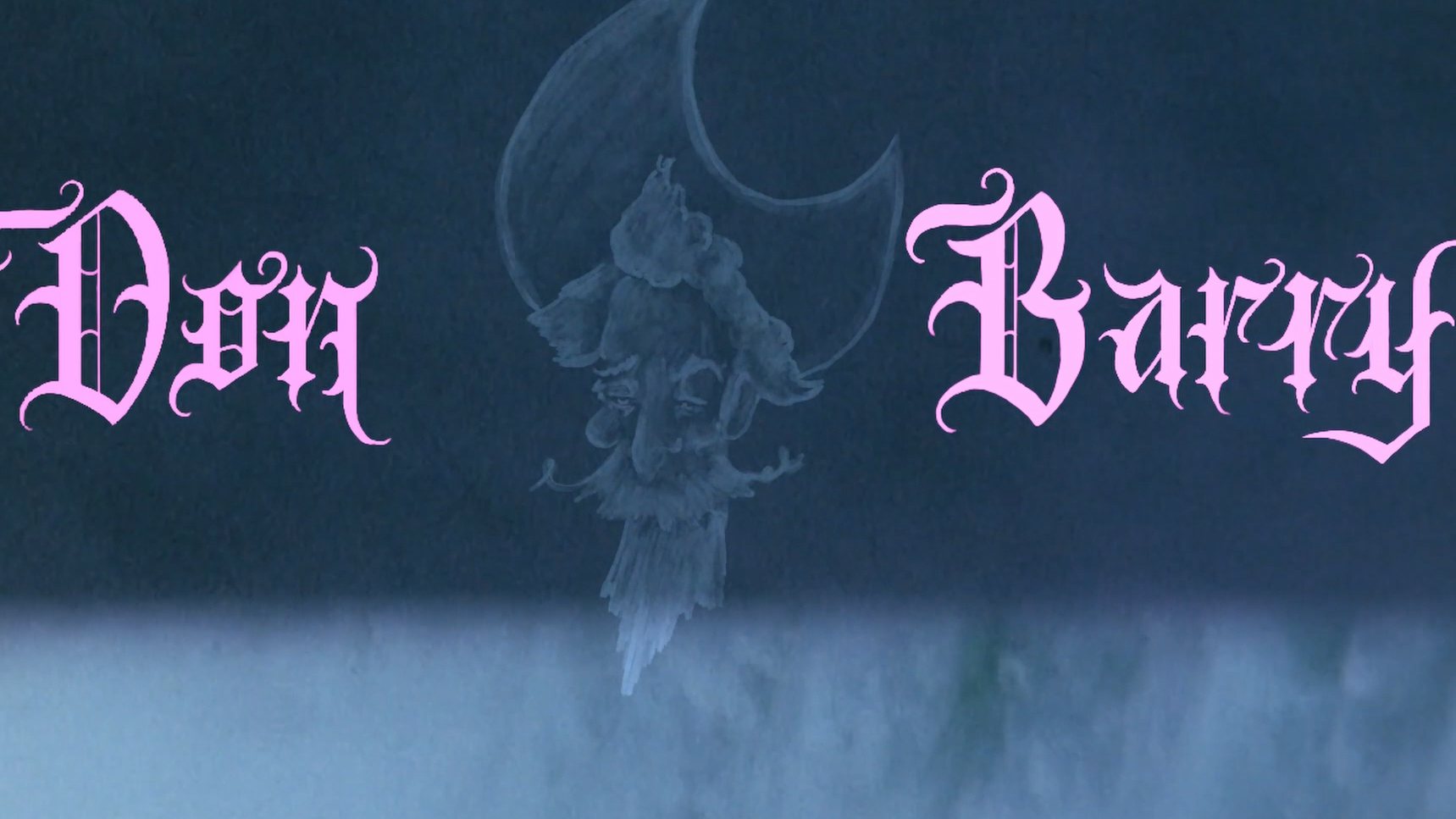
Docufiction, Experimental, by Paul Smart, Mexico, 2026.
Don Barry: A Quixotic Exploration is a debut feature that places the biography of an eighty-year-old experimental filmmaker and artist, Barry Gerson, within the metanarrative of Miguel de Cervantes’ Don Quixote. Don Barry was filmed in the city of Guanajuato during the 51st edition of the Cervantino Festival, as well as during the vibrant Day of the Dead celebrations held in the city’s UNESCO-listed tunnels. The film honors the director’s long friendship with artist Barry Gerson, drawing inspiration from Cervantes’ Don Quixote. Paul Smart’s directorial choices create something new that celebrates life and goes beyond conventional storytelling. A search for magic in our real lives. A moving film about the meaning of life, art, and death. Not to be missed.
Paul Smart is a proud outsider filmmaker with a long history of film screenings. In the 1980s, he emerged in New York’s vibrant youth art scene, working in theater production and later filmmaking, before retreating to rural upstate New York, in the Catskill Mountains, where he made a living writing and screening independent films in old parish halls for rural audiences, many of whom had never seen a film.
LANGUAGE: English
SUBTITLES: Spanish, French, German, Portuguese
Sisyphus Before the Philosophy
You have done this. Not metaphorically — literally. You have stood at the bottom of something, looked up at what needed to be done again, and felt the specific weight of the repetition before the effort even began. Not the weight of the task itself but the weight of its return. The knowing that this is not the first time and will not be the last. The alarm, the commute, the inbox, the dinner, the argument that resolves into temporary silence and then resurfaces three weeks later wearing slightly different clothes. The boulder is not a symbol when you are standing next to it. It is just heavy, and it is just there, and you are just the person who has to push it.
The Greeks understood something precise when they designed Sisyphus’s punishment. They did not sentence him to suffering. They sentenced him to meaninglessness dressed as effort. He was condemned not to pain but to the perpetual cancellation of his own labor — every completion undone before it could become an arrival. The ancient sources give different reasons for why Sisyphus earned this fate. In some versions he cheated death twice, tricking first Thanatos and then Persephone, refusing the terms of mortality with a cunning that the gods found intolerable. In others he was simply a man who loved life too much and too visibly, who could not accept that existence had a ceiling. What they all agree on is the punishment’s architecture: the rock, the hill, the summit that always gives back what it received.
For millennia this story lived as a warning. A cautionary silhouette projected against the cave wall to remind you what happens when you resist the order of things. Then a man in Paris in 1942 looked at it and said: but what if Sisyphus is happy?
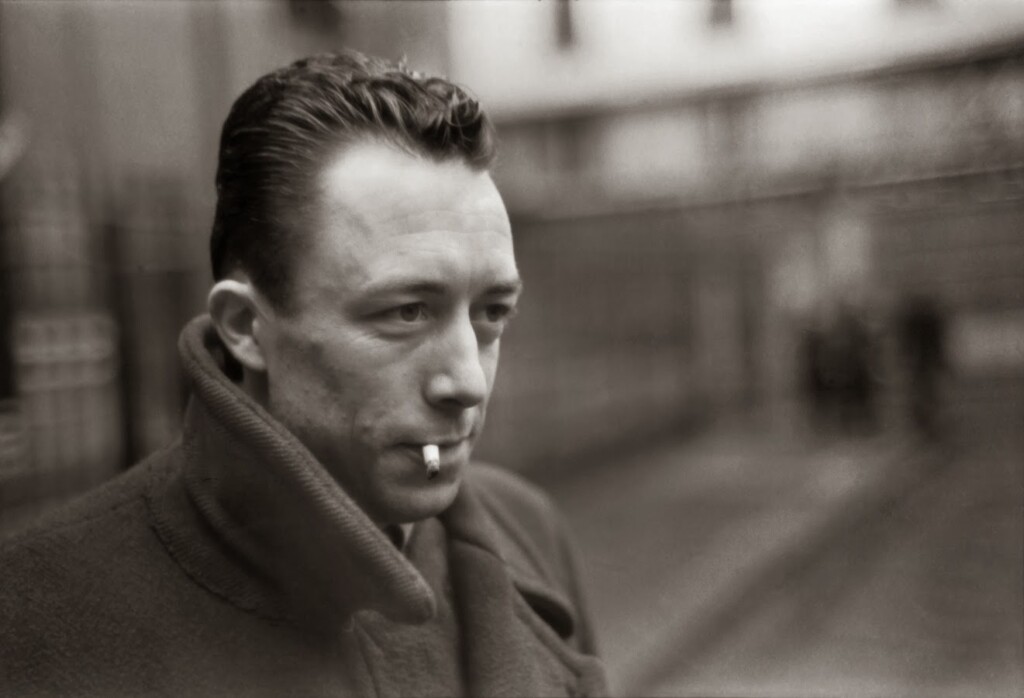
The audacity of that question is difficult to feel now because we have had eighty years to domesticate it. But try to restore the context. It is 1942. The city of Paris is under German occupation. The cafés are open but the wrong people are drinking in them. Deportations have begun. The French state has made its accommodations and is busy making more. A young Algerian-born writer named Albert Camus publishes two books in the same year, in October: L’Étranger and Le Mythe de Sisyphe. A novel and a philosophical essay, released together almost as a single gesture. The novel features a man who kills someone on a beach and feels nothing in particular about it, who is ultimately condemned less for the murder than for his refusal to perform the grief and remorse the court requires of him. The essay opens with a sentence that still lands like a flat palm on a table: “There is but one truly serious philosophical problem, and that is suicide.”
This is not provocation for its own sake. Camus is asking the only question that the historical moment seems to leave open. If the world is irrational, if meaning is not given but must be fabricated, if God is absent or irrelevant, then what is the argument for continuing? Not continuing to be happy — continuing at all. He is writing this while Europe is demonstrating, with administrative efficiency, exactly how irrational and brutal human civilization can become when given permission. The philosophical stakes are not abstract. They are the same stakes as survival, as resistance, as the choice to get out of bed in a city where getting out of bed requires a certain unverifiable faith in the worth of the day.
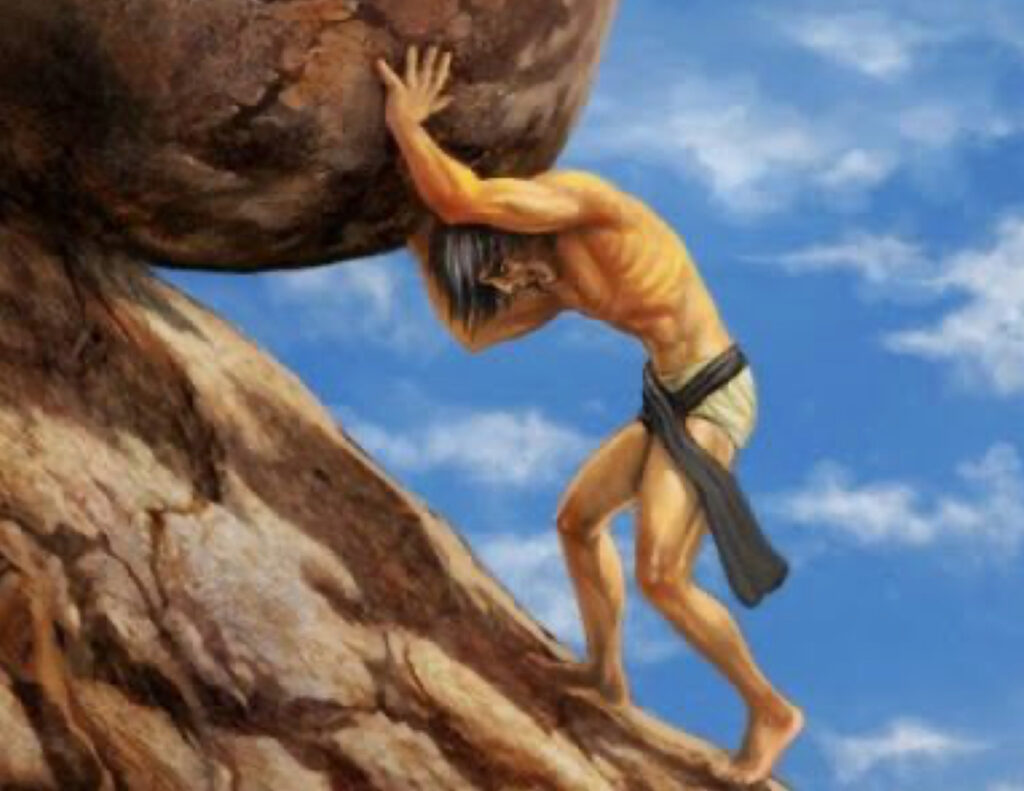
Camus calls the collision between human beings and the world’s silence the absurd. Not a feeling, not a mood — a structural condition. And Sisyphus, he argues, is not a victim of it. Sisyphus is its most honest portrait.

The Question Camus Actually Asked
You have probably asked yourself, at least once, not dramatically but quietly, in the middle of an ordinary afternoon, whether it is worth continuing. Not continuing with a relationship, or a job, or a city. Continuing, full stop. The question arrives without announcing itself, somewhere between washing a dish and looking out a window, and then you push it away because it feels indecent, because it sounds like something is wrong with you, because civilized people do not sit with that question for longer than a few seconds before reaching for their phone.
Camus sat with it. He sat with it long enough to make it the opening movement of an entire philosophical project. There is only one truly serious philosophical question, he wrote in 1942, and that is suicide. Not as provocation. Not as the theatrical posturing of a young man trying to shock the academy. As radical honesty about what it actually means to think seriously about human existence. If life has no inherent meaning, he was asking, then what exactly is keeping you here? And if your answer is habit, distraction, fear, the need to see what happens next, then say that clearly instead of dressing it up in purpose you borrowed from somewhere else.
The year matters. The Myth of Sisyphus was published in October 1942, in occupied France, when the question of whether existence was worth sustaining had migrated from philosophy into the daily arithmetic of survival. Camus was not writing from an armchair. He was writing from inside a Europe that had already begun murdering itself on an industrial scale, from inside a tuberculosis that had been dismantling his own body since his early twenties, from inside a poverty that had shaped his childhood in Algeria in ways that made abstraction a luxury he had never been able to afford. The question he asked was the question the century was asking with its boots on.
What he refused to do, and this is where he diverges sharply from almost every thinker who came before him, was to answer the question by making it disappear. Both the leap of religious faith and the leap into political utopianism struck him as forms of what he called philosophical suicide, a phrase that lands harder than it sounds. It means: killing the question rather than living with it. Deciding that meaning exists somewhere beyond human reach, in God, in History, in Progress, and then directing all your energy toward that beyond, is not a solution to the problem of meaninglessness. It is an escape from the problem, and Camus had no patience for escapes dressed up as answers.
The absurd, in his framework, is not a mood that descends on you when you are tired or lonely or thirty-five and questioning your choices. It is a structural condition. It is what happens in the gap between the human need for clarity, for coherence, for meaning, and the world’s absolute refusal to provide any. The French philosopher Emmanuel Levinas, writing in a different register, would later describe this structure as the encounter with the other that cannot be absorbed or resolved, only faced. Camus was mapping something similar, though he mapped it against the cosmos rather than against another person. The need on one side, the silence on the other, and nothing in the middle except the collision itself.
That collision is not a feeling. It is a fact of position. You are a creature built for meaning, living in a universe that generates none. You can look away from that, and most systems of thought are elaborate, ingenious, and sometimes beautiful ways of looking away. Or you can stand in the gap and keep looking. Not because it makes you stronger or wiser or more interesting at dinner parties. Just because it is the only honest thing to do with what is actually there.
The Lost Poet
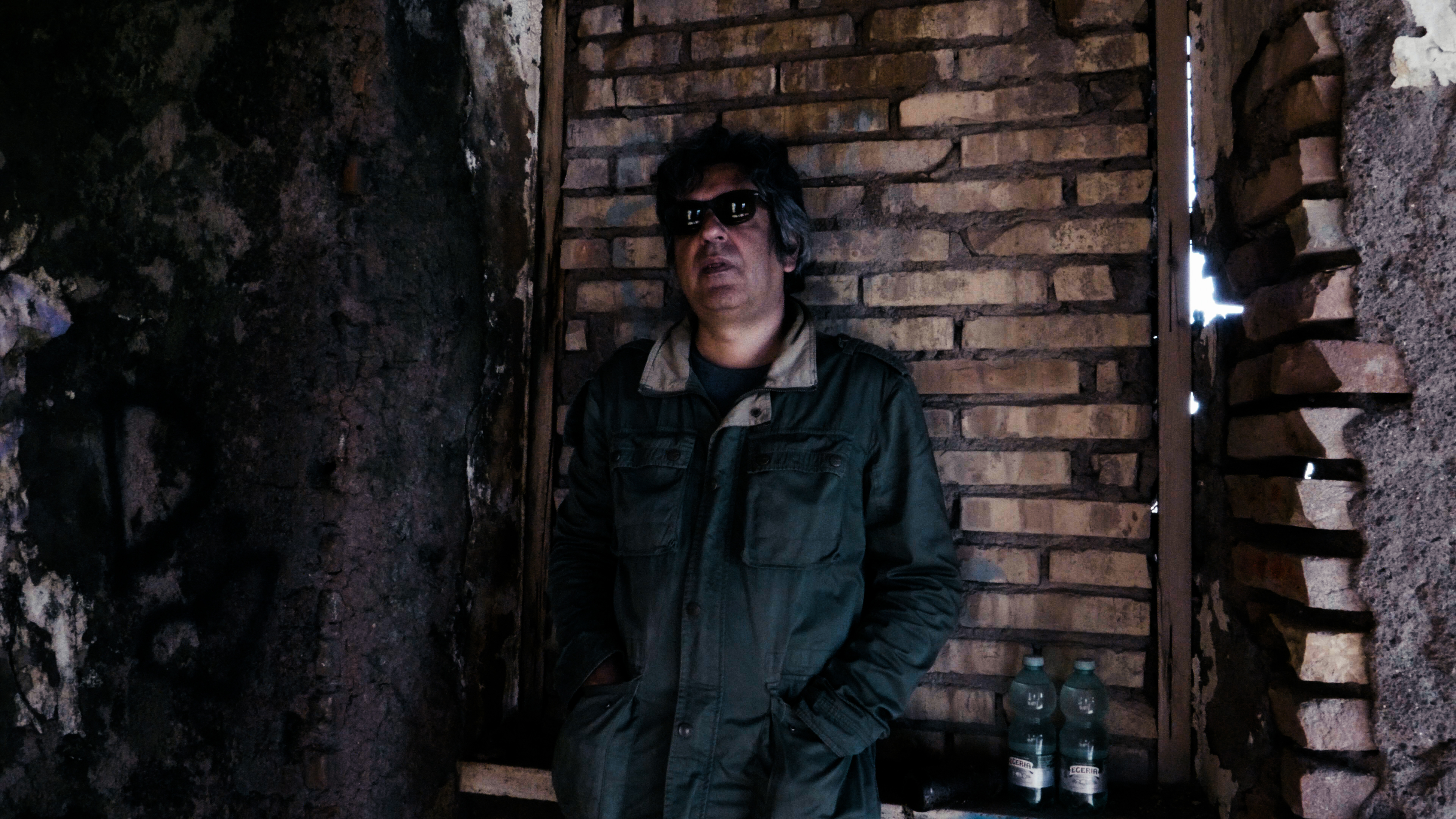
Drama, by Fabio Del Greco, Italy, 2024.
Dante Mezzadri wants to see an old friend, nicknamed the Iguana, whom he has lost sight of for many years, and who has managed to turn their shared youthful passion for poetry into a job, becoming a famous writer and poet. The man escapes from his bourgeois life and his wife to live homeless on the Roman coast, printing and trying to sell his poetry collections. At night he sleeps in a park of old carnival floats, inside a papier-mâché tank, and waits for the opportunity to meet his old friend, who however never shows up for appointments in the places they frequented when they were young, now in ruins. Dante's poetry books do not interest anyone and to support himself he is forced to "change product": he starts selling the infamous "cannibal pill" on behalf of young drug dealers, a new drug that sells like hot cakes and causes sensory and consumerist ecstasy. However, he realizes that this powerful drug is very dangerous for those who take it, he comes into conflict with his ethical conscience and throws all the pills into the sea. However, the dealers want to collect their money.
Shot over a period of 2 years, the film is a reflection on the cultural and artistic rubble of the society in which the protagonist lives, in an increasingly mechanized, consumerist and arid world. Dante Mezzadri is yet another human being who has renounced his inspiration and his creativity, but unlike many he is not willing to give his life to a system that distances him from his true identity. The physical world around him, however, seems constructed in such a way that it seems impossible to escape from this "invisible cage". The enthusiasm of the people he meets is ignited only by sensory gratification, by unreal visions of personal affirmation and success, by "metaverses" that offer an escape into an illusory and destructive reality. The poet's house on the coast, where he met with his friends as a young man, is just a pile of abandoned rubble. What happened to all those who wanted to become poets and ended up becoming something else? Are there internal forces with which that house can be "rebuilt"?
LANGUAGE: Italian
SUBTITLES: English, Spanish, French, German, Portuguese
The Collision Point
There is a moment, and you have likely had it, standing in front of a bathroom mirror at some unremarkable hour, when your own face suddenly stops making sense. Not in any dramatic way. The features are all where they should be, the eyes where eyes go, the mouth where mouths go, and yet something has slipped. You look at yourself and find, instead of recognition, a kind of blankness. This is my face, you think, and the thought feels like reading a word so many times it becomes nonsense. The face continues to stare. The logic of your own existence, which a moment ago was simply the air you breathed, has gone perfectly opaque.
Camus would say that in that moment, you have touched the absurd. Not caused it, not invented it. Touched it, the way you might accidentally touch an electric fence you didn’t know was there.
The precision of his definition matters here, because it is almost always misunderstood. The absurd is not the meaninglessness of the world. Camus is explicit on this in Le Mythe de Sisyphe, published in 1942, and his explicitness is itself a kind of intellectual aggression against the comfort of simple nihilism. The world is not absurd. The world is simply silent. It does not promise meaning or withhold it. It offers nothing on the question. Equally, the human longing for meaning is not absurd in itself. That longing is real, structural, almost anatomical in its persistence. What is absurd is the confrontation between them, the collision between a human being who demands that the world speak and a world that remains absolutely, constitutively mute. Remove either term and the absurd dissolves. It is purely relational, a condition that exists only in the space between.
This is why the man in front of the mirror is not simply experiencing existential despair or philosophical confusion. He is experiencing the moment in which the two terms of the equation become visible to him simultaneously, the self that requires the world to confirm its coherence, and the world’s total indifference to that requirement. His face does not stop making sense because he has gone mad. It stops making sense because he has, for one unguarded second, seen clearly.
Jean-Paul Sartre was reading Camus carefully, and he disagreed, and his disagreement sharpens the definition further. For Sartre, the confrontation that Camus describes was not a permanent condition to be inhabited but a problem to be resolved through the radical exercise of freedom and commitment. In his 1943 review of Le Mythe de Sisyphe, Sartre recognized the structural genius of Camus’s formulation but resisted what he saw as Camus’s refusal to move through the absurd toward something, toward engagement, toward the construction of meaning through chosen action. For Sartre, the collision point was a starting gun. For Camus, it was the finish line of a certain kind of honesty, the place you had to stay inside rather than leap from in terror.
This divergence is not merely academic. It reveals two entirely different relationships to the silence of the world. Sartre cannot tolerate the silence as a permanent address. He fills it with radical freedom, with the assertion that existence precedes essence, that meaning is manufactured in the act of living. Camus stares at the silence and says: yes, but filling it with manufactured meaning is its own form of dishonesty. The man who walks away from the mirror and reconstructs the narrative of his life as though the moment of blankness never happened has not solved anything. He has simply looked away.
And the man who stays, who holds the gaze of his own face until the strangeness becomes familiar in its strangeness, what has he done? Camus would say he has chosen to live without appeal.
The Three Exits Camus Refuses
There is a moment most people recognize, even if they have never named it. You are standing in the middle of something that has stopped making sense — a career, a relationship, a version of yourself you built carefully over years — and someone who loves you, genuinely loves you, offers you a way out. Not a solution. A door. They say: have faith, or they say: keep busy, or they say: maybe you just haven’t found the right person yet. The offer is made with warmth. The trap is built into the warmth itself.
Camus identifies three doors of this kind, and he refuses them all. Not with contempt, but with something colder and more honest: the refusal to pretend that walking through a door is the same as resolving what drove you to it.
The first door is the most literal. Physical suicide presents itself as the logical conclusion of the absurd — if life has no meaning, why continue it? The reasoning seems airtight until you examine what it actually does. It does not answer the question. It annihilates the questioner. Camus points out in The Myth of Sisyphus, published in 1942, that this is not a solution but an evasion disguised as courage. The absurd requires two things to exist: a human being who demands meaning, and a world that refuses to provide it. Remove the human being, and you have not resolved the tension. You have simply ended one of its two terms. The equation disappears, but it was never solved.
The second door is subtler, and Camus reserves his sharpest attention for it. He calls it philosophical suicide, and it is the move made by every thinker who, having stared honestly at the absurd, then leaps away from it into something that transcends reason. He reads Kierkegaard and recognizes the pattern precisely: a man who builds an entire philosophy on the impossibility of rational certainty, who demonstrates with devastating clarity that human existence cannot be grounded in logic, and who then concludes that this very impossibility is proof of God’s necessity. The leap of faith, in Camus’s reading, is not an answer to the absurd. It is a betrayal of the intellect that discovered it. You look clearly at the void, and then you flinch. You dress the flinch in theological language, or in the language of the transcendent, or in the language of cosmic purpose, and you call it enlightenment. You have not killed yourself. But you have killed the honest part of yourself that was asking the question.
This is the door most institutions are built around. The church offers it. But so does the motivational industry, with its insistence that suffering is always preparation, that failure is always a lesson, that the universe is always conspiring toward your growth. So does the logic of productivity culture, which transforms the unbearable openness of existence into a schedule, a set of goals, a five-year plan. The plan does not answer the question of why any of it matters. It simply ensures you are too busy to ask.
The third door is hope, which Camus treats not as a virtue but as a particular form of dishonesty. Hope, in his framework, is the insistence that the future will resolve what the present cannot. It is the emotional version of the philosophical leap — the feeling-toned conviction that meaning is deferred, not absent. Romantic love is perhaps the most powerful vehicle for this hope. You meet someone and suddenly the question dissolves, not because it has been answered but because it has been temporarily drowned in sensation and projection and the extraordinary human capacity for believing that another person can complete what existence left unfinished.
Camus is not telling you these exits are shameful. He is telling you they are exits. And that there is a difference between leaving a room and understanding what was in it.
The Sands
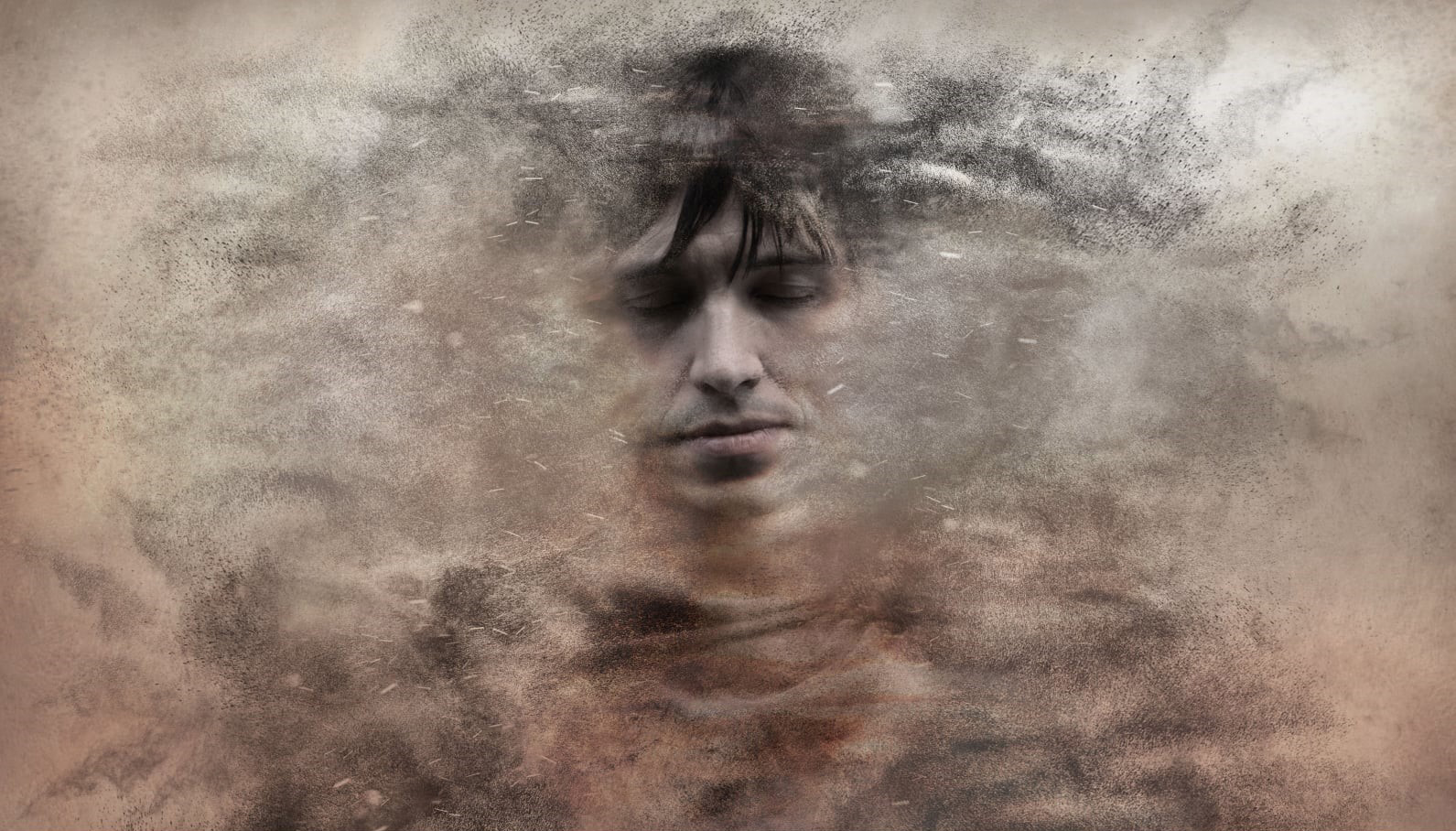
Science fiction, by Noah Paganotto, Argentina, 2022.
In an undetermined location on planet Earth, in an unknown time, Zoilo lives with his family in a wasteland surrounded by ruins. They live uprooted, without mothers, knowing that pregnancy for women is synonymous with death. For them there is only one collective routine; keep the fire alive. Only Zoilo escapes this logic, observing, intrigued, details that others do not see and therefore do not appreciate. Zoilo's personal search for answers will increase the differences with his relatives, increasingly revealing an empty world of interiority.
Avant-garde film that burns slowly in the first part and then reveals in the second the profound conflicts of a family prisoner of archaic beliefs. It is a dystopian and visionary work, with wonderful photography and images of rare power that allow us to grasp the depth of the story and its poetic potential. The faces of the actors, especially the protagonist boy, are perfect. The Sands metaphorically represents the world we live in: an alienated society, where what keeps us alive is demonized and blamed for death. In opposition to the fast pace of the typical mainstream film, The Sands is a meditative journey into the depths of images. The film was shot in natural environments in the city of Necochea, Buenos Aires province, Argentina.
LANGUAGE: Spanish
SUBTITLES: English, Spanish, French, German, Portuguese
A vision curated by a filmmaker, not an algorithm
In this video I explain our vision
Revolt, Freedom, Passion
There is a moment — you have probably lived it without naming it — when you keep doing something not because you believe it will work, but because stopping would require a kind of surrender you are no longer willing to perform. Not stubbornness. Not delusion. Something quieter and stranger than both. You continue, and you know you are continuing, and somehow that knowledge is not a weight but almost a relief. The lie has been retired. What remains is just you and the thing itself, stripped of the mythology you used to need around it.
A man sits at a table covered in papers he has sorted a dozen times. The system keeps collapsing. Files he organized yesterday have been redistributed by some administrative logic he did not authorize and cannot appeal. He starts again. There is a point — you can see it happen in his face — where the frustration drains out and something else takes its place. Not resignation. Something more alert than resignation. He almost smiles. Not at the absurdity in the mocking sense, but at the absurdity in the precise sense: the total clarity of a situation stripped of pretense. He knows what this is. He does it anyway. That is not defeat. That is the beginning of something Camus called revolt.
Camus is careful in The Myth of Sisyphus, published in 1942, to distinguish revolt from rebellion, from resentment, from the theatrical gestures of protest. Revolt is internal and constant. It is the refusal to accept, carried not as an emergency but as a permanent condition of wakefulness. The absurd man, Camus writes, does not transcend his condition. He does not resolve it. He maintains it in front of him, eyes open, and from that maintenance draws something that functions exactly like dignity. Hannah Arendt, writing about the nature of action in The Human Condition in 1958, would describe something adjacent when she argued that what makes human beings distinct is not their capacity to achieve outcomes but their capacity to begin — to initiate — even within systems that cannot guarantee results. Revolt, for Camus, is that beginning repeated daily. It is Sisyphus starting back down the mountain with full knowledge of what the morning will bring.
From revolt, Camus derives freedom, but not the freedom anyone is selling. It is not the freedom of possibilities or of open futures. It is the freedom that comes precisely from the closure of false futures. When you no longer expect the cosmos to reward you, when you have genuinely relinquished the hope that things will resolve into meaning, you are released from the specific bondage of hope itself. Everything you do, you now do without the hidden agenda of metaphysical return. Nietzsche came very close to this with amor fati — the love of fate, the affirmation of everything that happens as exactly what was necessary. But Camus departs here with precision. He does not want you to love your fate. He does not ask for that final performance. Amor fati risks becoming its own consolation, its own secret teleology: if I love what happens, then what happens is secretly good. Camus wants nothing secretly good. He wants the facts to remain facts, loved for nothing except that they are what is there.
And from freedom, passion. Not passion as intensity or romance, but passion as quantity — the desire to exhaust what is available rather than preserve yourself for something better that is not coming. A woman in a city she knows will never fully accept her walks its streets with an attention so specific it borders on the devotional. She is not pretending the city loves her back. She is spending herself against it anyway. She is, as Camus would say, living the maximum. Not longer. More. The difference between those two words contains an entire philosophy of how to be human without requiring the universe to cooperate.
One Must Imagine Sisyphus Happy
There is a moment — you have lived it, even if you have never named it — between setting something down and picking up the next thing. A breath between tasks. You have just finished something that required everything from you, and the next demand has not yet arrived, and in that thin strip of silence you stand at the kitchen sink, or on a landing, or in a car park staring at the tarmac, and something surfaces that is not quite sadness and not quite relief. It is the thing itself, the bare fact of your life, without costume. Most people move quickly to close it. They reach for the phone, they remember an errand, they make coffee with unusual deliberateness. The gap is intolerable not because it is painful but because it is clear.
Camus ends his essay in that gap. He descends with Sisyphus, watches the boulder begin its roll downward without him, and then writes the sentence that scandalized a generation and has been softened by every generation since: one must imagine Sisyphus happy. The scandal is not in the word happy. The scandal is in the word must. This is not a consolation. It is an instruction issued from the void, with no authority behind it except the naked fact of being alive and aware. It does not say Sisyphus is happy, or that he deserves to be, or that happiness is the reward for endurance. It says that the only honest response to the absurd condition, once you have refused both suicide and the leap of faith, is to imagine — to insist on, to construct from nothing — a state of being that the situation does not justify and cannot provide.
What Camus means by happiness here has nothing to do with satisfaction. Pierre Hadot, writing on ancient philosophy as a practice of transformation rather than a system of doctrine, understood that joy in the Stoic and Epicurean traditions was not the absence of suffering but a quality of attention. It was what happened when you stopped bargaining with reality and looked at it directly. Camus is closer to that tradition than the existentialist label ever allowed. His happiness is lucidity at full intensity. It is what happens in the descent when there is no boulder to push and no summit to reach — only the walker, the hill, the cool air, the fact of consciousness operating in a world that will never explain itself.
When The Myth of Sisyphus was published in occupied Paris in 1942, alongside The Stranger, it arrived into a context of literal meaninglessness, into a Europe where the administrative machinery of death had stripped every traditional justification from human life in real time. The text was not received as philosophy. It was received as air. Within a decade, existentialism had become the dominant intellectual atmosphere of postwar France and was spreading through West Germany, Italy, Britain, and eventually the United States, not as a set of arguments but as a sensibility, a fashion, a pose. By the mid-1950s it had acquired cafes, berets, record labels, and a vocabulary that could be deployed without having encountered a single page of the source material. Sartre understood this and played it. Camus resisted it and was punished for the resistance, marginalized by the Parisian left after The Rebel in 1951 and reduced in the cultural imagination to a kind of handsome stoicism, acceptable and decorative.
The domestication was not an accident. It was a necessity. Because the original idea, left intact, is not livable as a brand. You cannot put on a turtleneck and perform the descent. The descent requires that you actually stand at the sink, in the gap, and not close it. That you let the moment be exactly as empty as it is, and find in that emptiness not meaning, not comfort, but the irreducible fact of your own wakefulness pressing back.
What the Boulder Actually Is

So here you are again. The coffee is brewing, the same as yesterday, the same as the day before that. The commute will take roughly the same number of minutes it took last Tuesday. The inbox will contain the approximate weight it always contains, distributed across the approximate urgency it always performs. And somewhere between the first sip and the moment you open the first message, there is a gap — almost imperceptible, maybe two seconds long — where you know exactly what is coming and you go toward it anyway.
That gap is where Camus lived. Not in the dramatic confrontation with death, not in the philosophical treatise, but in the two seconds before you decide how to carry what you already know you must carry.
The question he was actually asking — the one that gets buried under all the commentary about Greek mythology and existentialist taxonomy — was whether you can inhabit that gap fully, without flinching away from it into either despair or false consolation. Not whether you can find meaning in the repetition. He was explicit, almost aggressive, on this point: meaning is not found. The universe does not owe you coherence. The silence it returns to your most urgent questions is not a riddle with a hidden answer. It is simply silence. What he was asking is something more uncomfortable than the search for meaning, because it requires you to stop searching and simply be present to the thing itself.
Owning the repetition is not the same as accepting it in the passive, shoulders-rounded sense of the word. There is a scene that stays with you, a man walking back down a slope after everything has collapsed, after the argument was lost, after the project failed, after the version of himself he had invested in turned out to be a draft. He walks slowly. He does not perform grief and he does not perform stoicism. He simply walks, and in that walking there is something that looks, from the outside, almost like dignity — not because he has resolved anything, but because he has refused to look away from the unresolved. That refusal is the act. That refusal is what Camus meant.
Erik Erikson, writing about what he called the crisis of integrity in later life, described the confrontation between the life you lived and the life you imagined you would live. He placed this reckoning at the end. But the absurd does not wait for the end. It shows up on a Tuesday morning. It shows up in the gap between the coffee and the inbox, in the moment when you recognize — if you let yourself recognize it — that the boulder is not your job or your relationship or your ambition or your body slowly aging. The boulder is the fact that you are a creature who needs things to mean something in a universe that is constitutively indifferent to that need. Everything else is detail.
And the detail is not nothing. The coffee is real. The two seconds are real. The person sitting across the commute from you, also somewhere inside their own version of this negotiation, is real. Camus did not ask you to transcend the detail. He asked you to stop using the detail as a distraction from the question the detail contains.
So what does it mean to carry the boulder rather than be crushed by it, when the boulder is this — this precise weight, this precise silence, this precise morning that is already becoming the past even as you move through it? The boulder is mid-air right now. You are in the moment just before it lands back in your hands, just before you decide, again, in the only way that has ever actually mattered, what kind of person walks back down the slope.
🪨 The Absurd, Existence & the Endless Search
Camus’s Myth of Sisyphus opens a doorway into some of philosophy’s most enduring questions: What does it mean to live without illusion? How do artists, writers, and thinkers confront the silence of the universe? These related articles trace the same restless inquiry across literature, philosophy, and existential thought.
Must-See Movies About the Meaning of Life
The question of life’s meaning has haunted cinema just as deeply as it haunted Camus. This curated selection explores films that dare to confront existence head-on, without reassuring answers or comfortable resolutions. Like Sisyphus, the protagonists of these works push their burdens uphill with open eyes.
GO TO THE SELECTION: Must-See Movies About the Meaning of Life
Deep Movies that Make You Think
Some films do not entertain — they disturb, unsettle, and force the viewer to reckon with reality in the way Camus demanded of philosophy. This collection gathers the deepest, most thought-provoking films that refuse to look away from life’s fundamental contradictions. They are cinematic companions to the absurd condition.
GO TO THE SELECTION: Deep Movies that Make You Think
Octavio Paz: Life and Thought
Octavio Paz spent a lifetime meditating on solitude, identity, and the labyrinthine nature of human existence — themes that resonate powerfully with Camus’s absurd. His poetic thought bridges existential philosophy and cultural myth, drawing surprising parallels to the Sisyphean struggle. Reading Paz alongside Camus reveals how the absurd is not a Western monopoly but a universal human horizon.
GO TO THE SELECTION: Octavio Paz: Life and Thought
Hannah Arendt: the Philosopher Who Unmasked the Banality of Evil
Hannah Arendt, like Camus, was a thinker shaped by the catastrophes of the twentieth century, compelled to understand how human beings act and suffer in a world stripped of transcendent guarantees. Her analysis of the banality of evil offers a chilling companion to the absurdist vision: evil, like the absurd, requires no grand justification. Together, Arendt and Camus form one of philosophy’s most urgent dialogues about freedom and responsibility.
GO TO THE SELECTION: Hannah Arendt: the Philosopher Who Unmasked the Banality of Evil
Find Your Own Sisyphus on Indiecinema
The struggle against meaninglessness has always found its truest expression in independent cinema. On Indiecinema streaming you will discover films that embrace the absurd with courage and beauty — stories that, like Sisyphus, keep climbing. Explore our catalog and find the film that speaks to your own infinite maze.
👉 EXPLORE THE CATALOG: Watch Indie Films in Streaming
A vision curated by a filmmaker, not an algorithm
In this video I explain our vision

