
The Arrested Moment
You are standing in a room that no longer belongs to you, except that it does, completely, in every way that unsettles you. The posters on the wall are yours. The trophies on the shelf, slightly yellowed at their plastic bases, were won by a version of you that believed winning mattered in ways that felt eternal. There is a shoebox under the bed — you know this without looking — filled with ticket stubs, folded notes passed in classrooms, a photograph of a group of people whose names you still know but whose faces have become theoretical. You are thirty-four years old and you are standing very still, because movement in any direction feels like a verdict.

Your mother asked you to sort through it. That was the official reason for the visit. Sort through it, decide what stays and what goes, make room. The sentence “make room” has been turning in your chest since she said it, because you understand, without being able to articulate it cleanly, that making room is not a logistical problem. It is an ontological one. To discard the trophy is not to throw away plastic and gold paint. It is to formally acknowledge that the person who earned it is not coming back, will not be vindicated, will not get another chance to mean something in the specific way he meant something then. You pick up the trophy. You put it down. You tell yourself you will decide later.
This is not nostalgia. Nostalgia is a gentle ache, a visit to the past with a return ticket already in your pocket. What happens in that room is something structurally different — it is a refusal to accept that the past is a country with a closed border. The person standing among those relics is not mourning a former self. He is insisting, through the sheer physical preservation of objects, that the former self is still an active option. The bedroom becomes a kind of legal argument: as long as the evidence remains intact, the case is not closed.
Dan Kiley named this configuration in 1983, in a book called The Peter Pan Syndrome: Men Who Have Never Grown Up, and the name stuck in the cultural vocabulary with the tenacity of a diagnosis that feels immediately recognizable. Kiley was a clinical psychologist, and he was describing something he encountered repeatedly in therapeutic practice: adult men, functional in the external sense, employed and sometimes partnered, who had developed an elaborate internal architecture designed to prevent the experience of adult accountability. The genius of Barrie’s original character, the one Kiley was borrowing, was precisely this: Peter Pan does not forget to grow up. He refuses. The distinction is total. Forgetting is passive. Refusal is a sustained act of will disguised as a natural state.
What Kiley’s clinical framework could not fully account for was the degree to which the culture that produced these men was also producing the conditions that made refusal rational. Erik Erikson, whose eight-stage model of psychosocial development laid out in Childhood and Society in 1950 described the transition to adulthood as requiring what he called “identity consolidation,” understood that this consolidation only becomes possible when the social environment offers coherent roles to step into. When those roles are absent, contradictory, or actively punishing, the developmental arrest he called “role confusion” is not a pathology — it is an accurate reading of the available information.
The shoebox under the bed is not a symptom of weakness. It is a record of a calculation, made below the level of conscious thought, that the future has not yet demonstrated it deserves the past’s surrender. And the room around it holds its breath, waiting to see whether the person standing in it will finally call that calculation what it is, or whether he will turn off the light, close the door, and tell himself he will deal with it next time.
Barrie's Original Wound
You are sitting across from someone who never quite arrived — not late, not distracted, but structurally absent, as though some essential part of them got off the train one stop before adulthood and has been waiting there ever since, perfectly comfortable, mildly puzzled by your urgency to move forward. You recognize this person. You may have loved them. You may, in certain unguarded moments, have recognized them as yourself.
The myth of eternal childhood did not originate in innocence. It was born from a mother’s grief so consuming it became a kind of psychological weather system inside a household in Kirriemuir, Scotland, in January 1867. When David Barrie died two days before his fourteenth birthday in a skating accident, his mother Margaret did not mourn and then recover. She installed the dead boy as a permanent resident of her interior life, and she communicated to her surviving son James — six years old at the time — that David’s great distinction was precisely that he would never age, never disappoint, never become the ordinary and compromised creature that adult men inevitably become. Margaret’s grief, documented with painful clarity in J.M. Barrie’s own biographical sketch of her, “Margaret Ogilvy,” published in 1896, transformed the dead into an ideal and the living into a perpetual understudy.
James Matthew Barrie spent the rest of his life attempting to occupy his dead brother’s position — not by dying, but by refusing, in almost every register of his existence, to fully grow. He remained physically small, reportedly experienced what biographers have described as psychogenic infertility within his marriage to Mary Ansell, and formed his deepest emotional attachments not to adult peers but to the Llewelyn Davies boys, whose lives he inserted himself into with an intimacy that was obsessive in its texture, however debated its precise nature remains. The character he eventually placed at the center of “Peter and Wendy,” first published as a novel in 1911, was not a fantasy of freedom. It was a portrait of arrested grief wearing the costume of adventure.
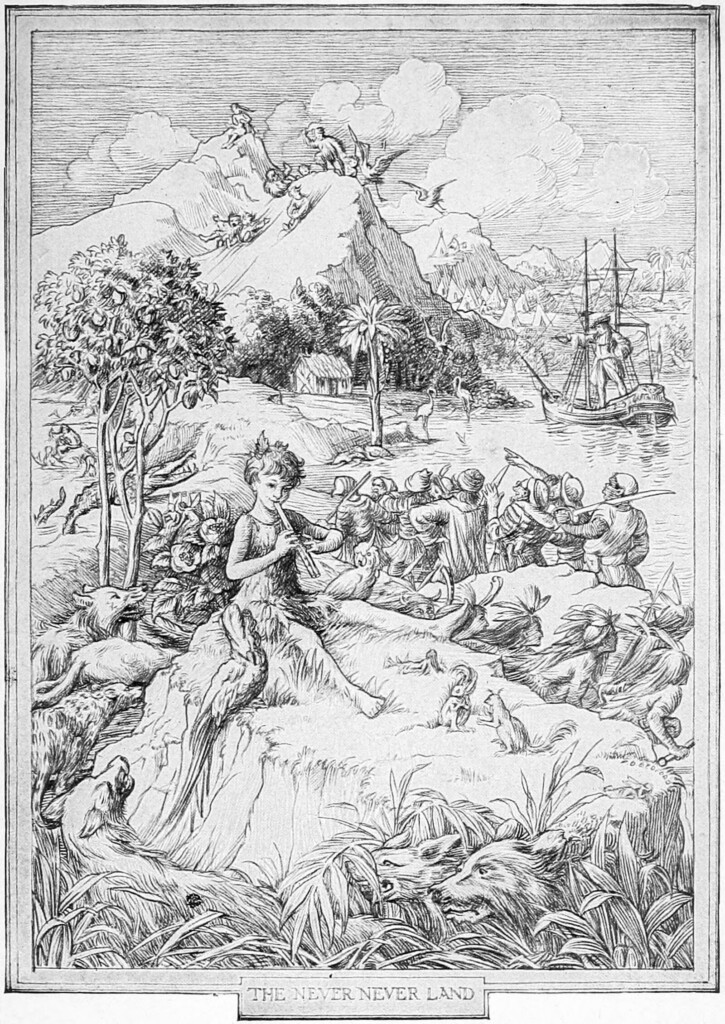
What Barrie encoded in Peter Pan is something far stranger and darker than the sanitized stage productions allow. Peter kills the Lost Boys when they begin to grow up — a detail so casually monstrous it tends to slide past audiences without registering its full weight. He is not playful in any innocent sense; he is ontologically committed to the elimination of change, which is to say, committed to the elimination of life itself as biology actually operates it. The island of Neverland is not a paradise. It is a closed system, a sealed atmosphere in which nothing develops because development would constitute a kind of betrayal. Barrie knew exactly what he was building: a monument to his mother’s pathology, externalized as myth.
What no grief counselor and no cultural commentator has ever quite managed to articulate with sufficient cruelty is that Margaret Barrie’s idealization of David was not, at its core, about love for the dead boy. It was about the convenience of the dead. The dead cannot argue back. The dead cannot prefer someone else or drink too much or make a financial catastrophe or simply turn out to be, as the living insist on being, flawed and difficult and real. The eternally young are eternally manageable, eternally a mirror in which a mother’s love is reflected back without friction. Barrie absorbed this lesson at an age when children absorb everything as fact rather than as interpretation, and it lodged in him as a conviction: that the surest way to remain beloved is to refuse the risk of becoming.
Every culture that has subsequently found Peter Pan charming, every parent who has used the story as a soft-focus bedtime ritual, has been unconsciously ratifying this architecture — inheriting not an ode to imagination but a theology of stasis constructed from a child’s bones.

When Psychology Became a Mirror for Culture

You are sitting across from a therapist, and somewhere in the first twenty minutes you have described your inability to commit to anything, your chronic restlessness, your suspicion that adulthood is a performance everyone else learned the script for and you simply never did. The therapist nods with the particular patience of someone who has heard this before. By the end of the session, there is a name for what you carry — and the name, paradoxically, makes it feel more personal, more yours, more internal than it ever did before you walked through the door.
Dan Kiley published “The Peter Pan Syndrome: Men Who Have Never Grown Up” in 1983, and it became an immediate cultural event rather than a quiet clinical monograph. The book sold millions of copies and entered the vocabulary of popular psychology with a speed that should have raised suspicion rather than enthusiasm. Kiley described a constellation of behaviors — irresponsibility, narcissism, dependency masked as independence, a terror of emotional commitment — and located their origin inside the individual man: an arrested emotional development caused primarily by overprotective mothers and absent fathers. The framework was seductive precisely because it was biographical. It gave readers a personal archaeology to excavate. It said: the answer is in your childhood, not in the world you inherited.
What Kiley’s diagnostic lens could not hold was the structural reality sitting directly in front of it. The early 1980s were not a random moment. They were the consolidation of a specific economic order, the one that had spent the previous decade dismantling the postwar social contract. Between 1973 and 1983, real wages for young American workers stagnated for the first time in the postwar era. The sociologist Richard Sennett, writing in “The Corrosion of Character” in 1998, documented how the new flexible capitalism demanded perpetual reinvention and punished long-term commitment — not as a side effect but as a design feature. The labor market was beginning to tell an entire generation that loyalty was naive, that stability was inaccessible, that the adult life their parents had constructed was no longer on offer. Kiley looked at the people this system produced and concluded they had a syndrome.
The clinical framing performed a specific ideological function: it individualized what was structurally manufactured. When a social phenomenon is reclassified as a personal pathology, something decisive happens — the conditions that produced it disappear from view, and the person experiencing it becomes the appropriate site of intervention. Therapy replaces policy. Character replaces circumstance. The question stops being “what kind of world makes full adulthood inaccessible” and becomes “what is wrong with you specifically.” This is not a neutral shift in language. It is a redistribution of responsibility, moving the burden from collective arrangements onto the individual psyche with extraordinary efficiency.
Philip Cushman’s 1990 paper “Why the Self Is Empty,” published in the American Psychologist, argued that post-World War II American culture had produced a specific type of self — boundaryless, chronically hungry, perpetually in need of filling from the outside — and that psychotherapy had largely responded not by questioning the conditions that produced this self but by becoming one of the primary industries that serviced it. Kiley’s book was a commercial expression of exactly this dynamic. It offered a self to be diagnosed, a self to be understood, a self to be worked on — and in doing so it absorbed the social discomfort of an entire era into a clinical category that left the era itself untouched.
What is most telling is what the book’s framing excluded by default. Women experiencing the same disorientation, the same refusal of prescribed adult roles, were not offered a parallel syndrome. The Peter Pan label was almost exclusively applied to men, which revealed that what was actually being diagnosed was the failure to perform a specific masculinity — the breadwinning, decision-making, forward-marching adult male — rather than any universal developmental arrest.
The Industrial Manufacture of Adolescence
You are seventeen years old and standing in a mall that doesn’t need you to buy anything specific — it needs you to want. The fluorescent light has been calibrated to make you feel slightly incomplete. The music is neither loud enough to dance to nor quiet enough to ignore. Every surface communicates the same instruction: stay here, keep feeling this, don’t resolve it.
What that mall understood, long before any sociologist named it, is that adolescence is extraordinarily profitable precisely because it is a state of suspended desire. But what almost no one bothers to question is whether adolescence — as a defined, protected, culturally mandated stage of life — existed at all before someone decided it should. The historian Philippe Ariès argued in his 1960 work Centuries of Childhood that childhood as a distinct condition was essentially an invention of modernity. Before the seventeenth century, children in Western Europe were largely treated as small adults: they worked, they married, they inherited, they died in the same economic and social rhythms as everyone else. There was no prolonged holding chamber between dependency and full participation in the world. The emotional weather of what we now call adolescence — the longing, the identity crisis, the suspended judgment — had no institutional architecture to live inside.
The architecture came later, and it came with a purpose. By the early twentieth century, compulsory schooling laws across Europe and North America had begun corralling young people into age-segregated institutions for increasingly long periods. In the United States, the percentage of adolescents enrolled in secondary school rose from roughly eleven percent in 1900 to nearly seventy-three percent by 1940. G. Stanley Hall, who published his two-volume work Adolescence in 1904, gave the stage its scientific name and its mythological weight — storm, stress, a necessary turbulence before the calm of adulthood. What Hall described as biological destiny was in practice a social arrangement, one that served industrial economies by standardizing the production of compliant workers while keeping cheap labor out of the adult market during periods of high unemployment.
The trap that consumer capitalism then laid was elegant in its simplicity: it took this artificially extended period of emotional hunger and built an entire industry around feeding it without ever satisfying it. By the 1950s, American teenagers had become a recognized demographic with disposable income and boundless brand loyalty. Seventeen magazine launched in 1944. American Bandstand began nationally broadcasting in 1957. The teenager was no longer a transitional creature moving toward something — the teenager was a market. And markets, by design, do not resolve; they circulate. Satisfaction kills consumption. Longing sustains it.
The more insidious development was not that adolescence was monetized but that its emotional grammar — the primacy of feeling over commitment, the valorization of possibility over choice, the terror of becoming fixed — was then exported upward into adult life. Cultural products, advertising, and eventually social media built an entire aesthetic around remaining porous, unfinished, available to reinvention. The adult who still skateboards, the executive who refuses to wear a tie, the forty-year-old at a festival with a flower crown: none of these are expressions of freedom. They are expressions of a market logic that found it could extend its most profitable demographic indefinitely by convincing adults that closure was a form of defeat.
Zygmunt Bauman, writing in Liquid Modernity in 2000, described this condition as the refusal of solid commitments in favor of perpetual optionality — a social structure that rewards those who keep moving and penalizes those who settle. What he was describing, without quite calling it by that name, was an economy that had learned to manufacture the adolescent condition as a permanent feature of mature life, not a phase to pass through but a disposition to inhabit forever, because the moment you stop wanting without resolution, you stop being useful to the system that depends on your incompleteness.
Adulthood as a Punitive Fiction
You are sitting across from someone at a family dinner, and they are looking at you the way people look at a fruit that has stayed on the counter slightly too long — not rotten, but suspicious. You are thirty-one, or thirty-four, or thirty-eight, and you have not bought a house, or you are not married, or you have decided not to have children yet, or perhaps ever. The conversation that follows is not really a conversation. It is a sentencing.
The word “adulthood” carries inside it a claim it has never had to prove: that the sequence of property, partnership, and parenthood represents something earned through genuine development rather than something performed under economic and social duress. Sociologists have been watching this sequence dissolve for decades without adequately questioning whether it was ever a reliable index of psychological maturity in the first place. The median age of first marriage in the United States was 20.3 for women and 22.8 for men in 1960; by 2023 those figures had risen to 28.6 and 30.5 respectively. The homeownership rate among Americans under thirty-five collapsed from roughly 43 percent in 1982 to under 37 percent by the early 2020s, a decline that accelerated precisely as housing prices in desirable labor markets outpaced wage growth by a ratio that no postwar model of “responsible adulthood” was ever designed to account for. These are not symptoms of generational immaturity. They are the predictable output of a system that raised the entry price of adult life while holding wages structurally flat.
Richard Sennett, writing in “The Corrosion of Character” in 1998, noticed something that the Peter Pan discourse consistently misses: flexible capitalism does not simply delay commitment, it makes commitment irrational. When a career can be restructured, outsourced, or automated without warning, when a rental lease offers more liquidity than a thirty-year mortgage in a market that can crater overnight, the person who refuses to lock themselves into the traditional sequence of adult obligations may not be fleeing responsibility — they may be reading the situation with uncommon clarity. The psychological literature on what Erik Erikson called the crisis of intimacy versus isolation, developed in a postwar period when a factory job could support a family of four on a single income, does not translate cleanly into a gig economy where the same individual holds three simultaneous contracts and none of them include healthcare.
What the accusation of immaturity accomplishes is to relocate a structural failure onto an individual body. The person who cannot afford a down payment in a city where median home prices represent eleven times the median annual income is recast as someone with a commitment problem. The person who declines to reproduce inside an economic environment that offers no guaranteed parental leave, no subsidized childcare, and a climate trajectory that serious scientists describe in terms of civilizational disruption is recast as someone who never grew up. The fiction of adulthood as a natural developmental endpoint depends entirely on suppressing the question of what conditions made that endpoint historically achievable, and for whom.
There is also a class dimension that the Peter Pan narrative conveniently obscures. The image of the overgrown child — living with parents past thirty, consuming entertainment rather than accumulating assets — maps almost exclusively onto the precarious middle class and the working poor. Nobody writes think-pieces about the immaturity of a forty-year-old heir who has never held a salaried position, who travels between inherited properties, who defers every consequential decision to a family trust. The cultural anxiety about failing to grow up is not evenly distributed. It falls with precision on those who cannot afford to perform the rituals that were always, at their core, economic rather than existential — which means the diagnosis was never really about psychology at all.
A vision curated by a filmmaker, not an algorithm
In this video I explain our vision
The Nostalgia Industry and Its Hostages

You are standing in a cinema lobby at thirty-eight years old, holding a collectible cup stamped with the face of a cartoon character you first encountered at seven, and something in your chest does not feel like nostalgia — it feels like homecoming, which is a different and more dangerous thing entirely.
The distinction matters enormously. Nostalgia, as the Swiss physician Johannes Hofer diagnosed it in 1688, was originally classified as a medical pathology — a debilitating longing for a lost home that caused physical deterioration in Swiss mercenaries stationed far from their mountains. His term combined the Greek nostos, return, with algos, pain. The condition was considered potentially fatal. Contemporary neuroscience has rehabilitated nostalgia as a largely benevolent emotion, with Constantine Sedikides and Tim Wildschut’s research at the University of Southampton demonstrating through studies published between 2006 and 2016 that nostalgic recall typically strengthens social bonds, elevates mood, and reinforces a sense of continuous selfhood. The entertainment industry read those findings not as a portrait of human psychology but as a business model.
What the franchise system discovered — and Disney’s acquisition strategy between 2006 and 2019, absorbing Pixar, Marvel, and Lucasfilm for a combined sum exceeding forty billion dollars, is the most concentrated example of this discovery — is that childhood intellectual property does not merely attract consumers. It conscripts them. The mechanism is more precise than nostalgia because it is not selling the past. It is selling the self-concept the viewer formed at nine or twelve, when identity was still molten and the stories they absorbed became load-bearing structures in their sense of who they are. To reboot the franchise is not to offer entertainment. It is to threaten the architecture and then sell the restoration.
Algorithmic curation accelerates this conscription without the need for a theatrical release. Spotify’s Discover Weekly, YouTube’s recommendation engine, and Netflix’s taste-profiling systems are built on collaborative filtering: they identify what you consumed at peak emotional intensity and rotate you back toward that axis with increasing precision. The result is not a curated life but a curated adolescence, perpetually refreshed. A person who at sixteen had their emotional world cracked open by a particular kind of music will find, by forty-two, that every recommendation curves back toward that original rupture — not because the algorithm loves them, but because emotional intensity at formation age generates the highest engagement metrics, and engagement is the only value the system is optimizing for.
The philosopher Albert Borgmann, writing in his 1984 work Technology and the Character of Contemporary Life, described what he called the device paradigm — the way modern technology conceals its machinery to deliver commodified outputs that replace focal practices, the deep engagements through which people actually construct meaning and identity. He could not have anticipated streaming platforms, but his framework maps onto them with uncomfortable accuracy: the device delivers sensation while hiding the cost, and the focal practice it replaces is the slow, often painful labor of building a present-tense self capable of locating meaning in actual life rather than in the loop of childhood replay.
What makes this particular trap so difficult to name is that the culture surrounding it has reframed capitulation as sophistication. The adult who maintains an encyclopedic investment in a franchise mythology is not described as arrested but as a fan, a collector, a guardian of culture. The vocabulary of curation and connoisseurship drapes itself over what is functionally a refusal to metabolize time. And because millions of people are doing it simultaneously — because the demographic of the thirty-five-to-fifty-year-old superhero film attendee became, by the mid-2010s, the primary revenue engine of global cinema — the behavior acquired the social legitimacy that numbers always confer on whatever they make normal.
The self that cannot be found in the present does not disappear; it outsources its continuity to a corporation that has made a business of pretending to hold it safe.
Freedom as the Inversion of Responsibility
You have probably, at some point, described yourself as someone who “keeps their options open.” It sounds reasonable. It sounds like wisdom. It has the texture of hard-won self-knowledge, the kind you announce at dinner parties with a slight tilt of the head, as if it cost you something to arrive there. But notice what the phrase actually does: it converts the refusal to choose into a personality trait, and then treats that trait as evidence of sophistication rather than paralysis.
Erik Erikson, writing in Identity and the Life Cycle in 1959, mapped the psychological territory between adolescence and adulthood as a battlefield between two forces — identity formation on one side, role confusion on the other. He was not describing a phase one passes through cleanly. He was describing a crisis that, if not resolved, does not simply disappear. It migrates. It camouflages itself. A person who never consolidates a stable sense of who they are does not walk around visibly lost; they often walk around performing fluidity as if it were a philosophy. Erikson understood that the inability to commit to a role, a relationship, or a value system was not the same thing as freedom from those things. It was the wound wearing freedom’s face.
What Erikson could not have fully anticipated was the cultural infrastructure that would later be constructed to reward exactly this wound. By the early 2000s, the language of personal branding had begun to colonize the language of selfhood, and Silicon Valley’s mythology of the pivot — the celebrated act of abandoning one direction for another at the first sign of friction — had been imported wholesale into how people talked about their own lives. Commitment started to look like a failure of imagination. Staying became something you had to justify. The person who had worked the same job for fifteen years, who lived in the same city, who had been with the same partner through difficulty, was quietly pitied as someone who lacked the courage to reinvent themselves. The person who left — the job, the city, the partner — was quietly admired for their bravery.
This inversion did not arrive without institutional support. The wellness industry, which generated approximately 4.5 trillion dollars globally by 2018 according to the Global Wellness Institute, built much of its product line on the premise that the self is a project requiring constant renovation. Therapy became, in its popular misreading, a space not for tolerating discomfort but for identifying which external structures were producing it — and then, implicitly, for justifying their removal. The result was a generation fluent in the vocabulary of self-care and genuinely confused about why they felt no more stable than before. They had optimized their environment relentlessly and discovered that the restlessness had not come from the environment.
Responsibility, in the deepest sense, is not about burden. It is about being the kind of entity whose choices have consequences that extend beyond the moment of choosing. It requires a self that persists through time, that can be held to something, that can disappoint and be disappointed. None of this is compatible with the permanent adolescent’s relationship to the future, which is always imagined as a space of possibility rather than a place one actually arrives and must inhabit. The sociologist Zygmunt Bauman, in Liquid Modernity published in 2000, described contemporary life as characterized by the dissolution of long-term thinking, the replacement of durable commitments with flexible arrangements — and he was not celebrating this. He was diagnosing it as a condition that produces not liberation but a specific kind of suffering, the suffering of someone who has all the exits memorized and has forgotten that the point was never to leave.
There is something worth sitting with in the recognition that the structures one spends a life escaping might have been the very ones capable of producing a self durable enough to want something.
The Cost Paid by Those Who Stay Present
You are the one who keeps track of the appointments. You write down what needs to be paid, what needs to be renewed, what is running out. You have learned, without anyone formally teaching you, that if you do not hold the structure together it will simply dissolve — and so you hold it, because the alternative is chaos, and chaos lands on you anyway.
The sociologist Arlie Hochschild documented something precise in 1989 in “The Second Shift”: that the invisible labor of managing domestic and emotional logistics falls disproportionately on those who cannot afford the luxury of selective attention. Her data was about gender, but the mechanism it described was wider than gender — it was about who gets to opt out of the present tense. When one person in a shared life decides, consciously or not, that reality is negotiable, the other person absorbs the difference. Not out of virtue. Out of necessity. The person who stays present pays with their own time, their own nervous system, their own capacity to be elsewhere in their mind.
Children raised alongside an adult who refuses to stabilize develop an orientation toward the world that psychologists have called parentification — a term introduced formally in the clinical literature by Salvador Minuchin in his structural family therapy work of the 1970s. What the term captures is the way a child reorganizes their entire self around the emotional needs of a parent who cannot hold their own weight. The child becomes prematurely competent in the way that emergency creates competence: not because they were given space to grow into it, but because the ground kept shifting and they needed traction. That competence has a cost that does not appear until much later, usually in the form of an incapacity to be cared for, a refusal of rest, an inability to believe that presence is ever truly safe.
What rarely gets said is that the person who avoids growing up often reads their relationships as evidence of love precisely because others absorb what they cannot carry. The partner who pays the bills, follows up on the forms, schedules the medical appointments, holds the social calendar — that person is not experienced as someone who is compensating for an absence. They are experienced as someone who is simply like that, efficient by nature, organized by temperament, built for the weight. The asymmetry disappears into the story of complementarity, and complementarity sounds like harmony, and harmony sounds like something to protect.
What actually gets protected is the arrangement. Paul Watzlawick, in his 1967 work “Pragmatics of Human Communication,” argued that relationships develop binding rules that operate entirely below the level of conscious agreement — rules that sustain a system’s equilibrium regardless of the damage they distribute. When one person in a system claims exemption from adulthood, the system does not collapse around that exemption: it recruits the others to fill it. The recruitment is never announced. It happens through disappointment, through sighing, through a particular quality of absence that the other person learns to preempt before it becomes a crisis.
Collaborators in professional settings experience a structurally identical dynamic. The colleague who never meets deadlines, who is perpetually in a becoming state — always about to deliver, always one revision away from readiness — generates around themselves a compensatory field of completed work that belongs, in the record, to the team. Their unreliability becomes everyone’s urgency. Their freedom from consequence is financed by the reputational and practical risk absorbed by those who cannot afford to be late.
The cost does not come in a single identifiable moment. It accumulates in the texture of days, in the subtle recalibration of what one expects from life, in the gradual narrowing of one’s own desires to fit the space left over after someone else’s eternal adolescence has taken its share of the room.
🧒 Trapped in Childhood: Fear, Identity and the Refusal to Grow
Peter Pan syndrome describes those who resist the responsibilities and emotional demands of adult life, clinging instead to the comforts and freedoms of youth. This fear of growing up intersects with deeper psychological patterns — identity crises, arrested development, and the cultural myths that romanticize eternal youth. The articles below explore the forces that keep us stuck, from social pressures to ancient human longings.
Eternal youth: myth, alchemy and human desire
The dream of eternal youth haunts Western culture from alchemical experiments to modern cosmetic obsession, revealing how deeply humanity fears the passage of time. This article traces the mythological and philosophical roots of the desire to never age, connecting ancient legends to the psychological drives behind Peter Pan syndrome. Understanding this myth helps us see how the refusal to grow up is not merely personal, but embedded in the cultural imagination itself.
GO TO THE SELECTION: Eternal youth: myth, alchemy and human desire
Regression in Psychology: When the Mind Returns to Childhood
Psychological regression — the unconscious return to earlier emotional states — is one of the key mechanisms behind the fear of growing up. This article examines how the mind retreats to childhood behaviors under stress, anxiety, or when confronted with the demands of adult responsibility. Recognizing regression as a defense strategy is essential to understanding why some individuals remain psychologically frozen in earlier stages of development.
GO TO THE SELECTION: Regression in Psychology: When the Mind Returns to Childhood
The rejection of the future and the dynamics behind the fear of change
The rejection of the future is not always passive — sometimes it takes the form of an active refusal to change, rooted in deep anxieties about identity and loss of self. This article explores the psychological and cultural dynamics behind the fear of change, showing how clinging to familiar roles and past versions of ourselves can become a trap. It offers a compelling framework for understanding the emotional paralysis at the heart of Peter Pan syndrome.
GO TO THE SELECTION: The rejection of the future and the dynamics behind the fear of change
Coming of age: the time that changes your life.
Coming of age is one of the most transformative and disorienting passages in human life, marking the threshold between the protected world of childhood and the open, uncertain terrain of adulthood. This article explores the psychological, emotional, and social dimensions of that transition, examining why for some it becomes a crisis rather than a rite of passage. It provides essential context for understanding the roots of Peter Pan syndrome and the longing to remain forever young.
GO TO THE SELECTION: Coming of age: the time that changes your life.
Discover the Cinema That Dares to Go Deeper
If these themes resonate with you, Indiecinema is the streaming platform where independent and auteur films explore the human condition with honesty and depth. From stories of arrested adolescence to portraits of existential paralysis, you will find films that don’t look away from the difficult truths of growing up. Step into a cinema that grows with you.
👉 EXPLORE THE CATALOG: Watch Indie Films in Streaming
A vision curated by a filmmaker, not an algorithm
In this video I explain our vision

