
The Body as the First Territory of Racial Violence
You are standing on a corner you have stood on a hundred times before, and something shifts in the air around you — not the weather, not the noise, but the quality of attention directed at your skin. A patrol car slows without stopping. A woman moves her bag from one shoulder to the other. A security guard at the entrance of a store tracks your movement before you have moved at all. Nothing has happened. Nothing, by any legal or civic definition, has occurred. And yet your body already knows: it has been read, catalogued, and quietly marked as a problem to be managed.

This is where racial violence begins — not in the extraordinary event that makes the news cycle, not in the documented atrocity that prompts an official inquiry, but in this anterior moment, before any word is spoken or any hand raised. The body of the racialized person becomes a territory that others feel entitled to surveil, interpret, and ultimately discipline, and this entitlement operates with a fluency that suggests long practice. It is not improvised. It has been rehearsed across centuries, refined through law, theology, economic doctrine, and popular culture until it no longer requires conscious intent to function. A person can participate in this system while believing, with complete sincerity, that they hold no prejudice whatsoever.
Frantz Fanon understood this mechanism with a precision that still cuts. In Black Skin, White Masks, published in 1952, he described the moment a child on a train points at him and says “Look, a Negro!” — and what that moment does to the body, how it pins the Black man to an epidermis, forces him to take on a weight assembled entirely by others, a mythology of fear and desire and contempt that precedes his birth and has nothing to do with who he actually is. Fanon called this “epidermal racial schema” — the replacement of a person’s own lived sense of their body with an image fabricated by the colonizing gaze. What matters for understanding the global history of racial violence is that Fanon was describing not a psychological curiosity but the foundational architecture of colonial power: it had to be done to the body first, because the body is what you cannot hide, cannot argue away, cannot translate into something neutral.
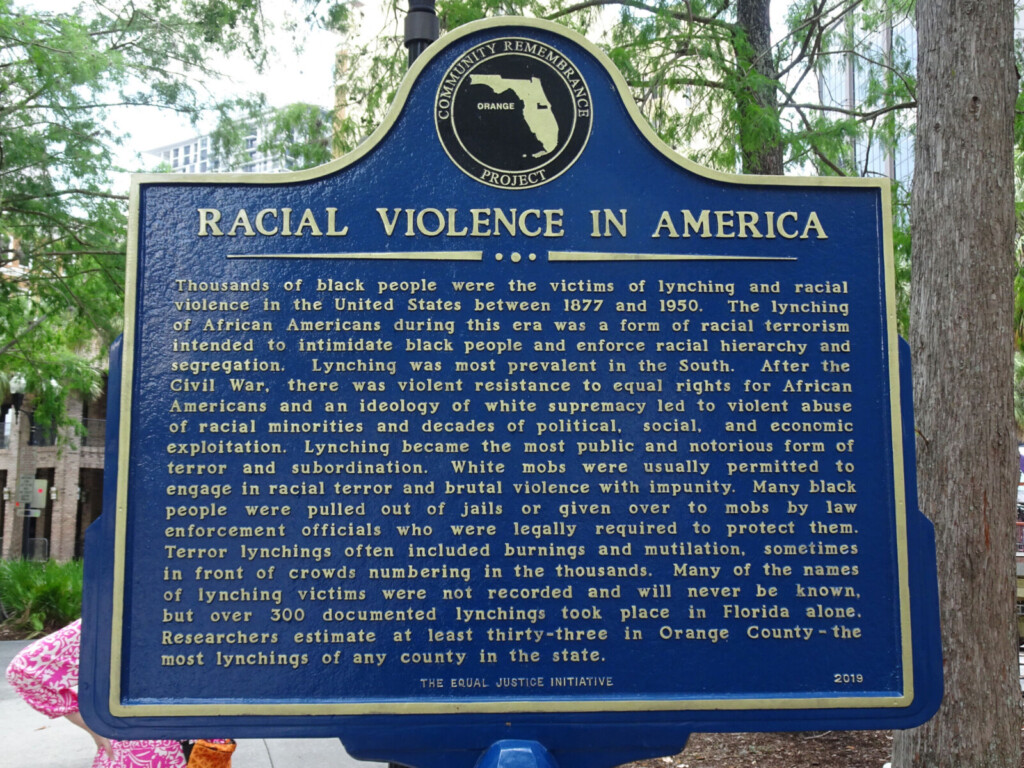
The data that follows from this architecture is not metaphorical. Between 1877 and 1950, more than 4,000 Black Americans were lynched in the United States, according to the Equal Justice Initiative’s 2015 report Lynching in America — and that count covers only the documented cases in the South, deliberately conservative in its methodology. Each of those deaths was a public event, often attended by crowds, sometimes preceded by the sale of souvenir photographs. The body was not merely killed; it was displayed. The violence was communicative. It carried a message addressed not only to the dead but to every living person who shared their skin, telling them what the boundaries of their permitted existence were, where they could walk, what they were allowed to want.
This communicative dimension separates racial violence from ordinary violence in ways that political philosophy has been slow to theorize adequately. When Hannah Arendt wrote about violence in her 1970 work On Violence, she distinguished it sharply from power, arguing that violence is always instrumental — a means to an end that destroys what it touches, including the power of the group that wields it. What her framework struggled to account for was violence deployed not to destroy a threat but to produce a geography: to carve the social world into zones of safety and zones of exposure, and to make certain bodies understand, permanently and in their nervous systems, which zone they inhabit.
That knowledge, once installed, does not require constant enforcement. It becomes self-enforcing. The surveillance you felt on that corner — you brought part of it with you.
When the State Becomes the Instrument
You have watched someone be killed slowly, methodically, in full daylight, while bystanders recorded it on their phones and begged the men in uniform to stop. The killing took eight minutes and forty-six seconds — a number that became a timestamp for an entire civilization’s reckoning with itself — and what made it unbearable was not only the cruelty but the administrative calm of it. The officer’s hand was in his pocket. He looked, as several witnesses noted, almost bored. That affect, that bureaucratic remove, is not incidental. It is the operating system of state racial violence, the condition that makes it not merely possible but sustainable across decades and continents without triggering the collapse of the institutions that carry it out.
Hannah Arendt spent much of “The Origins of Totalitarianism,” published in 1951, trying to explain how ordinary men inside ordinary structures become the machinery of extermination. Her answer was not psychological derangement but something worse: the division of labor, the paperwork, the chain of command that redistributes moral weight until no single actor feels they are holding the full weight of what they are doing. The officer kneeling on a neck is following a restraint protocol. The protocol was approved by a department. The department is funded by a municipality. The municipality was elected. At every link in that chain, responsibility bleeds out, and what remains is a posture — the posture of someone doing their job.
On March 21, 1960, in Sharpeville, South Africa, police officers opened fire on a crowd of Black South Africans who had gathered outside a police station to protest the pass laws — legislation that required Black citizens to carry documents authorizing their presence in white-designated areas. Sixty-nine people died; the majority were shot in the back while fleeing. The apartheid government declared a state of emergency within weeks, not in response to the massacre but in response to the protests the massacre triggered. What the historical record shows is that no officer was convicted. The state investigated itself and found itself innocent. This is not an aberration of the legal system; it is the legal system functioning exactly as it was designed to function, protecting the racial architecture it was built to enforce.
The Rohingya campaigns conducted by the Tatmadaw, Myanmar’s military, between 2016 and 2017 introduced a different grammar of the same logic. Here the instrument was not a single officer or a single crowd but coordinated military operations — clearance operations, as internal documents described them — that burned villages, systematically killed men, and used sexual violence as a weapon of demographic terror. The UN Fact-Finding Mission’s 2018 report documented the destruction of over 350 villages and the displacement of more than 700,000 people in a matter of months. Generals gave orders. Soldiers followed them. Politicians provided diplomatic cover. An international court would later use the word genocide, carefully, legally, with the weight of evidence behind it. The word matters less than the mechanism: a state apparatus deploying its full institutional legitimacy to make the elimination of a population look like a security operation.
What connects these three cases across their vast geographic and temporal distance is not hatred — hatred is the fuel, not the engine. The engine is legitimacy, the authority conferred by uniform, by law, by democratic mandate, by military hierarchy. When violence is institutionalized, its perpetrators do not experience themselves as violent. They experience themselves as professional. This is the particular horror that Arendt was pointing at: not the monster, but the functionary, the man who processes the paperwork without looking at what the paperwork processes. Racism does not need fanatics to do its worst work. It needs bureaucrats who have learned not to ask what the form is actually for.

The Invention of the Racial Enemy
You are standing in your kitchen in April 1994, and the radio is on. The voice coming through the speaker is not threatening — it is cheerful, almost neighborly, the cadence of someone giving directions or reading a weather report. It tells you that the inyenzi are moving through the hills. Cockroaches. The word is used without hesitation, without irony, as though it were a category long established in the natural order of things. By the time the machetes began moving across Rwanda that spring, approximately eight hundred thousand Tutsi men, women, and children would be dead in roughly one hundred days. The radio did not cause this. It completed it.
The ideological groundwork for that completion had been decades in the making. Racial violence does not erupt from hatred the way water erupts from a broken pipe — with pressure that simply needed release. It requires a prior architecture, a sustained dismantling of the victim’s interiority before the body itself is touched. What Radio Mille Collines was doing in 1994 was the terminal phase of a much longer grammatical project: the removal of a people from the category of the human. Once that removal is accomplished linguistically, the violence that follows does not feel like violence to those who commit it. It feels like pest control. It feels like hygiene.
This is precisely what made the Nazi racial science apparatus so methodologically distinct from ordinary prejudice. The Nuremberg Laws of 1935 were not born from street-level hatred spontaneously codified — they were the legislative arm of a biological discourse that had been constructed with institutional legitimacy across universities, medical schools, and public health bodies throughout the 1920s. The rhetoric of Lebensunwertes Leben, life unworthy of life, arrived draped in the authority of clinical measurement. Jews were not described as dangerous because they were powerful; they were described as a pathogen because the language of infection requires no moral argument. You do not debate a virus. You eliminate it. The conceptual move from citizen to biological threat collapsed the space in which ethical hesitation could live.
Frantz Fanon understood this mechanism not as a historical curiosity but as a structure of perception still operating in the present tense. In Black Skin, White Masks, published in 1952, he described how the colonial subject is produced through a gaze that systematically evacuates psychological depth — the colonized person is rendered not as a self with history, grief, desire, and contradiction, but as a surface onto which the colonizer projects fear, appetite, or disgust. Fanon was writing phenomenologically, tracing the lived experience of being looked at in a way that returns nothing of you. The violence he described was not only the violence of the whip or the prison — it was the prior violence of being made epistemologically invisible, of having your interiority declared nonexistent before your body is declared expendable.
What this reveals is that racial violence is never simply about the body it destroys. It is about the conceptual system that had to be built first, maintained with effort, repeated across institutions, embedded in language until it felt like common sense. The effort required is enormous and almost always hidden. By the time the machete falls or the transport train departs, the intellectual labor of dehumanization is so thoroughly absorbed into the social fabric that it no longer appears as a choice anyone made. The perpetrators in Rwanda who later testified described not hatred but a kind of dutiful inevitability. The German bureaucrats who signed deportation orders in 1942 used the vocabulary of logistics management. The language had already done its work so completely that what remained looked, from the inside, like administration.
And this is the feature that makes the ideological construction of the racial enemy so durable across radically different historical contexts: it never presents itself as ideology at all.
Spectacle, Witness, and the Architecture of Impunity
You are standing at the edge of a crowd in 1916, somewhere in Waco, Texas, and the men around you are taking photographs. Not hiding, not ashamed — photographing. The postcards will be mailed. Some will arrive before the week is out, bearing the frank, domestic stamps of a functioning postal service, tucked between letters about weather and harvest prices. The body in the image is Jesse Washington, seventeen years old, and the estimated crowd surrounding what was done to him numbered fifteen thousand people. No one was prosecuted. The local district attorney watched from a window.
Orlando Patterson, writing in 1982 in Slavery and Social Death, identified something more precise than oppression when he described the condition of the enslaved: not merely the removal of freedom, but the systematic elimination of the person as a social being — no recognized past, no legitimate future, no standing from which to make a claim against the world. What the Waco spectacle enacted, decades after abolition, was not a regression to that condition but its continuation through other instruments. The crowd did not gather despite the civilization around them; they gathered as an expression of it. The photography, the postcards, the open attendance of civic officials — these were not failures of the system to contain violence. They were the system performing its own coherence.
The grammar of that performance did not dissolve. It migrated. When a phone camera in Minneapolis in May 2020 recorded eight minutes and forty-six seconds of a man dying under a knee pressed to his neck, the footage circulated globally within hours, accumulating hundreds of millions of views. The immediate interpretive reflex — that visibility meant accountability, that the world watching meant the world witnessing — rested on an assumption Patterson’s framework quietly destroys. Visibility was never the obstacle. In Waco, the violence was maximally visible and maximally unpunished. The camera does not interrupt the architecture of impunity; it can, under specific conditions, become one of its newer rooms.
The sociologist Didier Fassin, in his 2018 work The Will to Punish, traces how the selective application of penal logic in contemporary democracies functions not as a failure of equality but as the production of inequality through the language of equal law. A trial happens, a verdict is rendered, and yet the structure that generated the killing reassembles itself with minimal friction. Between 2013 and 2020, the Washington Post’s Fatal Force database documented more than five thousand people shot and killed by American police. The rate of criminal charges against officers remained below two percent. The footage existed in the majority of these cases. The footage was not the variable that determined outcome.
What the spectacle requires — what it has always required — is an audience that remains an audience. The fifteen thousand in Waco were not passive; their presence was the mechanism. But contemporary viral consumption produces a particular kind of engulfed witness: someone who has seen, who can attest, who carries the image, and who is simultaneously located at an absolute distance from any consequential action. The philosopher Jacques Rancière, in The Emancipated Spectator published in 2008, argued that the very framing of spectatorship as passivity serves a political function — it positions the one who watches as inherently inactive, rendering the act of looking structurally inert before it begins. The footage of racial violence shared across platforms does not so much document a crisis as circulate it, feeding an economy of moral sentiment that spends itself in the act of consumption.
There is a man in Georgia in February 2020 jogging down a residential road, and two men in a truck decide his presence is illegible to them, meaning threatening, meaning available for correction. The video of his killing was suppressed for ten weeks by a local prosecutor who had previously worked with one of the men who fired the shot. When the footage finally circulated, the arrest came within days. What this reveals is not that visibility produces justice but that its selective withholding had been protecting something specific — and that something was not evidence.
The Economy Hidden Inside the Violence
You are handed a ledger before you are handed a weapon. This is the sequence that colonial administrators understood intuitively and that later generations have worked hard to forget, because the ledger makes the violence legible in ways that ideology alone cannot quite sustain. The arithmetic was never hidden — it was simply recorded in currencies and tonnages and interest rates rather than in the language of atrocity, and that translation made it socially respectable.
The transatlantic slave trade moved approximately 12.5 million human beings between 1500 and 1900, a figure documented across the Slave Voyages database compiled by scholars across three decades. What made this possible was not primarily hatred, though hatred was manufactured in abundance to service it. What made it possible was a financial architecture of extraordinary sophistication: insurance contracts written in London coffee houses, joint-stock companies chartered by European monarchies, credit instruments that circulated enslaved bodies as collateral. Eric Williams argued in Capitalism and Slavery in 1944 that the profits from this system directly capitalized the industrial revolution in Britain — a claim contested in its precise accounting but never successfully refuted in its structural logic. The body chained in the hold was simultaneously a unit of labor, a line of credit, and a commodity whose value could be leveraged before it even arrived at port. Destroying that body carelessly was, in the most literal sense, a financial loss. The violence was therefore calibrated: brutal enough to enforce total submission, measured enough to preserve productive capacity. Cruelty was an operating procedure.
Walter Rodney, writing in 1972 in How Europe Underdeveloped Africa, pushed this further by demonstrating that the process was not simply extraction but transformation — that Africa was actively made underdeveloped through the systematic removal of its most capable working-age population, the destruction of existing trade networks, and the deliberate suppression of any internal accumulation that might have competed with European commercial interests. The book cost him his academic career in the Caribbean and eventually contributed to the political climate in which he was assassinated in Guyana in 1980 at the age of thirty-eight. The argument, in other words, was dangerous precisely because it was not abstract: it named a mechanism still operating.
In South Africa, the Natives Land Act of 1913 reduced the Black population, then comprising roughly 67 percent of the country’s people, to legal ownership of 7 percent of the land. This was not incidental to apartheid — it was its economic foundation. The violence of forced removals, of pass laws, of the Bantustans created through the 1950s and 1960s, was in each case the enforcement mechanism of a labor system that required Black workers to be geographically captive, legally rightless, and economically dependent. The mines could not have functioned otherwise. The farms could not have functioned otherwise.
In Darfur, the conflict that escalated catastrophically between 2003 and 2005 and produced what the United States government formally designated as genocide was entangled from its origins with competition over land, water, and grazing routes made scarcer by desertification. The Arab militias mobilized by the Sudanese government were not acting from pure racial animus, though racial and ethnic taxonomies were activated and weaponized. They were clearing territory. The approximately 300,000 deaths and 2.7 million displacements documented by United Nations agencies represented, among other things, the violent resolution of a resource conflict in which Khartoum had strategic interests in the outcome.
What connects these moments across centuries and continents is not a unified conspiracy but a recurring structure: the people designated as racially inferior are, by remarkable coincidence, always sitting on land someone wants, always representing labor someone needs to control, always constituting an obstacle to an accumulation already planned. The racial category arrives as justification for a dispossession that was already decided on economic grounds, and it stays because it makes the dispossession heritable, transmissible, renewable across generations without requiring fresh justification each time it is enforced.
A vision curated by a filmmaker, not an algorithm
In this video I explain our vision
Memory, Denial, and the Politics of Forgetting

You have probably stood in front of a memorial and felt, without being able to name it, that the structure was designed not to make you remember but to make you feel that the remembering had already been done for you. The bronze plaque, the solemn date, the passive-voice inscription — “lives were lost,” “suffering occurred” — performs grief without requiring it, and in that performance licenses a clean departure. You walk away absolved. The society walks away intact.
Paul Connerton argued in How Societies Remember, published in 1989, that forgetting is not the opposite of social memory but one of its primary instruments. Societies do not simply fail to remember their violence; they organize the forgetting, institutionalize it, encode it into the very commemorative rituals that appear to be doing the opposite. The memorial becomes the alibi. The national day of reflection becomes the mechanism by which reflection is permanently deferred to a designated annual slot and therefore never permitted to interrupt ordinary time.
Germany is the case everyone reaches for when they want to believe that a nation can genuinely reckon with its atrocities, and the German Erinnerungskultur — the culture of remembrance built painstakingly after 1945 and restructured again after reunification — is real in ways that demand acknowledgment. The stumbling stones embedded in sidewalks across more than two thousand European cities since Günter Demnig began installing them in 1992, each one engraved with the name and fate of a single victim of National Socialism, force the encounter with historical murder into the literal path of daily life. The 2005 Memorial to the Murdered Jews of Europe in Berlin occupies 19,000 square meters of the capital’s center, and German law criminalizes Holocaust denial under Section 130 of the Criminal Code. These are not gestures. They constitute a structural commitment with legal and spatial consequences. And yet even this model, the most serious attempt by any modern state to institutionalize self-confrontation, has been contested from within — the AfD politician Björn Höcke described the Berlin memorial in 2017 as “a monument of shame” that Germans should feel no obligation to carry, and he was not speaking from the margins.
The United States never built the equivalent infrastructure for its own systematic racial terror. The National Memorial for Peace and Justice in Montgomery, Alabama, opened only in 2018, more than a century after the period it documents, and was funded not by the federal government but by Bryan Stevenson‘s Equal Justice Initiative, a private nonprofit. It catalogs 4,084 racial terror lynchings in the American South between 1877 and 1950 — not as a metaphor, but as a documented archive of names and counties. The country that spent decades projecting itself as the world’s moral arbiter required a private organization to erect the first national monument to the victims of its own domestic terror campaign. The state did not build it. The state did not pay for it.
Australia’s management of Aboriginal history operates through a different but structurally related mechanism: the repeated legislative and rhetorical framing of frontier massacres, forced removals, and the Stolen Generations as events belonging to a past that contemporary Australians did not personally cause and therefore cannot be held to have inherited. The 1997 Bringing Them Home report documented that between one in ten and one in three Aboriginal children were forcibly removed from their families between 1910 and 1970, yet a formal national apology was not delivered until 2008, by Kevin Rudd, and was opposed until the day of its delivery by the Liberal Party on the grounds that living Australians should not apologize for the actions of prior generations. The logic is elegant in its circularity: the generation that perpetuated the policy was never required to apologize, and by the time apologizing became thinkable, the perpetrators had been replaced by inheritors who claimed the history without the liability.
What all three cases share is not the scale of the original violence but the grammar of its management afterward — the way language, timing, and spatial politics conspire to produce a memory that serves the present social order rather than disturbing it, which is precisely what genuine historical reckoning would require.
The Perpetrator’s Ordinary Face
You are sitting across from a municipal clerk, a man in his late forties with reading glasses pushed up on his forehead and a coffee stain on his sleeve. He asks you for documentation you do not have, not because the law strictly requires it, but because this particular office, in this particular city, has developed a quiet procedural habit of asking certain kinds of applicants for more than others. He is not angry. He does not raise his voice. He types something into his computer, shakes his head almost apologetically, and tells you to come back when the file is complete. The violence in that room leaves no bruises.
Christopher Browning spent years reconstructing what happened inside Reserve Police Battalion 101, a unit of middle-aged German men — not SS ideologues, not fanatical party members — who between 1942 and 1943 murdered approximately 38,000 Jewish civilians in occupied Poland and deported another 45,000 to the Treblinka extermination camp. His 1992 study found that the men were given, at least once, the explicit option to step aside. Very few did. Browning’s conclusion was not that they were driven by eliminationist hatred but by something far more corrosive: the social pressure of the group, the bureaucratic framing of the task, the normalization that occurs when horror is administered through paperwork, schedules, and chain of command. The architecture of atrocity, he demonstrated, does not require monsters. It requires organizations.
Stanley Milgram had reached an adjacent conclusion three decades earlier in his obedience experiments at Yale, where ordinary American volunteers administered what they believed were increasingly severe electric shocks to strangers, not because they wanted to cause pain, but because a figure in a lab coat told them to continue. In his 1974 book Obedience to Authority, Milgram argued that the decisive variable was not individual cruelty but the degree to which a person experienced themselves as an agent within a legitimate institutional structure rather than as a free moral actor. Once that frame was in place, the capacity for harm expanded in ways that still unsettle any comfortable theory of human decency.
What this means for racial violence is that the search for perpetrators among the visibly deranged, the overtly hateful, the spectacular transgressor is largely a misdirection. The Rwandan genocide of 1994, in which somewhere between 500,000 and 800,000 Tutsi were killed in roughly one hundred days, was organized not only through radio broadcasts inciting slaughter but through local administrative structures, through mayors and prefects who had governed those same communities for years. The killers included neighbors who knew their victims by name, by land dispute, by the memory of shared funerals. The bureaucratic intimacy of that violence has never been fully absorbed into the international memory of the event, because absorbing it would require acknowledging that social order and racial terror are not opposites.
The same structural logic appears in less lethal but pervasive forms across institutional racism documented throughout the twentieth century and into the present. The redlining policies that the Federal Housing Administration systematically enforced across American cities from the 1930s onward — mapping Black neighborhoods in red to deny mortgage insurance, engineering decades of wealth exclusion — were carried out by assessors, loan officers, and city planners who went home at night, coached their children’s soccer teams, and considered themselves decent people operating within professional norms. The harm they produced was cumulative, statistical, and almost entirely invisible to those producing it, which is precisely what made it so durable.
What perpetuates racial violence across generations is not a reservoir of exceptional sadism but the extraordinary human capacity to follow procedure, defer to hierarchy, and experience institutional participation as a form of innocence — as if the signature on a document disperses moral weight so finely across so many hands that no single hand ever feels it.
What Solidarity Cannot Fix
You watch the news anchor’s voice break, just slightly, when the correspondent describes families fleeing across a European border — the tremor is real, the grief is real, and yet something else is also happening, something the anchor would never name and perhaps cannot see: a calculation, invisible and structural, is assigning this suffering a value that other suffering, elsewhere, has never been granted.
The architecture of international compassion has always had load-bearing walls that no one puts on the blueprint. When Western media covered the displacement crisis beginning in February 2022, correspondents said openly, on air, that these were “civilized people,” “people like us,” distinguishing them from refugees arriving from Syria, from Eritrea, from Afghanistan — the distinction stated without apparent awareness that it was a confession rather than a description. The hierarchy was not invented in that moment. It had been rehearsed for decades through the differential coverage of conflicts in which Black and brown bodies accumulate as statistics while white bodies accumulate as tragedies.
Mahmood Mamdani, writing in the aftermath of Rwanda and in the long shadow of Darfur, made a distinction that cuts through the sentimentality of humanitarian discourse: there is a politics of the victim, which demands international rescue and positions suffering people as objects of external intervention, and a politics of the survivor, which insists on political agency, historical context, and the right of those who endure to define their own terms of recovery. The victim framework, Mamdani argued, is not neutral — it requires a legible perpetrator, a sympathetic sufferer, and an intervening savior, and it tends to erase the structural conditions that produced the violence in favor of a moral theater that Western institutions can manage and exit on their own schedule.
The Democratic Republic of Congo has sustained one of the most prolonged and lethal conflicts of the post-Cold War era, with estimates from the International Rescue Committee placing excess mortality figures from the wars beginning in 1998 at over five million deaths by the mid-2000s — a number so large it became, paradoxically, incomprehensible to media systems calibrated for the singular face, the individual story, the name that could anchor a fundraising campaign. Yemen, under a blockade and aerial bombardment campaign that has produced what the United Nations designated as the world’s worst humanitarian crisis, has received a fraction of the sustained editorial attention devoted to conflicts where Western military or cultural stakes are more directly legible. The arithmetic of grief, in this sense, is not random — it follows the contours of geopolitical interest dressed in the language of universal humanity.
Solidarity, when it arrives from outside, almost always arrives with conditions embedded inside it, even when those conditions are unconscious. The NGO infrastructure that expanded dramatically through the 1990s operates within what Liisa Malkki, in her 1996 essay “Speechless Emissaries,” described as a humanitarian gaze that strips refugees of their political histories in order to render them consumable as objects of pity — silent, grateful, photogenic in their suffering, stripped of the inconvenient complexity of having opinions about the forces that displaced them. The child photographed in a camp becomes the emblem of a crisis; the same child’s father, who might have something precise and angry to say about the international arms trade or colonial land arrangements, is not the image that raises funds.
What this produces, over time, is a world in which racial violence is repeatedly laundered through frameworks that acknowledge suffering while neutralizing its political content — frameworks that allow Western publics to feel implicated enough to donate but not implicated enough to change anything structural about how violence is financed, armed, or ignored. The grief is real. The selectivity of the grief is also real. And the distance between those two facts is where history continues to be made.
✊ Race, Power, and the Wounds History Left Behind
Racial violence does not emerge in a vacuum: it is rooted in deep social structures, historical prejudices, and psychological mechanisms that have shaped entire civilizations. Understanding its causes and dynamics requires exploring the broader landscape of discrimination, marginalization, and collective identity. These articles illuminate the forces that fuel hatred and the paths that lead toward justice.
The impact of racial discrimination on contemporary social dynamics
Racial discrimination is not a relic of the past but a living force that continues to reshape social hierarchies and everyday experiences around the world. This article examines how racial bias infiltrates institutions, interpersonal relations, and collective consciousness, producing lasting psychological and societal damage. Understanding these dynamics is the first step toward dismantling the structures that perpetuate them.
GO TO THE SELECTION: The impact of racial discrimination on contemporary social dynamics
The roots of social prejudice and the mechanisms of exclusion
Social prejudice is rarely born of individual malice alone; it is cultivated by historical narratives, economic competition, and cultural fears that become embedded in community life. This piece traces the roots of exclusionary thinking and the mechanisms through which societies define who belongs and who is cast out. It offers a rigorous analysis of how prejudice functions as a tool of social control.
GO TO THE SELECTION: The roots of social prejudice and the mechanisms of exclusion
The psychology of the scapegoat and mass hysteria
Mass hysteria and scapegoating are among the most dangerous social phenomena, capable of transforming ordinary communities into instruments of collective violence against a designated enemy. This article draws on psychology and historical case studies to explain how fear, group conformity, and authoritarian suggestion combine to produce irrational persecution. Its insights resonate powerfully with the study of racial violence across different eras and cultures.
GO TO THE SELECTION: The psychology of the scapegoat and mass hysteria
How power elites manufacture the public enemy
Throughout history, those in power have repeatedly manufactured the figure of the public enemy to consolidate authority and redirect social frustration onto vulnerable minorities. This article exposes the deliberate strategies used by elites to stigmatize ethnic, racial, or religious groups, turning them into targets of institutional and popular violence. Recognizing these mechanisms is essential for any serious analysis of how racial hatred is engineered and sustained.
GO TO THE SELECTION: How power elites manufacture the public enemy
Discover the Cinema That Dares to Tell the Truth
If these themes move you and you believe that cinema can be a powerful witness to injustice, Indiecinema is where your next essential viewing awaits. Our streaming platform is dedicated to independent films that confront racial violence, social exclusion, and human dignity with uncompromising honesty. Join us and explore stories that the mainstream rarely tells.
👉 EXPLORE THE CATALOG: Watch Indie Films in Streaming
A vision curated by a filmmaker, not an algorithm
In this video I explain our vision

