
The Possessive Gaze as Ontological Claim
You watch them sleep and something moves in you that has no clean name. Not tenderness exactly, though tenderness is there. Something older, more structural — a quiet, cellular need to make what you are seeing stay exactly as it is, to press it between the pages of your memory like a dried flower, to own the image before it escapes into the morning and becomes a person again, with their own momentum, their own interior weather, their own refusals. You reach out, almost touch their face, and what stops your hand is not restraint. It is the brief, terrible recognition that touching them would remind you they are not yours.

Max Stirner published Der Einzige und sein Eigentum in Leipzig in 1844, and the philosophical establishment has never quite recovered its composure around it. Marx and Engels devoted more than three hundred pages of The German Ideology to attacking it, which is itself a form of tribute — you do not spend that kind of energy on a book you have actually dismissed. What Stirner did, with a brutality that still reads as fresh, was refuse every abstraction that philosophy and politics had ever tried to crown as sovereign over the individual. God, State, Humanity, Society, even the Feuerbachian species-essence that the Young Hegelians were so enamoured of — Stirner treated them all as spooks, Gespenster, ghosts that the individual had agreed to be haunted by without ever being asked. The Unique, der Einzige, was his answer: the self stripped of all inherited categories, answerable to nothing outside its own existence, its own appetite, its own will to persist.
What makes this more than adolescent rebellion is the precision of the ontological move. Stirner was not simply saying that the self matters. He was saying that the self is the only thing that exists in any philosophically serious sense, and that everything else — every bond, every institution, every value — is either property of the self or a claim made against the self by something that has no right to make it. This collapses the distinction between love and possession not by sentimentalizing possession but by ontologizing it. To relate to something is already to incorporate it into the field of the Unique. There is no relationship that is not, at its root, a form of annexation.
The political consequences were scandalous enough to get Stirner exiled from serious academic discussion for decades, but the psychological consequences are where the real vertigo lives. If the Unique is the only sovereign, then moral obligation is not a universal truth but a costume the collective forces individuals to wear so that their energy can be harvested for ends that are not their own. The feeling of duty you experience toward another person is, on Stirner’s account, not evidence of your depth but of your successful colonization. You have been taught to experience your own submission as virtue. What nineteenth-century liberal philosophy called moral development, Stirner called the production of useful ghosts — selves so thoroughly haunted by abstractions that they no longer recognize their own dispossession.
This is the knife edge the bedroom scene runs across. The urge to fix a sleeping person into permanence is not a pathology that deviates from love — it may be the most structurally honest expression of what love, as a social and psychological institution, has always been trained to do. The watcher at the bedside is not a monster. They are simply having an unusually transparent moment inside a system that has always organized intimacy around the question of who, in the end, gets to define whom.
Property Beyond Economics: Stirner Against Feuerbach and Marx
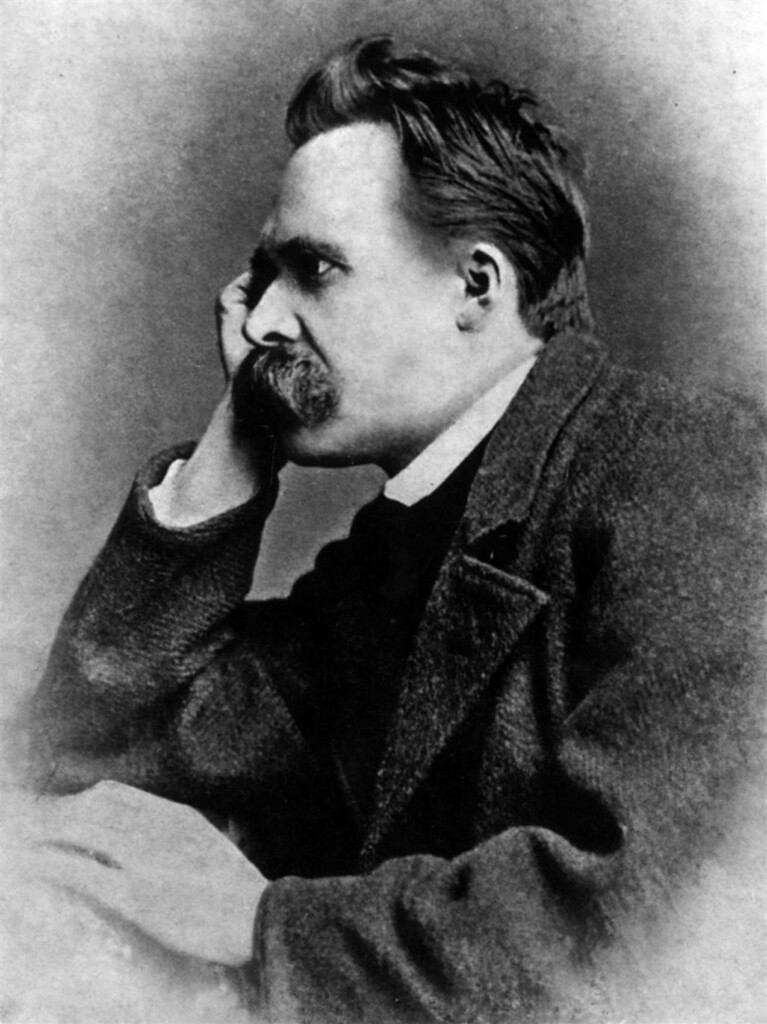
You have been told, at some point in your education, that the great emancipatory project of the nineteenth century was a war against God. What nobody mentioned is that the war was won too quickly, and the victors immediately installed new altars under secular names.
Ludwig Feuerbach believed he had solved the riddle of alienation by revealing that God was nothing but the human species projecting its own perfections outward and worshipping the projection. Return those perfections to Man, collapse the divine back into the human, and alienation dissolves. This was considered a radical move in 1841. Max Stirner read it and recognized it immediately as a pious act wearing a philosopher’s coat. The species-being that Feuerbach installed at the center of his anthropology was simply God with a new passport — still a generality demanding submission, still an abstraction to which the living individual owed fealty. Stirner’s Der Einzige und sein Eigentum, published in Leipzig in 1844, argued that “Man” as a category was precisely as tyrannical as “God” had been, because it functioned identically: it named something beyond and above the actual singular creature reading the page, something you were supposed to serve, embody, live up to, sacrifice yourself toward.
The Young Hegelians had believed they were dismantling the sacred. What Stirner saw was that they had merely changed the name of the congregation. Bruno Bauer was calling for liberation in the name of critical consciousness; Moses Hess was constructing a humanist communism built on the absolute value of human essence. Every one of these projects preserved the logical structure of theology: an ideal substance anterior to and greater than the individual, which the individual was obligated to realize. Stirner’s move was not to propose a better ideal. It was to designate all ideals, without exception, as hauntings — he called them Spooks, Gespenster — phantoms that the living person mistakes for obligations simply because language has given them nouns and therefore apparent weight in the world.
Karl Marx spent considerable energy in 1845 and 1846 writing more than three hundred pages of manuscript specifically to refute Stirner, in what would remain unpublished and largely unknown until 1932. The sheer volume is diagnostic. The sections on Stirner in The German Ideology are mocking, sometimes contemptuous, dismissing his work as the philosophical equivalent of adolescent self-assertion, an inability to move beyond bourgeois individualism toward genuine historical materialism. But the mockery barely conceals a structural anxiety. If Stirner’s critique holds — if every liberation movement that appeals to class consciousness, human dignity, species solidarity, or historical destiny is trafficking in sacred abstractions — then Marxism itself is not the escape from ideology but one of its most elaborate constructions. Marx could not afford to take this seriously, so he performed not taking it seriously at great length, which is rarely what confidence looks like.
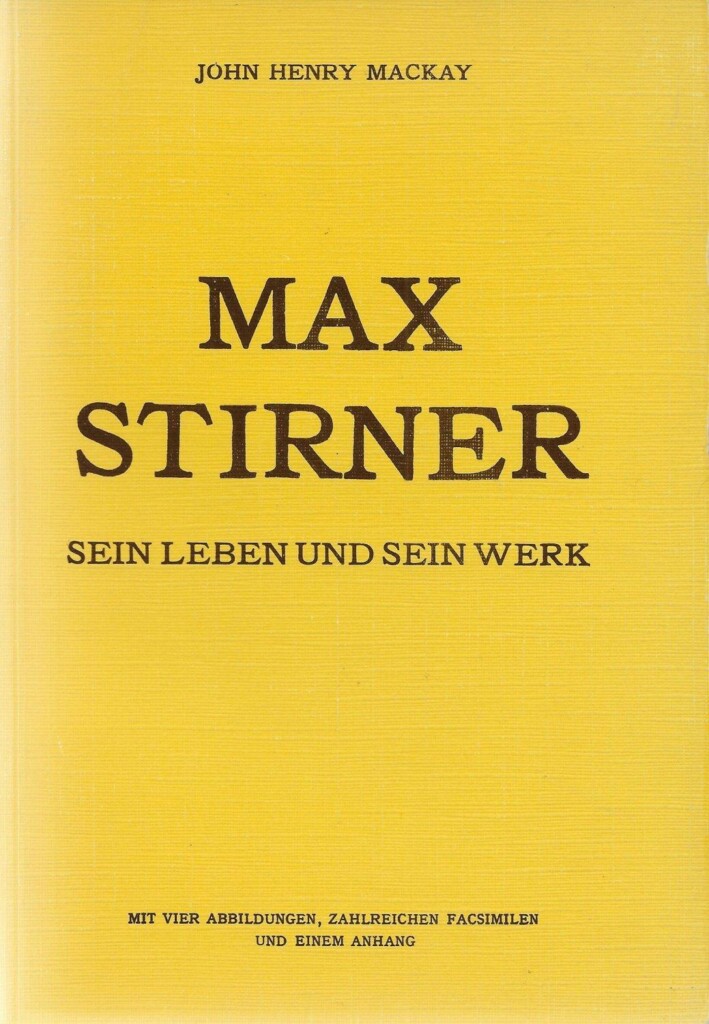
The book did not detonate upon publication. It sold modestly, provoked the flurry of responses from the Young Hegelians, and then essentially disappeared. For approximately four decades, Der Einzige und sein Eigentum existed in a condition of cultural irrelevance, shelved and uncited, neither refuted nor absorbed. It required the philosophical turbulence of the 1890s to exhume it: anarchist readers in Germany and France recognized in Stirner a weaponizable vocabulary against every form of collective authority, including socialist authority, and figures moving in the orbit of Nietzsche’s reception encountered the book as an uncanny precursor, a text that had arrived twenty years too early for the ears available to hear it. John Henry Mackay, the Scottish-German poet and individualist anarchist, almost single-handedly reconstructed Stirner’s biography from nothing and republished the book in 1898, initiating the second life of a thinker the century had chosen to forget.
What the rediscovery revealed was not that the nineteenth century had missed an eccentric voice, but that it had suppressed a question it could not answer without dismantling itself.

Ownness as the Structure of Intimate Violence
You have rehearsed the sentence so many times it no longer sounds like a threat. “You are mine” — spoken softly, in the dark, after something that looked from the outside like tenderness. The person beside you does not flinch because the grammar of possession has been so thoroughly naturalized in the architecture of intimate life that the sentence registers as devotion rather than annexation.
Eigenheit, the term Stirner uses to describe the self’s absolute ownership of itself, carries within its etymology a structural ambiguity that most readers move past too quickly. The German eigen means both “own” and “peculiar,” and this doubling is not accidental. What belongs to you is, by definition, what sets you apart — and what sets you apart is, by the same logic, what you are entitled to protect, develop, and extend. Stirner is not arguing for isolation; he is arguing for a kind of centripetal force in which everything that enters the orbit of the self becomes subject to its gravitational claim. The self does not merely inhabit the world; it appropriates it. This is not metaphor. It is the operational logic of Ownness as Stirner develops it across the second half of The Ego and Its Own, published in 1844, where he systematically strips away every category — God, State, Humanity, even Love — that asks the self to subordinate its appetite to something external. What remains after this stripping is not freedom in any relational sense. What remains is a structure of entitlement so clean it can accommodate another human being as its object without any internal contradiction.
Jessica Benjamin identified in 1988 something that political philosophy had largely refused to name: that domination in intimate life does not arise from hatred or pathology but from a failure of a far more ordinary and uncomfortable thing, which is the capacity to recognize that another person has an interior that does not belong to you. Her analysis in The Bonds of Love traces how the very intensity of desire produces the impulse to absorb rather than encounter — how the lover who wants to be everything to someone else is not celebrating that person but erasing the gap that makes them a person at all. The dominator is not indifferent to the other; the dominator is overwhelmed by the other’s separateness and moves to resolve that overwhelm through control. Benjamin draws on Hegel’s master-slave dialectic but redirects its energy inward, into the bedroom, into the daily negotiations of intimacy where recognition is extended and withheld with a precision no political institution could match.
What Stirner’s framework does, when placed against Benjamin’s analysis, is provide the dominator with a philosophical alibi so elegant it barely needs to be articulated. If Ownness is the foundational truth of selfhood, then the other’s interiority — their unexplained silences, their desires that diverge from yours, their insistence on being somewhere you are not — ceases to be evidence of their personhood and becomes, instead, an act of trespass. Their separateness is not something you failed to honor; it is something they are imposing on your sovereign territory. The emotional logic of the controlling partner, reconstructed across thousands of court testimonies and clinical transcripts, follows precisely this inversion: it is they who have been wronged by the other’s refusal to be fully available, fully knowable, fully possessed. The violence that follows — and it does follow, in gestures that range from the catastrophic to the barely visible — is experienced by its author not as an attack but as a correction.
What makes this particularly difficult to see from the inside is that Eigenheit does not announce itself as a system of domination.
The Legal and Political Afterlife of Absolute Egoism

You sign a contract. The document is twelve pages long, dense with indemnity clauses and arbitration waivers, and somewhere in its third paragraph it announces, with the confidence of a founding myth, that you are the sovereign owner of yourself. You initial each page. The logic feels unassailable — if you do not own yourself, who does? — and it is precisely this feeling of unassailability that should give you pause, because it arrived not from reason but from a genealogy that almost nobody traces back to its source.
Robert Nozick published Anarchy, State, and Utopia in 1974, and its opening axiom — that individuals possess themselves as a matter of foundational right — became the theoretical bedrock on which an entire architecture of minimal-state libertarianism was constructed. Nozick never cited Stirner directly; the intellectual distance he maintained was probably deliberate, given how radioactive the Stirnerian inheritance had become after its partial absorption into the rhetoric of the late nineteenth-century individualist anarchists, particularly Benjamin Tucker, who translated and distributed The Ego and Its Own in American circles as early as the 1890s. But the structural logic was identical: if the self is property, then all subsequent claims — on labor, on body, on the products of one’s will — flow from that original title deed. What Nozick dressed in the respectable grammar of analytic philosophy was the same irreducible nucleus Stirner had detonated forty years before Marx wrote a single page of Capital.
The mutation that followed was neither accidental nor innocent. When self-ownership becomes an axiom rather than a provocation, it ceases to be a critique and becomes a license. Stirner’s original formulation in Der Einzige und sein Eigentum, published in Leipzig in 1844, was designed to dissolve every fixed idea, including property itself — he called the state, the nation, and even humanity “spooks,” phantoms that colonize the individual’s inner life and extract tribute from it. The self-owner in Stirner was not a stable legal subject but a perpetual insurrection against stabilization. To freeze that insurrection into an axiom is to perform exactly the kind of conceptual arrest that Stirner spent three hundred pages attacking.
By 2023, the vocabulary of self-ownership had fractured into two currents that share a grammar but inhabit opposite rhetorical universes. On one end, certain far-right bodily autonomy arguments — particularly those rejecting vaccine mandates or state-enforced medical protocols — grounded their resistance explicitly in the language of sovereign self-possession, deploying the same axiom Nozick had formalized to argue that no collective claim could reach inside the boundary of the individual body. On the other end, tech-libertarian contractualism, visible in the terms-of-service architectures of platform economies and in the philosophical scaffolding around transhumanist self-modification, extended the self-ownership claim into data, cognitive labor, and biological substrate, treating the person as a startup whose equity belongs entirely to its founder. These two currents loathe each other politically, but they drink from the same well, and the water in that well was drawn by a nineteenth-century Berlin philosopher who believed that the absolute right to oneself was a weapon against every institution, not the founding charter of new ones.
Stirner would have recognized both camps as precisely the kind of fixed-idea machinery he was trying to detonate. The far-right self-owner wraps the sovereign self in the flag, the tradition, the biological nation — each of which Stirner identified as external ghosts parasitizing the individual will. The tech-libertarian self-owner submits the sovereign self to contractual frameworks, platform agreements, and algorithmic governance structures that are, in any honest description, new forms of the voluntary servitude he found more insidious than coerced obedience. What neither camp can tolerate is the conclusion their shared axiom actually produces when followed without flinching: that the self-owning individual owes allegiance to nothing, not even to the ideology of self-ownership itself.
When the Unique Encounters Another Unique
Two people sit across a table from each other, each with a document they have already decided to sign, each performing the ritual of reading it carefully. One taps the margin with a pen. The other nods slowly at a clause they find acceptable. Neither is deceived about the fundamental structure of the exchange: they are here because the other is useful, and both know it, and neither says so, and the silence around that knowledge is the actual contract — the one that will never be written down, the one that governs everything the written document cannot touch.
Stirner would have found nothing scandalous in that room. For him, the performance of mutual respect is not hypocrisy — it is simply the lubricant that keeps the machinery of use running without unnecessary friction. What he called the Verein von Egoisten, the Union of Egoists, is precisely this: a temporary convergence of sovereign wills who remain, throughout the alliance, irreducibly their own. The union is not a society, not a contract in the Rousseauvian sense, not a fusion of interests into some higher collective body. It is closer to a truce between armed parties who have calculated that standing down, for now, costs less than continuing to fire. When the calculation changes, the union dissolves. There is no betrayal in this because there was never a promise — only an arrangement.
The philosophical audacity here is real. In 1844, when The Ego and Its Own was published, the dominant vocabularies for describing human association were already burdened with duty: Kant’s categorical imperative demanded that the other be treated as an end, never merely a means; Hegel’s ethical life embedded the individual within family, civil society, and state as the necessary conditions of genuine freedom. Stirner burned through all of it by asking a single question — who benefits from your obligation? — and refusing to accept any answer that invoked something beyond the willing individual. His answer was brutal in its clarity: obligations serve the institutions that enforce them, not the persons who bear them.
But the Verein carries within it a structural problem that Stirner acknowledged without resolving, because resolution would have required conceding ground he was not willing to give. If two Uniques enter an alliance, and each remains sovereign, then no term of that alliance can generate a genuine obligation. The moment one party’s interest diverges, the union ends — not breaks, ends, the way a mathematical set ceases to exist when its defining condition lapses. There is no residue. No debt. No claim. This means the union can sustain exchange, cooperation, even sustained collaboration, but it cannot sustain care — and care is precisely what human vulnerability periodically demands from human proximity. A person who is ill, or grieving, or temporarily unable to calculate their own advantage, has no standing in the Verein. Their need is not a claim. It is simply data the other sovereign may or may not incorporate into their calculus.
What philosophy has never been able to settle is whether that is a description of how human association actually functions when stripped of its ideological clothing, or whether it is itself a specific ideological move — one that mistakes the social form of market relations for the permanent structure of selfhood. Emmanuel Levinas, working from an entirely different tradition a century later, built his entire ethics around the proposition that the face of the other generates an obligation that precedes any contract, any calculation, any decision to engage. For Levinas, the other’s vulnerability is not information — it is a command. The two positions are not merely different; they are incompatible at the level of what it means to encounter another person at all.
When two absolutes meet without any institutional form capable of holding the asymmetry between them, what remains is not freedom — it is the rule of whoever can afford to walk away first.
A vision curated by a filmmaker, not an algorithm
In this video I explain our vision
🕳️ The Abyss of Possession: Self, Other, and the Will to Own
Stirner’s radical assertion that the ego has an absolute right to possess the other opens a vertiginous philosophical corridor connecting anarchist individualism, existential despair, and the darkest architectures of human desire. From jealousy to control, from love as domination to the annihilation of the bond, these themes reverberate across philosophy, psychology, and literature in ways that are impossible to ignore.
Sartre’s Being and nothingness: when love becomes a delusion of control
Sartre’s ontology of desire reveals that love is never a pure gift but a strategy of appropriation: we seek to possess the other’s freedom without destroying it, an impossible paradox. This dialectic of control and recognition maps directly onto Stirner’s ego, which refuses to acknowledge any limit imposed by another’s subjectivity. Together, Sartre and Stirner form the twin poles of a philosophical tradition that sees interpersonal relations as inherently agonistic.
GO TO THE SELECTION: Sartre’s Being and nothingness: when love becomes a delusion of control
Possessive obsession and pathological jealousy: the destruction of the bond
Possessive obsession and pathological jealousy represent the lived, clinical face of the philosophical claim that the other is mine to own. What Stirner articulates as a metaphysical right, the jealous partner enacts as a behavioral compulsion, erasing the boundary between desire and destruction. This article traces the psychological mechanisms by which love curdles into a need for total domination over another person.
GO TO THE SELECTION: Possessive obsession and pathological jealousy: the destruction of the bond
Friedrich Nietzsche, the eternal return and the weight of the past
Nietzsche’s concept of eternal return forces the ego to confront its own choices as if they were to be repeated infinitely, lending a crushing weight to every act of possession or renunciation. Where Stirner liberates the ego from all moral constraints, Nietzsche binds it to the eternal consequence of its own will. Reading the two together illuminates the most extreme reaches of individualist philosophy and its psychological cost.
GO TO THE SELECTION: Friedrich Nietzsche, the eternal return and the weight of the past
Love in Philosophy: From Plato to Fromm
From Plato’s Symposium to Fromm’s art of loving, philosophy has repeatedly asked whether love is a form of union or a form of possession. This panoramic article maps the history of that question, revealing how the tension between eros as gift and eros as appropriation has never been resolved. Stirner’s radical position finds its most provocative context when placed within this long tradition of thought on desire, selfhood, and the other.
GO TO THE SELECTION: Love in Philosophy: From Plato to Fromm
Explore the Cinema of the Uncompromising Self on Indiecinema
If these philosophical depths have stirred something in you, Indiecinema’s streaming platform offers a curated selection of independent films that dare to explore possession, identity, and the violent intimacy of human desire with the same uncompromising honesty. Step beyond the mainstream and discover cinema that thinks.
👉 EXPLORE THE CATALOG: Watch Indie Films in Streaming
A vision curated by a filmmaker, not an algorithm
In this video I explain our vision

