
The Man Who Chose the Wall
You know the feeling. You are standing at the edge of something — a contract unsigned on your desk, a message drafted but not sent, a plane ticket you could still buy. The world is pulling forward, the way it always does, with its noise and its promises and its endless suggestion that more is always better than less. And then, for reasons you cannot fully explain even to yourself, you step back. Not out of fear. Not out of failure. Out of something that feels almost violent in its clarity: the recognition that forward, in this particular moment, would be a kind of betrayal of something you cannot name but can feel pressing against your ribs.

Most people step back once, maybe twice, in a lifetime. They remember those moments as the ones that actually made them who they are, more than the promotions, more than the arrivals.
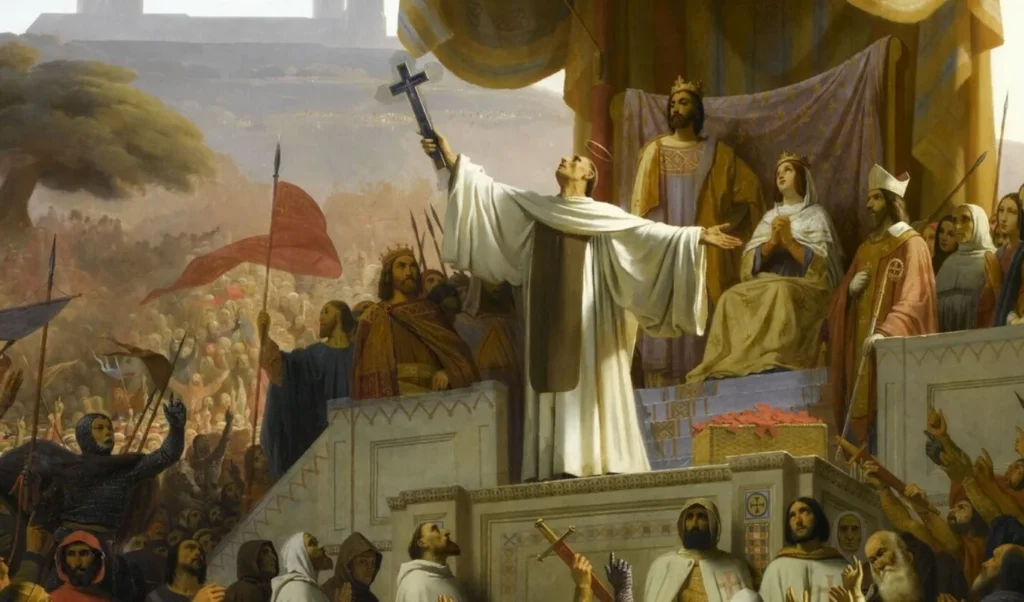
Bernard of Clairvaux stepped back permanently, and he brought thirty people with him.
In 1113, he was not yet the most powerful ecclesiastical voice in Europe, not yet the man who would launch the Second Crusade with his words alone, not yet the theologian whose Sermons on the Song of Songs would reshape the entire vocabulary of Christian mysticism across the medieval West. He was twenty-two years old, the son of a Burgundian nobleman, educated at Châtillon-sur-Seine, possessed of a mind that everyone who encountered him seemed to find almost unreasonably sharp. He had prospects. He had family connections. He had the kind of intelligence that medieval ecclesiastical society knew how to reward with titles, influence, and the slow accumulation of institutional power.
He chose Cîteaux instead. The Cistercian monastery at Cîteaux had been founded only fifteen years earlier, in 1098, as a deliberate rupture with the comfortable religiosity of Cluny — a return to the raw, literal interpretation of the Rule of Saint Benedict, stripped of ornament, stripped of softness, stripped of almost everything that made monastic life bearable to men of refinement. It was, by any reasonable account, a hard place. The kind of place that was slowly dying from a shortage of new members when Bernard arrived.
He did not arrive alone. He arrived with thirty companions — brothers, friends, men he had spent months recruiting with the same focused intensity that generals use to build armies or founders use to build companies. His own brothers. His uncle. Men who had lives, who had futures in the ordinary sense of the word, and who followed him through the gate of Cîteaux as if they were following something they had been waiting for without knowing it.
This is not a story about religious vocation in the comfortable sense. It is something stranger and more unsettling than that. William James, in The Varieties of Religious Experience published in 1902, described conversion as a process in which a self divided against itself suddenly reorganizes around a new center of gravity. The language is psychological, almost clinical, but what he is pointing at is exactly the moment Bernard seems to have inhabited and then extended outward into the lives of everyone around him: not persuasion, not argument, but something contagious in its certainty, something that made the wall look more real than the open road.
The wall, in Bernard’s case, was literal. Stone, cold, Burgundian, twelfth-century stone. But the choice it represented is one you recognize in your own body if you have ever stood at that threshold and felt, for a single unnerving second, that the only honest direction was inward.
He felt it, and then he built his life inside it. Every conversation that follows from that fact — every theological position, every political intervention, every line of mystical prose — begins here, in this one man’s decision to stop moving outward and start moving into depth.
The Wound Before the Doctrine
Before there was doctrine, there was a body in a doorway. A boy watches someone he has never imagined losing become someone he can no longer reach. The specific quality of that moment — the way the world reorganizes itself around an absence that has no edges — is not the beginning of grief. It is the beginning of a different kind of knowing.
Aleth of Montbard died when Bernard was somewhere around seventeen. She had been, by every account that survives, not simply a devoted mother but a formative force — a woman who prayed over her son before his birth and continued shaping the architecture of his inner life long after he could articulate what that architecture was. Her death did not arrive as an abstraction. It arrived as the sudden, disorienting fact that love has a body, and that body can be taken.
John Bowlby spent decades demonstrating what human beings have always known but refused to admit systematically: that early attachment is not sentiment but biology, that the loss of a primary bond does not simply cause sadness but reorganizes the entire nervous system’s relationship to safety, to longing, to the question of where comfort can be found. His three-volume work Attachment and Loss, published between 1969 and 1980, showed that grief is not a passage through discrete stages but a fundamental restructuring of the self — particularly when it strikes during adolescence, when identity is still plastic enough to be permanently reshaped by what it loses. Bernard was precisely that plastic age. And what he lost was not merely a person but a template for what closeness felt like.
This matters enormously for what he would eventually build with words. The eighty-six sermons on the Song of Songs — begun around 1135, when Bernard was already deep into his forties, already the most influential ecclesiastical voice in Europe — are not the product of a man who found God in tranquility. They are the language of someone who learned, very young and very specifically, that longing is indistinguishable from pain. When he writes about the soul’s desire for union with God, he is not deploying a metaphor. He is using the only accurate vocabulary available for an experience he had already lived in its secular, devastating form.
There is a moment — a man sorting through his dead mother’s belongings, holding a piece of cloth that still carries a smell, understanding for the first time that presence can persist inside an object long after the person has gone — that captures something of what Bernard must have been carrying. Not the theological insight. The prior wound. The discovery that love is simultaneously the thing that makes you most alive and the thing that makes you most vulnerable to obliteration. Mystical thought is rarely, despite its official biographies, born from serenity. It is born from exactly this: the moment when the ordinary channels of connection close, and something in the person refuses to stop reaching.
Bernard entered Cîteaux in 1112, taking not only himself but an improbable cohort of relatives and friends — some thirty men, by the accounts — with him into monastic life. The sheer social force of that act has always puzzled historians who approach it primarily as religious enthusiasm. But grief that cannot be metabolized through conventional human bonds does not simply disappear. It migrates. It finds structures large enough to contain its pressure. The monastery, with its rhythms of prayer and silence and communal longing directed toward an invisible center, was not an escape from what Bernard had felt at seventeen. It was, in the most precise psychological sense, its continuation under different conditions.
What he would eventually call the soul’s compunctio — that piercing, that wound that opens rather than closes — was not a theological concept he arrived at through study. He had already felt it, standing somewhere in the early twelfth century, in a grief that had no doctrine yet to hold it.

Cîteaux and the Architecture of Stripping
There is a particular quality of silence that belongs only to rooms where everything unnecessary has been removed. Not the silence of emptiness, which is merely absence, but the silence of subtraction — of something actively taken away, leaving behind an air that presses differently against the skin. Walk into one of the early Cistercian churches Bernard helped design and you feel it immediately, before you have formed any thought about what you are experiencing. Stone, light, proportion. Nothing that asks for your attention except the architecture of your own interiority.
This was not aesthetic minimalism in any modern sense, not the cultivated emptiness of a gallery or the deliberate bareness of a designer’s apartment. Bernard and his brothers at Cîteaux, and later at Clairvaux when he founded that house in 1115 at the age of twenty-four, were engaged in something far more radical: the systematic engineering of human consciousness through the control of sensory environment. When Bernard raged against Cluny’s elaborate ornamental programs — the carved monsters on the capitals, the gilded altarpieces, the chromatic excess of stained glass — he was not making an argument about liturgical propriety. He was identifying, with the precision of someone who had studied his own mind very carefully, the exact mechanism by which the ego feeds and sustains itself. The eye lands on the beautiful object. The mind narrates its own appreciation. The self swells, briefly, in the warmth of aesthetic experience. And the monk who came to disappear into God has instead rehearsed, one more time, the small theater of his own subjectivity.
Pierre Bourdieu spent decades building the theoretical architecture to describe what Bernard already understood in practice. The concept Bourdieu calls habitus — developed most fully in “The Logic of Practice” (1980) and “Distinction” (1979) — designates the way social environments restructure human dispositions below the threshold of conscious deliberation. We do not choose our habits of perception; we are shaped into them by the spaces we inhabit, the rhythms we repeat, the objects our hands touch and our eyes encounter. The body learns what the mind never decides. Bernard was running an experiment in reverse habitus: not the unconscious absorption of a culture’s values, but the deliberate engineering of conditions that would gradually dissolve the dispositions accumulated over a lifetime of living in the world. The bare wall does not ask you to admire it. The unornamented choir does not reward aesthetic sensitivity. The plain wooden table does not confirm that you have refined taste. Strip away every surface that reflects the self back to itself, and you begin — slowly, against enormous internal resistance — to stop looking for your reflection.
The paradox that tears through this whole enterprise is almost violent in its intensity. To build a machine for the dismantling of will, you must deploy extraordinary will. To create institutions capable of stripping others of their ego-structures, you must exercise precisely the kind of commanding, organizational, politically sophisticated intelligence that the ego loves best. Bernard founded sixty-eight monasteries before his death. He corresponded with popes and emperors, dictated terms to councils, redirected the course of crusades. The man who wrote that the soul must become nothing, must empty itself of every claim and preference, was simultaneously one of the most forceful personalities of the twelfth century, a figure whose letters could make kings change direction. There is no clean resolution to this. Bernard seems to have understood the contradiction and lived inside it without flinching, which may itself be the most honest thing about him.
What Cîteaux built, then, was not simply a reformed religious order but a particular kind of pressure — applied daily, architecturally, through the body’s routine — designed to make the self uncomfortable in itself, until the discomfort became a door.
Desire as the Engine of the Divine
There is a moment — you have almost certainly lived it — when someone you love does something for you not because they were asked, not because it was expected, but because they could not help themselves. The gesture arrives before thought. It precedes calculation entirely. And in that moment you understand, with a certainty no argument could produce, that this is something different in kind from everything else that passes between people. Bernard understood this. He built an entire theology around it.
In the treatise he composed around 1132, he posed what sounds like a simple question: why should we love God, and how much? The answer he gave was structurally strange, almost self-dissolving. We should love God, he wrote, without measure — sine modo. The measure of loving God is to love without measure. This is not a mystical evasion. It is a precise observation about the nature of desire itself, which does not operate by proportion. Desire, when it is genuine, exceeds every container you try to place around it. Bernard was not inviting the reader into sentiment. He was describing an anthropological fact: that the deepest movements of the human interior are not governed by the will but by transformation.
He identified four ascending degrees of love, a kind of phenomenology of the soul’s trajectory. First, the self loves itself for its own sake — the baseline condition of every human creature. Then, through experience of dependence and grace, the self learns to love God for what God provides. Then, gradually, the self begins to love God for God’s own sake. And finally — and here Bernard pressed into territory that unsettled even sympathetic readers — the soul loves even itself only for God’s sake. The self does not disappear in this fourth degree, but it is, as he put it in a phrase that has haunted Western mysticism ever since, like a drop of water dissolving into wine. The drop does not cease to exist. It ceases to be separate.
What was being built simultaneously in Paris was something entirely different in its architecture and its trust. In the cathedral schools, in the new dialectical culture that was producing systematic theology as an intellectual discipline, the assumption was that reason could approach the divine — not replace faith, but illuminate it, structure it, make it coherent to minds trained in logic. The man who represented this project most brilliantly and most dangerously, from Bernard’s perspective, was teaching in Paris and attracting enormous crowds of students precisely because he made difficult things legible. He brought Aristotelian tools to theological questions. He asked what words meant before deciding what doctrines required. He trusted the capacity of the trained intellect to navigate toward truth.
The confrontation came in 1140, at Sens, and it was total. Bernard arrived not to debate but to condemn, and the institutional machinery moved accordingly. What looked like a theological dispute about the Trinity, about the nature of sin, about the technical grammar of Christology, was something else beneath its surface. It was a collision between two models of what the human person fundamentally is — and therefore what the human person requires in order to reach God. One model located the transformative capacity in reason, which, properly disciplined, could ascend. The other located it in love, which, properly surrendered, could dissolve.
Simone Weil, writing eight centuries later, would describe attention as the rarest and purest form of generosity, a quality of inner orientation that cannot be manufactured by effort alone. She was, without knowing it in those terms, Bernard’s heir on this precise point. The mystic tradition to which Bernard gave one of its most rigorous Latin formulations insists that you do not think your way into union. You are drawn. The intellect can describe the territory, but it cannot cross it.
What Bernard mistrusted was not reason’s existence but reason’s pretension to sufficiency — the quiet, seductive claim that understanding something is already a form of contact with it.
The Mystic in the World’s Machinery
There is a moment that stays with you, the kind you have seen in rooms where power is exercised quietly, without raised voices. A man sits across a table from someone who has come to him for counsel, and everything about his posture communicates humility — the lowered eyes, the unhurried hands, the soft certainty of a voice that never needs to insist. And yet by the end of the conversation, the other person has agreed to something they did not intend to agree to. The man who did this never issued an order. He simply prayed aloud, and the prayer contained the conclusion.
This is Bernard of Clairvaux operating in the world, and if you miss the mechanism, you miss everything.
Hannah Arendt, in The Human Condition published in 1958, drew one of the sharpest lines in modern political thought: the vita contemplativa and the vita activa are not merely different modes of existence but fundamentally incompatible ones. The life turned inward toward silence and union with God cannot coexist, structurally, with the life that builds, judges, mobilizes, and commands. One requires the dissolution of the will into something larger. The other requires the will to be an instrument of force upon the world. Arendt traced the Western catastrophe of modernity partly through the long history of collapsing this distinction — the moment when the contemplative claims the authority of heaven to act upon earth, the moment when inner certainty becomes outer compulsion.
Bernard collapsed it completely, and he did it without ever appearing to do so.
In 1130, the Church fractured. Two popes were elected simultaneously — Innocent II and Anacletus II — and the schism threatened to tear apart not just ecclesiastical order but the political architecture of half of Europe. Bernard intervened not as a politician but as a mystic. He traveled, wrote, preached, cajoled, and ultimately determined the outcome. By the time he was finished, Innocent sat in Rome and Anacletus was erased from history as an antipope. Bernard had not held any institutional office. He had simply spoken from a position of spiritual authority so complete that kings found it easier to obey than to argue. The monk from Clairvaux had become, in Arendt’s terms, the most dangerous possible figure: a man whose vita contemplativa had been weaponized into a vita activa that wore contemplation’s face.
Then came Peter Abelard. When Bernard moved against him at the Council of Sens in 1141, what happened was not properly a debate but a destruction. Abelard had been one of the great intellectual forces of the century, the man whose Sic et Non applied systematic logical scrutiny to theological contradictions and whose personal history, ending in the mutilation he suffered at the hands of Fulbert’s hired men, had already cost him more than most men are asked to pay. Bernard did not engage Abelard’s arguments. He read a list of condemned propositions and demanded submission. The charge was not heresy in any precise doctrinal sense but something closer to pride — the pride of a man who believed reason could illuminate what only love should approach. Bernard won. Abelard was condemned, his books burned, his voice silenced. The man who had written with more tenderness about the soul’s ascent than almost any other medieval author had decided that tenderness had a boundary, and that boundary was enforced.
Arnold of Brescia, Abelard’s student, who had taken his teacher’s questioning into the political domain and attacked the Church’s temporal wealth, was eventually executed — partly as a consequence of the same network of condemnations Bernard had set in motion.
The mystic who claimed to want nothing had managed, through the machinery of spiritual authority, to shape the papacy, extinguish intellectual dissent, and launch a crusade that would leave two hundred thousand people dead in the sands of the Levant.
A vision curated by a filmmaker, not an algorithm
In this video I explain our vision
The Stages of Union and the Vertigo of the Self
There is a moment, familiar to anyone who has ever sat with a grief too large to name, when you realize that even your suffering belongs to you — that even in the depths of loss, some part of you is still watching, still narrating, still finding a way to make the pain about the one who feels it. You cannot escape yourself. The self is always there, the last and most tenacious possessor, clutching even its own undoing.
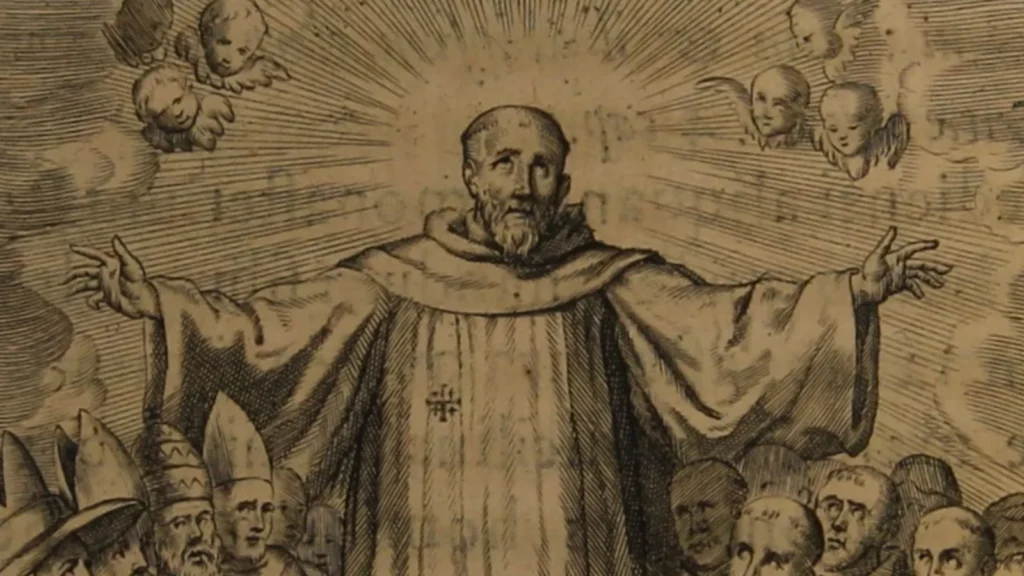
Bernard understood this with a precision that no purely philosophical system could have produced, because he understood it from the inside, from years of contemplative practice and the particular exhaustion of a man who had tried, repeatedly and with full seriousness of intention, to want nothing for himself. In De Diligendo Deo, written in the early 1120s, he mapped what he called the four degrees of love not as a theological diagram but as a phenomenology of the self in motion — or rather, the self in gradual collapse. The first degree is the one you already live in without knowing it: loving yourself for your own sake. This is not condemned. Bernard is precise here. It is where every creature begins, and there is no dishonesty in it. You protect yourself, you seek warmth, you want your hunger fed. The body is not the enemy. But this degree becomes a cage when it stops being a starting point.
The second degree opens when suffering or limitation forces a crack in the wall of pure self-reference — you turn toward God, but still as a resource, still because you need something. You love God the way you love a doctor: instrumentally, provisionally, for what the relationship yields. William James, writing in 1902, described this as the “piecemeal” religious life, the one that negotiates with the divine rather than surrendering to it, the life in which conversion has not yet reached the root of the self. The third degree is where most serious spiritual traditions plant their flag and declare victory: loving God for God’s sake, not for benefit or relief. You have moved from transaction to devotion. Most theologies stop here. Bernard does not.
The fourth degree is the one that produces something close to vertigo if you hold it long enough without flinching: loving yourself only for God’s sake. Not loving God. Loving yourself — but so completely transformed in orientation that even your own existence is not experienced as yours, not felt as a possession, not held as a center of gravity. Michel de Certeau, reading the great current of Christian mysticism with the precision of a historian who refused to sentimentalize his subjects, identified this movement as the constitutive gesture of mystical experience: the systematic evacuation of the self as ground, the self becoming, as he put it in his 1982 work, a site of passage rather than a site of residence. The soul is no longer where you live. It is where something else moves through.
Bernard himself admits, with a candor that is almost startling, that this fourth degree may not be fully achievable within a human life. The body insists. Memory insists. The narrative of the self — the story you tell about who is suffering, who is loving, who is receiving grace — insists. And yet he does not call it impossible. He calls it the condition of the resurrection, the logic of what a body might become when it no longer needs to secure itself against dissolution.
What is being asked of you here is not a thought. It is a structural alteration. You would have to stop being the person to whom your love happens. You would have to love without a lover remaining at the center of the act. You would have to become, in some sense that the language barely survives, no longer the subject of your own devotion.
What Bernard Knew About the Body He Refused
There is a particular kind of attention that disguises itself as indifference. You stop eating sugar not because you have forgotten its taste but because you remember it too precisely, the way it dissolves, the specific weight of wanting it again before the first piece is finished. The discipline is not the absence of desire. It is desire organized, redirected, given a shape it can survive in.
Bernard fasted with this kind of ferocity. He starved himself to the point of permanent gastric damage, a ruined digestion that troubled him for the rest of his life, and yet the language he reached for when he tried to describe the divine was overwhelmingly, almost embarrassingly physical. In his sermons on the Song of Songs — eighty-six of them, composed across roughly twenty years and still unfinished at his death in 1153 — he returned again and again to the mouth, the kiss, the smell of ointments, the sensation of being held. The soul’s approach to God was not a shedding of the senses but their most extreme intensification. He wanted to be touched. He wrote about it with a longing so precise it reads less like theology than like hunger.
Caroline Walker Bynum, whose 1987 study of medieval women’s religious practice dismantled a century of assumptions about Christian asceticism, argued that what looks like a war against the body is actually something far stranger: a hyperintense engagement with it, a refusal to let the flesh remain merely biological, a demand that it mean something absolute. The medieval ascetic did not flee the body. She — and Bynum’s subject was largely women, though the dynamic crosses gender — occupied it more completely than anyone who lived comfortably inside it. Fasting was not negation. It was a form of insistence.
Bernard’s Christology makes this structurally inevitable. His theology is emphatically incarnational, built around the scandal that God chose flesh, that the Word became not symbol or light or pure spirit but a particular body in a particular place, touchable, woundable, killable. If that body is the hinge of salvation, then matter itself has been permanently altered in its status. You cannot dismiss what God chose to inhabit. What you can do — what Bernard did — is engage it with a seriousness that looks, from the outside, like punishment.
The kiss of the mouth that opens the Song of Songs, which Bernard took as the explicit starting point of his long meditation, is not metaphor dressed as flesh. It is flesh claimed as the most precise available language for the soul’s condition. He wrote that the first kiss, the kiss of the feet, belongs to the penitent; the second, the kiss of the hand, to the one advancing in virtue; the third, the kiss of the mouth, to the mystic who has arrived at union. The architecture is bodily from ground to summit. There is no exit from the physical into something cleaner. There is only the body read with increasing depth.
A man stands in a room deciding not to open a particular door. The decision requires him to know exactly what is behind it, to hold it in mind with complete fidelity, to feel its weight against the frame. His restraint is not ignorance. It is a form of intimacy so sustained it becomes indistinguishable from obsession. What he refuses, he carries.
Bernard carried the body through every renunciation, pressed it into every image, encoded it into the grammar of approach toward God. The flesh he disciplined was the same flesh through which he believed God had spoken most clearly, most irrevocably. And so the fasting and the sensory mysticism were not contradictions. They were the same gesture performed from two directions, both of them saying: this matters, this cannot be set aside, this is where the real question lives.
The Silence That Still Speaks
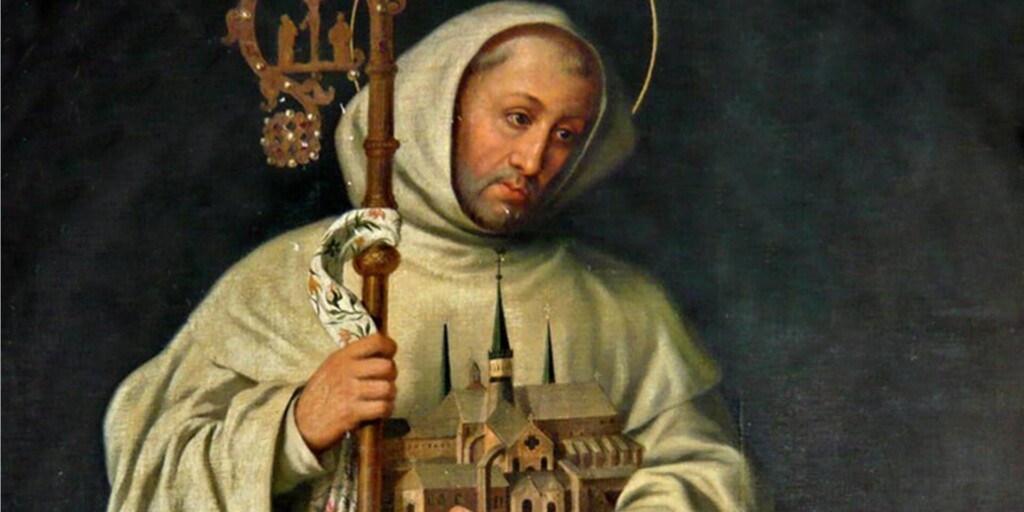
He died in August 1153, at Clairvaux, the monastery he had built from nothing on a plot of land that was, by most accounts, barely habitable when he arrived. By then, sixty-eight monasteries bore the mark of his founding. Thousands of monks had shaped their interior lives according to his teaching. Popes had deferred to him. Kings had bent. The Second Crusade, that catastrophic enterprise he had preached with the full force of his rhetorical genius, had ended in humiliation and blood, a wound he carried into his final years without ever quite resolving it publicly. He was not a man who made peace easily with his own contradictions.
Thomas Merton, writing in the mid-twentieth century with the particular authority of someone who had chosen the same withdrawal from the world and found it no simpler, called Bernard the last of the Fathers — meaning the final figure who could stand at the threshold between the great patristic tradition and whatever the modern interior life was becoming. The phrasing is precise in a way that rewards sitting with it. Not the greatest. Not the most original. The last. The one after whom something closes and something else, not yet fully named, begins.
What closes is a certain confidence about the self’s relationship to God — the confidence that dissolution is not loss but homecoming, that to pour yourself into something larger is not annihilation but the only true form of arrival. Bernard described this in the fourth degree of love, that final and largely unattainable state in which a person no longer loves themselves except in God, no longer experiences the boundary between their own longing and the source of that longing. He admitted it was barely possible in this life. Perhaps a single moment, he wrote, perhaps nothing more than a flash before the weight of the body pulls consciousness back to its ordinary separateness.
And here is where his thought leaves something genuinely unresolved, something that does not soften with time or scholarship. The question is not whether Bernard believed what he wrote. The question is structural, buried inside the very architecture of his mystical project. To desire your own disappearance so completely, to cultivate that desire through decades of prayer and writing and institutional building, to become the foremost articulator of selflessness in the Western tradition — is this liberation, or is it the most sophisticated form of self-assertion ever constructed? The man who wanted to dissolve into God became, in the act of describing that dissolution with such precision and such beauty, one of the most recognizable voices in eight centuries of Western thought. His name did not disappear. His style did not fade into anonymity. What he wrote in the name of annihilating the ego produced one of the most durable egos in the history of Christian spirituality.
This is not a criticism. It may not even be a paradox. It may simply be the condition that attaches to any genuine attempt at transcendence: that the attempt requires a self capable of sustaining it, and that self, in being exercised so strenuously toward its own erasure, grows more defined, more particular, more indelible with each step it takes toward disappearance. Simone Weil understood this. So, in his darker moments, did Augustine. The self that says I want nothing is still saying I.
Bernard of Clairvaux wanted to vanish into something larger than himself, and he wrote about that wanting with such force and such precision that eight centuries later you can still hear exactly what his voice sounds like — urgent, demanding, tender in unexpected places, never quite at rest — which means that whatever he found in that silence, he carried it back with him, and the carrying was, and remains, unmistakably his.
🕊️ Mystics, Saints, and the Language of the Soul
Bernard of Clairvaux lived at the crossroads of monastic discipline and burning inner vision, shaping the spiritual landscape of medieval Europe. The articles below trace the paths of kindred souls — visionaries, theologians, and philosophers — who sought the divine through contemplation, reason, and radical surrender. Follow the maze inward.
Hildegard of Bingen: Visionary Mystic and Scientist
Hildegard of Bingen stands as one of the most extraordinary figures of the medieval world, combining prophetic visions with scientific inquiry and musical genius. Like Bernard, she drew her authority from direct mystical experience, framing divine revelation through images of light and fire. Her life offers a powerful parallel to the Cistercian abbot’s own fusion of contemplative depth and public engagement.
GO TO THE SELECTION: Hildegard of Bingen: Visionary Mystic and Scientist
Meister Eckhart: Life and Mystical Philosophy
Meister Eckhart pushed the tradition of Christian mysticism beyond Bernard’s affective devotion into the realm of radical philosophical speculation, questioning the very nature of the soul’s union with God. His concept of the Godhead as a silent desert beyond all attributes resonates with yet fundamentally transforms the Bernardine mystical vocabulary. Reading Eckhart alongside Bernard reveals the full spectrum of medieval interior theology.
GO TO THE SELECTION: Meister Eckhart: Life and Mystical Philosophy
Medieval Abbeys and Monasteries: History and Architecture
The abbeys and monasteries of the medieval world were not merely buildings but living organisms of prayer, labor, and spiritual formation — and Bernard of Clairvaux was among their greatest architects in spirit. The Cistercian reform he championed sought to strip monastic life back to its austere Benedictine roots, and this article illuminates the physical spaces that housed such extraordinary interior lives. Understanding medieval monastic architecture deepens our sense of the world Bernard inhabited and transformed.
GO TO THE SELECTION: Medieval Abbeys and Monasteries: History and Architecture
Spiritual Alchemy: Inner Transformation and Symbolism
Spiritual alchemy, with its language of inner death and rebirth, purification and illumination, offers a striking symbolic echo of the mystical itinerary described by Bernard in his commentaries on the Song of Songs. The soul’s journey through darkness toward union with the divine light finds parallel expression in the alchemical stages of nigredo, albedo, and rubedo. This article opens a rich comparative lens on how different traditions have mapped the transformation of the inner human being.
GO TO THE SELECTION: Spiritual Alchemy: Inner Transformation and Symbolism
Cinema as a Path to the Inner Life
If these explorations of mysticism and spiritual thought have stirred something within you, Indiecinema streaming is where the journey continues on screen. Discover independent films that dare to ask the deepest questions — about the soul, the sacred, and the hidden dimensions of human experience. Enter the maze, and let cinema illuminate what words alone cannot reach.
👉 EXPLORE THE CATALOG: Watch Indie Films in Streaming
A vision curated by a filmmaker, not an algorithm
In this video I explain our vision

