
The Alarm Clock as Ideology
The alarm goes off at five-forty. Not because your body is ready. Not because light has entered the room or birds have announced anything worth announcing. It goes off because a number was agreed upon, weeks or years ago, between your survival and someone else’s productivity schedule, and your body — which remembers nothing of contracts — resists with everything it has. The heaviness in your limbs is not laziness. It is biology refusing a negotiation it was never party to. You silence the alarm anyway. You always do.

This moment, repeated by hundreds of millions of people every morning across the industrialized world, is not a private struggle with discipline. It is ideology made flesh. The override of the body’s own temporal logic by the clock’s imperative is one of the most successful feats of cultural engineering in modern history, so thorough that we have learned to feel shame at the resistance rather than curiosity about what is being resisted. The body pulling back toward sleep is not weak. It is the last honest signal in a day that will otherwise be organized entirely around someone else’s requirements.
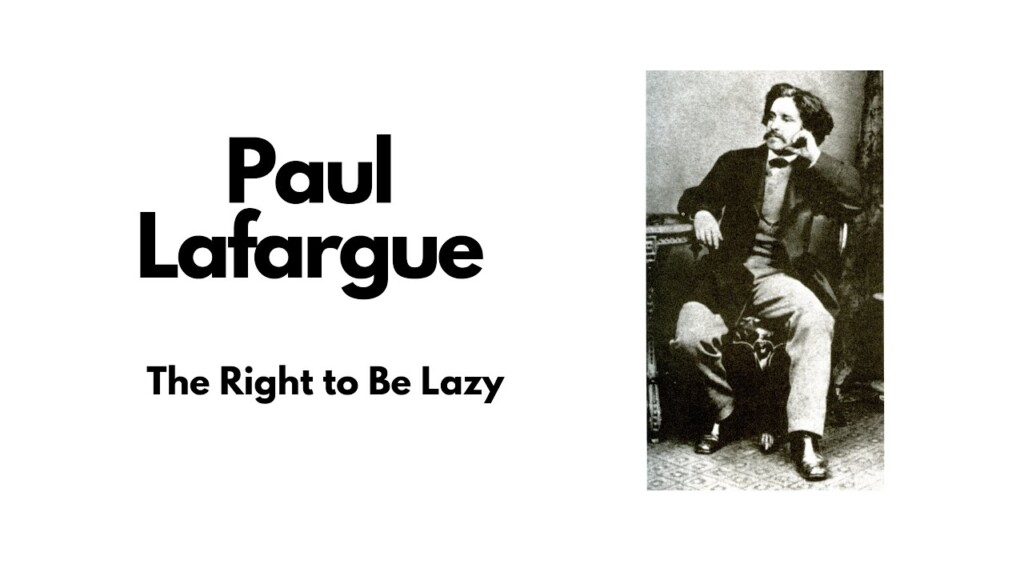
Paul Lafargue understood this. Not as metaphor, not as philosophical abstraction, but as a material fact he watched unfold in the bodies of workers in 1880 France, men and women whose muscles were giving out, whose children grew up in the dark, whose lives contracted around the factory bell until there was nothing left of existence outside its radius. What made Lafargue’s pamphlet — published that year under the title “The Right to Be Lazy,” a deliberately provocative inversion of every prevailing moral category — so strange and so precise was not the radicalism of its argument but its target. He was not attacking the owners. He was attacking the workers’ desire. Their hunger for more work. Their pride in exhaustion. Their willingness, even eagerness, to beg for the very thing that was consuming them.
This was not ingratitude. It was something more structurally unsettling: a population that had so thoroughly internalized the values of its exploitation that it could no longer distinguish between its own appetite and the appetite that had been installed in its place. Lafargue, writing as the son-in-law of Karl Marx and a figure embedded in the international socialist movement, had access to the full theoretical architecture of class analysis. He chose instead to write a pamphlet. Sharp, furious, full of sarcasm and classical citation, barely forty pages in its original form, circulated and reprinted across Europe and eventually translated into dozens of languages. The choice of form was itself an argument: the ideas he was advancing did not require a treatise. They required only that someone say them out loud without softening the conclusion.
The conclusion was this: the working class had been convinced to worship labor as a moral virtue, and this worship was the primary mechanism of its own subjugation. Not the whip, not the law, not even poverty in its most direct form — but the belief, bone-deep and socially reinforced, that to work was to be worthy, and to rest was to be suspect. By 1880 this belief was already ancient enough to feel natural. It had been preached from pulpits, encoded in poor laws, embedded in the new secular religions of progress and national productivity. The Industrial Revolution had not invented the moral elevation of toil, but it had industrialized that elevation too, scaled it, made it structural.
The alarm clock, which did not exist in the form we know it until the mid-nineteenth century, is the material object in which all of this crystallizes. A device designed not to wake you gently into your own morning, but to interrupt whatever your body was doing and redirect it toward a schedule that belongs to capital. The sound it makes is not neutral. It is a command dressed as a convenience.
Slow Life
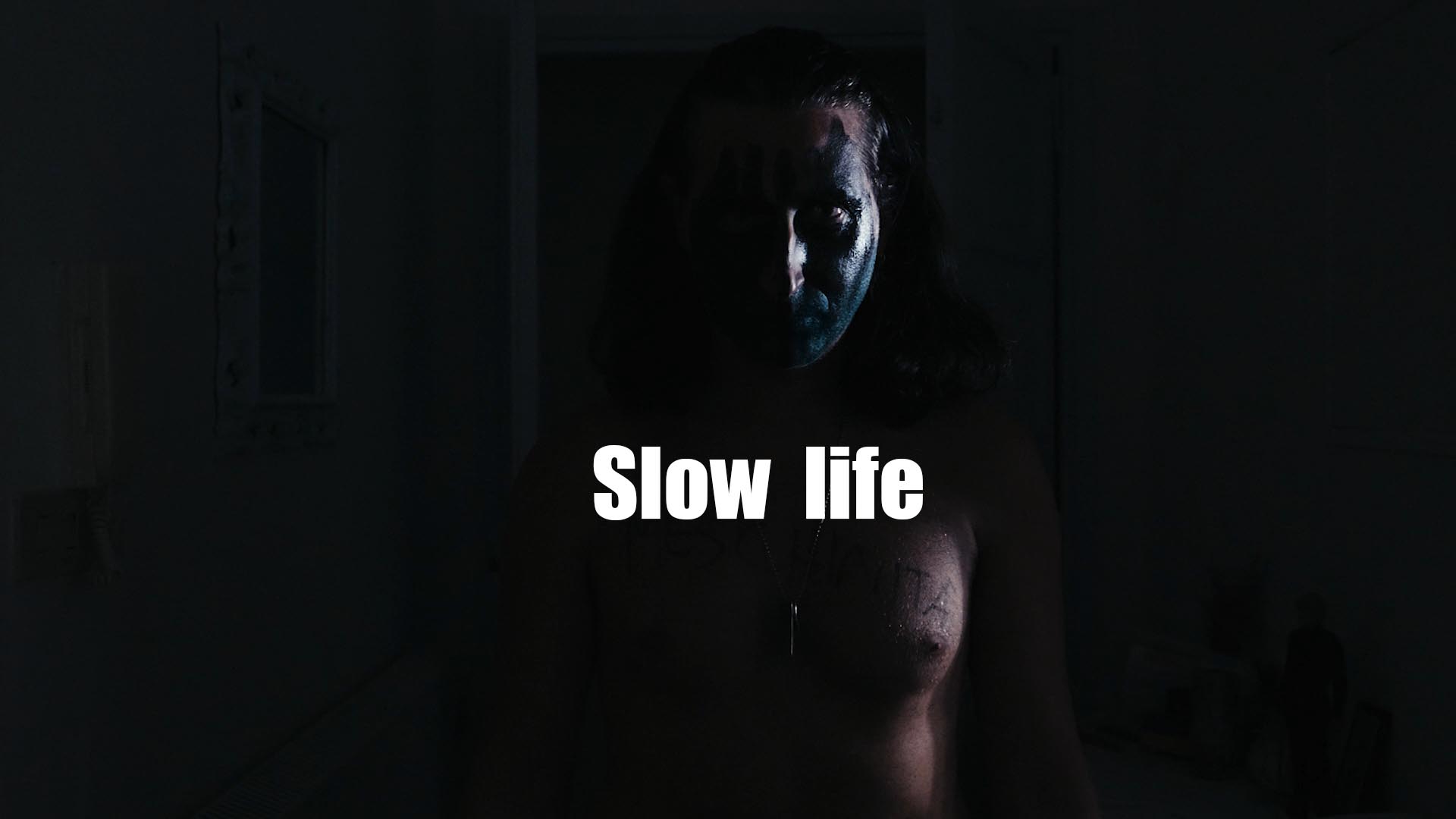
Drama, comedy, thriller, by Fabio Del Greco, Italy, 2021.
Lino Stella takes a period of vacation from his alienating job to devote himself to relaxation and his passion: drawing comics. But he did not foresee certain disturbing elements: the intrusive administrator of the building where he lives, the postman who delivers crazy fines and tax bills, an overbearing security guard, a very enterprising real estate agent, the old lady downstairs who raises the feline colony of the condominium. These characters will make his vacation hell.
Food for thought
The larger a social group is, the more rules and bureaucracy are needed, which often do not respect the individual. You have to learn to live with annoying people, but sometimes the social pressure and arrogance can become intolerable. The only laws that always come to our aid are the laws of Nature.
LANGUAGE: Italian
SUBTITLES: English, Spanish, French, German, Portuguese
A Son-in-Law Who Saw Clearly
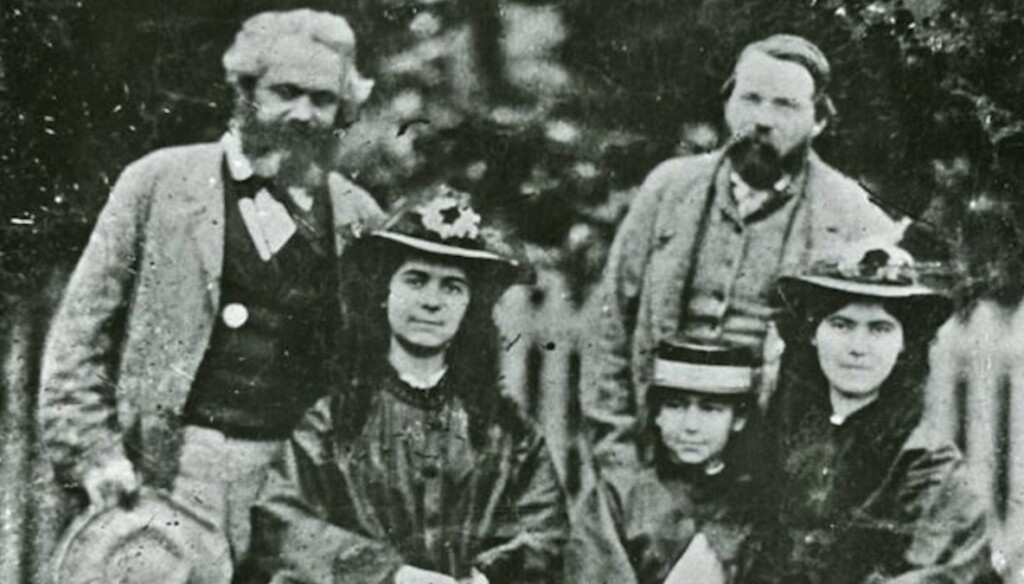
Santiago de Cuba, 1842. A child is born into a family that carries three continents in its blood — French, African, indigenous Caribbean. He will spend most of his life explaining himself to Europeans who have already decided what he is before he opens his mouth. That child, Paul Lafargue, would eventually marry the daughter of Karl Marx, move through the revolutionary circles of Paris and London, flee to Spain, return to France, get arrested, and write his most consequential work from inside a prison cell in Sainte-Pélagie in 1880. The circumstances are worth holding for a moment, because the text that emerged from them is not the kind of thing a man writes when he is comfortable.
There is something structurally significant about writing a defense of leisure while imprisoned, and Lafargue seems to have understood this without needing to say it. The irony does not undercut the argument — it sharpens it. He was not theorizing from a study, not reasoning from abundance. He was enclosed, watched, deprived of movement, which is perhaps the only position from which you can write about freedom without sentimentality.
His peripheral position within European intellectual culture was not incidental to what he produced. He had access to Marx’s framework — lived inside it, literally, as a son-in-law who ate at the same table and argued in the same rooms — but he did not share Marx’s Germanic investment in labor as the site of human dignity. This is not a small difference. Marx, for all his devastating critique of capitalism, retained something of the Protestant moral architecture he was dismantling: the idea that work, in its proper form, in its unalienated expression, is where human beings realize themselves. Hegel’s influence on this is traceable and documented. For Lafargue, raised in the Caribbean, shaped by a culture that had watched enslaved people work themselves to death for someone else’s profit for generations, there was nothing redemptive about labor as a category. The wound was different. The lesson drawn was different.
He had seen, in ways that the Paris intellectual left had mostly theorized, what it looks like when a body is valued exclusively for what it produces. The plantation is the logical endpoint of the work ethic, not its corruption. This is not a claim Lafargue makes gently, and it is one the European left in 1880 was not prepared to receive. Most socialist thinkers of the period were arguing for better work, fairer work, more work distributed more equitably. Lafargue was arguing against the premise itself.
His wife, Laura Marx, was by most accounts his intellectual equal and his closest collaborator. The household they formed was steeped in political argument, exile, financial precarity, and grief — three of their children died in infancy. This is the biographical texture behind a pamphlet that is often read as satirical and light. The lightness is real, but it is the lightness of someone who has looked directly at something unbearable and chosen irony as the only instrument sharp enough to cut through the piety surrounding it.
What his Creole background gave him was not exoticism or outsider romance. It gave him permission to find the European religion of work genuinely strange, to look at it the way an anthropologist looks at a ritual whose meaning the participants have long since stopped questioning. He did not need to deconstruct the work ethic because he had never fully inhabited it. He could describe it from the outside, which is the only position from which its full absurdity becomes visible.
The text he produced reads, as a result, less like theory and less like polemic and more like a man describing a collective delusion to the people suffering from it, in a tone that oscillates between contempt and genuine bewilderment that no one else seems to notice what he is seeing.

The Workers Who Demanded Their Own Chains
You are standing at the edge of a picket line, and the workers are not demanding rest. They are demanding the right to work more. The signs say so. The speeches say so. The union leader at the microphone, voice raw with conviction, is arguing that the factory should run longer shifts, that the men should be given more hours, more output, more of the thing that is grinding them into dust. And this is the moment Paul Lafargue found genuinely terrifying — not the cruelty of the masters, which was at least legible, but the enthusiasm of the enslaved.
What Lafargue was observing from the inside, Max Weber would later systematize from the outside. Weber’s The Protestant Ethic and the Spirit of Capitalism, published in 1905, two decades after Lafargue’s pamphlet, traced the genealogy of exactly this psychological structure. The Calvinist doctrine of predestination had created a peculiar crisis of the soul: you could not know whether you were among the saved, but you could perform the signs of salvation through disciplined, relentless, self-denying labor. Work became not a means to an end but a proof of election. To rest was not merely to be idle — it was to reveal yourself as one of the damned. Weber showed how this theological anxiety had been secularized over centuries, stripped of its explicit religious content but preserved in its moral architecture. By the time it reached the factory floor, nobody remembered Calvin. They just knew, bone-deep, that a man who did not work was worthless, possibly evil, certainly suspect.
This is the mechanism Lafargue was fighting without quite having Weber’s vocabulary to name it. The church had done its work so thoroughly that the church was no longer necessary. The worker policed himself. He felt shame at rest and pride in exhaustion. He measured his worth in hours rendered, in calluses accumulated, in the satisfying ache of a body that had been used. Lafargue saw this not as natural human dignity but as a cultivated pathology, a spiritual deformation that had been administered across generations until it became indistinguishable from character.
The cruelest part of this inheritance is that it feels like autonomy. The man who demands longer hours believes he is asserting himself. The woman who refuses to stop working through illness believes she is being strong. The cultural conditioning is so complete that its products experience it as freedom, as personal virtue, as the self choosing its best version. Weber called this the spirit of capitalism precisely because it was not the law but the atmosphere — the thing you breathed without deciding to breathe it.
Lafargue was not surprised that the bourgeoisie preached the sanctity of labor. He was devastated that the workers had started to believe it. That is a different kind of domination entirely. It requires no chains because it has convinced the prisoner that the cell is a temple.
The Machine That Was Supposed to Free Everyone
The machine arrives in the factory and everyone is told, quietly or loudly depending on who is doing the telling, that this is the moment everything changes. One device does the work of twelve hands. The calculation seems obvious, almost generous: if one machine replaces twelve workers, then twelve workers can rest, or those twelve workers can each work one-twelfth of the time they used to, and something resembling leisure becomes structurally possible for the first time in history. Lafargue understood this mathematics perfectly. He also understood that it was never applied.
In the French textile industry of the 1840s, workers entered the mills before dawn and left after dark, logging fourteen-hour days in rooms that smelled of oil and damp fiber and the particular exhaustion of bodies that have not been allowed to stop. By 1880, the looms were incomparably faster. The volume of cloth produced per worker per hour had multiplied several times over. The hours had not shortened. If anything, the pressure to keep pace with the machine had intensified the extraction, because now there was a new logic operating beneath the old one: the machine set the rhythm, and the human being had to match it or be replaced by someone who would.
This is what Lafargue named with a precision that still cuts: the machine, which should have been the instrument of collective liberation, became instead the instrument of collective discipline. The displaced worker — the one the machine had rendered redundant — did not disappear. He stood outside the factory gate, visible, hungry, and willing. His existence was not incidental to the system. His existence was the system’s most effective argument. Every worker still inside the mill knew what waited outside. The threat did not need to be spoken. It operated through pure spatial proximity.
Marx had theorized this as the reserve army of labor, that permanent surplus population whose function is not production but intimidation. What Lafargue added, with a fury Marx rarely allowed himself, was the moral obscenity of it: that this arrangement was celebrated. That the bourgeoisie had successfully convinced the working class that their own exhaustion was a virtue, that to be absorbed entirely into the rhythm of the machine was not degradation but dignity. The man who collapsed at his station was called hardworking. The man who asked to stop was called lazy.
There is an image that belongs to this argument completely. A man sits at a moving workstation, eating mechanically, his hands still performing tasks between bites because the conveyor belt does not pause for hunger. The food enters his mouth at the same tempo as the bolts he tightens. His jaw moves in the same rhythm as his wrists. His body has been so thoroughly synchronized with the machine that even the biological interruption of eating has been industrialized. He is not resting while he eats. He is producing while he eats. The distinction between the human function and the mechanical function has been erased not by accident but by design, and what is most disturbing about watching him is that he does not look surprised. He looks like someone who has forgotten that another arrangement was ever possible.
Lafargue’s argument is that this forgetting is the real product of industrial capitalism. Not the cloth, not the steel, not the coal. The forgetting. The machinery of production runs most efficiently when the people operating it cannot imagine operating otherwise, when the fourteen-hour day feels like a natural fact rather than a political choice made by specific people at a specific moment in history for specific reasons that had nothing to do with human flourishing and everything to do with the extraction of surplus value before the worker’s body gave out entirely.
The machine was never going to free anyone. It was built by people who had no interest in freedom, and it worked exactly as intended.
Leisure as Subversion, Not Reward
You are sitting in a park on a Tuesday afternoon, not waiting for anyone, not recovering from anything. You have nowhere to be. And somewhere in the architecture of your discomfort — the mild guilt, the reflexive reach for your phone, the sense that this stillness requires justification — you can read the entire history of an ideology that was never announced as one.
This is why the language surrounding free time is almost entirely constructed from negation and waste. You kill time. You do nothing. Hours are wasted, squandered, lost. The vocabulary is a confession: time has value only insofar as it is converted into something, and conversion requires a converter, which is to say a system of production that positions itself as the necessary mediator between human energy and human meaning. Every moment not spent producing or consuming is linguistically framed as a small death, an absence, a failure of proper existence. Lafargue saw this framing not as natural but as manufactured, installed into the laboring classes through the very moralizing he systematically dismantled.
What makes Bertrand Russell‘s In Praise of Idleness, published in 1932, so striking is not that it agrees with Lafargue but that it had to be written at all, fifty years later, with the same urgency, against the same resistance. Russell was writing as a philosopher of established reputation, appealing to precisely the educated classes who might be expected to defend contemplation, and still he felt the need to argue from scratch that leisure was not moral failure. The half-century gap between the two texts is not a sign of gradual progress. It is evidence of continuous suppression. The idea kept needing to be said because it kept being erased, absorbed, neutralized — converted, with perfect irony, into productivity discourse about the economic benefits of rest, the efficiency gains from vacation, the return on investment of unplugging.
That neutralization is the more sophisticated violence. When leisure is sold back as a tool for better performance, the subversive core is removed and the shell is preserved. You are permitted to rest, even encouraged to rest, but only within a framework that frames rest as preparation for renewed output. The worker who sleeps eight hours to work twelve is not free during those eight hours. The manager who takes a mindfulness retreat to reduce burnout returns sharpened, more capable of extraction. The holiday becomes a maintenance cycle. Nothing in the logic has changed; the terminology has simply become more accommodating.
What Lafargue pointed toward, and what Russell circled with his quieter Edwardian prose, was leisure as a site of relational and political consciousness. The person genuinely idle is not merely resting their body. They are inhabiting time without a master. They are experiencing duration that belongs to no one’s balance sheet. And in that experience, however briefly, the entire apparatus of compulsory productivity reveals itself as exactly that — an apparatus, constructed, contingent, and therefore, at least in theory, removable.
A vision curated by a filmmaker, not an algorithm
In this video I explain our vision
The Body That Remembers What the Mind Has Forgotten
Your hands know before your mind does. You sit down on a Tuesday afternoon with nothing scheduled, no deadline within reach, the afternoon genuinely open, and something in the chest tightens before you have formed a single thought about it. The body registers the stillness as a threat. Not a metaphorical threat — a physiological one, a faint but unmistakable signal that resembles the early grammar of shame, the same register that activates when you have done something wrong and not yet been caught.
You have not done anything wrong. You are sitting in a chair.
And yet the rehearsal begins, involuntary and exhausting: you mentally catalogue what you accomplished this morning, you construct a small internal argument for why this rest is deserved, you remind yourself that productivity must be followed by recovery as though you were a machine requiring scheduled maintenance. The justification happens before anyone asks for it. No overseer has knocked on the door. No employer has sent a message. The surveillance is already interior, already complete, and this is precisely what Zygmunt Bauman was tracking in Liquid Modernity when he described how flexible capitalism had solved the ancient problem of control by dissolving the boundary between the watcher and the watched. When factories required workers to be physically present under a visible foreman, the coercion was external and legible. It could be resisted, organized against, made into the object of collective fury. But once the logic of productivity colonizes the self — once you become both the laborer and the supervisor — resistance loses its target. You cannot strike against your own nervous system.
Bauman’s argument was that liquid modernity, his term for the post-Fordist dissolution of stable structures, had replaced the solid architecture of discipline with something far more insidious: a permanent state of individual responsibility for one’s own performance, one’s own optimization, one’s own readiness. The older capitalism needed you at the machine. The newer one needs you to need the machine yourself, to feel its absence as a kind of falling.
There is a man on a beach, somewhere warm, the kind of vacation that required months of anticipation and a deliberate clearing of the calendar. He is lying on a towel in the sun and his phone is face-down in the sand beside him, and every four minutes — not because he expects a message, not because anything is pending — he picks it up and checks it. He is not weak. He is not pathologically anxious in any clinical sense. He has simply internalized a tempo that does not pause for geography. The ocean does not register. The light does not register. What registers is the ambient dread of being unreachable, which has come to feel indistinguishable from being irrelevant.
The body remembers what the mind has rationalized into virtue. It remembers the lessons taught long before any individual employer or manager appeared — lessons delivered through school bells and graded effort and the persistent message that stillness is the antechamber of failure. By the time you are an adult sitting in a chair on a Tuesday afternoon, the pedagogy is so old it feels like instinct. You do not experience it as an ideology. You experience it as yourself. And that, precisely, is how it survives.
What Lafargue Got Wrong, and Why It Still Cuts
There is a man in the pamphlet who keeps gesturing toward Athens, toward the symposium, toward the philosopher walking slowly through the afternoon. Lafargue invokes Greek leisure as evidence that civilization can survive — even flourish — when human beings refuse the compulsion to produce without pause. It is one of his most seductive rhetorical moves, and it is built on a foundation he never examines. Moses Finley, in The Ancient Economy published in 1973, was precise about what that Athenian afternoon actually required: somewhere between one hundred thousand and one hundred and fifty thousand enslaved people in Attica alone during the classical period, performing the agricultural and domestic labor that freed the citizen body to think, argue, and rest. The leisure Lafargue romanticizes was not a social achievement. It was a distribution of exhaustion — the same exhaustion, simply transferred downward onto bodies that the polis had decided did not count.
This is not a minor footnote. Lafargue was the son-in-law of Marx, had read the materialist tradition with genuine seriousness, and yet somehow his classical references float free of their material conditions, as if Athens were a philosophical thought experiment rather than a slave economy. The contradiction is embarrassing in the specific way that only idealist lapses inside materialist frameworks can be embarrassing: the method condemns the error the writer is simultaneously committing.
And yet the structural argument does not collapse under the weight of this naivety. What survives is something sharper than Lafargue perhaps intended. Because the question his pamphlet keeps circling — who is permitted to rest, and who is punished for stopping — turns out to be exactly the question that Finley’s evidence makes more urgent, not less. Athenian leisure was real. The problem was never that it existed. The problem was the mechanism of its distribution, the violence that made it available to some by making it impossible for others. Lafargue looked at the product and forgot to ask about the price.
Every economy that followed the Greek model has reproduced that same structure, sometimes with chains and sometimes with debt, sometimes through juridical exclusion and sometimes through the subtler machinery of precarity that makes rest feel irresponsible rather than forbidden. Finley’s point is that ancient economies were not primitive versions of modern ones — they operated on entirely different organizing logics — but the one continuity that runs from the Athenian agora through the nineteenth-century factory to the contemporary gig platform is this: idleness is only ever dignified when it belongs to someone whose survival is already secured by someone else’s movement. The Roman aristocrat who wrote about otium as a moral good had slaves. The Victorian gentleman who theorized the civilizing effects of leisure had servants. The technology executive who speaks today about the creative necessity of unstructured time has a logistical workforce whose rest is monitored, whose bathroom breaks are timed, whose stillness is a disciplinary event.
Lafargue saw this architecture from one angle and described it accurately. He simply assumed a classical precedent that, looked at straight, reveals the same architecture operating at the foundation of what he was praising. That failure of seeing is not a reason to dismiss him. It is a reason to read him more carefully than he read himself — to take the structural insight and hold it free of the mythology he draped around it.
What his pamphlet could not say, but what its logic implies if you press it hard enough, is that the right to laziness has never been a universal aspiration waiting to be claimed. It has always already been claimed — selectively, violently, at someone else’s expense. The question is not whether human beings deserve rest. The question is which human beings a given society has decided that proposition applies to.
The Three Hours That Never Arrived
In 1930, John Maynard Keynes sat down and wrote what he called a piece of “economic possibilities for our grandchildren,” a document so serene in its confidence that it reads today like a letter from a man who had never met the people he was writing about. His argument was precise: technological progress, compounding over a century, would eliminate scarcity so thoroughly that the central problem facing humanity would no longer be how to produce enough but how to fill the time that production no longer required. Fifteen hours a week, he estimated. That would be sufficient. The rest would be leisure, cultivation, the slow education of desire toward something other than accumulation. He was not a romantic. He was an economist who believed his own numbers.
The numbers were not wrong. Between 1930 and 2025, productivity per worker in the industrialized world increased by factors that would have seemed absurd to Keynes’s contemporaries. The goods got made. The efficiencies arrived. The machines, the algorithms, the logistics networks — all of it performed more or less as predicted. What did not perform as predicted was the human response to that abundance. The hours did not shorten. In many sectors they lengthened. The forty-hour week, which was itself a hard-won reduction from the seventy and eighty hours that Lafargue had watched devour the bodies of the working poor in 1880, calcified into a floor rather than a ceiling. In the United States, where the ideology of productivity achieved something close to religious status, the average worker by the early twenty-first century was logging more annual hours than their counterpart in the 1970s — a decade already considered overworked by the standards of the European welfare states.
Keynes’s error was not mathematical. It was anthropological. He assumed that once survival was secured, human beings would naturally migrate toward idleness, toward what he called the “arts of life.” What Lafargue had understood, with the furious clarity of someone writing from inside the machine rather than observing it from a Cambridge study, was that the appetite for work is not natural — it is manufactured, installed, maintained by social force. The worker who cannot stop does not lack leisure because there is not enough time. The worker cannot stop because stopping has been made to feel like dying. Keynes measured output. Lafargue had measured ideology.
There is a kind of person — you may be this person — who, offered an unexpected Wednesday afternoon with nothing scheduled, feels a specific and sourceless dread. Not boredom exactly. Something more like vertigo. The structure has been removed and the body does not know how to be in its own presence without a task to justify that presence. That feeling is not a personal failing. It is the successful completion of a project that began long before you were born. Auguste Comte had already argued in the 1840s that industrial society required the subjugation of individual instinct to collective function — and what is that Wednesday dread if not the internalized enforcer of that requirement, still at work inside someone who has never read a word of positivism?
🏭 Labor, Leisure, and the Politics of Rest
Paul Lafargue’s The Right to Be Lazy is a radical manifesto that challenges the capitalist glorification of work, arguing that leisure and idleness are fundamental human rights. To fully grasp its provocations, it helps to situate it within a broader conversation about labor, alienation, class, and the social organization of time.
Karl Marx and Alienation: Economic and Philosophical Manuscripts
Karl Marx’s Economic and Philosophical Manuscripts lay the theoretical groundwork for understanding why Lafargue—Marx’s own son-in-law—could mount such a blistering critique of industrial capitalism. The concept of alienated labor, in which the worker is estranged from the product of their toil and from their own humanity, is the dark mirror against which Lafargue’s celebration of leisure shines brightest. Reading both together reveals a family of ideas united by a deep suspicion of work as it is organized under capitalism.
GO TO THE SELECTION: Karl Marx and Alienation: Economic and Philosophical Manuscripts
Veblen’s The Theory of the Leisure Class: Analysis
Thorstein Veblen‘s The Theory of the Leisure Class approaches idleness from the opposite social end: rather than championing rest for the working poor, Veblen anatomizes how the wealthy use conspicuous leisure as a marker of status and power. This ironic counterpoint to Lafargue exposes how ‘not working’ means entirely different things depending on one’s class position. Together, the two texts form a fascinating dialectic on the political economy of free time.
GO TO THE SELECTION: Veblen’s The Theory of the Leisure Class: Analysis
Thorstein Veblen: Life and Theory of the Leisure Class
Understanding Thorstein Veblen‘s life and intellectual context enriches any reading of his theory of the leisure class, a body of work that dissects the ritualized idleness of the bourgeoisie with sardonic precision. Veblen grew up on the economic margins and used that outsider perspective to expose the performative nature of upper-class inactivity. His biography offers essential context for seeing why questions of labor and leisure are never merely economic but are deeply entangled with social prestige and cultural identity.
GO TO THE SELECTION: Thorstein Veblen: Life and Theory of the Leisure Class
Bourdieu’s Distinction: Taste and Social Class
Pierre Bourdieu‘s Distinction explores how tastes, habits, and the use of free time function as instruments of social reproduction and class differentiation. Lafargue’s demand that workers reclaim leisure takes on new complexity when read through Bourdieu’s lens, which shows that how one rests, plays, and consumes is never innocent but is always already a field of class struggle. This sociological perspective transforms the simple demand for idleness into a radical challenge to the entire symbolic order of capitalist society.
GO TO THE SELECTION: Bourdieu’s Distinction: Taste and Social Class
Discover Independent Cinema on Indiecinema
If these ideas about labor, freedom, and the right to live fully have sparked your curiosity, Indiecinema’s streaming platform offers a curated selection of independent films that dare to question the world as it is. From radical political documentaries to poetic meditations on work and time, you’ll find cinema that thinks as boldly as Lafargue once wrote. Join us and explore a world of film that refuses to clock in.
👉 EXPLORE THE CATALOG: Watch Indie Films in Streaming
A vision curated by a filmmaker, not an algorithm
In this video I explain our vision

