
The Alarm You Didn’t Set
It is 5:47 in the morning and you are already awake. Not gently, not gradually — awake the way a switch is thrown, the way a body knows it has already lost something before the day has even begun. The room is dark. The alarm is set for 6:30. And yet here you are, your chest doing something that is not quite anxiety but is certainly not rest, while the first items on today’s list begin assembling themselves with a horrible efficiency: the email you didn’t answer, the meeting at nine, the thing you said you would finish by Thursday which is now, you realize, tomorrow. Your mind is running its inventory in the dark like a warehouse that never closes, and the most unsettling part is not the exhaustion. It is that this feels completely normal.

This is what acceleration looks like from the inside. Not the dramatic burnout, not the collapse that gets written about in magazine profiles of people who quit their jobs to move to Portugal. Just this: a body that has learned to begin before it is asked, a nervous system so thoroughly trained by the tempo of contemporary life that it no longer waits for permission. The philosopher Paul Virilio spent much of his career arguing that speed is not merely a feature of modern life but its organizing principle — that what we call progress is largely a story about the compression of time, the elimination of intervals, the steady abolition of pause. He called this dromology, the logic of the race, and he saw it not as liberation but as a kind of violence, one so normalized it had become invisible. What he perhaps could not have anticipated was the degree to which that violence would eventually migrate inward, colonizing not just our schedules but our sleep.
There is a man sitting in a kitchen somewhere, coffee already made at an hour when no coffee needed to be made, scrolling through messages that arrived while he was technically unconscious. He is not unusual. He is, by most measurable standards, a success. He is also living proof that the tempo of contemporary productivity has achieved something genuinely remarkable: it has convinced the human organism to enforce its own acceleration. No foreman required. No whistle, no clock on the wall. The alarm you didn’t set is the most efficient alarm ever designed.
Sociologist Hartmut Rosa, whose 2013 work on social acceleration remains one of the most precise diagnoses of contemporary temporal experience, identified three distinct but interlocking processes: the acceleration of technology, the acceleration of social change, and the acceleration of the pace of life itself. What makes his analysis worth sitting with is the distinction he draws between speed as a means and speed as an end that has forgotten it was ever a means. We accelerated to gain time. Then we used the gained time to accelerate further. The freed minutes were immediately filled. The labor-saving device created new labor. Somewhere in the compounding of this logic, the original purpose — to live better, to have more, to arrive somewhere — quietly dissolved, and what remained was the motion itself, stripped of destination.
To call slowness a lifestyle choice, then, is to fundamentally misread what it is. A lifestyle choice implies that speed was also a choice, freely made, available for revision at any moment. But the tempo most people are living at was not selected. It was inherited, imposed, drip-fed through decades of economic restructuring, technological design, cultural messaging, and the quiet social punishment of anyone who moves at a different pace. The person who does not respond to messages within the hour is already slightly suspect. The worker who takes a full lunch break is, in certain offices, considered not quite serious. Slowness, in this architecture, is not neutral. It reads as failure.
Which means that choosing it — genuinely, structurally, not just on a Sunday afternoon — is something closer to an act of refusal.
Slow Life
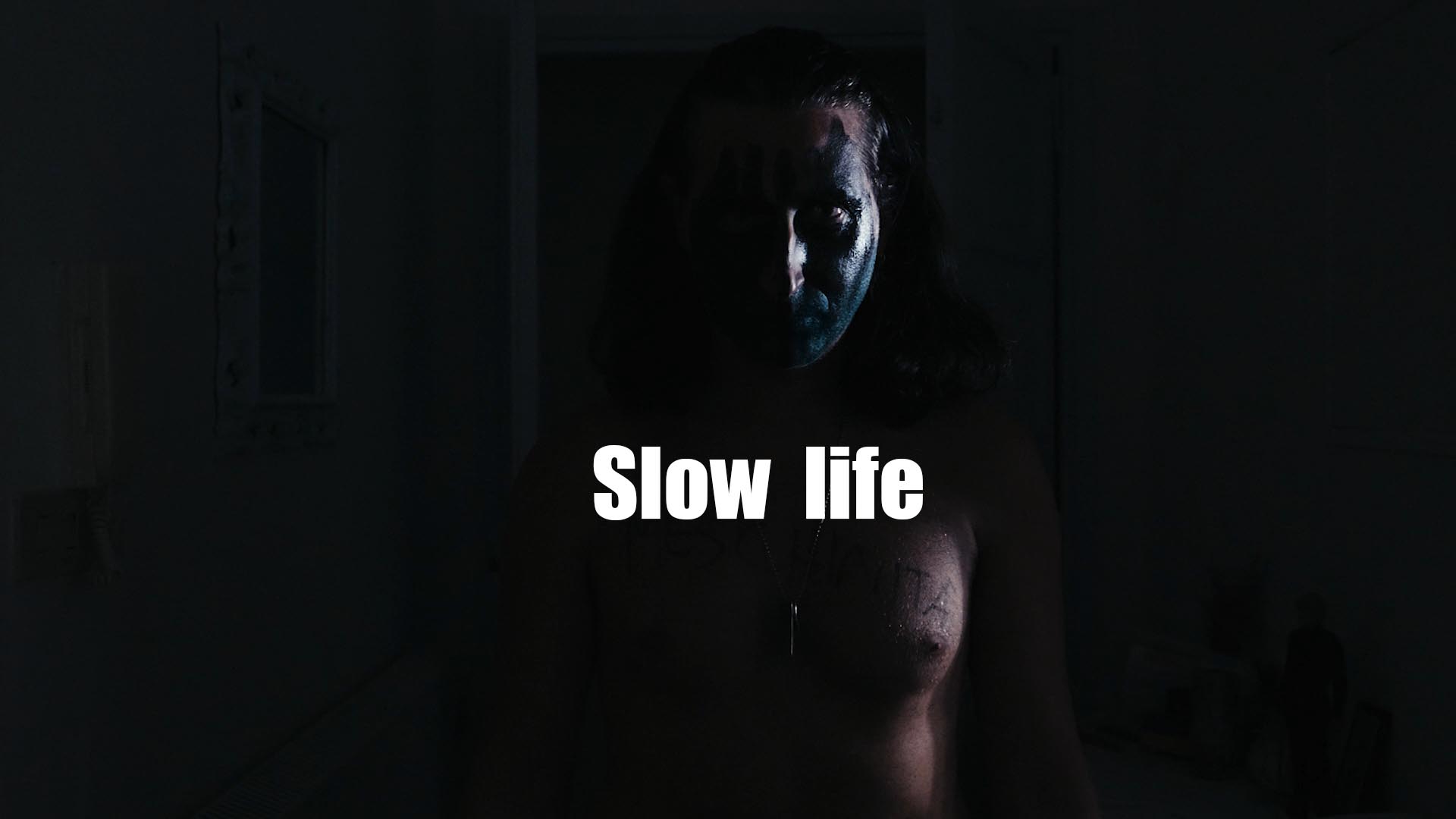
Drama, comedy, thriller, by Fabio Del Greco, Italy, 2021.
Lino Stella takes a period of vacation from his alienating job to devote himself to relaxation and his passion: drawing comics. But he did not foresee certain disturbing elements: the intrusive administrator of the building where he lives, the postman who delivers crazy fines and tax bills, an overbearing security guard, a very enterprising real estate agent, the old lady downstairs who raises the feline colony of the condominium. These characters will make his vacation hell.
Food for thought
The larger a social group is, the more rules and bureaucracy are needed, which often do not respect the individual. You have to learn to live with annoying people, but sometimes the social pressure and arrogance can become intolerable. The only laws that always come to our aid are the laws of Nature.
LANGUAGE: Italian
SUBTITLES: English, Spanish, French, German, Portuguese
Speed as Moral Virtue: A History Nobody Announced
Your grandfather did not choose to feel ashamed when he rested. That sensation arrived in him already assembled, handed down through generations so thoroughly processed that by the time it reached him it felt like character, like the simple texture of being a decent man. He would sit down in the afternoon and then stand back up again, not because there was something urgent to do, but because sitting felt like an accusation.
The equation between movement and moral worth did not emerge from human nature. It was engineered, and the engineering has a precise date. In 1911, Frederick Winslow Taylor published The Principles of Scientific Management, a document that would quietly reorganize how Western civilization understood the value of a human being. Taylor’s central argument was elegant in its brutality: every physical movement a worker made could be studied, timed, and optimized. Waste was not merely inefficient — it was a kind of moral failure. The stopwatch became the instrument of a new ethics. A man who moved slowly was not just unproductive; he was, in some barely articulated but deeply felt way, lesser.
What Taylor formalized, however, had deeper roots than any management manual. Max Weber, writing just eight years earlier in The Protestant Ethic and the Spirit of Capitalism, had traced the spiritual architecture beneath the economic structure. The Calvinist tradition, Weber argued, produced in its believers a particular and tormenting relationship with time. Since salvation could not be earned but might be inferred from worldly success, ceaseless labor became a form of theological self-reassurance. Idleness was not merely laziness — it was evidence of damnation. The soul that rested was the soul that doubted. Centuries of this logic did not disappear when the explicitly religious language faded; it simply migrated into secular culture, where it continued operating without a label.
By the time Taylor arrived with his clipboard, the spiritual groundwork was already laid. He did not need to convince people that rest was sinful. He only needed to provide a scientific vocabulary for a guilt that already existed. Efficiency became the secular sacrament of a Protestant conscience that no longer remembered its own origins.
Consider what this lineage actually produced in the lived body of a person. A man sits at his desk in 1960, having completed his work for the day, and finds himself unable to stop. Not because there is more to do, but because stopping triggers something that feels like moral vertigo. Erving Goffman, in his 1959 Presentation of Self in Everyday Life, described how individuals perform identity for their social audience — and busyness, by the mid-twentieth century, had become one of the most legible performances of social legitimacy available. To be seen doing nothing was to be seen as nothing. The performance of productivity was not cynical theater. It was survival.
What makes this inheritance so difficult to examine is precisely its invisibility as inheritance. Values that arrive through culture rather than argument feel like instinct. The child who grows up watching adults treat rest with suspicion does not receive a lesson — he receives a nervous system. By the time he is old enough to question the assumption, it has already shaped his body’s responses, his heartbeat when he opens a book in the middle of the afternoon, the faint nausea he associates with an empty afternoon. Bourdieu called this the habitus — the set of dispositions so deeply absorbed they appear as nature, as the simple fact of who one is, rather than as the accumulated residue of history pressing down on a person’s choices.
Nobody announced the moment when speed became virtue. That is precisely what made it stick. The revolutions that matter most are the ones that never declare themselves, arriving not as ideology but as the quiet, persistent feeling that you should probably get back to work.

The Man Who Stopped the Clock

Every clock in the house had been stopped at the same minute. Not broken — stopped, deliberately, by a hand that had decided that time had exhausted its authority. The wedding cake still sat on the table, decades deep in rot, white silk threads of mold where sugar roses once stood. She still wore the dress. Yellowed now, hanging from a body that had aged inside fabric that refused to. The candles had never been lit. The gifts had never been opened. A man who visited her once said afterward that the smell was not decay exactly — it was more like the air itself had given up moving.
This is not a story about madness. It is a story about a choice that most people make in softer, less visible ways. She had decided that a particular moment — the one just before the telegram arrived, the one just before the world rearranged itself permanently — was the last moment worth inhabiting. So she stopped the clocks. She pinned herself to that hour like an insect to felt. What looks from the outside like pathology is, from the inside, a ferocious act of sovereignty over time. An attempt to survive by refusing to let the present become the past.
Henri Bergson, writing in his 1889 doctoral thesis “Time and Free Will,” made a distinction that cuts directly into this scene. He separated two entirely different things that we collapse carelessly into one word: time. On one side, there is clock-time — the measurable, homogeneous, divisible sequence of identical units that science uses, that schedules require, that capitalism monetizes. It is the time of the stopwatch and the calendar, abstract and spatial, a line on which moments sit like beads. On the other side, there is what Bergson called duration — “durée réelle” — the lived, inner flow of consciousness that swells and compresses according to the weight of what is being experienced. An hour of grief and an hour of joy are not the same length inside a human body. Everyone knows this. Almost no one says it plainly.
The woman in the stopped house was not confused about time. She had simply rejected one version of it in favor of another. Clock-time said the day of her abandonment was decades gone. Duration said it was still happening. And duration, Bergson would insist, is more honest — it is the actual texture of how consciousness moves through the world, not the convenient fiction that every second is equivalent to every other second.
The problem is that social life is organized entirely around the fiction. You cannot grieve at your own pace in a workplace. You cannot process loss on a timeline that contracts and expands according to meaning when there are appointments to keep and invoices to file. The machinery of modern life is calibrated to clock-time because clock-time is manageable, predictable, and profitable. Duration is none of those things. It is wild and incommensurable. It refuses to be scheduled.
What the slow movement — in all its cultural forms, from deliberate idleness to the rejection of productivity metrics — is actually doing, even when it cannot name it, is staging a small insurrection on behalf of duration. Not stopping the clocks in a rotting house. But insisting that the inner rhythm of a life has some claim against the outer rhythm of the machine. That an afternoon which feels expansive is not wasted simply because a spreadsheet cannot record its value.
Bergson thought that the deepest source of modern unhappiness was precisely this — the colonization of inner life by spatial metaphors of time. We speak of saving time, spending time, wasting time, as though it were a currency in a wallet. But duration cannot be saved. It can only be lived. And the rate at which it moves is determined not by clocks but by how fully a person is present inside a moment.
Slowness as Heresy
You decide to take a Tuesday afternoon off. Not because you are sick, not because you have an appointment, not because some external circumstance has imposed itself on your schedule. Simply because you need to stop. You tell one colleague, almost in passing, and watch something shift almost imperceptibly in their expression — not hostility, not even judgment, but something closer to confusion, as if you had mentioned a symptom they did not know how to classify.
That expression is not personal. It is structural.
Hartmut Rosa, in his 2013 work on social acceleration, identifies something that goes well beyond the observation that we are busy. His argument is more precise and more uncomfortable: modern societies have not simply sped up, they have reorganized themselves around speed as a condition of participation. To belong, to remain relevant, to be legible to the institutions and relationships that surround you, you must keep pace. Deceleration is not a personal choice made against a neutral backdrop. It is a defection from a system that has encoded acceleration into its deepest logic — into career progression, into social recognition, into the very grammar of how competence is performed.
The person who reads a book slowly, who sits with a paragraph before moving to the next, is measurably inefficient in a world that rewards information throughput. The person who deliberates before deciding is readable as indecisive rather than careful. The person who rests without justification — without the alibi of illness, exhaustion, or scheduled recovery — is suspect. Rest, in the architecture of contemporary life, is something you must earn, and the currency required is prior productivity.
The data behind this is not metaphorical. The average working week in OECD countries has not shortened meaningfully in decades, despite a century of promises that technology would liberate time. In South Korea, workers averaged over 1,900 hours per year as recently as 2022. In the United States, a third of adults consistently report sleeping fewer than seven hours a night, the minimum the American Academy of Sleep Medicine associates with basic cognitive function. These are not individual failures of discipline. They are the arithmetic of a system that has quietly reclassified rest as waste.
In 2019, the World Health Organization formally recognized burnout as an occupational phenomenon — not a disease, but a syndrome resulting from chronic workplace stress that has not been successfully managed. The language of that recognition is worth pausing over: not successfully managed. As if the person who collapsed under the weight of unrelenting acceleration had failed at a management task rather than been failed by a structure. The medicalization of exhaustion, without the structural critique that should accompany it, turns a social problem into a personal one, and then sells you the solution.
A man sits in a waiting room somewhere, having been told by his doctor that he needs to reduce his stress levels. He leaves the appointment and checks his phone. There are eleven messages. He answers four of them before reaching his car. The advice was genuine. The conditions for following it do not exist.
This is precisely what Rosa means when he argues that modern subjects experience a structural compulsion to accelerate even when they do not want to. It is not that people love being busy. Many of them are exhausted in ways they can barely articulate. It is that the social cost of slowing down — the professional penalty, the relational distance, the identity erosion of being someone who is falling behind — exceeds, in most immediate calculations, the cost of continuing.
Slowness, then, is not simply countercultural in the soft sense of choosing artisan bread over industrial loaves. It is a genuine heresy against a system that has made velocity into virtue, and recuperation into a reward reserved for those who have first proven their worth by burning.
A Man Walks Into the Sea
The clothes come off one by one. Shoes first, then the watch — set down on the sand with a kind of deliberateness that looks almost ceremonial. The wallet follows. The shirt. He stands at the edge of the water as the light goes copper and flat, and then he walks in, not dramatically, not with the body language of crisis, but slowly, the way you enter something you have been postponing for a long time. He does not swim. He simply goes deeper until the water is at his chest and the shore, with its small pile of belongings, is a place he used to live.
He is not trying to die. That is the important thing to understand about this moment. He is trying to disappear from a life that has been moving without him for long enough that he can no longer find himself inside it. The velocity has been too great, the accumulation too fast, and somewhere in the acceleration he lost the thread that connected event to memory, decision to consequence, day to self. What he wants, standing chest-deep in cold water at dusk, is not oblivion. It is sedimentation. The geological patience of letting something settle.
Milan Kundera, writing in 1995, noticed something that had the quality of a law: the degree of speed is directly proportional to the intensity of forgetting. This is not a metaphor. It is a structural claim about how consciousness works in time. When you move slowly, experience accumulates. It layers. Each moment presses against the previous one and leaves a mark, the way water eventually grooves stone. But when speed becomes the organizing principle of a life, that pressure never builds. Nothing presses long enough against anything else to leave a trace. You do not remember because there is nothing to remember — not because the events were absent, but because they passed through you without resistance, without friction, without the contact required to become memory.
What Kundera is describing is not nostalgia and not a complaint about modernity. He is diagnosing a specific mechanism: that speed and forgetting are secretly the same movement, two names for the condition in which nothing accumulates, nothing becomes sediment, nothing solidifies into the kind of experience from which a self can be built. The man on the beach did not walk into the water because his life was empty. He walked in because it was full of speed — meetings, obligations, decisions, transitions — and yet he could retrieve almost none of it. The fullness had the texture of vacancy.
But the self is not built from velocity. It is built from return — from the capacity to go back over what happened, to find it still there, to turn it in the light and understand it differently than you did when it was happening. That recursive movement is what Kundera means by memory as the construction of identity, and it requires time to have moved slowly enough that there is something to return to.
The man in the water is standing very still now. The shore is quiet. His watch catches no light from where he left it.
A vision curated by a filmmaker, not an algorithm
In this video I explain our vision
The Attention Economy and the Theft of the Present

Your thumb moves before your mind does. That is not a metaphor — it is the precise sequence of events. The gesture precedes the intention, the scroll precedes the thought, and by the time any conscious decision might have intervened, you are already three minutes deeper into a feed that was never designed to end. This is not distraction in the old sense, the kind that philosophers warned against, the wandering of an undisciplined mind. This is something structurally different, and calling it a personal failing is precisely the misreading its architects depend on.
Timothy Wu, in his 2016 study of what he calls the attention merchants, traces a lineage that begins not with smartphones but with the nineteenth-century penny press, which discovered that human attention could be harvested and sold to advertisers at a profit. What changed across two centuries was not the principle but the precision. The early newspapers needed to interest you. The algorithmic feed needs to capture you, which is a different operation entirely — one that bypasses interest and goes straight for the compulsive loop, the variable reward, the unresolved pattern that the brain cannot leave alone. Interest requires a subject. Capture requires only a mechanism.
Aza Raskin, who designed the infinite scroll feature that eliminated the natural pause between pages, calculated after the fact that his invention generates approximately 200,000 additional hours of scrolling per day across the platforms that adopted it. He has since said publicly that he did not intend this, that the consequences appalled him. What his regret reveals is not malice but something more structurally disturbing: a design philosophy in which the measure of success was engagement, and engagement was never defined as meaningful attention but as duration of capture. The distinction was never made because making it would have been economically irrational. The present moment, your present moment, was the resource being mined.
This is where the philosophical consequence lands with real weight. The phenomenological tradition, from Husserl forward, understood consciousness as fundamentally temporal — not a static container but a moving now that retains the just-past and anticipates the about-to-come. Attention is not simply what you point your eyes at. It is the structure through which time becomes livable, through which experience coheres into something that can be called a life. When that structure is systematically interrupted — not occasionally, not by accident, but by design, at industrial scale — what erodes is not productivity or focus in the managerial sense. What erodes is the capacity to inhabit the present at all.
A man sits in a waiting room, and within forty seconds of sitting down he has opened his phone. Not because he was bored, not exactly — he had not yet had time to become bored. The movement was reflexive, preemptive, a closing of the gap before the gap could become anything. What he foreclosed in that moment was not empty time but the possibility of presence itself: the mild discomfort of stillness that, if held even briefly, opens into something that resembles interiority. The phone did not steal his attention. It simply arrived before attention had a chance to form.
Wu’s deeper argument is that attention economies do not merely compete with other uses of time — they reshape the very expectations people carry about what time is for. When capture becomes the ambient condition of daily life, unstructured time begins to feel not like freedom but like malfunction. The silence feels broken. The pause feels like something missing. And this is where the economic system completes its most elegant operation: it does not need to force anything. It simply makes its own absence feel like deprivation, until the person reaches for the device not out of desire but out of a trained intolerance for the present tense.
The present moment was not lost. It was made uninhabitable, systematically, by people who understood its value better than most philosophers ever have.
What the Body Keeps
Your jaw is clenched right now. Not dramatically, not in a way anyone would notice — just slightly, the way it has been for so long that you stopped registering it as tension and started registering it as the shape of your face.
Peter Levine spent decades watching bodies carry what minds had learned to explain away. His central insight, developed across his work on somatic experiencing, is not that trauma lives in memory but that it lives in tissue — in the held breath, the braced shoulder, the gut that contracts before any conscious thought has named a threat. What he described in clinical patients with identifiable trauma histories turns out to describe, at a lower intensity but no less structurally, the ordinary body of someone who has been moving too fast for too long. The physiology is not metaphorically similar. It is the same.
Chronic elevation of cortisol — the stress hormone that is supposed to spike and recede, spike and recede, in response to discrete demands — does something specific and measurable when it stops receding. It begins to erode the hippocampus, the region involved in contextualizing experience, distinguishing past from present, and converting short-term sensation into long-term meaning. A body running on sustained cortisol is a body that cannot properly locate itself in time. Everything feels urgent because the system that would assess urgency and downgrade it has been compromised by the same urgency it was meant to regulate. You are not anxious because you have too much to do. You are anxious because the mechanism that would tell you what actually matters has been worn down by the pace at which you have been doing everything.
Then there is the default mode network, which neuroscientists spent years treating as a problem to be solved — a region of the brain that activates not during tasks but during rest, during undirected thought, during the mental wandering that productivity culture has successfully rebranded as laziness. What the research eventually revealed is that this network is not doing nothing. It is doing the most intimate possible work: integrating experience, consolidating identity, processing social and emotional complexity, generating what researchers have started calling psychological coherence — the felt sense that your life has continuity, that you are someone rather than a sequence of reactions. This work cannot be scheduled. It cannot be optimized. It requires idle, unfocused time the way a wound requires oxygen. Block it long enough and the self does not disappear. It fragments.
Sleep architecture breaks down with precision. The slow-wave phases responsible for emotional regulation and immune function are the first casualties of chronic stress and artificial light exposure. What remains is technically sleep but physiologically impoverished — the body going through the motions without reaching the depths where actual restoration happens. You wake tired not because you slept too little but because the sleep you got did not go deep enough to do its work. And you push through the day on stimulants and momentum, accumulating a debt the body is keeping careful record of, in cortisol, in jaw tension, in the slight but persistent sensation that you are running slightly behind yourself at all times.
The Garden That Grew Without Permission
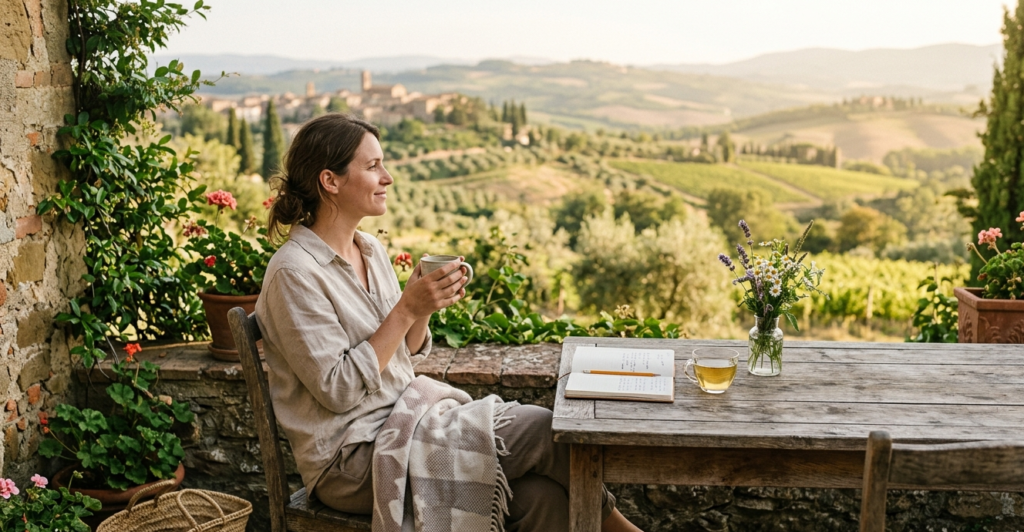
One hour a week, nothing scheduled. No app tracking it, no intention attached to it, no name given to what it was supposed to be. Just an hour that was left alone, the way you might leave a corner of a garden unplanted and then forget to go back and fix it.
What grew there was not peace, exactly. It was not productivity in disguise, not the recovered energy that self-help literature promises when it rebrands rest as optimization. Some weeks the hour was restless and uncomfortable, a low-grade anxiety about all the things that could have been done instead. Some weeks it dissolved into nothing that could be reported. And occasionally — not often enough to be a trend, not rarely enough to be dismissed — something shifted in a way that had no name and no utility. A thought completed itself that had been interrupted for months. A feeling arrived that had been waiting at the door without knocking. Not enlightenment. Just presence, arriving late, slightly out of breath.
This is what Byung-Chul Han means when he writes, in “The Scent of Time,” that profound boredom is not the enemy of experience but its precondition — the fallow state without which nothing genuinely new can take root. He is not celebrating idleness. He is observing something structural: that the kind of time required for depth is not the same kind of time that modernity produces. Modern time is transitive. It moves toward something. It justifies itself by what it leads to. The hour left unscheduled refuses that grammar entirely, and the refusal is not comfortable.
What lives in that refusal is the question that this entire inquiry has been circling without ever quite reaching the center of: whether love, grief, genuine thought, and the raw sensation of being alive rather than merely functional are not activities at all but conditions — states that can only arise in a quality of time that cannot be manufactured, scheduled, or optimized into existence. You cannot make an appointment with grief and expect it to arrive on time. You cannot fit love into a slot between meetings and expect it to deepen. These are not failures of organization. They are structural incompatibilities between the nature of those experiences and the architecture of time that late capitalism has built around us.
William James, writing in 1890 in “The Principles of Psychology,” described consciousness not as a stream of discrete events but as something continuous, something that thickens and thins, something that requires duration to become itself. The self, for James, is not a product but a process — and processes require time that is not constantly interrupted, redirected, or monetized. What happens when that kind of time is systematically removed is not simply that people become tired. What happens is that certain experiences become structurally impossible, not because people lack the will to have them but because the temporal conditions for their emergence have been eliminated.
The garden that grew without permission in that unscheduled hour did not produce anything demonstrable. There is no metric for what happened there. And this is precisely the point that no wellness industry, no slow living influencer, no productivity-adjacent mindfulness framework can absorb without destroying it: the value of that time is indistinguishable from its uselessness, and the moment you try to extract something from it, it becomes something else entirely.
Whether knowing this changes anything is a question that does not resolve cleanly. Knowledge of a structural condition is not the same as freedom from it. Understanding why you cannot breathe does not give you air. But something in the act of seeing it clearly — not performing clarity, not turning the seeing itself into content, but actually sitting with what is true — belongs to the same family of experience as that unscheduled hour, and may be the only form of resistance that does not immediately become what it was resisting.
🌿 Roots of Slowness: Philosophy, Nature, and the Good Life
The philosophy of slowing down does not emerge from a single thinker or tradition, but from a deep questioning of modern speed, consumption, and disconnection. From Thoreau’s solitary retreat to Epicurean simplicity, from Rousseau’s critique of civilization to Veblen’s dissection of leisure, these ideas form a rich intellectual tapestry. Exploring their origins helps us understand why the slow life is not nostalgia but a profound cultural and philosophical stance.
Thoreau’s Walden: Meaning and Analysis
Henry David Thoreau‘s Walden is one of the foundational texts of the slow life philosophy, chronicling his two-year experiment in deliberate, simplified living by Walden Pond. Thoreau argued that most people live in quiet desperation, trapped in labor and consumption rather than genuine experience. His call to ‘suck the marrow out of life’ remains a radical invitation to decelerate and attend to what truly matters.
GO TO THE SELECTION: Thoreau’s Walden: Meaning and Analysis
Epicurus: Life and Philosophy
Epicurus built a philosophy centered on tranquility, friendship, and the cultivation of modest pleasures as the highest human goods. Far from the caricature of hedonism, his teaching was a careful science of simplicity — avoiding unnecessary desires and finding contentment in the present moment. The Epicurean garden stands as one of history’s earliest experiments in slow, intentional community living.
GO TO THE SELECTION: Epicurus: Life and Philosophy
Rousseau and Nature: The Noble Savage
Rousseau’s vision of the noble savage and his critique of civilized society laid important groundwork for modern slow-life thinking by questioning whether social progress truly improves human happiness. He believed that the more complex and artificial society becomes, the further it drifts from natural human flourishing. His romantic longing for simplicity and authenticity continues to resonate in contemporary movements that challenge the pace of modern life.
GO TO THE SELECTION: Rousseau and Nature: The Noble Savage
Veblen’s The Theory of the Leisure Class: Analysis
Thorstein Veblen‘s Theory of the Leisure Class offers a sharp sociological lens through which to examine how modern societies equate busyness and conspicuous consumption with status and worth. His concept of conspicuous leisure reveals the paradox at the heart of capitalist culture, where both overwork and ostentatious idleness serve as social performances rather than genuine rest. Reading Veblen alongside slow-life philosophy exposes the structural pressures that make deceleration a genuine act of cultural resistance.
GO TO THE SELECTION: Veblen’s The Theory of the Leisure Class: Analysis
Discover the Cinema of Slowness on Indiecinema
If these ideas about slowing down, simplicity, and living with intention resonate with you, independent cinema offers some of the most powerful explorations of these themes. On Indiecinema, our streaming platform dedicated to independent and art-house film, you will find films that breathe differently — stories told with patience, silence, and depth. Join us and discover a cinema that invites you to stop, look, and truly see.
👉 EXPLORE THE CATALOG: Watch Indie Films in Streaming
A vision curated by a filmmaker, not an algorithm
In this video I explain our vision

