
The Moment You Agreed Without Knowing
You stop at the red light at three in the morning. The street is empty in every direction — no cars, no pedestrians, no police cruiser idling at the corner. There is no one to see you, no camera whose existence you can confirm, no consequence waiting on the other side of that intersection if you simply drive through. And yet you wait. You sit there in the particular silence of a city that has briefly forgotten itself, engine running, foot on the brake, obeying an instruction issued by a painted metal box on a pole, issued to no one, received by you alone. Something holds you there that is not fear of punishment, or not only that. Something older and stranger and more structural. You wait because somewhere, without ceremony or signature, you agreed to this.

You did not sign anything. There was no ceremony, no moment of conscious assent, no document slid across a desk with a line marked for your initials. You were born into a world already organized, already threaded through with obligations and permissions, already divided into what is yours and what belongs to someone else, what you may do and what will cost you dearly. The rules arrived before you had language to question them. By the time you were capable of asking why, you had already been shaped by the answer. The social contract is not something you entered. It is something that entered you.
Hobbes understood this with a clarity that still makes contemporary political philosophy uncomfortable. Not because his conclusions were pleasant — they were not — but because his premises are so difficult to honestly deny. Thomas Hobbes published Leviathan in 1651, in the aftermath of the English Civil War, amid the wreckage of a world that had just watched itself tear apart along every seam it believed unbreakable. He had seen what happened when authority collapsed. He had seen, or understood he had seen, what human beings actually do when the structure holding them apart from one another dissolves. His answer was not a utopia. His answer was a monster. A necessary, artificial, man-made monster that we build together so that we do not destroy each other separately.
The provocation of Leviathan is not philosophical in the abstract sense. It is diagnostic. Hobbes was not constructing an ideal. He was describing a mechanism already running, had always been running, underneath every civilization that ever called itself civilized. The sovereign — whether a king, a parliament, a constitutional order, a bureaucratic state — is not the opposite of freedom. It is the condition for anything resembling freedom to exist at all. You accept its authority not because you have been deceived, or not entirely, but because the alternative is a life that Hobbes described in perhaps the most quoted and least truly absorbed phrase in the history of political thought: solitary, poor, nasty, brutish, and short. He wrote those words in Part I, Chapter 13, and generations of readers have treated them as rhetoric. They are not rhetoric. They are an observation about what waits on the other side of the red light if no one stops.
The workplace policy that makes no sense, the tax form you file without understanding a single line of its logic, the fine print you click through without reading because the alternative is not participating at all — these are not aberrations of the system. They are the system, functioning exactly as Hobbes said it must. The Leviathan does not ask for your understanding. It asks for your compliance. And you comply, at three in the morning, with no one watching, because something in you already knows what Hobbes spent five hundred pages trying to prove.
He did not describe a theory. He described you.
The Mirror and the Rascal
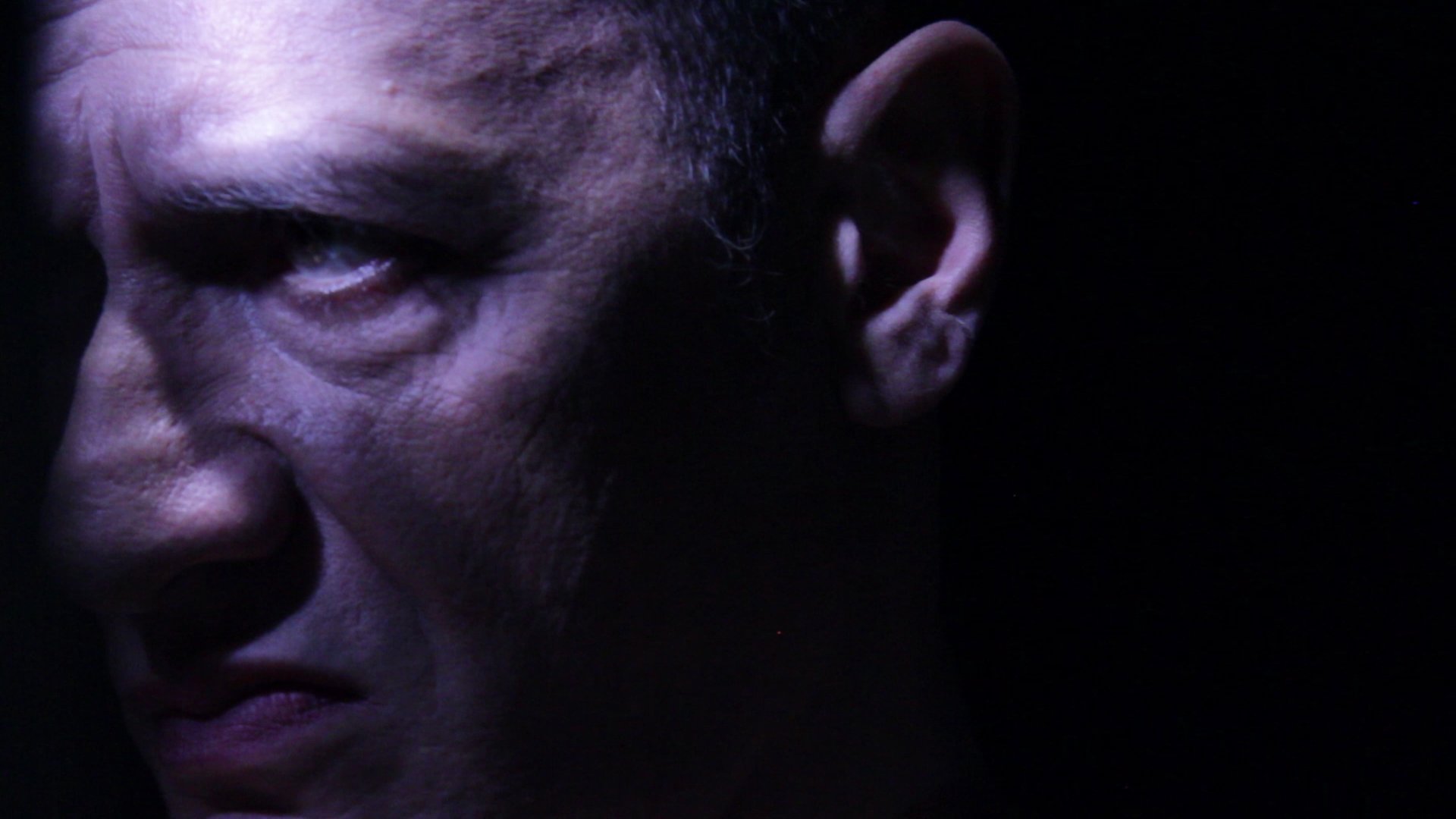
Drama film, by Valerio De Filippis, Italy, 2019.
The mirror and the rascal is an experimental film based on the tragedy "Richard III" by William Shakespeare. It tells the delirium of contemporary power in an author's reinterpretation of cinema, video art and music. The protagonist, Richard Duke of Gloucester, brother of King Edward IV, through a long series of crimes eliminates all the obstacles that stand between him and the throne of England.
Valerio de Filippis, a well-known painter who has been following his research path for a long time, investigating the relationship between light, corporeality and the psyche. The mirror and the rogue and the cinematographic equivalent of Valerio De Filippis' painting, his figurative style is in fact very recognizable looking at his paintings. But cinema is a new way where the artist can also be involved as an actor and performer, with an original mix between acting and singing. Staging the dark side of the human soul, the film is a surreal and disturbing interpretation of a great classic. The director says: "The first suggestion was musical: I was interested in transforming the text of Shakespeare's tragedy Richard III into notes. I love cinema and at a certain point I felt that the time had come to combine research on the image of painting to my love for cinema and music. When the film is finished I realize that I have remained faithful to painting: every frame of the film appears to me like a painting: the same light, the same colors, the same atmosphere ". The mirror and the rascal is a kind of psychoanalytic session that the painter does while hiding behind the mask of Richard III. Behind this ferocious and unscrupulous character we find a path of self-analysis by De Filippis, who is mainly interested in the more violent and turbid aspects. An experimental film in which, with great courage, the author gets involved completely, fragmenting the images in an unconventional montage, which is at the same time a flow of consciousness and spectacle.
LANGUAGE: English
SUBTITLES: Italian
The Man Who Watched a Civil War and Never Recovered
He was born too early, his mother frightened into labor by rumors of Spanish warships on the horizon. That is not a metaphor or a literary flourish. That is the biographical fact Thomas Hobbes himself recorded, noting with a kind of grim satisfaction that fear and he had entered the world together. The year was 1588, the Armada was approaching, and somewhere in Wiltshire a woman gave birth to a boy who would spend the next ninety-one years trying to think his way through the terror that had greeted him at the threshold of existence.
Most philosophers arrive at their central ideas through argument, through the accumulated pressure of reading and disputation. Hobbes arrived at his through watching. He watched England come apart. He watched men who had prayed together and farmed adjacent fields pick up weapons and kill each other over questions that God, apparently, had declined to answer. Between 1642 and 1651, the English Civil War consumed somewhere between 180,000 and 200,000 lives in battle alone, with disease and displacement pushing the total far higher in a nation of perhaps five million. These are not background statistics. For Hobbes, exiled in Paris by 1640, corresponding with friends who were losing property and sons and sometimes their heads, these numbers were the texture of daily reality, the material he was handling when he sat down to write.
The execution of Charles I in January 1649 was something else entirely. A king publicly beheaded by his own subjects was not merely a political event. It was a philosophical rupture, a demonstration that the social order everyone had been taught to regard as natural, divinely ordained, and permanent was in fact provisional, fragile, and revocable by force. Hannah Arendt, writing three centuries later in The Origins of Totalitarianism, would describe how the destruction of stable political structures produces not freedom but a specific and vertiginous terror, the terror of formlessness, of discovering that the ground beneath your assumptions was never ground at all. Hobbes did not need Arendt to explain this to him. He was living inside it.
What this means for understanding Leviathan, published in 1651, is that you cannot read it as a cool theoretical exercise in political science. The book is saturated with urgency, with the smell of something burning just outside the window. When Hobbes describes the state of nature as a condition of war of every man against every man, he is not constructing a thought experiment. He is describing something he has effectively seen, translating the chaos of a society in collapse into the language of first principles. The philosopher Michael Oakeshott, in his 1975 work On Human Conduct, observed that Hobbes was not diagnosing a hypothetical primitive state but articulating a permanent tendency latent within any human community, something that surfaces the moment authority loses its grip. The English Civil War had been that surface breaking open.
He finished Leviathan in exile, surrounded by other English refugees in Paris, writing in a city that was itself convulsed by the Fronde, the French civil unrest that would destabilize the monarchy of Louis XIV’s childhood. He could not escape political violence even in the place he had fled to. There is something almost relentless about the biographical picture, a man so thoroughly marinated in the evidence of human destructiveness that his philosophy could not have arrived at any other conclusion. The state, for Hobbes, is not an ideal. It is a necessary fiction, a constructed monster, an artificial man, as he calls it in the very opening of the text, built specifically because the alternative is something he had already seen and could not forget. The Leviathan is not a vision of the good society. It is a monument to what happens when there is none.

The State of Nature Is Not a Myth — You Have Lived It
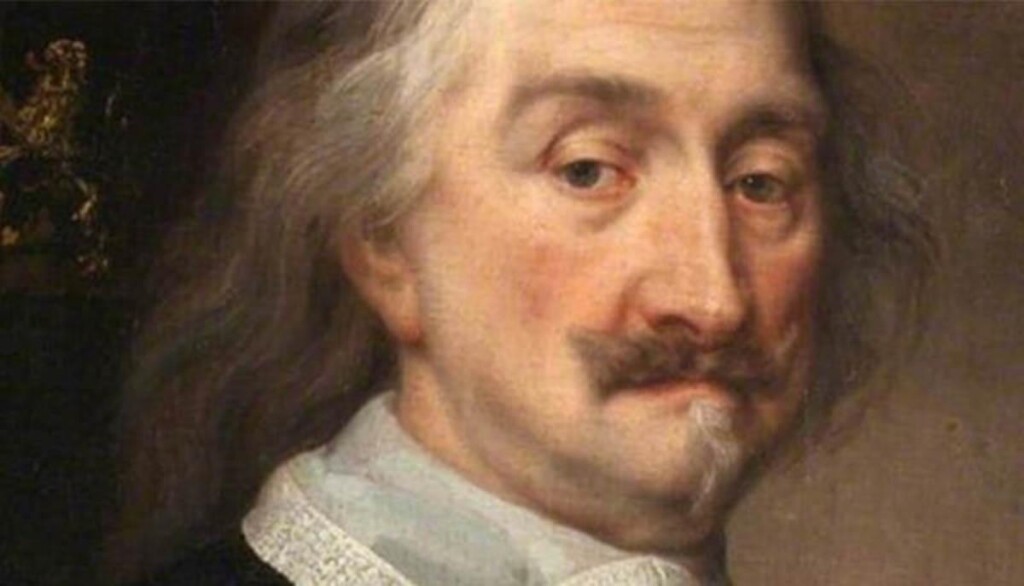
There was a night, maybe you remember one like it, when the lights went out across an entire district and stayed out. Not for an hour. For three days. And you watched something happen to the people around you that no political science textbook had ever quite prepared you for. The neighbor who had waved at you every morning for six years started eyeing your generator. The small shop on the corner was stripped bare by the second afternoon, not by strangers, but by people whose children went to school with yours. A man you had always considered reasonable stood in his doorway with something in his hand that made you cross to the other side of the street without consciously deciding to. Nobody had declared war. Nobody had gone mad. The institutions had simply paused, and in that pause, something older and more honest surfaced.
This is what Hobbes meant. Not cavemen. Not prehistory. Not a theoretical starting point you are permitted to dismiss once civilization has been adequately established. The state of nature is a pressure that exists beneath every functioning society at every moment, and it does not require catastrophe to become visible — it only requires a sufficient interruption of the systems that keep it submerged. Hobbes wrote in Leviathan, published in 1651, that even in civilized societies you can observe the logic of natural war by noticing that you lock your doors at night, that you carry keys, that you hire lawyers, that you build fences. These are not the behaviors of a species that has transcended mutual distrust. They are the behaviors of a species that has learned to manage it through architecture, law, and the permanent background threat of sovereign force.
The philosopher Gregory Kavka, in his 1986 work Hobbesian Moral and Political Theory, argued that what makes Hobbes genuinely disturbing is not his pessimism about human nature but his clarity about structural conditions. It is not that humans are evil. It is that under conditions of scarcity, uncertainty about others’ intentions, and the absence of enforceable agreement, even rational and decent people will behave in ways indistinguishable from the worst. This is what behavioral economists now call the collective action problem, and it is precisely what you watched unfold over three days when the lights stayed off and nobody knew when they would come back.
There is a particular quality of collapse that the theorists rarely capture and that only lived experience makes legible. A man sits across a table from a stranger whose language he barely speaks, and between them there is no shared law, no shared history, only the slow and terrible arithmetic of who needs what and who might take it. A woman moves through a city she once navigated casually and finds that every familiar landmark has become a calculation: is this safe, is this person safe, what do I have that someone else wants. The warmth of social trust, which Hannah Arendt described as the fragile web of human plurality woven by speech and action, does not require bombs to tear. It requires only silence, only the absence of reliable signal, only the withdrawal of the institutional hum that tells you the rules still apply.
What Hobbes saw, writing in the wreckage of the English Civil War, with its decade of broken contracts and reversed allegiances and neighbors killing neighbors over doctrinal abstractions, was not a theoretical possibility. He saw a specific historical demonstration that the underneath is always there. The state of nature is not where we came from. It is where we return the moment the Leviathan stops breathing. And the question that follows from this — the one that Hobbes himself could not quite answer — is whether any power we construct to prevent that return can ever be something other than another version of the threat it was built to contain.
Solitary, Poor, Nasty, Brutish, and Short — The Most Honest Sentence in Political Philosophy
There is a moment that happens in almost every serious argument between people who love each other — a marriage, a friendship, a business partnership that has lasted long enough to accumulate real stakes — when one person finally says the true thing. Not the diplomatic version, not the softened approximation, but the actual thing they have been thinking for months or years. And the room goes cold. Not because the statement is wrong. Because it is so precisely right that it strips away every comfortable layer both people had agreed, without ever saying so, to keep in place. Hobbes’s five words function exactly like that moment. Solitary, poor, nasty, brutish, and short. The room has been cold since 1651.
Every political philosophy written before and after that sentence has been, at least in part, an attempt to warm the room back up. Locke needed the natural state to be tolerable enough that consent could feel like a genuine choice rather than a transaction made at gunpoint. Rousseau needed it to be almost beautiful, a condition of original wholeness corrupted by civilization, so that the social contract could be framed as recovery rather than surrender. Rawls needed the original position to be so stripped of particulars that justice could emerge from reason rather than from the brute arithmetic of power. Each of these constructions is intellectually serious and each of them, at some level, is also a refusal. A refusal to sit with what Hobbes actually described: not a temporary condition that reason can dissolve, but the permanent substrate of what human beings are when the architecture of enforcement is removed.
Hobbes was a mechanist before mechanism had a name for itself. He believed that thought was motion, that desire was simply the body moving toward something, that aversion was the body recoiling, and that what we call reason is largely the instrument those movements use to justify themselves after the fact. He laid this out in the opening books of Leviathan with a clarity that makes most subsequent moral philosophy look like elaborate decoration. The human being is not a soul temporarily inhabiting matter. It is a system of appetites, a machine for wanting and fearing, and the wanting and the fearing never stop because they cannot stop. Power, he wrote, is simply the present means to obtain some future apparent good — and the desire for power ceases only in death. Not because human beings are evil. Because they are continuous.
Three and a half centuries later, Daniel Kahneman and Amos Tversky formalized what Hobbes intuited. Their work on prospect theory demonstrated that losses loom roughly twice as large as equivalent gains in human decision-making, that the fear of losing what you have distorts judgment far more consistently than the hope of gaining something new. This is not a cultural artifact or a product of capitalism or modernity. It is a structural feature of how the human nervous system processes uncertainty. The brain’s threat-detection architecture, which neuroscientists have traced through the amygdala’s rapid subcortical processing, operates on a logic of asymmetry — better to mistake a shadow for a predator than a predator for a shadow. Hobbes was describing, in the language of political philosophy, what neuroscience would eventually describe in the language of biology.
The state of nature is not a historical claim. It is a functional description of what persists underneath every institution we have built. You do not have to remove civilization to see it. You only have to watch what happens when the enforcement architecture weakens for a moment — a power outage that lasts three days, a neighborhood where police response time stretches past forty minutes, a financial system that pauses long enough for people to understand it might not restart. The five adjectives are not pessimism. They are the pressure that every lock, every law, and every social contract is designed to hold back.
The Covenant of Fear — Why You Gave Up Your Freedom and Called It Safety
You did not choose safety. You chose fear, and then you named it safety so you could live with yourself.
Think about the moment you first understood this — not intellectually, but in your body. A man sits across a desk from someone who holds power over his livelihood, his papers, his right to remain in a particular place. He does not like this person. He does not trust them. He knows, with a clarity that requires no philosophy degree, that the system they represent was not designed with his interests at the center. And yet he signs. He nods. He surrenders the particular freedom he walked in with and accepts the particular permission he is allowed to walk out with. He calls this a reasonable transaction. He calls it civilization.
This is not a metaphor for Hobbes. This is Hobbes, rendered in flesh and fluorescent light.
The social contract as Hobbes constructs it in the 1651 Leviathan is not a celebration of human rationality. It is a confession of human terror. The sovereign authority is not elected by hopeful citizens imagining a better world — it is conjured by people who have stared into the void of ungoverned existence and flinched. Hobbes calls the natural condition of mankind a war of every man against every man, and he means this with clinical precision: not a metaphor, not a historical period, but a permanent gravitational force that civilization keeps only barely at bay. The contract is not noble. It is the agreement you make when the alternative is worse.
Hannah Arendt, writing in Between Past and Future in 1961, draws a distinction that cuts directly across this. She argues that authority is not the same as power, and not the same as violence — it exists in a space between them, requiring voluntary recognition without coercion. What Hobbes describes, she would say, is not authority at all. It is submission dressed in the language of consent. The sovereign does not earn recognition; it extracts it. And Arendt’s distinction matters because it names what you already feel: that the legitimacy you extend to institutions is not freely given but structurally demanded, and the fiction of consent is precisely what makes the demand bearable.
Giorgio Agamben presses harder. In his 2003 State of Exception, he traces the way sovereign power reserves for itself the right to suspend the very rules it claims to uphold — the emergency decree, the temporary measure that becomes permanent, the crisis that justifies the contraction of the space in which ordinary life moves. Hobbes would not disagree with this mechanism. He would call it necessary. Agamben calls it the hidden grammar of modern governance, the point at which the Leviathan reveals that the covenant was never symmetrical, that you gave everything and received only a promise.
Somewhere a woman is told that the restrictions placed on her movement, her speech, her assembly are temporary, precautionary, for her own protection. She knows they may not be temporary. She knows protection and control share a syntax. She accepts them anyway, because the alternative — genuine ungoverned space — feels more dangerous than the authority she distrusts. She has made the Hobbesian calculation without ever opening a seventeenth-century text.
This is what makes Hobbes so uncomfortable to read honestly. He is not describing a historical moment of social formation. He is describing the psychological architecture you inhabit every morning when you decide, again, not to push back. The covenant of fear is not something your ancestors signed. It is something you renew continuously, in small increments, in every room where someone holds more power than you and you choose legibility over resistance. The Leviathan was never built once. It is built
A vision curated by a filmmaker, not an algorithm
In this video I explain our vision
The Leviathan as Monster, Machine, and Mirror

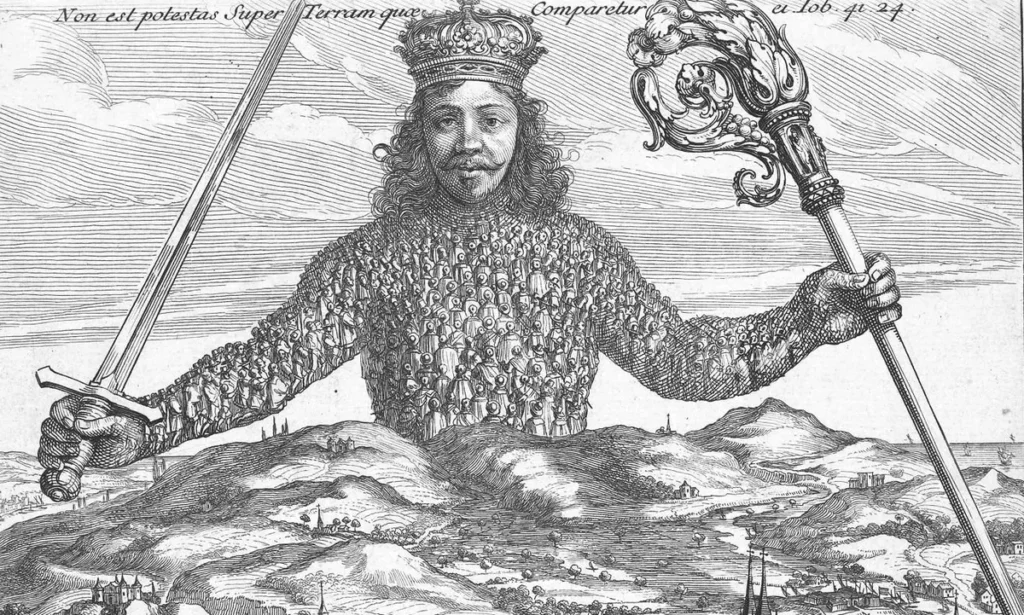
Look at it long enough and something shifts. The image that opens Hobbes’s 1651 text — a towering sovereign figure rising above a landscape of church and city, his body composed entirely of hundreds of tiny human forms pressed together, faces turned upward toward the head that contains them — stops being a political diagram and becomes something else. It becomes a body horror image. It becomes the thing you almost recognized before you could name it.
Those figures inside the sovereign are not subjects he rules. They are the material he is made of. You are in there. Your neighbors are in there. Every consent given, every social contract signed in silence by the simple act of not rebelling, every morning you obeyed a law you never chose — all of it is tissue in that body. Hobbes wanted to illustrate sovereignty as protection, as the rational solution to the war of all against all. What he accidentally illustrated was something far more disturbing: that the state does not stand above human beings as a shepherd above a flock. It stands above them because it is assembled from them. It is the sum of surrendered wills.
There is a scene where a man sits in a vast open office, surrounded by identical desks, filling out forms that authorize other forms that permit further forms to be filed. He is not imprisoned. He has a salary. He goes home at night. And yet something about the geometry of the space — the sight lines, the identical angles of identical bodies bent over identical tasks — makes it clear that the room is a machine and he is one of its moving parts, entirely replaceable, entirely necessary in his replacability. The machine does not need him. It needs the function he performs, which anyone could perform, which in a sense no one performs because the function performs itself through whoever occupies the position. This is not a metaphor for alienation. This is a precise description of how sovereign power reproduces itself through distributed human compliance.
Michel Foucault, writing in Discipline and Punish in 1975, traced exactly this architecture. The great transformation of Western governance after the seventeenth century was not the expansion of force but the internalization of surveillance. The Panopticon — Bentham’s circular prison where a single unseen guard could watch every cell — became for Foucault not a historical curiosity but a diagram of modern power itself. The crucial innovation was not that you could be watched. It was that you could never know whether you were being watched at any given moment, which meant you had to behave as though you always were. The watching became unnecessary once the watched had absorbed the structure. The sovereign no longer needs to be everywhere. It only needs to have been somewhere, once, convincingly enough.
Hobbes called this artificial man the Leviathan, borrowing from Job, from the biblical sea monster that no human force can subdue. But the monster in the book of Job is alien, other, terrifyingly external. Hobbes’s monster is nothing of the kind. It is not other. It wears your face. It speaks with your voice multiplied. Every surveillance camera mounted above a street corner, every digital record of movement and preference and purchase, every bureaucratic classification of a human being into a manageable category — this is not the Leviathan watching you from outside. This is the Leviathan maintaining its own coherence from within, using the data points you continuously generate just by living.
In another scene, a woman walks through a checkpoint, removes her shoes, places her body inside a scanner, is briefly resolved into an image of bones and soft tissue on a screen somewhere, then reassembles herself on the other side and continues walking. She does not think about what just happened. Neither do you, usually, when it happens to you. That is precisely the point.
Hobbes Was Wrong About One Thing — And That Is the Most Dangerous Part
There is a moment in the life of every modern state when its machinery turns quietly inward. Not with chaos, not with the howling disorder Hobbes feared — but with paperwork. With schedules. With the methodical allocation of railway carriages to destinations that had been decided in meeting rooms by men in suits who went home afterward to their families, who ate dinner and read the newspaper and did not consider themselves monsters. This is not a metaphor. This happened. The coordination required to move eleven million people to their deaths across a continent was not the product of barbarism breaking through civilization’s walls. It was civilization operating at full efficiency.
Hobbes built his entire architecture on a single load-bearing assumption: that the sovereign, once constituted, would function as a rational guarantor of order. That the Leviathan, having absorbed the violence of the state of nature, would neutralize it. What he could not account for — or perhaps chose not to — was that the sovereign might redirect that violence downward, inward, systematically, with all the organizational sophistication that only a modern state commands. The state of nature kills opportunistically. The state kills with planning committees and annual budgets.
Zygmunt Bauman spent the 1980s staring at what his colleagues in sociology had largely treated as an aberration, a rupture, an exception that proved the rule of civilizational progress. In Modernity and the Holocaust, published in 1989, he delivered the most uncomfortable verdict in modern social thought: the Holocaust was not a failure of modernity. It was one of its products. Bureaucratic rationality, the same rationality that builds hospitals and coordinates food distribution and makes trains run on time, is precisely the instrument that made industrialized extermination possible. The distance between the decision-maker and the act of killing — the very distance that Enlightenment administrative structures institutionalized — did not create moral clarity. It dissolved moral responsibility entirely. Each functionary executed their task. No one was responsible for the whole.
The twentieth century gave Hobbes’s framework not a test but a verdict. The First World War killed somewhere between seventeen and twenty million people between 1914 and 1918, orchestrated by sovereign states operating through conscription, logistics, and international treaty systems. The Second World War killed somewhere between seventy and eighty-five million by 1945, with the Holocaust accounting for six million Jews and five to six million others, executed not by stateless savages but by a fully sovereign, legally constituted government. In 1994, in Rwanda, a state apparatus used radio broadcasts and administrative lists to coordinate the killing of approximately eight hundred thousand people in one hundred days. These were not breakdowns of sovereign order. They were sovereign order, operating exactly as designed, pointed in a direction Hobbes never modeled.
The flaw in the original logic is not trivial. Hobbes imagined violence as a problem of coordination failure — that individuals, left to themselves, would destroy each other because no one could trust anyone else. The sovereign resolves this by monopolizing force and making defection costly. But this logic assumes that the sovereign’s interests are isomorphic with the population’s survival. The twentieth century demonstrated, repeatedly, that they are not. The Leviathan does not merely protect the body social. It can decide, at any moment, which parts of that body are expendable, which populations are legible as human, which groups constitute a problem to be administered rather than persons to be protected.
Hannah Arendt called this the banality of evil. Bauman pushed further: it is not even experienced as evil from inside the system. It is experienced as management. The horror is not in the deviation from bureaucratic rationality. It is in its perfect execution. The sovereign Hobbes imagined as mankind’s salvation carries, encoded in its very structure, the capacity to become the most lethal thing the state of nature never managed to be.
The Contract You Keep Renewing Every Morning
You wake up, and before you are fully conscious, the contract is already in effect.
The alarm pulls you back into the world of obligations, and within minutes you are performing the small ceremonies of participation: the login screen demanding your credentials, the commute folding you into the collective infrastructure, the tax form asking you to account for yourself in numbers the state recognizes as real. None of this feels like a choice. That is precisely the point. The Hobbesian bargain was never meant to feel like a choice after the first signing. It was meant to become the texture of reality itself, indistinguishable from gravity or weather.
Think of the man who sits in a government office, holding a numbered ticket, watching a screen that advances with geological slowness. He is not being oppressed in any dramatic sense. He is simply waiting for the Leviathan to process him, to confirm that he exists in the form it requires. The patience on his face is not resignation. It is something older and more structural: the recognition, absorbed so deeply it no longer registers as recognition, that his existence in the social world depends on this bureaucratic confirmation. Hobbes understood this. The sovereign does not need to threaten you every morning. The architecture of daily life does the work instead.
What the philosophers of social contract theory — Hobbes in Leviathan in 1651, Rousseau in Du Contrat Social in 1762, Rawls in A Theory of Justice in 1971 — consistently underestimated is how thoroughly the contract colonizes the imagination. It does not merely regulate behavior. It becomes the lens through which behavior appears natural or deviant, thinkable or unthinkable. Michel Foucault, in Discipline and Punish, described this as the transition from spectacular power to disciplinary power: the shift from the public execution to the timetable, the examination, the file. By the time Foucault published that work in 1975, the disciplinary apparatus had already completed its migration inward. You do not need the scaffold if the citizen carries the prison architecture in their own mind.
There is a woman who discovers, late in life, that every major decision she believed she had made freely — where to live, whom to marry, what work to pursue — was shaped by a set of permissions she never explicitly granted anyone the authority to issue. The contract was not a foundation she stood on. It was a suspended ceiling, always just above her head, defining the room without ever being acknowledged as a wall. When she finally looks up and sees it clearly, the shock is not that it exists but that she helped hold it in place without knowing, that her compliance was structural, load-bearing, essential to the whole arrangement.
This is where Hobbes becomes not merely a historical curiosity but something uncomfortably contemporary. The Leviathan he described was artificial, a construction made of human bodies and human fears, a mortal god assembled from the consent of the governed. But the assembled creature has long since outlived the memory of its own assembly. It presents itself now as natural, permanent, self-evidently necessary. The passport queue is not experienced as a ritual re-enactment of sovereignty. It is experienced as Tuesday.
The man in the queue, the woman examining the ceiling she helped hold up — they are not allegorical figures. They are the ordinary phenomenology of political existence, the daily texture of a bargain that was struck so long ago that the signatories are all dead, leaving only their descendants to honor a debt they inherited without consent and cannot locate well enough to dispute.
If the monster is made of us — assembled from our fears, ratified by our routines, sustained by our morning logins and our numbered tickets and our careful compliance — then the question is not whether you can escape it, but whether there is a place in you that the contract has not yet reached, and whether you would even recognize that place if you found it.
⚔️ Power, State, and the Foundations of Political Thought
Hobbes’s Leviathan stands as one of the most radical and enduring works in the history of political philosophy, raising questions about sovereignty, human nature, and the social contract that continue to resonate today. The articles below trace the intellectual landscape surrounding Hobbes’s thought, from the Renaissance origins of modern political realism to the theatrical staging of power and legitimacy.
Thomas Hobbes: Life and Political Thought
Thomas Hobbes did not emerge in a vacuum: his life traversed the English Civil War, the execution of a king, and the collapse of political certainties that had long defined European order. Understanding the biographical and intellectual arc of Hobbes is essential to grasping why the Leviathan argues so forcefully for an absolute sovereign as the only bulwark against chaos. This article traces his formation, his exile, and the philosophical debates that shaped his materialist and contractualist vision.
GO TO THE SELECTION: Thomas Hobbes: Life and Political Thought
Machiavelli’s The Prince: Meaning and Analysis
Machiavelli's The Prince is perhaps the only work that rivals the Leviathan in its unflinching examination of political power stripped of moral pretense. Where Hobbes theorizes the sovereign’s necessity through the logic of the social contract, Machiavelli counsels the prince on the raw mechanics of acquiring and maintaining power. Reading both texts together reveals a continuous thread of political realism running through early modern European thought.
GO TO THE SELECTION: Machiavelli’s The Prince: Meaning and Analysis
Niccolò Machiavelli: Life and Political Thought
Niccolò Machiavelli‘s life and political thought provide the Renaissance foundation upon which much of Hobbes’s political realism was later built, even as the two thinkers inhabited radically different historical and philosophical contexts. Machiavelli’s observations on republics, principalities, and the nature of fortune anticipate many of the questions Hobbes would later address through a more systematic philosophical method. Exploring Machiavelli’s biography and intellectual legacy illuminates the long genealogy of modern political science.
GO TO THE SELECTION: Niccolò Machiavelli: Life and Political Thought
Shakespeare’s Richard III: Meaning and Analysis
Shakespeare’s Richard III offers a dramatic and literary counterpoint to Hobbes’s philosophical treatment of sovereignty, presenting a sovereign who embodies the very state of nature Hobbes feared: a world of cunning, domination, and the war of all against all. Richard’s calculated seizure and manipulation of power can be read as a theatrical demonstration of what happens when legitimate authority dissolves into pure will. Analyzing Shakespeare’s play alongside the Leviathan enriches our understanding of how early modern culture grappled with questions of legitimacy and tyranny.
GO TO THE SELECTION: Shakespeare’s Richard III: Meaning and Analysis
Discover Independent Cinema on Indiecinema
If these explorations of power, sovereignty, and political thought have sparked your curiosity, Indiecinema’s streaming platform offers a carefully curated selection of independent and art-house films that engage with exactly these themes — from portraits of authority and rebellion to meditations on justice and the human condition. Step beyond the mainstream and let independent cinema deepen your thinking.
👉 EXPLORE THE CATALOG: Watch Indie Films in Streaming
A vision curated by a filmmaker, not an algorithm
In this video I explain our vision

