
The Aristocrat Who Feeds on You
You meet him at a party. He is the most interesting person in the room, which is to say he is the most dangerous, which is to say you do not yet understand that these are the same thing. He listens to you with an attention so complete it feels like recognition, and you mistake being seen for being loved. By the time you understand what has been taken from you, you are already half-empty, and the room where you met him seems very far away.

John Polidori published “The Vampyre” in 1819, and the creature he unleashed on English letters was not a peasant superstition dragged up from Balkan folklore. Lord Ruthven was a nobleman. He moved through drawing rooms and dining halls, through the estates of the English gentry and the salons of continental Europe, and he fed not on the necks of peasant girls in moonlit churchyards but on the social energy, the financial resources, and the erotic vitality of everyone he condescended to befriend. Polidori had spent enough time watching Lord Byron operate to know exactly what he was describing. The roman à clef quality of the story was understood immediately by its first readers, who recognized in Ruthven the predatory charisma of the Romantic celebrity, the man whose aristocratic exemption from ordinary moral accountability functioned as a kind of supernatural power in itself. The vampire was never a metaphor for the supernatural. It was always a portrait of the natural.
What Polidori grasped, almost certainly without the vocabulary to articulate it in sociological terms, was that the English class system had produced a specific human type whose survival depended on extraction. The aristocracy of the Regency period did not produce wealth. It inherited, consolidated, and consumed it, and it did so with a ceremonial grace that made the consumption appear to be a gift. To be drained by Lord Ruthven was, from the outside, to have been chosen. The victims in Polidori’s story are not attacked. They are elevated, selected, brought into proximity with greatness, and they wither in that proximity the way plants wither when something draws the moisture out of the soil without them noticing the roots going dry. This is not horror in the Gothic sense. This is political economy dressed in a cape.
The timing of publication was not incidental. 1819 was the year of Peterloo, the year a cavalry charge into a crowd of workers demanding parliamentary reform left eighteen people dead in Manchester. The distance between that field and the London salon was the entire distance the vampire story was designed to measure. Those who possessed political power in England at that moment possessed it by inheritance, by the accident of birth into a network of title and land, and that possession was protected by the same cordons of deference and ceremony that made Ruthven’s predation invisible to his victims. You did not accuse a lord. You thanked him for his attention.
Polidori’s innovation, the one that Stoker would eventually inherit and transform, was to locate monstrousness not in the other but in the familiar. Ruthven is not frightening because he is alien. He is frightening because he is recognizable, because the logic of his behavior follows naturally from the logic of the society that produced him. He is simply what a certain kind of privilege looks like when you strip away the justifications. The immortality is not a fantasy addition to the portrait. It is the point. The aristocratic claim was always that the bloodline persisted, that the name endured, that the family survived across generations by absorbing the labor and vitality of those who worked their land and attended their tables and believed, because they had been told so since birth, that proximity to greatness was its own reward.
The Ecstasy of Isabel Mann

Horror, thriller, by Jason Figgis, United States, 2016.
Set in Ireland, the film tells the story of Isabel Mann, an introverted and lonely teenager who is drawn into a dark and seductive world of blood, violence, and vampirism. As the story unfolds, Isabel undergoes a disturbing transformation—from a vulnerable young girl to a ruthless creature—guided by a group of vampires who pull her into a spiral of murder and ritual. At the same time, a team of detectives attempts to shed light on a series of brutal killings that seem to be connected. However, their investigation leads them toward a truth far more unsettling than they could have anticipated.
The film stands out for its cold, disturbing atmosphere and a slow, reflective narrative that favors psychological depth over action. Vampirism here is not just a genre element, but takes on a symbolic meaning tied to adolescent alienation, the search for identity, and the longing to belong. *The Ecstasy of Isabel Mann* embraces an auteur style and carries the emotional intensity of Ellen Mullen’s lead performance. It’s a different kind of horror film—intimate and melancholic—capable of blending teenage tragedy with the vampire myth in a modern, introspective way.
LANGUAGE: English
SUBTITLES: Spanish, French, German, Portuguese
Byron's Shadow and the Birth of a Genre
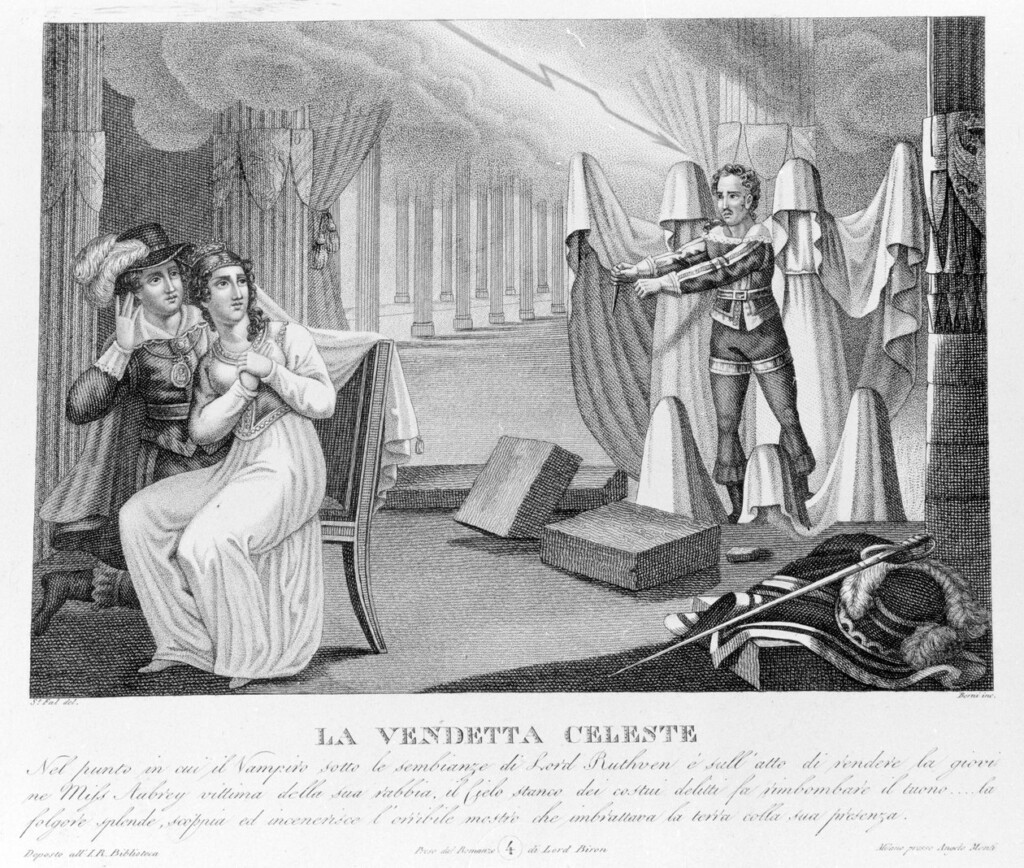
You are sitting across from someone who unnerves you — not because they are cruel, but because they are magnetic, and you cannot tell whether the pull you feel is admiration or the early stage of being consumed.
That sensation, which most people have felt and few will name honestly, is precisely what John William Polidori sat with during the summer of 1816, watching George Gordon Byron hold court in the Villa Diodati while lightning split Lake Geneva into white fractures. Polidori was Byron’s personal physician, twenty years old, and constitutionally unsuited for the role of observer. He was competitive, brittle, and desperately aware that Byron moved through rooms the way weather moves through a valley — without asking permission. The famous ghost story contest that produced Mary Shelley‘s creature also produced Polidori’s Lord Ruthven, and the distance between those two creations is itself a kind of diagnosis. Shelley’s monster was assembled from philosophical anxiety about Promethean science. Ruthven was assembled from a specific man’s face.
Published in 1819 in New Monthly Magazine — initially and incorrectly attributed to Byron himself, a misattribution that enraged Polidori and which Byron did nothing urgent to correct — The Vampyre introduced to English literature a vampire who was aristocratic, seductive, and socially lethal rather than merely physically threatening. Ruthven does not lurk in crypts. He attends parties. He destroys women in drawing rooms, in the middle of polite society, while everyone watches and no one intervenes because his charm functions as a kind of collective anaesthesia. The folkloric vampire of Eastern European tradition, catalogued by Dom Augustin Calmet in his 1746 Traité sur les apparitions, was a bloated, ruddy peasant creature — a revenant tied to village superstition, returning to drain cattle and sleeping relatives. Polidori’s innovation was to dress this creature in a tailcoat and give it excellent table manners.
What makes the portrait vicious rather than merely gothic is its precision. Byron had a documented pattern of pursuing, exhausting, and abandoning lovers — male and female — leaving behind people who described themselves, in letters that survive, as fundamentally altered by the encounter, diminished in ways they struggled to articulate. Lady Caroline Lamb, who famously called him “mad, bad, and dangerous to know,” was not making a romantic complaint. She was reporting a structural observation about how certain kinds of charisma operate as extraction. Polidori had watched this mechanism at close range for months, had been condescended to, had been occasionally charmed, and had no language adequate to the experience except the language of monsters. Lord Ruthven is what happens when a young man who cannot win an argument converts the argument into mythology.
The generic implications of this personal reckoning were enormous. By relocating supernatural evil inside a figure of social privilege, Polidori accidentally generated the template that would define vampire fiction for two centuries. The monster as aristocrat, the monster as lover, the monster as the most desirable person in the room — these are not Stoker’s inventions, and they are not the product of abstract Victorian anxieties about reverse colonization or female sexuality, however productively those readings have been applied to Dracula. They are the product of a twenty-year-old doctor’s wounded ego finding a form large enough to hold its grievance. What the literary tradition then did was expand that personal wound into a cultural one, recognize in Ruthven’s predatory elegance something that readers across decades kept identifying in the actual architecture of power around them.
The monster, in this lineage, is never invented from nothing. It is always recognized.

Varney, Le Fanu, and the Victorian Contamination Anxiety
You are reading a penny serial in 1847, each installment costing a halfpenny, the paper already softening at the edges from the hands of six people before yours, and what arrives on the page is not a nobleman’s curse but something closer to an infection moving through a neighborhood.
James Malcolm Rymer’s Varney the Vampire, serialized across 868 pages before anyone thought to bind it, was consumed by working-class readers in the same years that cholera was renegotiating the borders between the bodies of the poor and the bodies of the prosperous. The vampire in Rymer’s text does not arrive from a remote Transylvanian estate sealed off by mountains and folklore. He arrives next door. He knocks. He has, grotesquely, the social manners of someone who has learned them recently and imperfectly, which is precisely what made him legible to readers who recognized in him the shape of their own social anxiety — not the fear of what is ancient and foreign, but the fear of what is climbing.
Judith Halberstam, in Skin Shows: Gothic Horror and the Technology of Monsters, published in 1995, argues that the Gothic monster is never simply a figure of supernatural dread but a machine for processing social anxieties that the dominant culture cannot address directly. The monster, she writes, is a technology: it condenses race, class, gender, and disease into a single readable body, allowing the culture to examine what it cannot name elsewhere. Varney functions precisely this way. His pallor is the pallor of the laboring poor, his hunger is the hunger of economic resentment, and his bite — the contact that corrupts — maps almost perfectly onto the period’s medical terror of miasmatic transmission, the belief that disease traveled through proximity, through air, through touch, through the simple fact of being too close to someone whose body was constituted differently from yours.
What Sheridan Le Fanu did in 1872, publishing Carmilla as part of In a Glass Darkly, was to redirect that contamination anxiety along a different axis entirely. Le Fanu’s vampire is a woman, aristocratic, languid, intimate in ways that the story’s young female narrator cannot quite classify and therefore cannot refuse. The threat in Carmilla is not penetration from below the class structure but penetration from within the domestic interior, from within the bed, from within the embrace that looks indistinguishable from friendship or love. Victorian medical literature of the same decade, including Henry Maudsley’s work on hereditary nervous degeneration published in Body and Mind in 1870, was constructing female same-sex attachment as a pathology transmissible through emotional proximity — a contagion of sensibility rather than blood. Le Fanu did not need to read Maudsley to be writing inside the same epistemic structure, because both were drawing from the same cultural reservoir of fear about what women might become when left insufficiently supervised.
The shift from Varney to Carmilla is the shift from a fear of the streets entering the house to a fear of the house rearranging itself from within. In both cases, the vampire’s bite is less an act of violence than an act of conversion — the body that was yours is now participating in something it did not consent to consciously, something that alters its fundamental allegiances. The Victorians understood, at some cellular level of cultural intuition, that identity was not stable, that the self was permeable, that contact with the wrong body or the wrong desire could restructure you in ways that no amount of subsequent moral effort could fully reverse. The vampire was simply the most honest image they had for a process they watched happening around them every day in the slums, the hospitals, the drawing rooms, and the schools — which is why, by the time the 1890s arrived, the culture needed a vampire large enough to carry all of it at once.
Nosferatu
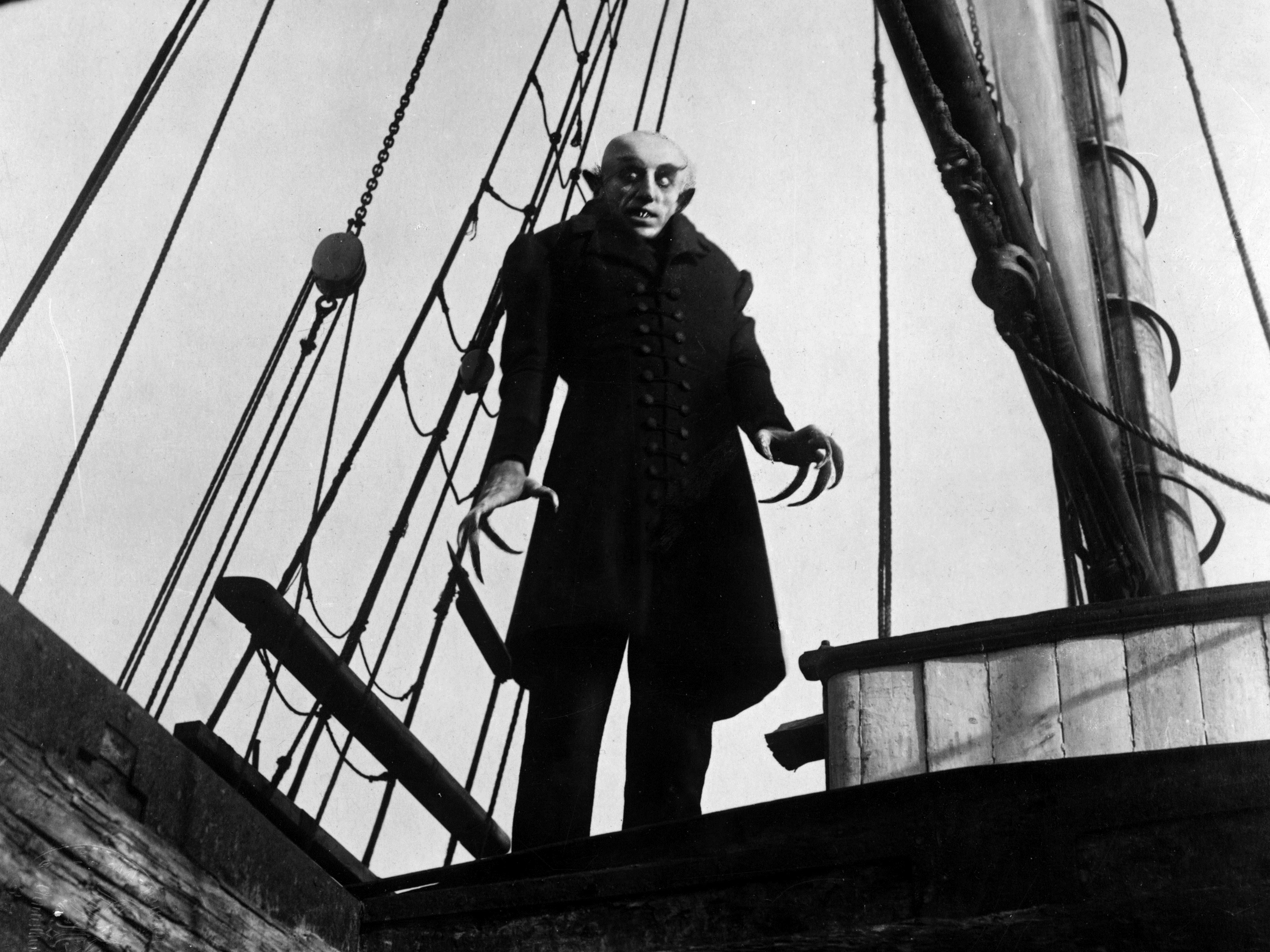
When a young real estate agent, Thomas Hutter, goes to the castle to close a deal, Orlok is attracted by his blood and decides to follow him to his hometown. The arrival of the count causes a series of mysterious deaths and spreads panic among the inhabitants.
Murnau, through evocative images and disturbing atmospheres, creates a work that goes far beyond the simple adaptation of Stoker's novel. The film explores universal themes such as the fear of death, isolation and the loss of humanity. The production of Nosferatu was characterized by some legal difficulties due to the copyright of Bram Stoker's novel. Despite this, Murnau and his crew managed to make a film of great visual impact. The choice of Max Schreck to play Count Orlok was ingenious. His cadaverous appearance and his unnatural movements have made the character of Orlok one of the iconic monsters in the history of cinema. Over the years, Nosferatu has become a cult film, influencing generations of filmmakers and becoming a reference point for the horror genre. The image of Count Orlok, with his elongated nails and sunken eyes, has become an icon of horror cinema.
Dracula as Colonial Blowback

You are reading the novel in London, 1897, and something is coming west. Not an army, not a plague in the medical sense, not even a man — something that crosses borders without papers, that purchases property in Whitechapel through layers of legal intermediary, that arrives in a ship whose crew have all died or vanished, and that begins, quietly, to feed on the city’s most respectable bodies. Bram Stoker gave this figure a Transylvanian address and a title of nobility, but the geography is the point: Eastern Europe, in the Victorian imperial imagination, was the zone where civilization thinned out, where Ottoman and Habsburg empires had ground against each other for centuries, where the peasantry still crossed themselves at crossroads and buried their dead with garlic. The Count arrives from the margin of the known world into its center, and the horror is precisely directional.
The British Empire in 1897 administered roughly a quarter of the earth’s land surface. It had spent two centuries moving outward — extracting, naming, governing, converting — and had developed an elaborate ideological apparatus to explain why this movement was natural, rational, and benevolent. What Stoker’s novel stages, without ever quite announcing it, is the return trip. Dracula does not invade with force; he infiltrates through the very mechanisms of modernity that British civilization had perfected — property law, rail schedules, shipping manifests, correspondence. He uses the infrastructure of empire against the empire itself, and this is what gives the novel its particular vertigo, the sense that the threat is not foreign at all but systemic.
Franco Moretti, writing in New Left Review in 1982 in an essay titled “A Capital Dracula,” pressed this structural logic into something more precise. Dracula is not merely a metaphor for colonial blowback — he is capital in its purest form. He accumulates without producing. He is mobile across borders while the humans who depend on him are rooted in place, in bodies, in daylight. He drains the life-force from working bodies and converts it into his own perpetuation, growing stronger precisely as others weaken. Moretti noted that Dracula operates through monopoly rather than competition — he does not share his victims, he does not negotiate, and the small group of Van Helsing’s associates who hunt him are striking in their bourgeois ordinariness: a lawyer, a doctor, a scientist, men of professional virtue and moderate means, defending a social order that is already being hollowed out from above rather than below.
The women in the novel bear this out with uncomfortable clarity. Lucy Westenra is bled slowly, transfused repeatedly by men who believe they are saving her, and ultimately destroyed by the very community that claimed to protect her. Mina Harker is more complex — she is rendered partly vampiric, tainted, and then managed with extraordinary care by the male circle, her intelligence used instrumentally while her autonomy is systematically suspended. Stoker was almost certainly not writing a feminist critique, but the structure of the novel enforces one anyway: the bodies being drained are female, the agency being exercised is male, and the monster is only the most visible participant in an economy of extraction that the heroes also inhabit.
What the 1897 reader could not have seen, and what the twenty-first century reader can hardly avoid, is that the empire Stoker was defending would begin its visible contraction within fifty years. The anxieties the novel encodes — about porous borders, about Eastern bodies moving west, about the vitality of the center being sapped by something it cannot fully name — would not resolve. They would migrate, shifting from the literary register into the political one, finding new vessels, new vocabularies, new counts with new addresses, each one arriving from a different margin of a differently drawn map, each one carrying the same charge: that what you sent out into the world has learned to come home.
The Immortality We Actually Want
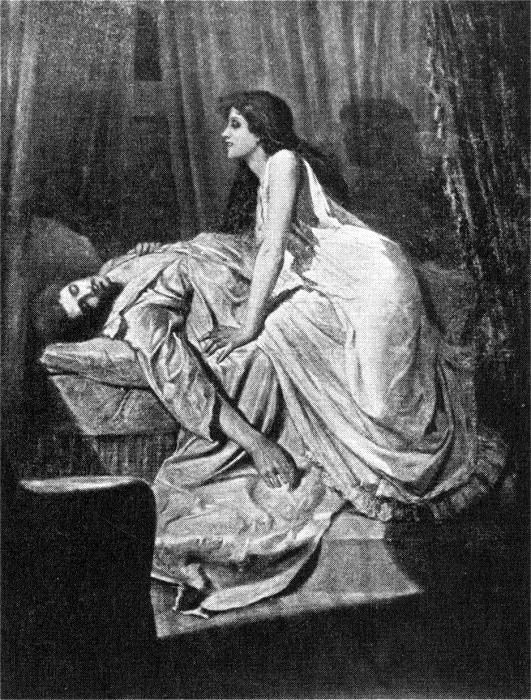
You have read the story knowing exactly how it ends for the human characters — diminished, drained, or turned — and you kept reading anyway, leaning slightly forward, secretly rooting for the wrong side.
That quiet betrayal of your own sympathies is not a glitch in your moral wiring. It is the most honest thing you do while reading. Ernest Becker argued in 1973 that the entirety of human civilization — its monuments, its religions, its hierarchies, its art — functions as an elaborate defensive structure erected against the single unbearable fact of biological mortality. The symbolic systems we inhabit, the careers we build, the legacies we chase: all of it, in Becker’s clinical dissection, is a negotiation with annihilation, an attempt to matter beyond the body’s expiration date. What the vampire offers is not the negotiation. It is the exit from the negotiation entirely.
This is why the creature’s aristocratic stillness reads as desirable rather than monstrous. Polidori’s Lord Ruthven, published in 1819 in The New Monthly Magazine, wore his predatory nature beneath the social costume of a London nobleman, and what disturbed his contemporary readers was not the horror of the disguise but the seductive coherence of it — power that required no democratic justification, appetite that needed no apology. The Industrial Revolution was reorganizing human beings into interchangeable units of productive labor, stripping time of its personal texture and replacing it with the clock’s tyranny. Against that backdrop, a creature for whom centuries pass like weather, who owns his own hours absolutely, was not a warning. He was a rebuke.
Bram Stoker worked with that inheritance and amplified it by inverting the geography of threat. Dracula travels westward in 1897, toward modernity, toward gaslight and shorthand and the new sciences of the rational mind, and he does not fear them. The novel’s heroes — a lawyer, a doctor, a psychiatrist, a scientist — assemble every instrument of contemporary knowledge to fight something that predates all of it. Their victory, if it can be called that, costs them Lucy Westenra and very nearly Mina Harker, and it leaves the world unchanged. Dracula’s castle still stands. The line of succession implied by the text remains open. Stoker could not bring himself to extinguish the fantasy completely, because the fantasy was never really his to kill.
What readers across two centuries have been rehearsing in these texts is not fear management but desire mapping. The vampire body does not age, does not hunger except on its own terms, does not answer to institutions, does not accumulate the small humiliations of biological debt — the fatigue, the illness, the slow arithmetic of physical decline. Sociologist Zygmunt Bauman wrote in Mortality, Immortality and Other Life Strategies in 1992 that modernity replaced the religious promise of eternal life with a secular project of indefinite postponement, turning death into a medical failure rather than a metaphysical appointment. The vampire short-circuits that entire anxious machinery. It does not postpone death. It has already survived it, and the survival required no virtue, no goodness, no deserving.
That last detail is the one that cuts deepest. The immortality we actually want is not the immortality of the saint or the martyr, earned through suffering and moral refinement. It is sovereignty without accountability, duration without diminishment, the right to persist simply because the appetite to persist exists. Every generation has rewritten the vampire slightly — made it more romantic, more tragic, more alienated — but the structural core has never changed, because the wish at the center of it has never changed either.
A vision curated by a filmmaker, not an algorithm
In this video I explain our vision
🦇 Blood, Darkness & the Gothic Imagination
The vampire myth did not emerge from nowhere: it grew from a rich soil of Gothic literature, Romantic obsession, and the Victorian fascination with the boundary between the living and the dead. From Polidori’s aristocratic Lord Ruthven to Stoker’s Transylvanian Count, the figure of the undead embodies repressed desire, social anxiety, and the horror of the Other. These related articles trace the literary and cultural currents that gave birth to one of literature’s most enduring monsters.
Sheridan Le Fanu: Irish Gothic and Domestic Horror
Sheridan Le Fanu, the Irish master of Gothic horror, explored themes of possession and vampiric desire decades before Stoker, most notably in his novella ‘Carmilla’. His domestic Gothic sensibility — locating terror inside familiar spaces and intimate relationships — shaped the psychological texture of vampire literature profoundly. Understanding Le Fanu is essential for tracing the literary genealogy that runs directly from Polidori to Stoker.
GO TO THE SELECTION: Sheridan Le Fanu: Irish Gothic and Domestic Horror
The Aesthetics of Decadentism: When Beauty Became Illness
Decadentism, with its cult of morbid beauty, corruption, and the aestheticisation of death, provided the cultural atmosphere in which the vampire myth flourished in the late nineteenth century. The Decadent movement embraced themes of physical decay, transgressive desire, and the seduction of darkness — all central to the vampire’s literary power. Stoker’s Dracula is inconceivable without this aesthetic backdrop that linked beauty irrevocably to illness and ruin.
GO TO THE SELECTION: The Aesthetics of Decadentism: When Beauty Became Illness
Robert Louis Stevenson: Life and Works
Robert Louis Stevenson, a near-contemporary of Stoker, explored the duality of human nature and the horror lurking beneath respectable Victorian surfaces with extraordinary literary skill. His work belongs to the same cultural moment that produced the literary vampire: an era haunted by fears of atavism, moral regression, and the animalistic impulses hidden within civilised humanity. Reading Stevenson alongside Polidori and Stoker reveals the shared anxieties that drove Gothic fiction in the nineteenth century.
GO TO THE SELECTION: Robert Louis Stevenson: Life and Works
Edgar Allan Poe and the Cursed House: Architecture of Terror
Edgar Allan Poe‘s conception of the cursed house as an architectural projection of psychological terror established a Gothic vocabulary that European writers, including the creators of vampire fiction, would draw upon repeatedly. The decaying mansion, the sealed vault, and the returning dead — all hallmarks of Poe’s imagination — echo powerfully through the vampire genre from Varney the Vampire to Dracula’s castle. Poe represents a transatlantic Gothic inheritance that enriched and darkened the blood-literature flowing between Polidori and Stoker.
GO TO THE SELECTION: Edgar Allan Poe and the Cursed House: Architecture of Terror
Discover Gothic Worlds on Indiecinema
If these dark literary labyrinths have stirred your imagination, Indiecinema is your gateway to independent films that explore the Gothic, the uncanny, and the horror of the human condition with the same depth and daring as the great vampire writers. Stream curated independent cinema that goes beyond the mainstream and dares to look into the darkness — only on Indiecinema.
👉 EXPLORE THE CATALOG: Watch Indie Films in Streaming
A vision curated by a filmmaker, not an algorithm
In this video I explain our vision

