
The Juridical Invention of Atrocity
You are standing in a courtroom that was built for the occasion, in a city chosen because it still had a functioning courthouse, in a year when the men being tried had already lost the war that produced the crimes being named for the first time. Nuremberg, 1945. The architecture of justice was assembled after the fact, the way a frame is built around a painting that already exists, and what most accounts of that trial have since obscured is the radical novelty of the gesture: the law invoked did not precede the acts it condemned. It was written in the interval between the surrender and the sentencing.

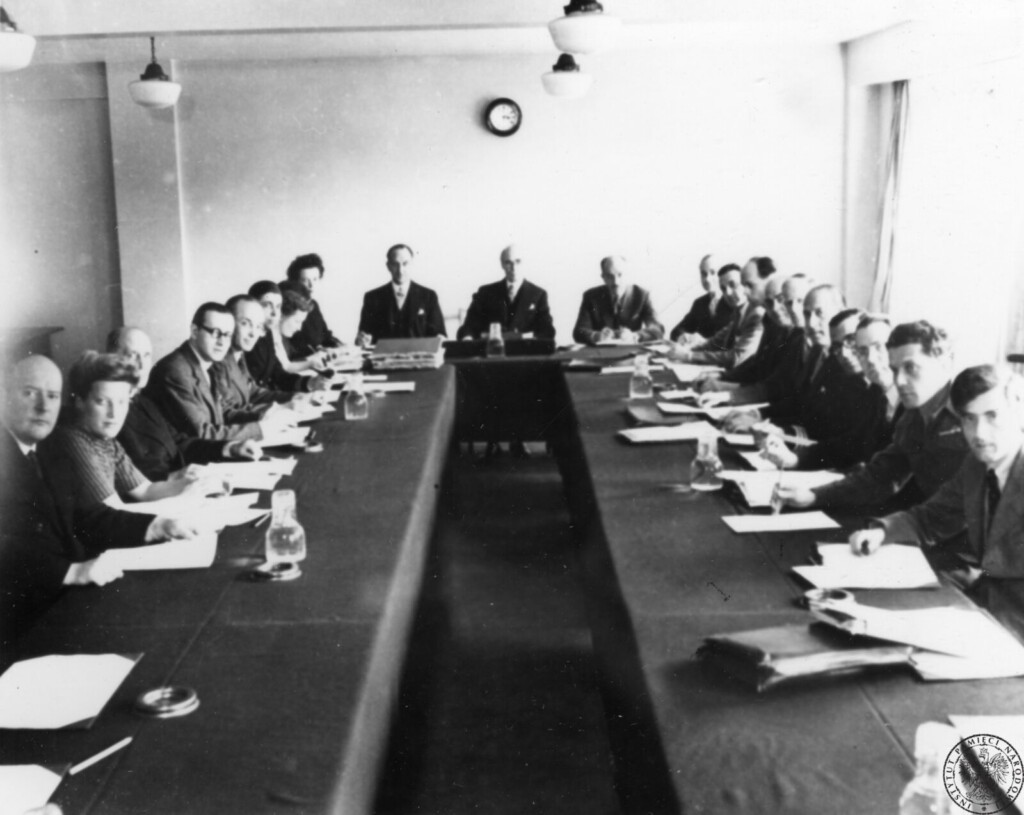
This is not a cynical observation. It is a structural one. The London Charter of August 1945, which established the legal basis for the International Military Tribunal, created three categories that had never been codified in international law with anything like the precision now required to kill men by them: crimes against peace, war crimes in the narrow sense, and crimes against humanity. The last of these was the most unprecedented. Hersch Lauterpacht, the Cambridge jurist who had spent his career arguing for individual legal standing within international law, had pressed for its inclusion precisely because he understood that states could commit atrocities against their own populations in ways that no existing treaty prohibited. What he achieved at Nuremberg was a juridical rupture, a category that did not describe a violation of a prior rule but that constructed the rule at the moment of its application.
The retroactive quality of that construction was noticed immediately, and not only by the defense. The Soviet judge Iona Nikitchenko, who had presided over Stalin’s show trials in the 1930s, sat on the tribunal. The United States had firebombed Tokyo in March 1945, killing an estimated 80,000 civilians in a single night. The victors were not indifferent to the problem this posed — they were acutely aware of it — and their response was not to resolve the asymmetry but to contain it through procedural authority. What gave Nuremberg its legitimacy was not the moral consistency of its architects but the sheer institutional weight of the apparatus they assembled around the proceedings, the robes, the simultaneous translation in four languages, the mountains of German documentary evidence that the defendants had themselves generated.
Hannah Arendt traveled to Jerusalem in 1961 to watch Adolf Eichmann stand trial, and what she wrote about what she saw became one of the most contested philosophical documents of the twentieth century. Her 1963 book “Eichmann in Jerusalem” proposed something the prosecutors could not accept and that many survivors found obscene: that Eichmann was not a monster. He was a bureaucrat. A man of staggering moral vacancy who had organized the logistics of mass deportation the way another man might have organized railway timetables, with professional diligence, an eye for efficiency, and an almost total incapacity for independent thought. Arendt’s phrase “the banality of evil” was misread almost immediately as a diminishment of the crime, when in fact it was a far more disturbing diagnosis — that the machinery of genocide does not require malevolence at its operational center, only compliance, paperwork, and a bureaucratic culture that severs the actor from the consequence of the act.
What that insight does to the legal category of the war crime is quietly devastating, because the entire juridical architecture of Nuremberg and its successors depends on locating individual criminal intent. The law must find a person who decided, who knew, who willed the harm. Arendt was showing that the most efficient forms of organized killing are precisely those that distribute responsibility so finely across a hierarchy that no single point of the system is clearly, unambiguously guilty in the way the law requires — and that the men in the dock at Nuremberg who seemed most monstrous were often those who had been most visible, most rhetorical, most personally invested, while the quieter engineers of the process had already vanished into the procedural fog of just following orders.
Sovereignty as Impunity Architecture
You are sitting in a lecture hall in 1946, and the professor at the front is explaining, with genuine bewilderment in his voice, why the trial happening in Nuremberg is legally impossible. Not morally wrong — legally impossible. The argument is simple: for nearly three centuries, the sovereign state had been, by definition, the entity that could not be judged. To put a state’s agents on trial for actions taken in service of that state was not merely unprecedented. It was a conceptual contradiction, like convening a court to judge the rules of logic themselves.
The Peace of Westphalia, signed in October 1648 after thirty years of war that reduced portions of Central Europe to roughly a third of their previous population, did not simply end a conflict. It manufactured a political grammar that would govern international relations for the following three hundred years. The principle was elegant in its circularity: states were sovereign, sovereignty meant freedom from external jurisdiction, and therefore what a state did to its own subjects was, by definition, not the business of other states. This was not a cynical arrangement disguised as philosophy. It was an earnest solution to a catastrophe — the catastrophe of religious wars in which external powers constantly intervened in the internal affairs of neighbors under moral pretexts. The cure was the absolute quarantine of domestic political space from international scrutiny.
What this quarantine produced, structurally and inevitably, was a world in which massacre could be committed with full legal cleanliness. The Armenian genocide of 1915 to 1916, in which somewhere between 600,000 and 1.5 million people were killed by the Ottoman state, generated international outrage but zero juridical consequence, because the Ottoman state was sovereign and the killings occurred within its territory against its own subjects. The 1907 Hague Conventions, often cited as a proto-humanitarian legal framework, addressed the conduct of war between states, not the conduct of states toward their own populations. The distinction was not incidental. It was load-bearing.
Hugo Grotius, writing in De Jure Belli ac Pacis in 1625, had imagined a natural law that could in principle constrain even sovereign actors. But Grotius was read selectively. What the post-Westphalian order absorbed from his work was the legitimacy of state power in international relations; what it quietly discarded was his insistence that certain acts were wrong regardless of who committed them. Emer de Vattel, whose 1758 treatise Le Droit des Gens became the practical legal bible of European diplomacy, went further and nearly entirely collapsed the distinction between legality and sovereignty: what the sovereign did was, by that very fact, within its rights. By 1914, this was not a contested philosophical position. It was the water that every diplomat, every general, and every treaty-drafter swam in without noticing it was wet.
The First World War produced the Treaty of Versailles in 1919, which included Article 227, calling for the trial of Kaiser Wilhelm II for “a supreme offence against international morality.” He was never tried. The Netherlands, where he had fled, refused extradition on the grounds that the alleged crime had no legal existence at the time it was committed — a jurisdictional argument that was, under the prevailing international legal order, entirely correct. The attempt collapsed not because of political cowardice alone, though there was plenty of that, but because the architecture itself did not permit what was being demanded. You cannot convict someone under a law that does not exist, and the law that would have made supreme political violence a crime against the international order simply had not been written.
When Robert Jackson stood before the Nuremberg tribunal in November 1945 and declared that four great nations were choosing law over vengeance, he was not describing an evolution. He was announcing a rupture so violent in its implications that the legal community spent decades arguing about whether it had actually happened.

The Geneva Conventions and the Grammar of Permissible Killing
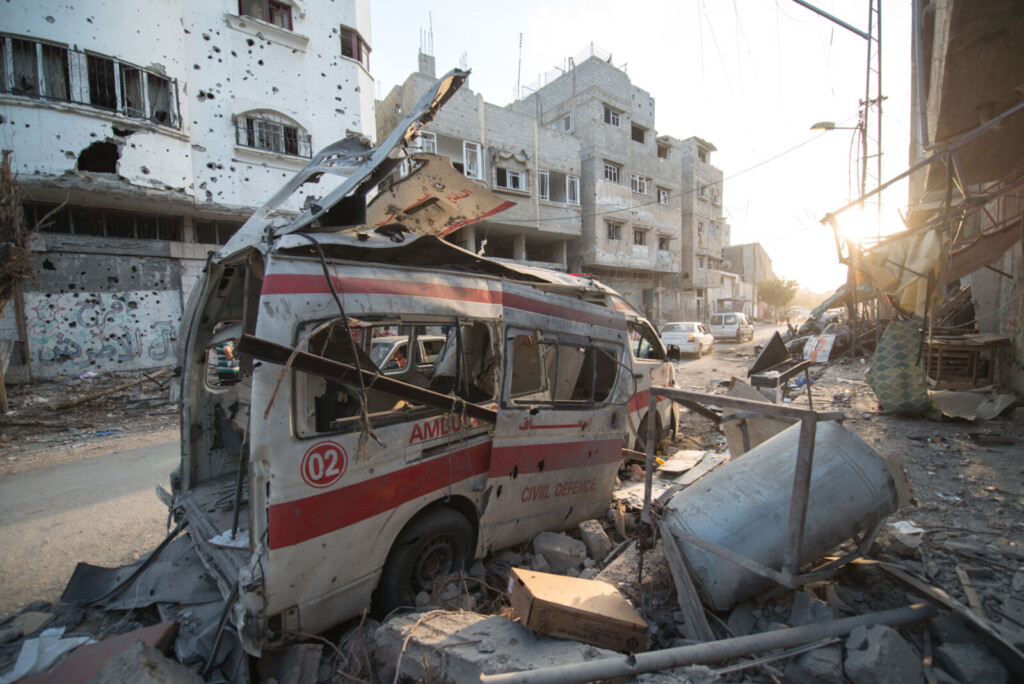
You are handed a document, forty-some pages, dense with subsections and annexes, and somewhere around page twelve you realize you are reading a manual for how to kill people correctly. Not a polemic, not a provocation — the actual Geneva Conventions of 1949, ratified by every recognized state on earth, the closest thing international law has produced to a universal moral consensus. The horror is not that they exist. The horror is that they are genuinely humane, carefully reasoned, and shot through with a logic that can only function if organized mass killing is first accepted as a permanent feature of human civilization.
The four Conventions, finalized in August 1949 with the smoke of the Second World War still readable in the drafting committee’s language, established protections for wounded soldiers, prisoners, civilians, and shipwrecked combatants. They were ratified by 196 states. They are cited in military training manuals from Washington to Beijing. They represent, by any honest measure, a genuine reduction in certain forms of cruelty. And yet to read them carefully is to notice that the prohibition on targeting civilians is only coherent once you have accepted that targeting combatants is legitimate — that there exists a human being who may be shot, bombed, burned, and killed by any method short of the specifically forbidden, and that this killing generates no legal or moral liability for the killer provided the uniform is worn correctly and the weapon is not chemically dispersed.
Carl Schmitt identified in 1932, in “The Concept of the Political,” the foundational grammar beneath all of this. His argument was not a celebration of violence but a diagnosis: the political is constituted by the distinction between friend and enemy, and this distinction, once operative, creates a domain where normal moral prohibitions are suspended not by exception but by definition. The enemy in Schmitt’s framework is not a criminal, not a sinner, not an inferior being — they are a public enemy, a hostis rather than an inimicus, someone who must be fought not because they are hated but because the political logic demands it. What the Geneva Conventions accomplished, without naming it, was the juridical formalization of exactly this structure: the combatant is the enemy in Schmitt’s sense, and the Conventions protect them precisely by confirming their status as a legitimate target.
This produces a grammar in which the sentence “you may not torture a prisoner of war” and the sentence “you may have killed him yesterday on a battlefield” belong to the same moral universe, enforcing the same underlying logic. The prohibition on torture does not interrupt the permission to kill — it decorates it. It tells the soldier, and the state behind the soldier, that they are operating within a civilized framework, that there is a line they will not cross, and the existence of that line serves as the ethical alibi for everything on this side of it.
What disappears inside this grammar is the possibility of asking whether the category of “combatant” is itself a constructed permission rather than a natural fact. A nineteen-year-old conscript from a rural province who has never formed a political opinion in his life, who was handed a rifle six weeks ago, becomes — by virtue of that rifle and that uniform — someone another nineteen-year-old from another rural province is legally and morally authorized to kill. The Conventions do not create this. They inherit it, stabilize it, give it the texture of international consensus, and then build their entire humanitarian architecture on top of it without ever questioning the foundation.
There is a school of thought in international law, associated with scholars like Karma Nabulsi in her 2001 study of the laws of war and their historical trajectory, that argues the codification of permissible conduct in war has historically served the interests of established military powers more than it has protected the vulnerable — that every Geneva article restricting certain weapons or methods was negotiated by states already possessing the weapons they were willing to give up.
The Selective Prosecution Problem
You have probably never noticed that every war crimes tribunal in modern history has been convened by the winners, staffed by the winners, and concluded with the punishment of the losers. This is not a conspiracy theory. It is a structural fact so obvious it tends to disappear into the background, the way the frame of a painting disappears once you are staring at the canvas.
At Nuremberg, the Soviet judges who presided over the condemnation of Nazi defendants for the massacre at Katyn were themselves representatives of the state that had ordered that massacre — roughly 22,000 Polish officers and intellectuals shot in the spring of 1940, a crime the USSR would not officially acknowledge until 1990. The procedural architecture of international justice was built, from its very first chamber, on a foundation that excluded itself from scrutiny. This was not an accident of history. It was the load-bearing wall.
The Tokyo Tribunal of 1946 to 1948 followed the same logic with elegant consistency. General Douglas MacArthur personally shielded Emperor Hirohito from prosecution despite overwhelming evidence of command responsibility, because a stable postwar Japan required the emperor’s symbolic continuity. Simultaneously, Unit 731 — the Imperial Army’s biological warfare division responsible for lethal experiments on thousands of Chinese and Soviet prisoners — was granted full immunity by American authorities in exchange for research data. The justice dispensed at Tokyo was real for some defendants and structurally unavailable for others, calibrated not by the severity of conduct but by the geopolitical utility of the perpetrators.
What happened in the 1990s only made the pattern more visible. The International Criminal Tribunal for the former Yugoslavia prosecuted 161 individuals between 1993 and 2017, the vast majority Serbian. The NATO bombing campaign of 1999, which killed an estimated 500 civilians according to Human Rights Watch, struck passenger trains, a television station, the Chinese embassy in Belgrade, and used cluster munitions in populated areas — all conduct the tribunal’s own prosecutor, Carla Del Ponte, opened a preliminary review on before concluding in June 2000 that no investigation was warranted. The reasoning was not that the deaths did not occur. It was that NATO’s intentions had been lawful, a standard of mens rea conveniently inapplicable to the defendants already in the dock.
The International Criminal Court, created by the Rome Statute in 2002 with the explicit mandate to end impunity, has issued 31 arrest warrants in its first two decades, every single one targeting African defendants — until Russia’s invasion of Ukraine generated sufficient Western consensus to indict Vladimir Putin in 2023. The United States, which invaded Iraq in 2003 on the basis of intelligence its own Senate Select Committee on Intelligence later described as fabricated, has never faced a formal ICC proceeding. It cannot: Washington signed but never ratified the Rome Statute, and the Trump administration sanctioned ICC officials in 2020 for even investigating American conduct in Afghanistan. The court’s jurisdiction is structured so that it applies maximum force precisely where sovereign power is weakest, and becomes theoretical where that power is strong enough to resist it.
Russia’s two Chechen wars — 1994 to 1996 and 1999 to 2009 — produced documented evidence of enforced disappearances, filtration camps, and extrajudicial executions compiled by Memorial, the human rights organization that the Russian government dissolved in 2021. The European Court of Human Rights ruled against Russia in more than 250 individual cases involving Chechnya. Not a single senior Russian military or political figure faced criminal prosecution in an international forum. The mechanism that should have activated did not activate, and the reason is not procedural complexity or evidentiary insufficiency — it is that international criminal law remains dependent on the political will of powerful states to enforce it, which means it enforces itself selectively, against those who lack the capacity to make enforcement costly.
Perpetrators as Ordinary Men
You have probably, at some point, told yourself that you would have refused. That if you had been there — in that century, in that uniform, in that chain of command — you would have been the one who stepped aside, who looked away and walked, who found some interior reserve of moral clarity that the others apparently lacked. This belief is not a sign of your virtue. It is a sign of how little you understand what happened to people who were, by every measurable standard, no different from you.
In 1992, the historian Christopher Browning published Ordinary Men, a meticulous reconstruction of Reserve Police Battalion 101, a unit of middle-aged German men — Hamburg dock workers, tradesmen, clerks — who were explicitly given the option by their commander to step out before the mass shootings began in occupied Poland. Most did not step out. By the end of their deployment, this single battalion had shot approximately 38,000 Jews and deported another 45,000 to Treblinka. Browning’s finding was not that these men were ideological fanatics. It was that they were not. They killed primarily because they did not want to appear weak in front of their peers, because the social cost of refusal felt larger in the moment than the moral cost of compliance, because human beings are structurally disposed to subordinate private conscience to group belonging when institutional pressure is sufficiently organized.
This is not a German pathology. The architecture of that subordination is universal, which is the part no one wants to accept. Philip Zimbardo spent decades building the experimental and theoretical case for what he called the Lucifer Effect — the title of his 2007 synthesis — arguing that evil is less a property of persons than a property of situations. His Stanford Prison Experiment of 1971, however flawed in its later methodological scrutiny, pointed toward something real that two decades of subsequent field research confirmed: given the right institutional conditions, the right hierarchy, the right diffusion of responsibility, and the right framing of the victim as something other than fully human, ordinary people will perform acts that, viewed from outside those conditions, appear monstrous. The conditions are not rare. They are, in fact, the standard operating conditions of military occupation, colonial administration, and emergency governance.
What this means sociologically is deeply uncomfortable. War crimes are not statistical outliers produced by the occasional psychopath who slips through recruitment screening. They are, in the language of the social sciences, expectable outcomes of predictable institutional structures. When Stanley Milgram published Obedience to Authority in 1974, synthesizing his famous electric-shock experiments from the early 1960s, he found that approximately 65 percent of ordinary American subjects would administer what they believed to be lethal electric shocks to a stranger when instructed to do so by a figure of institutional authority. Sixty-five percent is not a fringe. Sixty-five percent is the majority of any room you have ever entered.
The legal frameworks constructed after Nuremberg rested on an implicit theory of the exceptional perpetrator — the ideologically possessed fanatic, the sadist, the man visibly outside the moral community of humanity. This theory was emotionally necessary in 1945 because it allowed surviving societies to quarantine the violence as something foreign, something that had arrived from outside the normal range of human behavior. The evidence has never supported that quarantine. What Browning’s battalion showed, and what the social psychology of the following half-century confirmed, is that the distance between the person reading this sentence and the person who carried out a massacre under institutional orders is not a distance of character. It is a distance of circumstance — of whether the orders ever arrived, of whether the situation was ever constructed around them, of whether the social world they inhabited ever made refusal feel like a survivable act rather than an annihilation of belonging.
A vision curated by a filmmaker, not an algorithm
In this video I explain our vision
Memory, Testimony, and the Evidentiary Trap

You have already told your story once, in a refugee processing center, to a man who typed while you spoke and never looked up. You told it again to an NGO intake officer who needed it formatted into boxes on a form. You will tell it a third time here, in this room with high ceilings and simultaneous translation earpieces, and a lawyer in a pressed suit will ask you why you cannot remember whether the soldier’s insignia was on his left shoulder or his right, because the documentation requires precision, and your answer — that you were watching his hands, that you were calculating whether his hands were moving toward his weapon — will be logged as inconsistency.
The courtroom was not designed for this kind of knowing. It evolved from medieval English common law through centuries of property disputes, inheritance claims, contract breaches — contexts in which memory is expected to be sequential, detail-oriented, and stable across repetition. The adversarial cross-examination protocol, which remains the procedural backbone of both the International Criminal Tribunal for the former Yugoslavia and the Rome Statute proceedings before the International Criminal Court, assumes that contradictions in testimony signal fabrication or confusion. Neuroscience has understood since at least Bessel van der Kolk’s 1994 work on traumatic stress that the opposite is frequently true: trauma encodes experience in fragments, in sensory flashes, in non-linear bursts that resist the chronological scaffolding a legal narrative demands. What the defense attorney reads as a collapsing story is often the precise signature of a real one.
Primo Levi wrote in The Drowned and the Saved, published in 1986 — his final book before his death the following year — about the gray zone not as a moral evasion but as a structural condition imposed by extreme power on those it destroys. The Sonderkommando were not collaborators in any meaningful sense of the word; they were men forced into an impossible position by a machinery designed to make clean moral categories impossible to occupy. Levi understood that the gray zone exists precisely to make testimony unbelievable, to ensure that survivors carry within their own accounts the seeds of their own discrediting. When a witness before a tribunal admits to having complied, out of terror, with an order from the person now in the dock, the defense does not need to prove fabrication — it only needs to let the admission breathe in the courtroom air. The system extracts the complexity and converts it into doubt.
What makes this especially corrosive is that the tribunals genuinely believe in what they are doing. The judges are not cynical. The prosecutors are not indifferent. The procedural violence is invisible to those administering it because it is encoded in the very definition of evidence, of reliability, of legal truth. When the ICTY in 2001 convicted Radislav Krstic of aiding and abetting genocide for his role in Srebrenica, it did so partly on testimony that had survived brutal cross-examination — testimony that endured precisely because it was consistent in its emotional core even when the peripheral details shifted under pressure. But that outcome required a specific kind of survivor with a specific relationship to their own memory, and for every Krstic prosecution, there are proceedings in which the witness breaks under the epistemological demand and the case dissolves not because the atrocity did not happen but because the happening cannot be legally reconstructed.
Justice Richard Goldstone, reflecting on the early years of the ICTY in his 2000 memoir For Humanity, noted that the tribunals were simultaneously legal institutions and historical ones — a dual mandate that creates a structural tension no procedural reform has resolved. History accommodates ambiguity; law must terminate in a verdict. The survivor standing at the intersection of those two demands is asked to be something no human being can fully be: a clean, consistent, legally legible witness to their own destruction.
The ICC's Structural Contradictions
You are sitting in a courtroom designed to represent all of humanity, and the chair reserved for the most powerful nations in the room is empty. Not absent by accident, not empty through oversight, but deliberately, conspicuously, defiantly vacant. The International Criminal Court, brought into existence by the Rome Statute signed in July 1998 and formally operational by 2002, was conceived as the permanent institutional answer to the question that Nuremberg had raised and left unresolved: who holds sovereignty accountable when sovereignty itself commits atrocity? The answer the court offers is architecturally elegant and politically catastrophic in equal measure.
One hundred and twenty-four states have ratified the Rome Statute. That number sounds like a majority until you notice which states are missing. The United States signed the statute under the Clinton administration and unsigned it under Bush in 2002, a gesture so deliberately hostile that it required inventing a new diplomatic category. China never signed. Russia signed and then withdrew its signature in 2016, the same year the court released a report classifying the annexation of Crimea as an occupation. India, with 1.4 billion people, has remained entirely outside the court’s jurisdiction. What the ICC actually governs, then, is not humanity but a specific coalition of states, disproportionately African and European, whose political calculations made ratification either safe or symbolically useful at the moment of signing.
The political philosopher Martti Koskenniemi, whose 2001 work “The Gentle Civilizer of Nations” traced international law’s complicity in the very imperial structures it claimed to transcend, argued that international legal institutions carry within them the contradictions of the order that produced them. The ICC did not emerge from a neutral political space. It emerged from the post-Cold War moment when Western liberal democracies briefly believed they had won history and could institutionalize that victory in permanent form. The court was built in that window, and the window closed before the architecture was finished.
The practical consequences of this are not theoretical. The court cannot prosecute a crime committed by a citizen of a non-member state on the territory of another non-member state without a United Nations Security Council referral, and the Security Council contains permanent members with veto power who are themselves non-signatories. This is not a procedural flaw. It is a constitutional guarantee of impunity for the powerful, written directly into the operating logic of the institution. When the Security Council referred the situation in Darfur to the ICC in 2005, leading to the indictment of Omar al-Bashir, the United States abstained rather than vetoed, but it did so from outside the court’s jurisdiction, shaping outcomes in a system it refused to join. Power exercises itself through international law even when it refuses accountability to international law.
Between 2002 and 2023, every completed ICC conviction involved an African defendant. This statistical fact produced a predictable and not entirely dishonest accusation: that the court functions as a mechanism of selective justice, prosecuting the weak while the strong operate with structural immunity. The ICC’s defenders argue that African states themselves referred many of these cases, which is true, and that selective justice is still better than no justice, which is a more complicated claim than it appears. Selectivity in criminal law is not a minor procedural imperfection. It is a statement about whose violence counts as a crime and whose counts as policy.
What the ICC has actually produced, across its two decades of operation, is a detailed jurisprudence of accountability applied to a carefully circumscribed category of perpetrators, while simultaneously demonstrating that the states most capable of committing large-scale organized violence have successfully exempted themselves from the system they often publicly endorse. The court’s moral vocabulary is universal. Its jurisdiction is a negotiated perimeter around the already-vulnerable.
Reparation, Recognition, and the Debt That Cannot Be Paid
You are handed a check. It has your name on it, a government seal, a precise figure arrived at by a committee that spent months debating methodology. You hold it and feel nothing close to what it was supposed to produce, because the calculation behind it required converting something into a number, and the thing that was converted was a person.
This is the foundational embarrassment of reparative justice — not that it fails to work, but that it works exactly as designed and still leaves an abyss. Paul Ricoeur, writing in Memory, History, Forgetting in 2000, described what he called the “debt to the dead” — the irreducible obligation that living communities inherit from those who were destroyed, an obligation that cannot be discharged because its creditors no longer exist to receive payment. The transaction is structurally impossible. The check cannot clear. And yet the apparatus of transitional justice continues to issue checks, both literal and symbolic, because the alternative — acknowledging that the debt is permanent and unpayable — would require institutions to admit that their fundamental purpose is not restoration but the management of an irresolvable wound.
Rwanda after 1994 offers the most concentrated laboratory for this impossibility. Approximately eight hundred thousand people were killed in one hundred days, a rate of destruction that exceeded even the industrial efficiency of the Nazi genocide. The gacaca courts, convened between 2002 and 2012, processed nearly two million cases by mobilizing local communities as both judges and witnesses, a mechanism praised internationally for its scale and condemned internally for its coercions. Survivors were asked to sit across from perpetrators, to narrate their losses, to participate in a structured theater of acknowledgment. What the process produced was not healing — that word smuggled in from clinical psychology to colonize a political space where it does not belong — but a kind of enforced proximity between victim and killer that the state required for its own coherence. The Rwandan government needed a story of reconciliation because the alternative was a country permanently organized around the fact of its own catastrophe.
What gets suppressed in every reparative framework is the ontological scandal at the center of mass atrocity: the dead are not wounded, they are absent. Injury implies a body that can be treated, a before-state that can be approximated again. Murder eliminates the subject of any future restoration. When a truth commission grants “recognition” to a victim community, it is recognizing survivors — it is doing something for the living in the name of the dead, which is a fundamentally different act than justice for those who were killed. The substitution is so habitual, so institutionally embedded, that pointing it out feels like bad faith, like disrupting a funeral to discuss the theology of resurrection. But the substitution is the mechanism. The living receive acknowledgment because the dead cannot, and the state certifies its own legitimacy by presiding over the ceremony.
There is a more destabilizing possibility lurking beneath the entire architecture of international criminal justice — that the demand for accountability, the insistence that perpetrators be named and sentenced and recorded, may function less as justice for the dead than as a psychological necessity for the living. To prosecute is to assert that the catastrophe was not meaningless, that it has consequences that extend forward in time, that the world contains a moral structure capable of responding. Hannah Arendt saw something like this in the Eichmann trial — the way a legal proceeding could serve a narrative hunger that exceeded anything law was designed to satisfy. What the trial produced was not justice in any philosophically coherent sense but a story, with a beginning and an ending and a figure upon whom meaning could be concentrated. The story was necessary. It was also, in the strictest sense, a fiction imposed on an event that resisted narrative containment entirely — and perhaps every court convened in the aftermath of atrocity is, at its core, humanity’s refusal to tolerate the silence that mass death actually leaves behind.
⚖️ Justice, Memory, and the Crimes of History
War crimes do not exist in isolation — they emerge from systems of power, historical silence, and the slow erosion of human dignity. These articles explore the political, social, and psychological forces that enable atrocity, and the long struggle to hold perpetrators accountable. Follow these thematic threads to deepen your understanding of how violence, justice, and memory intertwine across history.
Racial violence worldwide: Emblematic cases of recent history
Racial violence is among the most documented and yet most denied forms of historical atrocity, surfacing in conflicts that range from colonial genocides to contemporary ethnic cleansing. This article examines emblematic cases from recent history, tracing the conditions that allow state-sanctioned brutality to flourish unchecked. Understanding these episodes is essential to grasping how international justice mechanisms have been shaped by repeated failures to intervene in time.
GO TO THE SELECTION: Racial violence worldwide: Emblematic cases of recent history
Banal Evil and Radical Evil: Kant and Arendt
Hannah Arendt’s distinction between banal and radical evil offers a foundational philosophical lens for understanding how war crimes are committed not only by ideological fanatics but by ordinary administrators of violence. This article explores how Kant’s moral framework and Arendt’s political thought converge on the question of individual responsibility within murderous systems. It is indispensable reading for anyone seeking to understand why international tribunals insist on prosecuting individuals rather than abstractions.
GO TO THE SELECTION: Banal Evil and Radical Evil: Kant and Arendt
The indissoluble link between historical memory and collective consciousness
The link between historical memory and collective consciousness lies at the heart of every effort to document, judge, and prevent war crimes. This article investigates how societies construct and transmit the memory of mass violence, and why some atrocities are remembered while others are systematically erased. Without active memory, impunity becomes the default condition of international politics.
GO TO THE SELECTION: The indissoluble link between historical memory and collective consciousness
How power elites manufacture the public enemy
War crimes have historically depended on the manufacture of a public enemy — a scapegoat whose dehumanization legitimizes extraordinary violence. This article examines how power elites construct and disseminate the image of the enemy, mobilizing populations behind campaigns of persecution that later come before international courts. Recognizing these mechanisms is the first step toward dismantling the propaganda architectures that make mass atrocity possible.
GO TO THE SELECTION: How power elites manufacture the public enemy
Discover Independent Cinema on Indiecinema
If these themes have moved you to look deeper, Indiecinema is the streaming platform where independent and documentary cinema confronts the hardest truths about history, justice, and human rights. Explore films that mainstream platforms won’t show you — stories of witnesses, survivors, and investigators told with the unflinching honesty only independent cinema can offer.
👉 EXPLORE THE CATALOG: Watch Indie Films in Streaming
A vision curated by a filmmaker, not an algorithm
In this video I explain our vision

