
The Myth of Rebellion as a Consumer Product
You are standing in a record store in 1991, and the fluorescent light above you is flickering in that specific way that makes everything feel slightly unreal. You pull a cassette from the rack — the cover is deliberately ugly, the band name printed in a font that looks like it was cut from a ransom note. You feel, for the first time in your life, that something was made specifically against you, and that this is exactly why you need it.

That feeling was real. And it was being catalogued by a marketing department in Manhattan before you ever felt it.
The paradox at the heart of nineties counterculture is not that it failed. It is that it succeeded so completely at being legible that the machinery of capital read it faster than its own participants could. Thomas Frank documented this with surgical precision in The Conquest of Cool, published in 1997, arguing that the advertising industry did not merely react to youth rebellion — it had been practicing a grammar of anti-conformism since the early 1960s. By the time Kurt Cobain wrote the word “corporate” as an accusation on his guitar, corporations had already spent three decades learning how to wear that accusation as a costume. The distance between authentic rupture and marketed identity was not closed from the outside. It was never open in the first place.
This does not mean the gestures were hollow. It means the system had developed an immune response so sophisticated that it could metabolize dissent at the cellular level, converting the energy of refusal into a new product category before the refusal had time to organize itself politically. Dick Hebdige‘s 1979 work Subculture: The Meaning of Style had already traced this mechanism through punk and reggae, showing how subcultural style moves from bricolage to commodity in a cycle that is not accidental but structural — the market requires novelty the same way a body requires oxygen, and counterculture is novelty in its purest, most emotionally charged form. The nineties simply accelerated this cycle to a speed that made the gap between creation and consumption nearly invisible.
Grunge is the clearest case study, but it is almost too clean, too obvious to be useful. More revealing is what happened to riot grrrl, the feminist punk movement that emerged from Olympia, Washington around 1991, built deliberately around practices of refusal: no photos, no interviews with mainstream press, zines instead of albums, community instead of audience. Kathleen Hanna and the women organizing around Bikini Kill understood, with a clarity that was almost prophetic, that visibility in the existing media ecosystem meant distortion. They tried to make themselves indigestible. By 1993, mainstream magazines were running features on “angry women in rock,” the political content evacuated, the rage aestheticized, the movement reduced to a fashion moment defined by baby-doll dresses and combat boots. The refusal had been reframed as a look.
What this reveals is something more structurally disturbing than simple co-optation. It reveals that capitalism in its late consumer phase does not suppress counterculture — it requires it. The system needs a position called “outside” in order to generate the desire to escape toward it, which then becomes the engine of new consumption. Guy Debord understood in 1967, in The Society of the Spectacle, that the spectacle does not impose false consciousness through lies but through the organization of appearances so total that the distinction between authentic experience and its representation becomes operationally meaningless. The nineties were the first decade in which an entire generation performed this diagnosis publicly, in real time, while being unable to step outside it — singing about the trap from inside the trap, amplified by the trap’s own speakers.
Grunge, Riot Grrrl, and the Body as Political Territory
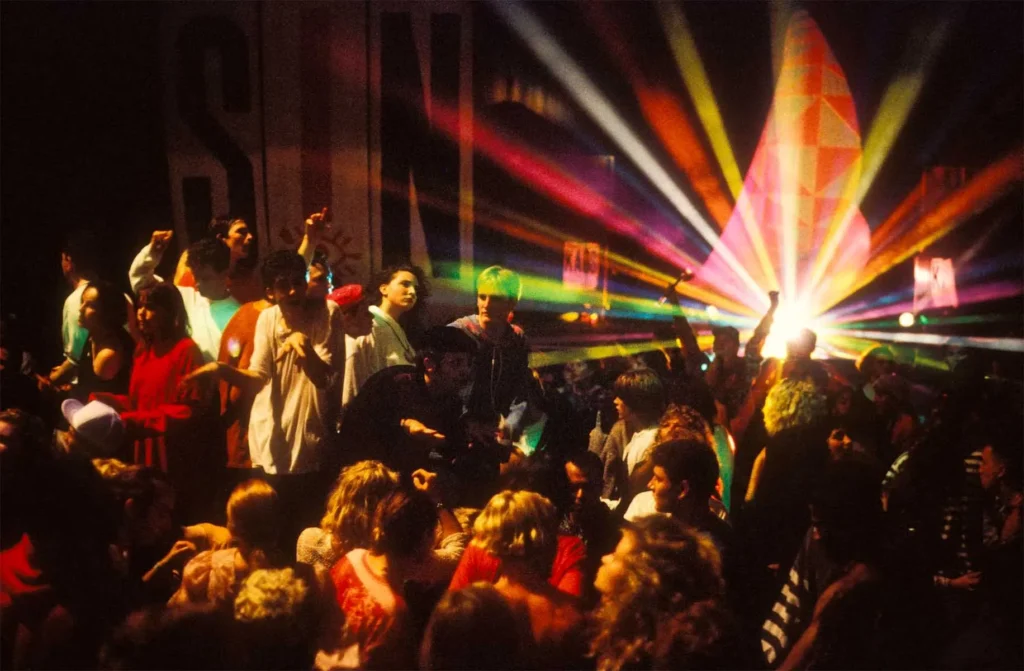
You are standing in front of a mirror at seventeen, and you have just taken a razor to the hem of your flannel shirt, not to ruin it but because ruination is the point — the fraying edge is the statement, the deliberate refusal of finish, the declaration that you will not be completed for their consumption.
What grunge understood, before it understood anything intellectually, was that the body is a surface that culture writes on first. The music industry in 1991 had perfected a grammar of desire: smooth production, symmetrical faces, choreographed motion, the performer as aspirational object. When Nevermind arrived in September of that year and displaced Michael Jackson from the top of the Billboard charts by January 1992, it did not win on the terms of that grammar. It won by burning the grammar. Kurt Cobain performed self-destruction not as tragedy but as refusal — the unwashed hair, the cardigan borrowed from a thrift store, the hunched posture that communicated I do not want your gaze, which is precisely what made the gaze impossible to withdraw. The paradox was structurally embedded: the more aggressively ugly the presentation, the more culturally magnetic the signal. Guy Debord had described the spectacle as the moment when lived experience becomes representation, when being is replaced by having, having by appearing. Cobain appeared to disappear, and that disappeared appearance became the most powerful spectacle of the decade.
But the machinery that consumed him was not the only machine running in the early nineties. Parallel and largely invisible to mainstream coverage, a movement was forming in Olympia, Washington that understood something grunge often fumbled: the body as political territory is not the same problem for everyone. Riot Grrrl, which crystallized around 1991 through the work of bands like Bikini Kill and zines photocopied on borrowed machines, took the punk inheritance and redirected its violence inward toward something more precise. Kathleen Hanna walked onto stages with words written in marker across her stomach — SLUT, RAPE, the vocabulary of male accusation turned into armor, worn as a challenge and a confession simultaneously. This was not metaphor. It was a literal inscription of the argument: that women’s bodies had always been written on without consent, and the act of seizing the pen was itself the politics.
The aesthetic of deliberate ugliness that grunge employed as alienation, Riot Grrrl employed as truth-telling. The noise was not nihilism but testimony. In 1991, Carol Gilligan’s work on adolescent girls losing their voices as they entered the social contract of femininity had already been circulating in academic spaces, but Hanna and her collaborators were not interested in academic translation. They were interested in the scream as a primary document. The Riot Grrrl manifesto, distributed in xeroxed fragments at shows, declared the need for a girl-style revolution not because revolution was a metaphor but because the alternative was continued occupation — the occupation of the female body by a culture that had monetized its surface while silencing its interior.
What connects these two currents, beneath the obvious differences, is an identical target: the polished, finished, market-ready image of the human being. The nineties mainstream offered a self that was always already edited — produced by the same machinery that produced the music, the advertising, the political campaign. Both grunge and Riot Grrrl understood that to refuse that editing was not merely a lifestyle choice but an epistemological act, a claim about what counts as real. The problem was that the market had learned, by the mid-nineties, to sell the unedited image as its own premium product, to package the fraying hem as a fashion category, to press the xeroxed manifesto into a major-label contract.

Theorists of the Fracture: From Baudrillard to hooks
You are watching the news and something feels wrong, not with the content but with the fact that nothing feels wrong. The anchor speaks in practiced cadences about a war, a famine, a market correction, and you nod along, reaching for your coffee, perfectly functional, perfectly untouched. This is not numbness. It is something more architectural than numbness.
Jean Baudrillard had named it a decade earlier, in Simulacra and Simulation, published in 1981, but the nineties were the first decade to actually live inside his diagnosis rather than merely read it. His argument was precise and devastating: Western culture had passed through representation, through distortion of reality, through the masking of absence, and arrived at something with no origin to falsify anymore. The Gulf War, he wrote in 1991, did not take place — not as a provocation but as a phenomenological claim. What the world watched was a media construction so total that the event itself became secondary to its image, a loop of footage and interpretation that referred to itself rather than to the desert. The counterculture movements emerging from that decade were building their identities inside a machine that could absorb any signal and rebroadcast it as product, and the most dangerous artists were the ones who understood this not as pessimism but as the actual terrain they had to cross.
bell hooks crossed it without flinching. In Black Looks: Race and Representation, published in 1992, she identified something the mainstream cultural left had refused to see: that the appetite for Black cultural production — the music, the language, the aesthetic, the pain — could function as a form of domination wearing the costume of appreciation. White consumers buying rap records in suburban malls were not simply discovering something authentic; they were participating in a market that extracted cultural meaning from communities it had systematically underfunded and over-policed, and called the transaction an embrace. hooks did not offer this as an accusation to make white readers feel guilty and then stop thinking. She offered it as a structural analysis of how desire itself can reproduce hierarchy — how wanting something, even loving something, does not exempt you from the power relations that delivered it to you.
Douglas Coupland was not a philosopher in any academic sense, and that was precisely his instrument. Generation X, published in 1991, invented a sociological vocabulary — McJob, Lessness, Decade Bleed — terms — and embedded it inside fiction because fiction could do what academic sociology could not: make you feel the diagnosis as your own autobiography. His characters were not rebels. They were people who had disengaged from aspiration not out of laziness but out of a clear-eyed assessment that the aspirational structures on offer were rigged, hollow, and aesthetically unbearable. The book sold modestly at first and then became a generational reference not because it told readers something new but because it gave precise language to a dull vertigo they had been experiencing without vocabulary.
What these three figures share is not a political alignment but an epistemological refusal. They each, in different registers and from different positions of privilege and marginalization, declined to accept the decade’s dominant explanatory frames. Baudrillard refused the frame that images are representations of reality. hooks refused the frame that cultural exchange is inherently democratic. Coupland refused the frame that disillusionment is failure rather than perception. The countercultures forming around grunge, riot grrrl, hip-hop, and zine culture were not simply expressing discontent. They were — whether or not they had read these texts — acting out the same refusals in sound, in lyric, in photocopied manifestos distributed by hand at shows no major label would ever book.
The Digital Threshold and the Last Analog Utopia

You are sitting in a copy shop at two in the morning, feeding quarters into a photocopier, watching your manifesto multiply itself into a stack of warm paper that smells faintly of toner and urgency. The machine jams. You unkink the page with your fingers, reload, keep going. There is no other way to get the words out. This is not nostalgia — this is the material condition of dissent before it became a profile.
The nineties occupy a position in cultural history that has no real parallel: the last decade in which a subculture could remain genuinely obscure, not as a failure of reach but as a structural feature of how information moved through the world. The Riot Grrrl network operated through zines that circulated hand to hand, through shows announced on telephone poles, through a deliberate refusal of mainstream press that Bikini Kill and Sleater-Kinney understood not as modesty but as immunity. When the movement’s founders issued their 1991 media blackout, asking journalists not to interview them so that girls could speak to girls without mediation, they were exploiting a friction that the internet would eventually abolish entirely. Friction was the architecture of their community.
What made this moment so philosophically dense was that the tools of mass connectivity already existed in embryonic form, and their arrival was not unforeseen. William Gibson had published Neuromancer in 1984, and by 1993 the World Wide Web had been open to the public for two years. The tension in nineties counterculture is not the tension of people who didn’t know what was coming — it is the tension of people who could feel it approaching and were building with materials they knew were temporary. Hakim Bey’s concept of the Temporary Autonomous Zone, published in 1991, is almost surgically precise about this condition: the insistence on impermanence, on the flash-point gathering that leaves no institutional residue, reads less like anarchist theory and more like a premonition of what permanence would cost.
That cost became visible faster than anyone anticipated. By 1994, Netscape existed. By 1995, Amazon. By 1996, the bandwidth of subcultural transmission had begun to shift in ways that rewarded visibility over depth, speed over incubation. The sociologist Maffesoli had written in 1988 about neo-tribes — fluid, affective, post-ideological clusters of belonging — but he had imagined them forming around physical proximity, around shared sensory experience in actual rooms. What networked identity did was extract the aesthetic surface of neo-tribal belonging and make it infinitely portable, infinitely reproducible, infinitely divorced from the specific risk that had given it meaning. A patch on a jacket means something different when it is sewn on in a basement and something different again when it is purchased from an algorithmic recommendation.
The structural fragility of nineties dissent was not a failure of ideas or even of organization. It was a fragility built into the medium itself — into the fact that the communities most committed to operating outside mainstream channels were also the most dependent on analog friction to maintain their integrity. When that friction was removed, what survived was not the movement but the iconography. Kurt Cobain understood something about this dynamic intuitively, which is why his hostility toward the commodification of Nirvana’s audience was so intense and so helpless simultaneously: the music had already escaped the conditions that made it legible, and there was no copy shop at two in the morning capable of jamming that machine.
What the decade bequeathed to history, then, is not a set of solutions but a set of questions about what dissent requires in order to remain itself — questions about whether a counterculture can survive the removal of the obstacles that defined it, or whether the obstacle was always the point.
Why the Nineties Could Not Save Themselves
You are sitting with a friend sometime in 1996, and he makes a devastating observation about a television commercial, dismantling its manipulative grammar in three sentences, and then you both laugh, and then you both watch the next one the same way, and nothing changes except that you feel slightly superior to the transaction you just completed. That laughter was not resistance. It was the fee you paid to participate without guilt.
David Foster Wallace identified this trap with surgical precision in his 1993 essay “E Unibus Pluram,” arguing that television had already metabolized irony as its native language, that the knowing wink had become the dominant cultural currency, and that a generation raised on self-referential media had confused the recognition of manipulation for immunity to it. The diagnosis was not that the nineties lacked intelligence. The diagnosis was that intelligence had been redirected into a posture that felt like critique while functioning as consent. Irony at that cultural scale does not destabilize power; it insulates the ironist from having to confront what they would do if the joke were taken away.
This is where the counterculture of that decade diverges from its predecessors in a structurally significant way. The movements of the late 1960s, whatever their eventual failures, operated under a grammar of sincerity that made them vulnerable, mockable, and therefore genuinely threatening to institutional culture. Sincerity is dangerous because it commits. The nineties underground, by contrast, had absorbed enough postmodern theory — Baudrillard’s “Simulacra and Simulation” had been in English since 1983, and by 1994 it was appearing on college syllabi with the regularity of scripture — to treat commitment itself as naive. The result was a counterculture that was aesthetically sophisticated and politically weightless, capable of diagnosing the disease while refusing on principle to touch the medicine.
Authenticity as a value carried its own demolition charges from the beginning. When Kurt Cobain became the involuntary icon of a generation’s alienation, the machinery he despised was already converting his refusal into a product, and his audience, trained in the same ironic grammar, could not distinguish between consuming the critique and agreeing with it. Greil Marcus, writing about rock and cultural mythology in “Lipstick Traces” in 1989, had already traced how subversive gestures get processed by the very culture they antagonize, emerging on the other side as style. What the nineties added to this dynamic was a generation that had read Marcus, or read someone who had, and still believed that awareness of the mechanism exempted them from it.
The corporations learned faster than the subcultures expected. By 1997, major advertising firms were openly hiring cultural anthropologists to study underground aesthetics and compress the cycle from emergence to absorption into months rather than years. Thomas Frank documented this process in “The Conquest of Cool,” published that same year, showing that the countercultural impulse had not been defeated by corporate America so much as it had been anticipated, pre-digested, and offered back as lifestyle branding before the original movement had finished forming its own identity. The underground was no longer ahead of the market; it was, in certain measurable ways, the market’s research and development department.
What the decade could not survive was the collision between its two deepest commitments: the insistence on authenticity and the philosophical suspicion that authenticity was a construction. These two positions cannot coexist productively for long. They produce paralysis dressed as sophistication, a culture that knows too much to act and too little to stop wanting to, standing at the edge of something it named correctly but could never bring itself to jump toward.
A vision curated by a filmmaker, not an algorithm
In this video I explain our vision
🔥 Rebels, Dreamers & Outsiders of the Twentieth Century
The counterculture of the nineties did not emerge from a vacuum — it was the heir to decades of dissent, artistic rebellion, and philosophical restlessness. To understand its protagonists and its pulse, we must trace the underground currents that shaped their imagination and fueled their refusal to conform.
Masterpieces of Rebellion and Counterculture Cinema
The cinema of rebellion has always been the most visceral mirror of countercultural movements, capturing their rage, their beauty, and their contradictions on screen. From the underground experiments of the sixties to the raw independent films of the nineties, these masterpieces document how dissent takes shape when it finds a camera. This article maps the essential films that defined the spirit of cinematic counterculture across generations.
GO TO THE SELECTION: Masterpieces of Rebellion and Counterculture Cinema
Herbert Marcuse and Mass Culture
Herbert Marcuse‘s critique of mass culture provided one of the most powerful intellectual weapons in the hands of countercultural thinkers from the sixties onward. His argument that advanced industrial society neutralizes genuine opposition by absorbing it into entertainment and consumerism resonated deeply with the artists and activists of the nineties. Understanding Marcuse means understanding why so many rebels felt that the system itself was the cage.
GO TO THE SELECTION: Herbert Marcuse and Mass Culture
Michel Foucault and Drugs: Pleasure and Power
Michel Foucault‘s exploration of drugs as a site where pleasure and power intersect offers a philosophically rich lens through which to read the psychedelic and chemical experimentations of countercultural movements. The nineties saw a renewed negotiation between subcultures and altered states of consciousness, from rave culture to grunge’s darker undercurrents. Foucault’s genealogy of pleasure helps decode why the body became a political battlefield for an entire generation.
GO TO THE SELECTION: Michel Foucault and Drugs: Pleasure and Power
Mass Social Homologation Today
Mass social homologation is the invisible force that countercultures have always sought to dismantle, replacing conformity with plurality, authenticity, and creative resistance. The nineties represented a particularly acute moment in this tension, as globalization and media saturation threatened to flatten every subculture into a marketable commodity. This article examines how homologation operates and why it provokes such fierce and lasting rebellions.
GO TO THE SELECTION: Mass Social Homologation Today
Discover the Cinema That Never Surrendered
If these themes ignite something in you, Indiecinema is the streaming platform where the spirit of counterculture lives on. Explore a carefully curated catalog of independent, avant-garde, and rebel cinema that mainstream platforms will never show you. Come and watch the films that refused to play by the rules.
👉 EXPLORE THE CATALOG: Watch Indie Films in Streaming
A vision curated by a filmmaker, not an algorithm
In this video I explain our vision

