
The Weight of Metal in the Hand
There is a moment, barely noticed, when you turn a gold ring over in your fingers before sliding it onto someone else’s hand. The weight of it is particular — denser than you expect for something so small, warm in a way that seems to come from within rather than from your own skin. You do not think about this. The ceremony absorbs you, the faces around you, the strange formality of the words being spoken. And yet your fingers know something your mind has forgotten: that what you are holding is not merely valuable. It is ancient. It carries a name older than any language currently spoken on earth, a correspondence so deeply embedded in the history of human thought that to have lost it entirely feels less like progress and more like a particular kind of amputation.

We move through a world saturated with metal. The copper coin that disappears into a vending machine, smooth from a thousand palms before yours. The silver spoon, slightly tarnished at the bowl, that your grandmother left behind and that you keep in a drawer without quite being able to explain why. The iron hinge on a door you push open every morning without looking at it. These objects have weights, textures, temperatures. They enter your day and leave it without ceremony. But there was a time — centuries of time, civilizations of time — when each of these metals was not a substance to be extracted and manufactured. It was a being. It was a correspondence. It was, in the most precise sense available to the people who worked with it, a fate.
The doctrine that organized this understanding was not primitive superstition dressed in the language of science. It was a coherent cosmological system in which the seven known planets of the ancient and medieval world — Saturn, Jupiter, Mars, the Sun, Venus, Mercury, and the Moon — each governed a metal that shared its nature, its temperament, its spiritual signature. Lead belonged to Saturn: heavy, cold, slow, associated with time and limitation and the long grinding patience of age. Tin answered to Jupiter: expansive, beneficent, associated with law and abundance. Iron was Mars: hard, combative, the metal of war and will. Gold was the Sun itself made dense and terrestrial. Copper was Venus: soft, conductive, associated with beauty and desire and the generative warmth of the body. Mercury — the planet and the metal — shared a single name because they were understood to be, in some essential sense, the same thing. And silver was the Moon: reflective, shifting, tied to cycles and water and the rhythms of the feminine principle as medieval cosmology understood it.
This was not metaphor. Or rather, it was not only metaphor, in the way we now use that word to mean decorative language draped over a literal truth. For the alchemists and astrologers who elaborated this system across more than fifteen centuries — from the Hellenistic laboratories of Alexandria through the Arabic transmission of the ninth and tenth centuries and into the European workshops of Paracelsus in the sixteenth — the correspondence between planet and metal was a statement about the structure of reality itself. The same force that moved through the heavens moved through the earth. The same intelligence that governed the orbit of Saturn governed the crystalline structure of lead as it cooled in a mold. To know a metal was to know its star. To work with a metal was to enter into a relationship with a cosmic principle.
What we have lost is not the belief. Beliefs change; this is ordinary and necessary. What we have lost is the weight of the question that belief was answering — the felt sense that the objects in our hands are not neutral, that matter is not mute, that to hold something is already to be in a conversation whose terms were set long before you arrived.
Seven Planets, Seven Metals, Seven Selves
There is a man who cannot stop working. Not because he loves his work, but because stillness terrifies him. His hands need weight, need resistance, need something that pushes back. He collects old tools, keeps them on shelves he never quite finishes building. The tools are iron. Always iron. He would never choose silver, would never choose something that reflects.
This is not a personality quirk. It is a cosmology.
The correspondence between the seven classical planets and the seven metals was not invented by credulous men who had not yet discovered chemistry. It was constructed, over centuries, by thinkers who understood that the universe and the psyche obey the same grammar — that what governs the outer world must also govern the inner one, because there is no clean border between them. Saturn rules lead: the heaviest metal, the slowest planet, the one associated with melancholy, with time, with everything that compresses and weighs down. Jupiter rules tin: lighter, more expansive, the metal of generosity and ambition. Mars rules iron: the metal of conflict, of will, of the capacity to cut through. The Sun rules gold: luminous, incorruptible, the metal that does not tarnish because it has nothing to hide. Venus rules copper: warm, malleable, the metal of beauty and desire. Mercury rules quicksilver: the one metal that refuses to be solid, that moves like thought itself, like language, like the space between meanings. The Moon rules silver: reflective, receptive, the metal of the unconscious and of everything the night knows that the day refuses to admit.
Marsilio Ficino, writing his De Vita in 1489, understood this system not as primitive astronomy but as therapeutic philosophy. He prescribed the use of solar objects — gold, the color yellow, the music in certain modes — to counteract saturnine excess in the scholar’s temperament. He was not performing magic. He was recognizing that the psyche is permeable, that it absorbs the qualities of what it touches, surrounds itself with, lives inside. The man who fills his house with iron is telling you something about his soul’s dominant register without knowing he is speaking at all.
Carl Gustav Jung spent decades insisting that the alchemists were not failed chemists but early psychologists, working in a symbolic language so dense it could only be read obliquely. His Psychology and Alchemy, published in 1944, traced the way the alchemical opus — the process of transforming base matter into gold — was always simultaneously a description of psychic individuation. The lead was not just lead. It was the prima materia of the self: raw, unworked, heavy with potential that has not yet become anything. The gold was not the goal of chemistry. It was the image of a consciousness fully integrated, neither crushing itself under Saturn’s weight nor burning itself out in solar excess.
A woman sits at a table after an argument that will never be resolved, turning a coin over and over in her fingers. She does not know she is doing it. The coin is copper. Venus, the metal that asks: what do I actually want, beneath what I have been told to want? She will not answer the question tonight. But her hands already know it is the right one to be asking.
What the seven metals offered was not a map of the sky but a map of states of being that recur, that possess us, that we cycle through without recognizing them as distinct. The man obsessed with iron is not stuck in a personality. He is stuck in a planetary register. And the alchemical tradition insisted, with the peculiar optimism of systems that do not flinch from darkness, that the lead can move.

The Forge as Laboratory of the Soul
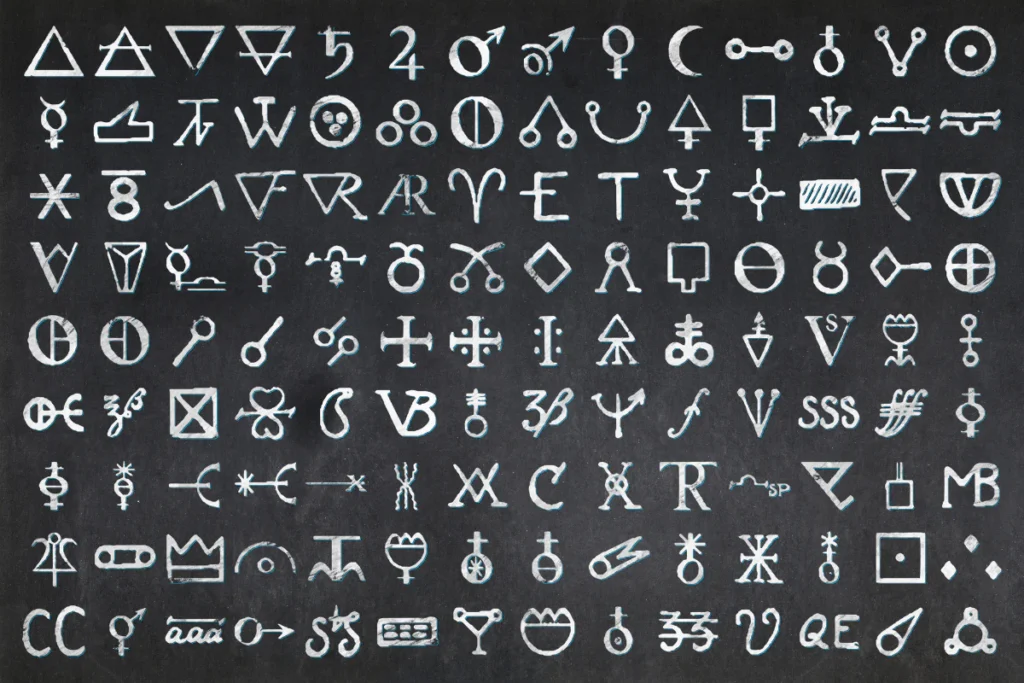
There is a particular kind of madness that settles into a man who has spent three winters watching the same crucible. The charcoal burns down and is replaced. The bellows exhale their patient breath. The metal shifts color through stages that feel almost biological — blackening, whitening, the tentative blush of reddening — and the man watching begins to lose the boundary between what is happening inside the vessel and what is happening inside himself. This is not metaphor. This was the phenomenological condition of the alchemical workshop, and to dismiss it as pre-scientific confusion is to misread the entire project from the beginning.
Paracelsus understood this with a ferocity that got him expelled from Basel in 1527, the same year he publicly burned the books of Galen and Avicenna in the city square. His offense was not merely theatrical. He was insisting, against a thousand years of received authority, that the physician who does not understand the mineral nature of the human body understands nothing at all. Sulfur, mercury, and salt — his tria prima — were not substances to be measured in a glass but principles of combustion, volatility, and stability that operated identically in lead ore and in human fever. The body was a furnace. Disease was a chemical imbalance. Healing was transmutation. The laboratory and the clinic were the same room, and the healer who could not transform matter could not transform flesh, because flesh was matter and matter was, at its deepest register, spiritual substance in a process of becoming.
This is the thread that runs unbroken from the Hermetic corpus — those Greek texts composed between the first and third centuries CE and misattributed to an ancient Egyptian sage called Hermes Trismegistus — through Ficino’s translations at the Medici court in the 1460s, through Pico della Mirandola’s astounding claim in his Oration on the Dignity of Man that the human being alone among creatures is not fixed in nature but is the sculptor of his own form. The forge, in this tradition, was never primarily a place of manufacture. It was a theater of self-authorship, where the practitioner, by working upon base matter, worked simultaneously upon the base matter of his own soul.
Consider what it meant to arrive in Prague in 1583 carrying an obsidian mirror and the conviction that angels spoke through a scryer’s eyes. The court of Rudolf II had become something unprecedented in European history — an emperor who collected not merely art and curiosities but entire systems of knowledge on the verge of dissolution or discovery, who invited the strange and the brilliant with equal appetite. Two men who arrived in that climate, one a distinguished mathematician and royal adviser, the other a convicted forger of uncertain genius, proceeded to spend years in meticulous angelic conversation, recording alphabets of a celestial language, mapping the hierarchies of spiritual forces with the same methodical patience a cartographer applied to coastlines. The notebooks they produced were not the work of fraudsters, or not only that. They were the work of men who had genuinely confused — or genuinely fused — the outer experiment with the inner one, who had stared so long into the black mirror that the distinction between vision and projection had become operationally meaningless.
Jung, whose Mysterium Coniunctionis of 1956 remains the most sustained psychological reading of alchemical literature, argued that the alchemists were doing something that could not be done consciously: projecting the contents of the unconscious onto matter, and then reading those contents back through the transformations they observed. The opus was always the self. The gold was always psychological integration. The problem with this reading is not that it is wrong but that it arrives four centuries late and translates into a clinical vocabulary what the alchemists themselves encoded in the only language available to them — which was also, always, the language of the stars.
What the Enlightenment Buried
There is a kind of man who has organized his apartment with surgical precision. Every object has a function. Nothing on the walls. The books arranged by subject, then alphabetically. He tells you, with something close to pride, that he has eliminated everything unnecessary. You look around and feel, inexplicably, that you cannot breathe.
This is what the eighteenth century did to the mind of Western civilization, and called it liberation.
The story we inherited runs like this: alchemy was superstition dressed in laboratory clothing, and chemistry arrived to strip away the costume and reveal the rational skeleton beneath. Robert Boyle in 1661, Antoine Lavoisier in 1789, the phlogiston theory collapsing, oxygen named and weighted — these are the milestones of a progress narrative so deeply embedded that to question it feels almost neurologically uncomfortable. But Michel Foucault, in The Order of Things published in 1966, offered a different account. What he called an epistemic rupture was not a gentle evolution of ideas but a violent reorganization of what counted as knowledge at all. Not a refinement. An amputation. The criteria for valid thought were redrawn, and everything that did not fit the new geometry was not disproven so much as declared invisible.
What was declared invisible was not irrationality. That is the falsification at the heart of the Enlightenment’s self-portrait. What was rendered invisible was a mode of knowing that kept the observer inside the system being observed. The alchemist working with Saturn’s metal did not stand outside lead and measure it. He understood himself to be subject to the same saturnine heaviness, the same gravitational pull toward melancholy and solitude that the metal embodied. The correspondence was not a metaphor. It was an epistemological position: that the human being is not the instrument of measurement but part of the substance being measured.
Theodor Adorno and Max Horkheimer saw this clearly, and named it with a precision that still cuts. In Dialectic of Enlightenment, written in exile in 1944 and published in 1947, they argued that the Enlightenment’s dream of dominating nature through reason produced not freedom but a new and more total form of domination — including the domination of the inner life. The disenchantment of the world, which Max Weber had already diagnosed as the defining wound of modernity, was not the price paid for rationality. It was rationality’s hidden engine. To know something, the Enlightenment decreed, you must stand apart from it. You must be the subject; it must be the object. The alchemical cosmos, in which the observer was always also the observed, was not superseded. It was expelled.
He sits in his perfectly empty apartment and explains to a visitor, slowly and carefully, why he no longer believes in anything that cannot be verified. The visitor notices that he explains this with something that functions like grief, though he would not call it that. He has dismantled everything that could not survive a rational audit, and he is technically correct in all of it, and he is suffocating inside his correctness. What he lost was not the belief in magic. What he lost was the feeling of being held inside a structure larger than himself — not comforted by it, not protected, but located. Given coordinates. The planetary metals were never primarily about lead or gold. They were about where you stood in relation to everything else.
The Scientific Revolution did not take this from him. He gave it away willingly, because the culture told him the gift was worthless. The Enlightenment’s deepest achievement was not to prove that symbolic knowledge was false. It was to make people feel ashamed of having needed it.
Gold That Cannot Be Touched

There is a moment, familiar to almost anyone who has ever walked through a jewelry store not intending to buy anything, when the hand moves toward the glass case before the mind has issued any instruction. Something in the body reaches. The gold is there, behind the barrier, lit from beneath, and the wanting is so immediate it bypasses every layer of irony or self-awareness you have spent years constructing. You know it is a metal. You know its price is partly fiction, sustained by consensus and historical accident. You know that the ring or the chain would sit on a shelf within months. And still the hand moves.
James Hillman argued in Re-Visioning Psychology, published in 1975, that the soul does not operate through concepts but through images, and that these images are not personal inventions but inherited structures, what he called the archetypal background of psychic life. He was not speaking in metaphors convenient for therapy. He was pointing at something with a more unsettling implication: that the categories through which we experience quality, value, mood, and meaning were already installed before we arrived, laid down in strata so deep that we mistake them for perception rather than inheritance. The planetary metals are precisely that kind of installation. We did not choose to associate gold with permanence and solar authority, or lead with depression and the weight of time. These correspondences were handed to us by a civilization that handed them to another, which received them from another still, reaching back through the Arabic transmission of Hellenistic thought, through Ptolemy and Galen and the Hermetic corpus, into something older and less locatable.
Claude Lévi-Strauss spent decades demonstrating that the human mind, across cultures with no historical contact, tends to organize the world through binary and analogical structures, through systems of correspondence that map the body onto the cosmos and the cosmos back onto social life. What he found in the mythological systems of Amazonian peoples, in the totemic classifications of Pacific islanders, in the kinship structures of central African societies, was not primitive confusion but a rigorous structural logic, one that modern thought has not abandoned but only displaced. We stopped drawing explicit charts of planetary influence and started building them into our language, our medicine, our economics, our emotional vocabulary. When someone describes a colleague as mercurial, they are not reaching for a quaint archaic term. They are activating a system of meaning that links speed, instability, cleverness, and unreliability into a single coherent image, an image that was once embodied in a planet, a metal, a deity, and a humor simultaneously.
The alchemical language never disappeared. It went underground, the way rivers go underground, continuing to move and shape the terrain from beneath, invisible but formative. We still call the best things golden. We still speak of silver-tongued persuaders, of iron will, of someone being in their element, of temperament as something fundamental rather than chosen. These are not dead metaphors. Dead metaphors leave no residue. These ones still carry charge, still organize our judgments before we have consciously formed them.
And this is where the vertigo begins. Because if the system is this persistent, if it runs this deep, if the hand moves toward the glass before the mind can intervene, then the question is not whether we have outgrown the correspondence between Saturn and melancholy, between gold and the incorruptible, between mercury and the mind that cannot stay still. The question is whether what we are reaching for, in all of our striving toward the permanent, the pure, and the luminous, is something we could ever actually hold, or whether the gold was always the reaching itself, and we have simply never been willing to say so.
A vision curated by a filmmaker, not an algorithm
In this video I explain our vision
⚗️ The Sacred Art: Metals, Planets, and Hidden Knowledge
The seven planetary metals of alchemy form a bridge between the cosmic and the terrestrial, binding ancient astronomy to the transformation of matter and soul. To understand their significance is to enter a vast tradition of hermetic wisdom that stretches across centuries of esoteric thought. These related explorations will deepen your journey into the symbolic universe of alchemy and its kindred arts.
What Is Alchemy: History and Origins
Alchemy did not emerge in a vacuum — its roots reach into Egyptian, Greek, and Arabic traditions where matter and spirit were never truly separate. This foundational article traces the origins of the alchemical worldview that gave birth to the doctrine of planetary metals. Understanding where alchemy began is essential to grasping why the seven metals carried such cosmological weight.
GO TO THE SELECTION: What Is Alchemy: History and Origins
Tabula Smaragdina: Text Meaning and Interpretation
The Emerald Tablet is perhaps the single most important text in the alchemical canon, encoding in a few cryptic lines the very principles that govern the relationship between planets and metals. Its famous maxim — ‘as above, so below’ — is the philosophical key to understanding why each metal was thought to mirror a celestial body. This article unpacks its layered meanings with rare editorial depth.
GO TO THE SELECTION: Tabula Smaragdina: Text Meaning and Interpretation
Paracelsus: Life and Alchemical Thought
Paracelsus revolutionized alchemical thought by insisting that the seven metals and their planetary correspondences were not merely symbolic but had direct applications in medicine and the healing of the human body. His vision fused astrology, alchemy, and natural philosophy into a unified system that would influence European thought for centuries. Exploring his life and ideas is indispensable for any student of the planetary metals.
GO TO THE SELECTION: Paracelsus: Life and Alchemical Thought
The Ouroboros: Esoteric and Alchemical Meaning
The Ouroboros — the serpent devouring its own tail — is one of alchemy’s most enduring symbols, encoding the very cyclical and self-renewing processes that the seven planetary metals were believed to embody. Its esoteric meaning speaks directly to the transformative logic at the heart of alchemical practice. This article illuminates how a single image can carry the weight of an entire cosmological tradition.
GO TO THE SELECTION: The Ouroboros: Esoteric and Alchemical Meaning
✨ Discover the Hidden Cinema on Indiecinema
If these ancient mysteries stir something deeper in you, Indiecinema is the streaming platform where visionary and independent cinema meets the questions that mainstream culture rarely dares to ask. From esoteric documentaries to boundary-breaking films that explore consciousness, symbolism, and the hidden layers of reality, Indiecinema curates a universe of images for those who seek more. Step through the screen and discover what independent cinema truly has to offer.
👉 EXPLORE THE CATALOG: Watch Indie Films in Streaming
A vision curated by a filmmaker, not an algorithm
In this video I explain our vision

