
The Man Who Walked Into the Wild and Never Fully Came Back
You are standing at the edge of something enormous and your body knows it before your mind catches up. A mountain range spreading out in every direction, or a forest so dense and old that the light arriving at ground level has been filtered through a thousand years of canopy, or a cliff above a valley so vast that the wind coming off it carries the particular silence of things that have never been named. And something happens to you in that moment that you did not anticipate and cannot quite explain afterward at dinner, or in the office on Monday, or to anyone who was not there. The sensation is not peace. It is closer to exposure. The feeling that the coordinates you have been using to navigate your life — ambition, schedule, obligation, the soft tyranny of what other people expect — have suddenly revealed themselves as arbitrary. As invented. As a story someone told you so early and so consistently that you mistook it for the shape of reality itself.

John Muir felt this and never recovered. That is the honest way to say it. Not that he found nature and was transformed into a better man, more serene, more grateful, more suited to inspirational calendars and national park brochures. He was undone by it. He walked into the wilderness of the American West in the second half of the nineteenth century and came out the other side carrying a fury that his contemporaries spent decades trying to domesticate into something more palatable, more useful, more compatible with the industrial civilization that was eating the continent alive.
He was born in 1838 in Dunbar, Scotland, into a Calvinist household so severe that his father Daniel believed physical punishment was the closest route to God. By the time the family emigrated to Wisconsin in 1849, Muir had already learned that the world adults constructed around children was less a shelter than a cage with theological justifications. He worked the family farm with a brutality of labor that left marks — not metaphorical ones, but actual damage to his body, to his spine, to the sleeping hours of his youth. He was brilliant in the way that people who have no access to formal education sometimes are: sideways, obsessive, building clocks and hydraulic mechanisms in the barn before dawn because the hunger to understand how things worked could not wait for permission. He eventually arrived at the University of Wisconsin in 1861 without graduating, which is perhaps the most honest credential he ever earned, because what formal education was offering him was a world already decided, and Muir had already begun to suspect that the decision had been made in someone else’s interest.
What happened in the years that followed — the thousand-mile walk to the Gulf of Mexico in 1867, the arrival in California in 1868, the first time he entered Yosemite Valley and stood there with the specific vertigo of a man who has just seen something that makes the rest of his life’s assumptions structurally unsound — was not a conversion experience in any religious sense, though Muir would sometimes borrow that language because it was the only one his century had available for encounters with the overwhelming. It was more like a philosophical detonation. The kind that William James, writing a few decades later in his 1902 Varieties of Religious Experience, would recognize as a complete reorganization of the self around a new center of gravity.
The world noticed. Not immediately, and not always warmly. But it noticed, because Muir was not content to have his revelation in private. He intended to bring it back and use it, sharpen it into argument and testimony and political pressure, press it against the soft underbelly of a civilization that had never once stopped to ask whether its appetite had any limits.
Eve of the Irises
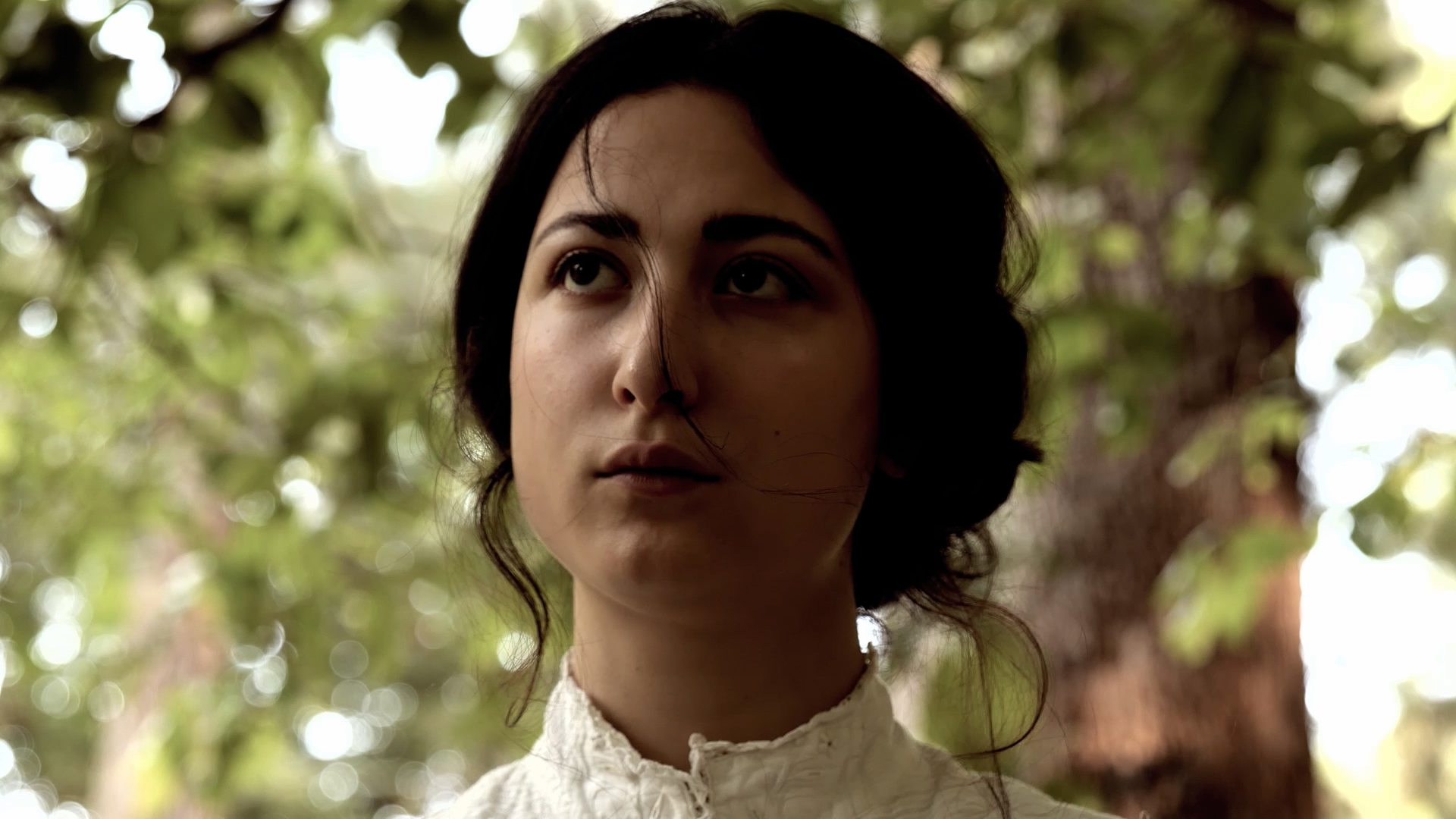
Documentary, by Isabel Russinova, Rodolfo Martinelli Carraresi, Italy, 2026
Eva of the Irises is a historical biographical docu-film about the scientist Eva Mameli Calvino, a botanist and pioneer of environmentalism in Italy, mother of the writer Italo, born in Sassari in 1886. The film, based on a multidisciplinary approach that combines several genres—such as theatre, documentary, cinema, and research—moves between memories, reflections on life, as well as the goals and missions the scholar still wished to achieve.
The multifaceted artistic sensibility of Isabel Russinova is expressed across many fields, from writing to acting, from directing to civic engagement, and finds one of its highest expressions in the docu-film Eva of the Irises, created with Rodolfo Martinelli Carraresi. The film blends scientific rigor and poetic refinement to portray the extraordinary figure of the botanist Eva Mameli Calvino, mother of Italo Calvino but above all an independent protagonist of 20th-century scientific culture. It is told through a combination of archival materials, interviews, and evocative staging capable of elegantly and profoundly conveying her intense human and professional story.
LANGUAGE: Italian
SUBTITLES: English, Spanish, French, Portuguese
A Childhood Carved by Severity and Soil
You know the smell of cold stone before you know the word for it. You know the particular silence of a house where obedience is the only currency, where a wrong answer costs more than ignorance ever would. John Muir knew that silence before he knew anything else about himself — born in Dunbar, Scotland, on April 21, 1838, into a household where Daniel Muir’s Calvinist God was not a comfort but a weight pressed against the chest of every waking hour.
Daniel did not merely teach scripture. He drove it in. The boys were required to memorize the entire New Testament by rote, then substantial portions of the Old, and the instrument of enforcement was the belt, applied without hesitation, without apology, and — this is the part that matters — without apparent doubt. Alice Miller, in The Drama of the Gifted Child, published in 1979, mapped this territory with a precision that feels almost forensic: the child raised under absolute authority learns early that their inner life is dangerous, that sensation and curiosity are liabilities, that the self must be buried beneath performance. What Miller observed, though, was not simply damage. She observed the strange alchemy by which certain children — the most sensitive, the most alive to the world — convert that suppression into an almost violent orientation toward everything outside the doctrine. They do not disappear into the system. They escape through a crack in the wall, and what they find on the other side becomes their true religion.
For Muir, the crack was literal. The cliffs of Dunbar, the cold North Sea, the birds that moved against the grey sky with an indifference to human theology that must have seemed, to a boy already bruised by certainty, like the most honest thing in the world. He climbed everything he could find. He ran. The body became the instrument of dissent long before the mind had language for what it was dissenting against. This is not metaphor — this is how authoritarianism produces its most passionate rebels. Not through defiance that names itself, but through a redirected hunger that finds sustenance in the physical, the sensory, the ungovernable.
There is a recognizable logic here that goes beyond individual biography. The sociologist Norbert Elias, in The Civilizing Process, traced how the internalization of external constraint reshapes the architecture of the self. But what Elias described as a general social process, Miller anatomized at the level of the single family, the single body. When the father’s law is total, the world beyond the father becomes infinite. The severity does not kill the appetite; it displaces it, and displacement, in minds of a certain quality, becomes vocation.
Daniel Muir moved the family to Wisconsin in 1849, when John was eleven, and the severity followed them across the Atlantic. But so did the hunger. The American wilderness was not, for the young Muir, a romantic abstraction imported from European literary tradition. It was the continuation of those Dunbar cliffs, that North Sea wind, the first wordless knowledge that something outside human systems was more real than anything inside them. The soil he turned on the Wisconsin farm was the same soil that would later, in ways neither he nor his father could have predicted, become the ground of an entirely different kind of devotion.
What is hardest to hold simultaneously is that the man who would spend decades arguing for the sacred character of wild places was shaped, at least in part, by a father who believed that the sacred lived only in text. Daniel Muir gave his son scripture. The boy took the lesson and applied it somewhere else entirely — to granite, to glaciers, to the particular light that falls through old-growth forest in the late afternoon, which asks nothing of you and forgives nothing either, because it does not deal in forgiveness at all.

The University of the Wilderness
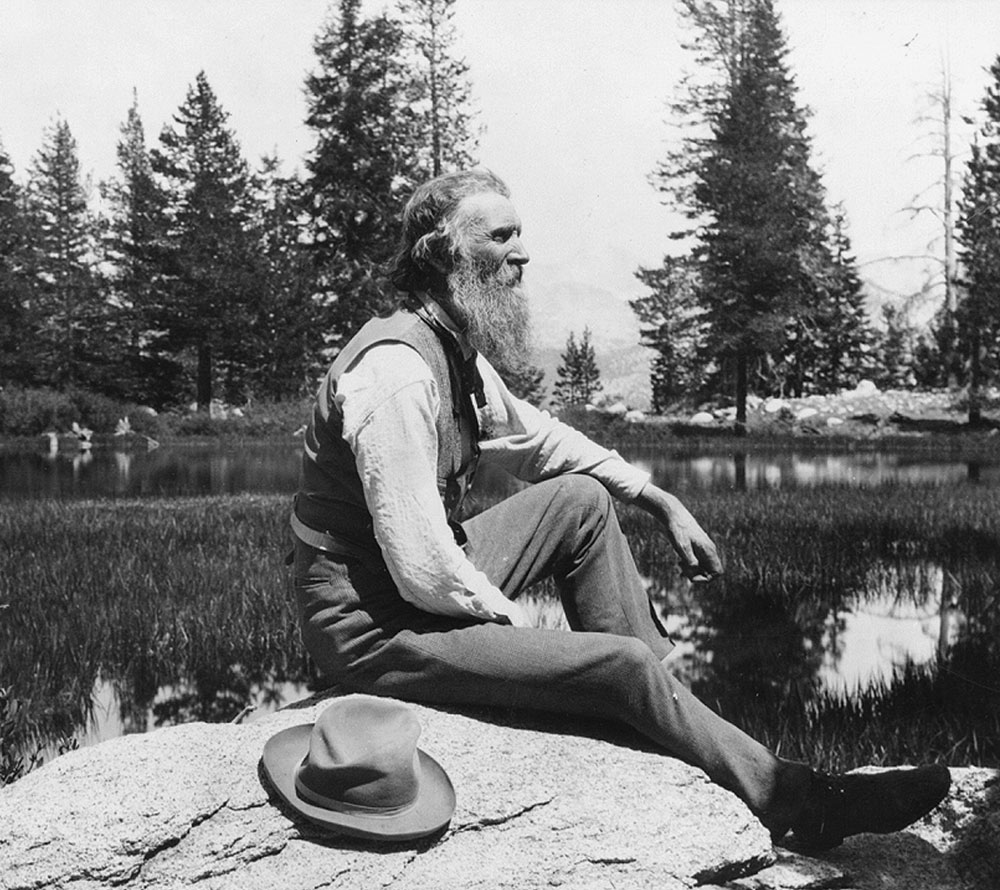
He left Indianapolis on September 1, 1867, with a small bag, a plant press, and a notebook. Not a manifesto. Not a plan. The destination was the Gulf of Mexico, roughly a thousand miles south, chosen not because it meant anything particular but because it was far enough that arriving there would require becoming someone else. You don’t walk a thousand miles to find yourself. You walk them to lose the version of yourself that other people have been carefully maintaining on your behalf.
Thoreau wrote in 1861 that in Wildness is the preservation of the World, and the phrase has been repeated so often it has calcified into decoration, something you put on a canvas print above a fireplace. But Thoreau was making a stranger claim than people remember. He wasn’t talking about national parks or clean air legislation. He was talking about what happens to the human animal when it is removed from the grids of obligation and productivity it mistakes for reality. Muir read this and understood it, but then went further than Thoreau was willing to go. Thoreau walked out of Concord and came back for dinner. Muir walked into Kentucky, into Tennessee, into Georgia, through swamps that gave him malaria, through terrain that had no interest whatsoever in his survival or his enlightenment.
There is a particular quality to watching a man move through landscape that does not care about him. Not hostile, which would at least be a relationship. Simply indifferent. The mosquitoes in the Florida marshes don’t discriminate between the visionary and the fool. The fever doesn’t pause for insight. In the journal Muir kept during that walk, later shaped into the book published posthumously in 1916, there is an honesty about discomfort that sits uncomfortably alongside the transcendent passages, and that tension is the actual argument of the text. He is not being tested and found worthy. He is being dissolved.
This is what the academy could never have given him. Muir had attended the University of Wisconsin at Madison beginning in 1861, studying chemistry and geology under Ezra Slocum Carr, absorbing what the institution offered but never fully belonging to it. The university teaches you to categorize the world. The wilderness, if you stay in it long enough without a return ticket, teaches you that you are also a category, and a fairly unstable one. Erik Erikson wrote in Identity and the Life Cycle, published in 1959, about the moratorium — that developmental space in which the young person is granted, or grants themselves, a suspension from the roles society has assigned. Muir’s thousand-mile walk was a moratorium that cost him forty pounds of body weight and very nearly his life to a fever contracted near Cedar Key, Florida, where he lay delirious for weeks in October and November of 1867.
What emerges from that fever is not Muir purified. It is Muir reorganized. The botany remains, the geological observation remains, the almost fanatical attention to plant structure and rock formation and the behavior of water remains. But the frame around them has shifted. He is no longer a young man with promising prospects examining nature. He is something closer to a creature among creatures, embarrassed by the earlier distinction.
William James, who would later correspond with Muir, described in The Varieties of Religious Experience in 1902 what he called the twice-born soul — the self that has passed through dissolution and arrived somewhere it could not have reached by gradual improvement. James was talking about religious conversion, but the mechanism he describes is identical to what Muir’s notebooks record without naming. The old self doesn’t improve. It is replaced by attrition, by heat, by insects, by the particular mercy of a landscape that refuses to become a mirror.
By the time he reached the Gulf and looked at it, the boy who had memorized scripture under a father’s belt was essentially gone.
Yosemite as a Living Argument
He arrived on foot, having walked much of the way from San Francisco, and what he found in that granite corridor was not scenery. It was evidence. The walls of the valley rose nearly a mile above the valley floor, polished in places to a sheen that catches afternoon light like the face of something recently abandoned by ice, and Muir looked at those walls the way a detective looks at a crime scene — not with wonder as an end in itself, but with wonder as a method.
He worked there first as a shepherd, then operating a sawmill, sleeping in a cabin he built over a stream so he could hear the water moving beneath him at night. These were not the occupations of a man in retreat. They were cover for an obsession. Every morning before the work began, and every evening after it ended, he was measuring, comparing, tracing the long scratches left in the granite, reading the landscape as a continuous text that the official science of his time had decided to misread.
The reigning interpretation belonged to Josiah Whitney, director of the California Geological Survey, a Harvard-trained authority whose prestige was essentially institutional. Whitney had concluded that Yosemite Valley was the result of a catastrophic subsidence — the floor had simply dropped, he said, during some ancient cataclysm, and the walls had been left standing. It was a dramatic story, appropriately violent, suitably mysterious. It was also wrong. Muir, who had no university position, no formal geological credentials, and no institutional backing, spent his years in the valley accumulating the counter-argument with the patience of someone who has nowhere more important to be. By 1871 he was writing to Asa Gray, the Harvard botanist who would become one of his few credible advocates, laying out in precise and urgent prose the glacial theory: that the valley had been carved slowly, over enormous time, by the grinding passage of ice. The letters were not tentative. They were the letters of a man who had touched the evidence with his hands.
When his articles began appearing in the Overland Monthly in 1872, the establishment responded with the particular contempt reserved for people who are right before their time. Whitney called him a mere sheepherder. The dismissal was meant to close the question by closing the man. Thomas Kuhn, writing nearly a century later in The Structure of Scientific Revolutions in 1962, would describe exactly this mechanism — how scientific communities protect paradigms not through argument alone but through the social control of who is permitted to make arguments. Whitney was not simply wrong about glaciers; he was operating the gate. And Muir was, in Kuhn’s terminology, the anomaly that the paradigm could not absorb.
What makes this more than a footnote in the history of geology is what it reveals about the relationship between experience and institution. Muir had spent years walking the valley floor, climbing its walls, camping on its glacial remnants, pressing his face against the polished rock. He had acquired what the philosopher Michael Polanyi called tacit knowledge — the kind that lives in the body and the eye before it can be articulated in a lecture hall. Whitney had acquired prestige. These are not the same thing, and institutions have a persistent tendency to treat them as though they were.
The glaciers won in the end, because evidence is stubborn even when careers are not. The valley that Whitney said had fallen was, in fact, a valley that had been slowly, patiently made — by forces operating over timescales that human authority finds deeply uncomfortable, because they make authority itself seem very small. Muir understood this. He had stood inside the argument. He had slept over running water and watched the light move across stone that remembered ice, and he knew that the landscape was not asking for anyone’s permission to have its history told correctly.
The Trap of the Pastoral: What Muir Got Wrong About Who Was Already There
There is a moment — you have probably felt something like it — when you walk into a place that feels untouched and realize, with a slow dropping sensation in the chest, that the silence you were hearing was not natural silence. It was the silence left by an absence. Someone cleared this space before you arrived and called the clearing wilderness so you would not ask who was removed to make it.
Muir arrived in Yosemite Valley in 1868 and wrote about it as though the land had been waiting, patient and virginal, for a consciousness capable of receiving it. The meadows, the granite, the cascades — all of it rendered in his prose as primordial, untouched, existing outside human time. What his sentences never quite accommodated was the fact that the Ahwahneechee people had lived in that valley for centuries before he set foot there. They had named its features, managed its meadows through deliberate burning, shaped the very openness that Muir experienced as pure nature. Seventeen years before his first visit, in 1851, the Mariposa Battalion had driven them out by force. The valley Muir described as pristine had been ethnically cleansed within living memory.
This is not a minor biographical footnote. It is the load-bearing wall of his entire philosophy.
Dina Gilio-Whitaker, in As Long As Grass Grows, argues that the American conservation movement was built on a foundational lie: that wilderness existed as a category prior to and independent of human presence. The concept required, as a precondition, the erasure of Indigenous peoples — not just physically from the land, but conceptually from the story of the land. Once they were gone, or made invisible in the telling, the landscape could be reimagined as empty, timeless, sacred in a way that only white romantic consciousness seemed equipped to receive. Roxanne Dunbar-Ortiz, in An Indigenous Peoples’ History of the United States, traces the longer arc of this erasure and shows it was never accidental. It was policy, repeated and refined across centuries, that produced the empty continent that settlers needed to believe in.
Muir believed in it completely.
There is a scene — a man walking alone through forest that feels ancient and undisturbed, until he crouches down and finds in the soil the unmistakable geometry of human work: a terrace, a boundary, the negative shape of a dwelling. The land beneath him has been a home. The emptiness he was moving through was constructed. He stands up and the forest is the same forest, but he is not the same man standing in it. That vertigo — the sudden doubling of a landscape into what you were told it was and what it actually held — is precisely what Muir never allowed himself to feel.
His journals describe Indigenous people, when they appear at all, in terms borrowed from Victorian anthropology: primitive, degraded, pitiable. He did not see them as the authors of the landscape he worshipped. He could not, because seeing them that way would have collapsed the entire architecture of his spiritual experience. The solitude that fed him required their absence. The cathedral required empty pews.
This is the trap inside the pastoral, and it did not begin or end with Muir. The idea that nature becomes meaningful only when emptied of prior human claim is a colonial habit of perception so deeply embedded that it still operates inside most environmental rhetoric today. We speak of protecting wild places as though wildness were a state preceding culture rather than a story told over a grave.
What Muir gave us was genuinely magnificent and genuinely compromised in the same breath. The mountains he loved were real. The people he failed to see in them were also real, and the failure was not innocent.
A vision curated by a filmmaker, not an algorithm
In this video I explain our vision
Writing as an Act of Ecological War

There is a specific kind of sentence Muir wrote that does not feel like description. It feels like testimony. Not the testimony of a witness recounting what happened, but the testimony of someone who has placed their hand on a wound and refuses to move it until the court looks. When he wrote in 1894 that the Sierra Nevada was “the Range of Light,” he was not offering a poet’s ornament. He was filing a legal brief in the only language he believed could penetrate the indifference of people who had never stood there and never intended to.
The Mountains of California arrived at a moment when the American West was being processed industrially, converted from geography into commodity with the methodical efficiency of a factory floor. Muir understood, with a clarity that most of his contemporaries lacked, that the extractive imagination does not recognize what it cannot price. So he did something tactically brilliant and almost perverse: he made beauty into an argument. Not beauty as consolation or as aesthetic pleasure reserved for the cultivated, but beauty as a form of moral pressure, as evidence of value that preceded and superseded any economic calculation. Walter Benjamin, writing decades later in his 1936 essay “The Work of Art in the Age of Mechanical Reproduction,” described the aestheticization of politics as the fascist move — the conversion of political content into spectacle that paralyzes critical thought. Muir was executing the precise inversion. He was politicizing aesthetics, turning the experience of the sublime into a claim with legal and ethical teeth. The mountain did not merely move you. It obligated you.
Our National Parks, published in 1901, was not a travel book. It was a mobilization document. By then Muir had already co-founded the Sierra Club in 1892, had already watched the political process swallow and spit out conservation efforts with routine contempt, and had learned that sentiment without strategic deployment was merely decoration. The book was addressed, with calculated aim, toward the kind of reader who held power — or knew someone who did. Two years after its publication, Theodore Roosevelt read it. What followed was not a policy meeting or a briefing from an agency official. It was three nights in Yosemite, in April of 1903, sleeping under the open sky, away from the press and the protocol, with Muir talking — relentlessly, precisely, with the accumulated force of thirty years of witness. Roosevelt later described those nights as among the most significant of his life. That is not the language of tourism.
The Antiquities Act came in 1906. The numbers it eventually enabled are almost impossible to hold in the mind as a single fact: 230 million acres of protected public land, a figure that began, in traceable and documented ways, with a man insisting in prose that something was worth saving. Not worth preserving for future economic use, not worth protecting as a strategic resource — worth saving because its existence carried a meaning that human industry had no authority to cancel. This is a different claim than conservation as management. It is closer to what the philosopher Holmes Rolston III would later call “intrinsic value in nature” — the idea, formalized in his 1988 Environmental Ethics, that wild systems possess worth independent of any human observer or beneficiary. Muir arrived at this intuitively, without the philosophical scaffolding, through sheer accumulation of attention.
The Yosemite, published in 1912, the year before the catastrophic congressional vote that authorized the damming of Hetch Hetchy Valley, reads now like a document written in full knowledge of impending loss. The sentences have a different weight. The beauty he describes is not triumphant. It is insistent, almost desperate, pressing itself against the page as if prose itself could hold back water.
It could not. But the question of what it did hold back, and for how long, and at what scale, is not a question that resolves easily into defeat.
The Hetch Hetchy Defeat and the Grief of Losing the Argument
There is a particular kind of stillness that falls over a person when they understand, not emotionally but factually, that the outcome has already been decided before the last argument was made. You can see it in a man sitting at a table covered in papers, the lamp burning low, aware that somewhere in another room the machinery has already started turning. The words he is still writing will arrive after the fact. They will be received politely and filed away. The decision was made in the corridors where he was not invited and could not have been, regardless.
This is where John Muir found himself between 1908 and 1913, and it is important to resist the temptation to call it simply a defeat, because Simone Weil would have recognized it as something more precise and more devastating than that. In her 1942 essay “La Pesanteur et la Grâce,” Weil drew a distinction that most languages blur: between suffering, which is pain that leaves the self intact, and affliction, which is pain that unmakes the self at its root, that strips away the social existence and the interior sense of being heard. Affliction, for Weil, is not intensified suffering. It is suffering that has been refused an audience. It is the argument made correctly, completely, with evidence and love, and then ignored not because it was wrong but because power had already chosen otherwise.
The Hetch Hetchy Valley sat north of Yosemite, carved by the same glacial logic, its meadows and granite walls and the Tuolumne River running through it a near-twin of the valley Muir had spent decades learning to read. He called it a grand landscape temple. The city of San Francisco wanted to flood it to create a reservoir, and the fight that followed lasted five years and drew in figures from Gifford Pinchot, the utilitarian conservationist who served as Chief Forester under Roosevelt, to senators who could barely locate the valley on a map. Muir wrote, petitioned, traveled, argued in language that was by turns ecstatic and precise. He understood that what was at stake was not only a valley but a principle: that wild places had value that could not be calculated in acre-feet of water.
Congress passed the Raker Act in December 1913. The dam was authorized. The valley would be flooded.
What Weil understood, and what makes her concept of affliction so difficult to read without flinching, is that the person struck by it does not simply grieve the loss. They grieve the loss of their own legibility. The world has heard them and proceeded. The argument has been tested and discarded not because it failed logically but because it was inconvenient to those who held the instruments of decision. There is a particular erasure in that, a kind of social death that precedes biological death, and in Muir’s case the interval between them was precisely thirteen months.
He died in December 1914, in a hospital in Los Angeles, the kind of institutional room that has nothing to do with mountains or glaciers or the specific silence of a valley at dawn. His luggage contained manuscript pages of the Alaska memoir he had been trying to finish, notes about a wilderness that by then existed primarily in his memory and his prose. He was alone. He was seventy-six years old.
The O’Shaughnessy Dam was completed in 1923. The valley was fully submerged by 1938. And in 1987, Interior Secretary Donald Hodel proposed restoring Hetch Hetchy by removing the dam, citing exactly the arguments Muir had made. The proposal was not adopted, but it was heard. Some arguments travel that way, through time rather than through rooms, arriving decades late to an audience that finally has the capacity to understand what was being said.
What the Mountains Remember That We Have Forgotten
There is a moment that happens to almost everyone who has stood at the edge of something genuinely vast — a canyon rim, a coastline battered by storm, a treeline that ends abruptly at raw granite and sky — when the body does something the mind has not authorized. The chest tightens. The breath shortens. Something older than language stirs in the architecture of the nervous system, and you cannot tell, with any certainty, whether what you are feeling is fear or recognition.
Muir felt it constantly and called it God. We have mostly stopped using that word, but we have not stopped feeling the sensation, and the question of what exactly it is — what it points toward, what its absence costs — sits unresolved at the center of everything his life was about, including the parts of his life that were ugly or wrong.
E.O. Wilson spent decades arguing that this sensation is not metaphor. His biophilia hypothesis, developed most fully in the 1984 book of the same name, proposed that the human nervous system evolved in intimate relationship with non-human life — with the specific textures, sounds, movement patterns, and spatial logics of living ecosystems — and that this relationship is not aesthetic preference but biological substrate. We do not merely enjoy nature in the way we enjoy music or architecture. We were assembled by it, over evolutionary timescales that dwarf the entire history of agriculture, let alone industry. The longing, when it appears, is not sentimental. It is structural.
Paul Shepard pressed this further and darker. In 1982 he published what remains one of the most uncomfortable books in the literature of environmental thought, arguing that modern psychological dysfunction — the chronic low-grade anxiety, the dissociation, the inability to tolerate stillness, the compulsive need for mediated experience — is not merely social or economic in origin. It is developmental. Shepard believed that human psychological maturation requires, at specific and sensitive periods of childhood, contact with non-human otherness: with animals that have genuine agency, with landscapes that do not respond to human intention, with the specific cognitive challenge of navigating systems that were not built for us and do not care whether we succeed. Remove those encounters from development and something fails to complete. Not dramatically, not in ways that show up cleanly in a diagnostic manual, but pervasively, in the texture of a life that cannot quite locate its own ground.
Muir was formed by the Wisconsin wilderness before his father’s religious tyranny tried to grind him into pure spirit and pure labor. Whatever survives in his prose — that quality of almost embarrassing aliveness, the way he writes about a storm in the Sierra as though reporting from inside his own bloodstream — may be less about genius than about timing. He met the non-human world at the age when Shepard says it reshapes you, and it did.
Most people living inside industrial civilization now do not get that meeting. They get images of it, which is a different thing entirely, in the way that a photograph of food is a different thing from eating. And the cost of that substitution is genuinely unclear, not because the evidence is thin but because we have almost no control population — almost no large human communities developing entirely within human-made systems against which to measure what is lost. We are, in a sense, running the experiment on ourselves without knowing we enrolled.
What Muir’s life suggests — not his ideology, not his politics, not his complicated and sometimes brutal silences — is that the body keeps a different account than the mind does. That the discomfort you feel at the edge of something vast is information rather than weakness. That what passes in modern life as ordinary unease might be the nervous system registering, with perfect accuracy, the specific texture of an absence it was never designed to sustain.
🌿 Nature, Thought, and the Wild Soul
John Muir’s life was shaped by a profound reverence for the natural world and a tireless commitment to preserving it. His ideas did not emerge in isolation — they grew from a rich tradition of naturalist thinking, transcendentalist philosophy, and ecological activism that continues to inspire thinkers and explorers to this day. Discover the intellectual landscape that surrounds Muir’s enduring legacy.
American Transcendentalism: History and Thought
American Transcendentalism provided the philosophical soil in which John Muir’s love of wilderness took root. Thinkers like Emerson and Thoreau elevated nature to a sacred realm, seeing in it a direct path to spiritual truth and self-knowledge. Muir absorbed these ideas and transformed them into a powerful advocacy for the preservation of wild places.
GO TO THE SELECTION: American Transcendentalism: History and Thought
Henry David Thoreau: Life and Works
Henry David Thoreau stands as one of the closest spiritual ancestors to John Muir, sharing his belief that time spent in nature is essential to a fully human life. Thoreau’s experiment at Walden Pond, living deliberately and simply in the woods, anticipated Muir’s own immersive wanderings through the Sierra Nevada. Both men argued that wilderness is not an escape from civilization but its necessary counterpart.
GO TO THE SELECTION: Henry David Thoreau: Life and Works
Alexander von Humboldt: Life and Works
Alexander von Humboldt was one of the great explorer-naturalists whose vision of nature as an interconnected, living whole profoundly influenced a generation of scientists and thinkers, including John Muir. His ambitious journeys across continents and his meticulous observation of ecosystems laid the groundwork for modern environmentalism. Muir read Humboldt with admiration and carried his spirit of wonder into the mountains of California.
GO TO THE SELECTION: Alexander von Humboldt: Life and Works
Deep Ecology: History and Philosophy
Deep Ecology as a philosophical movement can be seen as the intellectual heir to the wilderness ethics that John Muir championed throughout his life. It posits that nature has intrinsic value beyond its usefulness to human beings — a conviction Muir expressed in every page he wrote about the mountains, glaciers, and forests he loved. Understanding Deep Ecology helps place Muir’s legacy within a broader tradition of radical ecological thought.
GO TO THE SELECTION: Deep Ecology: History and Philosophy
Cinema That Breathes With the Earth
If these ideas about nature, solitude, and the living world move you, Indiecinema streaming offers a curated selection of independent and documentary films that explore the human relationship with wilderness, ecological philosophy, and the beauty of the natural world. Step beyond the mainstream and discover cinema that dares to ask the questions that matter.
👉 EXPLORE THE CATALOG: Watch Indie Films in Streaming
A vision curated by a filmmaker, not an algorithm
In this video I explain our vision

