
The Woman Who Was Not Born, But Made
You catch yourself in the mirror before you mean to. Not a long look, not a deliberate inventory, just a fraction of a second between one movement and the next — and in that fraction something contracts. Your shoulders. Your stomach. The angle of your chin. Something in your body responds to its own reflection with an almost automatic audit, a quick and silent accounting of where you fall short, where you exceed, where you must adjust. You have been doing this so long you no longer notice you are doing it. That is precisely the point.

This is not vanity. It is not narcissism. It is the result of decades of training so thorough it has become indistinguishable from instinct. You were handed a script before you could read, a posture before you could walk with intention, a set of permissions and prohibitions stitched into the very way you occupy space. You learned to make yourself smaller in rooms where men were speaking. You learned to soften disagreement with a smile. You learned that confidence in a woman reads differently than confidence in a man — that the same sentence, delivered from the same certainty, carries a different social charge depending on the body from which it emerges. You did not decide any of this. It was decided, gradually, collectively, historically, and then handed to you as though it were simply who you are.
In 1949, a French philosopher published a book that named this process with a precision that still feels like a small detonation. Simone de Beauvoir’s The Second Sex arrived not as a manifesto but as an anatomy — more than nine hundred pages of philosophical, historical, biological, and literary analysis aimed at a single, surgical question: what is a woman? Her answer dismantled the question itself. Woman is not a natural fact. She is a social construction, a historical production, an identity assembled through accumulated pressure, expectation, myth, and repetition. The sentence that carries the entire weight of the argument is among the most consequential ever written in French: one is not born, but rather becomes, a woman.
Read quickly, it sounds almost obvious. Read carefully, it is devastating. It means that everything you experience as your femininity — your hesitations, your apologies, your particular relationship to your own body, your learned capacity for self-erasure — is not an expression of some essential female nature. It is the result of a process. A process that began before you were conscious of it, that enlisted your parents, your teachers, your peers, your fairy tales, your advertising, your religion, your language, all working in the same direction, all producing the same result: a person who experiences her own subordination as her own character.
Beauvoir was drawing on the existentialist framework she had developed alongside Jean-Paul Sartre, but she pushed it somewhere Sartre had never thought to go. Existentialism’s central claim is that existence precedes essence — that human beings are not born with a fixed nature but create themselves through choice and action. Beauvoir asked the obvious and unasked question: what happens to people who are systematically denied the conditions for that self-creation? What happens when the freedom that existentialism celebrates as the bedrock of human dignity is structurally unavailable to half the population? The answer was not a philosophical puzzle. It was the woman in the mirror, auditing herself before she has had a single thought of her own that morning.
This is what makes Beauvoir’s opening claim not an abstraction but a diagnosis. Not a theory about women in general but a description of something you have already felt in your own body, in your own silence, in the particular quality of exhaustion that comes not from doing too much but from constantly managing how you are perceived while doing it.
Eve of the Irises

Documentary, by Isabel Russinova, Rodolfo Martinelli Carraresi, Italy, 2026
Eva of the Irises is a historical biographical docu-film about the scientist Eva Mameli Calvino, a botanist and pioneer of environmentalism in Italy, mother of the writer Italo, born in Sassari in 1886. The film, based on a multidisciplinary approach that combines several genres—such as theatre, documentary, cinema, and research—moves between memories, reflections on life, as well as the goals and missions the scholar still wished to achieve.
The multifaceted artistic sensibility of Isabel Russinova is expressed across many fields, from writing to acting, from directing to civic engagement, and finds one of its highest expressions in the docu-film Eva of the Irises, created with Rodolfo Martinelli Carraresi. The film blends scientific rigor and poetic refinement to portray the extraordinary figure of the botanist Eva Mameli Calvino, mother of Italo Calvino but above all an independent protagonist of 20th-century scientific culture. It is told through a combination of archival materials, interviews, and evocative staging capable of elegantly and profoundly conveying her intense human and professional story.
LANGUAGE: Italian
SUBTITLES: English, Spanish, French, Portuguese
Paris, Existentialism, and the Man in the Room
You have sat in a room full of brilliant people and said something true, something precise, something that shifted the air — and watched the credit migrate, almost gravitationally, toward the man sitting next to you. It did not happen through malice. It happened through a kind of atmospheric assumption so old it has become structural, the way gravity is structural. Nobody decided. It simply occurred.
This is the room Simone de Beauvoir inhabited for decades, and the remarkable thing is not that it happened to her. The remarkable thing is how completely the room itself was erased from the historical record, so that what remained looked like a love story rather than an intellectual catastrophe.
In 1929, at twenty-one years old, Beauvoir passed the agrégation in philosophy — one of the most rigorous competitive examinations in the French academic system — finishing second in all of France. Sartre finished first. The examiners reportedly noted that the first-place candidate had the superior technical training, but the second-place candidate had the more genuinely philosophical mind. That parenthetical observation was then filed away and forgotten for most of the twentieth century, which tells you something precise about how institutions handle inconvenient data.
What followed was Paris in the 1930s — the zinc counters of the cafés along Saint-Germain-des-Prés, the booths of Les Deux Magots where the existentialist circle gathered like a small republic of ideas, the arguments that lasted until the wine ran out and then continued anyway. Beauvoir was there. She was not there as an observer or as a muse or as a particularly attentive audience. She was there as someone whose thinking was actively shaping the conversation, whose notebooks from the period reveal a mind working through questions about freedom, situation, and the body with a precision that would crystallize, two decades later, into one of the most consequential philosophical texts of the century.
Yet the historiography performed a kind of slow surgery on this reality. Mary Evans, in her rigorous critical study of Beauvoir’s place within existentialist thought, documented how thoroughly Beauvoir was repositioned — not through deliberate falsification but through the accumulation of framing choices, each one individually defensible, collectively devastating. She was the companion, the lover, the interlocutor. The words used to describe her relationship to existentialism were always relational words, words that placed her in orbit around a center that was always Sartre. Evans identified this as a systematic pattern of minimization, one that operated precisely because it never needed to announce itself. It was embedded in the grammar of how intellectual history was written.
Consider what this means concretely. A man and a woman think together, argue together, challenge each other’s manuscripts, live inside the same intellectual atmosphere for years. When the history is written, one of them becomes the thinker and the other becomes the context. This is not an observation about bad faith. It is an observation about something more insidious — the way a culture encodes its assumptions into the apparently neutral act of narration.
Beauvoir herself was not entirely innocent in this dynamic, and that complexity matters. She wrote about Sartre with an admiration that sometimes shaded into a self-diminishment that her own philosophy should have made impossible. There is something almost archaeological about reading her early correspondence alongside her published work — the private voice pulling in one direction, the philosophical voice pulling in another, the tension between them never quite resolved.
The France she was navigating was not abstract. In 1929, French women could not vote, could not open a bank account without a husband’s permission, could not be legally autonomous in ways that men took as simply the default condition of adult existence. The room at Les Deux Magots was therefore not neutral space. It was space she had entered by force of intellect alone, against a current that ran in every institutional direction simultaneously.

Freedom Is Not Given, It Is Seized or Surrendered
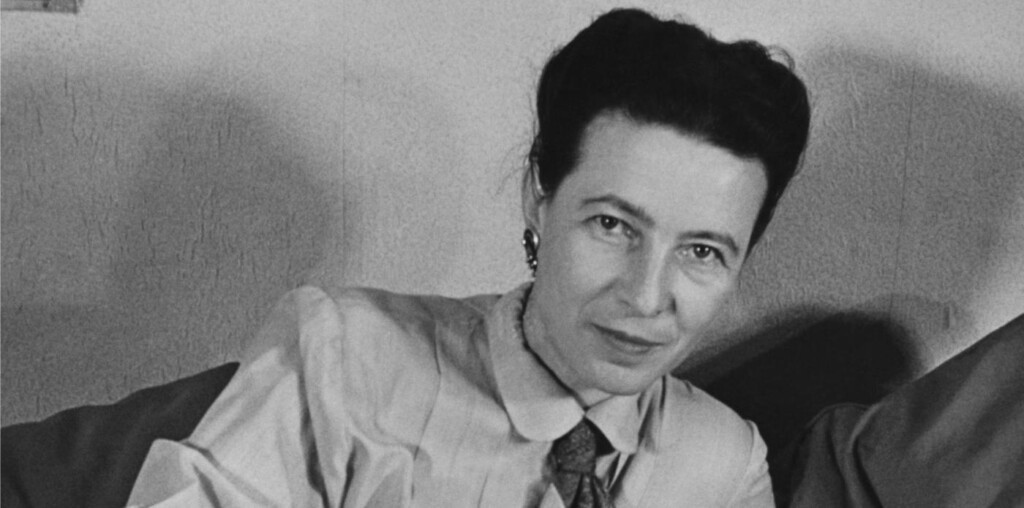
You have learned, over years of small surrenders, to call the feeling virtue. The moment your idea gets talked over in a meeting and you let it go, nodding along as someone else finishes your sentence with slightly less precision — you tell yourself it is generosity. The moment you shelve the project, the application, the ambition, because someone else’s need pressed itself more urgently against the available hours of the day — you tell yourself it is love. And perhaps it is both of those things, partly, genuinely. But there is something else coiled inside the gesture, something that Simone de Beauvoir identified with surgical clarity in 1947, when she published The Ethics of Ambiguity and refused to let the question of freedom remain comfortable.
She watched a woman arrange her entire life around the contours of another person’s existence — not because she lacked intelligence or desire, but because she had been trained, from the very beginning, to understand self-erasure as the natural form that feminine devotion takes. The training was so thorough, so embedded in the texture of daily approval and daily punishment, that the woman herself could no longer locate the seam between what she wanted and what she had been told to want. She was not lying. She genuinely believed the sacrifice was chosen. That is precisely what made it devastating.
Sartre had given the philosophical world the concept of bad faith — the act of pretending that one has no freedom, of collapsing into a role, a function, a social definition, as though it were a fact of nature rather than a choice sustained moment by moment. Bad faith, in the Sartrean sense, is an individual failure of consciousness, a refusal to confront the vertiginous openness of existence. It is the waiter who performs being a waiter so completely that he forgets he could, in principle, do otherwise. It is seductive as a framework because it places responsibility squarely on the individual: you are lying to yourself, you could stop.
Beauvoir took this framework and pressed on it until it cracked open to reveal something Sartre had not fully reckoned with. Her argument in The Ethics of Ambiguity is not that bad faith is impossible in conditions of oppression — it is that oppression creates the material and psychological conditions in which bad faith becomes nearly inescapable, and that blaming the individual consciousness for failing to transcend those conditions is its own form of philosophical dishonesty. Freedom, for Beauvoir, is always situated. It is never pure, never aerial, never the property of a solitary will hovering above its circumstances. It is embedded in a web of relationships, economic structures, historical inheritances, and social permissions — and when those structures systematically deny a person access to the world of projects and possibilities, calling their compliance a free choice is not philosophy. It is cruelty wearing the mask of rigor.
This is the hinge on which Beauvoir’s ethics turns, and it is what separates her from the existentialist tradition she inherited and simultaneously transfigured. She insists, with a force that builds quietly through the book, that one cannot be genuinely free while others are oppressed — not as a moral preference, but as a structural impossibility. Freedom is not a private possession. It exists only in relation, only in a world where others also have access to the field of genuine possibility. An existence built on the suppression of another’s transcendence is not freedom. It is a form of flight, a refusal to face the full weight of what one is doing.
The woman who defers her ambitions one more time is not simply making an individual choice in bad faith. She is enacting a script that was written before she was born, rehearsed in every institution that shaped her, and reinforced by every relationship that rewarded her disappearance. Beauvoir does not ask her to feel guilty. She asks us all to see the architecture.
The Architecture of the Other
You have been in that room. You know exactly what happened. You said something — clearly, with the evidence behind it, with the reasoning intact — and the conversation moved on as though the air had simply absorbed your words. Then, perhaps ten minutes later, perhaps less, someone else said it. The same thing. Not a variation, not a development: the same thing. And the room responded. Heads nodded, pens moved, the idea was credited, carried forward, built upon. You sat there with the particular vertigo of someone who has just watched their own existence be redistributed to another body.
Simone de Beauvoir was not describing a feeling when she wrote The Second Sex in 1949. She was describing a structure. The book, which sold twenty-two thousand copies in its first week in France and was immediately condemned by the Vatican, was not a catalogue of grievances but an ontological map. Its central claim was surgical and devastating: woman has never been allowed to be a subject. She has been constructed, across centuries and cultures and philosophical systems, as the Other — the negative pole against which man constitutes himself as the universal, the norm, the human.
To understand what Beauvoir meant by this, you have to go back to Hegel, specifically to the dialectic of recognition he elaborated in the Phenomenology of Spirit in 1807, where consciousness does not discover itself in isolation but in conflict — in the struggle with another consciousness that it must either dominate or be dominated by. The master defines himself through the subjugation of the slave, but Hegel’s point was that this relationship is dynamic, unstable, ultimately self-defeating. Beauvoir took this structure and asked a question Hegel had not thought to ask: what happens when one of the two terms in the dialectic is never allowed to enter the struggle in the first place? What happens when the Other is not a rival consciousness but a permanently assigned position, a role naturalized so thoroughly that even the person occupying it has begun to mistake their captivity for their character?
This is what happened in that meeting room. Not rudeness, not conscious exclusion, not even necessarily malice. Something older and more architectural. The woman who spoke was operating within a system that had already decided, prior to her opening her mouth, that her words would arrive as background rather than foreground, as supplement rather than substance. The man who repeated her idea was not stealing it in any simple sense. He was simply being legible in a way she was not yet permitted to be. The room was not malfunctioning. The room was working exactly as Beauvoir said it had always worked.
What makes this structure so difficult to dismantle is precisely that it does not announce itself. It operates through the accumulated weight of what is taken as natural, what Beauvoir called, borrowing from phenomenology and pushing it somewhere Husserl and Merleau-Ponty had not quite reached, the situation — the concrete historical and social conditions that shape not just what a woman can do but what she can imagine herself as being. Authenticity, for Beauvoir, was not a private achievement. It was a political condition, and for women, that condition had been systematically withheld.
Judith Butler, arriving four decades later with Gender Trouble in 1990, pressed on precisely this point — not to undo Beauvoir but to ask whether the category of woman that Beauvoir was liberating had itself been constituted by the same apparatus of power it sought to escape. Butler’s question was whether performativity might replace ontology as the operating logic. But the tension between them is more generative than it first appears, because Butler’s intervention assumes the world Beauvoir mapped. You cannot trouble a category that was never shown to be constructed in the first place. The meeting room has to be named before it can be dismantled.
Complicity and the Chains We Polish Ourselves
There is a moment that happens in kitchens, in hallways, in the quiet geometry of ordinary afternoons. A mother watches her daughter move through a room — too loudly, too much, taking up space the way only children who have not yet learned shame can do — and she reaches out, not in anger but in something closer to tenderness, and she says: be smaller. Not those words exactly. The words are softer. The words sound like advice, like protection, like love. Sit like this, not like that. Don’t laugh so hard. Let him speak first. And the daughter, who trusts this woman more than she trusts gravity, adjusts. She folds herself. She learns the geometry of acceptable diminishment, and she learns it from the hands that have held her longest.
This is the place Simone de Beauvoir identified that makes even her admirers uncomfortable. Not the oppressor who hates, not the system that openly forbids — but the chain polished to brightness by the person who wears it, handed down with genuine love, with genuine fear, with the most rational intentions imaginable. In “The Second Sex,” published in 1949, she did not excuse this. She did not pathologize it. She named it for what it is: complicity, the kind that emerges not from stupidity but from an exquisitely clear reading of the available options.
Carol Gilligan’s research, first published in “In a Different Voice” in 1982, showed that girls begin suppressing their own perceptions and desires at adolescence not randomly but in direct response to social punishment for having them. They are not confused. They are calculating. The math is brutal but coherent: the world consistently rewards the woman who accommodates over the one who insists. Gilligan called this a “loss of voice” — but it is less a loss than a strategic concealment, a survival choice mistaken by its own author for a personality trait.
Sandra Bem went further into the architecture of that concealment. Her work on gender schemas in the 1970s and 1980s demonstrated that these frameworks become cognitively invisible once internalized — not because women are passive recipients of ideology but because the schemas organize perception itself. You do not see the cage because you have begun to experience the cage as the shape of your own desire. You prefer the smaller room. You call it comfort. This is not false consciousness in any simple Marxist sense; it is something stranger and more intimate, the way a woman can genuinely want the very thing that diminishes her because wanting anything else has been made to feel like aggression, like ugliness, like a betrayal of the people she loves.
Beauvoir understood this before the psychological vocabulary existed to describe it. What she called the “Other” — the position of the woman defined always in relation to masculine subjecthood — requires active maintenance. The mother in the kitchen is not the villain of this story. She is its most tragic figure: someone who has survived by learning the rules, who loves her daughter enough to want to spare her the cost of ignorance, and who transmits the wound so precisely because she has lived inside it long enough to call it wisdom.
The scene does not end dramatically. There is no confrontation, no revelation. The daughter adjusts her posture, and the mother feels, briefly, that she has done something good. That feeling is not wrong, exactly. It is the most devastating proof of how thoroughly the system has succeeded — not when it forces compliance through violence, but when it teaches compliance to reproduce itself through love, so that the daughter will one day sit in her own kitchen, watching her own daughter move too loudly through a room, and reach out her hand with the same gentleness, the same terror, the same devastating care.
A vision curated by a filmmaker, not an algorithm
In this video I explain our vision
Aging, the Body, and the Violence of Becoming Invisible

You are standing in line at a pharmacy, and the young man behind the counter looks through you. Not past you — through you. His eyes travel from the person ahead to the space where you will eventually arrive, and in that gap, you are not registered as a body requiring acknowledgment but as a slight delay in the room’s geometry. You are sixty-three years old. You have read Proust and buried a parent and raised children and worked for four decades and the sum of that living has produced, apparently, something the visual field simply does not hold.
This is not rudeness. That would be easier. Rudeness requires that you be seen first. What Simone de Beauvoir identified in The Coming of Age, published in 1970 after years of research she described as nauseating in its implications, is something structurally more devastating: the elderly, and elderly women with particular efficiency, are excised from the social contract before they know the terms of their removal have changed. The process is not declared. There is no ceremony of erasure. There is only the accumulating evidence — the conversations that reroute around you, the medical appointments where doctors address your accompanying adult child, the storefronts whose visual language is simply not constructed with your eyes as the intended destination — that you have ceased to be a protagonist in the story the culture is telling about itself.
Beauvoir understood this as a class phenomenon before it became a feminist one. She insisted that how a society treats its aged reveals the truth of its values with a nakedness that no other social fact can match. The elderly are what capitalism makes of human beings once their productive and reproductive utility has been fully extracted. But she was also unflinching about the gendered acceleration of this process. Women, she wrote, do not age as men age. They are removed from the visible economy of desire and social relevance on a timeline that has nothing to do with their actual diminishment and everything to do with a system that only ever valued them instrumentally.
Susan Sontag named this with forensic precision in her 1972 essay, arriving at the same coordinates from a different angle. The double standard of aging she described is not merely aesthetic vanity but an entire architecture of social permission: a man’s grey temples signify authority accumulated, a woman’s signal expiration. A man at sixty is distinguished; a woman at sixty has simply stopped being young, which is to say she has stopped being. The cultural contract offered to women — remain desirable, remain visible, remain legible within the frame of reproductive and decorative value — is a contract that expires without notice and cannot be renegotiated.
The empirical record confirms what philosophy intuited. Studies on media representation have found that women over fifty account for a fraction of speaking roles in film and television disproportionate to their share of the population, while men in the same age range are more represented than their demographic weight would predict. Employment data in multiple countries shows women in their late fifties facing a compounded disadvantage where both gender and age penalties accumulate in ways that no single-axis analysis can capture. The body that was once managed, surveilled, and monetized by the culture is now simply abandoned by it.
What makes Beauvoir’s analysis almost unbearable in its intimacy is that she was writing from inside this process, not above it. She was in her sixties when the book appeared, and the horror she documents is not abstract sociological concern but something she felt arriving in her own reflection, her own social encounters, the changed quality of attention she received in rooms she had previously commanded. She looked at old age the way she had looked at femininity — as a condition imposed from outside that one is then expected to inhabit from within, as though it were simply nature, simply inevitable, simply what happens.
The Memoirs as a Philosophical Act
There is a moment you may recognize: a woman is telling the story of her own life, carefully, with precision, and the person listening keeps nodding and then gently, almost imperceptibly, correcting her. Not the facts. The tone. The emphasis. The meaning. He suggests she was perhaps more confused than angry. That what she calls a rupture was probably just a phase. That the version she is offering is, how to say it, a little harsh. And she watches her own experience being sanded down in real time, made presentable, made safe, made into something that does not disturb anyone at the table.
This is exactly what Beauvoir refused across four volumes and fourteen years. The autobiographical tetralogy she constructed between 1958 and 1972 is not memoir in any conventional sense. It is not confession, not self-promotion, not the soft retrospective glow that autobiography so often becomes when a life is packaged for public consumption. It is a philosophical act of sustained and deliberate aggression against the authorized version of herself.
Paul Ricoeur, writing in Oneself as Another in 1992, developed the concept of narrative identity to describe how selfhood is not a fixed substance but something constituted through the stories we tell about ourselves. The self, for Ricoeur, is not found but constructed in the act of narration, always temporal, always interpretive, always incomplete. This is a genuinely illuminating framework. But Beauvoir was doing something Ricoeur’s theory does not quite contain, because for him narrative identity is primarily a problem of coherence, of how a life can hold together across time. For Beauvoir it was a problem of resistance. The question was not how to narrate a self into coherence but how to narrate a self that the culture had already narrated for you, and had gotten wrong, and would keep getting wrong if you let it.
Memoirs of a Dutiful Daughter is the act of recovering a childhood that everyone around her had already interpreted as a success story, a well-raised bourgeois girl on her way to a proper life. She refuses that interpretation with a precision that is almost cold. She is not correcting minor details. She is dismantling the entire frame. The Prime of Life tears open the years with Sartre in a way that scandalized readers not because it was indiscreet but because it refused to be flattering to anyone, including herself. Force of Circumstance is the volume that most disturbed her contemporaries because she refused consolation: she looked at aging, at Algeria, at the gap between her ideals and history, and she did not soften a single edge. The famous closing line, that she had been cheated, provoked outrage precisely because an intellectual woman was not supposed to arrive at bitterness, was not supposed to name the distance between what was promised and what was delivered. All Said and Done, the final volume, is not a summation but a refusal to summarize, an insistence that the self is still in motion, still contradicting itself, still not available for cataloguing.
What Beauvoir understood, and what her critics consistently misread as vanity or exhibitionism, is that a woman writing her own life at length and without apology is already committing an act that the culture reads as transgression. Virginia Woolf had noted in 1929 that a woman must have money and a room of her own to write fiction, but the deeper prerequisite Beauvoir identified was something more dangerous: the willingness to be the subject of one’s own story without asking permission, without softening the testimony to make it socially digestible, without leaving space for the listener across the table to gently suggest that perhaps what you experienced as rupture was actually just a phase.
What She Left Unfinished and Why That Matters

There is something unsettling about the fact that Simone de Beauvoir spent decades arguing that motherhood was one of the primary mechanisms by which women were kept in immanence, only to never fully resolve what that meant for the women who wanted children, who loved their children, who found in maternity something that could not be reduced to a trap. She did not resolve it because it was not resolvable through the tools she had built. And rather than pretend otherwise, she left the wound open, which is perhaps the most honest thing a philosopher can do.
Her ambivalence was not weakness. It was evidence of actual thought. The woman who wrote in 1949 that a mother’s devotion could become a form of tyranny, that the child becomes the project onto which a woman displaces her own frustrated transcendence, was also the woman who watched her own mother die and wrote about it with a grief so physical it reads like testimony. She was not performing consistency. She was thinking, and thinking rarely produces clean edges.
Her relationship to feminism as an organized movement was equally fractured. For years, she insisted that the liberation of women would follow necessarily from the broader liberation of the working class, that feminism as a separate political program was a bourgeois distraction. She held this position long past the point where the evidence had stopped supporting it. It took the upheaval of 1968, the energy of women who were done waiting for socialism to remember them, to shift her. By 1971 she had signed the Manifesto of the 343, a document in which prominent French women publicly declared they had had illegal abortions, accepting legal risk in order to break the silence around bodily autonomy. She was fifty-three years old. The shift was real and it was late and it mattered enormously, which is exactly what makes it complicated. A woman who had theorized female oppression with such precision had spent a significant portion of her intellectual life subordinating that analysis to a political framework that consistently deprioritized it. Hannah Arendt wrote that thinking means thinking against oneself. Beauvoir eventually did. But the delay is not something to dissolve into a narrative of growth.
There is also the question of what she protected by not becoming a mother, not marrying, not fully entering the domestic structure she critiqued. She could think about the trap partly because she had, in significant ways, avoided it. Her freedom was real, but it was also purchased at a particular historical price and through a particular set of circumstances that were not available to most women. Judith Butler, writing decades later, would complicate exactly this kind of subject position, arguing in Gender Trouble that the very categories through which liberation is claimed are already contaminated by the structures being resisted. Beauvoir did not have Butler’s tools. But she felt the problem in her body, in her choices, in the gap between what she wrote and how she lived.
What she left unfinished is not a failure. It is the shape of a mind that refused to stop before the contradiction resolved itself, which means it is still working. The fractures in her thought are the places where the real questions live, the ones about whether you can use the master’s conceptual language to dismantle the master’s house, to borrow a different formulation, the ones about whether a woman who escapes the structure has escaped it or merely found an exceptional position within it. The philosopher who dismantles the cage from outside the cage is still inside the same courtyard, breathing the same air, and every radical woman who has tried to think her way free has eventually arrived at that threshold and stood there, looking at the door, unsure whether what waits beyond it is freedom or simply a room she has not yet been shown.
🌀 Existentialism, Freedom, and the Thinking Self
Simone de Beauvoir’s philosophy does not stand alone — it emerges from a rich tradition of existentialist and phenomenological thought, shaped by her encounters with other towering minds. These related articles trace the intellectual currents that define, challenge, and deepen her legacy.
Albert Camus: Life and Philosophical Thought
Albert Camus shared with de Beauvoir a passionate engagement with the absurd, freedom, and the human condition in postwar France. Exploring his life and philosophical thought illuminates the vibrant intellectual atmosphere of mid-twentieth-century Paris that shaped de Beauvoir’s own existentialist commitments. Their convergences and tensions reveal how existentialism was never a monolithic school but a living, contested conversation.
GO TO THE SELECTION: Albert Camus: Life and Philosophical Thought
Martin Heidegger: Life and Philosophical Thought
Martin Heidegger‘s meditation on being, time, and authenticity profoundly influenced the existentialist tradition from which de Beauvoir drew and which she radically transformed. His concept of Dasein and the call to authentic existence echo throughout de Beauvoir’s analysis of freedom, situation, and the Other. Reading Heidegger alongside de Beauvoir reveals both the debts she acknowledged and the critical distances she maintained.
GO TO THE SELECTION: Martin Heidegger: Life and Philosophical Thought
Hannah Arendt: the Philosopher Who Unmasked the Banality of Evil
Hannah Arendt, like de Beauvoir, was a woman philosopher who carved her own intellectual path in a world dominated by male thinkers and catastrophic political events. Her analysis of the banality of evil, public life, and human plurality stands in fascinating dialogue with de Beauvoir’s ethics of ambiguity and her commitment to political engagement. Together, these two voices define a distinctly feminine contribution to twentieth-century political philosophy.
GO TO THE SELECTION: Hannah Arendt: the Philosopher Who Unmasked the Banality of Evil
Phenomenology of Nature: Husserl and Merleau-Ponty
Phenomenology, as developed by Husserl and later transformed by Merleau-Ponty, provided de Beauvoir with essential conceptual tools for understanding embodied experience, perception, and the lived body. Her landmark work ‘The Second Sex’ owes a significant debt to phenomenological analysis, particularly in its treatment of how women experience their bodies and situatedness in the world. This article traces the philosophical tradition that gave de Beauvoir’s existentialism its concrete, embodied dimension.
GO TO THE SELECTION: Phenomenology of Nature: Husserl and Merleau-Ponty
Discover Independent Cinema on Indiecinema
If these philosophical journeys have stirred something in you, Indiecinema’s streaming platform offers a carefully curated selection of independent films that explore freedom, identity, and the human condition with the same depth and courage that defined de Beauvoir’s life. Dive into stories that challenge, provoke, and illuminate — streaming now on Indiecinema.
👉 EXPLORE THE CATALOG: Watch Indie Films in Streaming
A vision curated by a filmmaker, not an algorithm
In this video I explain our vision

