
The Light That Falls on the Wrong Face
You are standing at a bus stop at two in the morning when you see it: a man leaning against a wall across the street, his face caught in the narrow beam of a streetlamp, everything else swallowed by darkness so complete it seems intentional. He is not doing anything remarkable. He might be waiting, or resting, or simply existing in the way people do when they believe no one is watching. But the light has chosen him, arbitrarily and without mercy, and in that choosing it has made him undeniable. The shadows behind him are not empty — they are dense, pressurized, as if the darkness itself has weight and is pressing forward, trying to reclaim him. For a moment, before your bus arrives and you look away, you understand something about visibility that you cannot quite articulate. That being seen is not the same as being illuminated. That light can be a form of violence.

Michelangelo Merisi, born in Milan in 1571 and raised in the small Lombard town that would give him his name, understood this with an almost predatory precision. He did not invent darkness. He invented what darkness does to the thing it refuses to cover. The technique that art historians would eventually file under the Latin term chiaroscuro — the dramatic contrast between light and shadow — existed before him in quieter, more genteel forms. Leonardo had used it to give faces a soft, atmospheric ambiguity. Caravaggio used it to make faces confess. There is a fundamental difference between those two gestures, and it has less to do with paint than with intention.
The philosophical stakes here are older than any painter. Plato, in the allegory of the cave in the Republic, imagined truth as something that burns — something the prisoner who escapes the shadows must turn toward despite the pain it causes his eyes. But Plato’s light came from above, from the ideal and the transcendent, from a sun that illuminated the worthy and the beautiful. What Caravaggio understood, working in Rome in the violent, theologically turbulent final decade of the sixteenth century, was that truth more often falls on the wrong face. On the exhausted face. On the face of the person the institution would prefer to keep in shadow.
This is not a minor aesthetic disagreement. It is a rupture in how Western civilization had agreed to represent the sacred. For more than a century before Caravaggio, religious painting had operated under an implicit social contract: the holy would look holy. Saints would be luminous, composed, their suffering elevated into something palatable and distant. The Counter-Reformation Church, scrambling to reassert its authority after the Protestant schism that had fractured Europe since Luther’s 1517 Wittenberg theses, needed images that commanded devotion through grandeur. What it got from Caravaggio, when it commissioned him, was something far more destabilizing — images that commanded recognition.
Recognition is the more dangerous of the two responses, because it does not allow distance. You cannot kneel reverently before something that looks like your neighbor, your debtor, the man sleeping in the doorway near the market. You are implicated. The sociologist Erving Goffman, writing in 1959 in The Presentation of Self in Everyday Life, argued that social life is a continuous performance in which we manage what others are allowed to see of us. Caravaggio’s paintings tear that management away. His figures have not prepared for the light that finds them. They have not arranged their dignity in advance.
That streetlamp at two in the morning does the same thing. It does not care about your best angle. It finds you mid-thought, mid-failure, mid-breath, and it makes you visible before you have consented to be seen. And in that involuntary exposure, something true about you — something you might spend an entire life carefully obscuring — suddenly exists for anyone who happens to be watching.
A Body Before It Becomes a Symbol
He was born into a world that did not expect him to matter. The year was 1571, and whether the place was Milan or the small town whose name he would later carry like a brand — that dispute, still unresolved among scholars, already tells you something essential about him — the circumstances were those of a family clinging to the lower edges of respectability. His father was a household administrator, a craftsman of social maintenance for others. The plague took him when the boy was six. It would take the grandfather and an uncle the same year, in the same weeks, as if the disease had decided to make a point. What survived was a child with a name too large for his station — Michelangelo — and a body that would spend the next forty years proving it had the right to occupy space.
He arrived in Rome around 1592, probably on foot, certainly without money, almost certainly carrying the particular hunger of someone who has already learned that hunger is not a temporary condition but a grammar. Rome in the last decade of the sixteenth century was not a city that rewarded arrival. It was a machine with specific tolerances, and if you did not fit the aperture — if you lacked the patronage, the bloodline, the ecclesiastical connection, the inherited workshop — the machine simply expelled you back into the streets. The streets were full of people it had already expelled. Artists from the provinces slept in studios they could not heat, ground pigments for masters who barely acknowledged their existence, and waited for a commission that statistical probability suggested would never come.
Pierre Bourdieu spent a significant portion of his intellectual life anatomizing exactly this mechanism. In his 1979 study of cultural distinction, he demonstrated that what societies call talent is almost always talent plus inherited position, and that the rare individual who arrives without the second component must find a way to convert something else into currency. The conversion is never clean. It costs something. What Caravaggio converted was the very roughness of his origins, the violence of his formation, the social illegibility that would have destroyed a more accommodating temperament. He did not learn to paint like someone who had been taught to be careful. He learned to paint like someone who had learned to fight.
This is not metaphor. The Roman court records tell a story that runs parallel to the artistic career with almost uncomfortable consistency. Assaults, brawls, a killing in 1606 that sent him into exile and eventually to his death before he turned forty. His contemporaries described him as a man who moved through the world with the aggression of someone perpetually convinced the room was about to turn against him. They were probably right. The room had turned against people like him before. The room had a long history of turning.
What Bourdieu’s framework helps you see — not abstractly but concretely, in the texture of a specific life — is that Caravaggio did not simply overcome his precarity. He made it structurally visible inside his work. The boys he painted were boys from the streets he knew. The card players, the fortune tellers, the figures caught in the specific posture of someone deciding whether to run — these were not picturesque inventions. They were the social world he had survived, rendered with a precision that his more comfortable contemporaries found either electrifying or obscene, often both. He refused the available paths of elevation, the softening of origins that patronage usually required, and in refusing them he created a visual language that had no precedent because it was built from material that the tradition had agreed not to see.
A body before it becomes a symbol is just a body in a city that does not care whether it lives.

What the Cardinals Refused to Hang
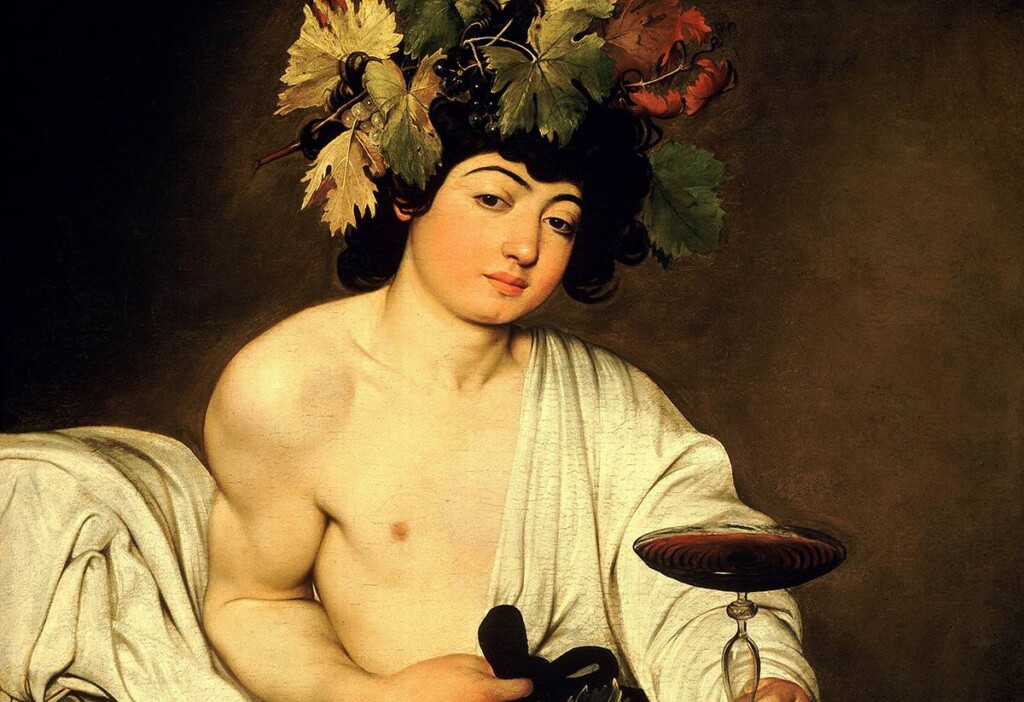
There is a moment in the story of a painting when the canvas arrives at the church and the priest looks at it and says: no. Not like that. Not here. This is not what we asked for.
It happened twice, in ways that illuminate something far more uncomfortable than artistic disagreement. The first time, a canvas had been completed for the Contarelli Chapel in Rome showing an elderly man with dirty feet and thick, laborer’s hands being guided by an angel who leans in with the casual intimacy of a neighbor helping you read a letter. The man looks confused, uncertain, almost embarrassed by his own writing. His foot pushes toward the viewer with a directness that feels almost aggressive in a sacred space. The clergy refused it. They wanted a saint transfigured, elevated, translated into the grammar of heaven. What they received was an old man who could not write, struggling with a quill, his bare feet grotesquely present in the foreground as if to insist: this man walked on roads. This man had a body. This man was not already divine.
The second rejection came a few years later, sharper and more wounding. A painting of the death of the Virgin, meant for the altar of Santa Maria della Scala in Trastevere, was removed almost immediately after its installation. The Virgin lay on a low catafalque, her body swollen, her ankles distended, her face the face of a woman who had actually died. The apostles gathered around her were not arranged in devotional elegance but in the posture of grief that does not know what to do with itself — hunched, weeping, turning away. There was a rumor, persistent and cruel, that the model had been a drowned prostitute pulled from the Tiber. Whether true or not, the rumor carried the exact anxiety the painting itself provoked: this body had been somewhere it should not have been.
Michel Foucault, in Discipline and Punish, published in 1975, argued that institutional power does not primarily work through ideas — it works through bodies. What you are permitted to show, to touch, to present in public space, to represent as sacred, is a form of political governance so total it barely needs enforcement because it has already colonized perception. The rejection of these paintings was not a theological dispute about iconography. It was an assertion of authority over what kind of body was allowed to appear inside a sacred institution. A Virgin with swollen ankles is not a minor aesthetic failure. She is a political transgression. She suggests that the divine passed through matter that was genuinely matter — corruptible, heavy, subject to the same indignities as a woman found dead in a river. The Church had spent two centuries carefully managing this distinction, and here was a painter who kept collapsing it with every brushstroke.
What makes these rejections extraordinary is that the patrons were not wrong about what they were seeing. They understood perfectly. The problem was precisely the accuracy. Giorgio Mancini, writing in the early seventeenth century, noted that Caravaggio painted from life with a literalness that disturbed his contemporaries not because it failed but because it succeeded. The dirt under the fingernails was real dirt. The feet were the feet of someone who had been standing on stone floors. The swelling was the swelling of a body that had held water too long. This was not a failure of idealization. It was a refusal of it — methodical, sustained, almost polemical in its insistence on remaining at the level of the flesh.
And the flesh, in the economy of Counter-Reformation Rome, was precisely what needed to be managed, elevated, transfigured, or hidden. A painting that did none of these things was not simply unwanted. It was a kind of argument.
The Murderer Who Painted Saints
It happened on a tennis court, or near one — the accounts differ on this detail the way accounts always differ when everyone involved has reasons to lie. What is certain is that on the evening of May 28, 1606, in the Campo Marzio district of Rome, a man named Ranuccio Tomassoni fell to the ground with a wound that would not stop bleeding. The blade had entered somewhere in the groin or upper thigh, severing something essential. He died there, in the street, while the man who cut him fled the city before dawn.
There was a gambling debt, possibly. There was a woman, possibly. There was the particular combustion that happens when two men with reputations for violence occupy the same space and neither is willing to yield an inch of it. What there was not — despite the centuries of art-historical softening that followed — was an accident. The wound was too precise, the flight too immediate, the papal death sentence issued too quickly for this to have been a tragic misunderstanding. The painter who had already been arrested for carrying weapons without a license, who had thrown a plate of artichokes at a waiter’s face, who had attacked a notary, who had wounded a soldier — that man killed Ranuccio Tomassoni and ran south toward Naples with blood on his hands and a price on his head.
Now hold that image for a moment and place beside it another. A table in an inn, three men suddenly rigid with recognition as a fourth breaks bread and the light falls on his hands in a way that makes time stop. Or a customs booth at the edge of a market, a shaft of light cutting diagonally across a group of men counting money, and one figure pointing at himself as if he cannot believe he is the one being called. Or a woman standing over a man she is killing, her face not triumphant but concentrated, almost clinical, while her servant holds the bag open and the sword does its necessary work.
Hannah Arendt, writing about Adolf Eichmann in Jerusalem in 1963, insisted on something that made her universally despised by those who needed monsters to stay monstrous: that the capacity for evil is not the opposite of the capacity for thought, or love, or creation. It does not work that way. The administrative mind that organized deportations was the same mind that wrote letters to his children. Arendt did not say this to absolve. She said it because the alternative — the idea that great violence requires a fundamentally broken or inhuman interior — is a comfort we cannot afford. It lets everyone else off the hook of self-examination.
But Caravaggio complicates even Arendt’s cold clarity, because the question is not only whether the man who painted the saints was capable of murder. The question is whether the murder is somehow inside the paintings. Whether the Judith’s arm has the particular authority it has precisely because the painter knew what it felt like to push a blade into a body and watch the consequences. Whether the chiaroscuro — that violent contrast of light and absolute darkness that became his signature, that influenced every painter who came after him for four centuries — is not merely a technique but a temperament. A way of seeing that admits no gradation between being seen and being obliterated.
Caravaggio’s saints are not serene. They are startled, reluctant, caught mid-gesture in something they did not choose. Matthew looks like a man who has just realized he cannot pretend not to have heard. The disciples at Emmaus look like men whose certainties have just collapsed beneath them. These are not faces of faith. They are faces of ambush. And the hand that knew how to ambush a man in a Roman street in the fading light of May also knew, with terrible precision, how to paint that exact expression on a saint’s face.
Darkness as a Philosophical Method
There is a moment that happens in dim rooms, in the late hours when someone across from you begins to speak the thing they have never said aloud before. You cannot see their full face. One side catches whatever light exists — a lamp behind them, a streetlight through a curtain — and the other side dissolves into the shadow of the room. And what you notice, what you cannot stop noticing, is that the half you can see becomes unbearably vivid. Every micro-tension in the jaw, every flicker at the corner of the eye. The darkness does not hide them from you. It delivers them to you, more completely than full light ever could.
This is not a metaphor. This is the structure of human perception itself, and Caravaggio understood it two centuries before anyone had the philosophical vocabulary to explain why.
Maurice Merleau-Ponty argued in his 1945 Phenomenology of Perception that we do not passively receive the world as a neutral field of data. Perception is always differential, always relational. We do not see brightness; we see brightness against darkness. We do not perceive a face; we perceive contrast, edge, the place where one thing ends and another refuses to begin. The visual field is not filled with objects — it is organized by tensions between presence and absence. Caravaggio painted exactly this. His darkness is not a background any more than silence is the background to music. The darkness is the condition under which visibility becomes possible at all.
Look at what he does with a hand emerging from shadow to receive something — a coin, a call, a wound. The hand does not appear against a neutral field. It erupts. The edge where skin meets darkness is not a border; it is an event. He understood, through practice rather than theory, that the eye is not drawn to light but to the threshold between light and its absence. The chiaroscuro tradition before him was decorative, concerned with volume and sculptural presence. What Caravaggio introduced was something epistemological — a claim about how knowledge itself arrives, which is always partially, always from one side, always with half the face in the dark.
This is why his figures feel so relentlessly physical, so cornered by their own reality. A man who has spent his life collecting taxes is called by name in a tavern, and his hand, still moving toward his money, freezes mid-gesture. You see only what the light allows you to see: the arrested hand, the half-turned face, the specific quality of a man caught between who he was a moment ago and who he is about to become. The rest is darkness, and the darkness is not an absence of information. It is the information. It tells you that transformation does not happen in full view, that grace or violence or recognition arrives from an angle you were not watching.
Gilles Deleuze wrote about the fold as the fundamental unit of Baroque thought — the way seventeenth-century culture became obsessed with surfaces that curve back on themselves, that conceal while revealing. Caravaggio is the painter of the fold in its most extreme form. His light does not illuminate a scene; it folds over it, selecting without explanation, insisting on this detail and abandoning that one with no apparent logic. Which is precisely how memory works. Which is precisely how understanding arrives — in fragments, in the patches that the available light permits, and never as a complete, evenly lit inventory of the truth.
To paint in full light is to make a claim about the world that the world does not support. Caravaggio refused that claim. He stayed in the dim room, with the half-visible face, with the hand caught between gestures, and he reported honestly what partial vision looks like from the inside.
A vision curated by a filmmaker, not an algorithm
In this video I explain our vision
The Models Were Real People
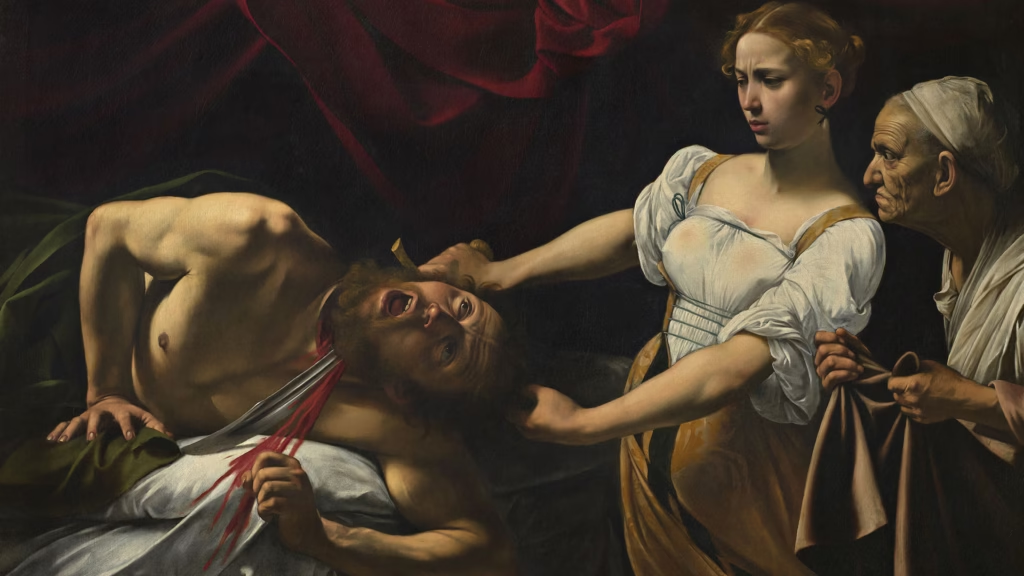
There is a woman’s body pulled from the Tiber on a cold morning, bloated and pale, her feet still bare, her hair matted against a face that was once, in some other life, particular and known to certain people. She is carried to a mortuary slab. Nobody important mourns her. She was a sex worker, and Rome in the early seventeenth century had tens of thousands of them — estimates place the number at roughly one in ten of the female population — which means she was also invisible in precisely the way that large numbers make people invisible. She disappears into a statistic before she is even buried.
Except that she doesn’t disappear. Because someone looked at her.
He looked at her with the kind of attention that Simone Weil, writing three centuries later in her essay “Reflections on the Right Use of School Studies,” would call the rarest ethical act available to a human being. Weil argued that attention — genuine, sustained, self-emptying attention to another person — is the foundation of all love and all justice. Not sympathy, which is still about you, still about your feelings in the presence of another’s suffering. Attention. The willingness to let what is actually there enter you, without filtering it through what you wish were there or what you find comfortable. Most of us, Weil wrote, spend our entire lives performing a kind of managed inattention to the world, and especially to the people the world has discarded.
Caravaggio looked at the drowned woman and painted her as the Virgin Mary. He gave her swollen ankles. He gave her the posture of a body that had been in water too long. He surrounded her with mourners who look like dock workers and market vendors because they were dock workers and market vendors — people he knew from the streets around Campo Marzio, from the taverns where he drank and fought, from the margins of a city that ran on invisible labor. The painting was commissioned for Santa Maria della Scala in Trastevere and was rejected almost immediately upon delivery. The rejection was not aesthetic. The church knew exactly what it was looking at, and that was precisely the problem.
What the patrons and ecclesiastical authorities understood — viscerally, before they could articulate it as theology — was that they were being asked to perform an act of devotion before a woman they had trained themselves not to see. The scandal was not nudity, not technical impropriety, not some violation of iconographic convention. The scandal was recognition. If this is the Virgin, then the women in the street outside are also the Virgin. If these grieving men with their cracked hands and their hunched shoulders are apostles, then the men unloading grain at the docks are also apostles. The logic is devastating and there is no way to contain it once you have let it in.
This is what the powerful have always known about visibility: it is dangerous. Not the visibility of monuments and proclamations, which the powerful control and deploy at will, but the visibility of faces. A face, as Emmanuel Levinas argued in “Totality and Infinity” in 1961, makes an absolute ethical demand. It says: you cannot treat me as nothing. You cannot look at me and proceed as if I am not here. The face of the other is the origin of all moral obligation, which is why systems of oppression have always worked, first and most fundamentally, by erasing faces — by turning people into categories, numbers, functions, problems.
Caravaggio painted faces. Specific, undeniable, unrepeatable faces. The face of a woman whose name no record preserves, whose life the city swallowed without ceremony, whose body the Tiber returned like an afterthought — and he put it at the center of the most sacred image in Catholic devotion and dared anyone to look away.
Exile, Malta, the Last Canvases
There is a particular quality of light that exists only in places where you do not belong. Not hostile, not welcoming — simply indifferent in a way that no familiar room ever manages to be. You notice the angle of it differently. The shadows it carves into walls and faces seem more honest somehow, less arranged for your comfort. Caravaggio, running from a death sentence that Rome had attached to his name like a second shadow, arrived in Naples in 1607 and began to paint with hands that no longer had anything to protect.
Edward Said, writing in “Reflections on Exile” in 2000, argued that exile is not primarily a condition of loss but of a peculiar, almost violent clarity. The person expelled from the center can see the structure of that center with a precision that its inhabitants are permanently denied. You cannot see the walls of the room you live inside. Caravaggio had lived inside Rome — its patronage systems, its cardinal collectors, its protected violence — and now, outside it, he could see every brick. What he painted in the years that followed carries the mark of that vision. Not despair, exactly. Something colder and more precise than despair.
In Malta, where he arrived in 1607 under the protection of the Knights of Saint John, he produced what remains his only signed work. The Beheading of Saint John the Baptist, completed in 1608 for the oratory of the co-cathedral in Valletta, is enormous — nearly four meters wide — and yet it operates through subtraction. The executioner kneels over the fallen Baptist, reaching for a short knife to finish what the sword began. A serving woman holds a platter waiting for the head that is not yet severed. A jailer points down, directing the operation with bureaucratic calm. An old woman covers her face. Two prisoners watch through a grating in the background, witnesses who cannot intervene and know it. The signature, “f. Michel Angelo,” is drawn in the blood pooling beneath the Baptist’s neck — the only time in his life Caravaggio signed his own name, and he chose to do it in a dead man’s blood, in the filth of an execution, in the very substance of what he had fled and what had followed him regardless.
Said’s insight lands here with particular force. The fugitive does not escape the structure. He carries its logic inside him and sees it operating everywhere he looks. What the exile perceives is not freedom but transparency — the mechanisms of power become legible precisely because you are no longer protected by them. The Maltese canvas shows an institution at work: roles assigned, gestures practiced, indifference professional. No one in the painting is evil. Everyone is simply performing their function within a system that requires this outcome. Caravaggio, who had killed a man and been killed for it in return by the same logic of honor and retaliation, knew the choreography from inside.
He was expelled from the Knights’ order before the year was out — accused, again, of violent conduct — and fled to Sicily, where he painted in Palermo and Syracuse with a rawness that even his Roman work had not reached. The technical armor was falling away, as if the flight had stripped something structural from his method. Figures grow more elongated, settings emptier, the darkness more total and less theatrical. The compositions breathe with a kind of desperation disguised as silence.
He was making his way back toward Rome, toward a pardon that the Pope had apparently agreed to grant. He carried his paintings with him on the boat. He was arrested by mistake at one port, released, and found that the boat with his canvases had already sailed without him. He walked the summer roads of the Lazio coast in the heat of July 1610 carrying almost nothing, heading toward a city that had not yet decided whether to let him live.
What Gets Canonized and What Gets Buried
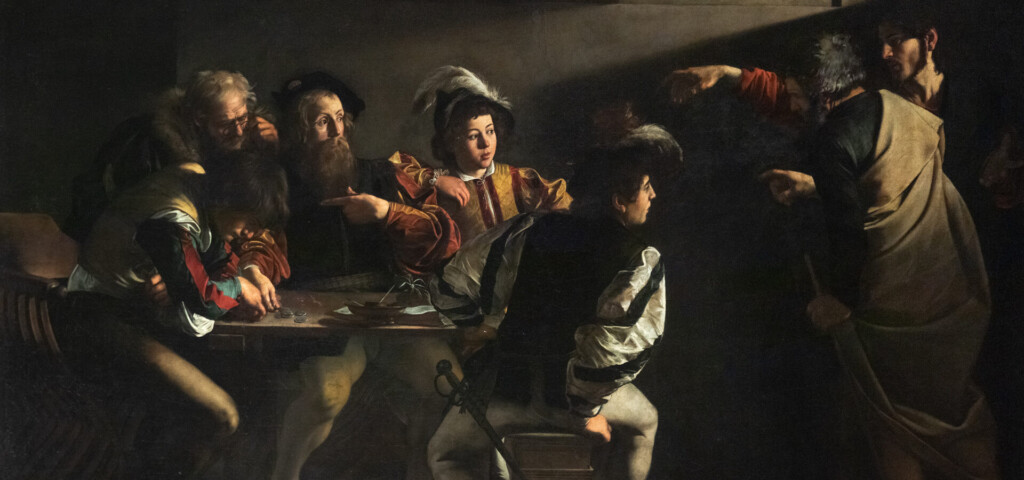
There is a museum somewhere — and you have been in it, or one exactly like it — where a reproduction of The Calling of Saint Matthew hangs in a corridor between the gift shop and the emergency exit, printed on high-quality paper, framed behind glass, lit by fluorescent tubes. People slow down in front of it. Some take photographs. Almost none of them know that the man who made the original had, by the time he painted it in 1600, already accumulated a criminal record stretching across Rome like a fault line — brawls, illegal weapons, assaulting a constable, pouring a plate of artichokes into a waiter’s face with sufficient violence to warrant a formal complaint. And none of that, in this corridor, matters. The frame has already done its work.
Walter Benjamin wrote in 1935, in “The Work of Art in the Age of Mechanical Reproduction,” that what withers in the age of reproduction is the aura — that singular, unrepeatable presence bound to the original’s specific location in time and space. But Benjamin did not quite anticipate the secondary operation that reproduction enables: not just the loss of aura, but the sanitization of origin. When an image circulates freely enough, it detaches not only from its physical location but from the historical body that produced it. The painting becomes a pure visual event. The painter becomes a name. And the name, over centuries, becomes a monument — which is to say, something no longer alive enough to be dangerous.
This is what the canon does. It does not simply celebrate; it launders. Caravaggio the convicted murderer, the man who fled Rome in 1606 after killing Ranuccio Tomassoni in a brawl that may have begun over a debt from a tennis match, the man who spent the last four years of his life moving between Malta, Sicily, and Naples in a condition closer to permanent flight than artistic pilgrimage — this man is methodically separated from the paintings so that the paintings can be safely admired. The violence is aestheticized, absorbed into notions of tortured genius, romantic transgression, the necessary darkness of the truly creative. It becomes atmosphere. It stops being a fact about what a specific human being did to another specific human being on a Roman street.
The philosopher Paul Ricoeur, in his work on memory and forgetting, described how collective memory operates through a kind of selective mourning — preserving what can be integrated into identity narratives and quietly releasing what cannot. What survives in the case of Caravaggio is the chiaroscuro, the revolutionary light, the influence on Rembrandt, on Rubens, on Artemisia Gentileschi, on cinema itself. What gets released is the texture of the life — not because it is unknown, but because knowing it in full would introduce a friction that institutional veneration cannot comfortably absorb. Museums need saints, not fugitives.
And yet the paintings resist this operation at some level, which is perhaps why they continue to disturb even across centuries of reproduction and familiarity. The figures in them do not look redeemed. They look caught — in the middle of something, surprised by a light they did not ask for, uncertain whether to accept what is being offered. The man at the table in that famous scene, the one toward whom the extended arm reaches through the darkness, does not look chosen. He looks interrupted. There is something in his expression that knows the cost of turning toward that light, and has not yet decided whether to pay it.
Which is to say: the hand that points in the painting and the hand that held the knife in the street may not be as separable as the canon requires them to be — and perhaps it is precisely that inseparability, buried but never fully erased, that makes you stop in the corridor between the gift shop and the emergency exit, longer than you intended, unable to quite look away.
🎨 Light, Shadow, and the Renaissance Soul
Caravaggio’s dramatic use of chiaroscuro and his raw, unidealized figures placed him at the crossroads of art history, theology, and human psychology. To fully understand his genius, one must explore the broader artistic and cultural landscape that both preceded and surrounded him. These related articles illuminate the world from which Caravaggio emerged and the visual traditions he so powerfully transformed.
Titian: Life and Works
Titian was one of the towering figures of Italian Renaissance painting whose mastery of color and sensuality left an indelible mark on generations of artists, including Caravaggio. His ability to render flesh, fabric, and emotion through warm, luminous pigments established a standard of pictorial intensity that would challenge and inspire the Baroque painters who followed. Understanding Titian’s innovations in portraiture and mythological narrative is essential to appreciating the revolution Caravaggio later unleashed.
GO TO THE SELECTION: Titian: Life and Works
Vanitas in Art: Symbolism and Meaning
The Vanitas tradition in art directly informs much of Caravaggio’s symbolic vocabulary, from the skulls and wilting flowers that appear in his still lifes to the meditations on mortality woven into his religious scenes. This genre, rooted in the transience of earthly life, gave painters a framework for exploring themes of sin, redemption, and the passage of time. Caravaggio absorbed these symbols and charged them with a visceral realism that made the vanitas message feel urgent and inescapable.
GO TO THE SELECTION: Vanitas in Art: Symbolism and Meaning
Memento Mori: History and Meaning
Memento Mori, the practice of keeping death in mind as a moral and spiritual discipline, permeates the iconography of Caravaggio’s most powerful works, from the decapitated Goliath to the dying Virgin. This centuries-old tradition connected visual art to philosophy and theology, reminding viewers of their own fragility before God and time. Tracing the history of Memento Mori reveals how deeply Caravaggio was embedded in a cultural conversation about sin, grace, and the value of a single human life.
GO TO THE SELECTION: Memento Mori: History and Meaning
Alchemy in the Italian Renaissance
Alchemy in the Italian Renaissance was not merely a proto-scientific pursuit but a rich symbolic and spiritual language that permeated the workshops, courts, and intellectual circles of the era in which Caravaggio was formed. Artists of this period often drew upon alchemical imagery to encode deeper meanings of transformation, purification, and hidden truth within their works. Exploring this esoteric dimension of Italian Renaissance culture opens unexpected pathways into understanding the hidden layers within Caravaggio’s own dramatic imagery of darkness and illumination.
GO TO THE SELECTION: Alchemy in the Italian Renaissance
Discover Art and Cinema on Indiecinema
If these explorations of art, symbolism, and cultural history have ignited your curiosity, Indiecinema streaming is the perfect place to continue the journey. Our catalog features independent and art-house films that explore the lives of painters, the mystery of the Baroque, and the enduring power of visual storytelling. Visit Indiecinema and let cinema deepen your encounter with the greatest art of all time.
👉 EXPLORE THE CATALOG: Watch Indie Films in Streaming
A vision curated by a filmmaker, not an algorithm
In this video I explain our vision

