
The Mystic in the Mirror
There are mornings when you wake inside your own life and it fits wrong. Not because anything has changed — the same ceiling, the same sounds from the street below, the same sequence of obligations pulling you toward vertical — but because something underneath all of it refuses to be still. A pressure. A sense that the person moving through the kitchen, filling the kettle, checking the phone, is a kind of elaborate performance you are somehow watching from a distance you cannot measure. You know this feeling. It passes. You let it pass, because the alternative — actually sitting with it, following it downward to wherever it leads — is not something the structure of your day permits, and honestly, it is not something the structure of your culture has ever particularly encouraged.

The medieval mystics did not let it pass.
This is the first thing to understand about them, and it is the thing most systematically distorted by centuries of hagiography, romantic revision, and the general human tendency to make dangerous ideas safe by enshrining them. Hildegard of Bingen, Meister Eckhart, Julian of Norwich, Marguerite Porete — these were not gentle souls floating in divine light, decorative figures for illuminated manuscripts and wellness retreats. They were people who looked directly at that uncanny pressure beneath ordinary existence and refused to look away, who followed it into territories so radical that the institutional world around them responded with surveillance, censure, exile, and fire. Marguerite Porete was burned at the Place de Grève in Paris in 1310. Her book, The Mirror of Simple Souls, was condemned. She refused to recant. The document she refused to recant was a systematic dismantling of the ego’s claim to be the center of spiritual life — which was, in the language of her century, heresy, but which in any honest language is simply one of the most destabilizing ideas a human being can encounter.
William James, writing in The Varieties of Religious Experience in 1902, identified mystical states by four characteristics: ineffability, noetic quality, transiency, and passivity. It is a useful taxonomy, but it domesticates something that was never domesticated in practice. What James called passivity — the sense that the self is being acted upon rather than acting — the medieval church experienced as a direct threat to ecclesiastical authority. If you had unmediated access to the divine, you did not need a priest. If the self could dissolve into something larger, the entire architecture of sin, penance, and institutional grace began to crack. The mystics were not marginal figures pursuing private spiritual experience. They were, structurally, revolutionaries — not because they wanted to overthrow anything, but because the logic of their inner experience contradicted the logic of every power structure organized around the premise that reality is exactly as it appears on the surface.
The thirteenth and fourteenth centuries — the period historians sometimes call the flowering of medieval mysticism — were also centuries of plague, schism, and the slow erosion of feudal certainties. The Black Death killed somewhere between thirty and sixty percent of Europe’s population between 1347 and 1351. The papacy sat in Avignon, exiled from Rome, politically compromised, spiritually suspect. In this context, the turn inward was not escapism. It was, for many, the only direction that still offered any solid ground. And what they found when they turned inward was not comfort. What they found was the self — and then, past the self, something that refused to be named, that dissolved every category they brought to it, that made the ordinary machinery of identity feel like exactly what it is: a useful fiction, not a final truth.
You already know what this is. You felt it this morning, briefly, before the kettle boiled.
What the Church Built and What It Could Not Contain
You have stood inside a cathedral and felt something that had nothing to do with theology. The sheer vertical ambition of it, the stone pulled upward as if gravity itself had been argued into submission, the light arriving through colored glass in a way that made the air seem to have opinions. What you felt was not God. What you felt was power wearing the costume of God, and the distinction matters enormously.
Jacques Le Goff spent decades excavating the medieval world not as a gallery of saints and miracles but as a civilization organized around control — control of time, control of death, control of the imagination. His work on the medieval West, particularly his foundational study of medieval civilization published in 1964, insists that the Church between roughly the eleventh and fifteenth centuries was a total institution in the most modern sociological sense: it administered birth and death, it owned approximately one third of the arable land in Western Europe by the thirteenth century, it ran the only functioning system of education, and it held the exclusive copyright, so to speak, on what happened to your soul after you died. The invention of Purgatory — which Le Goff traced with forensic precision in his 1981 study — was not a theological refinement but a financial and administrative instrument, a mechanism for extending ecclesiastical authority beyond the grave and generating a permanent economy of intercession. You could not escape the Church even by dying.
Into this machine, mysticism arrived not as a flower blooming in sanctioned soil but as water finding cracks. A woman in the Rhineland receives visions so precise and so total that she begins dictating them, and what she dictates cannot be fully supervised, cannot be fully corrected, because she claims the source is not a bishop or a council but God directly, unmediated, pressing itself into her like heat into wax. The institution knows exactly what this means. It means the entire architecture of intermediaries — the priest, the confessor, the papal legate, the sacrament, the indulgence — has been bypassed in a single visionary moment. If God speaks directly to the individual soul, then the Church is not a necessity but a convenience, and inconvenient conveniences get abandoned.
This is why the mystics were the most dangerous internal dissenters the medieval Church produced, far more threatening in their way than outright heretics, who could be identified, prosecuted, and burned with relative procedural clarity. The mystic presented a harder problem: she was often devout, often orthodox in her declarations, often willing to submit her writings to ecclesiastical review. She was not attacking the Church. She was simply reporting what had happened to her, and what had happened to her made the Church structurally redundant. The sociologist Max Weber, writing centuries later but diagnosing something permanent about institutional religion, called this the tension between charisma and institution — the original fire of direct religious experience and the bureaucratic apparatus that forms around it, simultaneously preserving and extinguishing it. By the twelfth century, the apparatus was so total, so refined in its administrative sophistication, that any charisma erupting within it created an immediate crisis of authority.
Consider what it meant to live inside that world without the vocabulary to name what was happening. A woman has an experience of dissolution, of the boundaries of self becoming permeable, of something vast and impersonal moving through her like wind through an open room. She has no secular psychological framework for this. She has only the language the Church has given her, and so she uses it, and in using it she simultaneously reports her experience and hands the institution a weapon it can use against her. Bernard McGinn, in his monumental history of Christian mysticism begun in 1991, calls this the permanent irony of medieval mystical literature: the very vocabulary of submission and obedience through which mystics expressed their experiences was also the vocabulary that authorized others to judge, restrict, and silence them.
The cathedral rises. The light enters. And somewhere in a cell nearby, something the builders did not intend is quietly happening.

Hildegard of Bingen and the Body That Speaks
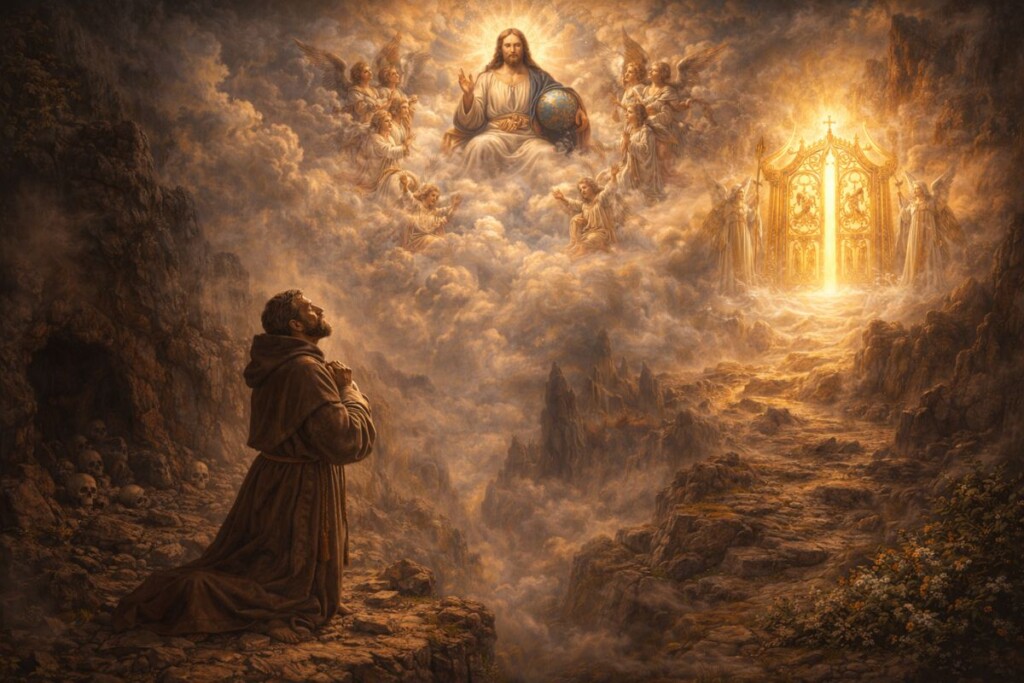
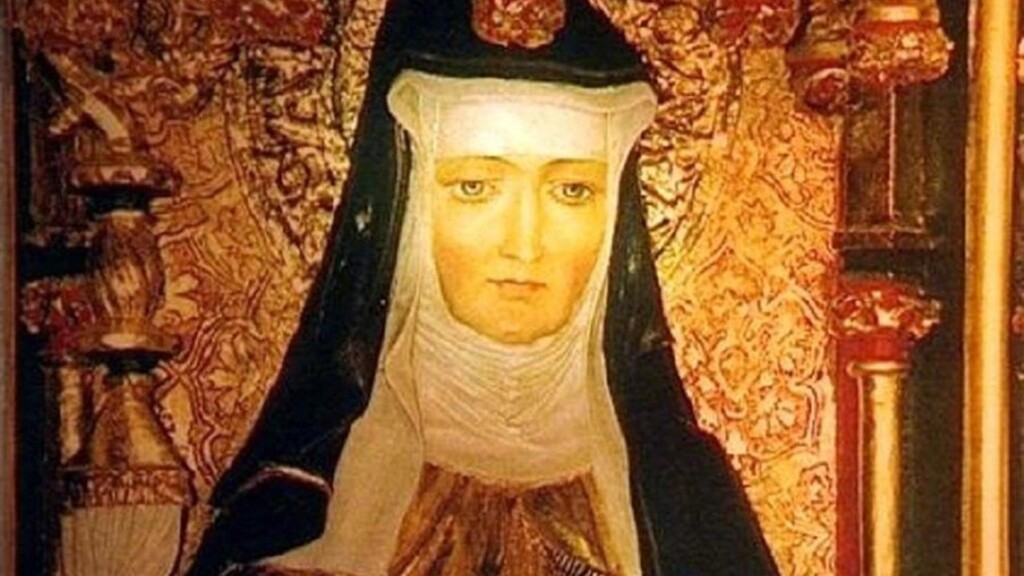
You have felt it, perhaps — that particular pressure of a room where your voice arrives half a second too late, where what you say is heard only after it has passed through the filter of what you are supposed to be. Hildegard of Bingen lived inside that pressure for the first forty-two years of her life, and then she did something that only looks like surrender: she announced that God was speaking through her, that she herself was merely the instrument, the hollow reed, the feather on the breath of the divine. It was the most politically sophisticated move of the twelfth century, and it worked.
She was born in 1098, the tenth child of a noble family in the Rhineland, and given to the Church as a tithe — a word worth sitting with, because it means she was a gift of property, not a person making a choice. She lived enclosed in an anchorite cell attached to a monastery at Disibodenberg, studied under a woman named Jutta of Sponheim, and absorbed everything that passed within reach of those walls: theology, music, natural philosophy, medicine. She suffered from a recurring illness throughout her life that produced states of visual and physical intensity she later described as a living light, a reflection of the living light, something that entered her not through the eyes or the mind but through the entire body at once. Whether what she experienced was migraine with aura, as some neurologists have speculated with the particular confidence of people who have never had a vision, or something else entirely, is beside the point. What matters is what she built from it.
Simone de Beauvoir argued in 1949 that woman had been constituted throughout history not as a subject but as the Other — the thing against which Man defines himself, the mirror that has no autonomous reflection. The trap de Beauvoir identified is structural: a woman who speaks as herself is already transgressing, already occupying a position that culture has declared empty. Hildegard solved this problem with an elegant brutality. She did not speak as herself. She spoke as the vessel of a voice that no one could refuse without refusing God. When she began writing Scivias — the title compressed from Scito vias Domini, Know the Ways of the Lord — around 1141, she had Pope Eugenius III’s explicit approval, obtained through Bernard of Clairvaux, the most influential man in Christendom at the time. She had made herself untouchable by making herself disappear.
But read Scivias. Read the medical texts she gathered under the title Causae et Curae, where she writes about the humors of the body, the nature of female desire, the specific textures of illness and heat and generation with a clinical directness that has no parallel in her century. Read the seventy-seven musical compositions she produced — an output that dwarfs every other known composer of the medieval period, male or female — and try to locate the hollow reed, the passive instrument. What you find instead is a mind of extraordinary ferocity that had learned to armor itself in the language of submission. She wrote letters to popes, emperors, abbots, kings. She preached publicly, which women were not permitted to do. She founded her own monastery at Rupertsberg over the fierce objections of the monks at Disibodenberg who did not want to lose their resident prophet and the donations she attracted.
The illness was real. The visions were real in whatever sense any overwhelming interior experience is real. But the claim of divine origin was also a weapon, and Hildegard held it with both hands. She understood, perhaps more clearly than any of her contemporaries, that the only speech a woman could make audible in that world was speech that arrived from somewhere other than herself — and so she gave her voice away in order to keep it entirely.
Meister Eckhart and the God You Cannot Name
There is a moment, not of peace but of dissolution, when you sit long enough in silence that the face reflected back at you in still water becomes unrecognizable. Not because something has changed in your features, but because the category of “your face” has quietly collapsed. The eyes looking back belong to no one you can locate. This is not serenity. This is vertigo. This is precisely where Meister Eckhart wanted to take you, and why the Church needed to stop him.
Eckhart von Hochheim, a Dominican friar and theologian, delivered sermons in the vernacular German of Cologne and Strasbourg between roughly 1300 and his death around 1328 that did not merely challenge theological convention — they detonated it from within. The peculiar danger of Eckhart was that he was not working from the margins. He was a trained scholastic, a master of theology at Paris, an administrator of his order. He knew exactly which walls he was dismantling and he did it from inside the building, with full command of the tools that built them.
The central provocation was his insistence on distinguishing between God — the personal, relational, nameable God of Christian tradition — and what he called the Godhead, the Gottheit, a ground of being so absolute that even the attributes of divinity could not be attached to it. Bernard McGinn, whose multi-volume work on Western Christian mysticism remains the most rigorous scholarly mapping of this terrain, argues that Eckhart’s mysticism cannot be separated from his metaphysics, that the spiritual and the philosophical were never two registers for him but a single movement. The soul does not ascend toward God in Eckhart. It breaks through God to reach something that has no name because naming requires distinction, and at the Godhead there is no distinction. There is only what Eckhart called the grunt, the ground, an abyss that is simultaneously the deepest root of the soul and the innermost silence of divinity.
The instrument he prescribed for this breakthrough was Abgeschiedenheit — detachment — which has been mistranslated into passivity often enough that its real violence gets obscured. Eckhart’s detachment was not the quiet withdrawal of a monk who has learned to want less. It was the annihilation of the wanting subject entirely. You do not empty yourself of preferences so that God can fill the space. You empty yourself of yourself, of the self that would even receive God, because as long as there is a receiver there is still a boundary, and where there is a boundary there is no Godhead. He preached this in German, not Latin, to laypeople, to women in beguine communities who had no access to university theology. He handed them a philosophical grenade in their mother tongue.
This is what made it intolerable. In 1329, one year after Eckhart died, Pope John XXII issued the papal bull In agro dominico, condemning twenty-eight propositions extracted from his work, seventeen as outright heretical, eleven as dangerous and presumptuous. The language of the condemnation is worth pausing over: these ideas were described as capable of misleading simple and uneducated people. The threat was not abstract. A theology that tells an ordinary person that the God they pray to is not the final ground of things, that the name-giving, will-having, person-relating God is already one step removed from the real — that theology undermines every structure that depends on God being a figure of authority who can be represented, mediated, and ultimately controlled by institutional hierarchy.
What is dangerous about nothingness is precisely that you cannot negotiate with it. You cannot appoint its representatives. A God beyond God leaves the Church with nothing to administer.
Julian of Norwich and the Scandal of Tenderness
You have been told, for as long as you can remember, that what you felt in that moment was not real. That the warmth you experienced at the edge of unconsciousness was a trick of oxygen deprivation, or wishful thinking, or the kind of softness the mind manufactures when it cannot bear the truth. You have been told to correct yourself. To revise the account. To make it fit.
Julian did not correct herself.
In May 1373, at thirty years old and near death from an illness severe enough that a priest had been summoned to administer last rites, she looked at a crucifix and saw something that would not stop insisting on itself for the next two decades. She saw suffering that was not only suffering. She saw a God who held her the way a mother holds a child — not metaphorically, not as rhetorical consolation, but as the primary and irreducible truth of what divinity actually is. And then, because she was a woman writing in fourteenth-century England inside an anchorite cell in Norwich with a window to the church and a window to the world, she spent twenty years asking herself whether she had the right to say what she had seen.
The Revelations of Divine Love, completed in its long form sometime around 1393, is the first book written in English by a woman. That sentence sounds like a fact from a history textbook. What it actually describes is an act of sustained defiance so quiet it was almost invisible for centuries. Grace Jantzen, in her 1987 study Julian of Norwich: Mystic and Theologian, is precise about what this cost. Julian was writing against every institutional structure that defined what a woman could legitimately know about God, which is to say she was writing against the entire architecture of medieval ecclesiastical authority. Women were not theologians. Women who claimed direct access to divine revelation were, at best, tolerated as curiosities and, at worst, destroyed. The line between mystic and heretic ran exactly through the body of a woman who said: I know what I saw.
What she saw was a God who called himself Mother. Not as analogy. Not as gentle supplement to the Father. Julian writes that just as God is our Father, so God is also our Mother — in our making, in our sustaining, in the manner of mercy and grace. She uses the word mother more than sixty times across the long text. This is not a modern feminist retrofitting of medieval piety. This is a woman inside the fourteenth century dismantling the gender architecture of her own theology from within, using the only language available to her and pressing it past its own limits.
And then there is the question of hell. The Church taught its existence with the confidence of geography. Julian was told, in her visions, that all shall be well, and all shall be well, and all manner of things shall be well. She heard this. She believed it. And she could not reconcile it with eternal damnation. She does not resolve the contradiction. She holds it openly, writes around it, admits she cannot see how both things are true and yet refuses to abandon either. There is a word for this kind of intellectual honesty. It is not heresy. It is closer to courage.
Jantzen argues that what Julian represents is not simply a historical curiosity but a suppressed tradition of interiority that European Christianity systematically marginalized because it located authority in the experience of the body rather than in the institution of the church. To feel something so completely that twenty years of solitude cannot erode it is not mysticism as escapism. It is mysticism as a form of witness.
She looked at what she had been told was only suffering and saw something else moving inside it. She wrote it down. She did not apologize.
A vision curated by a filmmaker, not an algorithm
In this video I explain our vision
The Rhineland Mystics and the Geography of the Soul
There is a man who sits before a small fire — not a dramatic pyre, not a theatrical gesture — just a modest flame in a clay bowl, feeding it carefully with folded paper. The papers are letters. He wrote them to himself over the course of years, precise and sincere records of his interior life, his fears, his certainties, his maps of God. He burns them not because he is ashamed of what they say but because they no longer fit. The man he was when he wrote them no longer exists, and the words, though still technically accurate, describe a country he has emigrated from. He does not grieve this. He feeds the fire slowly, methodically, the way a person tends something alive.
This is what the Rhineland mystics understood before anyone had given it a proper name. Johannes Tauler, preaching in Strasbourg in the mid-fourteenth century to congregations that included both Dominican friars and the laywomen known as Beguines, spoke of an interior movement so constant and so radical that any fixed description of the soul was already obsolete by the time it was spoken. His sermons — more than eighty survive — were not theological lectures. They were something closer to dispatches from a country being explored in real time, the language straining at its own edges. Henry Suso, his contemporary and fellow inheritor of Meister Eckhart’s condemned legacy, went further into the body of that strangeness, his mystical autobiography recording experiences so physically intense — self-mortification, visions, a kind of divine eros — that modern readers sometimes misread them as pathology. They are not. They are the record of a man for whom interiority had become the only geography that mattered, and who understood that geography as requiring an entirely different cartographic method.
Michel de Certeau, writing in the late twentieth century, described mysticism precisely as a science of singularity — not a theology of universals, not a system, but a discipline of attending to the irreducibly particular, to what cannot be transferred or institutionalized. His work, especially in “The Mystic Fable” published in 1982, argued that the great mystical movements represented a rupture within Christianity itself: a turn away from the collective and the doctrinal toward something that resisted institution by its very nature. The Rhineland movement embodied this rupture with uncomfortable precision.
Mechthild of Magdeburg, who began recording her visions around 1250 in Low German rather than Latin — a choice as radical as writing a legal brief in slang — described the soul’s relationship with God in terms so erotic, so fluid, so resistant to ecclesiastical containment that her work, “The Flowing Light of the Godhead,” was almost lost entirely. She wrote from outside the monastery, from within the Beguine communities that had spread across the Rhine valley and the Low Countries in the twelfth and thirteenth centuries. The Beguines were laywomen who took no permanent vows, owned no shared property in the traditional sense, and answered to no single rule. They were not nuns. They were not entirely secular. They occupied a category that the medieval Church found increasingly intolerable, and the Council of Vienne in 1311 formally moved to suppress them, condemning their way of life as presumptuous and their theology as dangerous.
What was dangerous, specifically, was their insistence on direct access. Not mediated, not supervised, not channeled through a male confessor or an institutional structure. The Beguines were mapping interior territories that had no institutional address, which is precisely what de Certeau meant by singularity — a form of knowledge that cannot be administered, cannot be made general without being destroyed. Mechthild’s flowing light did not flow through approved channels. Neither did Suso’s anguish, nor Tauler’s insistence that the ground of the soul was a place where even the concept of God had to be surrendered.
Marguerite Porete and the Price of Saying It Out Loud
There is a particular vertigo in reading something that articulates what you have always known but never had the language for. Not recognition as comfort, but recognition as exposure — the feeling that someone has seen the interior of your thought and written it down before you arrived. Marguerite Porete knew how to produce that feeling. She also knew, with a precision that reads now as almost prophetic, that producing it would kill her.
Her book circulated without her name. It moved through Beguine communities, monastery libraries, contemplative circles — a text that seemed to belong to no one and therefore to everyone who needed it. The Mirror of Simple Souls described a soul so utterly dissolved in divine love that it no longer required the mediation of virtues, the sacraments, the moral scaffolding the Church spent centuries constructing. The annihilated soul, she wrote, is beyond asking and beyond being asked. It is beyond sin not because it is perfect but because the category has ceased to apply. This was not mystical poetry. It was a structural argument, and the institution that heard it understood exactly what it meant.
Hannah Arendt observed, in her work on totalitarianism and political thought, that truly radical ideas are not dangerous because they are extreme but because they are incompatible — because they cannot be absorbed, reformed, or redirected into existing systems without those systems ceasing to be themselves. What Porete wrote was not a reform proposal. It was not a complaint addressed to the hierarchy. It was the declaration that the entire apparatus of mediated salvation — priest, sacrament, penance, obedience — was irrelevant to a soul that had genuinely found what the Church promised to lead you toward. The institution could not answer this. It could only eliminate it.
She was brought before the Inquisition in Valenciennes around 1300. Her book was burned in the public square. She was told to stop circulating it. She continued. This was not defiance in any theatrical sense. It was something more unsettling: the act of a person who had genuinely ceased to locate authority where the institution needed her to locate it. The Bishop of Cambrai, the theologians who examined her text, the inquisitor William of Paris — they were not dealing with a rebel who acknowledged their legitimacy and refused it. They were dealing with someone for whom that legitimacy had simply become invisible, the way certain things become invisible when you have looked past them long enough.
She refused to speak at her trial. For eighteen months she answered nothing. Arendt wrote about the political actor who understands that certain forms of speech are not dialogue but trap — that to engage on the institution’s terms is already to have conceded the ground. Porete’s silence was not passivity. It was the logical extension of everything she had written: a soul beyond asking cannot be interrogated. She was burned in Paris on the first of June, 1310, in the Place de Grève, alongside her book.
The book survived her by centuries. It circulated anonymously, attributed to Ruysbroeck, to Eckhart, to unnamed contemplatives, until a historian in 1946 identified the manuscript as hers. Readers across those centuries had encountered it as a text without an author — which meant they encountered it as a text without a martyr, without the weight of institutional murder pressing on every sentence. They read it as something that had always existed, the way certain truths seem to have always existed, waiting only to be found.
There is a particular kind of reader who reaches the final pages of such a book and understands, with that specific vertigo, that they have not been taught something new. They have been shown something they already carried, unnamed, in the part of themselves they had learned not to examine too closely.
The Living Flame and the Unbearable Question
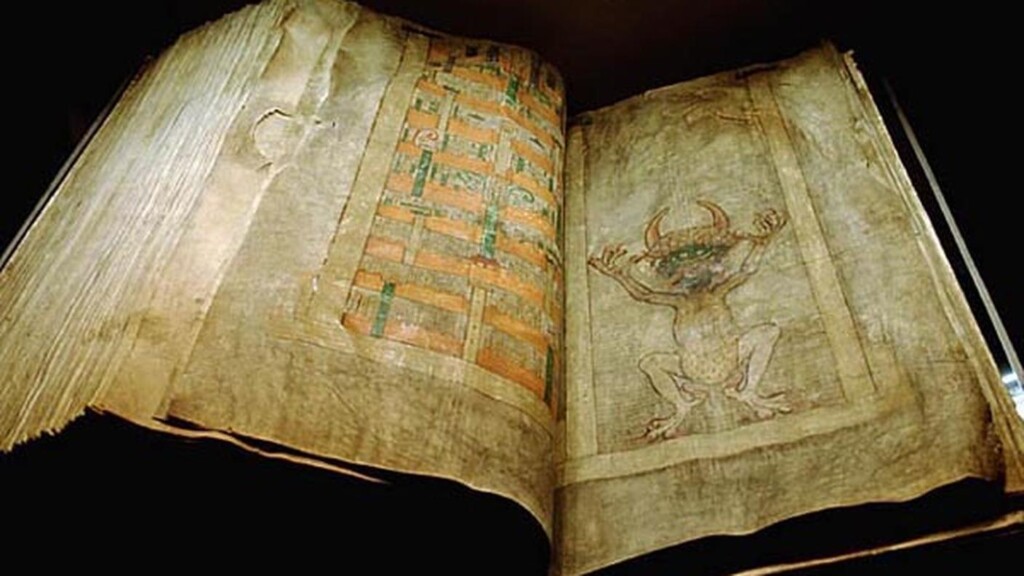
There is a man in a dark room — not metaphorically, but actually dark, a cell, a silence so complete it becomes a kind of pressure against the ears — and he is writing about fire. Not the fire of punishment, not the fire of purification in any institutional sense, but a flame he describes as living, as wounding, as unbearably tender. The wound is the point. The pain is not a stage to pass through but the very texture of arrival. Jan van Ruusbroec, writing in the fourteenth century in the vernacular Flemish that his Church superiors found dangerously accessible to ordinary people, described the mystical encounter as a flowing and an ebbing, a rhythm the soul cannot control or manufacture, only receive and lose and receive again. The anonymous English author who produced The Cloud of Unknowing sometime around the 1370s agreed on the essential point with a bluntness that borders on aggression: you cannot think your way to God. Every concept, every theological formula, every careful doctrinal construction must be placed beneath a cloud of forgetting. What remains, once all the mental furniture has been cleared away, is something the text refuses to name, because naming it would immediately falsify it.
This is the thread that does not break across centuries, the same insistence that direct experience overflows every container the institution builds for it. William James, lecturing at Edinburgh in 1901 and 1902 in what would become The Varieties of Religious Experience, identified four markers that recur across mystical accounts regardless of tradition or century: ineffability, noetic quality, transiency, and passivity. The mystic does not produce the state, James argued; the state produces the mystic, briefly, overwhelmingly, and leaves them changed in ways that ordinary psychological categories cannot adequately describe. James was a pragmatist, not a theologian, and he was careful not to adjudicate the metaphysical question. What interested him was the functional reality: these experiences transform people, and transformed people change the world around them, for better and sometimes for catastrophically disruptive worse.
Andrew Newberg, working with neuroimaging technologies that James could not have imagined, has spent decades documenting what happens in the brain during states of intense mystical absorption. The parietal lobes, which generate the brain’s sense of the boundary between self and world, show dramatically reduced activity. The orientation association area goes quiet. The self, neurologically speaking, temporarily dissolves. Newberg is careful, as careful as James, not to interpret this data as either proof or disproof of anything metaphysical. What the data shows is that the experience is real, measurably and reproducibly real, and that its signature in the nervous system is unlike any other known state.
John of the Cross, imprisoned by his own Carmelite brothers in Toledo in 1577, wrote the Noche oscura del alma in conditions that were meant to break him. The dark night he described was not a poetic device. It was the systematic withdrawal of every consolation — intellectual, emotional, sensory, spiritual — until nothing remained that the self could grasp. And what he found in that emptiness was not emptiness. This is the unbearable precision of the mystics: they do not report absence. They report a presence so total it annihilates the categories available to report it.
Every civilization produces these people. Every civilization then constructs elaborate machinery to explain why their testimony, while perhaps personally valid, cannot be granted general authority. The mystic is absorbed, domesticated, venerated safely after death, or simply destroyed. The question that this millennium-long pattern refuses to close is a simple and devastating one: if what the mystics encountered was merely private, merely neurological, merely pathological, why has every known human culture found it necessary to spend such extraordinary energy ensuring that no one takes them entirely at their word?
🕯️ Paths of the Medieval Soul and Spirit
Medieval mysticism did not arise in isolation: it flourished within a rich web of theological debate, visionary experience, and philosophical inquiry. Explore the figures and ideas that shaped one of the most spiritually intense periods in Western history.
Meister Eckhart: Life and Mystical Philosophy
Meister Eckhart stands as one of the most radical and profound thinkers of medieval mysticism, weaving together Neoplatonic philosophy and Christian theology into a vision of the soul’s union with God. His sermons and treatises pushed the boundaries of orthodox thought, earning both admiration and suspicion from Church authorities. Understanding Eckhart is essential for grasping the full depth and daring of medieval mystical speculation.
GO TO THE SELECTION: Meister Eckhart: Life and Mystical Philosophy
Hildegard of Bingen: Visionary Mystic and Scientist
Hildegard of Bingen was a visionary abbess whose extraordinary life encompassed prophecy, music, natural science, and mystical theology. Her illustrated manuscript Scivias remains one of the most remarkable documents of medieval religious experience, blending divine visions with intricate symbolic imagery. She represents the unique space where feminine spirituality, intellectual rigor, and mystical insight converged in the medieval world.
GO TO THE SELECTION: Hildegard of Bingen: Visionary Mystic and Scientist
Bernard of Clairvaux: Life and Mystical Thought
Bernard of Clairvaux was a towering figure of twelfth-century Cistercian spirituality, whose passionate writings on divine love shaped the affective tradition of Christian mysticism. His commentaries on the Song of Songs transformed the biblical text into a map of the soul’s longing for union with God. Bernard’s influence extended far beyond the monastery, touching theology, politics, and the spiritual imagination of an entire era.
GO TO THE SELECTION: Bernard of Clairvaux: Life and Mystical Thought
Thomas Aquinas: Life and Philosophical Thought
Thomas Aquinas brought systematic philosophical rigor to the heart of medieval Christian thought, forging a monumental synthesis between Aristotelian reason and Catholic theology. While not a mystic in the visionary sense, his intellectual architecture provided the doctrinal framework within which mystics lived, argued, and occasionally transgressed. Knowing Aquinas is key to understanding the intellectual world that both nourished and constrained the great medieval mystics.
GO TO THE SELECTION: Thomas Aquinas: Life and Philosophical Thought
Cinema That Touches the Sacred
If the inner depths of medieval mysticism have stirred something in you, Indiecinema offers a curated selection of independent and spiritual films that explore consciousness, faith, and the hidden dimensions of human experience. Discover on Indiecinema streaming the films that dare to ask the questions that matter most.
👉 EXPLORE THE CATALOG: Watch Indie Films in Streaming
A vision curated by a filmmaker, not an algorithm
In this video I explain our vision

