
The Room Where She Was Not Supposed to Think
You have prepared for this meeting. Not casually — genuinely prepared, the kind of preparation that involves reading past midnight and cross-referencing sources and rehearsing articulations in the car on the way in, testing the weight of each word before committing to it. You sit at the table with your notes and your clarity and your careful thinking, and when you speak, something strange happens. Not argument. Not disagreement. Something quieter and more corrosive: a brief pause, a slight reorientation of the room’s attention, and then someone else — usually seated to your left or your right, rarely across from you, as if proximity to your idea makes it easier to absorb and re-emit — says almost exactly what you have just said, and the room responds to him the way rooms respond to things they have decided to hear. You recognize the words. You recognize the structure of the thought. What you do not recognize is how entirely it has become his.

This is not paranoia. This is a room’s way of processing information it was not architecturally designed to receive from you.
There is a specific exhaustion that comes not from being attacked but from being filtered. From having your thinking pass through an institutional membrane that retains the substance and discards the source. The fatigue is cognitive but also something deeper, something that sits in the chest near where dignity lives and makes itself known only in the elevator afterward, when you are alone and the performance of composure is no longer required. You know what you said. You know what you know. The problem is structural, not personal, and somehow that makes it worse, because structural problems have no face you can confront and no apology you can collect.
What you are experiencing is not new. It is not even modern. It has a history so long and so consistent that calling it a pattern understates its precision. It is closer to a technology — a set of interlocking social and institutional mechanisms refined over centuries to ensure that certain kinds of minds are received only under certain conditions, and that those conditions include, as a prerequisite, a particular kind of body, a particular kind of authority granted from outside, a particular kind of permission that precedes speech and determines whether speech becomes knowledge or merely noise.
The philosophers have tried to name this. Miranda Fricker, in her 2007 work on epistemic injustice, identified what she called testimonial injustice — the systematic credibility deficit applied to speakers based not on the quality of their testimony but on the social identity of the speaker. The hearer’s prejudice, she argued, distorts the rational economy of knowledge: ideas are not weighed, they are sorted by origin before the weighing even begins. This is not a metaphor. It is a mechanism. It operates in boardrooms and seminar rooms and hospital wards and editorial meetings, and it operated with equal precision in monasteries, courts, and the ecclesiastical structures of twelfth-century Europe, where a woman who could read Latin, compose music of structural complexity, theorize about the natural world, and diagnose illness with a conceptual framework more sophisticated than most of her contemporaries was nonetheless required to deliver her knowledge through the mediating voice of a male secretary, as though her thinking needed a translator not for language but for gender.
Her name was Hildegard. She was born in 1098 in the Rhineland, the tenth child of a noble family, offered to the church as what was then called a tithe of children — a practice that tells you something immediate and unsentimental about how medieval society understood both children and women. She would live until 1179, which means she inhabited eighty-one years of a world entirely unprepared for the precision and range of her mind, and she navigated that world not by diminishing herself but by finding the one leverage point the institution could not refuse: the claim that her knowledge did not come from her at all.
A Body as Antenna
You know the feeling of a migraine before it arrives. There is a shimmer at the edge of vision, a slow architectural collapse of normal perception, and then the light itself seems to become something solid, something that presses. For Hildegard, this was not pathology. This was the moment the world opened.
She described what she called the living light as something distinct from ordinary luminosity, not a brightness that revealed objects but a brightness that was itself the object. It moved, it pulsed, it carried meaning in its motion the way a face carries emotion before any word is spoken. She saw fortresses of radiance, figures of fire, geometries that dissolved and reformed. And she felt all of it in her body first. The visions came with physical collapse, with exhaustion so total she could not lift herself from the ground, with fevers that lasted days, with a sensation she described as being pulled through herself. She was not floating above her flesh in some beatific trance. She was more inside it than most of us ever allow ourselves to be.
Oliver Sacks, writing in 1970 in his clinical study of migraine, looked at Hildegard’s illuminated illustrations and recognized something immediately. The geometric phosphenes, the radiating patterns, the fortified walls of light with their zigzag architecture — these were textbook auras. The visual phenomena she had drawn with extraordinary precision in the twelfth century matched what neurology had spent the twentieth century trying to diagram. Sacks was careful and genuinely respectful in his reading. He did not say she was merely ill. He said that her neurological condition, whatever its source, became the medium through which a powerful and original mind organized its experience of the world. But the cultural reflex that followed his analysis was less generous. The takeaway, in many popular retellings, became something reductive: she was having migraines. As if naming the mechanism dissolves the meaning. As if the channel determines the content.
This is the trap. The moment a woman’s perception becomes inconvenient — too intense, too insistent, too certain of itself — the culture reaches for its diagnostic vocabulary. What cannot be categorized as productivity gets reclassified as symptom. Susan Bordo, in Unbearable Weight, traced how the female body has historically been constructed as a site of disorder requiring interpretation and management by external authority. The hysteric, the mystic, the visionary: different centuries, same gesture. You did not see what you saw. You experienced something that happened to you. The distinction sounds subtle but it carries the full weight of epistemological dispossession.
Hildegard refused this dispossession with extraordinary strategic precision. She submitted her visions to Church authority for approval — she was not naive about the institutional landscape she inhabited — but she never framed them as experiences that required the Church to explain. She framed them as dictations. She was the instrument, yes, but she was also the scholar who transcribed, analyzed, and systematized what came through. The body as antenna, not as passive receiver but as tuned, practiced, disciplined receiver. She fasted deliberately. She cultivated silence. She understood that the quality of the instrument affected the quality of the signal. This is not mystical vagueness. This is a sophisticated theory of perception, and it predates by eight centuries what neuroscience would come to call embodied cognition.
There is a moment in her own writings where she describes the living light not as something external descending into her but as something her body and the light accomplished together, a kind of co-production. The fever was part of it. The collapse was part of it. The physical cost was not incidental to the vision. It was the vision’s condition of possibility. She knew that seeing at that depth required everything. Which means she also knew, without ever stating it plainly, that the people who kept their comfort intact were seeing considerably less.

What the Twelfth Century Already Knew About Power
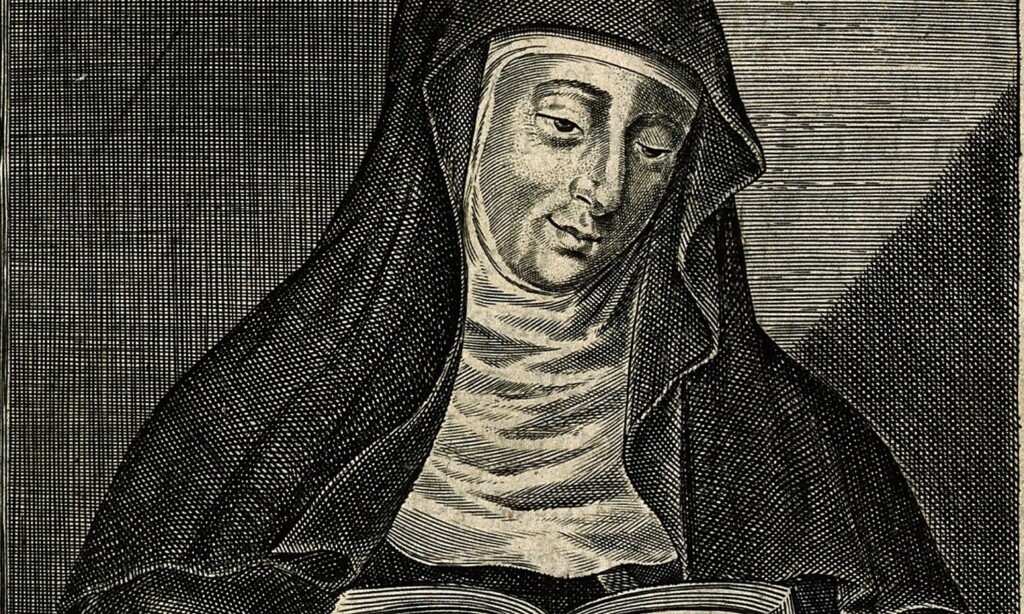
She was born in 1098, the tenth child of a noble family in the Rhineland, and at eight years old she was given to the Church the way you give a tenth of a harvest — not out of cruelty, necessarily, but out of arithmetic. The tithe of children was a practiced logic of medieval piety, and Hildegard von Bingen entered the anchorage at Disibodenberg before she had any language for what was being done to her. The walls closed. The enclosure became her world.
What the twelfth century understood about power that we have largely forgotten is that the institution does not simply suppress — it also, in ways it cannot control, produces. Michel Foucault argued in Discipline and Punish that institutional space operates through the arrangement of bodies, the regulation of time, the architecture of visibility. The monastery, the prison, the school — all of them organize the self into something the institution needs. But Foucault was also honest about the excess, the residue, the thing that the disciplinary machine cannot fully capture. Hildegard was that residue. Enclosed at eight, bound by the Benedictine Rule, subject to an abbess, dependent on male ecclesiastical sanction for every written word — she became, inside that cage, one of the most sovereign minds of her century.
This is not a paradox you can dissolve by saying the Church was secretly kind to women. It was not. The enclosure was real, the subordination was structural, and the permission to speak always arrived through a man — first Jutta of Sponheim who raised her, then the monk Volmar who served as her secretary and theological guardian. And yet. There is a moment you recognize from somewhere visceral: a woman inside a sealed room, surrounded by walls built precisely to contain her vision, who can see out further than anyone standing free in the open air. Not metaphorically. Literally. The ones outside the walls are navigating the noise of a world that doesn’t require them to look inward. She had nowhere else to look.
Think of what it means to have your geography reduced to a rectangle of stone and a rectangle of sky. The mind, deprived of horizontal wandering, goes vertical. Hildegard described her visions not as dreams, not as states of unconsciousness, but as a waking illumination she called the living light — lux vivens — a clarity she experienced while in full possession of her senses. The neurologist Oliver Sacks, writing in Migraine in 1970, proposed that the scintillating visual phenomena she described in such precise detail correspond closely to the aura phase of a complex migraine. This observation is not a reduction. It is an enlargement. It means her nervous system was translating something real — pressure, light, the firing of neurons — into a symbolic architecture of extraordinary complexity, and that she had both the intellectual formation and the inner discipline to build a cathedral out of what others might have simply endured as pain.
By the time she was permitted to write, she was in her forties. The permission itself is a scandal hiding inside a miracle. Bernhard of Clairvaux, the most powerful ecclesiastical voice of the era, endorsed her project after she submitted it for approval. The Pope himself gave his blessing. The institution that had enclosed her at eight was now, reluctantly, opening a door — but only because the force pressing against it from the inside had become undeniable. She had spent decades not waiting for the door to open. She had been building something on the other side of it that the institution would eventually need more than it needed her silence.
The enclosure did not make her. But the enclosure could not unmake what the enclosure had, without intending to, allowed to grow.
The Heresy of Competence
You have met this person. Maybe at a dinner table, maybe in a meeting room, maybe in the particular silence that falls when someone answers a question too completely. The knowledge lands and something shifts in the room — not toward admiration, but toward suspicion. The competence itself becomes the accusation.
Hildegard spent a decade writing Scivias, completing it in 1151 after ten years of dictating visions to her monk-secretary Volmar, who then corrected her Latin while she corrected his corrections. Simultaneously, across those same years, she was composing what would become 77 musical works — antiphons, sequences, a full liturgical drama called Ordo Virtutum — in a melodic style so distinctive that modern musicologists still cannot locate its precedent. She was also developing a cosmological system that mapped the universe as a series of concentric spheres animated by divine breath, and constructing from nothing a complete language, Lingua Ignota, with its own alphabet and a lexicon of over 900 words, mostly nouns for beings and objects and the invisible things between them. Not sequentially. Simultaneously. As a woman. Inside a convent. In the twelfth century.
The Church’s response was not immediate condemnation. It was something more psychologically precise: the response was delay, qualification, and the slow institutional machinery of verification that functions less as discernment and more as a mechanism for making extraordinary people prove their ordinariness before being permitted to proceed. Pope Eugene III read portions of Scivias at the Synod of Trier in 1147 and gave his approval — but only after Bernard of Clairvaux, the most powerful ecclesiastical voice of the age, had personally vouched for her orthodoxy. She needed a guarantor. The work itself was insufficient. The mind that produced it required a male signature before it could be trusted.
Hannah Arendt, writing in The Origins of Totalitarianism and later refining the thought in her essays collected in Between Past and Future, identified something she called the banality of institutional resistance — not evil in its dramatic form, but the ordinary, procedural, bureaucratic suppression of genuine thinking by people who are themselves not thinking, who are simply administering categories that precede them. The danger, Arendt argued, is not the spectacular inquisitor. It is the committee. It is the process that requires you to justify your existence in terms the process itself has already decided are the only legitimate terms. Hildegard did not face a bonfire. She faced something more exhausting: the endless requirement to be legible to minds smaller than her own.
There is a man sitting in a room where he has reconstructed, from memory and inference, the entire structural logic of a system everyone else accepted as given. He has been right for years. The people around him do not dispute the facts; they dispute the tone. They suggest he is arrogant. They recommend he communicate differently. What they mean, though they will never say it, is that they would prefer he understand less. Because his understanding makes visible the gap between what they claim to know and what they actually know, and that gap is socially intolerable. He does not leave the room. He learns to speak more slowly. This is not adaptation. This is a form of self-amputation.
Hildegard never fully amputated herself, which is why her relationship with the Church remained permanently frictional even after her vindication. She wrote letters of rebuke to emperors and popes with a directness that her authorized status as a visionary supposedly licensed but which everyone understood exceeded that license. The vision gave her permission to speak. The breadth of what she spoke remained, always, slightly more than permitted.
The competence was the problem. It always is. Not because institutions fear ignorance — they are built to manage it — but because they have no protocol for someone who simply knows more than the protocol assumes is possible.
The Science She Was Not Allowed to Do
There is a moment — you have probably witnessed it, or lived it — when a woman explains something with precision, with depth, with the kind of fluency that comes only from years of sustained attention, and the person listening nods and says: you have a real instinct for this. Not knowledge. Not expertise. Instinct. As if what she knows arrived through the body rather than the mind, through some warm animal intuition rather than through labor and rigor and thought accumulated over decades. The compliment is designed to look like praise. What it actually does is relocate her intelligence from the category of the earned to the category of the innate, which is another way of saying: from science to nature.
Hildegard wrote two encyclopedic works in the 1150s that together constitute one of the most comprehensive attempts at systematic natural knowledge produced in the medieval Latin West. The Physica catalogs hundreds of plants, stones, fish, birds, metals, and their medicinal properties with a methodological consistency that any honest historian of science would have to call observational. The Causae et Curae goes further: it is an investigation of the human body, its humors, its diseases, its relationship to season and diet and psychological state, constructed from a framework that integrates what we would now separate into physiology, pharmacology, and what she understood as the animating forces of creation. She was not transcribing recipes. She was building a theory of living matter.
And yet for centuries the dominant interpretive habit has been to absorb her medical knowledge into the softer category of folk wisdom, healing lore, the intuitive pharmacopoeia of women who worked close to the earth. Her male contemporaries — William of Conches, Hildegard’s near-exact contemporary, or Albertus Magnus a century later — wrote about natural phenomena in texts that have been consistently received as philosophy, as the precursors of scientific rationalism, as the serious intellectual labor of men grappling with the structure of reality. The distinction is not primarily one of method. It is one of gender as an interpretive frame applied after the fact by historians who did not notice they were applying it.
Londa Schiebinger, in The Mind Has No Sex? published in 1989, traced with meticulous care the process by which women were systematically excluded from the emerging institutions of European science in the seventeenth and eighteenth centuries — not because they lacked the capacity, but because the very definition of scientific credibility was constructed around the exclusion. What her work makes visible is not simply that women were kept out, but that the categories themselves — genius versus intuition, philosophy versus craft, discovery versus accident — were built with a gendered architecture. Once you see this, you cannot unsee it. You start to notice how far back the architecture goes.
There is a woman, brilliant and technically precise, who has spent years mastering the systems of a complex and demanding domain. The people around her watch her work with a kind of uneasy admiration, and when she succeeds — when the solution she arrives at is elegant and exact — they circle the achievement with language that quietly removes her agency from it. She was lucky. She has a feel for it. It came naturally to her. The praise and the erasure happen in the same breath. She herself may begin to internalize the language, to distrust the word knowledge when applied to herself, to think of what she does as something less formal, less legitimate, than it actually is. This is not a medieval problem. This is a structure that has proven extraordinarily durable.
Hildegard described the properties of fennel, of plantain, of the spleen’s relationship to grief, of the way cold and heat move through the body’s chambers, with the same analytical impulse that drives any empirical inquiry. The question is not whether what she did was science. The question is what we lose — what we have already lost — by deciding it wasn’t.
A vision curated by a filmmaker, not an algorithm
In this video I explain our vision
Music as Argument

There is a moment when a voice does something a voice is not supposed to do. It leaps. Not gently, not by half-steps in careful submission to what the ear expects, but by a ninth, a tenth, an interval so wide it feels like a body throwing itself across a chasm. You hear it and your chest tightens before your mind has processed anything, because the body understands transgression before the intellect names it.
This is what Hildegard’s music does. What it has always done, since approximately 1151, when she completed the Ordo Virtutum — a sung morality drama in which the Soul is contested between the Virtues and the Devil, the oldest surviving musical play of its kind in the Western tradition. But to call it a theatrical curiosity or a liturgical experiment is to domesticate something that was, in its structural bones, an argument. A philosophical position rendered in sound rather than words, which made it all the more difficult to refute.
Jacques Attali understood this mechanism with unusual precision. In Noise: The Political Economy of Music, published in 1977, he proposed something that most aesthetics still resist: that music is not an innocent pleasure or a spiritual supplement to real life, but a system of power. Sound organizes social relations. It defines what is permitted, what is harmonious, what belongs inside the walls of authorized experience. To compose within established conventions is to ratify those conventions. To break them is to make a claim — not a decorative one, but an ontological one, about how the world is structured and who has the right to name its order.
Hildegard broke them systematically. The modal structures of twelfth-century sacred music were not merely aesthetic preferences; they were theological architecture. Plainchant moved in measured steps, staying close to the center of its range, embodying through form the virtue of restraint, the Benedictine ideal of proportion. To exceed that range too wildly was to suggest something ungovernable in the relationship between the human and the divine. Hildegard’s melodies exceed it constantly. They ascend to registers that female voices strain to reach and then plunge downward with equal violence. They refuse resolution where resolution is expected. They hold tension as a spiritual condition rather than a problem to be corrected.
Think of someone who enters a room where a formal ceremony is underway — a ceremony with prescribed movements, approved gestures, a known sequence — and begins to move differently. Not in protest, not with a banner or a declaration, but with a quality of motion so authentically other that the ceremony cannot absorb it. The room adjusts around this person uncomfortably. Some observers feel disturbed, others feel, for the first time, that the ceremony was the performance and this new motion is the truth. The confrontation is total and it happens entirely through form.
This is the Ordo Virtutum. The Devil in Hildegard’s play is the only character who does not sing. He speaks, he shouts, he intrudes on a world of melody with the brute fact of unmusical noise. This is not accident and it is not naive symbolism. It is a philosophical statement about the nature of evil — not as something powerful in its own right, but as the refusal of harmony, the incapacity for the kind of organized beauty that Hildegard understood as participation in the divine structure of creation. Evil cannot compose. It can only interrupt.
Attali wrote that noise is to music what cruelty is to power — its shadow, its necessary outside. Hildegard built that boundary into the very architecture of her drama. And in doing so she made an argument that no theological treatise of her era quite managed: that beauty is not decorative but structural, not offered to God as a gift but identical, in its deepest form, with the act of perceiving God at all.
The Letters She Should Not Have Written
You receive a letter. It is addressed to you personally, by name, with the precision of someone who has studied your failures and found them worth cataloguing. The sender is a woman. The year is somewhere in the middle of the twelfth century. She is telling you — Frederick Barbarossa, Holy Roman Emperor, man of armies and divine appointment — that you are behaving like a child, that your stubbornness is not strength but sickness, that God watches your arrogance with something that resembles patience only because patience is infinite and your reign is not.
She does not ask. She does not petition. She informs.
Hildegard of Bingen wrote letters the way other people use weapons — not to wound, but to change the geometry of a room. To Bernard of Clairvaux, the most influential ecclesiastical voice of the age, she wrote not as a supplicant seeking blessing but as a peer seeking recognition of what she already knew to be true. To Pope Eugenius III she wrote with a directness that most cardinals would not have risked. The letters survive, more than three hundred of them, and they constitute one of the most extraordinary archives of authorized transgression in Western history.
The key word is authorized. Because Hildegard understood something with perfect tactical clarity: she could not speak as a woman. That door was sealed by centuries of theological argument, Pauline injunction, institutional habit. But she could speak as a vessel. She could speak as the hollow reed through which the Living Light moved, and in doing so she transformed her biological and social vulnerability into a kind of immunological advantage. She was not claiming authority. She was merely reporting what she had been told. The responsibility for the content, therefore, resided not in her but in its source — a source that outranked everyone receiving her letters.
Judith Butler, writing in Bodies That Matter in 1993, argued that marginalized subjects are required to perform their own legitimacy before being granted even the right to speak. They must stage their authorization as spectacle before the content of what they say is permitted to register. Hildegard grasped this eight centuries before Butler named it. She did not simply claim divine mandate — she constructed it with deliberate, architectural care. The documented visions, the approved texts, the imprimatur of Eugenius himself in 1147 and 1148 at the Synod of Trier: these were not spiritual accidents. They were a permission structure, built piece by piece, designed to create the one crack in a closed system through which a precise voice could pass.
There is a figure who appears sometimes in certain kinds of stories — someone who has studied the walls of a closed institution so thoroughly that they know exactly where the mortar is thin. Not a rebel, not a revolutionary, but a reader of systems. They find the single point where the rules, applied to the letter, produce the opposite of their intended effect. They speak through that point with total calm, total precision, and the institution cannot respond with punishment without exposing the contradiction at its own center. Hildegard was that figure. Her divine mandate was not a mystical escape from the world — it was a precise legal argument dressed in the grammar of prophecy.
What this means is that every frank letter to every pope and emperor was simultaneously an act of theological submission and one of the most sophisticated power maneuvers of the medieval period. She was, in the same gesture, prostrating herself before God and standing entirely upright before men. The paradox was not accidental. It was the mechanism. She was feathered by it, lifted by it, and she knew exactly what she was doing when she sealed each letter and sent it toward the centers of a world that had not asked for her opinion and could not, once her authorization was established, afford to ignore it.
What We Call Her When We Cannot Call Her Equal

There is a word that gets placed over certain women like a glass dome. It preserves them beautifully. It keeps them at a safe distance. The word is “mystic,” and once it has been applied, something extraordinary happens to the person underneath it: she becomes untouchable in a way that is indistinguishable from being unreachable.
Call Hildegard a mystic and you have technically said something true. Call her a visionary and you have done the same. Call her a saint, a healer, a prophetess, and with each successive label you have moved her one step further from the territory where she actually lived and worked, which was the territory of knowledge, argument, institutional power, and intellectual combat. Each word functions less as a description than as a relocation. She is moved from the map of human achievement into a different kind of space altogether, one where admiration replaces reckoning, where wonder substitutes for the more demanding work of understanding what her existence cost and what her suppression meant.
Edward Said, writing about how the West constructed “the Orient” as a conceptual object in Orientalism in 1978, identified a mechanism that has nothing to do with geography and everything to do with power. The Orientalized subject is not ignored but rather lovingly elaborated, studied, catalogued, made fascinating, rendered exotic, and in that rendering made permanently other. The fascination is the distance. The scholarship is the wall. Said argued that this kind of knowledge production does not describe its subject so much as contain it, keeping it perpetually available for Western contemplation while ensuring it never becomes a position from which to speak back with equal authority. What he described in relation to colonized cultures operates with surgical precision on the suppressed intellectual history of European women.
Hildegard has been Orientalized within her own civilization. She has been given the full treatment of loving enclosure: the illuminated manuscripts reproduced on calendar covers, the Gregorian chant recordings sold in airport bookstores, the documentary films shot in honeyed amber light, the wellness brands borrowing her name to sell tinctures. None of this is malicious. That is precisely what makes it so effective. The hostility that would have been legible in simple erasure has been replaced by something warmer and more durable, a kind of reverent quarantine. She is celebrated in a register that forecloses comparison. You do not compare a mystic to your colleagues. You do not read a visionary’s medical treatise and ask why no woman held a university chair for seven hundred years after she wrote it. The vocabulary of the sacred is also the vocabulary of the exceptional, and the exceptional, by definition, does not require structural explanation.
The historian Gerda Lerner, whose 1993 work The Creation of Feminist Consciousness spent years tracing precisely this pattern, observed that women’s intellectual contributions have been systematically severed from their successors, forcing each generation of women thinkers to begin again without the inheritance that accumulates for men almost automatically. Hildegard could not build a school in the sense that her male contemporaries built schools, institutions that outlasted them and carried their names forward as intellectual lineages. What she built was archived instead as spiritual phenomenon, which meant it could be revered without being inherited, admired without being continued.
This is the architecture of the glass dome. It is not a ceiling, which implies something you press against. It is a display case, which implies something you have already been placed inside, gently, by hands that meant you no well.
And so the question that remains, the one that does not close, is not about Hildegard at all: which women alive today, in whatever field, are already being fitted for the vocabulary that will make them safe, the words that will arrive after their deaths to ensure that what they knew never becomes what the rest of us are required to answer for.
🌿 Mystics, Scientists, and the Medieval Sacred
Hildegard of Bingen stands at a remarkable crossroads of visionary spirituality, natural philosophy, and medieval sacred culture. These related articles illuminate the world she inhabited and the intellectual traditions she both embodied and transcended.
Medieval Abbeys and Monasteries: History and Architecture
Medieval abbeys and monasteries were not merely places of prayer but vibrant centers of knowledge, healing, and artistic creation — the very environment that shaped Hildegard’s extraordinary mind. Understanding their architecture and communal rhythms reveals how a woman like Hildegard could rise to theological and scientific prominence. The cloister was, paradoxically, the most open space available to medieval women of genius.
GO TO THE SELECTION: Medieval Abbeys and Monasteries: History and Architecture
Paracelsus: Life and Alchemical Thought
Paracelsus, like Hildegard before him, sought to unify spiritual insight with empirical observation of the natural world, blending medicine, alchemy, and mystical philosophy into a singular vision. His alchemical thought echoes many of the healing principles Hildegard articulated centuries earlier in her works on natural medicine and the viriditas, or greening power, of creation. Exploring Paracelsus deepens our understanding of the long tradition of healer-mystics in Western esoteric history.
GO TO THE SELECTION: Paracelsus: Life and Alchemical Thought
Albertus Magnus: Alchemy and Natural Philosophy
Albertus Magnus was one of the greatest medieval minds to bridge natural philosophy and theological inquiry, making him a direct intellectual contemporary of Hildegard’s broader tradition. His engagement with alchemy and Aristotelian science reflects the same hunger for understanding creation that animated Hildegard’s scientific writings on plants, stones, and the human body. Together, they represent the medieval ambition to read the Book of Nature as a sacred text.
GO TO THE SELECTION: Albertus Magnus: Alchemy and Natural Philosophy
Romanesque Art: History and Characteristics
Romanesque art, with its powerful symbolic language and spiritual intensity, formed the visual world that surrounded Hildegard throughout her life in the Rhine Valley. Its iconography of cosmic order, divine hierarchy, and sacred nature resonates directly with the illuminated visions she described and had illustrated in her masterwork, Scivias. To look at Romanesque art is, in many ways, to enter the visual grammar of Hildegard’s inner universe.
GO TO THE SELECTION: Romanesque Art: History and Characteristics
Discover Visionary Cinema on Indiecinema
If Hildegard’s fusion of inner vision and outer inquiry inspires you, Indiecinema’s streaming catalog offers a rich selection of films that explore mysticism, spirituality, and the boundaries of human consciousness. From avant-garde meditations to profound documentaries, independent cinema is the modern space where visionary thought finds its most daring expression. Join us on Indiecinema and let the journey continue.
👉 EXPLORE THE CATALOG: Watch Indie Films in Streaming
A vision curated by a filmmaker, not an algorithm
In this video I explain our vision

