
The Clock You Cannot Stop
There is a particular quality of silence that settles over a street when the last shop you remember from childhood finally closes. Not the silence of emptiness, exactly, but something denser — the silence of a place that has forgotten what it was for. You walk past the papered-over windows and the handwritten sign taped crookedly to the glass, and you feel it not as an idea but as a pressure behind the sternum, something that knows it has no precise name. The hardware store that smelled of oil and wooden handles. The café where old men played cards until the afternoon light turned orange. The particular noise a city makes when it is inhabited by people who believe, without examining the belief, that the place belongs to them and they to it. That noise is gone. What replaced it is not silence but something worse: the ambient hum of transience, of people passing through rather than arriving.

This is where Oswald Spengler begins, in effect, even if he never admits to it. He begins in the gut, not the library. His great work, published in 1918 while Europe was still bleeding from the machinery of the First World War, carries a title that sounds like prophecy but functions more like diagnosis. The Decline of the West is not a prediction. It is a recognition — the kind that arrives too late to be comfortable but too early to be dismissed. Spengler had completed most of the manuscript by 1914, and the catastrophe that began that summer did not contradict his thesis so much as perform it in real time, with artillery.
The central provocation is almost unbearably simple once you state it plainly, which is perhaps why so many readers have spent a century arguing around it rather than with it. Civilizations, Spengler insists, are not projects. They are not the accumulated achievements of rational actors moving toward improvement. They are organisms. They are born, they develop, they mature, they decline, they die. This is not metaphor deployed for rhetorical effect. For Spengler, it is the structure of historical reality itself, the single pattern that emerges once you stop reading history as a story of progress and begin reading it as a series of life cycles. Each great culture — he identifies eight, including the Classical, the Arabian, the Chinese, and what he calls the Faustian, the Western — passes through seasons as inevitable as the ones that turn leaves. The spring of mythic creativity. The summer of civic flowering. The autumn of intellectual refinement. The winter of mechanization, of mass politics, of the replacement of culture by civilization, of organic community by administrative management.
The distinction between culture and civilization is where Spengler’s argument acquires its sharpest edge. Culture, for him, is the living form — the period in which a society’s deepest symbol-making energy is still alive and creating. Civilization is what comes after, and it is not an achievement but a symptom. It is the hardened shell left behind when the animating force has already exhausted itself. The Roman Empire was not the height of Classical culture. It was its afterlife, impressive in scale and hollow at the core.
You have felt this, even if you have never read a line of Spengler. You have felt it in the very streets that taught you what a city could be, watching them rearrange themselves into something more efficient and less inhabited. The philosopher Giorgio Colli once observed that late cultures possess enormous capacity and diminishing necessity — they can do almost anything and mean almost nothing. That sensation of walking past the papered window, of feeling the loss without being able to justify it to anyone who asks, is not nostalgia. It is historical perception arriving in the body before the mind has found the words.
The Lost Poet
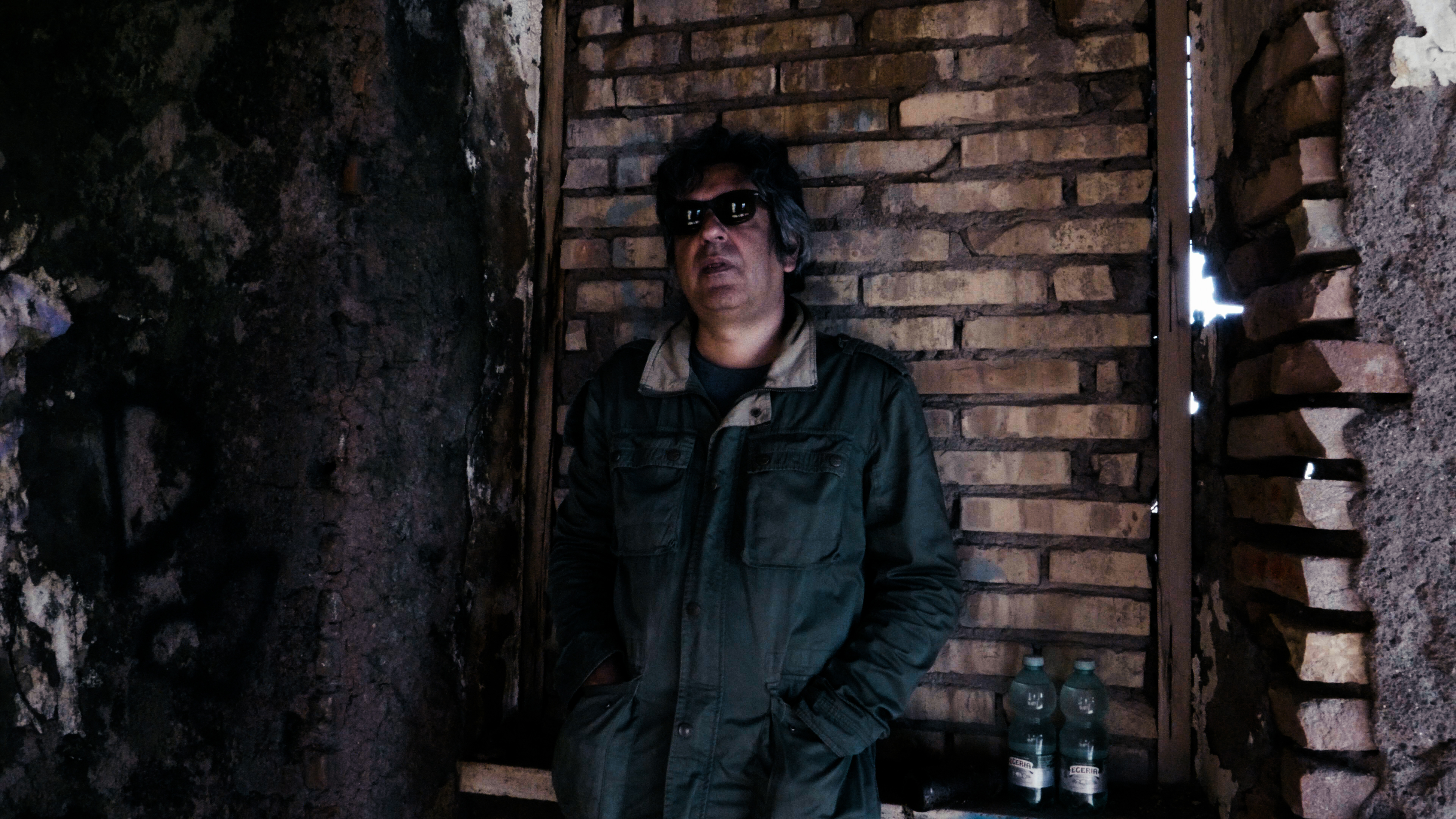
Drama, by Fabio Del Greco, Italy, 2024.
Dante Mezzadri wants to see an old friend, nicknamed the Iguana, whom he has lost sight of for many years, and who has managed to turn their shared youthful passion for poetry into a job, becoming a famous writer and poet. The man escapes from his bourgeois life and his wife to live homeless on the Roman coast, printing and trying to sell his poetry collections. At night he sleeps in a park of old carnival floats, inside a papier-mâché tank, and waits for the opportunity to meet his old friend, who however never shows up for appointments in the places they frequented when they were young, now in ruins. Dante's poetry books do not interest anyone and to support himself he is forced to "change product": he starts selling the infamous "cannibal pill" on behalf of young drug dealers, a new drug that sells like hot cakes and causes sensory and consumerist ecstasy. However, he realizes that this powerful drug is very dangerous for those who take it, he comes into conflict with his ethical conscience and throws all the pills into the sea. However, the dealers want to collect their money.
Shot over a period of 2 years, the film is a reflection on the cultural and artistic rubble of the society in which the protagonist lives, in an increasingly mechanized, consumerist and arid world. Dante Mezzadri is yet another human being who has renounced his inspiration and his creativity, but unlike many he is not willing to give his life to a system that distances him from his true identity. The physical world around him, however, seems constructed in such a way that it seems impossible to escape from this "invisible cage". The enthusiasm of the people he meets is ignited only by sensory gratification, by unreal visions of personal affirmation and success, by "metaverses" that offer an escape into an illusory and destructive reality. The poet's house on the coast, where he met with his friends as a young man, is just a pile of abandoned rubble. What happened to all those who wanted to become poets and ended up becoming something else? Are there internal forces with which that house can be "rebuilt"?
LANGUAGE: Italian
SUBTITLES: English, Spanish, French, German, Portuguese
Cultures as Living Bodies
You know the feeling without having a name for it. You sit in a meeting — the kind that has been happening in the same room, with the same agenda, using the same vocabulary, for longer than anyone present can remember — and something in you registers, quietly and without drama, that nothing decided here will matter. Not because the people are incompetent or cynical, though some may be both, but because the institution itself has already finished doing whatever it was born to do. The form survives. The content has long since departed.
Oswald Spengler spent the years between 1911 and 1917 writing a book that explained why this feeling is not paranoia or burnout but historical perception. Published in 1918, The Decline of the West proposed something that the educated European mind was not remotely prepared to accept: that cultures are not chapters in a single progressive story but organisms, each with its own birth, flowering, decay and death. History does not march forward. It breathes in and out, repeatedly, and each breath is a civilization that believes itself to be the final and definitive one.
The method Spengler called morphological. He borrowed it, consciously and provocatively, from Goethe’s natural philosophy — the idea that living forms follow inner laws of development that can be read, the way you read the growth rings of a tree, if you are willing to look at the whole rather than obsess over the sequence of individual rings. Against this he placed the dominant tradition running from Hegel through Marx and the liberal positivists: the conviction that history has a direction, a telos, a destination toward which all previous events were merely preparation. Hegel’s Geist moving toward self-realization, the Marxist dialectic converging on emancipation, the liberal narrative of progress accumulating like compound interest — Spengler regarded all of these as the same intellectual error wearing different clothes. They were, he argued, the mythology of one particular culture mistaken for the grammar of reality itself.
Nietzsche had already performed a version of this unmasking. His insistence on the will to power as a biological-aesthetic force, his contempt for the herd morality dressed up as universal ethics, his demand that one look at what life actually does rather than what our theories wish it would do — all of this saturated Spengler’s thinking even when Spengler disagreed with Nietzsche’s conclusions. The vitalism is the same: culture is not a product of ideas but an expression of something more primal, a style of being-in-the-world that precedes its own intellectual articulation.
The crucial distinction Spengler drew — the one that cuts closest — is between Culture and Civilization. Culture is the living phase: spontaneous, creative, driven by a central symbol or prime sensation that organizes everything from its mathematics to its architecture to its treatment of death. Civilization is what comes after. It is not a continuation but a calcification. The energy that once generated cathedrals and symphonies and new philosophies now generates bureaucracies, imperial expansion, technical mastery without spiritual content. The form proliferates as the meaning drains away.
Think of the man who goes on mowing the lawn, repainting the fence, sealing the gutters of a house he already knows, in some part of himself he cannot quite face, will be demolished to make way for a highway. The maintenance is not irrational. It is the only language available to him for a grief he has not yet been permitted to name. Spengler would have recognized the gesture immediately. Civilization is the long, meticulous, technically impressive maintenance of a structure whose animating purpose has already migrated elsewhere — or simply ceased to exist. The house stands. The family that made it a home is gone, and has been gone for some time, and the going was so gradual that no single morning ever announced it.

The Faustian Soul and Its Hunger
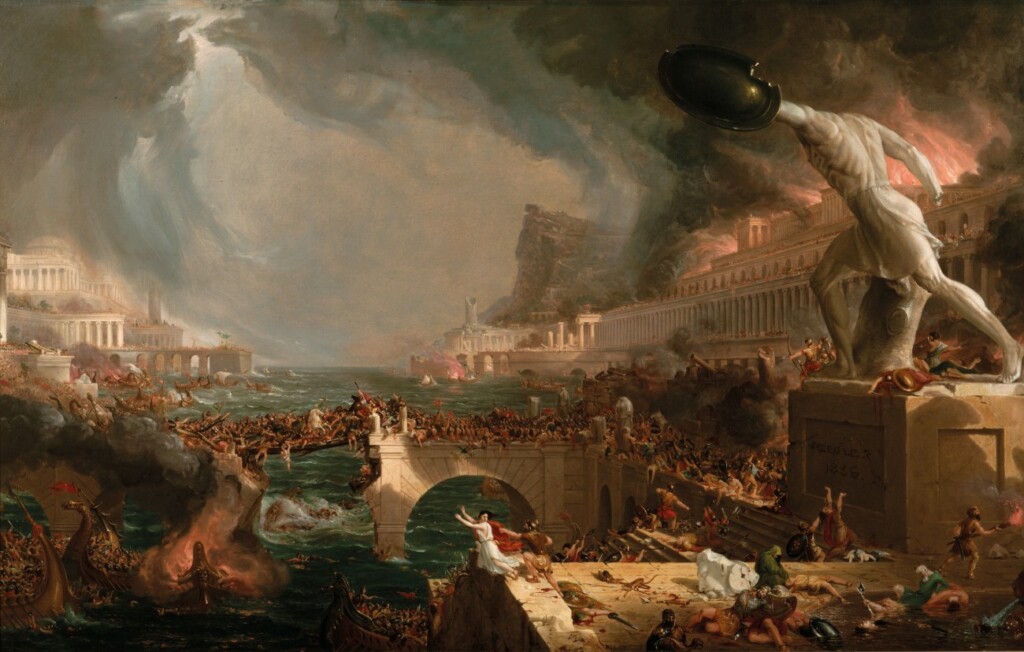
There is a man standing at the window of the office he spent twenty years trying to occupy. The title is on the door. The view is exactly what he imagined. And something in him — not sadness, not relief, but something older and more animal than either — is already looking past the glass toward the next ridge, the next threshold, the next problem that will make this moment feel like it was worth something. The achievement does not land. It passes through him like light through a window, illuminating nothing it touches.
This is not failure. This is the Faustian condition, which Spengler identified as the psychic signature of Western Culture with a precision that still cuts. In The Decline of the West, published in its first volume in 1918, he named this soul-type after Goethe’s great symbol — the scholar who sells his immortality not for pleasure but for more experience, more becoming, more world. Faust does not want to possess anything. He wants to want. The moment he says to the passing moment “stay, you are so beautiful,” the bargain is complete and he is lost. The horror is not that the devil takes him. The horror is that the moment of satisfaction is the moment of death. Rest is annihilation.
Spengler read this not as a personal psychology but as a civilizational one. The entire trajectory of Western history, from roughly the year 1000 onward, expresses in its most concrete forms the same metaphysical hunger. The Gothic cathedral does not sit in space the way a Greek temple does — grounded, proportioned, at peace with the earth beneath it. It thrusts. The spire is not decorative; it is a declaration of war against the horizontal. Every pointed arch is a vector. The builders of Chartres and Cologne were not making a house for God; they were making an argument about direction, and the direction was up and beyond, toward something that can never be reached because reaching it would mean the argument was over.
The same impulse organizes perspective painting, which the Italian Renaissance codified but which belongs to a much deeper compulsion. Perspective is not a technique for representing space. It is a technique for generating infinite space, for pushing the horizon back so that the eye is always traveling and never arriving. The vanishing point is a theological construct: it is the place where all lines converge but where no human being can stand. You are always moving toward it. That is the point.
Then comes calculus, which Newton and Leibniz developed independently in the second half of the seventeenth century, and which Spengler considered the supreme intellectual achievement of the Faustian soul. Calculus is the mathematics of the infinitely small and the infinitely large simultaneously — it thinks in limits, in approaches, in quantities that tend toward values they never touch. It is the formal language of the horizon. No other Culture produced it, Spengler argued, because no other Culture needed it. Chinese mathematics, Indian mathematics, Arabic mathematics — all of them brilliant, all of them bounded by different existential problems. Only the West needed to calculate what happens at the edge of the reachable.
And then the Atlantic. The voyages that began in earnest in the late fifteenth century were not primarily economic projects, whatever the balance sheets say. They were the Faustian soul expressing itself in ships. The Pacific, the poles, eventually space — the pattern is identical. You reach the shore of the known world and you build something that crosses the darkness beyond it, not because you know what is there, but because the not-knowing is intolerable. Faust does not rest. The man at the window is already calculating the distance to the next ridge, and the calculation is the only thing keeping the hollowness from becoming total.
When Money Becomes the Last God
There is a man you have seen before, even if you have never met him. He sits above the city in a building whose glass walls make the sky look like a spreadsheet. He is deciding something — a merger, a restructuring, the reallocation of capital across three continents — and the decision will alter the working lives of perhaps forty thousand people he will never see. What strikes you, watching him, is not his cruelty. He is not cruel. What strikes you is his perfect indifference to content. The numbers must move in a particular direction. They will move. The human texture of what they represent is, for him, a secondary consideration that belongs to a department further down the corridor.
Spengler saw this man coming. Not this specific man, but this type, this function disguised as a person, this executor of pure mechanism. Late Civilization, he argued in the second volume of The Decline of the West, is precisely the age when money ceases to be a tool and becomes the structuring logic of everything — art, politics, religion, even war. Form dissolves into function. The cultural organism that once generated cathedrals and contrapuntal music now generates financial instruments and electoral campaigns managed with the same technical precision. The question is never what is being done, only how efficiently it can be executed.
Georg Simmel had already laid the philosophical groundwork in 1900, when his Philosophy of Money traced the way modern exchange relations progressively evacuate qualitative meaning from human life. Money, for Simmel, is the perfect symbol of modernity because it is purely relational — it has no content of its own, only the capacity to mediate between other things. When it becomes the dominant metaphor for all value, everything else acquires that same quality of interchangeability. A painting, a vote, a spiritual conviction — each becomes a quantity that can be compared to another quantity and, in principle, exchanged. Spengler was reading Simmel, consciously or not, when he described the Civilization phase as the reign of the abstract over the living.
Max Weber arrived at the same diagnosis from a different angle. His rationalization thesis, elaborated across his sociology of religion and economy in the years straddling the First World War, described how Western modernity had constructed an iron cage of bureaucratic and economic logic from which no individual, however gifted or willful, could simply walk free. The cage was not built by villains. It was built by the cumulative weight of rational procedure, each step locally sensible, the total architecture suffocating.
The historical evidence Spengler was metabolizing was structural and measurable. Between 1870 and 1913, the share of British national income derived from financial services and overseas investment grew dramatically while aristocratic land values collapsed across Western Europe — in England, the great estates that had underwritten political authority for centuries were being broken up and sold, not because of revolution but because capital had simply found more efficient vehicles. The landed gentry did not lose a war. They became economically irrelevant. By 1900, the London financial markets were intermediating capital flows that dwarfed the budgets of most sovereign states. A merchant bank could, and did, exercise geopolitical pressure that no duke could match.
This is what Spengler meant by Caesarism — not necessarily a single dictator, though he saw that coming too, but the emergence of power stripped of cultural legitimacy, power that operates through the control of economic and organizational machinery rather than through any shared symbolic world. The Caesar of late Civilization does not need you to believe in him. He needs the system to function. Your belief is a variable he can manage, if necessary, through the same channels he uses to manage everything else.
The Masses and the Formless City
At three in the morning, an airport is the most honest place on earth. You have been there — or somewhere indistinguishable from it — moving through corridors that smell of recycled air and synthetic coffee, passing storefront after storefront selling objects you will not remember buying, reading signs that direct you toward gates that look identical to the gates you just left. Every surface carries a logo. Every interaction follows a script so internalized that no one needs to learn it anymore; it simply happens, like breathing, like the slow conveyor belt carrying luggage no one has yet claimed. There are other people around you, hundreds of them, and yet the sensation is one of profound, structurally enforced solitude. You are not in a place. You are in the processing of a place.
This is precisely what Spengler meant by the megalopolis, and he meant it as a diagnosis, not a description. The great city in its terminal phase is not a cultural achievement but a cultural negation — a space that has become so vast, so internally complex, so dedicated to function and transaction that it has lost the capacity to generate anything spiritually original. It consumes the countryside, absorbs the provinces, draws inward the energies of an entire civilization and converts them into administration, commerce, entertainment, and the endless circulation of opinion. The stone of the cathedral was once cut by hands that believed in what they were building. The glass and steel of the terminal was assembled by contractors working to specifications written by committees accountable to shareholders. The difference is not aesthetic. It is ontological.
Spengler published the first volume of The Decline of the West in 1918, during the collapse of one European order and the uncertain birth of another. He was watching the same process accelerate that Ortega y Gasset would anatomize twelve years later in The Revolt of the Masses, where the Spanish philosopher argued that modernity had produced a new human type: the mass-man, not defined by poverty or class but by a radical interior emptiness, a person who “finds within himself a repertory of ideas” but “has never passed through the apprenticeship of learning” how those ideas were made, who they cost, what they replaced. The mass-man is not ignorant in the traditional sense. He is, in Ortega’s precise formulation, “the learned ignoramus” — a being saturated with information and drained of formation. He moves through the airport at three in the morning reading headlines on his phone and feels himself to be a citizen of the world, which is another way of saying a citizen of nowhere.
Hannah Arendt, who understood rootlessness not as metaphor but as lived political catastrophe, saw in mass society something Spengler had intuited but not fully theorized: that the dissolution of stable communities, of the intermediate structures between the individual and the state, creates a peculiar human vulnerability. In The Origins of Totalitarianism, published in 1951, she showed how atomized individuals — people without meaningful membership in anything smaller than the nation or larger than the self — become not liberated but available. Available for mobilization, for manipulation, for the great simplifying narratives that fill the vacuum left by genuine cultural belonging.
The rootless cosmopolitan intellectual, whom a certain liberal tradition celebrates as the highest achievement of open civilization, is for Spengler something more troubling: the symptom of a Culture that has finished thinking and begun merely commenting. He produces analysis of things he did not build, criticism of traditions he did not inherit, irony toward forms of life whose inner necessity he cannot feel. He is not wrong, exactly. He is simply late.
A vision curated by a filmmaker, not an algorithm
In this video I explain our vision
The Problem of Spengler’s Determinism

There is a particular kind of conversation that happens in a doctor’s office when the news is genuinely final. The physician does not raise his voice. He does not search for the right metaphor or soften the language into ambiguity. He simply describes what is happening inside the body with the same neutral precision he would use to explain the weather. You sit across from him and realize, slowly, that you had come expecting a negotiation and found instead a declaration. The diagnosis is not an accusation. It is not even a warning. A warning implies that something can still be done. This is something else entirely — a description of a process already underway, already irreversible, already following its own internal logic toward its predetermined conclusion.
This is precisely the posture Spengler assumes, and it is the thing about him that most people cannot tolerate. He is not prescribing. He is not standing at the edge of the abyss waving his arms and calling you back. He has already calculated where you will land. His entire morphological system rests on the premise that civilizations are not political problems to be managed but organic entities to be observed, and organisms do not respond to moral urgency. They fulfill their nature. The transition from Culture to Civilization, from creative tension to administrative exhaustion, from soul to intellect, is not a mistake that the West made. It is what the West is doing, the way a season turns, the way a wave breaks, without malice and without remedy.
Karl Popper spent considerable energy in 1945 attacking exactly this structure of thought, and his critique in The Open Society and Its Enemies remains the most disciplined assault on Spenglerian historicism from within the liberal tradition. Popper’s argument was precise: the claim that history follows knowable laws, that the trajectory of civilizations can be predicted from their internal morphology, is not science — it is a pseudo-scientific narrative that masquerades as prediction while functioning as a kind of intellectual fatalism. For Popper, the open society depends on the assumption that the future is genuinely open, that human decisions and institutions can redirect outcomes, that piecemeal rational intervention is not theater performed inside a sealed fate. Spengler’s determinism, in Popper’s reading, is not just wrong; it is politically dangerous, because it drains the will to resist by insisting that resistance is merely the last performance of a civilization that has already finished composing itself.
Arnold Toynbee mounted a different objection, less epistemological and more structural. In his twelve-volume Study of History, which he developed across the middle decades of the twentieth century, Toynbee proposed that civilizations do not die according to internal biological clocks but according to how they respond to challenges. The challenge-and-response model is explicitly anti-Spenglerian: it reintroduces contingency, creativity, the possibility that a civilization might answer its historical crisis with something genuinely new rather than with the mechanical repetition of exhausted forms. Toynbee’s civilizations are not organisms obeying a lifespan. They are dramas, and dramas can surprise you.
And yet sitting inside the tension between these positions, you notice something uncomfortable. Popper is right that open futures require open minds. But Toynbee’s creative minorities, those elite groups capable of generating genuine responses to civilizational challenge, look increasingly like what Spengler would simply classify as late-period administrators managing decline with greater or lesser elegance. The question of whether a response is truly creative or merely sophisticated exhaustion is one that neither Toynbee’s framework nor Popper’s epistemology can settle in advance. You would only know afterward. You would only know when the wave had already broken and someone was standing on the shore counting the foam, trying to remember whether this had felt, from the inside, like a choice.
What Spengler Got Wrong, and Why It Still Cuts
It would be convenient if Spengler were simply wrong. It would be a relief, actually — the kind of relief you feel when you discover that the man delivering an uncomfortable verdict has a criminal record. Discredit the messenger, dissolve the message. And there is no shortage of genuine crimes to lay at his feet.
His racial categories are not merely outdated in the way that Victorian medicine is outdated. They are structurally embedded in his argument, not ornamental. When he speaks of “Faustian man” and traces cultural vitality along lines that conspicuously privilege Northern European experience, he is not making a metaphor he later clarifies. He means it, and the meaning is ugly. His treatment of African, Mesoamerican, and Chinese civilizations as essentially passive scenery — historical backdrop against which the real drama of Western becoming unfolds — is not an oversight of a mind too focused elsewhere. It is a refusal, a willful narrowing that disqualifies entire human worlds from the category of genuine historical agency. This is not a minor technical failure in an otherwise sound framework. It is a wound through the center of the work.
Then there are his political sympathies, which he managed to hold with the particular self-assurance of someone who believes he understands forces too vast for ordinary politicians to grasp. In the early 1920s he was drawn toward what he imagined as a Caesarist renewal — a strong, unsentimental leadership that would shepherd the West through its terminal phase with dignity rather than democratic noise. He met with emerging National Socialist figures, entertained a vision of national rebirth that shared vocabulary, if not identical content, with what was being assembled in Munich beer halls. His 1933 pamphlet The Year of Decision maintained enough critical distance from Hitler to make his break with the movement legible, but the distance was narrow, and the years before it were not innocent. He died in 1936, spared the full spectacle of what his intellectual flirtations had helped, however partially, to normalize.
All of this is true. None of it is an escape hatch.
Because what survives the demolition of his racial schema and his catastrophic political adjacencies is the structural diagnosis — and that diagnosis has not aged the way his specific predictions have aged. It has, in certain respects, sharpened. In Man and Technics, published in 1931, Spengler turned away from civilizational morphology and focused with almost claustrophobic intensity on the human relationship to technology. What he described there was not progress. It was a machine that had outgrown its operators, a technical civilization that had become self-referential, generating complexity not in service of any human purpose but as a kind of metabolic process that had forgotten what it was metabolizing toward. He foresaw, with a bleakness that reads less like prophecy than like field notes from a present we now inhabit, a world in which the engineer replaces the philosopher, in which optimization becomes the only remaining value because it is the only value that does not require justification. You do not ask what efficiency is for. You measure it.
The sociologist Max Weber, writing from a different temperament and tradition, arrived at adjacent territory when he described the “iron cage” of rationalization — the process by which means progressively devour ends until the original purpose of an institution becomes archaeologically remote from its actual operation. What Spengler added, and what neither Weber’s precision nor his relative optimism fully contained, was the civilizational timescale. This was not a correctable malfunction. This was the organism completing its arc.
To dismiss Spengler entirely because he was wrong about race and dangerously naive about power is to perform a kind of intellectual hygiene that leaves the wound untouched. The errors are real. So is what the errors surround.
The Feeling That Has No Name Yet
There is a specific quality to the exhaustion you feel in certain meetings, certain ceremonies, certain elections. Not boredom exactly, and not cynicism, though it resembles both. It is closer to the sensation of watching someone recite vows they no longer believe in a language they no longer speak, with a fluency so polished it almost passes for conviction. The words land correctly. The gestures arrive on cue. And yet something in the room knows. Everyone in the room knows, including the person speaking.
This is not a crisis. That is the strange part. Crises have energy. What this is has no name in the standard vocabulary, because the standard vocabulary was built to describe either health or emergency, and this is neither. It is the condition of institutions that still function but no longer persuade, of cultural forms that still reproduce but no longer generate belief in their own necessity. The theater runs. The actors are professional. The play continues. What has been forgotten is why the play was written, and no one has yet decided whether that matters enough to stop the performance.
Spengler saw this coming with a clarity that still feels indecent. Not because he was a prophet, but because he was a morphologist — someone who reads shapes rather than events, patterns rather than headlines. By 1918, when the first volume of his great work appeared, he had already mapped what he called the transition from Culture to Civilization: the moment when a living organism of meaning exhausts its formative energy and begins instead to administer itself. The date is not incidental. Europe was finishing a war that had destroyed the 19th century’s confidence in its own narrative of progress, and Spengler was already explaining why the war was not an accident but a symptom.
What he described as the Faustian soul — that peculiarly Western compulsion toward infinite expansion, toward the horizon, toward mastery of space and time — had, in his reading, reached the outer limit of its trajectory. Not collapsed. Not failed. Simply arrived at the place where expansion becomes administration, where vision becomes procedure, where the cathedral becomes the office building, where the philosopher becomes the technician. The forms persist. The spirit that created them has moved on to wherever spirits go.
A man enters a room he has entered a thousand times. He knows every face, every argument, every procedural maneuver. He performs his role with the competence of someone who has long since stopped needing to think about what he is doing. There is nothing wrong with any of it, technically. And yet on the drive home he cannot account for the feeling that something was missing that could not have been present, because whatever it was belongs to a kind of building that no longer gets built.
Spengler’s final position was not despair, and it was not the false courage of pretending the sun is still rising when the light has turned that particular shade of late afternoon gold that looks warm but no longer heats anything. His position was something more austere and, in its way, more demanding: that those born into the late phase of a civilization have a specific task, which is not to resurrect what cannot be resurrected, but to do what is worth doing with full knowledge of where the sun is. To maintain the aqueduct not because the empire is eternal but because people still need water. To write the precise sentence not because literature will save the world but because precision is its own form of dignity.
The question you have been carrying, the one that surfaces in those meetings and ceremonies and elections, the one that feels almost embarrassing to articulate because it sounds too large and too unspecific — it is not whether the civilization survives, but whether you will spend the time you have left inside it pretending not to see what you already see.
🌅 The Twilight of Civilizations: History, Decline, and Meaning
Oswald Spengler’s ‘The Decline of the West’ stands as one of the most ambitious and controversial attempts to interpret the rise and fall of human cultures as organic, cyclical phenomena. His vision resonates deeply with thinkers who questioned power, memory, and the fate of Western civilization. These related articles trace the philosophical, political, and cultural threads that run parallel to Spengler’s monumental inquiry.
Jan Assmann and Cultural Memory
Jan Assmann’s theory of cultural memory offers a powerful lens through which to examine how civilizations preserve and transmit their identity across generations. His distinction between communicative and cultural memory illuminates precisely the mechanisms that, for Spengler, determine the vitality or exhaustion of a culture. Understanding Assmann enriches any reading of Spengler’s claim that cultures carry within them an irreversible destiny.
GO TO THE SELECTION: Jan Assmann and Cultural Memory
The Psychology of Power: History and Theory
Spengler’s morphology of history is inseparable from his analysis of how power shapes and ultimately consumes civilizations from within. The psychology of power — its seductions, its corruptions, and its structural role in cultural decline — forms a subterranean current running through ‘The Decline of the West.’ This article traces the theoretical history of power’s psychological dimensions, from antiquity to modernity, offering essential context for Spengler’s political pessimism.
GO TO THE SELECTION: The Psychology of Power: History and Theory
Johann Wolfgang von Goethe: Life and Works
Johann Wolfgang von Goethe was one of Spengler’s most profound intellectual inspirations, and the concept of morphology — the study of organic form — was directly borrowed from Goethe’s natural philosophy. Spengler applied Goethe’s method to history itself, treating cultures as living organisms that bloom, mature, and die. To understand Spengler’s method, one must first understand the Goethean vision of nature and form that underlies his entire framework.
GO TO THE SELECTION: Johann Wolfgang von Goethe: Life and Works
Mass Social Homologation Today
Spengler anticipated, with alarming clarity, many of the processes of social standardization and spiritual flattening that define late Western modernity. Mass social homologation — the erosion of individual depth in favor of collective mediocrity — is precisely what Spengler called the mark of ‘civilization’ as opposed to living ‘culture.’ This article examines how homologation operates today, providing a striking contemporary echo of Spengler’s darkest diagnoses.
GO TO THE SELECTION: Mass Social Homologation Today
Rediscover the Depth of Cinema on Indiecinema
If Spengler’s vision of cultural cycles and the search for meaning resonates with you, independent cinema offers some of the most courageous explorations of these themes. On Indiecinema streaming you will find films that dare to confront history, decline, and the human spirit with the same uncompromising depth. Explore our catalog and let independent cinema take you beyond the surface of things.
👉 EXPLORE THE CATALOG: Watch Indie Films in Streaming
A vision curated by a filmmaker, not an algorithm
In this video I explain our vision

