
The Man Who Could Not Stay
You have done it at least once. You unpack a suitcase after returning from somewhere, fold the clothes back into drawers, set your toiletries on the bathroom shelf, and feel, within hours — sometimes within minutes — a quiet dread settling over you like a second skin. Not sadness, exactly. Something more precise than that. A sense that the walls have moved slightly inward, that the familiar room has become a kind of argument against you, that the stillness of your own belongings is faintly accusatory. You are home. And home, inexplicably, feels like the problem.

Most people push this feeling down. They call it post-travel blues, readjustment, the ordinary friction of return. They make tea. They check their phone. They allow the architecture of routine to close back over them like water over a stone. But some people never quite manage that submersion. Some people stand in the middle of their own living room holding a half-empty toiletry bag and understand, with a clarity that is almost physiological, that they are constitutionally unsuited to arrival.
Bruce Chatwin was one of those people. Born in Sheffield in May 1940, into a Britain already remade by war, his earliest years were shaped not by the stability of a single household but by the serial dislocations of a country rearranging itself under pressure. His father was in the Royal Navy, absent for long stretches across the Atlantic. His mother moved with young Bruce from relative to relative, aunt to grandmother, one borrowed house to another, the war redistributing families the way it redistributed everything else — according to necessity rather than desire. The child who grows up without a fixed address does not simply learn to cope with movement. He learns, at a level beneath language, to distrust the fixed. Settlement becomes associated not with safety but with the arbitrary, the provisional, the thing that could be taken away at any moment anyway, so why pretend otherwise.
The psychoanalyst John Bowlby, whose foundational work on attachment theory was published in three volumes between 1969 and 1980, argued that the earliest experiences of separation shape the individual’s fundamental relationship to place and presence for the rest of their life. A child whose attachment is disrupted does not simply learn to love differently. He reorganizes his entire orientation toward the world around the management of loss — sometimes by refusing, at the deepest level, to arrive anywhere fully enough to be hurt by leaving. Chatwin’s biographer Nicholas Shakespeare, working with remarkable access to letters, notebooks, and the testimony of those who knew him intimately, traced this pattern with precision: the man was never more animated than in the moment before departure, and never more visibly uncomfortable than in the weeks after return.
What makes this more than a biographical footnote is the way it became a philosophy, or at least the raw material from which a philosophy was hammered. Chatwin would spend decades constructing an intellectual architecture to justify what was in fact a visceral compulsion. He would read the ethologists, the evolutionary biologists, the anthropologists. He would quote Konrad Lorenz and reach back to Pascal. He would build, eventually, the argument that nomadism is not a failure of civilization but its original condition, that the house is a relatively recent imposition on a creature built for the open steppe. But all of that came later. At the beginning there was simply a boy being carried from one temporary address to another, watching England through the windows of vehicles, learning the texture of other people’s furniture, absorbing the particular silence of rooms that do not belong to you.
Sheffield itself was no sentimental anchor. The city of steel and cutlery, industrial and unyielding, never figures in Chatwin’s imagination as a lost paradise or a place of buried roots. He did not flee Sheffield. He simply never returned to it in any meaningful sense — which is, perhaps, its own kind of statement about what we carry and what we do not.
Sotheby’s and the Education of the Eye
He was eighteen years old when he walked into Sotheby’s as a porter, carrying things, moving things, existing at the periphery of a world that dealt in the distilled residue of human civilization. Within a few years he had become something the auction house had rarely seen: a young man whose eye was so precise, so unnervingly accurate, that senior colleagues began bringing him objects they themselves could not place. He had no formal training in art history. He had, instead, something rarer and more dangerous — an absolute, consuming appetite for the visual, a way of looking at things that was less aesthetic appreciation than it was predation.
By the early 1960s he was a recognized expert in Impressionist art and antiquities, advising on acquisitions, authenticating objects, moving through the great private collections of Europe with an authority that should have taken decades to earn. What Sotheby’s gave him was not knowledge in the academic sense but something closer to what Walter Benjamin called the aura — the understanding that an object carries within it the entire history of its making, its handling, its survival. Chatwin did not merely see objects. He interrogated them. He pressed his attention against them until they yielded something.
There is a scene that belongs to this period of his life, or to the life of anyone who has ever pushed perception past the point of safety. A man sits in a room full of extraordinary things — textiles, bronzes, fragments of antiquity — and realizes, with a strange calm, that he can no longer see properly. Not blindness exactly, but a dissolution of clarity, as though the world has begun to refuse his gaze. The edges of things blurring, the colors bleeding into one another, the very mechanism of looking beginning to fail. He had, by his own account, been seeing too much. The explanation sounds mythological, and perhaps it is. But mythology often encodes something physiologically real about the consequences of intensity.
The diagnosis, such as it was, gestured toward psychosomatic origins. His sight simply began to deteriorate under the pressure of what he had been demanding from it. Susan Sontag, in her 1977 meditation on illness as metaphor, traces precisely this tendency — the way certain bodies convert their most fundamental drives into symptoms, the way the organ most implicated in an obsession becomes the site of its punishment. Chatwin’s eyes had been his instrument of power and his means of desire. Of course they failed him first.
What he did in response to this failure is the detail that clarifies everything. He did not consult the finest ophthalmologists London could offer, though he did that too. He traveled to Sudan. He went into open landscape, vast and empty and ancient, and looked at the horizon for weeks. The sight returned. Whether this is medicine or parable matters less than what it reveals about his understanding of himself: that the cure for having looked too hard at civilization was to look at the edge of the world where civilization had not yet pressed its claims.
This is not the behavior of a collector or a scholar. It is the behavior of someone for whom perception is not a tool but a total condition of existence — and for whom the failure of perception is not an inconvenience but an existential emergency. The years at Sotheby’s trained him, certainly, gave him the vocabulary of objects, the grammar of rarity and authenticity. But they also confirmed something in him that no institution could have created: the conviction that looking, real looking, the kind that does not blink or soften or categorize too quickly, is both the highest form of attention a human being can bring to the world and potentially the most self-destructive.
He left Sotheby’s in 1966, enrolled briefly at Edinburgh to study archaeology, then abandoned that too. The eye, once educated past all institutional limits, finds its own curriculum.

Patagonia as Philosophical Argument
There is a piece of skin nailed to a wall in a house at the end of the world, and a child stares at it the way children stare at things they cannot name but will never forget. It is rough, leathery, enormous in the way only childhood objects are enormous, and someone has told him it belonged to a creature that no longer exists. That is where it begins. Not with a plane ticket, not with a journalist’s assignment, not with the romantic restlessness that critics would later romanticize into a personality trait. It begins with an object that should not exist because the thing it came from has been gone for millions of years, and yet here it is, undeniably tactile, demanding an explanation that the world refuses to provide.
When In Patagonia appeared in 1977, the literary establishment did not quite know what to do with it. It was shelved as travel writing, which is the category we reach for when something moves through geography without belonging to fiction or history or journalism. But the book was doing something far more unsettling than describing a place. It was dismantling the very logic by which places get described, from the inside, using the tools of the tradition it was quietly destroying. The colonial gaze had always worked by converting the unknown into the knowable, by arriving somewhere and naming it, measuring it, rendering it legible for the civilization that sent you. Chatwin arrived in Patagonia and did the opposite. He let it remain strange. He let himself remain the stranger, not the authority.
Gaston Bachelard, writing in The Poetics of Space in 1958, argued that we do not experience space geometrically but poetically, that a corner, a drawer, a nest carries more phenomenological weight than any map coordinate. The places we inhabit most deeply are the ones that hold our dreams, not our bodies. Chatwin had absorbed this without necessarily having read it, or perhaps having read it so thoroughly it had dissolved into instinct. Patagonia in his hands is not a destination but a psychic condition, a place that exists most powerfully as the place you have not yet reached, the place that organizes your longing by remaining just beyond it.
This is the structural genius of the brontosaurus skin, or what the child believed was brontosaurus skin and what science would later reclassify as mylodon, a giant ground sloth extinct for roughly ten thousand years. The reclassification does not diminish the object. If anything it deepens the argument, because what Chatwin is circling is not natural history but the nature of desire itself, and desire, as any honest phenomenologist will tell you, requires an impossible object. The moment the thing is reachable, fully known, correctly labeled, it loses its gravitational pull. The skin on the wall works precisely because it points toward something that cannot be recovered. The journey to find more of it, to find the cave, to find some trace of the creature, is a journey that is structurally prohibited from succeeding. And Chatwin knew this. The book is not about arriving anywhere.
Think of a man who spends years searching for a woman he loved briefly in a city he can no longer return to, who builds an entire inner geography around her absence, who collects objects that remind him of her without ever admitting that what he is collecting is the impossibility of her. The search is the life. The object of the search is almost incidental. Chatwin understood that travel, at its most honest, is this kind of confession, an admission that you are organized around a lack, that movement is not progress toward something but circling around the shape of what you cannot have.
The colonial traveler arrived to possess. Chatwin arrived to be reorganized by what he could not possess, and wrote the record of that reorganization with the precision of someone who understood that precision and mystery are not opposites.
Nomadism and the Neurological Self
There is a particular kind of fatigue that arrives not from exhaustion but from stillness. You know it. It settles somewhere behind the sternum, a low-grade pressure that no amount of sleep resolves, because sleep is itself a form of staying. Chatwin knew this feeling with the precision of someone who had spent years trying to name it scientifically before he trusted himself to name it honestly.
Long before The Songlines appeared in 1987, he had been assembling what he called The Nomadic Alternative, a sprawling, ultimately abandoned manuscript that attempted to make the biological case for restlessness. He carried it through the 1970s like a wound he couldn’t close, convinced that the compulsion to move was not psychological weakness but evolutionary inheritance, that the human animal had been shaped by two million years of walking and that sedentary civilization was, in the deepest physiological sense, an experiment still in progress and possibly failing. His editors found the manuscript unruly, too speculative, too hungry in too many directions simultaneously. He set it aside, but he never stopped believing it.
What he intuited then, neuroscience has since begun to confirm in ways that would have thrilled and probably also vindicated him. Bruce Perry, the neurobiologist and trauma researcher, has documented in extensive clinical work how rhythmic movement — walking, rocking, repetitive physical motion — directly regulates the brainstem, the oldest and most foundational architecture of the nervous system. In his research into developmental trauma, Perry observed that children and adults in states of chronic stress could be reached through movement when language and cognition had failed entirely, because movement operates at a neurological level that precedes thought. The brainstem does not negotiate. It responds to rhythm, to locomotion, to the ancient grammar of a body in motion.
Chatwin had arrived at something adjacent to this conclusion through anthropology, through Konrad Lorenz, through his readings of Paul Shepard‘s argument that the human psyche was formed in conditions of constant environmental novelty and that domestication — of animals, of humans, of attention itself — produced a kind of species-wide dysregulation. In The Songlines he embedded this argument inside a book that was officially about Australian Aboriginal song-paths, those invisible routes across the continent that the Ancestors had sung into existence at the beginning of time, and which living people maintained through walking and singing them into the present. The Aboriginal concept he encountered there was not metaphor. It was infrastructure. The land existed because it was traversed, and the self existed because it moved through the land. Stillness was not rest. Stillness was a kind of forgetting.
What the book argued, underneath its anecdotes and digressions and the long notebook sections that critics found structurally awkward, was that the modern Western experience of restlessness — the inability to stay, the recurring sense that elsewhere holds something this place cannot — is not pathology. It is memory. The body remembering what the culture has declared obsolete.
This matters because the way we diagnose restlessness has consequences. A child who cannot sit still in a classroom, a man who leaves each relationship before it calcifies, a woman who changes cities the way others change jobs — these are people whom contemporary therapeutic culture routinely interprets as avoidant, as commitment-phobic, as running from something internal that they have refused to face. The diagnosis is not always wrong. But it is not always right either, and the confidence with which it is applied reveals more about the values of sedentary civilization than about the actual neurological reality of the person in motion.
Chatwin was not arguing against intimacy or depth or the value of staying. He was arguing that the permission to move, to follow the body’s oldest intelligence toward the horizon, was not the enemy of a meaningful life. He suspected, and the evidence suggests he was not wrong, that it might sometimes be its condition.
The Viceroy of Ouidah and the Violence of Rootedness
There is a photograph — not a photograph, a memory you carry without knowing where it came from — of a man seated at the head of a long table, the food long since removed, the candles burned to their sockets, and he is still there. Not waiting. Simply there, in the way that furniture is there, in the way that walls accumulate damp and portraits accumulate dust. He is not unhappy. That is the disturbing part. He has simply become identical with the place he built, and the place is rotting around him with the particular elegance of things that were once magnificent.
Francisco Manoel da Silva, the Brazilian slave trader at the center of Chatwin’s 1980 novel, is precisely this figure. He arrives in Dahomey as almost nothing — a minor opportunist, a man of negligible origins who discovers that the Atlantic trade in human bodies offers what wandering never could: accumulation, permanence, a name that sticks to a place. He builds his compound. He plants his lineage across the bodies of African women. He watches his empire consolidate and his children multiply into a small, confused nation of their own. And he stays. He stays until staying has devoured him entirely, until the man and the monument have become indistinguishable, until what was once a person has transformed into a kind of architecture.
Chatwin understood something that most historical fiction flinches from. The monster is rarely the nomad, the intruder, the one who passes through. The deepest atrocities are committed by builders. They require patience, infrastructure, record-keeping. They require the willingness to stay in one place long enough to systemize cruelty, to give it ledgers and gates and rituals of succession. Hannah Arendt, covering the Eichmann trial in Jerusalem in 1961 and publishing her account two years later, named this with a precision that still disturbs: evil does not announce itself as evil. It presents itself as administration. It wears the face of a man doing his job thoroughly, a man who has found his place in a system and occupies it with the same quiet dedication that a root system occupies soil.
Francisco Manoel da Silva is not Adolf Eichmann. But they share this: neither is a figure of chaos or passion. Both are figures of settlement. The violence they enable is inseparable from their rootedness. The compound in Ouidah is not backdrop — it is argument. Chatwin builds it in the prose with the same obsessive, accumulating logic by which da Silva builds it in the story, and by the novel’s end the reader understands that the horror was always architectural. The horror was the staying.
There is a scene — a man in a decaying colonial interior, surrounded by the evidence of decades of dominion, portraits of children he cannot name, objects acquired through transactions he no longer remembers. He is peaceful in the way that certain ruins are peaceful. He moves through the rooms with the slowness of someone who has confused territory with identity so thoroughly that he can no longer locate where one ends and the other begins. His power has become his prison in the most literal sense: he cannot leave because he has built himself into the walls.
Chatwin spent three weeks in Dahomey researching the novel and drew extensively on the real history of Francisco Félix de Souza, the Brazilian slave trader whose descendants still inhabit Ouidah and still bear, with complicated pride, the weight of that inheritance. The novel is not an indictment in any simple moral register. It is something more unsettling: an autopsy of a worldview. The rootedness that Western culture consecrates — the house, the dynasty, the name attached to land — examined in the context of the slave trade, reveals itself as what it always was beneath the respectable surfaces.
The civilized man and the slaver are not opposites. They share a methodology.
A vision curated by a filmmaker, not an algorithm
In this video I explain our vision
On the Black Hill and the Trap of Belonging

There is a farm in the Black Mountains where two brothers have slept in the same bed for eighty years. The sheets are worn to the shape of their bodies. The fields outside are worn to the shape of their lives. When one of them falls ill, the other stops eating. When one of them dies, the survivor does not know what direction to face anymore, because every direction has always been toward his brother. You look at this and feel something you cannot immediately name — not pity, not admiration, but a kind of recognition so deep it embarrasses you, as if someone has described the room you built around yourself and called it home.
This is Chatwin at his most disorienting. The man who spent decades running from every fixed point, who refused leases and addresses and the permanent weight of a single country, sat down in 1982 and wrote the most intimate portrait of rootedness in twentieth-century British fiction. On the Black Hill gives us Benjamin and Lewis Jones, twins born at the turn of the century on a Welsh border farm called The Vision, who spend their entire lives within sight of the same ridge. They do not travel. They do not leave. The world arrives to them in fragments — the First World War takes boys from neighboring farms but not them, the twentieth century modernizes around them like a river changing course while a stone stays still — and they remain, season after season, shaped by the same weather, sleeping in the same room their mother slept in, tending the same land their grandfather broke.
Simone Weil wrote in 1943, composing what would become The Need for Roots while in exile in London, that uprootedness is by far the most dangerous malady afflicting human societies. She believed that belonging to a place, to a community, to a continuous living tradition, was not sentiment but nutrition — that a human being deprived of roots would wither in ways that no amount of political freedom or material comfort could repair. She saw this clearly because she was writing from absence, from the experience of a people scattered, a continent torn. Her argument was urgent and real and it landed hard.
Chatwin had read Weil. You can feel it in the way he constructs The Vision — not as a prison but as a world entire, self-sufficient, possessing its own gravity. The twins are not diminished by staying. They are, in many of the novel’s passages, more fully present to their lives than anyone who has rushed through a dozen countries accumulating experience like souvenirs. Benjamin remembers every particular of every morning for eighty years. The quality of attention he brings to a field, a fence, the way frost sits on a particular stone — this is not smallness. This is a form of knowledge that velocity destroys.
And yet. And yet Weil’s own argument contains the fracture Chatwin presses on. She knew that roots could strangle as easily as nourish. The community that holds you also defines you. The tradition that gives meaning also forecloses alternatives you never even knew existed. Lewis, the more restless of the twins, carries inside him a life unlived — an attraction suppressed, a journey refused, a self that never quite surfaces because the farm and the brother and the shape of the valley make every deviation feel like a betrayal of something sacred. Belonging, Chatwin shows us, is never neutral. It is always also a story you tell yourself about why you cannot leave, dressed in the language of love and duty until you can no longer see the seams.
What makes the book genuinely unsettling is that Chatwin refuses to adjudicate. He does not tell you that the twins were trapped, and he does not tell you they were saved. He simply shows you the bed, worn to their shapes, and lets you feel the full unbearable weight of what it means to have been that faithful to a single place.
Utz and the Objects We Become
There is a man in Prague who has spent forty years collecting Meissen porcelain figurines, and when the moment finally arrives to leave — when the borders open just enough, when the bureaucratic machinery briefly loosens its grip — he stays. Not because he is afraid. Not because he loves the regime or has made his peace with it. He stays because the collection cannot go with him, and without the collection, he does not know what he is.
Caspar Joachim Utz is one of Chatwin’s most quietly devastating creations, a character who has organized his entire existence around objects so completely that the objects have become the architecture of his self. The novella published in 1988, the year before Chatwin’s death, reads like a final concentrated statement, a philosopher’s last argument compressed into a hundred and fifty pages. Everything Chatwin spent his career circling — possession, rootlessness, the fatal attachment to things — arrives here in its most stripped and precise form.
Walter Benjamin wrote in 1931 that the collector lives in a peculiar tension between order and disorder, that every act of acquisition is also an act of autobiography. For Benjamin, unpacking one’s library was not merely a domestic scene but a confession: the books, the objects, the accumulated things reveal a life’s hidden logic, the private cosmology a person constructs against the chaos of time. The collector believes, Benjamin argued, that ownership is a form of rescue — that to possess an object is to save it from the entropy of history, to freeze it in a permanent present tense. What Benjamin did not say, but what Chatwin shows with clinical precision, is that this rescue always runs in both directions. The collector saves the object; the object, in the same gesture, imprisons the collector.
Utz understands this on some level. He has always understood it. He navigates Communist Prague the way a man navigates a room he has memorized in total darkness, moving around each obstacle with the confidence of someone who has made his arrangement with the world. His apartment is a kind of embassy of another civilization, the Meissen figures standing in their glass cases like ambassadors from the eighteenth century, from a Europe of court and artifice and exquisite uselessness. And this is precisely the point. The uselessness is the meaning. These objects produce nothing, serve nothing, feed nobody. Their entire value consists in being beautiful and being his.
Freud observed in Civilization and Its Discontents that the love of beauty is one of the few forms of human striving that does not curve back toward aggression, and yet Utz’s relationship with his collection carries its own violence, a slow suffocation dressed in velvet. He has refused every exit. He has bent himself around the collection’s requirements the way a tree grows around a wire fence, incorporating the obstruction into its own shape until the obstruction and the organism are inseparable. When a Meissen shepherdess fits in the palm of your hand and you have held her every morning for thirty years, when you know the particular weight of her, the hairline crack on her left sleeve, she has ceased to be an object you own and become instead a condition of your perception.
This is what ideology could never quite accomplish with Utz — it could surveil him, regulate him, periodically threaten him, but it could not get inside the grammar of his attention the way the porcelain had. The regime controlled his movements; the collection controlled his interiority. And in some terrible arithmetic, the collection won, because it had arrived first, and arrived wearing the disguise of love.
Chatwin saw in the collector a figure for something universal, the human compulsion to defeat time through accumulation, to believe that if you can just hold enough beautiful things closely enough, mortality itself might be persuaded to look elsewhere.
The AIDS Diagnosis, the Invented Disease, and the Last Dispatch
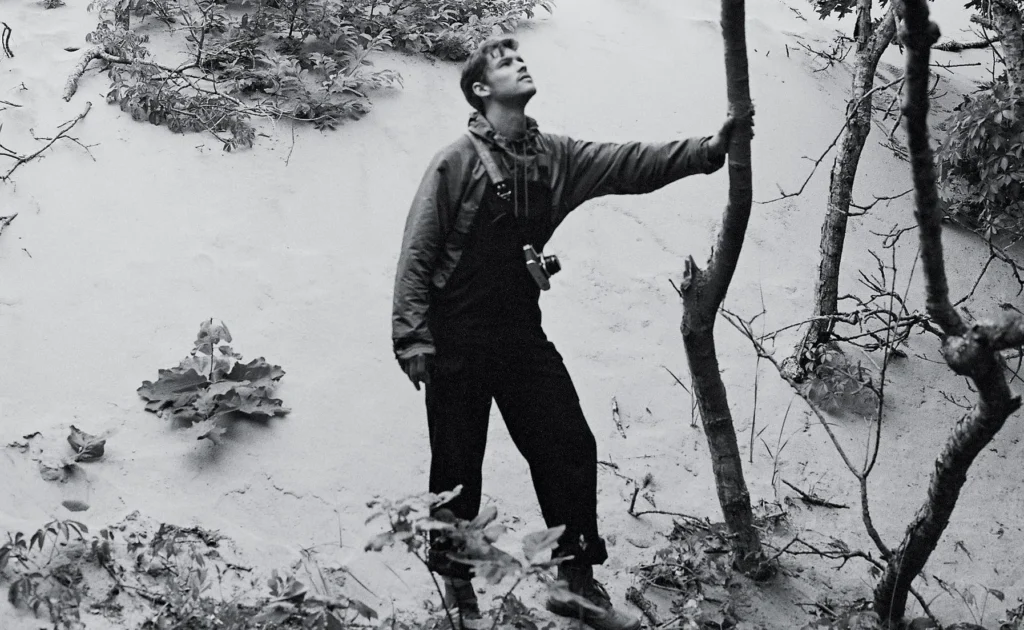
He died in January 1989, forty-eight years old, in a clinic in Nice, and even in dying he could not resist the revision. The story he told — to friends, to journalists, to anyone who asked with the particular hunger of people who sense they are being kept from something — was that he had contracted a rare fungal infection in China, a disease so exotic it barely had a name in Western medicine, something picked up from a fossil bone he had handled in Yunnan province. The story was precise, detailed, clinically convincing in the way that only thoroughly invented things can be. It had the texture of a Chatwin sentence: specific enough to foreclose doubt, strange enough to open wonder.
The truth, which almost everyone around him knew and which he refused to confirm until he could no longer speak with enough force to deny it, was AIDS. He had been diagnosed in 1986. He spent the years between diagnosis and death doing what he had always done: moving, writing, performing the self that the work required. The Songlines appeared in 1987, that magnificent hybrid of novel and notebook and philosophical treatise on nomadism, selling in numbers that surprised even his publisher at Jonathan Cape. Utz followed in 1988, shortlisted for the Booker Prize, a novella of such controlled elegance that it read like a man demonstrating mastery precisely because he understood the demonstration was almost over.
He spent part of his final months in the south of France with Werner Herzog, the German filmmaker who had turned Chatwin’s On the Black Hill into a project of his own imagining, and whose sensibility — the conviction that landscapes contain a violence that civilized life perpetually suppresses — matched Chatwin’s with an almost uncomfortable exactness. There is something worth pausing over in that image: two men who had each built their life’s work around the refusal of settled meaning, sitting in the Mediterranean light while one of them was visibly disappearing. It was not, by any account, a scene of tragedy. It was, by those who witnessed it, closer to something like continuous argument, continuous interest, the mind still insisting on its own mobility even as the body retracted.
The philosopher Charles Taylor, writing in Sources of the Self in 1989, the same year Chatwin died, argued that modern identity is constituted narratively — that we cannot understand who we are except through the story we tell about how we came to be here. Chatwin spent his entire life sabotaging that formulation. He refused the stable narrative. He refused the confessional mode. He refused, at the end, the narrative that his own dying seemed to demand: the sick gay man, the era’s emblematic victim, the body that had wanted too much and paid for it in the currency the decade had decided was appropriate. The invented Chinese fungus was not, or not only, shame. It was one last act of taxonomic resistance. He would not be the story that 1989 needed him to be.
There is a scene that stayed with people who knew him near the end: thin, the skin pulled in strange new ways across his face, he is holding a manuscript, talking about a new book, the ideas arriving faster than the sentences can contain them, the hands moving in the old way, the enthusiasm indistinguishable from the enthusiasm of the man who had walked into Sotheby’s auction rooms in his twenties with the absolute certainty that everything interesting was somewhere else. The body was leaving. The orientation remained. He was still, to the last recognizable moment, facing outward, toward the unnamed place, the unwritten book, the route not yet taken.
Whether that constitutes courage or delusion or simply the only way a particular kind of person can move through the world without breaking is not a question that resolves itself just because the man in question finally, inevitably, stopped moving.
🧭 Wanderers, Writers, and the Restless Mind
Bruce Chatwin’s life and works orbit around restlessness, nomadism, and the philosophical meaning of human displacement. These related articles explore the writers, thinkers, and cities that share his obsession with journeys — both inner and outer — and the stories we tell to make sense of a world always on the move.
Situationist Psychogeography: The City as Lived Space
Situationist psychogeography reimagines the city not as a functional grid but as a landscape of desires and drifts, where the act of wandering becomes a radical act of perception. Chatwin, like the Situationists, believed that movement through space was also movement through meaning. Both visions challenge the settled life and insist that the body in motion discovers truths the sedentary mind cannot reach.
GO TO THE SELECTION: Situationist Psychogeography: The City as Lived Space
Calvino’s Invisible Cities: Meaning and Analysis
Calvino’s Invisible Cities constructs an atlas of imagined places that exist only in the dialogue between Marco Polo and Kublai Khan, making travel a form of storytelling rather than geography. Like Chatwin’s nomadic prose, Calvino dissolves the boundary between the journey taken and the journey imagined. Both writers understand that the real destination is always a kind of inner architecture.
GO TO THE SELECTION: Calvino’s Invisible Cities: Meaning and Analysis
Philosophy of the City: History and Theory
The philosophy of the city asks what it means to inhabit space, to belong to a place, and to be shaped by the walls and streets we move through. Chatwin’s work constantly interrogates settlement and rootedness, treating the built environment as both seduction and trap. Exploring this philosophical tradition illuminates why Chatwin’s characters — and Chatwin himself — could never quite stay still.
GO TO THE SELECTION: Philosophy of the City: History and Theory
Montaigne: Life and Essays
Montaigne, wandering through his own mind in the Essays, invented a literary form built on digression, curiosity, and the refusal to arrive at final answers. Chatwin inherited this essayistic restlessness, blending autobiography, anthropology, and fiction in a way that owes much to Montaigne’s radical self-examination. Both writers turn the act of thinking into a kind of perpetual travel.
GO TO THE SELECTION: Montaigne: Life and Essays
Discover the Cinema of the Open Road on Indiecinema
If Bruce Chatwin’s restless vision of the world has stirred something in you, Indiecinema streaming is where that spirit finds its moving image. Explore independent films that share his passion for nomadism, forgotten landscapes, and the stories only outsiders can tell — films that refuse to stay still, just like the man himself.
👉 EXPLORE THE CATALOG: Watch Indie Films in Streaming
A vision curated by a filmmaker, not an algorithm
In this video I explain our vision

