
The Chair by the Window
You know the feeling. It is past midnight, the room is dark except for whatever thin light comes through the window — streetlamp, moon, the neighbor’s porch left on — and your mind will not stop. You have tried everything that is supposed to work. You have counted, you have breathed, you have turned the pillow to the cold side. Nothing. The thoughts come not as ideas but as pressure, a kind of hum behind the sternum that you cannot locate precisely enough to push away. You are not thinking about anything in particular. You are thinking about everything at once, and underneath it all there is something you do not want to name: the sensation that the darkness outside is not simply darkness but enormity, that the silence is not peaceful but indifferent, that you are very small and the night around you is very large and does not care whether you exist at all.

This is where Pascal lived. Not occasionally, not in his weaker moments, but as a permanent condition of being alive. The man who calculated probabilities, who invented one of the first mechanical calculators at the age of nineteen, who corresponded with the finest mathematical minds in Europe about the geometry of conic sections — this same man sat in the dark and felt the universe pressing against him like water against a hull, and wrote about it in terms so exact they sound like someone reading your own interior aloud to you without your permission.
He was born in Clermont-Ferrand in June 1623, and from childhood his body and his mind seemed to be at war, each demanding resources the other needed. His father, Étienne, was a tax official with serious mathematical interests and the social confidence to impose them: he schooled Blaise himself, famously withholding geometry from him as though it were a dangerous substance, only to discover that the boy had reconstructed much of Euclid on his own at twelve, drawing figures in charcoal on the floor. This story, even if partly embellished in the retelling, contains something true about how Pascal worked — not because someone showed him the way, but because the way presented itself to him as necessity, as something that could not be left unfinished.
By his twenties the headaches had started in earnest. He described a sensation of fire in his legs, paralysis that came and went, a pain behind the eyes that made sustained reading an act of will bordering on self-punishment. Some biographers have suggested he suffered from a form of chronic migraine, others point toward what we might now recognize as a neurological condition of greater complexity. Whatever the diagnosis would have been had he lived three centuries later, the lived reality was this: a man who could not stop thinking, trapped in a body that punished him for thinking. He died in Paris on August 19, 1662. He was thirty-nine years old. He had been in almost continuous pain for roughly two decades.
What emerges from this is not the portrait of a saint or a prodigy but something more uncomfortable: a person for whom consciousness itself was an affliction. Søren Kierkegaard, writing two centuries after Pascal’s death, would describe a related condition — the vertigo that comes not from heights but from freedom, from the unbounded quality of one’s own interiority. Pascal arrived at the same territory not through philosophy but through the body, through nights that would not end, through a mind that ran and ran and found nothing to hold onto in the dark. The chair by the window was not a metaphor for him. It was where he actually sat. And the infinite silence he heard beyond the glass was not rhetorical. He meant it, and it terrified him, and he spent his entire life trying to say precisely why.
Trench
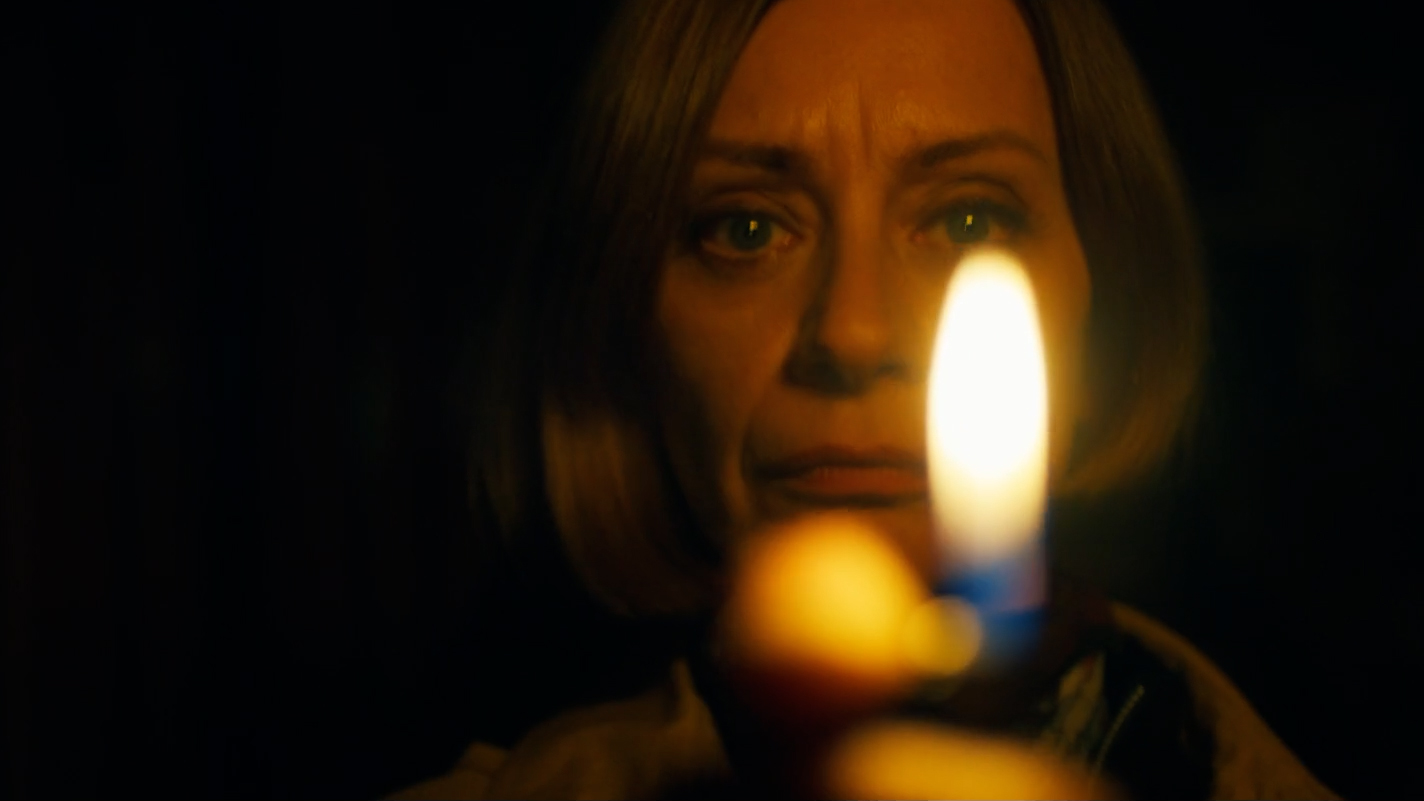
Thriller, Mystery, by Serge Turgeon, Italy, 2023.
In Venice, an art historian realizes that her brilliant mind will not be enough to solve the mystery surrounding the disappearance of an unknown woman. In addition to regaining trust in her intuition and her heart, she will need the help of a series of colorful characters from her community.
The idea behind Trench is to tell, through a detective story, the journey of an intellectual woman who suffered while growing up in a working-class district of Venice, where she never felt truly valued. In order to solve a mystery, she must face danger and rely on the help of the “non-intellectual” members of her community, rediscovering along the way her resourcefulness, her Venetian identity, and her true self.
LANGUAGE: Italian
SUBTITLES: English, Spanish, French, German, Portuguese
A Child Who Reinvented Geometry
There is something quietly vertiginous about watching a child draw figures on the floor with a piece of coal, alone, in a room where he was not supposed to be thinking about what he was thinking about. No books. No teacher. No permission. Just a boy and the cold stone and the shapes that kept insisting on their own logic. He had been told that mathematics would come later, once Latin and Greek had done their proper work on his mind. His father, Étienne, was himself a mathematician of considerable reputation, a man who understood the discipline well enough to know exactly how dangerous it was to introduce it too early, how it could swallow a mind whole before that mind had learned to protect itself with other forms of knowledge. So he hid the books. He removed the texts. He drew a boundary around the subject the way you might draw a boundary around fire.
The boy was Blaise, and he was twelve years old when he crossed it anyway.
What he reconstructed on that floor was not a crude approximation of geometry. It was Euclid’s first thirty-two propositions, reached independently, through pure spatial intuition, without a single external prompt beyond his own restless need to understand why shapes behaved the way they did. When Étienne discovered what his son had done, the accounts suggest he wept. Not from anger. From something closer to awe, or perhaps from the specific grief of recognizing that a child has already exceeded the category of child.
This is not a story about genius as triumph. It is a story about a mind that could not be administered. And that distinction matters enormously when you place it against the sociological reality of seventeenth-century France, where intellectual life was organized with almost military precision around patronage, hierarchy, and the slow credentialing of men through academies and courts. The Republic of Letters, as scholars like Dena Goodman have described it, was a republic in name only — a network of correspondence and publication governed by the same systems of authority that governed everything else. To be known, you had to be introduced. To be introduced, you had to wait.
Pascal never waited in quite the way the system expected.
By the time he was sixteen he had written and circulated the Essai pour les coniques, a treatise on conic sections that extended the projective geometry of Girard Desargues and introduced what would become known as Pascal’s theorem — the observation that if a hexagon is inscribed in a conic section, the three points at which the pairs of opposite sides meet will always be collinear. René Descartes, upon reading it, refused to believe it had been written by someone so young. He assumed Étienne had done the real work and allowed his son’s name to appear. The refusal to accept the source was itself a kind of violence, the way authority protects itself by rendering inconvenient evidence implausible.
But the mathematics was not the most unsettling thing. The most unsettling thing was the process. Blaise had not arrived at projective geometry by mastering what came before it. He had arrived at it sideways, through an intuition that preceded his formal education, which means his mind was not climbing a ladder. It was moving through something more like space itself, finding the structure of things before anyone had told him the structure existed.
Erik Erikson wrote about the relationship between extraordinary intellectual precocity and what he called identity foreclosure — the way a self can become so identified with a single capacity that the rest of development gets organized entirely around it, leaving permanent lacunae where ordinary human flexibility might have lived. Pascal’s body was already failing him. Headaches, digestive pain, a nervous system that seemed to register thought as a kind of physical event. He would spend much of his adult life ill. The mind was racing. The life around it was struggling to keep pace.

The Machine That Counted Grief
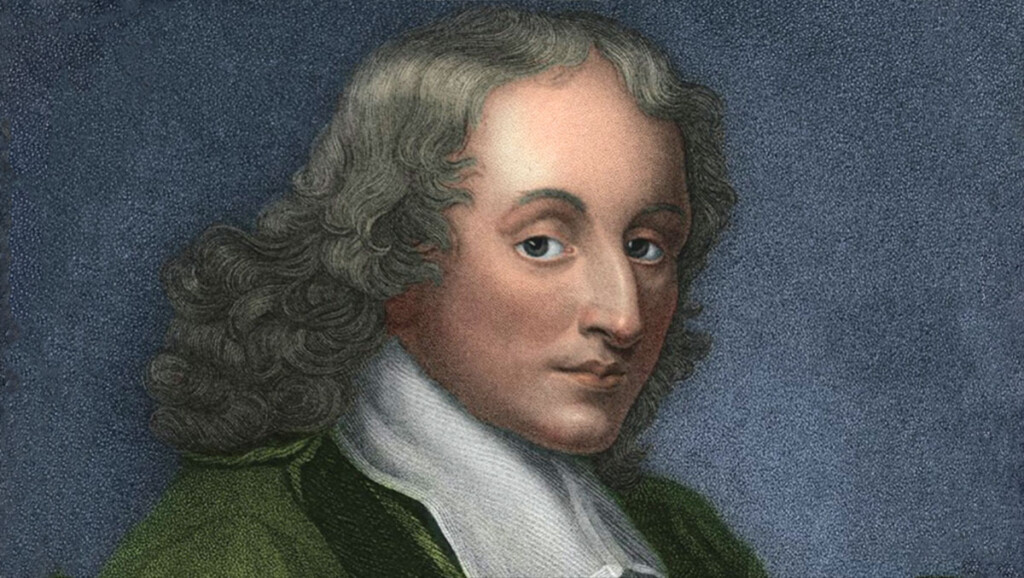
Étienne Pascal was going blind. Not metaphorically — his eyes were failing him, slowly, the columns of numbers blurring into one another as he bent over the tax ledgers of Rouen, where Richelieu had appointed him intendant in 1639. His son watched this. He was nineteen years old, already the author of a mathematical treatise on conic sections that Descartes had refused to believe was written by someone so young, and he watched his father dissolve into administrative exhaustion, night after night, surrounded by the merciless arithmetic of the state.
So he built a machine.
Between 1642 and 1645, Pascal produced approximately fifty prototypes before arriving at a working model — a brass box of gears and wheels that could add and subtract through a system of interlocking drums, each carrying digits zero through nine, each designed to carry overflow automatically to the next column. He called it the Pascaline. He believed it would save his father. He believed, at nineteen, that a problem made physical could be solved physically, that grief translated into mechanism could be made to stop.
There is a particular kind of silence that surrounds a machine you have built to solve something that cannot be solved by machines. You have seen it — or something very like it. A man sits in a room, watching a device he constructed with his own hands hum and process and output results with perfect fidelity. The problem it was built for has not disappeared. The problem was never really the calculation. The device sits there, correct and indifferent, and the man understands this slowly, the way you understand something you already knew.
Hannah Arendt, writing in “The Human Condition” in 1958, drew a distinction that cuts directly into this moment. She separated labor — the cyclical, body-bound toil that produces nothing permanent — from work, which fabricates a durable world of objects. The Pascaline was work in Arendt’s sense: it produced something that outlasted the effort. Pascal filed for a royal privilege to manufacture it in 1649. It was a real object, a world-altering object, the direct ancestor of every computational device that followed. And yet what Étienne Pascal needed was not an object. What he needed was for the work to matter less, for the state to require less of him, for his body not to be consumed by a system that treated human perception as a resource to be depleted. The machine could not give him that. Machines never can, and we keep building them anyway.
This is not a criticism of Pascal’s invention. It is an observation about the logic that produces invention — the logic that says: if I can remove the cognitive burden, I remove the suffering. Automation, in its deepest psychological grammar, is always a response to pain. The question Arendt forces us to ask is whether the pain being automated was ever really cognitive in the first place. Whether the exhaustion was in the counting, or in being made to count.
By 1652, Pascal had dedicated the Pascaline to Chancellor Séguier in terms of elaborate flattery, describing the machine as a servant that could surpass human limitation. The rhetoric is telling. A servant that surpasses. Something made to bear what you cannot bear, designed precisely to stand between you and the weight of a task that was given to you by a power you could not refuse. Étienne Pascal died that same year. Whether the machine had lightened anything for him in the intervening decade is not recorded.
What is recorded is that Pascal kept one of the surviving models near him for the rest of his life. Not using it, apparently. Just keeping it close, the way you keep something that reminds you of a problem you solved and the thing the solution could not reach.
Water, Pressure, and the Weight of the World
There is a moment, familiar to anyone who has ever argued against consensus, when the evidence you hold in your hands feels almost embarrassing in its simplicity. You are not producing something complicated. You are pointing at something obvious. And yet the room does not move.
In the autumn of 1648, a man climbed a mountain in the Auvergne carrying a glass tube filled with mercury. His name was Florin Périer, and he had been asked to make this ascent by his brother-in-law, who was too ill to climb himself but too restless to wait without knowing. The instruction was precise: measure the height of the mercury column at the base of the Puy-de-Dôme, then again at the summit, then again on the way back down. Repeat the measurement. Be certain. The mountain was nearly 1,500 meters at its peak, and what Périer found there — a column of mercury noticeably shorter at altitude than at the base, recovering its original height on the descent — was not merely a data point. It was the physical world confirming what Blaise Pascal had already understood in his bones: that air has weight, that weight varies with height, and that the column of mercury in Torricelli’s tube was not sustained by nature’s alleged abhorrence of a vacuum but by the simple, measurable pressure of atmosphere pressing down from above.
The Aristotelian tradition had explained the phenomenon differently, invoking the principle that nature abhors a vacuum, a formulation so philosophically tidy that it had survived nearly two thousand years without anyone finding it intolerable. Pascal found it intolerable. What Thomas Kuhn, writing in The Structure of Scientific Revolutions in 1962, would later identify as the distinguishing mark of a paradigm shift is not the arrival of new data but the moment when someone decides that the accumulated anomalies can no longer be explained away — when the old framework stops feeling like wisdom and starts feeling like evasion. Pascal was living inside exactly that moment, and he experienced it not as intellectual triumph but as something closer to vertigo.
His Traité de l’équilibre des liqueurs and the Traité de la pesanteur de la masse de l’air, both written in the late 1650s and published posthumously in 1663, are documents of a mind that has done the physical work necessary to trust itself. He had already conducted experiments with varying liquid densities in syringes and tubes, demonstrating that pressure in a fluid transmits equally in all directions — what we now call Pascal’s principle, the hydraulic foundation beneath every modern press, every car’s braking system, every surgeon’s syringe. He had injected wine and oil into sealed chambers to show that the behavior of the mercury had nothing to do with the mystical properties of any particular substance and everything to do with the mechanical reality of weight and column height. He was, in Kuhn’s precise sense, not refuting the old paradigm through argument but dissolving it through demonstration, replacing an explanation that required invisible metaphysical forces with one that required nothing more than a scale and a mountain.
But what the historical account rarely recovers is the quality of need in all of this. Pascal was not a detached empiricist contentedly running trials. He was a man in fragile health, frequently in pain, whose mind was constitutionally incapable of resting on received authority. The experiment at Puy-de-Dôme was not cold method. It was a desperate appeal to the physical world to settle what no conversation had managed to settle, a wager placed not on logic alone but on the irreducible testimony of altitude and gravity and glass. When Périer descended with his measurements confirmed, Pascal was not vindicated. He was relieved, in the way one is relieved when something you already knew turns out to be true in a form that others cannot dismiss.
The Night of Fire
It is past midnight and you are sitting somewhere you did not intend to stay. The engine is off. The parking lot is empty except for the particular quality of silence that only exists in places built for motion and now entirely still. The dashboard clock reads something after three. You cannot explain, not to yourself and certainly not to anyone else, why you cannot simply open the door and leave. Something has happened, or is happening, or has not yet finished happening, and your body knows this even though your mind has no language for it. You will remember this night. You will not know what to call it.
On November 23, 1654, between roughly ten-thirty in the evening and half past midnight, Blaise Pascal experienced something he spent the rest of his life unable to fully articulate. What he did, immediately and with the precision of a man who had spent decades measuring the world, was write it down. The document he produced, known as the Memorial, runs to approximately two hundred and fifty words. It begins with the word FIRE, written in capital letters and alone on the line, as if language had briefly broken open before reassembling into something more manageable. He wrote on a piece of parchment, copied it onto paper, and then sewed both into the lining of his coat. He wore it close to his body for the remaining eight years of his life. It was found only after his death, when someone finally thought to look.
What do you do with that? A man who had corresponded with Fermat, who had built a calculating machine at nineteen, who had settled the question of atmospheric pressure through an experiment on a mountain in the Auvergne, reducing everything to data and demonstration — this man spends two hours in a state he can only describe through the name of God, through tears he mentions explicitly, through the repeated insistence on certainty and joy and the forgetting of the world and of everything except this. He does not tell us what he saw. He tells us only what the encounter left behind.
William James, lecturing at Edinburgh in 1901 and 1902 in what would become The Varieties of Religious Experience, proposed something that neither theology nor dismissal had managed: that conversion experiences are psychologically real events that reorganize the self at a structural level. He described the phenomenon of a field of consciousness suddenly acquiring a new center, the old self collapsing not through destruction but through a kind of rapid reorientation, the way a compass needle swings when you bring it near something sufficiently powerful. James was careful to say that the psychological reality of the experience neither confirmed nor denied its metaphysical claims. The experience happened. The transformation was measurable in behavior, in affect, in the entire subsequent shape of a life. What caused it remained, in his framework, permanently open.
Pascal would not have found this satisfying. His Memorial insists on the God of Abraham, Isaac and Jacob, not the God of philosophers — a distinction he draws explicitly, as if he had spent his life building the wrong instrument and had only now been handed the right one. But what James gives us that Pascal could not give himself is permission to take the experience seriously as an event before we decide what kind of event it was. Something happened in those two hours. The coat knew it. The body sewn inside the coat knew it. The man who had trusted nothing he could not prove suddenly trusted something he could not explain, and he trusted it so completely that he kept the record of it pressed against his ribs, hidden from everyone, a private document addressed to no one, carried everywhere.
There is no adequate philosophical category for what happens in a parking lot at three in the morning when you cannot make yourself leave.
A vision curated by a filmmaker, not an algorithm
In this video I explain our vision
Port-Royal and the Politics of Conscience

There is a particular kind of courage that looks, from the outside, like theological pedantry. Someone begins writing letters, anonymously, about the fine distinctions between sufficient grace and efficacious grace, about whether a confessor can absolve a penitent who has no firm intention of changing, about whether a Jesuit manual permits a duel under sufficiently elaborate circumstances. You read the first lines and think: this is a dispute among clerics, and it has nothing to do with me. Then something shifts. The language sharpens. The irony begins to cut. And you realize you are not reading a doctrinal argument at all. You are reading a demolition.
Pascal’s eighteen letters, published between January 1656 and March 1657 under the pseudonym Louis de Montalte, were addressed to a fictional correspondent in the provinces who needed explaining to — and that fictional naivety was the entire weapon. The persona of the bewildered layman, earnestly seeking clarification from learned Jesuits who kept contradicting each other, allowed Pascal to do something that direct polemic never could: he made his targets speak. He quoted them. He let their own manuals, their own published casuistry, their own accommodations of sin to social convenience stand in the light, and the light was devastating.
The Society of Jesus had, by the mid-seventeenth century, become the dominant force in French Catholic intellectual life, the confessors of kings, the architects of elite education, the institution whose theological flexibility had made them indispensable to precisely the people who needed indispensability most. Pierre Bourdieu‘s concept of symbolic violence is almost embarrassingly precise here: the Jesuits had accumulated not just institutional power but the power to define what counted as legitimate religious discourse, to determine which questions were serious and which were seditious. Pascal understood that to attack them frontally was to lose before you began. You had to attack the legitimacy of the symbolic order itself, not from outside it, but by inhabiting its language until the language collapsed under its own contradictions.
What Foucault traced in his analyses of institutional discipline — the way power sustains itself not through brute force but through the normalization of its own categories, through making the governed complicit in their governance — Pascal enacted in real time, against one of the most sophisticated institutions in European history. He did not argue that the Jesuits were evil. He demonstrated that they had constructed an entire apparatus of moral reasoning whose function was to make sin administratively manageable for those wealthy and connected enough to afford a learned confessor. The poor, he noted with a precision that reads as cold fury, had to actually repent.
Voltaire, who disagreed with nearly everything Pascal believed about the human soul and its destiny, called the Lettres provinciales the first masterpiece of French prose. This is not a casual compliment from a man who gave compliments like a miser parts with coins. What Voltaire recognized was that Pascal had done something linguistically unprecedented: he had fused theological argument with comic timing, had made the rhythm of a sentence do moral work, had discovered that clarity itself — the refusal of obfuscation — is a political act when the institution you oppose depends on obfuscation to survive.
The letters were condemned by Rome, burned by order of the king, and widely read by everyone in France who could read. This is the standard fate of books that work. Pascal kept writing them after the condemnation. He did not stop, did not soften, did not seek accommodation. The Port-Royal community he defended was not simply a theological preference; it was the last position from which a certain kind of moral seriousness could be held without surrendering it to institutional management. He understood, with a clarity that cost him, that some arguments cannot be moderated without being abandoned.
The Wager and the Abyss
There is a man sitting at a table covered in green felt, and he is not there because he wants to win. You can see it in the way he places the chips — not with the quick, practiced flick of someone calculating odds, but slowly, almost ceremonially, as though the act of committing is itself the point. He has been awake for a long time. The uncertainty has become unbearable. At some moment in the small hours, losing became preferable to not knowing.
This is not greed. This is a man trying to make the infinite stop.
Pascal understood this from the inside. The wager — that notorious argument buried in the Pensées, the book he never finished, assembled from 800 fragments found scattered after his death in 1662 — is almost always read as a piece of cold rationalism, a cost-benefit analysis applied to the soul. Bet on God: if He exists and you believe, infinite gain; if He does not exist and you believed anyway, you lose nothing significant. The mathematics are clean. But mathematics was how Pascal thought when he was frightened, and the wager is the record of a man who was very frightened indeed.
He wrote it himself: “Le silence éternel de ces espaces infinis m’effraie.” The eternal silence of these infinite spaces terrifies me. This is not a rhetorical flourish. It is a confession. Copernicus had decentered the earth in 1543, and in the century that followed, the cosmos had not stopped expanding in the European imagination. Pascal, who had spent years calculating probabilities and corresponding with Fermat about games of chance in 1654 — the very year of his nocturnal conversion — knew better than almost anyone what infinity actually meant mathematically. And what it meant existentially was this: you are a point. A thinking reed, he called himself, a roseau pensant, something that the universe can crush without even noticing. The dignity of a human being lies precisely in the awareness of being crushed. But awareness is cold comfort at three in the morning when the spaces are silent and enormous.
The wager is not proof. Pascal knew this too. What it is, instead, is a structure for bearing the unbearable. Kierkegaard, writing two centuries later in works like Either/Or and Concluding Unscientific Postscript, would name this same movement the leap of faith — not a logical conclusion but a volitional lunge across a gap that reason cannot bridge. What is striking is that Kierkegaard’s leap assumes the abyss. It does not pretend the gap is smaller than it is. Pascal’s wager does the same, though it dresses the leap in the clothes of calculation to make it seem like something a rational man could choose without humiliation.
But Sartre saw the other side of this: radical freedom is not a gift but a condemnation. When there is no God, there is no script, no role to step into, no structure that pre-exists your choices. You are thrown into existence — Heidegger’s Geworfenheit, the sheer facticity of finding yourself already here — and from that moment, every decision is yours and the weight is absolute. Pascal’s wager can be read as the precise inverse of Sartrean freedom: it is the attempt to convert terrifying openness into a decision that closes it, to transform the vertiginous nothing into a structured bet with defined outcomes. To place the chips and watch them slide and not take them back.
The man at the green felt table finally pushes everything forward. His face does not change. He is not hoping to win anymore. He simply needs the roulette wheel to spin, because a spinning wheel has a direction, and a direction is a universe that means something, and a universe that means something is one where the silence, for a moment, is not quite so eternal.
The Unfinished Architecture of the Pensées

When they entered his room after he died on August 19, 1662, they found paper everywhere. Not manuscripts in the conventional sense, not chapters arranged in sequence awaiting a final polish, but scraps — some sewn together in rough bundles, some loose, some carrying a single sentence that broke off mid-thought as though the hand had simply stopped. He was thirty-nine years old, and what he left behind were approximately eight hundred fragments that no one, including Pascal himself, had organized into anything resembling a book.
You walk through a house where someone stopped living mid-gesture. A coat still hanging by the door. A cup on the table, the tea long evaporated but the ring it left still dark against the wood. A letter begun and never finished, the pen placed beside it at an angle that suggests the writer meant to return in a moment. The rooms do not feel tragic so much as honest. They show you what a life actually looks like when nothing has been arranged for your arrival.
This is what the Pensées are. The word itself means simply thoughts, and the Port-Royal editors who published the first version in 1670 — eight years after his death, working from the chaos of those bundles and loose papers — felt compelled to impose order, to smooth the rougher edges, to present something that looked more like the finished apology for Christianity Pascal had reportedly planned to write. What they produced was more comfortable and less true than what he had actually left. It took nearly three centuries of scholarship to begin recovering the fragments in something closer to their original disorder, a process that culminated in the critical editions of the twentieth century, particularly Louis Lafuma’s work in 1951, which returned the text to an arrangement based on the bundles Pascal himself had partially organized.
But the deeper question is whether the incompleteness is a failure or a form. Maurice Merleau-Ponty, writing in the mid-twentieth century about the fragmentary nature of philosophical thought, understood that certain truths resist systematic presentation not out of intellectual weakness but because the reality they address is itself resistant to closure. Pascal had written, in one of the most devastating of the fragments, that all of humanity’s problems stem from the inability to sit quietly in a room alone. That sentence does not need a sequel. It lands and it stays.
A man moves through corridors he once knew well, touching walls that still hold the warmth of old decisions. He is not lost. He is recognizing, which is a different and more painful thing. The architecture is intact but the life it was built for has shifted irrevocably, and what remains is the shape of intention without its fulfillment. This is not ruin. This is the most accurate record of what was actually happening.
Pascal understood the human being as a creature suspended between two infinities — the infinitely large and the infinitely small, a thought he developed with genuine mathematical precision given his work in physics and his correspondence with scientists of his era — and this suspension was not a metaphor for him but a lived condition. You cannot build a closed system to describe a being whose defining characteristic is that it cannot close. The fragments are not the draft of the Pensées. They are the Pensées, exactly as honest as the man who produced them.
What the work ultimately leaves you with is not a resolution but a pressure. Pascal shows you the wretchedness of the human condition with a clarity that feels almost aggressive in its refusal to soften, and then he points, not gently, toward what he believed was the only exit from that wretchedness. Whether you follow him through that door, or whether you stand in the corridor recognizing everything he has described and choosing to remain there, is the question the fragments open and, with absolute integrity, decline to answer for you.
🌀 Reason, Infinity, and the Abyss of Thought
Blaise Pascal stood at the crossroads of mathematical genius and existential anguish, haunted by the silence of infinite spaces and the fragility of human reason. The thinkers and works gathered here share his restless search for meaning beyond the limits of logic and certainty.
Henri Bergson: Life and Works
Henri Bergson, like Pascal, was consumed by the mystery of time and the inadequacy of purely analytical thought to grasp the depths of experience. His philosophy of duration and intuition offers a compelling counterpoint to Pascal’s wager between reason and faith. Together, they trace a lineage of French thought that refuses to let the human condition be reduced to mere calculation.
GO TO THE SELECTION: Henri Bergson: Life and Works
Montaigne: Life and Essays
Montaigne, Pascal’s great predecessor in the French essayistic tradition, pioneered the art of turning inward and examining the self with radical honesty and skepticism. Where Montaigne found a kind of serene acceptance in uncertainty, Pascal was driven toward divine terror and conversion. Reading both side by side reveals the full spectrum of what it means to think dangerously in early modern France.
GO TO THE SELECTION: Montaigne: Life and Essays
Albert Camus: Life and Philosophical Thought
Albert Camus inherited Pascal’s confrontation with the absurd and the silence of the universe, but chose rebellion over submission to God. His philosophy of the absurd can be read as a secular mirror to Pascal's Pensées, both works born from the same vertigo before the infinite. Where Pascal leaped into faith, Camus planted his feet in defiant lucidity.
GO TO THE SELECTION: Albert Camus: Life and Philosophical Thought
Martin Heidegger: Life and Philosophical Thought
Martin Heidegger‘s meditation on Being and Time resonates deeply with Pascal’s intuition that human existence is defined by its thrown condition, its finitude, and its anxiety before death. Both thinkers force us to confront what is most unsettling about consciousness: its awareness of its own limits. Heidegger gives philosophical rigor to the existential dread that Pascal expressed with the force of a mystic.
GO TO THE SELECTION: Martin Heidegger: Life and Philosophical Thought
Discover Cinema That Thinks and Dares
If these ideas stir something in you, Indiecinema is where thought meets image in its most daring forms. Explore our streaming catalog for independent films that carry the same restless spirit as Pascal’s infinite spaces — films that question, unsettle, and illuminate. Join us and let cinema take you where reason alone cannot.
👉 EXPLORE THE CATALOG: Watch Indie Films in Streaming
A vision curated by a filmmaker, not an algorithm
In this video I explain our vision

