
The Invisible Ritual of the Open-Plan Office
You notice it before you can name it. You walk through the door at the usual time, set your bag down at the usual desk, and something in the room has already shifted — not dramatically, not in any way you could photograph or record or bring to anyone’s attention without sounding paranoid. The shift is molecular. Two colleagues who were mid-sentence when you entered have reached the natural end of their thought a half-beat too quickly. Someone’s eyes find their screen with slightly too much purpose. The coffee machine conversation continues, but the radius of the group has contracted by roughly one body’s width, which happens to be exactly the distance between where you’re standing and where you’d need to be to belong to it.

This is not a bad day. This is a system.
What makes workplace mobbing so devastatingly effective as a form of psychological violence is precisely that it operates beneath the threshold of the documentable. There is no single incident you can point to, no slur, no threat, no moment that a human resources department could label and file. What there is instead is a relentless, low-frequency choreography of exclusion — the kind that the body registers long before the conscious mind is willing to accept the implications. You were removed from an email chain. Not fired from it, not blocked, just quietly, surgically absent from the next thread in a sequence you had been part of for months. You discover this not because anyone tells you, but because a decision was made in a meeting you didn’t know was happening, and the outcome lands on your desk as a fait accompli, wrapped in the cheerful language of efficiency.
Heinz Leymann, the Swedish psychologist who first gave this phenomenon its clinical architecture in the 1980s and 1990s, defined mobbing as a form of psychological terror in the workplace involving hostile and unethical communication directed in a systematic way toward one individual. His research, conducted across Scandinavian work environments and later published in comprehensive form in 1993, identified forty-five distinct behaviors that constitute mobbing — none of which, taken individually, would necessarily alarm a reasonable observer, but which, in combination and over time, produce what he documented as devastating psychiatric consequences, including rates of post-traumatic stress disorder comparable to those found in combat veterans. The word he borrowed from ethology, from Konrad Lorenz’s observations of how smaller animals collectively drive a larger predator away from a group. The predator, in the workplace version, is almost always the person with the least institutional power to defend themselves.
What you’re living through when you sit at that desk and feel the room’s atmosphere pressing against you like a change in barometric pressure is not sensitivity, not imagination, and not a failure of professionalism. It is a biologically rational response to social threat. Matthew Lieberman, the social neuroscientist at UCLA whose work on social pain was consolidated in his 2013 book Social, demonstrated through neuroimaging studies that social exclusion activates the same neural circuitry as physical pain — the dorsal anterior cingulate cortex lights up identically whether someone has been hit or left out. The body does not distinguish between a bruise and being removed from a meeting. The nervous system files both under the same category of emergency.
And yet the culture of the modern open-plan office — that architectural experiment in enforced transparency that became the dominant spatial grammar of knowledge work from roughly the 1990s onward — is perfectly designed to make this kind of pain invisible while simultaneously maximizing its delivery range. Everyone can see everyone, which means everyone can perform the act of not seeing you with maximum audience. The glass walls and collaborative furniture and the deliberately casual geography of hot-desks and breakout zones create an environment where belonging is constantly on display, and therefore so is its withdrawal. The open plan was sold as a democracy of space. What it produced, with remarkable efficiency, was a theater of social hierarchy with nowhere to hide.
Return to Planet Underground

Drama, Thriller, by Gideon Homes, Netherlands, 2025.
A former underground techno DJ working in a large and famous law firm delves into the dark side of society. With one eye on the past and one on the future, he stirs up the ashes of the true underground. The demand of society to function superficially and deliver top performance increasingly clashes with the protagonist's questioning of his own life reality and the values of his past. After being employed for almost six years and being a respected employee, Tyrel falls ill. On top of that, he witnesses a fraud within the company and asks to leave. But the illness creates a complex situation in which his employer starts playing a game of chess with Tyrel.
In "Return To Planet Underground", director Gideon Homes gives the audience a gripping insight into the Dutch underground techno scene, offering a gripping drama set in a dark world, full of intense moments and touching human tragedies. This film is not just a visual feast; it is a gripping exploration that immerses viewers in the lives of its protagonists. Set to a backdrop of thumping techno beats, "Return To Planet Underground" takes audiences on a rollercoaster ride through the highs and lows of human desires, drug-fueled escapades, societal pressures and the pursuit of perfectionism. Drawing inspiration from iconic films such as Trainspotting, Berlin Calling and Human Traffic, Gideon Homes' work stands out for its unique stylistic devices and unconventional storylines. Based on real events and personal experiences, "Return To Planet Underground" faced numerous lawsuits before finally conquering audiences around the world. Prepare yourself for an immersive dive into a world where music, morality and the human spirit collide.
LANGUAGE: English, Dutch
SUBTITLES: Spanish, French, German, Portuguese
Heinz Leymann and the Name We Were Never Given
You already know the feeling, even if you have never had a word for it. The meeting ends and everyone files out with the same unreadable expression, and you are left standing near the whiteboard wondering whether what just happened was real. The project you led for six months is reassigned without explanation. Your emails receive replies that answer a question you never asked. Your name is pronounced correctly by everyone except the person who matters most, and they have been mispronouncing it for two years now, and somehow correcting them has become the socially dangerous act. You are not being beaten. Nothing is illegal. You are simply being unmade, one small gesture at a time, and the most disorienting part is that you have no language for the process you are living through.
In 1990, Leymann published what became his foundational contribution in the journal Violence and Victims, establishing not merely a concept but a clinical taxonomy. He identified 45 discrete hostile behaviors that, when deployed systematically over time against a single target, constituted what he defined as psychological terror in working life. These behaviors ranged across five domains: attacks on the victim’s ability to communicate, attacks on social relationships, attacks on social reputation, attacks on the quality of professional and personal life, and attacks on physical health. None of these behaviors, taken individually, would register as violence in any legal or institutional sense. A colleague who stops including you in informal conversations is not breaking any law. A manager who assigns you tasks beneath your qualification level and then evaluates you on their poor execution is not technically abusing you. It is the pattern, the duration, the intentionality, and above all the institutional tolerance that Leymann identified as the mechanism of destruction. He argued that mobbing required a minimum frequency of at least one hostile act per week over a period of at least six months before it could be clinically distinguished from ordinary workplace conflict. The precision was deliberate. He was trying to make the invisible legible.
What made his findings institutionally unwelcome was not their methodology but their implication. If systematic psychological terror was occurring inside the very workplaces that Scandinavian social democracy had held up as models of human dignity, then the problem was not a few aberrant individuals. The problem was structural. It lived inside hierarchies, inside the informal social contracts of conformity that held productive communities together, inside the silence of managers who saw what was happening and calculated that intervention cost more than complicity. Leymann estimated that in Sweden alone, approximately 3.5 percent of the working population was experiencing active mobbing at any given time, a number that, scaled across an economy, represented tens of thousands of people being psychologically destroyed inside institutions that officially celebrated their wellbeing. The productivity religion of postwar Scandinavia had not eliminated the human appetite for social exclusion. It had simply given it better cover.
What Leymann understood, and what his critics in organizational psychology were slow to accept, was that the target’s experience of reality itself becomes the primary casualty.

The Group as Organism, the Individual as Threat

There is a particular kind of silence that falls over a team meeting the moment someone says the wrong thing. Not wrong in substance — often, dangerously, quite right — but wrong in timing, wrong in tone, wrong in the unspoken grammar of the room. The person who spoke watches the air change. Others look down, or sideways, or at their phones. Nobody disagrees openly. Nobody agrees either. What happens instead is something colder: a collective stillness that communicates, with extraordinary precision, that a line has been crossed, a boundary violated, a body rejected. The person sits back in their chair and understands, with the wordless part of their nervous system, that something has shifted. They are not entirely sure when it began. They are quite sure it will not easily end.
René Girard spent decades trying to name exactly this mechanism. In La Violence et le Sacré, published in 1972, he argued that human communities have always managed their internal tensions not by resolving them but by displacing them — by converging collective anxiety onto a single figure whose exclusion produces, at least temporarily, a sensation of unity and peace. The victim does not need to be guilty. They need only to be sufficiently identifiable as different: a foreigner, an eccentric, someone who arrived late to the cultural consensus, someone who asks the kind of questions that make collective comfort slightly impossible. Girard called this the scapegoat mechanism, and he traced it through Greek tragedy, biblical narrative, and the deep structure of sacrificial religion. What he was describing, though he did not use the word, was the organizational life of the modern office, the open-plan floor, the weekly stand-up, the team-building retreat where someone is always, quietly, on trial.
The power of this framework is that it strips mobbing of its accidental quality. We are accustomed to thinking of workplace persecution as a failure of management, a dysfunction of particular personalities, an unfortunate collision of difficult people. Girard forces us toward a more unsettling reading: that the group is not malfunctioning when it produces a scapegoat. It is functioning exactly as groups have always functioned. The expulsion is not the breakdown of the social organism. It is the social organism doing what it evolved to do — consolidating identity, purging ambiguity, converting diffuse internal rivalry into a single, manageable target. The person being mobbed is not collateral damage. They are the product.
Wilfred Bion arrived at adjacent territory from an entirely different direction. Working with therapeutic groups at the Tavistock Institute in the 1940s and publishing his observations in Experiences in Groups in 1961, Bion identified what he called the basic assumption states — unconscious modes of collective behavior that groups adopt when anxiety rises and rational task-focused work becomes psychologically unbearable. In the fight-flight basic assumption, the group organizes itself against a perceived threat, real or invented. It needs an enemy. If none presents itself from outside, one is manufactured from within. Bion was careful to note that this is not a conscious conspiracy. The group does not decide, in any deliberate sense, to destroy one of its members. The persecution emerges from something more primitive and more difficult to interrupt: a shared emotional logic that operates below the threshold of individual intention, generating collective behavior that no single member would necessarily endorse if asked to account for it alone.
What Bion and Girard together describe is a system, not a collection of bad actors. The individual who becomes the container for group anxiety is often, paradoxically, the person most attuned to the group’s actual dysfunction — the one who sees the unspoken conflict, names the avoided problem, refuses the comfortable fiction. Their distinctness is not incidental to their persecution. It is precisely what makes them available for the role. The group does not fear what is alien to it. It fears what is almost familiar but insufficiently compliant — the mirror that reflects something the room has agreed not to see.
The Smartphone Woman
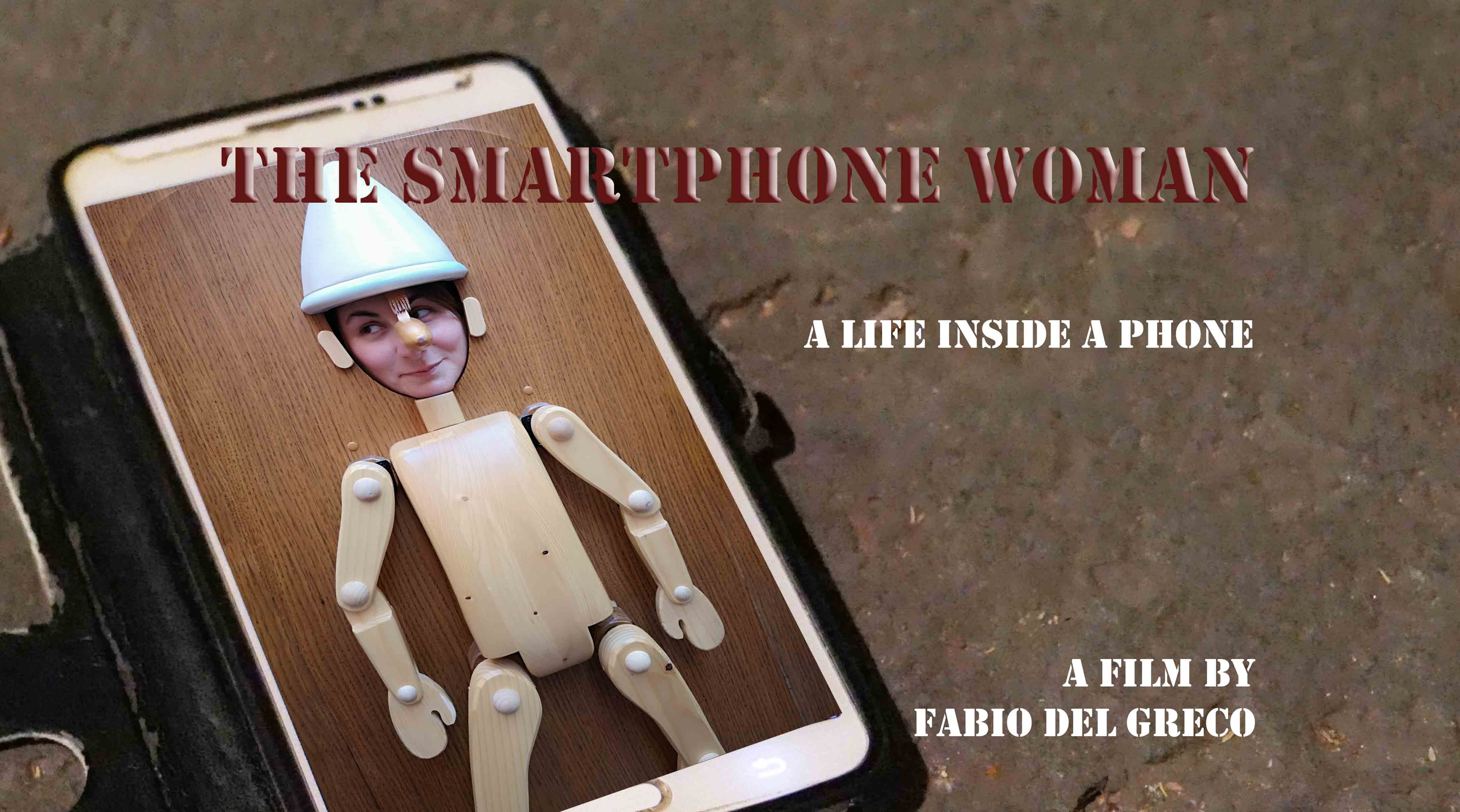
Drama, thriller, dark comedy, by Fabio Del Greco, Italy 2020.
On a bridge over the Tiber River, an elderly and severely ill man has decided to end his life, but an unusual discovery changes his mind: he comes across a lost smartphone. Intrigued, he decides to return home and watch the videos contained within it. On the screen, a series of videos unfold, telling the story of a woman who has emigrated from southern Italy to Rome to work as a teacher in schools and her struggles with integration in a social reality she cannot fully grasp.
"The Smartphone Woman" is a realistic tale of a woman's life and her complex relationship with an "infernal" city. It portrays the challenges she faces, her connection to her origins, the social discomfort she discovers in the outskirts, and the eerie presence of the ghosts of ancient Roman empire. Fabio Del Greco employs a fragmented style, using pieces of "real life" shot with the smartphone, to construct a narrative that ambiguously oscillates between fiction and truth. This creates a captivating exploration of the discomfort and alienation within the bustling city, contrasting with the peaceful village life from which the protagonist hails. The film is constructed with a variety of heterogeneous characters and situations, an emotional kaleidoscope, weaving between evenings of exploration in the Eternal City and daily struggles. Realistic smartphone-shot videos are alternated with a narrative thread reminiscent of film noir and, ultimately, surrealism in the finale. On screen, a succession of grotesque characters unfolds, representing the director's vision of a tumultuous humanity. The film's potency lies in the emotion it manages to convey and in the protagonist's naive perspective. "The Smartphone Woman" is a must-see for enthusiasts of independent and experimental cinema.
LANGUAGE: italian
SUBTITLES: English, French, German, Portuguese, Spanish
Hierarchy’s Hidden Enforcement Arm
You already know the meeting where no one looks at you. Not because they are distracted, but because they have decided, collectively and without a memo, that you have become a problem to be managed through absence rather than confrontation. The supervisor sits at the head of the table and says nothing about what is happening to you. This is not negligence. This is architecture.
Michel Foucault, writing in Surveiller et Punir in 1975, argued that modern power does not need a king to order punishment. It needs a system in which individuals become both the subjects and the instruments of their own discipline. He called this disciplinary power, and he traced its logic through prisons, hospitals, and schools — institutions designed not to destroy the deviant body but to correct it, to normalize it, to return it to productive function. What he did not live to see analyzed with full force — though the framework demands it — is how perfectly that same architecture fits the open-plan office, the quarterly review cycle, the team chat that goes silent when you enter.
The workplace presents itself as a space of collaboration and merit, but its actual organizing principle is conformity made invisible through the language of culture. When an organization says it values innovation, it almost always means a very narrow corridor of acceptable deviation, the kind that increases profit without disturbing hierarchy. The employee who questions the process too loudly, who declines to perform enthusiasm, who holds a different background or neurological pattern or set of values — that person is not fired immediately, because firing is expensive, documented, and legally scrutinized. Instead, something more efficient begins. Information stops flowing to them. Their contributions are talked over in meetings. Small humiliations accumulate without leaving fingerprints. This is mobbing functioning not as a spontaneous eruption of cruelty but as an informal enforcement arm of a structure that cannot afford to be seen enforcing.
What makes this mechanism so durable is precisely its deniability. No policy was violated. No rule was written. The manager who stood by and watched it happen — or who, in subtler cases, initiated it through strategic coldness, through the redistribution of assignments, through a single comment dropped into the right ear — can say in perfect sincerity that they saw nothing. Foucault’s panopticon worked because the prisoner could never be certain whether they were being watched, which meant they internalized the watch and policed themselves. The mobbing target experiences the inverse: they are watched with total intensity by the group, but the watching produces no formal record, no official gaze, only the social pressure that accumulates like water damage, invisible until the wall collapses.
What the organization gains from this is the removal of a problematic element without the institutional cost of a formal process. What it loses is harder to quantify but not invisible: the engineer who asked the question no one wanted to hear, the analyst whose difference of perspective might have caught the failure before it became a crisis. But organizations rarely do the accounting on what they eliminate. They only count what they keep, and what they keep is whatever did not threaten the structure of who gets to look down and who is required to look up. The correction was completed. The deviation was resolved. The culture, as they say, was protected.
The Physiology of Being Watched and Rejected
You notice it first in the body. Not in your thoughts, not in some internal monologue you can narrate to yourself or describe to a friend over dinner. It is there before language arrives: a tightness across the sternum when you see the meeting invite that does not include your name, a low-grade nausea when you walk into a room that goes slightly quieter, a precise muscular bracing that happens in the half-second before you open your work email in the morning. You have been telling yourself this is stress. You have been telling yourself it is anxiety, sensitivity, perhaps an overreaction you should work on managing. But there is a more accurate description for what is happening, and it does not belong to the vocabulary of emotional resilience or mindfulness. It belongs to neuroscience.
In 2003, Naomi Eisenberger and her colleagues at UCLA published findings that quietly dismantled one of the foundational assumptions of how we think about social suffering. Using neuroimaging to observe participants who were excluded from a simple virtual ball-tossing game — a paradigm so banal it sounds almost trivial — they found that the dorsal anterior cingulate cortex, the very region of the brain that registers the distress component of physical pain, activated with measurable intensity when people were socially rejected. Not metaphorical pain. Not pain-like discomfort. The same neural circuitry. The brain, confronted with exclusion, pulls from the same alarm system it uses when the body is under physical threat. What this means, structurally, is that the person being left off the invitation list, ignored in the hallway, spoken about in the third person while present in the room, is not being hurt in some soft and manageable emotional register. They are being hurt in the same register as someone whose body is being harmed. The culture insists on treating these two things as categorically different. The brain does not.
What Eisenberger’s work illuminated at the neurological level, Hans Selye had already begun mapping at the physiological level decades earlier. Selye, whose work on stress physiology produced the concept of the general adaptation syndrome in the mid-twentieth century, described how the body responds to sustained threat not through a single crisis but through three sequential stages: alarm, resistance, and exhaustion. The problem with chronic low-grade hostility — which is precisely the texture of workplace mobbing, its slow accumulation of small injuries rather than one legible assault — is that it keeps the body locked in the resistance phase. The organism is neither in acute emergency nor at rest. It is perpetually braced. Cortisol, the primary stress hormone, is designed for short-term deployment. When it runs continuously, when the threat never resolves, it begins to erode the systems it was meant to protect. Sleep architecture collapses: the deep, restorative phases of sleep are progressively undermined, and without them the brain cannot consolidate memory, regulate affect, or repair cellular damage efficiently. The immune system, expensive to run and suppressed by sustained cortisol elevation, begins to falter. The target of a mobbing campaign develops infections more easily, heals more slowly, ages in ways that show up not only in subjective experience but in measurable biological markers.
This is not a metaphor for what the workplace is doing to them. This is what the workplace is doing to them. The sustained social surveillance, the ambient exclusion, the daily micro-aggressions that never quite cross a threshold anyone could point to in a formal complaint — these are not producing sadness. They are producing physiological degradation, incrementally, in a body that was built to treat rejection as a survival threat because, for most of human evolutionary history, it was. To be cast out from the group was to die. The nervous system has not caught up with the organizational chart. It is still responding to being left off the email thread as though the consequences could be fatal, because somewhere in its deep architecture, it remembers that they were.
A vision curated by a filmmaker, not an algorithm
In this video I explain our vision
The Complicity of Witnesses and the Silence That Speaks

You already know this person. You have been this person. Someone at the table who saw everything, said nothing, and later — in the corridor, in a lowered voice, with a hand briefly on your arm — told you they were sorry, that it was unfair, that they thought you were right. And then, a week later, in the meeting where your reassignment was proposed, their hand went up. Not dramatically. Not with visible conflict. Just up, with the others, as if the weight of that private conversation had never existed, as if it had happened in a parallel life that carried no obligations into this one.
This is not a story about cowardice in the simple sense. Philip Zimbardo, whose situationist argument in The Lucifer Effect reshaped how we understand moral failure, spent decades insisting that the question “how could they do that?” is almost always the wrong question. The right question is: what was the situation, and what did it make available, permissible, invisible? The bystander who votes against you is not a monster. They are a person inside a system that has structured silence as the path of least resistance, and they have taken that path with the practiced efficiency of someone who has been rehearsing it their entire professional life.
Stanley Milgram understood something related but more disturbing. His obedience experiments, conducted at Yale in the early 1960s and published in Obedience to Authority in 1974, did not reveal that humans are uniquely cruel. They revealed that humans are uniquely talented at diffusing responsibility across a structure. When authority is present, when roles are assigned, when an institutional frame surrounds the action, the individual moral agent partially dissolves. The person pressing the button is not a sadist; they are a participant in a system, and systems absorb guilt the way bureaucracies absorb blame: by spreading it so thin it becomes undetectable. The colleague who raises their hand in the meeting has not abandoned their empathy. They have temporarily outsourced their moral calculus to the collective, which has generously agreed to carry it for them.
What makes this dynamic structurally essential to mobbing — not incidental, not secondary, but load-bearing — is that the target’s isolation depends entirely on it. The aggressor, whether a manager or a peer cluster, cannot sustain the campaign alone. It requires the witnessed silence of the surrounding group to confirm to the target that what is happening is, in fact, happening, but that it is somehow also acceptable, because no one is stopping it. The message encoded in bystander passivity is not “we do not see.” It is “we see, and we have decided this is the order of things.” That message lands with a precision that no explicit attack could achieve. It tells the target that their reality is real and simultaneously illegitimate, that they are experiencing something and that the experience does not merit intervention. This is the particular cruelty of structural exclusion: it does not need to raise its voice.
Zimbardo’s situationism should make us uncomfortable precisely because it is generous. It explains without excusing, accounts without forgiving. The bystander is a product of forces larger than individual will — hierarchical pressure, social conformity, the rational fear of becoming the next target if solidarity is displayed too openly.
Organizations That Eat Their Own and Call It Culture
There is a particular kind of organization that promotes the person who survived the last round of eliminations and calls it meritocracy. You have seen this person. They carry themselves with a specific economy of warmth — dispensing just enough to be tolerated, never enough to be trusted — and they have learned, through years of careful observation, that the safest position in a toxic hierarchy is not at the bottom and not at the top, but directly behind whoever is currently being destroyed. They did not become this way through malice alone. They were selected for it.
Robert Hare and Paul Babiak, in their 2006 study of corporate psychopathy, documented something that many employees already understood in their bodies before they could name it in language: that certain organizational structures do not merely tolerate psychopathic behavior at the leadership level, they actively reward the traits that define it. The charm, the absence of guilt, the capacity to instrumentalize relationships without residue — these are not bugs in the system. In hypercompetitive environments built around cult-of-personality leadership, they function as the precise qualities the culture selects for, generation after generation of promotion cycles. Hare and Babiak estimated that the prevalence of psychopathic traits in corporate leadership is roughly four times higher than in the general population. That number does not describe a contamination. It describes a preference.
Manfred Kets de Vries, whose psychoanalytic work on organizational life spans decades and includes his foundational analyses in The Neurotic Organization and later in The Leader on the Couch, argued that organizations develop what he called character structures — collective psychological dispositions that mirror, with eerie precision, the interior life of their dominant leaders. A paranoid leader produces a paranoid culture, one where information is hoarded, alliances are tested through betrayal, and loyalty is performed rather than felt. A narcissistic leader produces a culture of mirrors, where only those who reflect the leader’s self-image survive long enough to be called successful. In both cases, mobbing does not erupt as an aberration. It emerges as the logical immune response of a system that has defined belonging in terms of threat elimination.
What makes this structurally predisposed rather than merely accidental is the mechanism of normalization over time. An organization that metabolizes mobbing as a feature does not announce itself. It announces values — innovation, excellence, resilience — while quietly constructing an environment where those words mean something entirely different in practice. Innovation means tolerance for the destruction of whoever resists the dominant paradigm. Excellence means the willingness to participate in the degradation of a colleague when the hierarchy requires it. Resilience means the capacity to have been a target once and to have emerged, not with insight, but with the learned understanding of how to redirect the next cycle toward someone else. The survivor is not traumatized out of the culture. The survivor is graduated into it.
This is the mechanism that ideologically conformist organizations share with hypercompetitive ones, despite their surface differences. In both, the enforcement of norms happens laterally — through peers, through teams, through the low-grade social pressure of exclusion and inclusion — because lateral enforcement leaves no fingerprints on institutional record. The manager never gave the order. The team simply stopped including the target in conversations that mattered, stopped copying them on emails that counted, stopped laughing at their jokes, in ways so incremental and deniable that by the time the target understands what has happened, the organization has already generated a performance review that explains their deteriorating output as evidence of personal inadequacy. Kets de Vries would recognize this as the paranoid script executing itself perfectly: the system produces the evidence for its own verdict.
What Hare and Babiak understood, and what organizations rarely survive admitting to themselves, is that the psychopathic individual at the top is not an anomaly who corrupted an otherwise healthy culture. In most cases, the culture was already the selection pressure. The individual simply rose because they fit what the organization had already decided, long before they arrived, that it wanted to become.
The Target’s Disappearance and What Remains

There is a desk that stays empty for longer than it should. The person who sat there is gone — resigned under pressure, dismissed for “performance issues,” or simply absent in the way that chronic illness makes people absent, quietly and without drama. Someone eventually boxes up what was left behind. Someone else takes the chair. Within a few weeks, the geometry of the office has reorganized itself around the gap so seamlessly that newer employees wouldn’t know a person had ever occupied that space at all. The erasure is not malicious at this point. It is simply efficient. And that efficiency is perhaps the most telling detail of everything that preceded it.
Heinz Leymann spent years collecting what came after. His clinical and epidemiological work in Sweden during the 1980s produced numbers that most organizations have never been forced to confront directly: between ten and fifteen percent of suicides recorded in Sweden during that decade were linked, in his assessment, to workplace mobbing. These were not people who died in the workplace. They died afterward, once the process had completed itself, once the target had been expelled or had resigned or had simply endured long enough that the self could no longer hold its own weight. Leymann estimated that roughly 3.5 percent of the Swedish workforce was experiencing mobbing at any given time during that period. The suicides were not a dramatic spike visible in any single institution. They were distributed, quiet, and statistical — which is exactly how institutional violence tends to leave its mark.
What the target carries out with them is rarely legible as damage to anyone who wasn’t there. Post-traumatic stress, the kind Leymann documented in mobbing survivors and explicitly compared to PTSD in combat veterans, does not present with visible wounds. It presents as hypervigilance in a new job, as an inability to trust a compliment, as flinching when a manager calls an unexpected meeting. It presents as a person who used to be capable of something and now moves through professional life like someone waiting to be found out again. The damage is real, longitudinal, and almost impossible to litigate because it accumulated through a thousand individually deniable gestures.
This is where Hannah Arendt‘s work becomes something other than intellectual framework — it becomes a precise description of mechanism. In Eichmann in Jerusalem, published in 1963, Arendt observed that the most efficient cruelty is not performed by monsters who know themselves to be cruel. It is performed by ordinary people who have outsourced their moral judgment to procedure, hierarchy, and the comfort of collective consensus. The banality she named was not the banality of small things. It was the banality of the administrative mind — the capacity to participate in systematic harm while genuinely experiencing oneself as someone who is only doing their job, only following protocol, only being professionally realistic about a difficult situation. Each actor in a mobbing process would, if asked, describe their own conduct as reasonable. The colleague who stopped making eye contact was simply uncomfortable with conflict. The manager who reassigned the target’s responsibilities was responding to legitimate performance concerns. The HR officer who recommended separation was protecting the company from further disruption. None of them are lying, exactly. Each account is locally true. And yet the person is gone.
The question Arendt leaves open, and that Leymann’s data makes unbearable, is not whether this constitutes evil in some theological or judicial register. The question is whether the aggregate of locally defensible decisions can produce an outcome — a destroyed career, a fractured identity, a body found — for which no one is responsible because everyone’s hands, examined individually, appear clean. Organizations have learned to structure accountability precisely this way, distributing culpability so finely across roles and procedures that it becomes invisible to any single audit. What remains, after the target disappears and the desk is reassigned and the quarterly review moves on, is a system that has successfully taught itself not to see what it has done.
🕳️ Infinite Maze: Power, Control, and the Wounded Self
Mobbing is not merely a workplace conflict — it is a symptom of deeper structures of power, exclusion, and psychological domination. These articles trace the philosophical, sociological, and psychological roots of toxic dynamics, helping us understand how institutions can become labyrinths from which escape seems impossible.
The Psychology of Power: History and Theory
The psychology of power reveals how authority can corrupt individuals and entire organizational cultures, transforming hierarchies into instruments of control and humiliation. Understanding the mechanisms by which power operates on the psyche is essential to recognizing how mobbing emerges and is sustained within groups. This article traces the history and theory of power psychology, from early social experiments to contemporary research.
GO TO THE SELECTION: The Psychology of Power: History and Theory
Banal Evil and Radical Evil: Kant and Arendt
Hannah Arendt‘s concept of the ‘banality of evil‘ reminds us that the most destructive behaviors are often carried out not by monsters, but by ordinary people who abdicate moral responsibility within institutional contexts. Mobbing thrives precisely in this moral vacuum, where each actor performs small acts of cruelty while diffusing collective guilt. This article explores how Kant and Arendt illuminate the philosophical dimensions of everyday harm.
GO TO THE SELECTION: Banal Evil and Radical Evil: Kant and Arendt
Karl Marx and Alienation: Economic and Philosophical Manuscripts
Marx’s notion of alienation describes the estrangement workers experience when their labor no longer belongs to them — a condition that creates fertile ground for resentment, scapegoating, and psychological violence. In toxic workplaces, alienation intensifies until colleagues become rivals and human dignity is systematically eroded. This article delves into the Economic and Philosophical Manuscripts to trace the origins of alienated work.
GO TO THE SELECTION: Karl Marx and Alienation: Economic and Philosophical Manuscripts
Kafka and Bureaucracy: The Trial and The Castle
Kafka’s The Trial and The Castle depict protagonists trapped in opaque bureaucratic systems that punish without reason and deny any possibility of appeal — a literary prefiguration of what victims of mobbing experience in real institutions. The sense of guilt without cause, the endless procedural maze, and the dehumanizing indifference of authority all mirror the psychological landscape of workplace persecution. This article analyzes how Kafka’s visionary fiction maps the inner logic of institutional violence.
GO TO THE SELECTION: Kafka and Bureaucracy: The Trial and The Castle
Cinema That Dares to Look Inside the Labyrinth
If these themes resonate with you, independent cinema offers some of the most honest and courageous explorations of power, identity, and resistance. On Indiecinema streaming you’ll find films that refuse easy answers and invite you to think more deeply about the world we inhabit — discover them now.
👉 EXPLORE THE CATALOG: Watch Indie Films in Streaming
A vision curated by a filmmaker, not an algorithm
In this video I explain our vision

