
The Night Carl Jung Stopped Being a Doctor
You are lying awake at three in the morning and something is wrong with the ceiling. Not the ceiling itself — the ceiling is fine — but the way you are looking at it, the way the familiar geometry of your own room has become subtly hostile, as if the walls have shifted a few degrees and you cannot quite remember how you got here, not just to this bed but to this life, this name, this accumulated architecture of choices that supposedly adds up to a person. The thoughts that come in that hour do not arrive as thoughts. They arrive as weather. Something moves through you that has no clinical name you would accept in daylight, something that makes the version of yourself you present to colleagues and mirrors feel like a costume left on a chair.

Carl Gustav Jung was thirty-eight years old in 1913 when he made a decision that almost no one in his position would have made, and that most people in his position have spent the century since trying to explain away. He was not a troubled man in the ordinary sense. He held a prestigious post at the Burghölzli psychiatric clinic in Zurich, had published work that earned him international recognition, and had been publicly designated as the intellectual heir to the most consequential psychological thinker of the early twentieth century. He had, in the language of professional success, everything to lose. And then he deliberately walked toward the edge of his own mind and looked down.
What he found there he spent the next sixteen years painting, writing, and illuminating by hand in a volume he called Liber Novus — a manuscript of such visual and textual intensity that when it was finally published in 2009, nearly fifty years after his death, readers who encountered it without preparation sometimes described the experience as disorienting in a way they could not immediately account for. The book is not a theory. It is not a case study. It is closer to a confession made to no one, or perhaps to everyone, depending on the hour at which you read it. The psychologist Sonu Shamdasani, who spent years editing the manuscript for publication, described it as the seedbed of everything Jung subsequently developed — not a supplement to his theoretical work but its actual origin, the unprocessed core that all the later system-building was circling without ever quite touching.
The prevailing professional response to what Jung underwent during those years has always carried a faint diagnostic odor. Words like psychosis and breakdown appear in the literature with the careful hedging of people who are uncomfortable with what they are implying. Jung himself used the phrase confrontation with the unconscious, which is sufficiently neutral to be almost meaningless. What he actually did was refuse the frame that his training had given him for understanding his own interior. He was a man who had spent years categorizing the fractured inner lives of patients, and then he looked at his own fractured inner life and chose not to categorize it. He chose instead to follow it. To listen to the figures that appeared in his waking visions not as symptoms requiring management but as interlocutors deserving genuine engagement. This is a choice that the entire apparatus of modern clinical psychology was built, in part, to make unnecessary. The whole architecture of diagnosis exists so that no one has to do what Jung did.
There is a particular loneliness in the position of the person who knows the vocabulary for what is happening to them and finds the vocabulary useless. To understand the mechanism of a thing is not the same as surviving it, and Jung understood this in a way his training could not have prepared him for, because the training was precisely the thing that was failing him.
The Kempinsky Method

Drama, by Federico Salsano, Italy 2020.
The introspective imaginary road movie of a man in the maze of his own mind, his memories of his youth, his never dormant passions and contradictory truths. The road is made of water, the destination is falsely unknown. His traveling companions are three mysterious men, projections of his imagination and of different aspects of his personality: the perennial melancholy, the crazy creative, the introverted child. He is also followed by a female presence that tells the umpteenth human story. At a certain point of the crossing he decides to abandon the boat and his ghosts of him diving into the sea and arrives swimming on a deserted beach, naked, with a small Pinocchio puppet closed by a padlock.
In this splendid film life is like a long sea voyage and the human being is a small creature confronting immensity. Sometimes the ocean is calm, other times there are terrible storms. Sometimes we are captains of a boat with a well-defined route, other times we are shipwrecked in search of a land in which to save ourselves. But despite the long journey and the movement in physical space, there are other questions that resonate in the mind: who are these men I travel with? What is the mystery of this immense mass of water that seems to be made of my memories? You can circumnavigate the whole world but the main question always remains the same: who am I really?
LANGUAGE: italian
SUBTITLES: english, spanish, portuguese, german, french
1913 and the Architecture of Collapse
You are sitting on a train somewhere between Zurich and Schaffhausen in October 1913 when it comes for you — not a thought, not a metaphor, but a vision that fills your entire field of perception: a flood covering Europe, the water yellow and thick, carrying wreckage and corpses until it reaches the Alps, and then turning to blood. Carl Gustav Jung, then thirty-eight, a man of substantial clinical reputation and the apparent heir to the movement Sigmund Freud had assembled with paternal ferocity, experienced this waking hallucination not once but twice in the space of a few weeks, followed by a dream of an Arctic winter descending on the continent in July. He wrote it down. He kept writing.
The rupture with Freud had been formalized the previous year, but its real devastation arrived in the body before the letters stopped. Their correspondence, published in full in 1974, reveals not merely an intellectual disagreement about the libido but something closer to a mutual unmasking — Freud insisting on sexuality as the primary architecture of the unconscious, Jung sensing in that insistence a defensive move, a deliberate sealing-off of something larger and more dangerous. When Jung published “Wandlungen und Symbole der Libido” in 1912, he understood that the friendship was structurally finished. What he could not have anticipated was the degree to which that personal catastrophe would rhyme with something happening at the scale of civilization. The Balkan Wars of 1912 and 1913 had already shredded the fiction of European stability. In Sarajevo, the mechanisms of dynastic assassination were eighteen months from being triggered. The continent was not drifting toward war; it was already, in its political and economic architecture, a detonation looking for a spark.
There is a question worth taking seriously here, and it cuts against the instinct to treat historical context as mere backdrop: what if Jung’s visions were not symbolic representations of external events but direct perceptions of collective psychological states that had not yet materialized politically? The physicist Wolfgang Pauli, who would later enter analysis with one of Jung’s students, once described synchronicity as the place where inner events and outer events lose their separateness. In 1913, the boundary between a man’s private mental crisis and the civilizational stress fractures visible to anyone reading a newspaper was genuinely thin. Jung himself would later describe what he called the “collective unconscious” not as a library of inherited symbols but as a living psychic substrate — one that reacts, that generates pressure, that erupts when the cultural structures containing it become too rigid or too dishonest. Europe in 1913 was precisely that: rigid, dishonest, armored in imperial self-confidence while privately metabolizing decades of colonial violence, industrial dislocation, and class warfare that official culture refused to name directly.
The Red Book, the illuminated manuscript Jung began assembling from his notebooks and visions during this period — working on it intermittently until 1930 and leaving it unfinished — is often described as a record of his personal confrontation with the unconscious. That framing, while accurate, inadvertently domesticates what was happening. The figures Jung encountered in his self-induced visionary states, most critically Philemon, the winged old man who spoke to him as a presence genuinely independent of his own mind, were not symptoms. They were, in his interpretation, autonomous psychic entities — and the distinction matters because it repositions the Red Book from pathology to something closer to an anthropological event. A man was discovering, through the fracture opened by personal and historical catastrophe simultaneously, that the modern Western subject — rational, boundaried, master of his own interiority — was a construction. Not a wrong construction, necessarily, but a temporary one, and one that the pressures of the coming century were already beginning to dissolve from the outside in.
The war that began in August 1914 killed seventeen million people. Jung had seen the water turn to blood fourteen months before the first mobilization order.

The Lie of the Integrated Self
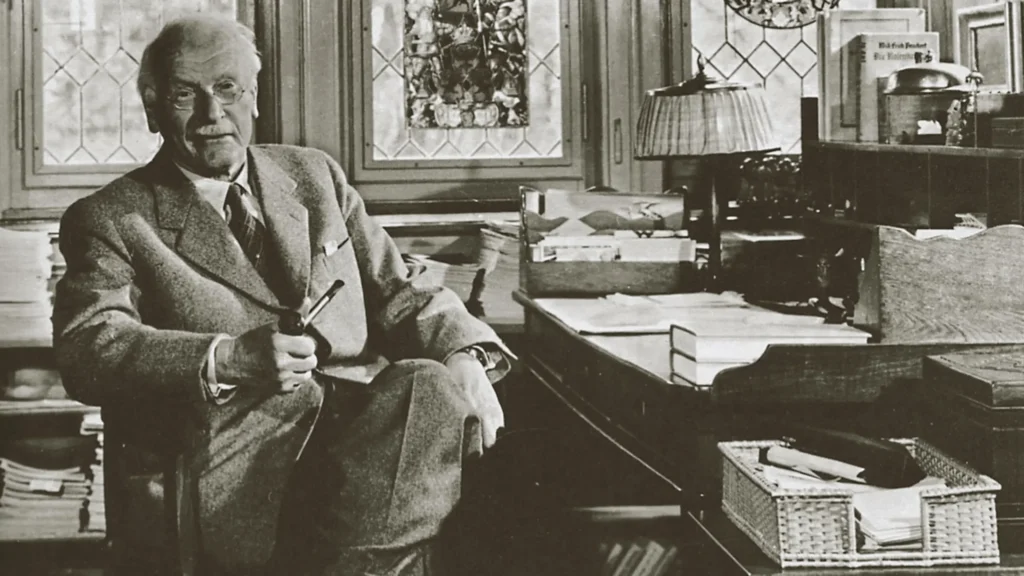
You have been told, at some point in your life, that the goal is to become whole. A therapist said it, or a book said it, or you said it to yourself in the language you had borrowed from somewhere you could no longer identify. The word integration was used. The idea was that the scattered, contradictory parts of you could be gathered, named, and reconciled into something coherent — a self that finally held together. This promise has become one of the most durable pieces of therapeutic furniture in Western culture, and its genealogy is almost always traced back to Carl Gustav Jung.
The attribution is a falsification so complete it borders on irony. What Jung actually produced during the years he spent composing the Liber Novus — that manuscript of nearly 600 handwritten pages, painted and illuminated in a medieval style, begun in 1914 and never publicly released during his lifetime — is not a document of wholeness achieved. It is a record of irreconcilability endured. The figures he encountered in what he called his confrontation with the unconscious did not dissolve into him. They argued. They refused. They contradicted not only each other but every framework he brought to contain them.
Philemon is the clearest evidence of this. Jung describes the figure — winged, ancient, carrying the horns of a bull — as a presence with an autonomous mind, one that held opinions he had not thought and would not have arrived at on his own. In the Liber Novus, Jung writes that Philemon taught him psychic objectivity, the fact that there are things in the psyche which I do not produce, but which produce themselves and have their own life. This is not the language of integration. It is the language of cohabitation with something that will not be absorbed. The self Jung was navigating was not converging. It was multiplying.
The theological crisis running through the Red Book is equally resistant to any reading that tidies it into a psychology of growth. Jung’s encounter with what he calls the God who is not good, the figure of Abraxas who contains both divine and demonic in a single force, is not resolved. Abraxas — drawn from Gnostic cosmology and described in the Seven Sermons to the Dead, the text Jung embedded within the Liber Novus — represents a deity that exceeds moral categories entirely. This is not a symbolic staging post on the way to equilibrium. It is a genuine theological rupture, one that the text never seals. Jung does not come out the other side of this encounter believing in integration. He comes out believing that the psyche contains forces that will tear you apart if you mistake their negotiability for their nature.
Sonu Shamdasani, who edited the 2009 edition of the Red Book published by W. W. Norton, spent decades establishing the manuscript’s historical and intellectual context. His commentary makes clear that what Jung was performing in those pages was not a method. It was a crisis that generated a method only later, in retrospect, when it was translated into the theoretical language of analytical psychology and made teachable. The original text precedes its own interpretation. And in that unprocessed form, it shows a man who is not becoming whole but learning to speak to parts of himself that will never merge with the rest.
The cultural myth of the integrated self is not innocent. It reframes an unending negotiation as a destination, which means it installs failure as the permanent condition of anyone who cannot arrive. It turns the psyche’s actual structure — plural, contested, non-convergent — into evidence of personal inadequacy rather than into the ordinary texture of inner life. What Jung actually encountered in those years of descent was not integration waiting to happen. It was the discovery that the self is a room in which multiple presences live, and none of them agreed to be there.
What Philemon Was Actually Saying
You are sitting across from someone who knows more than you do. Not more facts — more about you. They have watched you for years without your permission, catalogued the evasions you dressed as decisions, and they are now speaking with a patience that unsettles you precisely because it carries no need for your approval. The discomfort you feel is not metaphorical. It is the specific vertigo of encountering intelligence that did not arrive through the channels you trust.
Carl Jung encountered this vertigo in 1913 when a figure he would call Philemon began appearing in his visions and, later, in the painted pages of what became the Liber Novus. Philemon had the wings of a kingfisher, the horns of a bull, and the philosophical bearing of a man who had been thinking longer than Jung had been alive. Jung was not a naive man — he was by then a trained psychiatrist, a published theorist, a former intimate of Freud — and yet he recorded something that most intellectual biographies quietly minimize: Philemon taught him things he did not know. Not things he had forgotten. Not repressed material surfacing. Things he had never thought, expressed in formulations he could not have produced alone.
James Hillman, writing in Re-Visioning Psychology in 1975, took this seriously in a way that academic psychology largely refused to. Hillman argued that the psyche is fundamentally polytheistic — populated by autonomous figures with their own intelligences, their own agendas, their own rhetorical styles — and that the monotheism of the ego, its insistence on being the sole author of mental life, is not a sign of psychological health but of psychological imperialism. The figure that speaks from within you and says something you did not intend to think is not a symptom. It is a fact about the structure of mind that the Cartesian tradition has spent four centuries trying to administrative away.
The problem Philemon poses is not mystical but epistemological. If the unconscious can produce a figure more coherent, more nuanced, more honestly diagnostic than the conscious personality, then the hierarchy we have built — rational ego above, chaotic depths below — is not a description of how the mind works. It is a political arrangement, one that concentrates interpretive authority in exactly the part of the self most invested in its own continuity. The ego is not neutral. It has a career to protect.
What Philemon was actually saying, across those painted pages, can be partially recovered in the translated Liber Novus published in 2009, and what emerges is not comfort. He tells Jung that thoughts are not possessed by the thinker — that thoughts walk through human beings the way weather moves through a landscape. The thinker does not generate the thought; the thinker is the site where the thought occurs. This is either a description of unconscious cognition that anticipates later neuroscience by half a century, or it is the most destabilizing claim you can make about identity: that the voice you call your own is largely a residence, not a resident.
The person reading this has almost certainly had the experience of saying something they did not plan to say, writing a sentence that surprised them, waking from a dream carrying an answer to a problem their waking mind had declared unsolvable. They filed those experiences as anomalies. They kept building the curated self — the professional persona, the narrative of consistent values, the carefully maintained image of someone who knows what they think — and they treated the interruptions as noise rather than as the signal. Philemon is the name Jung gave to the interruption. What he could not give it was a place in any existing epistemology, because every existing epistemology had been built specifically to prevent that interruption from counting as knowledge.
The question is not whether your interior voices are real. The question is why you decided, and when, that your public identity was more trustworthy than what they tell you.
The Red Book as Theological Heresy
You are sitting in a church you stopped believing in years ago, attending a funeral for someone you loved, and the priest is speaking with absolute authority about a God who watches, judges, and decides. You feel the weight of that architecture pressing down — the verticality of it, the deliberate engineering of smallness. Every stone is a theological argument. Every upward angle insists on the same thing: the divine looks down, and you look up.
Jung did not write the Red Book to comfort people who had left the church. He wrote it to detonate the structure of the ceiling itself. Between 1914 and 1930, in a private manuscript that would not be published until 2009 — nearly fifty years after his death in 1961 — he developed what can only be described as a theological counter-system, not as an abstract philosophy but as a direct report from experience. He had crossed into something, and what he found there did not confirm the God of Abraham. It replaced him with something stranger and more demanding.
The lineage he was entering, whether consciously or not, is one of the most persecuted in Western intellectual history. Meister Eckhart, the fourteenth-century Dominican mystic, came so close to the same inversion that the papal bull In agro dominico condemned twenty-eight of his propositions in 1329, one year after his death. Eckhart had argued that the soul and God share a ground — the Seelenfunklein, the spark of the soul — that precedes all distinction between creator and created. The Church understood immediately what this meant: if the divine ground and the human ground are continuous, then moral authority cannot flow in one direction only. The entire hierarchy of sin, judgment, and intercession depends on an absolute asymmetry between God and humanity. Eckhart’s proposition collapsed that asymmetry. The Church condemned it with the specific alarm of an institution that had recognized an existential threat.
What Jung wrote in the Red Book goes further. In a passage from Liber Secundus, he renders a vision in which the figure of God appears not as omniscient sovereign but as something incomplete, something that requires the consciousness of human beings to actualize itself. The divine, in Jung’s account, is not finished. It becomes through the encounter with the human psyche. This is not metaphor. Jung is making a cosmological claim: God needs man to become conscious. The moral implications are seismic. If God is not already complete, then obedience to a perfect divine will is not submission to something higher — it is submission to an illusion of completeness that serves institutional power and nothing else.
This argument has a precise genealogy in Gnostic cosmology, where the Demiurge — the creator God of the material world — is not the highest principle but a flawed and often ignorant emanation of a deeper, unknowable pleroma. The Gnostic texts recovered at Nag Hammadi in 1945 show a tradition stretching back to the second century in which the God who issues commandments is not the God who transcends them. Jung had read deeply in this tradition; his 1916 text Septem Sermones ad Mortuos, written under the pseudonym Basilides of Alexandria — a second-century Gnostic teacher — is explicit evidence of how seriously he took this cosmology as a living rather than historical framework.
The suppression of the Red Book for nearly a century after its composition was not accidental negligence. Jung himself locked it away. The manuscript passed through his estate under conditions of deliberate restriction. What he had written was not merely heterodox — it was structurally incompatible with any institutional religion that requires a fixed divine authority above human experience. To publish it was to publish the evidence that the most significant psychological mind of the twentieth century had looked directly into the foundations of Western moral order and found something other than what the architecture promised.
A vision curated by a filmmaker, not an algorithm
In this video I explain our vision
The Social Contract Against Depth

You have probably been in a meeting where someone said exactly what they were supposed to say, in exactly the tone that was expected, and received exactly the approval that was offered in advance — and for a brief, uncomfortable moment you watched the whole performance from outside it, the way you might watch actors who don’t know the cameras are still rolling. That fracture lasted perhaps two seconds before you snapped back into your own role and forgot it entirely.
Erving Goffman spent an entire career examining what happens in those two seconds and what it costs to close them. In The Presentation of Self in Everyday Life, published in 1959, he argued that social interaction is not communication between persons but performance between roles — that the self we bring to any given situation is assembled for that situation, calibrated to its demands, and dismantled the moment the curtain drops. What Goffman called the “front stage” is where we are legible, predictable, and safe for others to be around. The “back stage” is where the performance relaxes. But what he left unexamined, perhaps deliberately, is whether there exists any region further inward than the back stage — a room behind the room, where no performance has ever been rehearsed because no audience has ever been expected there.
That is precisely the room Jung entered in 1913, and the Red Book is the record of what he found. The dialogues he conducted with interior figures — with the spirit he named Elijah, with the feminine presence he called Salome, with the voice he would eventually term Philemon — were not hallucinations he indulged but structured confrontations he refused to walk away from. The dramatic logic of the Red Book is insistent: every figure who appears must be allowed to speak fully, must be answered rather than dismissed, and must be permitted to disturb. This is not a therapeutic protocol. It is the exact opposite of Goffman’s front stage, which operates on the principle that disturbance must be managed before it reaches the audience.
Modern institutional life — the office, the school, the clinical consultation room, the family dinner — is not accidentally organized this way. It is systematically organized this way. The sociologist Richard Sennett, in The Fall of Public Man published in 1977, traced how the collapse of formal public roles in the nineteenth century pushed personality itself into the foreground, making every individual responsible for projecting a coherent self at all times. What looked like liberation from rigid social theater was actually the internalization of that theater. The performance became continuous because there was no longer a designated stage — only performers who had forgotten they were performing.
This is the context in which the Red Book is genuinely dangerous. Not because it describes madness, but because it describes an interruption of the performance so total that the performer himself disappears for extended periods — and then returns, changed, and begins rewriting what the performance was for. A culture that has made seamless self-presentation into a survival skill cannot afford for many people to do this. The institutions that organize daily life — including the institutions of mental health, which arrived precisely during the decades the Red Book was being written — carry an implicit mandate to return the disrupted person to functional legibility as quickly as possible. The diagnosis is not wrong, exactly. It simply has a different goal than the one Jung was pursuing.
What the Red Book insists upon is that the encounter with what lies beneath the performance is not a pathology to be treated but a necessity that has been mistaken for one. The mistake is structural. It serves too many interests to be accidental. Goffman’s front stage does not merely organize our appearances — it organizes our sense of what is real, and what lies outside its boundaries begins to look like disorder simply because it has never been given a form the audience could recognize.
Calligraphy, Illumination, and the Politics of Form
You open a book and the form tells you what kind of knowledge you are allowed to receive. This is not a metaphor. The codex, the footnote, the numbered section, the abstract at the top of a scientific paper — each of these is a technology of epistemological gatekeeping, a way of signaling which thoughts are permitted to count as serious and which belong to the embarrassing register of the personal, the irrational, the pre-modern. Jung understood this with a precision that most of his critics have never granted him credit for, which is why the Liber Novus is not simply unusual in content but structurally adversarial in its very materiality.
Walter Ong, writing in Orality and Literacy in 1982, made the point that technologies of the word do not merely transmit thought but restructure it at the root. Print culture, he argued, produces a particular kind of mind: sequential, detached, analytical, oriented toward the fixity of the text as an authoritative object independent of speaker and listener. The manuscript tradition that preceded Gutenberg operated by different cognitive laws — it was closer to voice, to breath, to the living presence of the hand. When Jung chose to inscribe the Liber Novus in a calligraphic gothic script modeled on medieval illuminated codices, spending roughly sixteen years on its physical production between 1914 and 1930, he was not performing nostalgia. He was refusing to allow the content to be processed by the epistemological machinery that print had normalized.
The illuminated borders, the dense red ink of the running titles, the gold leaf, the interlacing of zoomorphic figures drawn from Celtic and Byzantine traditions — none of this is decoration in the sense that a dust jacket is decoration. In the medieval manuscript, the image and the word were not hierarchically separated. The marginalia were not marginal. The body of the text breathed with figures that commentary culture, post-Enlightenment, would exile to the category of illustration, the merely ornamental. By reinstating that visual density, Jung was insisting that the unconscious cannot be known through a form that has already decided what counts as knowledge before a single sentence is read.
This has an implication that goes beyond aesthetics and into something closer to epistemological politics. The scientific paper of the early twentieth century, the format in which Jung himself published works like The Psychology of Dementia Praecox in 1907, carries within its structure a set of implicit commitments: reproducibility, third-person authority, the suppression of the author’s body and affect, the citation apparatus that anchors each claim to a chain of prior claims. To write in that form is to agree in advance that only what can survive that apparatus is real. The Liber Novus violates every one of these commitments at the level of its physical existence. It cannot be reproduced without transformation. Its authority is radically first-person. The author’s hand is everywhere visible, trembling slightly in some passages, pressing harder in others, a physiological record that print erases entirely.
There is a man transcribing his own dissolution in a script that takes hours per page, that demands stillness of hand even when the content demands the opposite of stillness. The act of that slowness is itself an argument. When you are forced to form each letter with a brush rather than a pen, when the medium resists haste, you cannot write reactively. You are compelled to dwell inside each word before it is committed. The form enforces a kind of attention that the typewriter, which had already colonized Western intellectual production by 1914, structurally prohibits. Nietzsche said that his writing instrument participated in the formation of his thoughts — he noticed the difference in his prose after moving to a typewriter in 1882. Jung took this logic to its extreme conclusion and built a writing technology designed to slow cognition to the speed of the image rather than accelerate the image to the speed of argument.
What you cannot write quickly, you cannot dismiss quickly either.
The Question the Red Book Cannot Answer
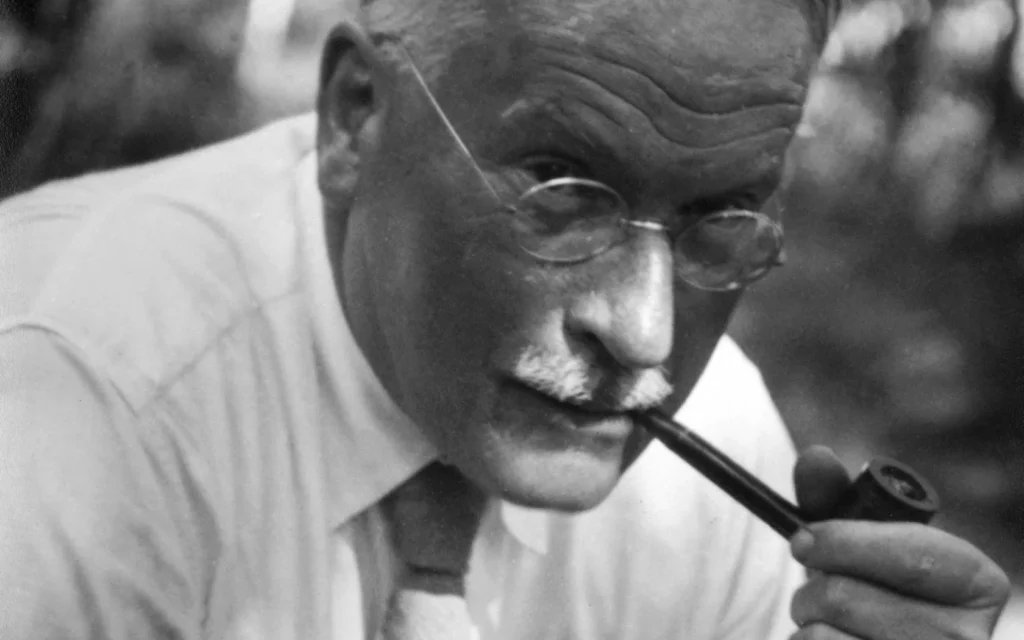
You sit with the book open in your lap — not the Red Book itself, which weighs seven kilograms and costs more than most people’s rent, but a reproduction, a facsimile, the shadow of a shadow — and you notice that the images are genuinely beautiful, and you notice that you cannot tell whether that beauty is evidence of something or merely the successful output of an exceptionally gifted mind in prolonged distress.
That uncertainty is not incidental. It is the hinge on which everything turns.
Jung believed that what he encountered during those years of deliberate psychological descent was real in a meaningful sense — not real as a chair is real, but real as a force capable of reshaping a life, restructuring personality, generating knowledge that could not have been arrived at by conscious intention alone. He called this process active imagination, and he distinguished it carefully from fantasy, from mere daydreaming, from the passive drift of an unanchored mind. The distinction mattered enormously to him because without it the entire architecture of analytical psychology collapses into autobiography. If the unconscious is only producing what the ego already wants to hear, arranged in dramatic costume, then Philemon is not a guide. He is a puppet.
Adolf Grünbaum pressed exactly this nerve in 1984 in The Foundations of Psychoanalysis, a work of analytic philosophy that applied rigorous epistemological pressure to the entire tradition from which Jung emerged and to which he remained, despite his protests, attached. Grünbaum’s central argument was that psychoanalytic interpretation lacks what he called tally correspondence — the verified alignment between the analyst’s constructions and the patient’s actual psychological history. The interpretations feel illuminating. They achieve narrative coherence. They produce what feels like recognition. But feeling recognized is not the same as being correctly described, and the clinical setting, far from neutralizing this problem, actively amplifies it. The analyst’s theoretical commitments shape what the patient produces, which then appears to confirm those commitments. The circle is not vicious by accident. It is vicious by design.
Jung was not a psychoanalyst in Freud’s clinical sense, and the Red Book is not a case history. But Grünbaum’s epistemological problem does not respect that boundary. When Jung descends into the imaginal space and encounters figures who instruct him, correct him, refuse his interpretations, and occasionally frighten him, the question of contamination does not disappear. It sharpens. Because Jung is simultaneously the experimenter and the experimental material, the interpreter and the interpreted, the one who constructs the method and the one the method is applied to. There is no external check. There is no tally. There is only the experience, and then the story told about the experience, and then the theoretical system built to justify the story.
What makes this so uncomfortable is that none of it necessarily means the Red Book is worthless. Some of the most durable insights in human history arrived through methods that would fail any rigorous epistemological audit. The problem is that the same structural features that allowed genuine discovery also allow elaborate confabulation, and from the inside the two processes feel identical. A man in a visionary state who encounters a figure of ancient wisdom and receives instruction that changes the course of his life cannot determine, from within that encounter, whether he is touching something that exceeds him or whether he is constructing the most persuasive possible version of what he already believed.
The Red Book does not resolve this. It cannot. Its entire method depends on suspending the question long enough to allow the images to speak, and once you allow them to speak, you have already conceded the terrain on which the epistemological battle would have been fought. Jung knew the objection. He simply decided, at some point in those sixteen years, that the risk of dismissing the experience was greater than the risk of being deceived by it.
Whether that was wisdom or a very sophisticated capitulation is a question the book leaves entirely, and perhaps deliberately, open.
🌀 Depths of the Psyche: Jung and the Inner Labyrinth
Jung’s Red Book is one of the most extraordinary documents of psychological self-exploration ever produced, a visionary journey through the unconscious that reshaped modern thought. These related articles illuminate the wider landscape of depth psychology, spiritual transformation, and the symbolic imagination that surrounds this monumental work.
Jungian Individuation and the Great Work
Jungian individuation lies at the very heart of the Red Book’s visionary project, representing Jung’s attempt to reconcile the conscious ego with the deeper forces of the psyche. This article explores how the alchemical Great Work served as a symbolic map for Jung’s understanding of psychological transformation and wholeness. Understanding this connection reveals why Jung turned to alchemy as the language most adequate to describe inner change.
GO TO THE SELECTION: Jungian Individuation and the Great Work
Jungian Alchemy: Jung and Alchemical Psychology
Jung’s engagement with alchemy was not merely scholarly curiosity but a profound recognition that alchemical symbolism mirrored the hidden processes of the unconscious mind. This article examines how Jung reinterpreted the ancient art as a psychological system, decoding the nigredo, albedo, and rubedo as stages of inner development. It provides essential context for understanding why alchemical imagery saturates the visions recorded in the Red Book.
GO TO THE SELECTION: Jungian Alchemy: Jung and Alchemical Psychology
The Hero’s Journey as Inner Transformation
The Hero’s Journey as a framework of inner transformation shares deep structural affinities with the descent into the unconscious that defines Jung’s Red Book. This article traces how mythological patterns of trial, death, and rebirth map onto the psychological process of individuation that Jung was living through during his years of creative illness. Reading this piece alongside the Red Book reveals how universal mythic structures informed Jung’s most personal and daring self-exploration.
GO TO THE SELECTION: The Hero’s Journey as Inner Transformation
Hesse’s Steppenwolf: Analysis
Hermann Hesse‘s Steppenwolf stands as one of the most vivid literary expressions of the Jungian inner conflict between the civilized persona and the raw, instinctual forces of the unconscious. Written in close dialogue with Jungian ideas and the cultural atmosphere that the Red Book itself helped to shape, the novel dramatizes the painful fragmentation and potential integration of the modern soul. This analysis offers a rich comparative lens through which to appreciate the literary and psychological dimensions of Jung’s own visionary narrative.
GO TO THE SELECTION: Hesse’s Steppenwolf: Analysis
Discover the Cinema of the Inner World on Indiecinema
If Jung’s descent into the unconscious and these explorations of inner transformation have stirred something in you, Indiecinema streaming is the place to continue the journey. Our curated selection of independent and art-house films dives deep into the psyche, the sacred, and the symbolic — the same territories that Jung charted in the Red Book. Join us and let cinema become your own gateway to the unconscious.
👉 EXPLORE THE CATALOG: Watch Indie Films in Streaming
A vision curated by a filmmaker, not an algorithm
In this video I explain our vision

