
The Puppet Who Believed He Was Alive
You are seven years old and someone is explaining to you, with great tenderness, what a good boy looks like. He sits still. He listens. He does not interrupt. He eats what is placed before him and says thank you and means it, or at least performs meaning it convincingly enough that no one investigates further. You absorb this. You practice it. And somewhere in the cavity of your chest, something clicks into place like a latch — not a door opening, but a door closing — and you begin the long career of becoming the person the room requires. Nobody called it obedience. They called it growing up.

Carlo Collodi published his story serially in an Italian children’s newspaper between 1881 and 1883, initially killing off the puppet in chapter fifteen, hanging him from a tree as straightforward punishment for disobedience. The editors demanded a continuation. Collodi complied, and in that editorial act of resurrection something stranger than a children’s story emerged — a text that would spend the next century being systematically misread as a moral fable about the virtue of compliance, when its actual architecture encodes something far more disturbing about the nature of consciousness, identity, and what societies demand you sacrifice in order to be recognized as real.
The wooden puppet who wants to become a real boy is one of the most disquieting premises in Western narrative precisely because most readers never pause on the word “real.” They assume they understand it. They assume it means flesh, warmth, biological continuity. But Collodi’s Italian is specific: Pinocchio wants to become un bambino per bene — a well-behaved child, a proper child, a child of good standing. The transformation being promised is not metaphysical. It is social. What the Blue Fairy offers is not humanity. It is legibility within a moral order that was already constructed before Pinocchio arrived and will persist long after he is gone.
Carl Gustav Jung spent considerable energy in his later work tracing the structures by which cultures manufacture what he called the persona — the mask the individual constructs to interface with collective expectations, described at length in the 1928 essay “The Relations Between the Ego and the Unconscious.” The persona is not deception, exactly. It is adaptation. But Jung’s uncomfortable observation was that people routinely confuse the mask for the face, and that this confusion does not happen by accident. It is encouraged, rewarded, and enforced by every institution that benefits from a population incapable of distinguishing its performed self from its actual one. The puppet who believes he is alive is not a metaphor for naivety. He is a precise diagram of what successful socialization produces.
What makes Collodi’s text resistant to simple moralization is that Pinocchio is, in every chapter before his transformation, more vivid than he is in the final one. His hunger is more real. His fear is more real. His grief when he loses Geppetto is more real than any virtue he displays once he has been granted the status he was promised. The rewards of compliance arrive precisely when the character becomes least interesting, least present, least himself — and this is not a flaw in the narrative. It is the narrative’s actual argument, visible only to a reader willing to sit with the discomfort of recognizing that the happy ending is the tragedy.
There is a theology embedded in this structure that predates Collodi by centuries, one that runs through Gnostic cosmology, through the Kabbalistic concept of the golem, through Romantic-era anxieties about automata and galvanism. The question of what separates a constructed being from an authentic one is never purely philosophical. It is always also political, always also about who holds the authority to declare a being real and on what grounds they have been permitted to claim that authority.
The Kempinsky Method

Drama, by Federico Salsano, Italy 2020.
The introspective imaginary road movie of a man in the maze of his own mind, his memories of his youth, his never dormant passions and contradictory truths. The road is made of water, the destination is falsely unknown. His traveling companions are three mysterious men, projections of his imagination and of different aspects of his personality: the perennial melancholy, the crazy creative, the introverted child. He is also followed by a female presence that tells the umpteenth human story. At a certain point of the crossing he decides to abandon the boat and his ghosts of him diving into the sea and arrives swimming on a deserted beach, naked, with a small Pinocchio puppet closed by a padlock.
In this splendid film life is like a long sea voyage and the human being is a small creature confronting immensity. Sometimes the ocean is calm, other times there are terrible storms. Sometimes we are captains of a boat with a well-defined route, other times we are shipwrecked in search of a land in which to save ourselves. But despite the long journey and the movement in physical space, there are other questions that resonate in the mind: who are these men I travel with? What is the mystery of this immense mass of water that seems to be made of my memories? You can circumnavigate the whole world but the main question always remains the same: who am I really?
LANGUAGE: italian
SUBTITLES: english, spanish, portuguese, german, french
Collodi’s Dark Diagnosis
You are eight years old and you have just watched a wooden puppet get hanged by the neck until dead, swinging from the branches of the Great Oak, the killers vanishing into the dark without a word of explanation. This is not a nightmare. This is the ending Carlo Collodi wrote for his story when it first appeared in the Giornale per i Bambini in 1881, before reader outcry forced him to continue and eventually, reluctantly, provide the resurrection that transformed execution into adventure. The original death was not an accident of narrative carelessness. It was the point.
Collodi was writing in a unified Italy that was less than two decades old, a country stitching together incompatible regions under the pressure of a modernizing bourgeois project that needed, above all else, docile labor. The 1877 Coppino Law had made elementary education compulsory, not because childhood was suddenly considered sacred, but because the industrial economy required literate workers who could follow instructions. The child reading Collodi’s story was being prepared for a social function, and Collodi, a journalist and satirist who had spent years translating French fairy tales and watching the political theater of Risorgimento idealism collapse into bureaucratic mediocrity, understood this preparation with cold clarity. His puppet is not a metaphor for innocence seeking wisdom. He is a piece of raw material being processed into usefulness.
What makes the original text so structurally uncomfortable is its punishment logic, which operates without proportion or mercy. Pinocchio is beaten, starved, nearly fried in a pan, imprisoned, transformed into a donkey worked to death, swallowed by a sea monster, and subjected to repeated near-executions, all for the crime of preferring pleasure to obligation. The violence is pedagogical in the strictest sense: it exists to instill, through sheer accumulated terror, the understanding that deviation from the prescribed path carries mortal consequences. Michel Foucault‘s analysis in Discipline and Punish of how early modern institutions converted spectacular bodily punishment into internalized self-regulation finds in Collodi’s text a precise literary parallel, except that Collodi makes no attempt to disguise the coercive mechanism behind rehabilitation rhetoric. The puppet suffers openly, visibly, and the reader is meant to feel that suffering as a warning aimed at their own body.
The Disney adaptation of 1940 did not simply soften this. It performed an ideological inversion. It replaced class terror with individual moral failure, reframing Pinocchio’s suffering as the natural consequence of personal weakness rather than social control. Jiminy Cricket, that cheerful externalized conscience, transforms the story’s entire architecture: now the puppet has a guide, a helper, a friend who represents internalized bourgeois virtue offering itself as a companion rather than a warden. The brutality of Collodi’s world, where no adult is trustworthy and every institution from school to courtroom to prison is a trap, becomes in the Disney version a series of avoidable mistakes made by a naive but fundamentally good-hearted child. The horror is aestheticized into whimsy, the mortality stakes dissolved into sentimentality, and the class diagnosis replaced with a fairy tale about wishing upon stars.
This replacement matters because the original text’s darkness was not cruelty for its own sake but precision. Collodi was documenting what socialization under industrial capitalism actually demanded of children born without property: the total surrender of autonomous desire, the complete subordination of the body’s appetites to the rhythms of productive labor, ratified by the threat of physical destruction if refused. The Talking Cricket, the figure Disney would eventually transform into Jiminy, appears in the original text only briefly. Pinocchio kills him with a hammer almost immediately, and the cricket’s ghost haunts the story as a warning, not a guide. The conscience does not accompany the child through the world offering advice. It is murdered at the beginning and returns as a specter of everything the child chose to destroy in himself in order to survive.

The Wooden Condition as Ontological State
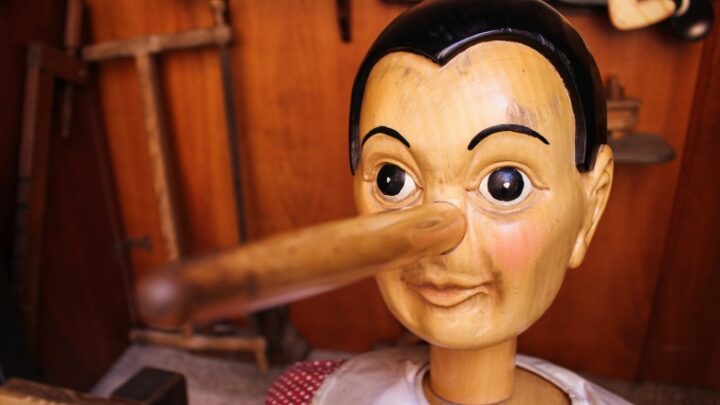
You are sitting in a meeting you did not choose, agreeing with conclusions you do not hold, nodding at the precise rhythm the room demands. Your face arranges itself. Your hands stay still. Somewhere in the architecture of your compliance, there is a craftsman’s satisfaction — the joins are tight, the surface is smooth, and nothing betrays the hollow interior.
Wood does not choose its grain. It receives the tool, accepts the shape imposed, holds the form because it has no alternative. When Carlo Collodi first published his story in installments beginning in 1881, the puppet he described was not a child longing to become real — he was a condition accurately named. The wooden boy is not a symbol of innocence waiting to mature. He is a portrait of a self that has been entirely organized from the outside, whose every gesture originates in a hand that is not his own, and who does not yet register the difference between being moved and moving.
Erich Fromm, writing in 1941 with the specific horror of European fascism still assembling itself into its final form, argued in Escape from Freedom that the most dangerous human tendency is not cruelty but surrender. Not the willingness to harm others, but the willingness to dissolve the self into a structure that relieves the individual of the unbearable weight of autonomous existence. What Fromm called automaton conformity is not cowardice in any simple moral sense. It is a rational response to a genuine terror: the terror of being a separate self in a world that does not guarantee your significance. The wooden condition is precisely this — not stupidity, not malice, but the strategic abandonment of interiority as a form of protection.
The strings are the part everyone notices, but the strings are almost incidental. What matters is the prior condition they exploit: the absence of any internalized center of gravity that could resist them. A puppet does not require strings to be controlled — it requires only the prior evacuation of autonomous will. By the time the strings appear, the real work is already done. This is what makes Fromm’s analysis so structurally precise when placed alongside the puppet: the mechanism of control is secondary to the psychological formation that makes control welcome. People do not fall into conformity because they are weak. They fall into it because the self, in its full exposed particularity, is genuinely terrifying to inhabit.
What has never been adequately addressed in the cultural reception of this story is why wood specifically carries this weight. Stone would suggest permanence and resistance. Metal would suggest rigidity without vulnerability. But wood is organic matter that has been stopped — it was once alive, it carried sap and responded to seasons, and now it holds a shape imposed at the moment of its killing. There is a precision in that image that no other material provides. The wooden creature is not alien to life; it is life that has been interrupted and redirected by an external will before it could determine its own form. This is not metaphor — it is biological fact repurposed as philosophical argument.
The philosopher Charles Taylor, in his 1989 work Sources of the Self, located the crisis of modern identity in the collapse of what he called moral frameworks — the background structures that once gave individuals a sense of orientation in a meaningful universe. Without such frameworks, the self faces what Taylor described as a kind of vertiginous freedom, a groundlessness that generates not liberation but panic. What Collodi’s puppet embodies, before any transformation begins, is a self that has already solved this problem by refusing it entirely — by accepting the craftsman’s framework as its own nature, by treating the imposed shape as identity, by becoming, in every functional sense, content with wood.
The question that follows from this is not whether the puppet wants to become real. The question is whether wanting, in any genuine sense, was ever available to him in the first place — and whether the same question applies to the person nodding in that meeting, whose hands are still.
Gepetto and the Architecture of Manufactured Desire
You are given a wooden toy for your birthday, not because you asked for it, but because someone needed to give it. Watch the moment carefully: the giver’s face as you unwrap it, the hunger in their eyes for your reaction, the way their satisfaction depends entirely on your performance of delight. The gift was never about you. It was a projection wearing the costume of generosity.
Gepetto carves Pinocchio in a room full of clocks he cannot sell, in a poverty that has eaten his ambitions down to splinters. The figure he creates is not born from surplus love but from deficit — from a man who wanted a son because a son would make him, retroactively, a father. This distinction matters enormously. René Girard spent decades arguing, most rigorously in Deceit, Desire, and the Novel published in 1961, that human desire is almost never spontaneous or original. We do not want things because they are intrinsically valuable. We want things because someone else wants them, or because someone else has modeled wanting them for us. The mediator of desire is always a third figure, often disguised as love, tradition, or gift.
Gepetto is that mediator. When he wishes upon the star, he is not performing an act of selfless longing for another being’s flourishing. He is performing a desire for completion — the completion of his own interrupted narrative. The puppet, once animated, inherits not just life but a full curriculum of wants that were never assembled by the puppet himself. Go to school. Make me proud. Become a real boy. These imperatives arrive already dressed as the puppet’s own ambitions, but they carry the fingerprints of someone else’s grief.
What Girard identified as the scandal of mimetic desire is not that we imitate others — imitation is simply the mechanism by which culture transmits itself — but that we systematically deny the imitation. We insist on the originality of our desires. We defend them as personal, earned, chosen. The wooden child running toward school is already running toward a destination that was chosen before he could speak, and the tragedy is not that he obeys but that he genuinely believes he is free when he does. The moment he deviates, the moment Pleasure Island glitters more brightly than the schoolroom, every adult in his orbit frames the deviation as moral failure rather than as the first authentic gesture of a self that doesn’t yet exist.
This is the architecture the creator builds: not a house, but a set of walls that look like horizons. And this architecture is not unique to fairy tales. In 1979, the sociologist Richard Sennett described in The Fall of Public Man how modern intimate life had become saturated with the demand that private relationships carry the entire weight of meaning — that the people closest to us fulfill not just emotional needs but ontological ones. Gepetto is the logical endpoint of this demand: a man so hollowed by loneliness and frustrated ambition that he requires a creature made entirely of his desire to mirror him back to himself. The puppet is not his child. The puppet is his autobiography, written in wood, sent out into the world to vindicate a life.
There is something almost unbearable in recognizing how ordinary this is. Every classroom contains children who are narrating a story their parents began. Every marriage contains one person performing a desire that was installed in them by someone who died before the wedding. The mechanism doesn’t require malice. It doesn’t even require awareness. It requires only a creator who is incomplete, and the human compulsion to externalize that incompleteness into something that breathes, something that can succeed where the self has failed, something that can go out into the world and bring back proof that the original longing was worth having.
The Blue Fairy’s Conditional Grace
You are standing in a room where someone who claims to love you is watching everything you do. She is luminous, patient, and entirely unmoved by your suffering until you demonstrate the correct response to it. She does not punish you with cruelty. She withholds warmth until the behavior conforms, and then she opens like a door, and you feel chosen, and the feeling is so overwhelming that you never once question what you had to do to earn it.
The Blue Fairy in Collodi’s 1883 novel is not a mother, not a goddess, not even a protector in any stable sense. She is a mechanism. Her beauty is the aesthetic face of a conditional architecture: grace extended not as gift but as incentive structure, withdrawn not as cruelty but as calibration. She does not transform Pinocchio because he suffers. She transforms him when he passes the test, when the lying stops, when the disobedience converts into something legible and socially manageable. The magic is real, but it is also a salary paid to a worker who has finally learned to punch the clock correctly.
Michel Foucault, writing in 1975, described how modern institutions ceased to rely on spectacular punishment — the public torture, the broken body on display — and instead refined something far more efficient: the internalization of the watching eye. In Discipline and Punish, he traces how the prison model colonized the school, the hospital, the factory, producing subjects who regulate themselves not because they are afraid of being caught but because they have forgotten there was ever a self that existed before the watching began. The Blue Fairy does not need a whip. She needs only to be luminous and conditional, because the child — the reader, the real target — will do the rest of the work alone, monitoring his own deviation and correcting it before she ever has to notice.
What makes this particular dispensation so durable is that it arrives dressed as love. Not the cold administrative love of an institution, but something that feels personal, chosen, maternal. Pinocchio does not experience the Fairy’s system as control. He experiences it as the desperate hope of being loved unconditionally by an entity that is, structurally, incapable of loving him that way. Every elongated nose, every donkey ear, every failed promise is not evidence of his wickedness — it is evidence of the gap between who he is and who the system needs him to become. The guilt is a feature, not a malfunction.
Sociologist Nikolas Rose, building decades after Foucault in Governing the Soul (1989), identified how modern psychological culture transferred this architecture inward, making self-optimization feel like freedom. The child who wants to be a real boy, who weeps at his own failures, who tries harder after each punishment — this child is not rebelling against the system. He has become its most devoted agent. His shame is the surveillance that never sleeps, the Blue Fairy he carries inside himself long after she has left the room.
There is something worth sitting with in the fact that she is blue. Not red, not gold, not the warm colors of earthly appetite and human mess. Blue is the color of distance, of sky, of the space between you and what you want. She is always slightly unreachable, which is precisely her function. A goddess you could fully possess would have no leverage. Her partial distance, her approachability-in-principle, is what keeps the subject moving, reforming, hoping. The economy of conditional grace requires that full acceptance always remain just one more transformation away — and that you believe, each time, that this transformation will finally be the last one.
The nose that grows when Pinocchio lies is usually read as a metaphor for truth. But the body that betrays you involuntarily, that signals your inner deviation to the one who holds the power of reward — that is not a lesson about honesty. That is a body under observation that has learned to report on itself.
A vision curated by a filmmaker, not an algorithm
In this video I explain our vision
Pleasure Island and the Abolition of Interiority

You arrive somewhere that has no rules, and for a moment your body believes it. The rides are lit, the candy is free, the boys around you are already drunk on the permission of it all. Nothing is forbidden here because nothing has to be — the architecture of the place has already done the work. You reach for what you want before you even know you want it, and that speed, that frictionless immediacy between impulse and satisfaction, is not liberation. It is the most elegant cage ever constructed.
Collodi published the original Pinocchio serially in the Giornale per i Bambini beginning in 1881, and the island he named the Land of Toys — Il paese dei balocchi — was already something more precise than a warning against laziness. It was a portrait of a social mechanism that would not have a name for another eighty years. Guy Debord, writing in 1967 in Society of the Spectacle, described a world in which lived experience had been replaced by its representation, in which human beings no longer inhabited their own desires but watched themselves desiring, consuming images of fulfillment rather than fulfillment itself. The terrifying accuracy of Pleasure Island is that it does not offer Pinocchio false pleasure. It offers him real pleasure in a container designed to make that pleasure destroy him. The distinction matters enormously, because most critiques of consumer culture get this wrong. The seduction works precisely because the candy is real candy.
What Debord understood, following a logic that Georg Lukács had already pressed against in History and Class Consciousness in 1923, is that reification — the transformation of human relations and inner life into things that can be exchanged, managed, and owned — does not announce itself. It arrives as convenience. The boys on Pleasure Island are not being lied to about the rides or the tobacco or the pool tables. They are being systematically dispossessed of the one thing that makes a self a self: the experience of wanting something you do not yet have, of sitting with that wanting long enough to learn what it actually is. Instant gratification does not satisfy desire. It erases the conditions under which desire becomes self-knowledge.
The donkey transformation is where the narrative stops being allegory and becomes diagnosis. The boys do not become donkeys because they were bad. They become donkeys because they stopped being interiors. They became pure appetite, pure reaction, pure surface — and the market for that, it turns out, is robust. Someone is waiting to buy exactly that kind of creature. Coachman Volpe does not corrupt these boys; he simply harvests what the environment has already produced. This is the structure that sociologist Zygmunt Bauman would later identify in Consuming Life, published in 2007, as the logic of liquid modernity: the human being reconstituted as a commodity, valuable insofar as they generate demand, disposable once the cycle completes.
What makes Pleasure Island specifically devastating as a symbol is its voluntary architecture. No one forced anyone through the gate. The most effective systems of control have always understood that coercion is expensive and unstable, while desire is cheap and self-renewing. When you make the cage look like freedom, you do not need guards. You need only to keep the rides running, the music loud enough that no one hears their own thoughts, the stimulation dense enough that the question of who you are never quite forms into words. The interiority that is abolished on Pleasure Island is not destroyed violently. It is simply never given the silence it requires to exist.
Pinocchio escapes, but the text never explains how he still possesses the capacity to want to. That is the question Collodi leaves open like a wound — what survived in him that did not survive in the others, and whether the difference was moral, or merely accidental.
The Conscience as Installed Software
You are handed a conscience before you are old enough to refuse it. That is the first violence, and it arrives so early that most people spend the rest of their lives mistaking it for their own voice. Jiminy Cricket does not emerge from inside Pinocchio — he is appointed, assigned, dispatched from above by a figure of supernatural authority who decides, on behalf of a wooden boy who has not yet lived a single hour, that he will need monitoring. The gesture is presented as a gift. It always is.
Freud’s 1923 structural model, laid out in The Ego and the Id, described the superego not as wisdom but as sediment — the compacted residue of parental prohibitions, cultural mandates, and the threatening voice of figures who once held power over survival. The superego does not reason with you. It does not negotiate or explain. It condemns, shames, and surveils, often with a ferocity that has no proportion to the actual stakes of any given moment. What Collodi’s story stages so nakedly is the superego’s origin as something alien and installed: Jiminy Cricket is literally an external agent assigned to produce guilt in a being who, left alone, would simply act. The discomfort is not that Pinocchio disobeys. The discomfort is that the architecture of obedience is made visible, and visibility is what the whole system depends on suppressing.
Nietzsche, writing in 1887 in On the Genealogy of Morality, made the mechanism explicit in a way that neither psychology nor theology has fully recovered from. Conscience, he argued, is not humanity’s highest achievement but its most successful wound — the result of instincts that could no longer discharge outward turning inward and feeding on the self. The “bad conscience” is not a sign of moral development; it is the psychological scar tissue of a creature that has been broken to social constraint and then taught to call the breaking sacred. What Nietzsche identified as the creditor-debtor relationship at the root of guilt — the ancient logic in which suffering is extracted as repayment, in which pain becomes currency — maps with unnerving precision onto every scene in which Jiminy Cricket’s disapproval lands on Pinocchio like a verdict. The boy does not learn to think. He learns to feel bad, which is an entirely different and far more controllable outcome.
The deeper structural trick is that the installed monitor is made lovable. Jiminy Cricket is charming, small, comic, genuinely affectionate in his way — and this is not incidental. A threatening authority can be resisted. A beloved one colonizes the interior and rearranges the furniture while you’re distracted by the warmth. By the time the child who encounters this story is old enough to ask who gave anyone the right to appoint a conscience for someone else, the appointment has already succeeded. The question arrives too late, which is the point of making it arrive at all — the delayed critique becomes evidence of the system’s confidence in its own permanence.
What gets erased in this architecture is the distinction between ethics, which is something a being works out through contact with the actual consequences of living, and morality, which is a code transmitted from elsewhere and enforced through shame. Pinocchio is never given the first. He is subjected to the second from his first moment of animation, which means he spends the entire narrative not discovering what he values but performing recovery from deviation. The question he is never allowed to ask — what do I actually want, and is wanting it wrong — is precisely the question that a healthy moral life would need to begin with. Instead it is foreclosed, and a small cricket in a top hat is stationed at the threshold to make sure it stays that way. The tragedy is not that Pinocchio lies. It is that he is never once trusted with the truth of his own desires long enough to find out what he would do with them.
The Swallowed Self and the Monster Within
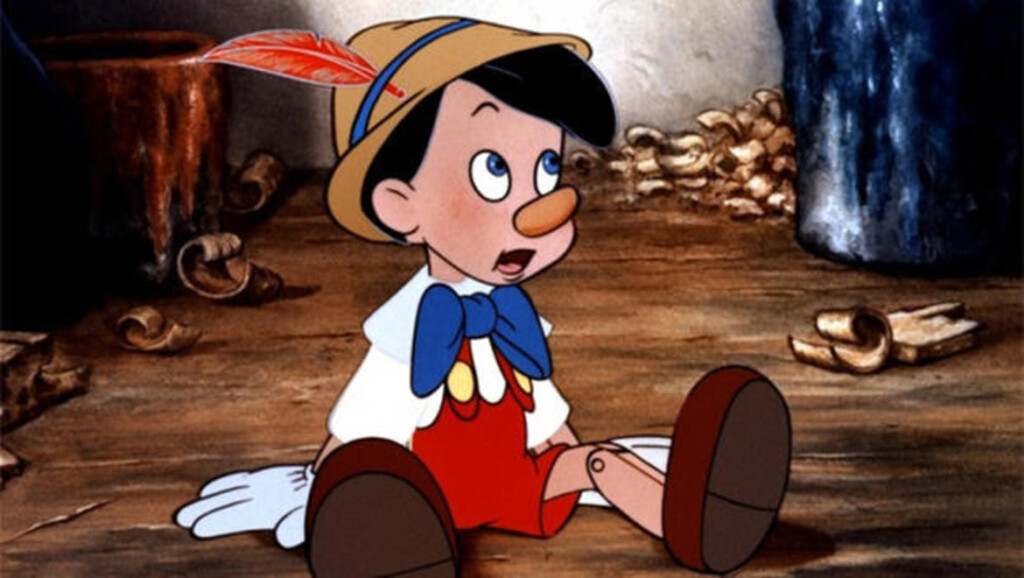
You are standing in the dark, somewhere between your ribcage and the bottom of the ocean, and you cannot tell which walls belong to you.
The belly of the whale has never been a punishment. Across mythologies so geographically distant they could not have borrowed from one another — the Jonah tradition of the Hebrew scriptures, the Maori figure of Māui pulled through the body of Hine-nui-te-pō, the Mesopotamian descent of Inanna through seven locked gates — the devouring interior is the precondition, not the obstacle. You do not arrive at transformation by avoiding consumption. You arrive by surviving it, which is an entirely different proposition than escaping it. Carl Gustav Jung, writing in Symbole der Wandlung in 1912, identified this mythic swallowing as the psyche’s most ancient diagram of itself: the monster that devours is always a projection of the interior life that the conscious self has refused to metabolize. The hero does not fight the creature from the outside. The hero is already inside it before the story knows what to call him.
What makes Collodi’s original 1883 text so disquieting at its core is that Geppetto is already inside the whale before Pinocchio chooses to enter. The father — the origin, the one who carved the self into being — has been swallowed by the consequence of the son’s own earlier abandonment. Pinocchio does not descend into Monstro out of obedience or out of instruction. He dives because there is no other move left, because every social performance has collapsed, because the accumulated architecture of false goodness — the coins buried in the Field of Miracles, the years at Pleasure Island, the puppet-theater ambitions — has produced nothing but deeper captivity. Jung would have recognized this precisely: the regression to the devouring mother-image is not a failure of will but a destruction of the false self sophisticated enough to have fooled the ego into calling it identity.
The fire is the crucial detail that most readings ignore. Inside Monstro, Pinocchio does not pray and does not wait. He builds a fire from the debris inside the whale’s belly — the wreckage of ships, the bones of swallowed things — and uses the smoke to force an involuntary opening. This is not a rescue. It is a provocation. The exit is achieved not by becoming good enough to be released but by making the interior environment so hostile to the devouring force that expulsion becomes its only option. There is a violent intelligence in that act that has nothing to do with the Blue Fairy’s morality lessons or the cricket’s ethical narration. It belongs to a register of action that is beyond reward and beyond the performance of virtue — it is the act of a self no longer interested in being witnessed.
And Pinocchio nearly dies in the water afterward. He washes ashore unconscious, and the transformation into a real boy happens not in triumph but in the grammar of aftermath, in the quiet of a body that has stopped straining toward an ideal. This is where the esoteric tradition has always placed the moment of genuine change — not in the achievement but in the exhaustion that follows the descent, the strange lightness that settles when the constructed self has finally burned through its own materials. The Rosicrucian alchemists called this the nigredo dissolving into something unnamed, the putrefaction that precedes any new form. It cannot be scheduled. It cannot be performed for an audience.
What Collodi understood — perhaps without a theoretical vocabulary for it, perhaps in the way that storytellers know things that precede their articulation — is that the real transformation is irreversible precisely because it is unwitnessed, because no one who matters is watching when the fire is lit in the dark, and because the self that surfaces afterward cannot remember exactly how it made the decision to burn everything it had left.
🌀 Symbols, Myths, and the Hidden Journey of the Soul
Pinocchio is far more than a children’s fable: it is a dense allegorical map of initiation, deception, and spiritual awakening. The articles gathered here explore the same symbolic and esoteric territory — from the labyrinthine structures of myth to the inner alchemy of transformation. Each text offers a key to reading the hidden language embedded in story, image, and ancient wisdom.
The Labyrinth of Knossos: History and Myth of the Minotaur
The Labyrinth of Knossos is one of the most powerful mythic structures in Western imagination, encoding themes of entrapment, trial, and heroic liberation that resonate deeply with Pinocchio’s wandering through temptation and illusion. Like the wooden puppet who must navigate a world of snares — the Fox, the Cat, Pleasure Island — Theseus must confront the monster at the center of the maze before achieving true selfhood. This article explores the labyrinth as a universal symbol of initiation and the death of the false self.
GO TO THE SELECTION: The Labyrinth of Knossos: History and Myth of the Minotaur
Spiritual Alchemy: Inner Transformation and Symbolism
Spiritual alchemy reads the transformation of base matter into gold as a metaphor for the purification of the soul — a process strikingly mirrored in Pinocchio’s journey from wooden puppet to real, conscious boy. The nigredo, albedo, and rubedo stages of the Great Work correspond eerily to Pinocchio’s descents into darkness, moments of remorse, and final moral resurrection. This article unpacks the symbolic language of inner transformation that underlies so many initiatory narratives in Western culture.
GO TO THE SELECTION: Spiritual Alchemy: Inner Transformation and Symbolism
The Hero’s Journey as Inner Transformation
Joseph Campbell‘s Hero’s Journey offers one of the most illuminating frameworks for understanding Pinocchio’s esoteric arc: the call to adventure, the road of trials, the descent into the belly of the whale — quite literally, in Collodi’s tale — and the return transformed. This article examines how the monomyth functions not merely as narrative structure but as a map of genuine inner metamorphosis. Reading Pinocchio through this lens reveals it as a profoundly initiatory text disguised as a children’s story.
GO TO THE SELECTION: The Hero’s Journey as Inner Transformation
Jungian Individuation and the Great Work
Carl Gustav Jung saw in alchemy a projection of the psyche’s own drive toward wholeness, a process he called individuation — and Pinocchio’s story follows this trajectory with uncanny precision, from unconscious puppet to self-aware human being. The Jungian shadow, the anima, and the wise old guide (Geppetto, the Blue Fairy) all appear in disguised form throughout Collodi’s narrative. This article explores how Jungian individuation illuminates the deeper psychological and spiritual layers of the Great Work.
GO TO THE SELECTION: Jungian Individuation and the Great Work
Discover the Cinema That Dares to Go Deeper
If these symbolic and esoteric dimensions fascinate you, Indiecinema’s streaming platform is the ideal place to continue your journey — featuring independent films that explore myth, transformation, and the hidden architecture of the soul. From visionary art cinema to documentary explorations of consciousness, Indiecinema brings you the stories that mainstream platforms leave in the dark. Join the community and watch the films that truly make you think.
👉 EXPLORE THE CATALOG: Watch Indie Films in Streaming
A vision curated by a filmmaker, not an algorithm
In this video I explain our vision

