
The Mountain Does Not Care About You
You are standing at the edge of something that has no interest in you whatsoever. The cliff drops four hundred feet straight down to a sea that is neither angry nor indifferent — it simply does not register your presence at all. Your legs know this before your mind does. There is a tightening in the thighs, a slight backward lean that happens without your permission, and your breathing changes in a way that has nothing to do with effort. You have not moved a muscle deliberately, and yet your entire body has already begun negotiating with the possibility of your erasure. The wind hits you in irregular gusts, each one carrying the specific, almost chemical smell of altitude and open water, and for a moment — just a moment — the noise inside your head that normally runs continuously, the appointments and resentments and half-formed sentences, goes completely silent. Not because you have achieved something. Because something vastly larger than your life has briefly occupied the same space as your nervous system.

What happens next is the strange part. You do not run. You do not step back to a comfortable distance and pull out your phone to document the view, or at least not immediately, not before something else occurs first. You feel, underneath the fear and the vertigo and the wind-induced watering of the eyes, something that has no clean name in ordinary language. It is not happiness. It is closer to a feeling of being simultaneously very small and somehow, inexplicably, adequate to the experience of being very small. As if the terror itself were a form of recognition. As if the cliff were confirming something about the nature of existence that you had always suspected but could never find in the places where you normally look.
This experience is so common across human cultures that it becomes suspicious. People have stood before erupting mountains, at the mouths of deep canyons, on the decks of ships in mid-ocean swells, in the open path of thunderstorms on flat plains, and reported versions of the same internal event with a consistency that cuts across centuries and continents. Indigenous oral traditions, Greek lyric poetry, medieval Christian mysticism, Romantic landscape painting — all of them circle around this precise physiological and emotional knot as though it were a coordinate on a map that everyone keeps finding independently. The Japanese concept of mono no aware touches it from one angle, the Hebrew sense of the numinous from another, the Stoic confrontation with the vastness of the cosmos from a third. The specifics of the theology or the aesthetics differ enormously. The description of what happens in the body and the chest does not.
There is something worth pressing on in the terror component specifically, because most cultural frameworks around natural grandeur have a tendency to domesticate it retrospectively. The sublime gets repackaged as inspiration, as spiritual uplift, as the reassuring evidence of divine design or ecological wonder. Adventure tourism sells it as a commodity — the controlled adrenaline of the organized hiking excursion, the cliff-edge selfie, the measurable altitude. But the raw experience, before it gets processed into meaning, is not uplifting in any comfortable sense. It is, for a few genuine seconds, an encounter with the possibility that you are simply not the point. That the scale of what exists around you does not require your comprehension to function. The mountain was there for roughly sixty million years before your species learned to walk upright, and it received the news of your arrival with absolute geological silence.
What is peculiar is not that humans find this frightening. What is peculiar is that they find it beautiful at the same time, and that this simultaneous double response — dread and exhilaration, annihilation and strange expansion — has proven nearly impossible to explain without eventually reaching toward the architecture of the mind itself.
Simon Marsden’s Haunted Life In Pictures
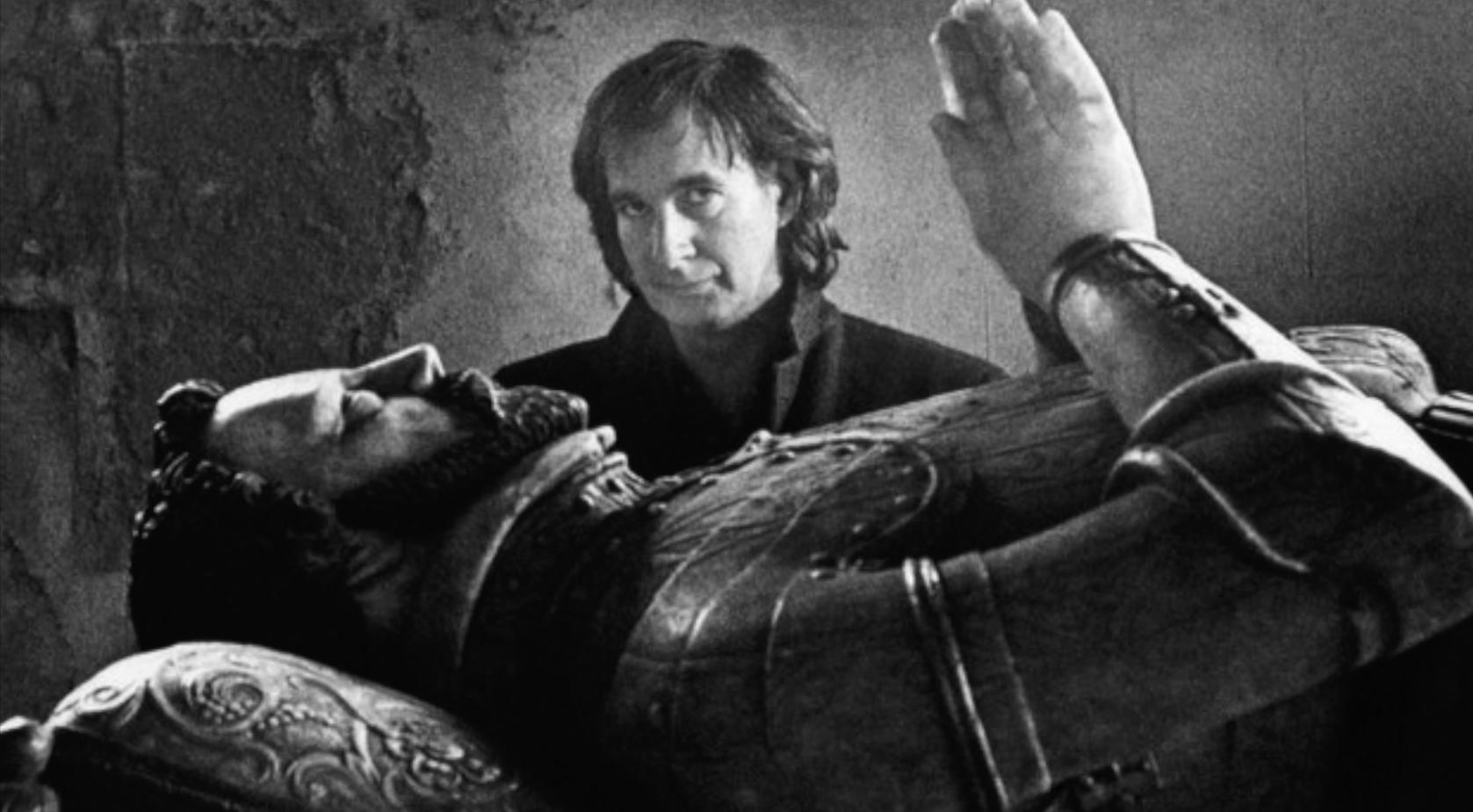
Documentary, by Jason Figgis, United States, 2019.
This documentary retraces the life and work of Simon Marsden, widely regarded as one of the foremost photographers of the supernatural. Premiered at the British Film Institute in London, the film offers a fascinating journey into his creative universe, appealing not only to photography enthusiasts but also to scholars, teachers, students, and anyone intrigued by the mysteries of the unseen. Through evocative imagery and first-hand accounts, it explores the artistic path of a photographer whose work has appeared in books, on U2 album covers, and in museum exhibitions around the world.
Although convinced of the existence of ghosts, Marsden never claimed to capture them directly with his camera. Instead, he used black-and-white infrared film to record the atmosphere and the invisible traces that, in his view, spirits left imprinted upon places. From the landscapes of Ireland to the vast expanses of Russia, passing through Venice and the American Southwest, he transformed historic buildings, ruins, and haunting locations into deeply evocative images capable of suggesting dark and unsettling stories. His photographs continue to captivate the imagination, demonstrating how the most powerful works of art can leave a lasting impression on those who behold them.
LANGUAGE: English
SUBTITLES: Spanish, French, German, Portuguese
Königsberg and the Edge of the Knowable
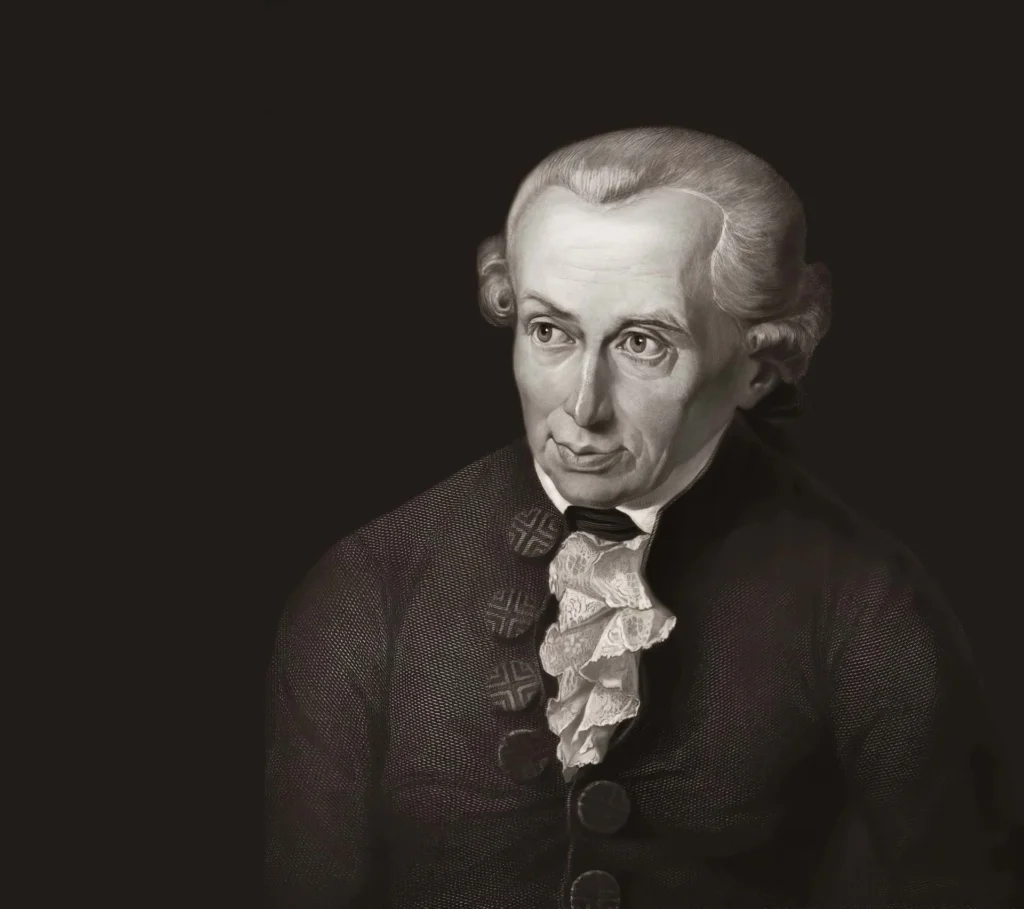
You are born in a city that smells of the Baltic and trades in amber, a city where the horizon is close enough to touch on clear mornings and where the sky, on certain winter evenings, seems to press down against the rooftops like a lid being lowered. Königsberg in 1724 was not the edge of the world, but it was close enough that a man who spent his entire life within its boundaries could be forgiven for believing the world had edges. Immanuel Kant never left. Not once, in eighty years of living, did he cross beyond the perimeter of that Prussian port city, and for two centuries this biographical fact has been treated as a curious footnote, a charming eccentricity, the philosopher’s one small peculiarity. It was never a footnote. It was the argument itself.
Kant’s stillness was not temperamental timidity dressed in academic robes. It was a wager — a philosophical position expressed through the body before it was ever expressed through language. If you believe, as Kant came to believe, that the structures shaping human experience are not out there in the landscape but in here, inside the apparatus of the mind that processes landscape, then travel becomes a category error. You do not find the conditions of possible experience by moving through space. You find them by pressing hard enough against the inside of your own skull. Geography, for Kant, was never the point. The architecture of cognition was.
Between 1770 and 1781, he published almost nothing. This silence lasted eleven years, and it was not the silence of a man who had run out of things to say. It was the silence of someone dismantling an entire way of thinking and rebuilding it from the joists. What emerged in 1781 was the Critique of Pure Reason, a book so dense and so structurally unprecedented that even its most sympathetic early readers confessed they could not follow it. Moses Mendelssohn, one of the sharpest philosophical minds of the German Enlightenment, reportedly described it as a work that had exhausted his nerves. It was 856 pages in its first edition. It was not trying to be accessible. It was trying to be true, and truth, Kant had concluded, required a new vocabulary built from scratch.
What the Critique established — and what rewired Western philosophy so fundamentally that Kant himself compared it to the Copernican Revolution — was the idea that the human mind does not passively receive the world. It actively constitutes it. Space and time are not features of external reality that the mind stumbles upon. They are forms the mind imposes on experience before experience can even begin. This is not idealism in the dreamy sense. It is something far more unsettling: the recognition that the world as you know it is always already shaped by the cognitive machinery you brought to the encounter. You have never seen the thing itself. You have only ever seen what your mind made of it.
This is where the biographical and the philosophical fuse into something irreducible. A man who never traveled anywhere had, in eleven years of silence in a cold Baltic city, charted the absolute boundary of what any human being can ever know. The frontier was not geographical. It was epistemological, and it ran straight through the center of every conscious mind that had ever tried to think clearly about anything. Kant called the realm beyond this boundary the noumenal — the thing-in-itself, permanently inaccessible, permanently real. You can gesture toward it. You can feel its pressure. But the moment you try to step across and know it directly, the machinery of cognition has nothing to grip, and the mind begins, as Kant showed with devastating precision, to contradict itself in ways it cannot resolve.
The infinite was not waiting somewhere beyond the city walls.

What Beauty Refuses to Do
You are standing at the edge of something enormous — not a mountain yet, not a storm, just a painting of one, hanging in a gallery where the temperature is controlled and the lighting is soft. You feel moved. You nod, perhaps. You take a small step back to adjust your frame. The experience is comfortable in its intensity, which is exactly the problem.
Kant published the Critique of Judgment in 1790, and the third Critique — as scholars call it, distinguishing it from his earlier epistemological and moral work — performs a strange diagnostic on aesthetic experience that most readers miss because they come looking for theories of art and find instead a theory of the mind’s limits. Beauty, for Kant, is the experience of a harmony between imagination and understanding. When you look at a well-proportioned face, or hear a melody resolve, your cognitive faculties fall into a kind of alignment. The imagination presents the object; the understanding processes it; and the two shake hands without friction. This is what Kant calls free play, and the pleasure derived from it is real, but it is the pleasure of a machine running smoothly. The mind recognizes itself in the beautiful object. It finds, in the world outside, a reflection of its own internal coherence.
That recognition is precisely what makes beauty so easy to recruit for ideology. Aesthetic harmony has been systematically weaponized — from Alberti’s proportional canons of the fifteenth century to the Third Reich’s architectural commissions, beauty has served as a tool for projecting power precisely because it feels like consensus. It feels universal. When everyone agrees something is beautiful, the agreement itself becomes evidence of some deeper order, some shared nature. This is the cognitive trap Kant himself tried to build into his framework: the judgment of taste claims universal assent without possessing the logical right to demand it. You say “this is beautiful” as if stating a fact, while knowing, somewhere below the sentence, that you cannot prove it.
The sublime refuses this consolation entirely. Where beauty flatters the imagination by offering it something it can hold, the sublime presents the imagination with what it cannot hold — and then watches it fail. A thundercloud that fills your entire field of vision, a mathematical sequence that extends without terminus, the sheer tonnage of geological time: these are not objects the imagination can successfully represent. Kant is precise about this. The sublime is not located in nature itself. It is located in the mind’s experience of its own inadequacy. The vastness does not overwhelm you. What overwhelms you is the discovery that you were never built to contain vastness in the first place.
This distinction matters more than it appears to. When beauty fails — when a painting seems kitsch, when a face loses its proportion — the experience is mildly disappointing. The system simply does not achieve its harmony. But when the sublime strikes, the cognitive machinery does not merely fail to achieve harmony; it is temporarily disabled by an encounter it was not designed to survive intact. Kant calls this a displeasure that coexists with a higher satisfaction, and the philosophical density of that phrase has occupied scholars from Friedrich Schiller to Paul Guyer, whose 1979 study Kant and the Claims of Taste mapped the underlying structure with forensic precision. The satisfaction is not aesthetic. It arrives afterward, from a different faculty entirely — not the imagination, not the understanding, but reason, which steps into the wreckage and recognizes that what just broke the imagination is smaller than the ideas reason itself can generate.
That movement — from imaginative collapse to rational recovery — is not reassuring in the way beauty is reassuring. It does not leave you with a sense of the world’s harmony. It leaves you with something colder: the knowledge that the human mind contains a capacity that exceeds every object the physical world can throw at it, while simultaneously being unable to perceive those objects without flinching.
The Ego That Cannot Contain the Storm
You are standing at the base of something that will not let you finish looking at it. Not because it is moving, but because it is simply too much — the cliff face that keeps rising after you thought it had ended, the glacier that swallows the horizon and then keeps going, the sky on a clear night in a place without electric light, where the stars do not decorate the dark but overwhelm it. Your eye tries to measure, to frame, to establish a boundary, and the boundary does not come. Something in the cognitive machinery grinds, slips, and then goes quiet.
Kant calls this the mathematically sublime, and the distinction matters more than it first appears. In the 1790 Critique of the Power of Judgment, he separates it carefully from the dynamically sublime — which is about force, about nature’s violence, about the storm that could kill you. The mathematical variant is not about danger. It is about sheer quantity, about magnitude so vast that the imagination, in its effort to apprehend the whole as a whole, exhausts itself and fails. The technical term he uses is Zusammenfassung — a comprehensive grasp, a taking-together of parts into a unified whole. Imagination can perform this operation for ordinary objects. A table, a building, even a mountain range, can eventually be mentally held as a complete thing. But some scales break the operation entirely. The imagination reaches its structural limit and, in Kant’s precise language, falls back into itself.
What most people experience in that moment is something they would call smallness. The instinct is to interpret the failure as a revelation about the self — that one is minor, temporary, cosmically insignificant. This reading has become almost automatic in the Western tradition of nature writing, from the Romantic poets who stood on Alpine ridges deliberately seeking annihilation to the contemporary wellness industry that sells oceanic experiences as a cure for excessive self-regard. Smallness as medicine. The sublime as a corrective dose of perspective. This interpretation is not wrong, but it stops thinking exactly where thinking becomes interesting.
For Kant, the collapse of imagination is not a lesson in modesty. It is the first moment in which the mind encounters something genuinely beyond its synthetic powers, and in doing so, discovers that it contains something those powers cannot account for. Because the failure is not total. The person standing before the glacier is not destroyed. They are distressed, then strangely elevated. And what does the elevating is the recognition that reason — not imagination, not sensory processing, but the faculty of pure rational ideas — was already demanding more than perception could provide. The mind was reaching toward totality before the glacier gave it an occasion to reach. The infinite was already a concept the human being carried internally, which is precisely why its external appearance feels like a confrontation rather than simply a spectacle.
This is where Kant departs sharply from Edmund Burke, whose 1757 Philosophical Enquiry into the Origin of Our Ideas of the Sublime and Beautiful had framed the sublime almost entirely in terms of terror and bodily response — darkness, vastness, and obscurity triggering physiological fear. Burke’s sublime is fundamentally passive, something that happens to the body. Kant’s sublime happens to reason, and reason responds not with submission but with the slow recognition of its own depth. The abyss turns out to be internal.
What the glacier exposes, then, is not human limitation in any simple sense. It exposes the gap between what the mind can process and what the mind can conceive — and the fact that this gap exists at all is the most unsettling discovery available to a thinking person. Because if reason can form the idea of the infinite while imagination cannot represent it, then the mind is somehow larger than its own machinery, haunted by demands it cannot satisfy and cannot stop making.
Reason Steps In Where the Senses Drown
You are standing at the base of something vast enough to make your eyes useless. Not because you are blind, but because the thing in front of you exceeds the machinery of vision entirely — the cliff face does not end where the sky begins, the gorge does not resolve into a bottom, the storm assembles itself faster than any instrument of perception can follow. This is the precise moment Kant found most philosophically charged, not because something mystical happens, but because something structural is revealed: the senses reach their ceiling, and something else in the human being refuses to stop there.
The standard account of Enlightenment thought runs something like this: reason is the faculty of order, system, and law, while sensory experience provides the raw material. What the Critique of Judgment disrupts is the clean division between these territories. Published in 1790 as the third and completing volume of Kant’s critical project, the work refuses to treat aesthetic experience as decoration or appetite. When Kant theorizes the sublime, he does so through a vocabulary of failure and recovery — the imagination strains to comprehend a magnitude or a force, collapses under the attempt, and in that collapse something philosophically essential rises to the surface.
The move is counterintuitive enough that readers have been misreading it for two centuries. The sublime does not feel good in the way beauty feels good. It initially produces something closer to what Kant calls Achtung — a term he more frequently uses in his moral philosophy, typically translated as respect, though the German carries an edge of gravity, almost of alarm. The feeling that arises when you confront the mathematically sublime — a quantity so enormous that successive apprehension cannot synthesize it into a whole — is first an acknowledgment of inadequacy. But the second movement, the one that transforms the experience, is a recognition that the human being possesses a faculty capable of thinking totality as a concept, even when no image of it is possible. Reason does not explain the infinite. It simply demonstrates that it can demand the infinite as an idea.
The dynamically sublime introduces something more viscerally threatening. Here it is not magnitude that overwhelms but power — volcanic rock faces, churning ocean during a tempest, lightning that reduces human construction to rubble in seconds. The physical vulnerability is not metaphorical. A human body next to an erupting mountain is fragile in precisely the ways evolution has always made it fragile. Kant is not interested in pretending otherwise. What he observes instead is that nature’s destructive capacity is entirely indifferent to the portion of the human being that can frame nature as destructive. The faculty that judges, that measures, that holds the concept of annihilation while remaining intact — that faculty exists in a different register than flesh.
Edmund Burke had arrived at similar territory in his 1757 Philosophical Enquiry into the Origin of Our Ideas of the Sublime and Beautiful, grounding the sublime in physiological terror and the biological instinct for self-preservation. For Burke, the sublime worked on the body. Kant read Burke and found the account insufficient, not wrong about the terror but wrong about where the significance resided. The body’s alarm is real, but the experience Kant is tracking begins precisely where the body’s alarm becomes philosophically interesting rather than just physiologically automatic. The person who survives the storm without having felt anything other than fear has not yet had the sublime experience in Kant’s sense. The experience requires a second operation: the recognition that one’s capacity for moral and rational selfhood is constitutively untouched by the force that could end one’s biological existence.
This is not consolation. It is not the kind of thought a frightened person reaches for to feel better. It is, if anything, unsettling in its own right — the discovery of a faculty whose dignity depends on its absolute separation from everything that keeps you alive.
A vision curated by a filmmaker, not an algorithm
In this video I explain our vision
The Social History of Awe

Picture a crowd pressed together in a vast cathedral nave in 1215, the year the Fourth Lateran Council codified confession as mandatory annual practice for every Catholic in Christendom. The stone vaulting overhead disappears into darkness that no candle can fully reach. The chanting arrives from somewhere unseen, bouncing off walls thick enough to swallow sound and return it changed, stripped of its human origin. These people do not know where the voice is coming from. That disorientation is not incidental — it is load-bearing architecture of a different kind, designed to make the self feel small and the source of sound feel eternal. What the body registers in that nave is not transcendence freely arrived at. It is transcendence administered.
The engineering of awe has a longer political history than democracy, longer than literacy, longer than almost any institution we still recognize. Edmund Burke published his Philosophical Enquiry into the Origin of Our Ideas of the Sublime and Beautiful in 1757, and what makes it disturbing to read now is not that he was wrong but that he was descriptive where he should have been alarmed. Burke’s central claim is that the sublime operates through terror — that whatever threatens to overwhelm or annihilate us produces the characteristic sensation of elevation, precisely because we are close to destruction but not destroyed. Astonishment, he wrote, is the effect of the sublime in its highest degree, and astonishment is a state in which all motions are suspended. The mind is entirely filled with its object. There is no room left for reasoning, for resistance, for comparison. Burke meant this as aesthetic psychology. What he accidentally produced was a manual.
Every authoritarian spectacle of the twentieth century understood Burke’s mechanism before it had read a word of him. The Nuremberg rallies of the 1930s were designed by Albert Speer with explicit attention to vertical scale, synchronized light, and the deliberate dwarfing of individual human figures within geometric masses — one hundred and thirty searchlights creating what Speer himself called a cathedral of light, specifically because cathedrals had already done the work of training populations to conflate verticality with legitimate power. The individual standing inside that geometry does not argue with it. The body has already surrendered before the mind can object. This is what institutionalized awe produces at its most concentrated: not Kant’s rational subject discovering its own dignity against the backdrop of a crushing nature, but a person who has been architecturally persuaded that their smallness is the point, that submission is participation, that to be overwhelmed is to belong.
The difference is not subtle and it is not merely philosophical. Kant’s version of the sublime requires solitude in a specific sense — not physical isolation, but the absence of mediation, the absence of someone who has arranged the experience on your behalf and needs something from your response. The moment awe is curated by an institution with interests, the cognitive movement Kant describes becomes nearly impossible, because the institution does not want you to recover your rational footing. It wants you suspended in Burke’s astonishment, motionless, filled entirely with the object it has placed before you. The French sociologist Émile Durkheim called this manufactured intensity collective effervescence — that surge of energy generated when bodies gather in synchronized ritual, which he documented across indigenous ceremonies and Catholic mass alike in The Elementary Forms of Religious Life in 1912. He observed it as social glue, the mechanism by which groups renew their bonds and reaffirm shared identity. What he did not fully interrogate is who profits from the bonding, and what exactly gets dissolved in that effervescence along with individual doubt.
Power has always known that a person struck dumb with awe is a person not asking questions about grain prices, inheritance law, or who controls the water.
What Nietzsche Heard in the Silence Kant Left
You are standing at the edge of something you cannot name, and instead of retreating, you feel — briefly, shockingly — that the act of standing there is itself a kind of victory. That feeling is the trap Nietzsche saw most clearly, the one that Kant had built with such architectural precision that its walls looked like open sky.
Nietzsche came to Kant sideways, filtered through Schopenhauer’s 1818 masterwork The World as Will and Representation, which had already transformed the Kantian sublime into something rawer and more honest: the moment of aesthetic contemplation as a temporary suspension of the will’s hunger, a brief peace purchased by the fiction that the mind could stand outside its own suffering. Schopenhauer respected this peace. Nietzsche did not. He saw it as the philosopher’s version of a warm blanket pulled over a wound — not healing, but postponement dressed as elevation.
What Kant had established, with genuine rigor, was that the mind’s capacity to conceive of infinity where the senses fail constitutes a kind of dignity. The mathematician looks at the ocean’s violence and thinks: I can count. I can measure. I can, in principle, encompass this. Reason survives where perception drowns. But Nietzsche’s diagnosis, sharpened through the years he spent annotating Schopenhauer in his early twenties at Basel, was that this survival is itself a symptom — the symptom of a civilization that had learned to convert its terror into intellectual pride rather than face the terror as such. The sublime, in this reading, becomes the moment humanity invented a god called Reason to replace the gods it had already lost.
Thus Spoke Zarathustra, published in four parts between 1883 and 1885, does something structurally violent to this tradition. Zarathustra descends from the mountain not to teach reason’s sovereignty but to announce that the absence of given meaning is not an emergency to be managed — it is the only condition under which genuine creation becomes possible. The abyss does not confirm your rational dignity. It asks what you are willing to build in the dark, without scaffolding, without the consolation that your building reflects some pre-existing order. The will to power, so catastrophically misread as domination, is actually closer to what a sculptor feels confronting unmarked stone: not the desire to conquer but the compulsion to impose form where none was inherited.
This distinction matters because it exposes something in ordinary life that is rarely named directly. Every person who has stood at a genuine threshold — a diagnosis, a collapse, an ending that cannot be reversed — knows the moment when the mind reaches for a framework, any framework, to transform raw exposure into something narratable. The Kantian move is to reach for reason’s superiority. The Nietzschean challenge is to notice that this reach is still a flinch, still a refusal of the unmediated fact. What remains when you stop reaching is not chaos — it is the raw material of valuation, the point at which you discover that values are not found but enacted, not received but staked.
The philosophical stakes here run deeper than a disagreement between two Germans about aesthetics. By 1882, in The Gay Science, Nietzsche had already written the parable of the madman who announces God’s death not as atheist triumph but as civilizational vertigo — the recognition that every structure built on a transcendent guarantee, including the guarantee of Reason as capital-R refuge, shares the same foundational vulnerability. The sublime is not the place where reason proves itself. It is the place where you discover what you actually believe when belief is no longer optional, when the mountain does not care whether your categorical faculties are functioning, when the magnitude that surrounds you has never heard of the faculty of understanding and will not wait for it to recover its composure.
The Infinite Has No Interest in Your Survival
You are standing at the edge of something that was already complete before you arrived. The cliff did not wait for a nervous system capable of registering vertigo. The storm did not organize itself around the possibility of a witness. Whatever is happening at the threshold of the measureless was, by every geological and thermodynamic account, happening long before the cortex evolved its peculiar talent for turning raw sensation into meaning — and will continue, with total indifference, long after that talent goes dark.
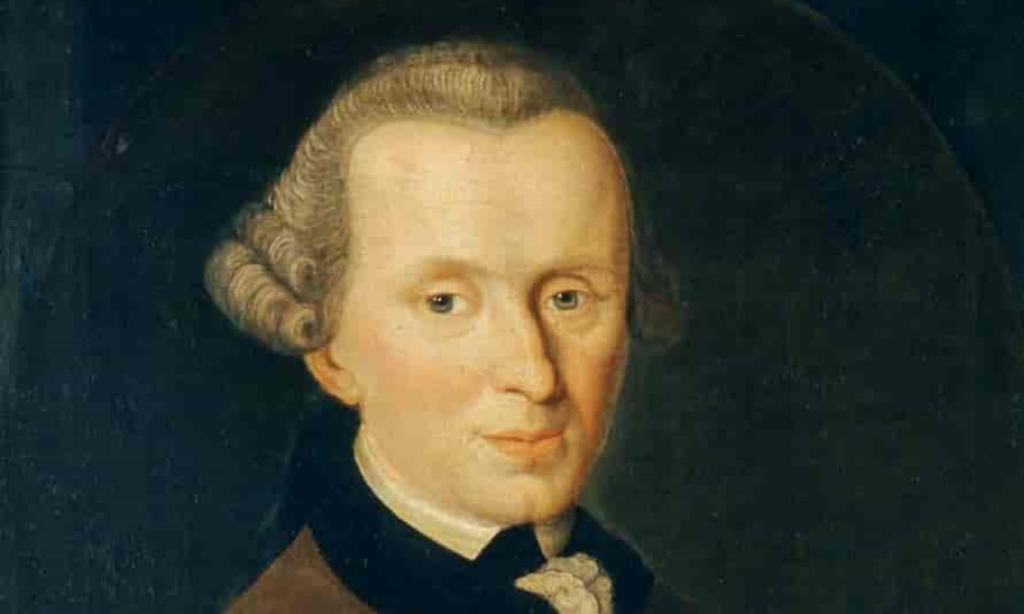
This is the pressure point that Kant’s architecture, for all its precision, was built to survive rather than confront. His 1790 Critique of Judgment is a monument of philosophical courage, but it is also, quietly, a monument of philosophical self-protection. When he argues that the dynamical sublime produces in us a recognition of our own supersensible vocation — that the mind rises above nature precisely because it can conceive what nature cannot contain — he is performing a rescue operation on the human being at the exact moment the human being is most exposed. The formlessness is real, he concedes. The scale is annihilating, he admits. But then reason arrives like emergency services and restores us to dignity. The question no one pressed hard enough is whether the rescue was earned or merely necessary.
Edmund Burke had already sensed, forty years earlier in his 1757 Philosophical Enquiry into the Origin of Our Ideas of the Sublime and Beautiful, that the terror of the sublime was physiological before it was philosophical — that the tightening of the throat, the arrested pulse, the galvanic refusal of the body to remain still were not preconditions for a transcendent insight but the full content of the experience itself. He was dismissed as a sensualist. But what he had actually identified was the body’s honest report: this thing does not need you, and some part of you already knows it. The aesthetics that followed, hungry for elevation, preferred Kant’s version because it let consciousness keep the trophy.
What neither account fully pressed is the logical consequence of the sublime’s indifference: if the experience completes itself without a witness, then the dignity located inside the witnessing mind is not a discovery about the cosmos — it is a story the mind tells about itself under conditions of maximum duress. Friedrich Nietzsche, writing in 1878 in Human, All Too Human, called this kind of elevation a form of gratitude that mistakes its own relief for metaphysical truth. The climber who survives the rockfall does not emerge with knowledge of the mountain. He emerges with knowledge of his own terror transformed, retroactively, into proof of something larger. The mountain recorded nothing.
By the twentieth century, the sciences had made this embarrassment structural. When the Voyager 1 probe, launched in 1977, crossed into interstellar space in 2012 and transmitted back measurements of a medium so vast and so silent that no human category of scale could organize it, no one experienced the sublime. They experienced data. The infinite, unmediated by risk, by proximity, by the body’s animal alarm, produced not elevation but numbness. Which means the sublime was never about the infinite at all. It was about the precise calibration of threat — close enough to annihilate, far enough to survive — and the mind’s furious, productive refusal to accept what that calibration actually implied.
Kant was right that something extraordinary happens in the gap between the overwhelming and the enduring self. He was wrong, or perhaps unwilling, to name what makes that something possible: not reason’s sovereignty over nature, but nature’s absolute sovereignty over reason, and the mind’s ancient, elegant, and entirely unverified insistence on reversing the verdict.
🌌 When Thought Encounters the Boundless
Kant’s encounter with the sublime opens a corridor into the infinite — a space where reason falters and something deeper awakens. The articles gathered here trace the philosophical, literary, and existential territories that border on that same vertiginous threshold, where meaning dissolves and reconstitutes itself.
Banal Evil and Radical Evil: Kant and Arendt
Hannah Arendt‘s confrontation with Kant’s notion of radical evil brings the moral sublime into the harshest light: the terrifying possibility that evil requires no demonic will, only the absence of thought. This article explores how Kant and Arendt together map the outer limits of human moral reason, where the comfortable certainties of judgment collapse. It is an essential companion to understanding why the Kantian sublime is not merely aesthetic but profoundly ethical.
GO TO THE SELECTION: Banal Evil and Radical Evil: Kant and Arendt
Schopenhauer: Life and Philosophical Thought
Schopenhauer inherited Kant’s architecture of the mind and radically transformed it, turning the unknowable thing-in-itself into a blind, striving Will that underlies all existence. His philosophy is in many ways a dark mirror of the Kantian sublime — where Kant found awe and moral elevation, Schopenhauer found suffering and the desperate beauty of resignation. Reading Schopenhauer alongside Kant reveals how the same infinite can produce reverence in one thinker and existential horror in another.
GO TO THE SELECTION: Schopenhauer: Life and Philosophical Thought
Jorge Luis Borges and the Labyrinth of Identity
Borges and the labyrinth of identity is one of the most fertile literary conversations with the Kantian infinite, translating the philosopher’s infinite regress of reason into narrative corridors with no exit. Borges constructs textual mazes where the self dissolves, multiplies, and encounters the sublime not through mountain vistas but through the endless proliferation of meaning and mirrors. His labyrinths are, in essence, thought experiments in the Kantian mode — reason pushed to its own limits until it becomes something else entirely.
GO TO THE SELECTION: Jorge Luis Borges and the Labyrinth of Identity
Heidegger’s Being and Time: Guide to Reading
Heidegger’s Being and Time represents a direct philosophical reckoning with the Kantian legacy, dismantling the transcendental subject and plunging thought into the groundless ground of existence. Where Kant’s sublime gestures toward the infinite through the failure of imagination, Heidegger’s Dasein confronts the abyss of its own finitude as the very condition of authentic life. This article guides the reader through a dense and rewarding text that can only be fully appreciated against the backdrop of Kant’s own confrontation with what exceeds the human.
GO TO THE SELECTION: Heidegger’s Being and Time: Guide to Reading
Explore the Infinite on Indiecinema
The sublime has always found its most daring expressions not in mainstream spectacle but in the margins — in films that dare to sit with silence, immensity, and the unreachable. On Indiecinema streaming you will find a curated world of independent and auteur cinema that speaks the language of the infinite, inviting you to experience what no philosophical argument alone can fully capture.
👉 EXPLORE THE CATALOG: Watch Indie Films in Streaming
A vision curated by a filmmaker, not an algorithm
In this video I explain our vision

