
The Incest Taboo as Political Architecture
You are sitting with a text that was printed in 1633, and something in it refuses to stay historical. John Ford‘s play arrives already in its own title carrying the full weight of its provocation — the “pity” in that phrase is not sympathetic, it is structural, a lament built into the grammar of condemnation, as if the speaker already knows that desire and catastrophe are not separable events but a single architecture.

The incest prohibition is among the oldest recurring objects in anthropological literature, but what Claude Lévi-Strauss argued in The Elementary Structures of Kinship in 1949 was that the taboo is not primarily a moral reflex — it is an economic mechanism. The prohibition against endogamy exists to force the circulation of women between groups, to generate alliances, debts, and political bonds. The ban on Giovanni and Annabella’s desire, read through this lens, is not the thunderclap of divine revulsion. It is the sound of a property circuit being broken.
Jacobean England ran on arranged marriage as its foundational instrument of wealth transfer. A daughter was not a person with an interior life in any legally actionable sense — she was a vessel through which land, title, and commercial alliance moved from one male household to another. Lawrence Stone documented this with forensic patience in The Family, Sex and Marriage in England 1500–1800, showing how among the gentry and merchant classes, a woman’s consent was procedurally irrelevant to contracts being negotiated in rooms she would never enter. What Ford stages is not two young people breaking a sacred law. He stages a woman withdrawing her body from the only economy it was ever meant to serve.
The moment Annabella accepts Giovanni she destroys, in one gesture, her value as a transferable asset. She cannot be delivered to Soranzo or any other suitor as an intact unit of exchange if she has already circulated within the family. This is the precise horror the other characters register — not the sin in any theological register, but the contamination of the commodity. Soranzo’s rage when he discovers her pregnancy is not the rage of a betrayed husband in any modern emotional sense. It is the rage of a buyer who has received damaged goods, which is exactly the mercantile vocabulary the period would have recognized without irony.
Ford was writing in a theatrical climate already under siege. The Puritanical pressure on the London stages that would close them entirely in 1642 meant that every provocation in a play of that era was calibrated against a specific cultural anxiety. To place passion that names itself openly at the center of a tragedy was not simply a dramatic choice — it was a diagnosis. The Friar in the play attempts to contain Giovanni’s desire through theological argument, and he fails completely, not because theology is weak but because Giovanni does not actually need forgiveness for violating a divine law. He needs absolution for violating a contractual one, and those are not the same instrument.
What makes Ford’s intervention genuinely dangerous is that he refuses to make Giovanni monstrous. The character reasons, eloquently, in the idiom of Neoplatonic love philosophy that the period’s educated audience would have recognized from Sidney and Spenser — the idea that beauty is a manifestation of divine perfection and that love directed toward it is therefore sanctioned by its very intensity. Ford borrows that framework and aims it at the one target it was never supposed to reach, exposing that the entire tradition of idealized love poetry was always already structured around the control of where desire was permitted to land.
Sovereignty of Desire Against the Body Politic
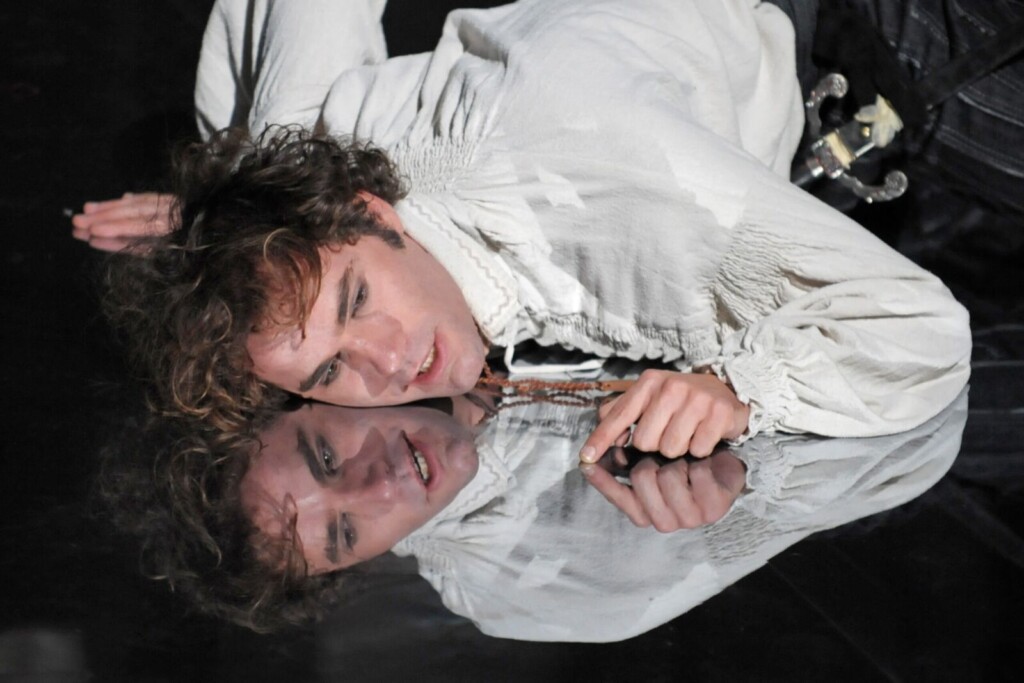
You already know the argument Giovanni makes before he makes it. You have heard it at weddings, in philosophy seminars, in the mouths of people who wanted something they were not supposed to want and reached instinctively for the most elevated language available to justify the reach. Love as recognition. Love as the soul’s return to its own reflection. Love as a force so interior and so absolute that no external law could have arrived before it.
Marsilio Ficino gave that argument its Renaissance architecture in his Commentarium in Convivium Platonis, written in 1469 and circulating through English court culture for over a century before Ford put quill to paper. Ficino’s reading of Plato’s Symposium transformed eros from appetite into metaphysics: the lover perceives in the beloved a divine form that the soul already carries within itself, and the movement toward that form is not transgression but homecoming. The language is rarefied, the implication radical. If love is fundamentally a relation between a soul and a transcendent beauty that happens to be instantiated in another body, then the social coordinates of that body — its gender, its rank, its kinship to the lover — become contingent noise, interference between the self and its proper object. Ficino built a theological escape hatch into the very center of Renaissance love doctrine, and every poet and playwright who came after him lived with that structural instability, whether they named it or not.
Ford names it. Giovanni’s opening appeal to the Friar is not the raving of a man who has abandoned reason; it is a formally constructed philosophical argument, delivered in the precise idiom that educated Jacobean audiences would have recognized as legitimate. He does not say he cannot help himself. He says the beauty he perceives in Annabella carries a necessity that mere social prohibition cannot outrank, because prohibition is conventional and what he feels is natural, and nature, as any Neoplatonist would confirm, is closer to God than custom is. The Friar responds with orthodox theology, but the orthodox response lands weakly, because it has to fight on terrain that Giovanni’s vocabulary has already claimed. The play’s social order cannot simply dismiss the argument; it can only punish the person making it, which is a different operation entirely, and one that the audience watches with the uncomfortable awareness that punishment and refutation are not synonyms.
What makes this theatrical rather than merely philosophical is the body. Neoplatonic doctrine performed a sustained act of dematerialization: the beloved was always becoming an occasion for something beyond the beloved, a ladder toward abstract form. Ford refuses the ladder. Giovanni’s passion is insistently, graphically carnal, and the play holds both registers simultaneously without resolving the tension between them. The elevated language does not sublimate the desire; it legitimizes it while leaving it fully embodied, which is precisely what the court culture that produced that language was designed to prevent. Sidney’s Astrophil and Stella, published in 1591, performs the same tension but keeps it safely within the conventions of unrequited lyric — the beloved remains unattained, the desire remains circulating. Ford removes the safety mechanism. He lets the argument arrive at its destination.
The institution that suffers most visibly from this is not the Church, though the Friar’s impotence is spectacular. It is the family understood as a political unit, the structure through which property, alliance, and social reproduction moved in seventeenth-century England. Giovanni does not threaten God; he threatens the ledger. And the ferocity of the play’s ending is proportional not to the sin’s theological weight but to the economic and political damage a legitimized sovereign desire would inflict on every arrangement that depended on desire remaining disciplined, deferred, redirected into sanctioned channels before it could choose its own object.

The Church as Dramaturgical Accomplice
You sit in the confessional and speak the unspeakable, and something strange happens: the act of naming it makes it more real, not less. The priest leans close, asks you to be more precise, to leave nothing out, to excavate the sensation down to its root. By the time you exit into the cold air of the nave, the sin you came to dissolve has acquired a density it did not possess before you arrived.
Friar Bonaventura is the most dangerous figure in John Ford’s play, and he is dangerous precisely because he appears to be its moral conscience. He is the voice that names Giovanni’s desire as an abomination, that frames incest as the one transgression no earthly logic can redeem. Yet every time he opens his mouth to condemn, he performs an act of theatrical amplification. The audience hears the prohibition and simultaneously hears the desire it is meant to extinguish described in sharper relief. Ford understood, with an instinct that predates the theory by three centuries, what Michel Foucault argued in La Volonté de savoir in 1976: that confession does not reduce sexuality but produces it as an object of knowledge, of fascination, of obsessive return. The Church’s machinery of sin is also, inescapably, the machinery of eros.
What Bonaventura does in the play’s early scenes is structurally identical to what Foucault’s confessor does in the historical analysis. He interrogates. He demands specification. He asks Giovanni not merely to stop but to explain, to locate, to describe the feeling with enough precision that it can be categorized and condemned. And in demanding that precision, he hands the incestuous passion its vocabulary, its architecture, its tragic grandeur. Without the Friar’s horror, Giovanni’s love would be merely sordid. The priest’s revulsion is what elevates it to the sublime, and Ford stages that elevation with deliberate theatrical intelligence.
The sixteenth and seventeenth centuries were saturated with this productive paradox. The Index Librorum Prohibitorum, first established under Pope Paul IV in 1559, did not make banned books disappear from European intellectual life; it created a cartography of the forbidden that functioned as a reading list for the curious and the daring. The very act of ecclesiastical prohibition advertised the transgression, gave it coordinates, made it findable. Ford was writing into a culture that had lived with this mechanism long enough to have internalized its irony, and his Friar is its perfect dramatic embodiment: a man who believes he is building a wall and is in fact building a monument.
There is a secondary function that Bonaventura serves, one that makes the play’s structure even more unsettling. He is the character through whom the audience grants itself permission to watch. As long as the Friar is present and condemning, the spectator can claim moral distance. The horror is being named from the stage; the institutional voice is performing its duty. This is not so different from the mechanism Philip Stubbes identified, with furious incoherence, in The Anatomie of Abuses in 1583, when he argued that theatrical representations of vice corrupted the audience even as they were framed as cautionary. Stubbes was wrong about the cause but right about the effect: the frame of condemnation does not neutralize the object it frames. It intensifies it by giving it a stage.
Ford seems to have recognized that the theatre and the confessional were cousins, both dark enclosures in which forbidden things were spoken aloud before an audience sworn to listen, both structured around the pretense that naming the transgression serves its elimination rather than its perpetuation.
Female Consent in a Theatre Without Women

You are watching a boy perform grief. Not grief at the loss of a lover, not grief at the discovery of betrayal, but something more precise and more impossible: grief at the moment a woman recognizes that her desire has been named by someone else before she could name it herself. The boy is perhaps fourteen, his voice not yet broken, his body dressed in the stiff brocade of a woman of means, and he is being asked to make an audience believe that Annabella’s surrender to Giovanni is not capitulation but want. That distinction — between a woman yielding and a woman choosing — is the entire ethical weight of the play, and it rests on a body the institution of the English stage had already decided could not authentically bear it.
Katharine Eisaman Maus, writing in Inwardness and Theater in the English Renaissance in 1995, identified the foundational anxiety of Renaissance theatrical representation as a problem of surfaces: the stage produced bodies that signified, but it could not guarantee that what those bodies signified corresponded to anything interior. This gap between visible performance and invisible interiority was, for Maus, not a flaw in the theatrical system but its constitutive condition. Every figure on the English Renaissance stage was already suspected of dissembling. But that suspicion fell with different weight on different bodies, and the body of a woman — never actually present, always prosthetic, always a boy wearing femininity as costume — collapsed inwardness entirely. Annabella’s desire cannot be verified. It can only be performed.
This is not an abstract theoretical problem. In the specific grammar of the play, Giovanni arrives at his sister’s room with a philosophical argument about the naturalness of their mutual attraction, and Annabella responds by confessing that she has already loved him secretly, before he spoke. That prior, silent desire is the thing the play needs most and can least afford to show. It exists only in retrospect, declared after the fact by a character whose interiority the stage has structurally foreclosed. What Ford wrote as erotic reciprocity — a love that precedes its own articulation — is forced, by the conditions of its own performance, to appear instead as a woman whose desire is activated by a man’s speech. The boy actor does not cause this collapse. He inherits it.
English theatre between roughly 1576, when the first permanent playhouse opened in Shoreditch, and 1642, when Parliament closed them all, staged somewhere between two and three thousand original plays, the overwhelming majority of which featured significant female roles performed by male apprentices. The practice was not identical to drag, not equivalent to classical Greek masking, and not the same as the commedia dell’arte tradition of the zanni performing femininity for comic deflation. It was a sustained institutional decision to locate women’s interiority in male bodies trained to project it outward as sign. What this means for a play that requires the audience to credit Annabella’s autonomous desire is that the text must work against the very medium that delivers it.
There is a technical word in early modern rhetoric for speech that performs feeling without originating it: enargeia, the quality of vividness, of making-present. Ford’s Annabella is written with extraordinary energia. Her language in the seduction scene does not merely respond to Giovanni — it registers, it discriminates, it arrives already knowing. But the body speaking those lines was hired precisely because it could simulate women’s interiority convincingly, which means the audience always held two contradictory recognitions simultaneously: this is a woman desiring, and this is a craft. When those two recognitions coexist, consent becomes a matter of technical performance rather than witnessed experience, and the question of whether Annabella truly chooses is never resolved — it is simply restated, in more elaborate costume, every time the play is performed.
Tragedy as Refusal of Resolution
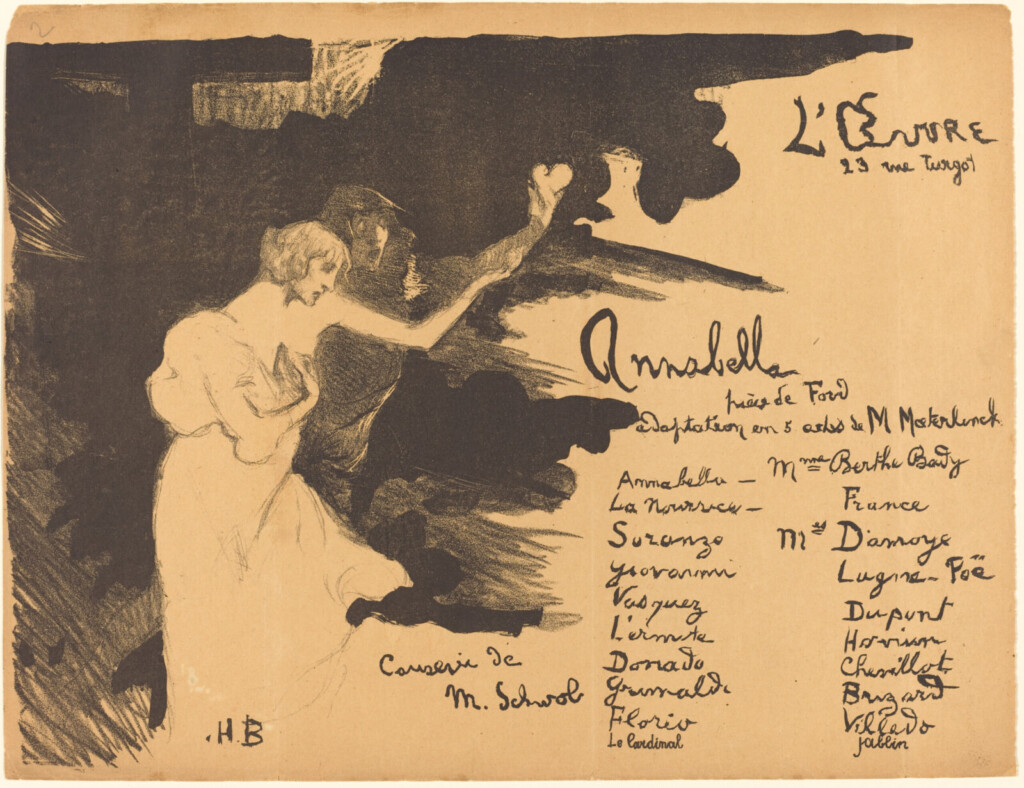
You are in the theatre, watching a man walk onto the stage carrying a human heart on a dagger, and nothing in the architecture of the play has prepared you to find this acceptable — nor has it prepared you to find it simply monstrous. That suspension is the point. John Ford, writing in the early 1630s when the Caroline stage was already contracting under Puritan pressure, does not give his audience the release valve of unambiguous condemnation. The final scene of the play accumulates corpses with a velocity that resembles less the controlled purgation of classical tragedy than a system violently consuming itself from within.
The critical tradition has largely wanted to read this carnage as punishment, as the inevitable gravitational consequence of transgression — incest names its own sentence, and the bodies on stage are the bill coming due. That reading is comfortable precisely because it restores the audience to safety. It allows the play to function as a cautionary exhibit, a warning carved in flesh, which the community of spectators can observe from the far side of a moral boundary they never had to question. But Ford’s dramaturgy refuses this comfort at the structural level. Giovanni does not die repentant, confused, or diminished. He dies in a fury of self-assertion that the play never sufficiently undercuts, and Annabella, by the final act, has moved through confession and genuine spiritual reckoning without that journey producing any outcome the society around her is equipped to honor. The institution of the Church, represented by the Friar, retreats — literally flees the city — before the catastrophe fully lands. The institution of secular authority, embodied in the Cardinal, arrives only to absorb property and redistribute power among survivors whose own corruption the play has spent five acts documenting. Nothing is restored. The stage is not cleansed.
René Girard argued in Violence and the Sacred, published in 1972, that sacrificial ritual functions not to punish genuine guilt but to redirect undifferentiated communal violence onto a surrogate victim — a figure sufficiently marginal or transgressive to serve as a container for the crisis, yet sufficiently connected to the community to make the violence feel meaningful. The sacrifice works only when the community believes it, only when the fiction of the guilty victim is maintained with enough force to prevent the mechanism from becoming visible. What Ford stages is the precise moment of that mechanism’s exposure. Giovanni and Annabella are destroyed, yes — but the destruction is performed in a register that makes the surrounding social order look not restored but revealed: revealed as built on the same appetite for dominance, ownership, and erotic possession that it claims to prosecute in the siblings. Soranzo’s jealousy is not qualitatively different from Giovanni’s passion; it is simply licensed by the marriage contract. Grimaldi kills with impunity because his aristocratic connections redirect the violence of law. The Cardinal accumulates an estate over a pile of bodies and calls it justice.
Girard’s deeper claim was that sacrificial crisis — the moment when the surrogate victim fails to absorb communal violence — does not produce moral clarity but mimetic contagion, a spreading collapse of the distinctions that hold a society’s self-image in place. Ford’s ending generates precisely this effect. The audience leaves not purged but implicated, unable to locate a position outside the violence from which to pronounce the verdict the genre seemed to promise. The tragedy does not resolve the crisis; it performs the discovery that the crisis was never really about Giovanni and Annabella at all — they were the occasion, the designated vessels, for a violence that the community needed to externalize in order to go on believing in itself, and Ford, with the cold precision of a playwright who understood exactly how close the theatre was to the scaffold, refused to let it.
A vision curated by a filmmaker, not an algorithm
In this video I explain our vision
🔥 Forbidden Desire: When Passion Defies Every Law
John Ford’s ‘Tis Pity She’s a Whore plunges into the darkest recesses of human desire, where incestuous love collides with social taboo, jealousy, and blood vengeance. The play reverberates across centuries because it stages universal forces — obsession, guilt, patriarchal control, and the destruction wrought by forbidden passion. These thematic threads connect Ford’s Jacobean tragedy to some of the deepest explorations in psychology, philosophy, and cultural history.
Possessive obsession and pathological jealousy: the destruction of the bond
Possessive obsession in romantic bonds transforms love into a machinery of control and annihilation, mirroring the dynamic at the heart of Ford’s tragedy. Giovanni’s consuming desire for Annabella is not merely forbidden — it is totalizing, erasing all boundaries between self and other. This article dissects the psychological mechanisms by which jealousy and possession corrode intimacy until only destruction remains.
GO TO THE SELECTION: Possessive obsession and pathological jealousy: the destruction of the bond
Repressed Desire: When Society Stifles Feelings
The tension between inner desire and the crushing weight of social norms is one of the defining dramas of human experience, and it is precisely this tension that Ford stages with such brutal clarity. When society forbids the expression of genuine feeling, desire does not disappear — it festers, mutates, and eventually erupts with violent force. This piece explores how repression shapes the psychology of characters who cannot reconcile who they love with who they are permitted to be.
GO TO THE SELECTION: Repressed Desire: When Society Stifles Feelings
The patriarchy: history, structures, and social impact of male dominance
The patriarchal structures of Elizabethan and Jacobean society form the invisible architecture of Ford’s tragedy, determining who owns whom and who has the right to punish transgression. Florio’s authority over Annabella, Soranzo’s claim on her body, and even the Church’s power over her soul all reflect a world in which women exist as property rather than persons. This article traces the historical and sociological roots of male dominance and its devastating consequences for those who dare to resist it.
GO TO THE SELECTION: The patriarchy: history, structures, and social impact of male dominance
Guilt: the psychological anatomy of an inner torment
Guilt is the invisible wound that bleeds through every scene of Ford’s play, haunting both Annabella and Giovanni with the full weight of their transgression. The anatomy of guilt reveals how it operates not as a single emotion but as a complex inner torment that can simultaneously compel confession and silence, repentance and defiance. This article offers a rigorous psychological portrait of guilt as a force that shapes action, distorts perception, and ultimately drives characters toward catastrophe.
GO TO THE SELECTION: Guilt: the psychological anatomy of an inner torment
Discover the Cinema That Dares to Tell Forbidden Stories
If the raw passions of Ford’s theatre resonate with you, Indiecinema is the streaming destination where forbidden desires, transgressive loves, and social taboos find their most daring cinematic expression. On Indiecinema you will discover independent and auteur films that refuse easy answers and explore the darkest corners of the human heart with honesty and artistic courage. Join the community and let independent cinema lead you where mainstream screens will never dare to go.
👉 EXPLORE THE CATALOG: Watch Indie Films in Streaming
A vision curated by a filmmaker, not an algorithm
In this video I explain our vision

