
The Shape of an Empty Chair
You stop eating. Not because you are full, not because the food has gone cold, though it has — but because something at the edge of your attention demands more processing power than chewing can afford. The doorway. You are watching the doorway again. You have been watching it the way sailors once watched particular stars, not for beauty but for information, for the navigational data that would tell you where you were and whether you were safe. The door does not open. The door has not opened at the expected hour for eleven nights in a row, and some part of your nervous system, far older and more precise than your seven years of conscious experience, has begun updating its model of the world. Not dramatically. Not with grief, because grief requires an understanding of permanence that a child’s mind resists as a biological reflex. Just quietly, the way a house settles — a small structural adjustment, a weight redistributed, something load-bearing now carrying a different kind of load.

What the body learns before language arrives is not forgotten when language does. This is the essential and largely ignored fact at the center of what psychologists since John Bowlby have been documenting with increasing precision across decades of attachment research. Bowlby’s 1969 work Attachment established that the infant’s bond with a caregiver is not, as Freudian theory had it, a derivative of hunger satisfaction — it is a primary biological system, as fundamental as immune response, oriented toward proximity and protection. When that system is chronically activated without resolution — when the child reaches and nothing comes — the nervous system does not simply register disappointment. It reorganizes. It begins building a secondary architecture, a set of perceptual and behavioral adaptations designed for a world where the expected presence cannot be relied upon. The child at the table is not waiting anymore. The child is becoming someone who has stopped waiting, which is an entirely different and far more consequential condition.
The statistics that researchers have accumulated around father absence in Western societies are not abstract. In the United States, as of the most recent census data analyzed by the Father Absence Crisis organization in 2023, approximately 18.4 million children live in homes without a biological father present. In the United Kingdom, the figure approaches one in four families with dependent children. These numbers describe something more than household demographics. They describe a distributed neurological event occurring across millions of childhoods simultaneously, largely invisible because it produces no emergency, no acute crisis that announces itself — only a slow, structural reorientation of the self toward a world perceived as fundamentally unreliable at its most intimate level.
What makes father absence particularly resistant to cultural acknowledgment is that it frequently arrives without the clean narrative of loss. Death grants permission to grieve. Divorce creates at least a story, a before and after. But the father who was simply not present — who showed up infrequently, unpredictably, whose absence was ordinary rather than catastrophic — leaves behind something harder to name and therefore harder to metabolize. Judith Herman observed in Trauma and Recovery, published in 1992, that it is precisely the chronic, normalized forms of psychological injury that prove most difficult to treat, because they do not present themselves as injuries at all. They present themselves as personality. As the way things are. As the shape of the person.
The child at the table eventually pushes back the chair and carries the plate to the sink. The motion is fluid, practiced, unremarkable. No tantrum, no visible collapse. The adaptation is already working. And that is exactly the problem — that the wound closes so quickly, so efficiently, sealing something inside before it has been seen or spoken or even fully felt, leaving only the scar tissue of a self shaped around an absence it has learned, very early, not to mention.
Along For The Ride
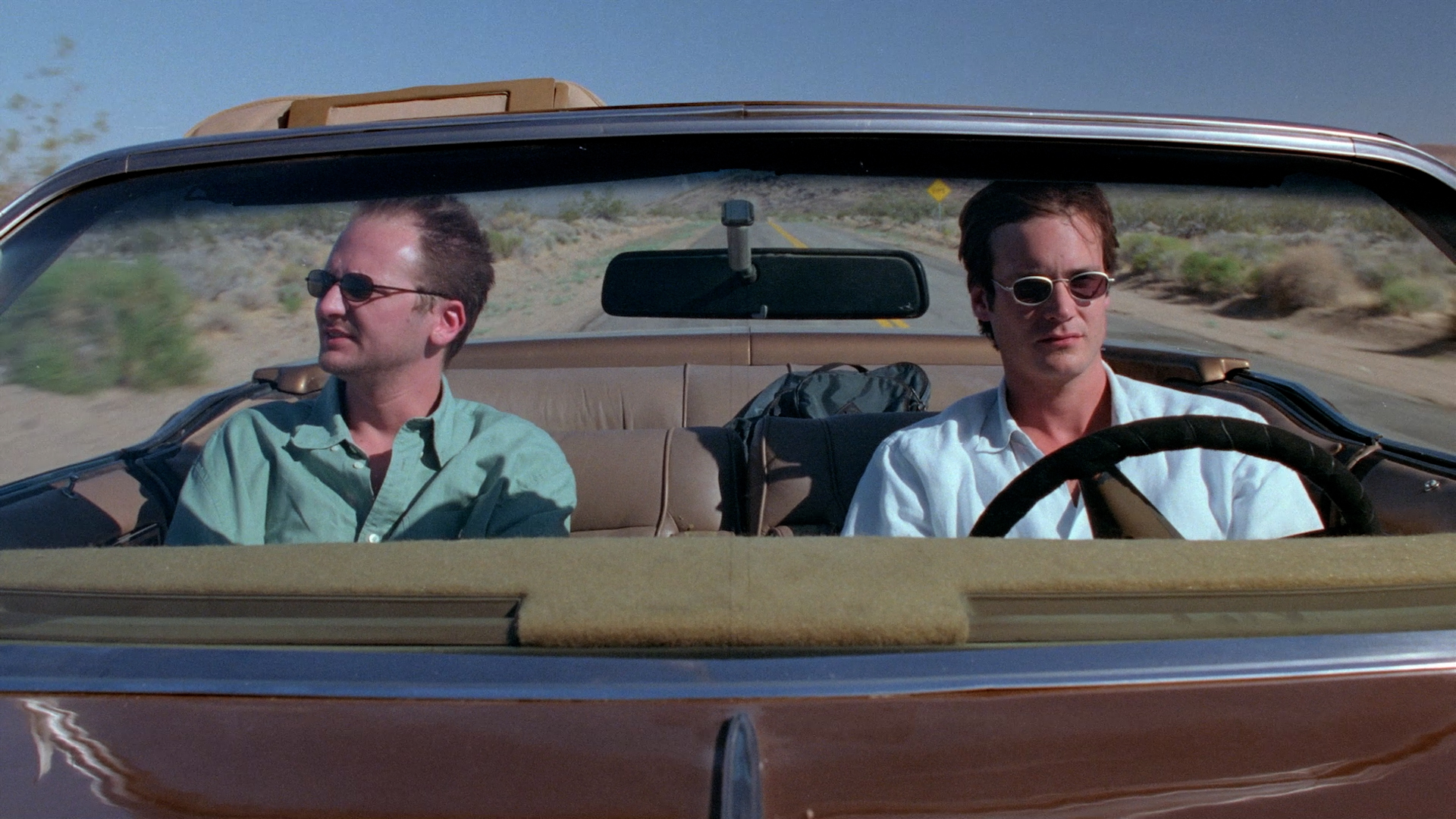
Drama, Comedy, by Bryan Simon, USA, 2001.
Two brothers, Terry (Randy Batinkoff) and Vance (Dylan Haggerty), embark on a journey into the desert with the body of their recently deceased father. Their goal is to find a burial site for him, but along the way unresolved family conflicts resurface. Terry, a successful former baseball player, has always exerted a dominant influence on the younger Vance, a humble mailman. Both carry within themselves the burden of a complicated relationship with their father, Jake (J.E. Freeman), a former professional player obsessed with sports. Even after his death, Jake appears to his children in dream sequences, but instead of offering wise advice, he continues to be distant and authoritarian. The journey thus becomes not only a physical but an emotional journey, in which the two brothers confront their mutual grudges and the emotional legacy of their father.
The film, directed by Bryan Simon with a budget of 150,000 dollars, was shot in extreme weather conditions, with a screenplay adapted by Jim Moores from a work by Randall Wheatley. The film also explores the role of sport as a vehicle for communication between father and son. For many men, expressing feelings is difficult, while talking about sport is a natural and shared language. "Along for the Ride" addresses these issues with sensitivity and realism, resulting in a touching work for those who have experienced similar family dynamics. An indie not to be missed for lovers of quality independent cinema.
LANGUAGE: English
SUBTITLES: Spanish, French, German, Portuguese
Absence as Architecture
You learn to navigate around something that isn’t there. The furniture of your interior life gets arranged with a particular care — not the care of someone who has too much, but the care of someone who has learned to protect an empty center. You don’t name it. You don’t need to. The body already knows the shape of the missing thing, the way a tongue finds a gap where a tooth used to be, automatically, without instruction, dozens of times a day.
Absence, when it arrives early enough, does not feel like loss. It feels like architecture. This is the distinction that most clinical language fails to make: between something taken away from a formed self and something that was never present during formation. Object relations theorists, following D.W. Winnicott’s work through the 1950s and 1960s, understood that the self does not arrive whole and then suffer damage — it is built, iteratively, in the space between the infant and the caregiver. When that space is consistently empty on one side, the psyche does not simply develop without that input. It develops around the absence, incorporating the void as a structural element, the way a load-bearing wall’s removal doesn’t leave a room unchanged — it leaves a room that reorganizes every remaining beam to compensate for what no longer holds.
The consequences of this reorganization are not what popular psychology tends to advertise. They are not always visible in obvious dysfunction. They are often more insidious than that: a hypercompetence, a relentless self-sufficiency that operates like an immune response to the original wound, a refusal to need anyone structured so deeply into the personality that it reads as strength. In 1978, the developmental psychologist Michael Lamb published research demonstrating that paternal involvement — or its chronic absence — affected not only emotional regulation but cognitive development, risk assessment, and the child’s capacity to tolerate uncertainty in relationships. What Lamb was measuring, without quite naming it this way, was the degree to which a missing structural element had forced adjacent elements to overfunction.
This overfunctioning is particularly precise in its targeting. It rarely spreads evenly across a life. A man raised without a father may manage extraordinary complexity at work and collapse entirely in the face of intimacy. A woman in the same situation may form profound connections with peers and find herself mysteriously unable to trust any figure who carries institutional authority. The absence doesn’t create a generalized deficit. It creates a map with specific territories marked uninhabitable, specific roads that lead nowhere because they were built toward a destination that was never there to receive them.
There is something almost geological about how this works across generations. Salvador Minuchin, whose structural family therapy emerged from clinical work in the 1960s with families in the Philadelphia slums, documented the way relational patterns calcify into family structure — not as metaphor but as literal organizational logic that governs who speaks to whom, who protects whom, and who is silently assigned the labor of managing the system’s central instability. An absent father does not simply leave a family; he leaves a reorganized family, one in which children are often promoted into roles that no architecture of childhood was designed to support. A twelve-year-old becomes the emotional anchor for a grieving mother. A teenager becomes the disciplinary authority for younger siblings. The gap gets filled, always — but filled by elements borrowed from places that cannot afford to give them.
What makes this particularly difficult to see from inside the structure is that it feels normal. Not comfortable — normal. The adapted self cannot perceive its own adaptations as adaptations. They present themselves as personality, as preference, as simply the way one is. And the way one is becomes the lens through which every subsequent relationship is evaluated, every new figure measured against an original template that was itself a response to a template that never materialized.

The Myth of the Natural Father
You have been told, in ways so subtle you stopped noticing them, that the father who sits at the dinner table every night, who attends the school play, who knows the name of your best friend and the subject you dread most — that this father is the original model, and his absence the modern corruption. The story goes that something went wrong, that divorce rates and feminism and moral loosening broke apart what was once whole. This is not history. This is mythology dressed in the grammar of loss.
Before 1850, in most of Western Europe and North America, the domestic life of the working-class family did not contain a father in any emotionally present sense. He left before dawn. He returned after dark, if he returned at all during the week. In the textile mills of Manchester, in the coal seams of Pennsylvania, in the shipyards of Liverpool, the physical body of the father was consumed by industrial capital from roughly the age of twelve until it was used up. E.P. Thompson documented this exhaustively in The Making of the English Working Class, published in 1963 — a book almost no one reads who nevertheless repeats the myths it dismantles. The preindustrial father, the one supposedly present in the fields and the workshop, had already been severed from domestic intimacy before the twentieth century invented divorce as a widespread social exit. The machine did it first.
What replaced his presence was not grief but structure. The mother became the emotional architecture of the household — not because women are naturally better at nurturing, but because the economic system had outsourced the father’s body to production and left everything else to whoever remained. Sociologist Arlie Hochschild, in The Second Shift, traced the persistence of this division well into the late twentieth century, where men who had returned from factories to offices still performed a fraction of the domestic and emotional labor of women, and experienced almost no cultural pressure to explain the gap. The asymmetry was not felt as injustice because it had been normalized so thoroughly it read as biology.
The emotionally available father, the one held up now as the standard against which real fathers are measured and found wanting, is largely a post-war, middle-class construction. He emerged in the specific economic conditions of the American 1950s and 1960s, when a single male income could sustain a household, when the suburbs created physical proximity between work and home that the industrial city had never offered, when Dr. Benjamin Spock was telling a generation of parents in Baby and Child Care — first published in 1946 and selling half a million copies a year through the 1950s — that emotional attunement mattered as much as discipline. This father was real, but he was regional, temporal, and dependent on a set of economic conditions that lasted perhaps thirty years before stagflation, deindustrialization, and the collapse of the single-income household dissolved him.
What survived was the image without the infrastructure. The cultural expectation of fatherly presence calcified precisely as the material conditions enabling it disintegrated. By the time sociologists began measuring father absence in the 1980s and 1990s, they were comparing a statistically aberrant mid-century ideal against a much longer history of structural removal, and calling the deviation a wound. The wound is real. But its origin story is fabricated.
There is something almost cruel in telling a man he has failed a role that was invented for a class he was never part of, in a decade his own economic reality made impossible, against a standard that required a specific combination of union wages, cheap housing, and a wife legally barred from the workforce. The cruelty is not intentional. It rarely is. It operates through the precise mechanism by which myths sustain themselves — by making the constructed feel eternal, and the historical feel like personal failure.
What Winnicott Never Finished Saying
You are sitting across from someone who loves you, genuinely loves you, and yet something in their gaze slides off you like water off glass. They see you, but they do not quite confirm you. And you have spent so long in that sensation that you have begun to mistake it for intimacy itself.
Donald Winnicott spent decades trying to name what happens in the space between a primary caregiver and a child before language arrives to complicate everything. In his 1971 collection “Playing and Reality,” he described the mother’s face as the child’s first mirror — not metaphorically, but structurally. The infant looks up and sees not the mother’s features but the mother’s response to its own existence, and from that reflected response it begins to construct the raw material of a self. The holding environment he theorized was not warmth in any sentimental register; it was the scaffolding of reliable presence, the conditions under which a psyche could afford to become real. Without it, the child does not simply feel unloved. It feels ontologically precarious — unsure whether it exists in any durable sense at all.
What Winnicott’s framework illuminates, it also quietly forecloses. His architecture is primarily dyadic and domestic, calibrated to the earliest phase of life where the mother-infant orbit is the entire known universe. But the psyche does not remain in that orbit. Somewhere between the ages of three and six, the child discovers that there is a world beyond the home — a world with rules that did not originate from the person who fed it, a world that operates according to logics the mother did not invent and cannot fully translate. The child needs someone who already lives in that world, who moves through it with apparent legitimacy, to extend a hand and say, wordlessly: you are allowed here too.
This is the specific gravity of the father’s role, and it is categorically different from mirroring. The mirror shows you that you exist. The witness shows you that your existence travels — that it holds up outside the contained theater of domestic love, that it survives contact with the indifferent exterior. When the father is present and engaged, his gaze does not reflect the child back to itself; it grants clearance. It is less a mirror than a passport stamped at a border the child did not even know it was approaching.
When that witness is absent — physically through departure, emotionally through chronic unavailability, or structurally through the particular silence that some men have inherited as a birthright — the child does not lose its reflection. It loses its authorization. It grows into an adult who can perform competence in the world while privately suspecting that the performance has not been legitimized by anyone with the authority to do so. The French psychoanalyst Françoise Dolto, writing in “La Cause des enfants” in 1985, argued that the paternal function is precisely the introduction of the symbolic register — the set of rules, limits, and permissions that structure social existence. Her formulation is clinical, but the lived experience it describes is visceral: the adult who never received that introduction moves through social space the way an undocumented person moves through a bureaucracy, always half-expecting to be asked for papers they do not possess.
The cruelty of this wound is its invisibility to the person carrying it. You do not walk around consciously grieving a gaze you never received. You walk around slightly over-explaining yourself in professional settings, or collapsing inexplicably when someone in authority fails to acknowledge your contribution, or working twice as hard as the evidence requires because the internal auditor never received the memo that the work was already good enough. The absence does not announce itself as absence. It announces itself as a deficiency in you — a suspicion, rarely spoken aloud, that you have not yet earned the right to take up the space you are already standing in.
The Wound That Performs Competence
You learned to need nothing before you understood that needing was normal. By the time you were eight, maybe nine, you had already developed the specific competence of the quietly self-managed child — the one who packs their own lunch, who doesn’t ask twice, who reads the emotional weather of a room and adjusts accordingly. Adults called you mature. Teachers noted it in report cards as a virtue. Nobody named it for what it was: an adaptation to abandonment so thorough it had become indistinguishable from character.
Judith Wallerstein spent twenty-five years following 131 children from divorced families in Marin County, California, beginning in 1971, and what she documented in “The Unexpected Legacy of Divorce” published in 2000 destabilized an entire generation’s comfortable assumptions. The children who appeared most adjusted in the immediate aftermath of paternal absence were frequently the ones in the worst condition a decade later. The crisis had not been resolved — it had been deferred with extraordinary competence. Wallerstein called it the “sleeper effect,” and she found it concentrated overwhelmingly in daughters who had been praised for their early self-sufficiency, women who arrived at intimacy in their twenties carrying a wound they had successfully hidden even from themselves.
The mechanism is not complicated once you see it, but it is genuinely difficult to see because it wears the costume of health. When a child cannot rely on a parent’s consistent presence, the nervous system does not collapse — it reorganizes. It builds a compensatory structure around the void: hyper-competence, emotional self-regulation performed with precision, an almost aggressive independence that preemptively refuses help before help can be withheld. Psychologists working within attachment theory, particularly those following the late John Bowlby’s foundational mapping of anxious and avoidant attachment patterns, have identified this as a form of defensive exclusion — the systematic filtering out of emotional needs so that the unbearable information of dependency never fully reaches conscious awareness.
What makes this particularly insidious is that the culture rewards it without reservation. Western industrial societies since at least the mid-nineteenth century have elevated self-sufficiency to something approaching moral virtue, and the child who enacts it most convincingly is the one who receives the most praise, the most opportunity, the most early success. By the time that child is an adult, the performance has been reinforced ten thousand times, so that distinguishing it from the self becomes nearly impossible. The man who cannot ask for help at forty is not exercising strength. He is following a script written by a frightened eight-year-old who had no other option, and the script has simply never been revised because nothing in his environment has ever required the revision.
There is a particular cruelty in discovering this late. A woman in her mid-thirties, the kind who runs departments and handles crises with unsettling calm, sits in a therapist’s office not because she collapsed but because she can no longer understand why every relationship she enters eventually produces in her an uncontrollable panic the moment genuine dependency becomes possible — the moment someone actually shows up. The presence triggers what the absence installed. The nervous system, trained to manage alone, reads reliable care not as safety but as a threat to the only competence it knows.
Frank Pittman, the American psychiatrist who wrote extensively about fatherless sons in “Man Enough” in 1993, argued that the boys most determined to prove they needed no one were the ones most catastrophically shaped by male absence — not because they were weak, but because the determination itself was the wound speaking. The performance of invulnerability is not the opposite of the injury. It is the injury’s most sophisticated product, the final form the damage takes when it has had enough time and enough praise to fully calcify into what the person sincerely believes is simply who they are.
A vision curated by a filmmaker, not an algorithm
In this video I explain our vision
A Man Watches His Own Son Sleep

You stand in the doorway at eleven at night, the hall light casting your shadow across the foot of the bed where your son sleeps, and you cannot make yourself cross that threshold. It is not exhaustion, though you will tell yourself it is. It is not the fear of waking him. It is something older and more precise — a gravitational force pulling you back to the exact position your own father occupied in relation to you, which was always slightly outside the room, always almost present, always on the verge of an arrival that never quite completed itself.
What transmits between generations is rarely what anyone intended to pass on. The sociologist Karl Mannheim argued in his 1923 essay on the problem of generations that what binds people across time is not shared blood or even shared experience, but shared exposure to a particular structure of the world — a common horizon of what feels natural, inevitable, unremarkable. A man who grew up inside the horizon of paternal absence does not learn absence as a lesson. He breathes it as atmosphere. By the time he becomes a father himself, the pattern has no name because it was never experienced as a pattern. It was simply how things were.
The neurobiologist Stephen Porges, developing his polyvagal theory through the 1990s and formalizing it in his 2011 work, demonstrated that the human nervous system learns safety not through instruction but through repeated co-regulation — through the physical proximity of a calm, attuned other. A child whose father was physically present but emotionally unreachable does not experience a partial form of connection. The nervous system registers the disconnection as threat, and the system calibrates itself accordingly, hardwiring a posture of low-grade vigilance that will later be mistaken for personality, for stoicism, for independence, for being the kind of person who does not need much from others.
That posture becomes the invisible architecture of fathering. The man in the doorway is not consciously withholding. He is operating from a body that was trained, before language, to expect that intimacy collapses or disappoints or disappears — and so his nervous system enacts the withdrawal preemptively, as protection, both for himself and, in a logic so distorted it almost passes for love, for his child. If I don’t go in, I can’t fail him the way I was failed. The catastrophe is indefinitely postponed. The boy keeps sleeping, untouched, and the man mistakes his own paralysis for restraint.
The psychoanalyst Christopher Bollas introduced the concept of the unthought known in 1987 to describe experiences so early and so foundational that they shape perception without ever being consciously registered as memories. The child does not remember learning that fathers stand at distances. He simply knows it the way he knows how to breathe. When he stands at his own son’s doorway decades later, he is not recalling anything. He is enacting a structure that was installed before thought was possible, before he had the vocabulary to resist it, before he even understood there was something to resist.
What makes this particular transmission so durable is precisely its invisibility. Trauma that arrives through violence or rupture at least announces itself, leaves an event that can be named and eventually examined. But the transmission of absence arrives without incident. Nothing happened. There is no story to tell. The father was simply not quite there, in the way that weather is not quite there — present as condition, absent as presence, shaping everything without being legible as cause. The son grows up and becomes the weather for his own child, and neither of them will ever be able to point to the moment it began.
The boy in the bed shifts slightly, pulls the blanket toward his chin, and the man in the hallway watches this small movement with an intensity that looks, from the outside, almost like devotion.
Patriarchal Silence as Cultural Grammar
You were taught that your father’s silence was a private fact, something that belonged to your family alone, a wound with no genealogy. But silence has architects.
Michael Kimmel spent decades mapping what he called the “marketplace manhood” that crystallized in American culture after industrialization pulled men out of the domestic sphere and into the wage economy. In his 2006 study “Manhood in America,” he traced how the 19th-century bourgeois father was systematically redefined: no longer the patriarch who managed his household’s moral and economic life from within its walls, but a figure who proved his adequacy by leaving. Absence became productive. Presence, by contrast, began to carry the faint odor of weakness, of a man who had not made it far enough into the world to be genuinely needed elsewhere. The emotional withdrawal that so many children experience as personal rejection was not invented by their fathers — it was inherited by them, passed down through a cultural grammar so thoroughly internalized that most men could not have named it even if asked.
Anthropologists studying the emergence of Western bourgeois domesticity across France, Germany, and Britain between roughly 1830 and 1900 documented something striking: the physical architecture of the middle-class home began encoding paternal distance. The father’s study, with its closed door, its signals of concentration and unavailability, was not simply a room. It was an ideology made of wood and plaster. Boys learned by watching their fathers disappear behind that door that dignity was a form of withdrawal, that the man who was always emotionally available was somehow lesser, suspect, not fully masculine. By the time Freud was theorizing the paternal function in Vienna in the 1890s, he was already theorizing a man who was structurally remote — and treating that remoteness as necessary for civilization rather than as a historically contingent arrangement that had taken hold within living memory.
The damage this economy inflicted runs in two directions simultaneously. Sons internalized the grammar and reproduced it, often without ever consciously endorsing it — men who swore they would be different discovering, somewhere in the third or fourth year of fatherhood, that they had no emotional vocabulary for closeness because none had ever been spoken to them. But daughters were shaped by it differently, learning to read male silence as depth, as substance, as the mark of a serious person — which meant spending years, sometimes entire adult lives, mistaking emotional unavailability in partners for complexity, confusing withholding with mystery. The cultural encoding did not just produce absent fathers; it produced people calibrated to find absence legible, even compelling.
Kimmel identified what he called the “masculinity crisis” that erupts whenever this economy comes under visible strain — the panic, the rage, the sudden retreat into harder performances of indifference. What looks like individual fragility in those moments is something closer to a system defending its own logic. The man who cannot tolerate being witnessed in tenderness by his children is not simply afraid; he is obeying a code that promises him coherence in exchange for constriction, that offers social legibility at the price of relational presence. The bargain was never announced. It was simply modeled, generation by generation, in the posture of men who sat at the head of tables without speaking, in the handshakes substituted for embraces, in the advice dispensed instead of comfort.
What makes this history particularly difficult to reckon with is that it produced genuine love. The fathers who went silent were not, in most cases, indifferent. Many of them believed, at some level below conscious articulation, that their withdrawal was a gift — that by not burdening their children with emotional need, they were practicing a form of protection. The cruelty of the grammar was that it disguised itself as virtue, made damage feel like discipline, turned the wound into something that looked, from the inside, almost exactly like strength.
The Question the Scar Cannot Answer
You do your work. You sit across from the therapist, you speak the names of things, you trace the architecture of what happened with enough precision that eventually you can hold it without shaking. You read the right books, you understand the developmental literature, you know what attachment theory says about the internal working model and how early relational absences reorganize the nervous system at a structural level. You may even reconcile — sitting across a table from an old man who looks smaller than the wound he made, finding words for forgiveness that you genuinely mean. And still, on an ordinary Tuesday, something arrives that none of it touches.
It is not grief for the person. That is the confusion people carry out of therapy thinking they have resolved something, when in fact they have only resolved the more legible half of the problem. What persists underneath is not longing for the father who existed — flawed, absent, sometimes cruel, often simply not present in the way that mattered — but for the self that might have been assembled in his presence. The psychoanalyst Christopher Bollas, in his 1987 work The Shadow of the Object, introduced the concept of the “unthought known” — things that are known in the body before they can be articulated in the mind, experiences that shaped the self before the self had language for them. The absent father lives precisely there, in that register, as a form of self-knowledge that was never permitted to develop, a version of you that required his consistent gaze in order to come into existence and simply did not.
This is what makes fatherlessness categorically different from other losses. When someone you love dies, you mourn a presence that once existed. The mourning has an object. With the absent father, the object of mourning is hypothetical — it is a self you were supposed to become, a confidence you were supposed to inherit, a way of inhabiting your own authority that required transmission and received silence instead. You cannot mourn something that never existed, and yet the longing for it is precise and insistent, more specific than nostalgia, less nameable than grief.
George Vaillant’s decades-long Grant Study, following Harvard men from the late 1930s through old age, found that the quality of childhood relationships with fathers had measurable effects on income, mental health, and life satisfaction well into the participants’ seventies and eighties. The data is not surprising. What it cannot capture is the texture of the remainder — the moment a man in his fifties, accomplished by any external measure, watches another man receive easy public praise and feels something move in his chest that does not belong to ambition or envy but to something older and more particular, something that has no adequate name in the emotional vocabulary available to him.
Cultures have historically had rituals for exactly this threshold — initiation rites, elder transmission, deliberate ceremonies of passage in which older men made younger men legible to themselves by bearing witness to them. These were not sentimental. They were structural. Their function was precisely to provide the external recognition that allowed internal coherence to form. When that function is privatized into the nuclear family and then the nuclear family fails to perform it, there is no institutional fallback. The boy becomes the man who becomes the elder without ever having been truly seen at the moment it was formative, and the lack does not announce itself as damage so much as a persistent low frequency of incompleteness, a sense that somewhere in the construction of the self a room was framed but never finished, with bare walls and a door that opens onto nothing.
What cannot be healed is not the wound itself but the fact that the wound reveals an absence of something that was never present to begin with, and you cannot restore what was never there — you can only learn, slowly, at great cost, to build differently inside the space it left.
🪞 Wounds of the Soul: Absence, Memory & Identity
The absent father leaves traces that go far beyond childhood — shaping identity, memory, and the ways we relate to others throughout life. These articles explore the psychological and cultural dimensions of absence, grief, and the long journey toward understanding oneself in the wake of what was never given.
Grief in Childhood: When Children Lose Their Parents
When a parent disappears from a child’s life — through death, abandonment, or emotional unavailability — the wound can shape an entire inner world. This article examines how children process grief and loss, and why the absence of a father figure often leaves a particularly complex psychological imprint that resurfaces in adulthood.
GO TO THE SELECTION: Grief in Childhood: When Children Lose Their Parents
Forgotten Memory: When the Past Resurfaces
Memory does not always surrender its secrets willingly — sometimes the past resurfaces only when the psyche feels ready to face what it once buried. This piece explores how forgotten or suppressed experiences find their way back into consciousness, often triggered by relationships, crisis, or the sudden absence of someone who defined our earliest sense of self.
GO TO THE SELECTION: Forgotten Memory: When the Past Resurfaces
Carl Gustav Jung and the Shadow: The Dark Side We Don’t Want to See
Carl Gustav Jung identified the Shadow as everything we refuse to acknowledge in ourselves — the rejected, the unlived, the inherited wound passed silently from parent to child. Understanding how paternal absence can become part of one’s Shadow is essential to any honest reckoning with identity and emotional wholeness.
GO TO THE SELECTION: Carl Gustav Jung and the Shadow: The Dark Side We Don’t Want to See
Dissociation in Psychology: When the Mind Divides
Dissociation is one of the mind’s most powerful defenses against unbearable emotional pain — and the absence of a father is among the earliest wounds that can trigger it. This article traces the psychological mechanisms by which the self learns to divide in order to survive, and why healing requires the courage to reunite what was once split apart.
GO TO THE SELECTION: Dissociation in Psychology: When the Mind Divides
Explore the Cinema of Inner Truth on Indiecinema
If these themes resonate with you, Indiecinema’s streaming platform offers a curated selection of independent films that dare to portray the invisible wounds of family, identity, and emotional inheritance with honesty and depth. Discover stories that mainstream cinema rarely tells — because sometimes only independent cinema has the courage to look directly at the absence.
👉 EXPLORE THE CATALOG: Watch Indie Films in Streaming
A vision curated by a filmmaker, not an algorithm
In this video I explain our vision

