
The Man Who Spoke to Angels in a Language That Predated Babel
There is a moment most people have experienced at least once, usually late, when the world has gone quiet and the screen or the page in front of you begins to feel like something more than a surface. A pattern emerges. Numbers align in ways that seem too deliberate. A sequence of events compresses into what feels like a signal rather than noise. The rational mind offers its usual explanations, and you almost accept them, but something else — older, more insistent — whispers that you are on the edge of receiving something. Not imagining. Receiving. Most people close the laptop, drink a glass of water, go to bed. John Dee never did.

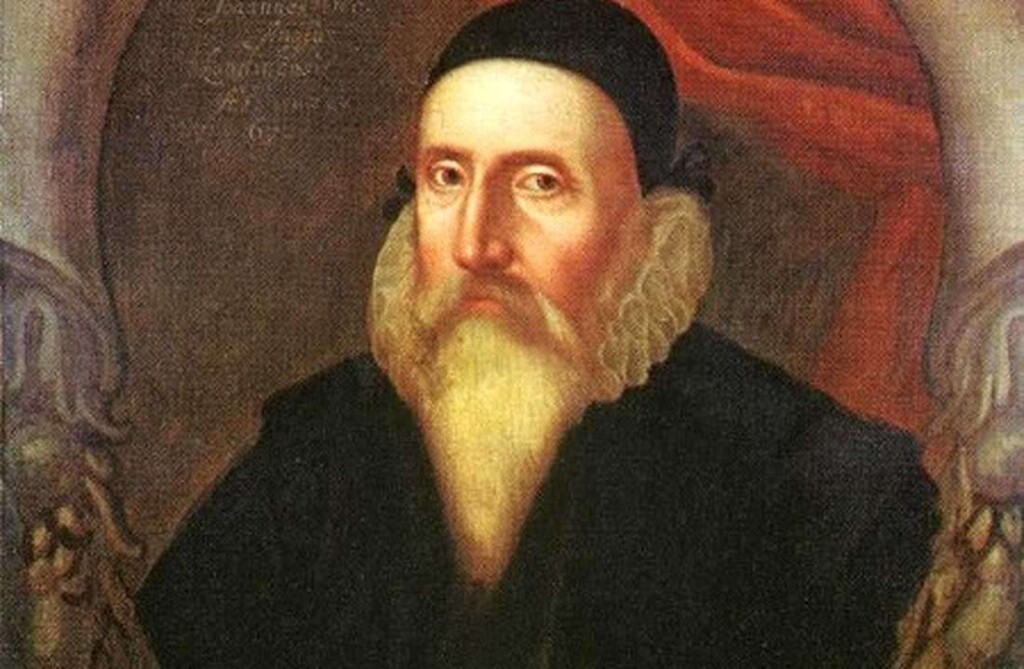
He was born in London in 1527, in a century when the boundary between natural philosophy and divine mystery was not a wall but a membrane, permeable and frequently crossed. By the time Elizabeth I sat on the English throne, Dee was her court astrologer, her cryptographic advisor, her navigator of futures. He had studied at St John‘s College, Cambridge, and later at Louvain, where the best scientific minds of Europe gathered. He helped design the navigational instruments and mathematical frameworks that would carry English ships across unknown oceans. His personal library at Mortlake contained over four thousand volumes at a time when the entire collection of Cambridge University barely exceeded that number. He corresponded with Tycho Brahe, the great Danish astronomer. He annotated Copernicus. He wrote Propaedeumata Aphoristica in 1558, a rigorous attempt to describe how celestial forces might operate through mathematical law on terrestrial matter — not a mystical pamphlet but a work of quantitative cosmology, earnest and precise.
And yet none of this was separate, in Dee’s mind, from the sessions in which he knelt before a polished obsidian mirror and waited for angels to speak.
The comfortable modern story about figures like Dee requires a clean partition: here is the scientist, there is the madman, and somewhere around the seventeenth century one of them wins. Francis Bacon builds his empirical cathedral, the Royal Society is founded in 1660, reason conquers superstition, and we learn to feel appropriately embarrassed about everything that came before. But this narrative is a form of cultural vanity, and Dee refuses it. He was not a rational man who had a mystical breakdown. He was not a credulous mystic who happened to read mathematics. He was a single coherent intelligence operating on a single coherent premise: that the universe was structured by hidden correspondences, divine in origin and mathematical in expression, and that the task of the educated mind was to read them by whatever means available — telescope, compass, or angel.
The historian Frances Yates spent decades in the mid-twentieth century demonstrating exactly this, tracing through figures like Dee the lineage of what she called the Hermetic tradition in European thought, the idea that the natural world is a text written in a sacred cipher and that human beings possess, or can recover, the capacity to read it. Her 1964 work Giordano Bruno and the Hermetic Tradition and the later The Rosicrucian Enlightenment showed how this tradition ran not beneath Renaissance science but through it, inseparable from it. Dee was not the exception. He was the exemplar.
What haunts Dee’s story is not the strangeness of his beliefs but their familiarity. The physicist who suspects there is an equation beneath everything. The programmer who finds the architecture of consciousness more interesting than consciousness itself. The person awake at three in the morning who cannot quite shake the feeling that the pattern they are seeing is not theirs alone. Dee looked into a dark mirror and believed something looked back. The question worth sitting with is not whether he was right. It is what it means that he could not stop looking.
The Elizabethan Mind and the Architecture of the Invisible
Imagine standing in a room where every wall breathes. Not metaphorically — literally, in the sense that each surface is covered with texts that are simultaneously instructions for living, maps of the cosmos, recipes for transformation, and arguments with God. This was Mortlake in the 1570s, a house on the Thames where a man received queens and corresponded with emperors, where the shelves held over four thousand volumes at a time when Oxford’s entire Bodleian held fewer. To walk through that library was not to enter a place of quiet scholarship. It was to enter a pressure system, a room where every question opened into three others, where the boundary between what we now call science and what we now call mysticism had not yet been drawn with the confident cruelty of later centuries.
Frances Yates spent much of her scholarly life trying to recover this texture, and what she found in her 1964 study Giordano Bruno and the Hermetic Tradition was something that the standard narrative of intellectual history had quietly buried: that the Renaissance mind did not experience a conflict between rational inquiry and occult knowledge because it did not yet recognize them as separate territories. The Hermetic corpus — those texts falsely attributed to the ancient Egyptian sage Hermes Trismegistus, which Ficino translated in Florence in 1463 on the direct orders of Cosimo de’ Medici, who asked him to abandon Plato and translate these first — was understood as the oldest wisdom available to man, a prisca theologia, a primordial theology that preceded and encompassed both Greek philosophy and Christian revelation. To work within that tradition was not to deviate from truth. It was to pursue it at its deepest root.
Dee inhabited this tradition not as an eccentric but as a logical product of it. His library was a laboratory of synthesis in precisely the sense that synthesis was the intellectual imperative of the age — the urgent conviction that all true knowledge, properly understood, must converge. He held Euclid alongside Paracelsus, Roger Bacon alongside Ramon Llull, astronomical tables alongside grimoires of angel-summoning. These were not contradictions requiring resolution. They were different instruments measuring the same invisible architecture. When Dee wrote his Mathematicall Praeface to the 1570 English edition of Euclid, arguing that mathematics was not merely a practical tool but a language connecting the material and the divine, he was not being poetic. He was being precise in the only vocabulary available to a mind trained to see number as the structural principle of creation itself.
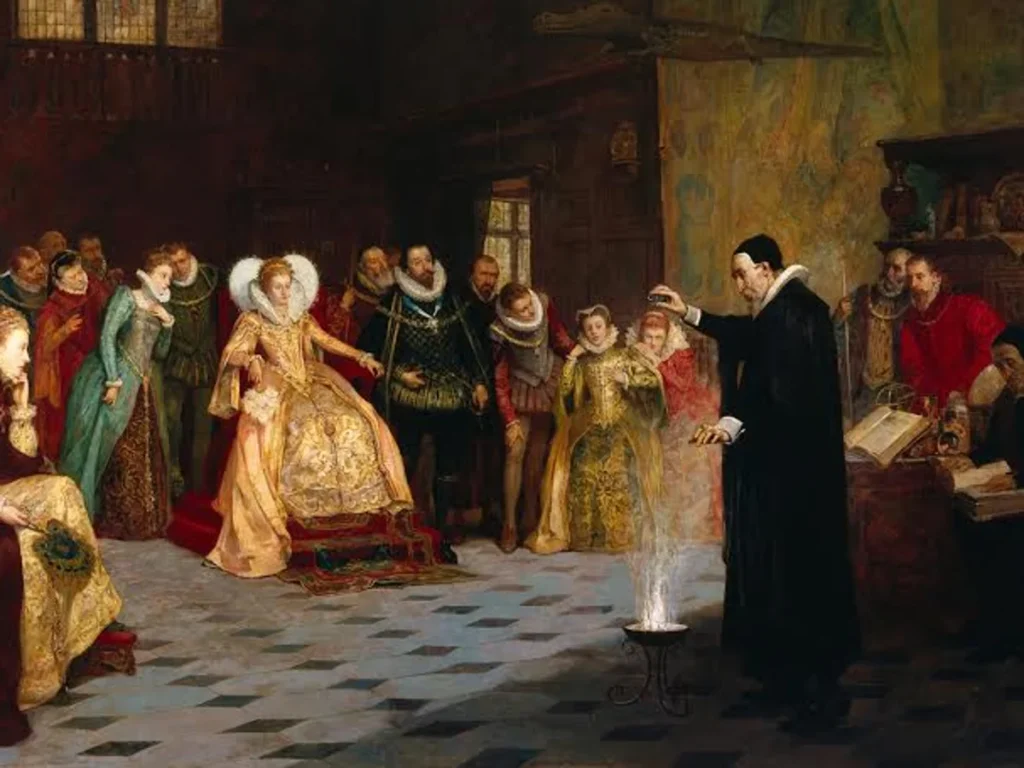
This is the world Elizabeth I moved through when she visited Dee at Mortlake, which she did more than once — pulling up her horse at his garden gate, asking him to explain a book he had sent her, listening with the specific attention of a monarch who understood that natural philosophy and political intelligence were not unrelated concerns. Power in the sixteenth century was still partially supernatural in its self-presentation, and anyone who could read the heavens, interpret celestial omens, or claim access to angelic counsel was not a curiosity but a strategic resource. Dee cast horoscopes for the queen. He advised on the most auspicious date for her coronation. He proposed the legal framework for what he called, in a 1577 treatise, a “British Empire” — a phrase he may have coined — arguing from navigational mathematics and ancient territorial claims that England had a divinely sanctioned destiny across the oceans.
The theological, the imperial, the astronomical, and the alchemical were not departments of knowledge. They were registers of the same question: what is the hidden order of things, and how does a human being position themselves within it correctly? To fail at this question was not merely intellectual error. It was something closer to damnation, a falling out of alignment with a cosmos that expected to be read.

Alchemy as the First Systems Theory
There is a moment most people recognize, even if they have never named it. You are sitting across from someone you love, or someone you are trying to explain yourself to, and you feel the entire architecture of who you are pressing against the walls of language, looking for a door that does not exist. You reach for a metaphor. You abandon it. You start a sentence three times. What you are trying to do, without knowing it, is what John Dee spent the better part of 1564 doing: compress the irreducible into the singular.
The Monas Hieroglyphica, published when Dee was thirty-six, is not a curiosity or an occult footnote. It is one of the most audacious theoretical documents of the sixteenth century, a single glyph — constructed from the symbols of the seven classical planets, the cross of the elements, and the sign of Aries — that Dee claimed encoded the entire structure of reality. Not a map of reality. A compression of it. The difference matters enormously. A map leaves the territory intact and separate. What Dee was attempting was a kind of symbolic singularity, a point at which sign and cosmos collapse into each other and the distinction between knowing and being dissolves. He sent the finished work to Emperor Maximilian II within ten days of completing it, apparently convinced that a sufficiently prepared mind would see in those few strokes of ink what others spent lifetimes circling.
This is not madness. This is a recognizable intellectual hunger. A contemporary physicist chasing a unified field theory, a semiotician trying to locate the ur-sign beneath all signification, a programmer building a compression algorithm that approaches losslessness — they are all doing a version of what Dee was doing. The ambition is structural, not mystical. The question being asked is whether complexity has a root, whether the proliferating surfaces of the world fold back into something singular and generative.
Carl Jung, writing Psychology and Alchemy in 1944, made the argument that alchemy had been systematically misread for three centuries. The mistake, he insisted, was treating it as failed chemistry. What the alchemists were actually doing, without the conceptual vocabulary to say so clearly, was projecting the operations of the unconscious psyche onto matter. The calcination, dissolution, conjunction, the nigredo and the albedo and the rubedo — these were not botched attempts to transmute lead. They were a working phenomenology of psychological transformation, mapped onto the physical world because the inner world had no independent language yet. The alchemist did not know he was describing himself. That unknowing was not a defect. It was the condition of the work.
Dee’s alchemy was precisely this kind of doubled operation. When he worked with the symbol of the Monas, he was not simply encoding astronomical data or chemical procedure. He was enacting a theory of correspondence — the belief, traceable through Neoplatonism and Hermeticism back to the Emerald Tablet’s resonant formula, that the structure of the macrocosm and the structure of the human mind are homologous, that to understand one is to transform the other. This is not mysticism dressed as science. It is an epistemological claim, serious and falsifiable in its own terms: if the cosmos has a grammar, and if consciousness participates in that grammar, then a symbol precise enough to encode the grammar becomes an instrument of genuine knowledge.
The problem is that symbols escape. Everyone who has ever tried to reduce their life’s meaning to a single sentence for a gravestone, or to a tattoo they will carry forever, has encountered this. You find the phrase, the image, the compression that feels finally right — and then you live another six months and the symbol has already become a partial truth, a relic of a self slightly smaller than the one you are now. Not because the symbol was wrong. Because meaning is not a thing that stays still long enough to be held.
Dee knew this. He kept revising the Monas in his mind long after it was printed.
Edward Kelley and the Seduction of the Medium
There is a particular kind of room that exists in the history of desperate men — small, poorly lit, furnished with the props of belief rather than its substance. A table. A polished stone. A man who looks into it and begins to speak. Another man who writes down everything.
John Dee met Edward Kelley in 1582, and from that moment the shape of his spiritual project changed irrevocably. Kelley was thirty years old, which made him roughly half Dee’s age. He had already lost both ears — cropped by law for the crime of forging title deeds in Lancaster — and he wore a black skullcap to conceal the absence. He had traveled under at least two names. He arrived at Mortlake carrying manuscripts he claimed to have found in a tomb, alongside a powder he believed could transmute base metal into gold. He was, by any contemporary measure, a man running from something. What Dee saw in him instead was arrival. The thing he had been waiting for.
René Girard spent much of his intellectual life mapping what he called mimetic desire — the idea, developed most systematically in Mensonge romantique et vérité romanesque in 1961, that human beings do not desire objects directly but through the mediation of others. We want what another person shows us is worth wanting. Kelley showed Dee that the angels were reachable. Not by argument, not by proof — but by demonstration. By performance. And the distinction between those two things collapsed almost immediately inside that room.
The scrying sessions began in March of 1582 and did not stop for years. Dee documented them with extraordinary, almost compulsive precision — hundreds of pages accumulated in what became known as his spiritual diaries, later published in part as A True and Faithful Relation of What Passed for Many Years Between Dr. John Dee and Some Spirits in 1659, more than fifty years after Dee’s death. The sheer density of the record is itself something to reckon with. Every angelic utterance transcribed. Every gesture noted. The sessions had the texture of bureaucracy, which is perhaps the most unsettling thing about them — they looked like work.
What psychiatry has since named folie à deux — the shared delusional disorder that travels between two people in intimate proximity — is not a condition that announces itself. It arrives through gradual calibration. One person sets the terms of what is real. The other, slowly, finds those terms preferable to their own. Psychologist Jean-Pierre Luauté, reviewing the clinical literature, observed that the secondary partner in such a dyad typically does not begin as a true believer but as someone who finds belief structurally useful. Kelley needed Dee’s protection, his legitimacy, his library, his name. Dee needed a channel, a conduit, something that could convert his decades of preparation into actual contact. They were not deceiving each other so much as co-producing a shared necessity.
There is a scene that lives in memory — two men in a dim interior, one of them holding a stone and beginning to speak in a voice slightly unlike his own, the other writing furiously without looking up, as though looking up would break the spell. What makes it unbearable to watch is that the writing man knows, on some level, that he is choosing to believe. Not because the evidence compels him. Because the alternative — that nothing is coming, that thirty years of study have opened no door — is a silence he cannot afford to inhabit.
This is what it means to record what you cannot verify. It does not mean you are simple. It does not mean you are deceived. It means that the act of transcription has become its own form of faith, that the notebook itself has become the altar, and that the man filling it has decided, without quite deciding, that the cost of skepticism is higher than the cost of surrender.
The Enochian Language: Grammar of the Impossible
There is a moment in any serious study of the Enochian material when the sheer structural density of it stops feeling like madness and starts feeling like something else entirely, something harder to dismiss. The language that Edward Kelley began dictating backward, letter by letter, in the spring of 1583 — received in reverse, Dee believed, because its power was too dangerous to speak forward — consists of twenty-one letters with their own phonological values, their own syntax, their own internal grammar, and a lexicon of approximately eight hundred recorded words organized across nineteen hierarchical divisions called Aethyrs, each governed by angelic intelligences arrayed within a system of Watchtowers corresponding to the four cardinal elements. This is not the vocabulary of a fever dream. This is the vocabulary of a system.
Donald Laycock, the Australian linguist who published his comprehensive study of Enochian in 1978, approached the material with the tools of structural linguistics and arrived at a conclusion that satisfied no one cleanly. He found that Enochian possesses genuine phonological patterns — certain consonant clusters, vowel distributions, syllable structures — that recur with the kind of statistical regularity you would expect from a language shaped by the constraints of a human mouth and a human mind. He found syntactic regularities that are not random. And he found, simultaneously, that the vocabulary shows signs of English cognates in proportions too high for coincidence, that the word-formation processes are inconsistent with the behavior of a fully autonomous linguistic system, and that no natural language has ever been recorded emerging fully formed without the evolutionary sediment of centuries. His verdict was calibrated: neither pure invention in any simple sense, nor a natural language by any known definition. A third thing, sitting in a category that did not yet exist.
Noam Chomsky, writing in the 1960s and building on what became the cornerstone of modern generative linguistics, proposed that all human languages share deep structural universals — not surface similarities, but an underlying grammar built into the architecture of the species, what he called universal grammar, the innate capacity that allows any human infant to acquire any human language. The Chomskyan framework suggests that the rules governing language are not arbitrary but biological, embedded in cognitive structure. Which means that when Kelley channeled a language that follows rules, the explanation most available to a rationalist is that his unconscious mind — literate, creative, soaked in Latin and Hebrew and the syntactic patterns of Tudor English — generated those rules automatically, the way any human mind generates linguistic structure, because it cannot help itself.
This is a coherent account. It is also, in a way that deserves to be felt rather than argued away, profoundly strange. The unconscious producing a consistent grammar across months of sessions, maintaining internal coherence across hundreds of pages of dictation received backward in a state of altered attention, generating an angelology of such elaborate cross-referencing that it took twentieth-century occultists decades to map it fully — this explanation saves the category of fraud or delusion while quietly importing into that category something that behaves almost nothing like fraud or delusion.
A man stands at a window at three in the morning, unable to name what is happening to him, and he finds that the language coming out of him has rules. Rules he did not consciously design. Rules that hold. Whether those rules came from angels or from the silent machinery of the human unconscious matters less, in the end, than what their presence tells us about the nature of the impossible — which is that the impossible, when examined closely, almost always turns out to follow a grammar. The question is only whose grammar it is, and whether the distinction between those two answers was ever as solid as we needed it to be.
A vision curated by a filmmaker, not an algorithm
In this video I explain our vision
Power, Surveillance, and the Spy Who Prayed
There is a man in a room full of people who are watching him, and he knows they are watching him, and he performs his strangeness with the precision of a surgeon. He moves through the hall at a slight angle to everyone else, speaks just barely too quietly to be heard without effort, allows his reputation to arrive before him like a herald. The others lean in. They always lean in. That is the point.
John Dee understood something that most scholars of his life prefer to discuss in softer light: that mysticism and statecraft share the same grammar. Both operate through controlled revelation. Both depend on the management of what is known, what is suspected, and what is deliberately left obscure. A man who can speak to angels and a man who can move information across borders without detection are, functionally, engaged in the same art. The audience believes one thing. The practitioner is doing another. The gap between those two things is where all the real work happens.
Glyn Parry’s 2011 study “The Arch Conjuror of England” is perhaps the most uncomfortable book ever written about Dee, precisely because it refuses the comfortable frame of the misunderstood visionary. Parry’s argument is meticulous and damaging to hagiography: Dee’s occult reputation was not merely a private obsession tolerated by powerful patrons. It was, at least in part, a strategic construction. A tool. A positioning device within the dangerous machinery of Elizabethan court politics, where appearing useful to the Crown while remaining indispensable to no single faction was a survival skill as sophisticated as any cryptography.
And Dee was, in the most literal sense, a cryptographer. The network signature he used in correspondence with Francis Walsingham’s intelligence apparatus was not metaphor or legend. It was documented. Two circles, representing the eyes of Her Majesty, connected by a vertical line — 007 — a notation that preceded Ian Fleming‘s fantasy by nearly four centuries and carried none of its glamour. Walsingham ran the most effective surveillance network in Tudor England, a web of informants, double agents, and couriers that stretched from London to Prague to Constantinople. Dee traveled through all of these territories. He traveled repeatedly, at suspicious moments, carrying his instruments and his reputation and, almost certainly, something else.
His extended time on the Continent between 1583 and 1589, nominally in service of the crystal-gazing work with Edward Kelley, took him through courts and cities that were geopolitically critical to England’s interests. He met with Emperor Rudolf II in Prague. He moved through the circles of Caspar de Nidbruck and other figures who operated at the membrane between scholarship and intelligence. The occultist’s peripatetic life, seen through Parry’s lens, begins to look less like spiritual wandering and more like a route carefully chosen by someone with more than one set of instructions.
This is the thing that the romantic narrative of Dee always wants to erase: that power has never had any particular problem with mysticism, as long as mysticism remains useful. The Elizabethan state did not tolerate Dee despite his strangeness. It used his strangeness. A man with a reputation for communing with angels is a man who can travel, ask unusual questions, meet unusual people, and depart without leaving the kind of trace that a diplomat or soldier would leave. His very unintelligibility was a form of cover. The incomprehensible is, almost by definition, difficult to surveil.
What Dee understood, and what Parry forces us to confront, is that the border between devotion and performance has always been negotiable. He prayed. He also calculated. He opened his diaries to the spirits and he opened his letters to the Secretary of State. These things were not contradictions. They were departments of the same operation, running simultaneously, each providing cover for the other, neither entirely false.
The Collapse: Prague, Betrayal, and the Return to Silence

There is a particular kind of devastation that comes not from losing what you never had, but from returning to what you were certain was still yours, only to find the space has quietly redistributed itself around your absence. The rooms are the same shape. The walls stand. And yet everything has already moved on into someone else’s story, and you are the one standing in the doorway who no longer has a name for what you’re looking at.
Dee arrived back in England in 1589 to find Mortlake exactly this way. The house stood. The library did not. In the years he had spent moving through the courts of central Europe — Kraków, then Prague, under the reluctant and ultimately treacherous patronage of Rudolf II — someone had taken the books. Not all at once, not in a single dramatic act of confiscation, but gradually, opportunistically, the way things disappear when no one who loves them is watching. He had assembled what contemporaries estimated at over four thousand volumes, one of the largest private libraries in Elizabethan England, an almost inconceivable concentration of knowledge for a single household. What remained when he returned was furniture, walls, and the particular silence of a place that has been emptied of its meaning.
The years in Prague had not been what he hoped. Rudolf II was a collector of marvels — he filled his Kunstkammer with automata, bezoar stones, celestial globes, and men like Dee who promised contact with forces beyond the ordinary reach of imperial ambition. But Rudolf’s interest was the interest of a museum curator, not a believer. He kept Dee at a distance that felt like proximity, interested enough to maintain the relationship, never committed enough to protect it. And throughout those years, Edward Kelley was unraveling in a direction Dee either could not see or could not afford to acknowledge.
The crisis of 1587 is documented in Dee’s own diary with a particularity that reads less like a record and less like a confession than like a man forcing himself to write down something he desperately wishes were not true. Kelley informed him that the angels — those same messengers whose words had been so carefully transcribed across years of sessions — had issued a new commandment: the two men were to share their wives. Dee’s response, as he recorded it, oscillates between theological submission and unmistakable human horror. He did not refuse immediately. He wrestled. He prayed. He wrote it down and then wrote around it, the prose moving in circles the way a person moves around something they cannot look at directly. The agreement was eventually recorded. Whether it was honored in any meaningful sense remains disputed by scholars. What is not disputed is that it destroyed something between the two men that had already, perhaps, been deteriorating for years.
Erving Goffman, writing in Stigma in 1963, described the predicament of the discredited individual — not someone who fears being found out, but someone who has already been found out, who must now navigate the social world with the knowledge that others possess information that reframes everything. Dee returned to England as this figure. The angelic conversations were known. The shared-wives episode was known. Elizabeth I, who had once received him with something resembling intellectual warmth, was no longer curious about him. He was appointed Warden of Christ’s College in Manchester in 1596, a position that became its own slow humiliation — the fellows refused his authority, the local community regarded him with hostility, and he eventually resigned in 1605, by which point the world had moved entirely past the vocabulary he had spent his life building.
He kept writing. Impoverished, unread, his Monas Hieroglyphica already strange and inaccessible in 1564, even more so forty years later, he kept producing pages that almost no one requested and fewer still understood. He died in 1608 or 1609 — the exact date uncertain, which itself feels like a final indignity — still in motion, still reaching toward something the silence refused to answer.
What the Angels Were For
There is a man who sits every morning at the same table in the same chair, and he has done this for eleven years. Not out of habit, exactly, but out of obligation to something that happened once and has not happened again. He opens a notebook. He does not write in it. He is waiting for the quality of a particular light, the particular silence that preceded an experience he cannot name and cannot disown, an experience that rearranged the furniture of his inner life so completely that everything since has been lived in reference to it. People around him have stopped asking. They recognize the posture of someone who knows something that cannot be handed across a table.
William James, lecturing at Edinburgh in 1901 and 1902, called this the noetic quality of mystical states. He was precise about it, which is itself remarkable for a subject so resistant to precision. He argued that mystical experiences carry with them a conviction of having learned something, a sense of illumination so dense and so certain that the person who has undergone it cannot afterward treat the knowledge as absent, even when they cannot reproduce it, demonstrate it, or describe it without feeling that the description is a betrayal. The Varieties of Religious Experience is not a book about God. It is a book about what happens inside a human being when the cognitive architecture briefly exceeds its own parameters, and James was honest enough to admit that such moments leave a residue no amount of skepticism can fully dissolve.
Dee sat at his own table for nearly three decades. He was not waiting. He was working. The distinction matters because waiting implies passivity, a receptive posture, while what Dee built around his angelic encounters was an active, systematic, almost engineering-minded project. He catalogued. He cross-referenced. He developed a grammar. He built, from what he claimed to have received through the shewstone and through Kelley’s trembling voice, a structure so internally consistent that scholars in the twentieth and twenty-first centuries have continued to find within it patterns that resist dismissal as mere noise. Whether those patterns were placed there by angels, generated by the human unconscious, or constructed by two men who needed desperately to believe they were doing something that mattered is not a question with a clean answer.
The Enochian system might have been a language, in the sense that it possesses phonology, syntax, and a logic of address. It might have been a technology of the self, in Michel Foucault‘s sense, a practice designed to transform the practitioner, to push the subject toward a limit experience that reorganizes what they are capable of perceiving. It might have been a shared madness, follie à deux elevated to cosmic ambition by two men who were each other’s only witness and each other’s only confirmation. Or it might have been something that has no category yet, a map drawn at the edge of what human cognition can sustain before it folds back on itself, unable to represent what it has briefly touched.
James believed that the noetic quality of mystical experience meant that such states had to be taken seriously as events in the history of knowledge, not validated as truth but not dismissed as error. They are, he wrote, states of insight into depths of truth unplumbed by the discursive intellect. Dee would have recognized that sentence as his own autobiography.
What Dee was reaching for was not power, not madness, not consolation, though it wore each of those masks at different moments across the long decades of his work. He was reaching for something that sat just past the boundary of what language, including the divine language he believed he was recovering, could finally hold, and he spent his life building elaborate structures at that boundary, not to cross it, but because living near it was the only condition in which he felt fully awake.
🔮 Mystics, Mages & the Invisible Architecture of Reality
John Dee stood at the crossroads of Renaissance science and celestial mysticism, channeling angelic voices and forging a secret language said to predate humanity itself. His work did not emerge in isolation — it grew from a rich soil of alchemical tradition, Hermetic philosophy, and occult ambition shared by many extraordinary minds across the centuries. These related articles illuminate the wider world Dee inhabited and the esoteric currents that flowed through his era and beyond.
Giordano Bruno and the Hermetic Tradition
Giordano Bruno was perhaps the most daring Hermetic thinker of the Renaissance, weaving together magic, memory, and cosmology into a vision of an infinite universe animated by divine intelligence. Like John Dee, Bruno drew deeply from the Hermetic tradition, believing that the magus could align himself with the cosmic forces underlying all creation. His tragic fate at the hands of the Inquisition only underscores how dangerous such ideas were in an age when the boundary between philosophy and heresy was razor-thin.
GO TO THE SELECTION: Giordano Bruno and the Hermetic Tradition
Paracelsus: Life and Alchemical Thought
Paracelsus revolutionized both medicine and alchemical thought by insisting that the human body was a microcosm of the universe, governed by the same spiritual forces that moved the stars and elements. His synthesis of alchemy, astrology, and natural magic shares significant ground with John Dee’s own quest to decode the hidden grammar of creation. Understanding Paracelsus is essential for grasping the intellectual atmosphere in which Dee’s angelic conversations and alchemical ambitions took root.
GO TO THE SELECTION: Paracelsus: Life and Alchemical Thought
Aleister Crowley: the Great Beast and the Religion of Will
Aleister Crowley, centuries after Dee, would pick up the threads of ceremonial magic and angelic invocation with his own system of Thelema and the infamous Enochian workings he adapted from Dee and Kelley’s original transmissions. Crowley’s obsessive engagement with the Enochian system transformed what Dee had recorded in cryptic diaries into a living magical practice still used by occultists today. Exploring Crowley’s life reveals how Dee’s legacy continued to pulse through the veins of Western esotericism long after the Elizabethan age.
GO TO THE SELECTION: Aleister Crowley: the Great Beast and the Religion of Will
What Is Alchemy: History and Origins
Alchemy’s origins stretch back through Hellenistic Egypt, Islamic scholarship, and medieval Europe, forming the deep historical current from which figures like John Dee drew their symbolic vocabulary and spiritual ambitions. Understanding what alchemy truly was — not mere proto-chemistry but a sacred art aimed at the transformation of matter and soul — is indispensable for decoding Dee’s own pursuits. This foundational article maps the terrain that made the angelic experiments and Philosopher’s Stone quests of the Renaissance not only possible but spiritually urgent.
GO TO THE SELECTION: What Is Alchemy: History and Origins
Discover the Hidden Worlds of Independent Cinema
If these journeys through angelic language, alchemical fire, and mystical vision have stirred something in you, Indiecinema streaming is your next portal. Our curated selection of independent and esoteric cinema brings the invisible worlds of mystics and seekers to life on screen in ways mainstream film rarely dares. Step inside and let independent cinema take you where the maps run out.
👉 EXPLORE THE CATALOG: Watch Indie Films in Streaming
A vision curated by a filmmaker, not an algorithm
In this video I explain our vision

