
The Body Before the Idea
You are standing in it before you understand what it is. The heat arrives not as weather but as verdict — a physical fact pressed against your skin with the indifference of something that predates every word you know for discomfort. The ground beneath your boots is not dirt in any sense you grew up with; it is something older and less forgiving, cracked into polygons by centuries of contraction, pale as old bone, scattered with stones that have been here since before the continent held its current shape. You turn to find a landmark and there is nothing. There is only more of the same, extending in every direction to a horizon so flat and so far that the eye, trained by cities to stop at walls and windows, keeps reaching past it involuntarily, keeps searching for the edge of something, and finds only sky bleeding into rock.

The silence is the first thing that destabilizes you, because it is not actually silence. There is wind moving through creosote at a frequency just below language, a dry rustling that sounds like whispered warnings in a room you just left. There are birds somewhere — not nearby, not visible — whose calls arrive stripped of all context, pure sound detached from source. You realize that what you have been calling silence for your entire life was in fact the absence of machinery, which is a completely different thing. True quiet, the kind that has existed in the Mojave basin for roughly fifteen million years, has texture and density. It presses back.
Your sense of scale collapses next, and this happens faster than you expect. The mountains on the eastern edge look close enough to reach before afternoon. They are forty miles away. The Joshua trees that seemed like scattered individuals from the road reveal themselves, on foot, to be a community operating on a timescale so alien to human biography that a single specimen can live for five hundred years and register your presence less than it registers a change in humidity. You are not a visitor in any social sense the word implies. You are a temporary atmospheric condition.
The body registers all of this before the mind produces a single coherent response. Sweat evaporates so rapidly in the single-digit humidity that you feel dry even as you dehydrate — a deception so elegant it has killed people who trusted their own physical sensations. The UV index in the Sonoran summer regularly exceeds eleven, which is the point at which the standard scale simply labels the category “extreme” and stops offering gradations, as though the numbers themselves become inadequate. Your pupils dilate against the brightness even through sunglasses, your heartbeat shifts, the architecture of your attention reorganizes around the single biological imperative of not dying here, which turns out to be a surprisingly clarifying cognitive state.
What gets stripped away in those first hours is not comfort — comfort is too small a word for what disappears. What disappears is the entire scaffolding of assumed context that urban and suburban life constructs around a human being so thoroughly that most people never notice it exists. Traffic patterns, social schedules, the sound of HVAC systems cycling on and off, the ambient glow of screens through windows at night — all of it functions as a kind of continuous narration that tells you who you are by telling you where you are. Remove it completely, replace it with nothing but geological time and available light, and something in the self becomes suddenly, uncomfortably provisional.
You have no idea how long you have been standing here. Your phone has one bar. The shadow of a red-tailed hawk crosses the ground twenty feet to your left without making a sound, and you watch it move across the pale earth like a thought moving across a mind that no longer belongs to you.
Along For The Ride
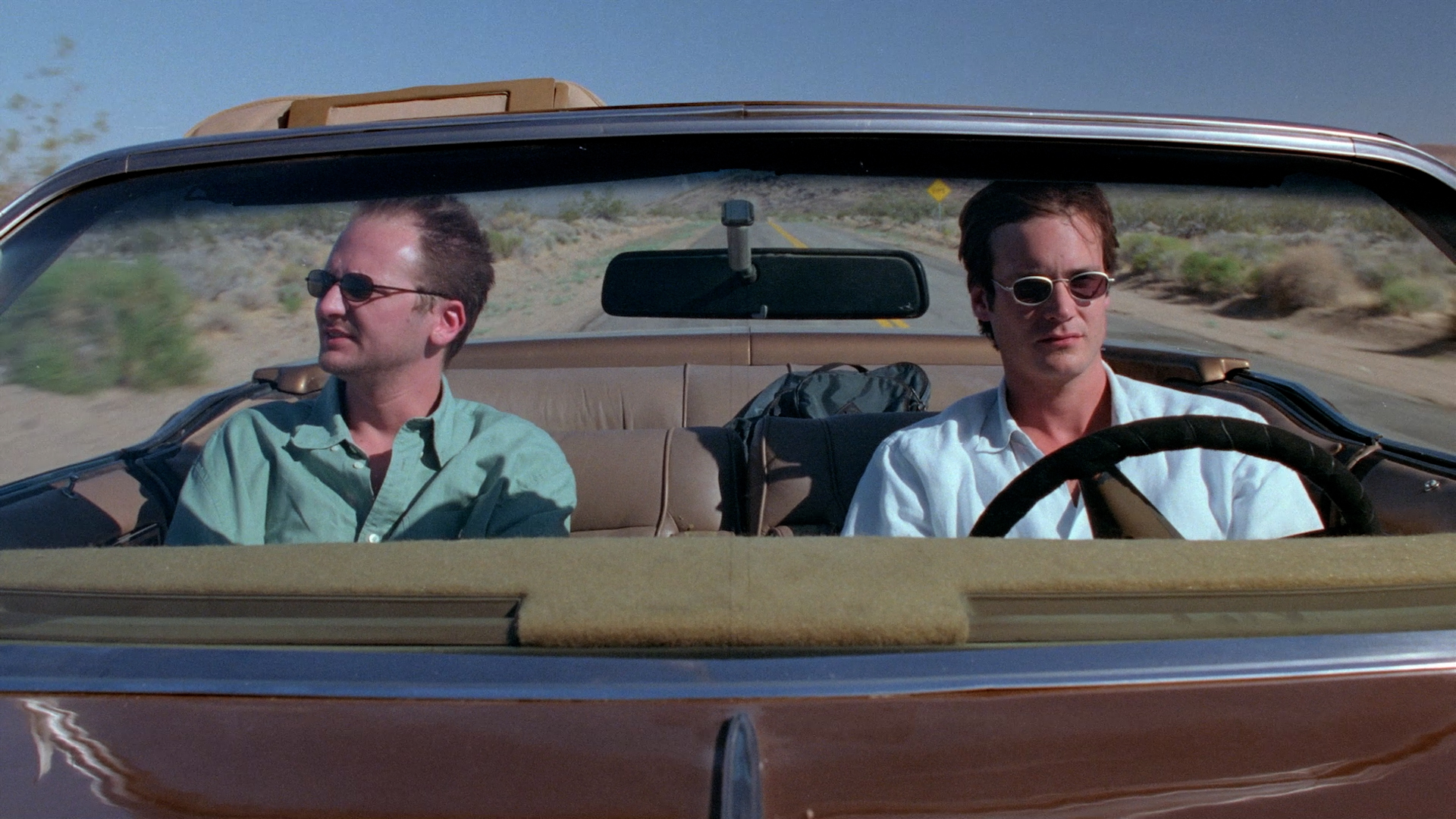
Drama, Comedy, by Bryan Simon, USA, 2001.
Two brothers, Terry (Randy Batinkoff) and Vance (Dylan Haggerty), embark on a journey into the desert with the body of their recently deceased father. Their goal is to find a burial site for him, but along the way unresolved family conflicts resurface. Terry, a successful former baseball player, has always exerted a dominant influence on the younger Vance, a humble mailman. Both carry within themselves the burden of a complicated relationship with their father, Jake (J.E. Freeman), a former professional player obsessed with sports. Even after his death, Jake appears to his children in dream sequences, but instead of offering wise advice, he continues to be distant and authoritarian. The journey thus becomes not only a physical but an emotional journey, in which the two brothers confront their mutual grudges and the emotional legacy of their father.
The film, directed by Bryan Simon with a budget of 150,000 dollars, was shot in extreme weather conditions, with a screenplay adapted by Jim Moores from a work by Randall Wheatley. The film also explores the role of sport as a vehicle for communication between father and son. For many men, expressing feelings is difficult, while talking about sport is a natural and shared language. "Along for the Ride" addresses these issues with sensitivity and realism, resulting in a touching work for those who have experienced similar family dynamics. An indie not to be missed for lovers of quality independent cinema.
LANGUAGE: English
SUBTITLES: Spanish, French, German, Portuguese
What Emptiness Was Before We Named It
You stand at the edge of what the government once called nothing, and the problem is not that you feel small — it is that you feel accused. The ground does not curve away from you apologetically. It simply extends, flat and mineral and indifferent to the category assigned to it in 1862 by men who had never touched it.
The Homestead Act passed on May 20th of that year, and its logic was deceptively simple: 160 acres of public land, free to any citizen willing to cultivate it for five years. Cultivation was the operative word, the moral operator hidden inside a legal instrument. What could be farmed was civilized. What resisted the plow was, by implication, incomplete — not yet land in any meaningful civic sense, just raw material waiting to be redeemed. The Great Basin, the Mojave, the Colorado Plateau: these territories did not resist the plow by accident or temporary misfortune. They resisted it constitutionally, geologically, across millions of years of their own internal logic. The federal legislation had no category for land that simply refused to participate in the American project of transformation. So it invented one retroactively: wasteland.
John Charles Frémont, whose surveys of the Great Basin in the 1840s remain among the most meticulous geographical documents of the period, wrote of the region with a vocabulary that oscillated between awe and bureaucratic alarm. His 1845 report to Congress described an interior drainage system — water flowing nowhere, evaporating into alkaline flats — as though the land were performing some kind of physiological defect. The absence of outflow to the sea read, in the cartographic imagination of the era, as a symptom of incompleteness. A healthy landscape drained properly. It participated in the hydrological cycle the way a productive citizen participated in commerce. The Great Basin drained inward, which meant, in the logic of the period, that it hoarded rather than contributed. The surveyor’s notebook became, without intending to, a diagnostic ledger.
What is worth sitting with is that Frémont was describing a system of extraordinary complexity — thousands of species adapted precisely to those alkaline conditions, microbial communities in the salt flats that predate multicellular life, migratory bird routes that had operated for longer than human language has existed. The Paiute, Shoshone, and Goshute peoples had sustained themselves across these same landscapes for at least twelve thousand years, moving with the seasonal availability of pine nuts, fish, and game in patterns that required an intimate and precise knowledge of what the surveyors were calling dead zones. Their presence was not invisible to Frémont — it appeared in his journals — but it did not register as evidence of the land’s productivity, because productivity had already been defined in a way that excluded them.
This is the mechanism that turns geography into ideology: you establish a standard of value, apply it to a landscape, and then treat the landscape’s failure to meet that standard as an intrinsic property of the land rather than a limitation of the standard itself. By 1878, when John Wesley Powell submitted his Report on the Lands of the Arid Region of the United States to Congress, he was essentially trying to correct the category error the Homestead Act had enshrined into law. Powell argued that 160 acres was a meaningless unit in arid terrain — that the entire framework of eastern agricultural logic could not simply be transplanted westward. Congress ignored him for the better part of a century, and the Dust Bowl of the 1930s, the desertification of over 100 million acres of formerly productive Great Plains soil, was partly a consequence of that refusal to hear a geographer explain that the land had its own terms.
The emptiness, then, was never a property of the desert. It was a projection — a bureaucratic verdict written in the language of agricultural utility and mapped onto terrain that had never agreed to be judged by those terms.

The Puritan Negative Space
You have never stood in the Mojave and felt guilty, but you have felt its cousin — that specific unease that rises when you sit still too long on a weekday afternoon, when you produce nothing, when the hours pass without yield. That sensation has a theological address. It was constructed, brick by brick, in the Geneva of John Calvin and shipped westward across an ocean as cargo more durable than timber or salt cod, and it arrived on the North American continent before any Anglo settler had ever laid eyes on a basin of cracked alkaline earth.
Max Weber, writing in 1905, traced the genealogy of that unease with the precision of a diagnostician. His argument in “The Protestant Ethic and the Spirit of Capitalism” was not simply that Calvinist doctrine encouraged hard work. It was that a specific terror — the terror of election, of not knowing whether you were among the saved — had been metabolized into compulsive productivity as a symptom of grace. The chosen man was a busy man. The idle man was already damned. What Weber identified was not a work ethic but a theological panic wearing the costume of virtue. And once panic becomes virtue, it begins to organize the landscape around it.
Land that does not produce is land that confesses. This is the logic that Anglo-Protestant settlers carried into the American interior, and it meant that the desert arrived pre-interpreted before the first wagon wheel cut a rut in its floor. The Puritan tradition had already established a grammar of sacred terrain: the tended field was covenant, the managed forest was stewardship, the garden was election made visible. The reverse was equally legible. Wilderness — and particularly arid, unyielding wilderness — read as abandonment, as a space from which Providence had withheld its hand. The settlers who encountered the Great Basin in the 1840s did not need to construct a negative theology of dry land from scratch. They inherited one that had been two centuries in refinement.
What is remarkable is how completely this inheritance bypassed conscious examination. The historian Patricia Limerick, in “The Legacy of Conquest” published in 1987, documented the degree to which Anglo-American expansion was narrated through the framework of improvement — the land was not taken, it was rescued from its own emptiness. This was not cynical propaganda, which would have required distance from the belief. It was genuine conviction, which is far more durable and far more dangerous. A man who knows he is lying can be argued with. A man who has absorbed a theological category as perception cannot be reached by argument at all, because he is not making a claim — he is simply seeing.
The desert, in this framework, became a psychological projection before it became a geographic encounter. The barrenness that troubled Anglo-American settlers was not merely outside them. Puritanism had spent two centuries cultivating an interior desert — the soul stripped of ornament, suspicious of pleasure, hostile to rest — and the landscape of the American West reflected that interior back at them with an accuracy that must have been genuinely disorienting. The dry wash, the salt flat, the ridge of bare volcanic rock: these were not alien to the Protestant imagination. They were disturbingly familiar. They looked like conscience.
This is why so many early Anglo accounts of the desert resort immediately to moral language — not metaphorically, but structurally, as though the landscape demanded ethical evaluation before it could be described. John C. Fremont’s 1845 report to Congress on his western expeditions describes the Great Basin not as inhospitable terrain but as land that has “refused” cultivation, a verb that assigns the desert agency and fault simultaneously. The ground itself becomes a refusal, a negation, a thing that will not participate in the covenant.
Indigenous Plenitude and the Cartography of Erasure
You have been walking for three hours across ground that looks, to you, like nothing. Cracked alkaline flats, a few brittlebush skeletons, the occasional saguaro casting almost no shade. Your water is getting low and you are beginning to understand, in the most physical way possible, that you do not know how to read what surrounds you.
A Tohono O’odham elder would see the same terrain as a library. The desert of the Sonoran basin was, for millennia before any European boot touched its gravel, a system of precise and transmissible knowledge: which depressions hold water twenty-four hours after a storm, which palo verde root can be followed to a seep, which animal tracks converge at dawn and therefore mark a hidden spring. Ethnobotanist Gary Paul Nabhan documented in his 1982 work “The Desert Smells Like Rain” that Tohono O’odham agricultural and hydrological knowledge had produced reliable food systems in one of the harshest environments on the continent, including floodwater farming techniques that required reading the land’s surface geometry with a precision that no surveyor’s instrument could replicate. The desert was not empty. It was annotated.
Diné cosmology — what outsiders call Navajo — went further, because it refused the separation between landscape and meaning that Western epistemology treats as obvious. The four sacred mountains marking the boundaries of Dinétah were not metaphors. They were jurisdictional and ontological facts: the land as a living body with its own relational grammar. Keith Basso’s work among the Western Apache, published as “Wisdom Sits in Places” in 1996, demonstrated with uncomfortable precision that place-names in these cultures functioned as compressed moral and historical archives — a single name encoding an entire narrative about how to behave, what happened there, who was responsible. The land spoke. Not symbolically. Procedurally. You could navigate, govern, and remember by attending to it.
Then the surveys arrived. Between 1853 and 1879, the United States government dispatched a sequence of expeditions — the Pacific Railroad Surveys, the Wheeler Survey, the Hayden Survey — explicitly tasked with producing cartographic knowledge that could support territorial administration and resource extraction. The maps these surveys produced were masterworks of selective blindness. Indigenous place-names were systematically replaced or simply omitted. Water sources known to every Native community in a given region appeared as blank terrain or were marked speculatively, incorrectly. The 1879 founding of the United States Geological Survey consolidated this process into a permanent institutional apparatus, and by the 1890s, official federal maps of the Southwest depicted vast territories as featureless voids — no settlements, no paths, no hydrological knowledge, no history. The cartographic term for this erasure is “terra nullius” in its practical, visual form: land that looks, on paper, like it contains nothing worth inheriting.
What settlers encountered when they moved into these mapped territories was therefore not the desert itself but a prior representation of the desert — a document that had already performed the cognitive work of emptying the landscape before anyone physically crossed it. The historian Patricia Limerick, in “The Legacy of Conquest” published in 1987, showed how this representational machinery was not incidental to westward expansion but constitutive of it: you cannot morally justify taking what is already legibly occupied, so occupation must first be rendered invisible, and the most efficient instrument for that rendering is a map that omits it. The settlers who described their experience as pioneers entering virgin wilderness were, in a precise sense, reading a fiction that the state had authored for them. Their sense of discovery was real as a psychological event. As an epistemological claim, it was the residue of a bureaucratic deletion.
What persists from that deletion is a trained incapacity — a habit of not-seeing that was institutionalized over four decades of survey work and has since been absorbed into the aesthetic vocabulary through which the desert is still photographed, painted, and imagined as the place where the self goes to encounter its own solitude, as if solitude were a feature of the ground rather than a condition produced by forgetting who already lived there.
Solitude as Pathology, Solitude as Method
You drive four hours into the Mojave with a dead phone and realize, somewhere around the second hour, that the silence is not peaceful. It is loud in a way that has nothing to do with sound. Something is assembling itself in the gap where distraction used to be, and it does not feel like clarity — it feels like exposure, like something unfinished in you has finally caught up.
Paul Tillich, writing in 1952 in The Courage to Be, argued that anxiety is not a pathology to be treated but an ontological condition to be confronted — the trembling at the edge of nonbeing that every self must eventually face. He distinguished this from fear, which always has an object you can name and therefore manage. Anxiety has no object. It is the awareness of your own contingency, of the fact that you exist provisionally, that nothing in the structure of the universe guarantees your continuation or your meaning. Most of what modern civilization produces, Tillich understood, is elaborate infrastructure for not being alone with that awareness. The shopping mall, the news cycle, the social feed — these are not entertainment. They are ontological insulation, and they work precisely because they are ceaseless.
D.W. Winnicott, working in the clinical tradition rather than the theological one, arrived at a related discovery through a different door. His 1958 paper “The Capacity to Be Alone” proposed that the ability to be genuinely solitary — not lonely, not bored, not in retreat from others, but simply present with oneself — is a developmental achievement, not a default condition. It requires, paradoxically, having first been held well enough by another person that the self learns it can sustain itself without constant relational proof of its own existence. The people who cannot be alone are not weak. They are people for whom solitude was never made safe, who were handed distraction as a substitute for presence, and who grew up in environments where inwardness was treated as something to be corrected rather than cultivated.
The desert makes no accommodation for this history. It does not calibrate its demands to what you were or were not given in childhood. It simply continues, indifferent, in every direction, at a scale that makes the personal feel temporarily irrelevant and then, in the next moment, inescapably central. This oscillation — between feeling dissolved and feeling violently, uncomfortably particular — is the specific crisis the desert induces, and it is experienced as crisis precisely because the culture that produces most of its visitors has spent decades ensuring they would be unprepared for it.
Consumer society’s deepest investment is not in selling you products. It is in engineering a self that requires continuous external input to feel real. The business model of attention economies, documented in detail by researchers like Shoshana Zuboff in The Age of Surveillance Capitalism, published in 2019, depends not on your engagement but on your inability to disengage — on the creation of a psychological architecture in which five minutes of silence feels like deprivation. This is not incidental to the economy. It is foundational. A self that can tolerate its own company is a self that is structurally less profitable.
What the desert confronts you with, then, is not emptiness but the precise dimensions of what has been hollowed out. The discomfort is not caused by the absence of stimulation. It is caused by the sudden visibility of how much stimulation was required to prevent you from noticing that absence. The crisis is diagnostic. And here is where the landscape stops being scenery and starts functioning as something closer to a clinical instrument — not gentle, not therapeutic in any reassuring sense, but accurate in the way that a fever is accurate, burning through exactly what made the body vulnerable in the first place.
A vision curated by a filmmaker, not an algorithm
In this video I explain our vision
The Nuclear Sublime and the Landscape of Consequence

A man sits in a vinyl booth at the edge of the Nevada flats, a cup of coffee cooling beside his hand, a newspaper folded open to a short column near the bottom of page four. The detonation is scheduled for two in the afternoon. He reads the paragraph twice, folds the paper, and looks out the window at the bleached expanse that ends somewhere beyond the range of human sight. He finishes the coffee. He leaves a coin on the table. No one in the diner looks up.
That indifference is not stupidity. It is something far more precise: it is a culture’s learned capacity to absorb the unabsorbable by placing it at the edge of attention rather than the center. The desert had already been doing that work for a century — pushing the unbearable toward the horizon, making enormity feel like geography. The nuclear program simply inherited a ready-made theater. When J. Robert Oppenheimer stood at Trinity on July 16, 1945, and the fireball rose 40,000 feet into the pre-dawn sky over the Jornada del Muerto — the Journey of the Dead Man — the name of that stretch of New Mexico desert was not a coincidence anyone bothered to examine. The Americans had chosen, unconsciously or otherwise, to conduct the single most consequential act in the history of warfare on a landscape that had already been named for annihilation.
What followed was not reckoning but logistics. Between 1951 and 1992, the Nevada Test Site recorded 928 detonations, a number that reads like a bureaucratic inventory and lands with the moral weight of one only if you slow down long enough to feel each unit as a separate event, a separate column of vaporized earth, a separate invisible migration of isotopes into the bodies of the Shoshone people who had lived in that basin for ten thousand years before a federal designation declared it uninhabited. The sociologist Kai Erikson, in his 1994 study A New Species of Trouble, identified what he called “a new kind of anxiety” specific to technological disasters — one characterized not by the sharp trauma of sudden loss but by the chronic, invisible contamination of places, bodies, and futures that leaves no visible wound and therefore permits no clean grief. The desert, already a landscape stripped of visible life, became the perfect container for this new species of consequence: you could not see what had been done to it, and that invisibility became an active social instrument.
Edmund Burke drew a distinction in 1757 between the beautiful and the sublime that has never been more precisely illustrated than in the mushroom cloud itself: beauty produces pleasure through harmony and proportion, while the sublime produces a kind of terror that carries within it an obscure satisfaction, a proof of scale that dwarfs the self without quite destroying it. The nuclear test was engineered sublimity, a detonation calibrated not only for military data but for the visceral confirmation of national power. Photographers were brought in. Observation bleachers were erected in the desert. Citizens were bused to witness shots with names like Tumbler-Snapper and Upshot-Knothole, the language itself a strange domestication, a barnyard softening of megaton yields. The experience of standing before the detonation was meant to produce awe that translated into loyalty, the desert enlisted as a stage for patriotic terror.
But landscapes accumulate what is done to them in ways that outlast the intentions of the people who used them. The half-life of cesium-137 is thirty years. The half-life of plutonium-239 is twenty-four thousand years. The desert does not forget on a human schedule, and the fantasy that empty space is consequence-free space — that what happens at the margin does not eventually move toward the center — is perhaps the defining American delusion about its own geography.
Speed, Glass, and the Prevention of Arrival
You pass through the Mojave at eighty miles an hour and you do not feel the heat. This is not incidental — it is the point. The glass between your face and the desert is not a window in any meaningful sense of the word; it is a screen, and what plays on it is a landscape rendered safe by velocity and climate control, a moving image of a place you are technically inside but have never, not for a single moment, inhabited.
The Federal Aid Highway Act of 1956 was signed by Eisenhower with an explicit military rationale — the network of 41,000 miles was modeled on the German Autobahn, designed to move troops and civilians rapidly across continental distances in the event of nuclear attack. But the cultural consequence was something its architects either did not foresee or preferred not to name: the systematic conversion of American terrain into scenery. The desert, which had previously demanded weeks of dangerous negotiation, could now be crossed in a single day without leaving a controlled environment. You did not need to know the Sonoran or the Great Basin. You needed only to endure them until the next city materialized.
Gaston Bachelard, writing in 1958 in “The Poetics of Space,” argued that inside and outside are not neutral geometric conditions but existential ones — that the threshold between interior and exterior is where the self is actually formed, tested, and changed. To be inside a house is to be held; to step outside is to be exposed to what exceeds you. The encounter between the two is the site of genuine experience. The automobile collapses this dialectic entirely. It is an interior that moves through an exterior without ever permitting the crossing of the threshold. You are perpetually inside, perpetually held, and the landscape outside the glass cannot touch you. What Bachelard diagnosed as the ontological structure of dwelling, the highway system weaponized as a mode of avoidance.
This matters because the American desert is precisely the kind of space that requires threshold crossing to become anything other than empty. Its meaning — and it has always had one, as every Indigenous culture that lived within it understood — is inseparable from bodily exposure. The Tohono O’odham people conducted ritual journeys into the Sonoran that lasted days, barefoot on salt flats, under a sun that offered no negotiation. The desert registered on the body as a teacher registers on a student: through pressure, through demand, through the refusal to accommodate. Every petroglyph in the Coso Range, some dating to 16,000 years ago, was made by a person who arrived on foot, carrying their own water, inside the place rather than moving through it.
What the Interstate produces instead is what the French theorist Paul Virilio would later call the aesthetics of disappearance — the idea that speed does not simply move us through space but erases our relationship to it. At eighty miles an hour, a Joshua tree at the roadside exists for approximately two seconds before it is gone. You do not learn a Joshua tree in two seconds. You do not learn anything about a place by passing through it at that speed. What you accumulate instead is a sensation of having covered distance, which is then confused — consistently, culturally, almost universally — with having traveled.
The rest stop changes none of this. You step out into a parking lot engineered to prevent wandering, use a bathroom that smells identical to every other bathroom on every other Interstate in every other desert, and return to the vehicle. The managed pause, the permitted glimpse, the timed exposure: these are not encounters with the Mojave. They are proofs of concept for a system designed to deliver you to your destination without the desert having made any lasting claim on who you are.
The Mirror the Culture Refused to Look Into
You go looking for solitude in the Mojave and you find a fence. Not always immediately — sometimes you drive for an hour on a two-lane road that seems to promise genuine remoteness, the Joshua trees thinning, the silence thickening, the sky doing that thing it does at elevation where it turns a shade of blue with no adequate name — and then the fence appears, and behind it the infrastructure of something classified, something federal, something that politely declines to explain itself. This is not incidental. The concentration of restricted military land across the American Southwest is staggering in its scale: roughly two-thirds of Nevada is federally administered, the Mojave hosts overlapping jurisdictions of military testing ranges, national monuments, and Bureau of Land Management territory that effectively renders the terrain legally navigable but humanly absent. The emptiest-seeming landscape in North America is also among the most deliberately controlled.
What this means psychologically is worth sitting with. A culture reveals its anxiety by what it locks away. The desert was psychologically destabilizing long before anyone theorized it — its capacity to dissolve ego, to strip the self of its social scaffolding, to make the human body feel contingent rather than sovereign, made it threatening in precisely the register that organized power finds most illegible. Carl Jung observed in 1928, in his essay “The Spiritual Problem of Modern Man,” that Western civilization’s dominant neurosis was its estrangement from the irrational and the numinous — from experiences that exceed management. The desert is structurally irrational. It does not optimize. It does not produce. It simply persists, indifferent to whether you live or die inside it, which is the one kind of indifference that industrial civilization cannot metabolize or monetize.
Edward Abbey handed the culture a document in 1968 that named this with unusual precision. “Desert Solitaire” was not a nature book in the tradition of careful observation and gentle uplift; it was an act of controlled fury, a sustained argument that the landscape itself was being colonized by the very people who claimed to love it — tourists with trailers, bureaucrats with management plans, a National Park Service that had begun paving access roads through Arches so that Americans could experience wilderness without leaving their cars. Abbey understood that the mediation of the experience was the destruction of the experience. He was celebrated, taught in university courses, quoted on the back of water bottles, and thereby rendered harmless. The text was absorbed into the culture’s self-congratulatory archive of ecological concern, which meant it could be appreciated without being acted upon. Museumification is one of the more elegant mechanisms a culture uses to contain what it cannot answer.
What the desert keeps offering, and what the culture keeps declining, is the specific terror of sufficiency — the recognition that the self does not require the density of stimulation that modern life treats as baseline. Neurological research conducted over the last two decades, including work from the environmental psychology laboratories associated with Rachel and Stephen Kaplan’s attention restoration theory, has documented what desert-dwellers have known experientially: sustained exposure to vast, low-stimulus environments restructures the attentional system, quiets the prefrontal cortex’s relentless prioritization machinery, and produces states of awareness that resemble, physiologically, what contemplative traditions have always called presence. The culture knows this, abstractly, the way it knows most things that threaten its operating premises — at a distance sufficient to prevent application.
So the desert sits there, as it has for geological time scales that make the entire human story look like an afternoon misunderstanding, baking in its own testimony, fenced and monitored and occasionally visited by people who return to the city having felt something they cannot quite name and do not quite pursue, the landscape perpetually almost-seen, the mirror tilted at an angle that lets the culture walk past it without catching its own reflection.
🌵 When Landscape Becomes the Language of the Soul
The American desert is not merely a geographical fact — it is a philosophical condition, a space where the ego dissolves and something deeper surfaces. These related articles explore the intellectual and spiritual coordinates that surround this vast, silent territory of inner reckoning.
American Transcendentalism: History and Thought
American Transcendentalism placed nature at the center of a radical spiritual and philosophical project, insisting that the wilderness was not empty but overflowing with meaning. Writers like Emerson and Thoreau saw landscape as a mirror of the divine within the self, a conviction that would echo through every American artist who ever stared into open desert space. Understanding this tradition is essential to grasping why the American desert carries such enormous metaphysical weight in literature and cinema.
GO TO THE SELECTION: American Transcendentalism: History and Thought
Genius Loci: When Places Have a Soul
The concept of Genius Loci — the spirit or soul of a place — offers one of the most compelling frameworks for understanding why certain landscapes seem to speak directly to the human psyche. From ancient Roman religion to contemporary phenomenology, the idea that places possess an invisible but palpable identity has shaped art, literature, and architecture across centuries. The desert, with its crushing silence and geometric clarity, is perhaps the purest expression of this haunting presence.
GO TO THE SELECTION: Genius Loci: When Places Have a Soul
Gaston Bachelard and the Poetics of Inhabited Spaces
Gaston Bachelard‘s poetics of inhabited spaces invites us to consider how environments shape consciousness from the inside out, transforming mere geography into lived imagination. His phenomenological approach reveals that spaces are never neutral — they are charged with memory, desire, and the architecture of the soul. Applied to the desert, Bachelard’s thinking helps us understand how barrenness can paradoxically become the most fertile ground for inner transformation.
GO TO THE SELECTION: Gaston Bachelard and the Poetics of Inhabited Spaces
The Aesthetics of the Sublime: When Beauty Is Frightening
The aesthetics of the sublime — that overwhelming encounter with forces larger than human scale — finds its most immediate natural embodiment in the desert’s infinite horizons and annihilating silences. From Burke’s terror to Kant’s moral elevation, the sublime names the experience of standing before something that dwarfs reason yet somehow enlarges the spirit. The desert, precisely because it offers so little to the senses, strips away everything that is not essential, forcing a confrontation with what remains.
GO TO THE SELECTION: The Aesthetics of the Sublime: When Beauty Is Frightening
Discover the Cinema That Goes Where Maps End
If these themes resonate with you — landscape as destiny, silence as revelation, the journey inward disguised as a journey outward — then independent cinema is where you belong. On Indiecinema you will find films that dare to dwell in open spaces, films that trust the desert, the void, and the soul of the image. Come explore a streaming platform built for those who watch with their eyes and their interior life.
👉 EXPLORE THE CATALOG: Watch Indie Films in Streaming
A vision curated by a filmmaker, not an algorithm
In this video I explain our vision

