
The Myth of the Solitary Genius
You are alone in a cold room, staring at a canvas that has not moved in three days, and somewhere in the back of your mind lives the image of a man in a garret, feverish, translating his suffering into immortal marks. That image did not arrive by accident. It was manufactured, with considerable care, by people who had reasons to manufacture it.

The figure of the solitary genius is one of the most successful ideological constructions of the last three centuries. Its genealogy runs through the German Sturm und Drang movement of the 1770s, through the English Romantics who turned Byron’s theatrical self-exile into a template for artistic identity, and into the popular biographies of the nineteenth century that transformed the messy, collaborative, commercially entangled lives of actual artists into parables of heroic isolation. When Giorgio Vasari wrote his Lives of the Artists in 1550, he was already rehearsing the formula, depicting Michelangelo as a man touched by divine fury, working alone, answering to no one. What Vasari omitted was the army of assistants in the Sistine Chapel, the sustained patronage negotiations with Julius II, the guild structures that had trained Michelangelo’s hands long before he raised them toward any ceiling.
Norbert Elias spent years excavating this problem in his 1993 study Mozart: Portrait of a Genius, demonstrating that Mozart’s received image as a free-floating, divinely inspired individual was constructed retrospectively, after his death, to serve the cultural needs of a rising bourgeoisie that wanted art to feel transcendent and therefore unthreatening to its own economic logic. The actual Wolfgang Amadeus Mozart was a court musician, dependent on aristocratic patronage, constrained by commission requirements, trained within a family enterprise run by his father Leopold with the methodical intensity of a small business. The genius narrative required the suppression of all of that — the dependency, the pedagogy, the market — because those elements belong to the world of labor, and labor cannot be transcendent.
What the Romantic mythology accomplished, structurally, was the erasure of infrastructure. Every celebrated individual work exists on top of a vast, mostly invisible architecture: the teachers who transmitted technique, the critics who generated the discursive environment in which certain works became legible, the patrons and publishers and gallerists who made material circulation possible, the peers whose adjacent experiments created the aesthetic pressure that forced a given innovation into existence. When T.S. Eliot published The Waste Land in 1922, the poem that emerged was substantially different from the manuscript Eliot had written, because Ezra Pound had cut nearly half of it, restructuring its architecture with the confidence of a co-author. Literary history credited Eliot. Pound became a footnote, then a biographical complication.
The sociologist Howard Becker addressed the systematic nature of this erasure in his 1982 work Art Worlds, arguing that all artistic production is collective action, involving chains of cooperation so dense and so habituated that they become invisible precisely because they function well. Becker counted the people involved in a single orchestral performance and arrived at figures in the hundreds when he traced supply chains, instrument manufacturing, notation standardization, and venue construction back to their origins. The solitary genius, in Becker’s framework, is not a person but a convention — a narrative shortcut that art worlds use to organize reputation, assign credit, and make commerce legible to consumers who prefer mythologies to supply chains.
There is something more uncomfortable underneath this, though. The myth does not only serve institutions and markets. It serves the artists themselves, or rather it serves a particular psychological need that artists share with everyone else: the need to believe that one’s most private suffering is cosmically significant, that the pain of creation is proof of election rather than evidence of ordinary human difficulty scaled up by ambition.
Studio 2091
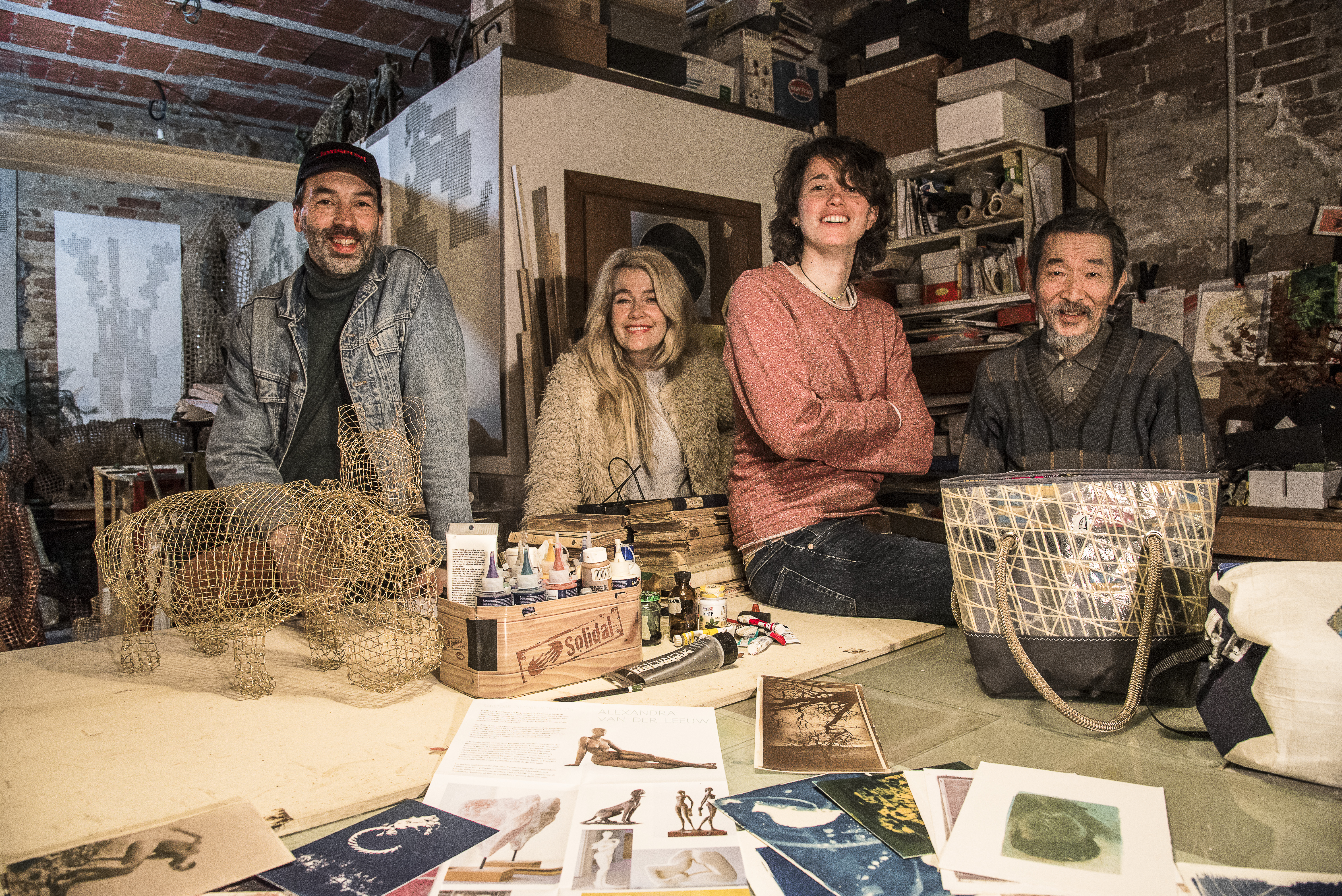
Documentary, by Naù Germoglio, Italy, 2020
In a former warehouse on the ground floor of the civic number "2091", in the district of “Santa Croce” in Venice, two sculptors, a craftswoman and an alchemist-photographer work together. It is a 65 square meters space with two windows overlooking a small canal. It is called "STUDIO2091" and it is a unique example of creative co-working space where there is no wifi connection, the cellphones work very bad, there are no tables for meetings, nor computers.
His "tenants" carry out only manual activities related to art and crafts. Each of them has a different reason to live in Venice, a beautiful and unique city, yet expensive, problematic, overrun by mass tourism and high tide. The photographer-alchemist Andrea Buffolo, who was born in Switzerland,is the only one who has spent almost all his life in the historical center of Venice. Japanese sculptor Masaru Kashiwagi chose to live in Venice 35 years ago, because he considers it the only city in the world perfect for an artist; the craftswoman Camilla Morelli was born and raised in Valtellina ( a valley in the Lombardy region of northern Italy), and although she grew up in the mountains, she chose to live in Venice to enjoy the proximity to the sea; the Dutch painter and sculptor Alexandra Van der Leeuw lives on the island half of the year carrying on a family tradition. The four protagonists of the documentary film chose to live in Venice because here,and only here, they succeed in being themselves, realizing themselves and feeling free.
SUBTITLES: English, Spanish, French, German, Portuguese
Workshops, Guilds, and the Pre-Modern Economy of Collective Making
You are standing in a room that smells of linseed oil and warm gesso, surrounded by four other people who will never be remembered. One of them is grinding pigment. Another is transferring a cartoon onto a prepared panel with a stylus, following the master’s underdrawing line by line. A third is gilding the halo of a saint with a patience that borders on religious devotion. None of them will sign the finished altarpiece. None of them expect to.
This was not an aberration. This was the normal condition of image-making across medieval and Renaissance Europe, and understanding it requires a fundamental reclassification of what we think an artwork is and where we think it comes from. The Florentine bottega was not an artist’s studio in any sense we would recognize today. It was a manufacturing operation, a site of distributed skill and stratified labor, closer in structure to a textile workshop than to the romantic atelier of nineteenth-century mythology. Apprentices entered these spaces as children, sometimes as young as seven or eight, bound by contract to masters who taught them not self-expression but craft grammar — the preparation of supports, the mixing of grounds, the grinding of specific pigments to specific consistencies for specific applications. Michael Baxandall, in Painting and Experience in Fifteenth-Century Italy published in 1972, documented how Florentine contracts between patrons and painters specified not merely subject matter but the precise quality and quantity of ultramarine to be used, because lapis lazuli was a commodity priced by weight and patrons wanted their investment visible in the blue of the Virgin’s robe. The painting was an economic document before it was an aesthetic one.
The guild system that governed this labor was not a quaint medieval holdover but a sophisticated regulatory architecture. In cities like Bruges, Ghent, and Antwerp, the Guild of Saint Luke controlled who could produce and sell images, enforced quality standards, maintained monopolies on certain materials, and recorded the names of masters admitted to its membership. What the guild system did not do was valorize individual creative genius. The concept would have been not merely foreign but actively suspicious, since the guilds derived their authority precisely from collective standards, collective training, and collective accountability. When a painting left a Netherlandish workshop in the fifteenth century, it carried the implicit guarantee of an entire institutional body, not the signature of a solitary sensibility.
The erasure of this collective infrastructure from art history’s dominant narrative was not an innocent oversight. It accelerated in the sixteenth century alongside the Italian theorization of the artist as intellectual rather than artisan, most systematically in Giorgio Vasari‘s Lives of the Artists, first published in 1550, which retrospectively constructed a lineage of singular geniuses culminating in Michelangelo. Vasari’s biographical method required a subject — a singular, nameable, narratable individual — and so the workshop became invisible, reduced to a supporting cast, a chorus without lines. This theoretical move was not politically neutral. It coincided precisely with the period in which capitalist market relations were restructuring artisanal production across Europe, demanding identifiable authorship as a mechanism for pricing, provenance, and the emerging logic of scarcity. A painting by a named master could command a premium that a painting by a workshop could not, and so the market trained everyone — collectors, critics, eventually historians — to see individuality where there had been collectivity.
What gets lost in this reframing is not merely credit, though the apprentices and journeymen who executed significant portions of canonical works deserve more than footnotes. What gets lost is an entire ontology of making, a way of understanding creativity as something that circulates through shared hands rather than originating in a singular mind. The medieval craftsman did not experience the absence of individual credit as deprivation, because the category of individual artistic identity had not yet been invented as a value worth possessing.

The Sociological Architecture of the Avant-Garde
You are handed a manifesto. Not asked — handed. The gesture itself is the initiation ritual, the moment you cross from observer to participant, and the weight of that single sheet of paper carries an entire social architecture you are only beginning to understand.
Howard Becker argued in “Art Worlds” in 1982 that artistic production is never the isolated act of a solitary genius but rather a cooperative network of people whose coordinated activity produces the work we eventually call art. He meant this sociologically, empirically, almost bureaucratically — and in doing so he dismantled one of the most tenacious myths Western culture has manufactured about itself. The avant-garde movements of the early twentieth century are the perfect stress test for his framework, because they present themselves as radical ruptures with convention while simultaneously reproducing, with startling fidelity, the social machinery they claimed to be destroying.
Dada arrived in Zurich in 1916 at the Cabaret Voltaire, founded by Hugo Ball and Emmy Hennings, and it announced itself as the negation of all systems, all hierarchies, all aesthetic authority. Yet within months it had developed internal divisions sharp enough to exile members, competing factions in Zurich, Berlin, and Paris with distinct ideological orientations, and an informal but ruthlessly enforced canon of who was authentically Dadaist and who was merely imitating. The movement that declared war on categorization was itself obsessively categorical. Richard Huelsenbeck, returning to Berlin in 1917, immediately began drawing distinctions between the German and Swiss branches that were less artistic than tribal — questions of who had the legitimate authority to speak in Dada’s name, which is to say, questions of property and inheritance dressed in the language of revolution.
What the Surrealists did with this inheritance was to formalize it almost beyond recognition. André Breton’s “Surrealist Manifesto” of 1924 established not just a poetic program but a membership structure, and Breton himself functioned less as an artist than as a kind of chief executive of the unconscious, presiding over a group that published official lists of members, conducted formal expulsions, and maintained ideological purity with the vigilance of a political party. Antonin Artaud was expelled in 1926. Georges Bataille was kept permanently at arm’s length. Robert Desnos, Salvador Dalí, Paul Éluard — each passed through phases of inclusion and exclusion that had less to do with the quality of their work than with their alignment to the movement’s internal power dynamics. The freedom Surrealism promised to the dreaming mind was administered by a waking bureaucracy.
The Bauhaus presents perhaps the most structurally honest case because it never claimed to be anti-institutional — it was, from its founding in Weimar in 1919 by Walter Gropius, explicitly a school, which meant it had students, masters, fees, curricula, and dismissals. What makes it sociologically fascinating is the gap between its stated ideology of craft democracy and the actual stratification that governed daily life within it. The master workshops were split between a form master and a craft master, a division that reproduced the very hierarchy between fine art and applied art that the Bauhaus theoretically sought to abolish. Women were systematically directed away from painting and architecture and toward weaving, a redirection Gropius defended on grounds of technical aptitude that were indistinguishable from the cultural assumptions of 1919 Germany. Anni Albers became one of the great textile artists of the twentieth century partly because she was refused entry to the glass workshop she had originally wanted to join.
What Becker’s framework reveals, when applied here, is that the political economy of any art world determines not only who gets to make art but what counts as art at all — and that this determination is made not in manifestos but in the quiet, repeated, largely invisible decisions about space, time, money, and attention that constitute the actual texture of collective creative life.
Collective Identity as Creative Constraint
You have been to that meeting — the one where everyone in the room called themselves an outsider. The zines were stacked on the table, the manifestos were half-written, and the conversation kept returning, with a kind of religious satisfaction, to everything the group refused to be. Nobody noticed that the refusal had itself become a doctrine, that the very posture of transgression was being policed with the same vigilance as any academic committee enforcing citation standards. The room felt free. It was not free.
Wilfred Bion, working through his wartime clinical experiences at Northfield Military Hospital before publishing Experiences in Groups in 1961, identified something that should have permanently altered how we romanticize collective creativity. He observed that groups consistently abandon the stated purpose of their gathering — the work — in favor of what he called basic assumption life: a shared emotional state, either of dependence on a leader, of fantasized fight-or-flight, or of a pairing dynamic through which two members are unconsciously nominated to produce the group’s salvation. The creative community is not exempt from this. It is, in many respects, the ideal incubator for it, because its stated purpose is diffuse enough to absorb any substitution without anyone noticing the switch.
The substitution happens at the level of taste before it happens at the level of ideology. A collective dedicated to, say, post-industrial sound art develops within eighteen months a shared grammar of acceptable reference — the theorists one is permitted to cite, the predecessors one is allowed to claim, the aesthetic gestures that signal belonging versus those that signal naivety or, worse, commercial compromise. Howard Becker mapped this process with anthropological patience in Art Worlds, published in 1982, arguing that artistic production is always cooperative action embedded in convention. What Becker’s framework implies, though he phrased it with sociological restraint, is that the convention-making is never innocent: it distributes legitimacy, and those who distribute it are rarely the most radical voices in the room.
This is where the paradox grows teeth. The collective organized around shared transgression produces its own hierarchy of transgression — a ranking of who transgresses most authentically, who has the deepest commitment to rupture, who arrived earliest and therefore owns the original gesture. Pierre Bourdieu‘s concept of the field, developed across multiple works from 1969 through The Rules of Art in 1992, describes this as the inversion of the economic principle: in cultural fields, those who most loudly disavow commercial logic are often the most aggressive competitors for symbolic capital. The bohemian community does not escape competition. It rebrands it as purity.
What makes this particular constraint so difficult to name is that it wears the costume of its opposite. The group member who begins to deviate from shared aesthetic assumptions does not receive a formal sanction. They receive something more efficient: a slight cooling of enthusiasm, a pattern of being talked over, an absence of their name in the conversations that matter. Erving Goffman’s work on stigma and social interaction, particularly in his 1963 study, reveals how social discipline operates most powerfully not through explicit rules but through the management of attention and acknowledgment. To be subtly unacknowledged inside a community that defines itself by radical inclusion is a punishment with no court of appeal, because there is no law to cite, no edict to contest.
The result is a creative output that often looks, from a distance, more homogeneous than the work produced by individuals operating in isolation. Studies of avant-garde movements bear this out with uncomfortable regularity: the Bloomsbury Group’s essays circulate within a remarkably consistent emotional and tonal register, the Situationist texts share a rhetorical DNA that becomes nearly indistinguishable across authors, and the New York School poets, for all their proclaimed spontaneity, developed orthodoxies of casualness so precise that deviation from the casual register read as a betrayal of the collective project.
The Geography of Creativity: Place, Density, and Cultural Clusters
You arrive in a city you’ve never seen before, carrying almost nothing, and within six months you’ve produced more work than in the previous three years. Something about the density of strangers, the cheapness of rent in buildings with bad plumbing, the fact that no one knows your name yet — it unlocks something. Artists have been describing this phenomenon for centuries without being able to explain it, which is precisely why sociologists have spent decades trying to reduce it to a formula.
Richard Florida’s 2002 work “The Rise of the Creative Class” attempted exactly that reduction, arguing that cities which attract artists, bohemians, and gay communities generate a measurable competitive advantage in innovation and economic growth. His Creative Class index ranked metropolitan areas by their capacity to draw what he called the “three T’s” — talent, technology, and tolerance — producing a kind of cartography of cultural vitality. The argument was seductive and almost immediately weaponized by urban planners who began treating artistic communities not as ends in themselves but as instruments of real estate appreciation. What Florida described as a spontaneous ecology was converted into a deliberate policy lever, and the cities that followed his prescriptions most enthusiastically — cities that aggressively courted galleries and boutique coffee shops — often ended up accelerating the displacement of the very populations that had made them culturally legible in the first place.
The geography that actually produced great concentrations of artistic work operated by entirely different pressures. Montmartre at the turn of the twentieth century was not a cultural policy zone. It was the cheapest elevated land in Paris, poorly connected to the center, populated by workers, cabaret performers, and immigrants from across Europe. Picasso arrived there in 1904 at the Bateau-Lavoir, a ramshackle wooden building on the Rue Ravignan that wobbled in the wind and shared a single water tap among dozens of tenants. The creative density was not designed — it was the residue of economic exclusion. The people who gathered there did so because they had no better option, and the friction between their different national traditions, their poverty, their mutual incomprehension, and their desperate need to be taken seriously by a city that largely ignored them generated a productive pressure that no urban master plan has ever successfully replicated.
The sociologist Sharon Zukin, in her 1982 study “Loft Living,” traced a structurally identical pattern in downtown Manhattan, where artists moved into abandoned industrial buildings in SoHo during the 1970s not out of romantic choice but because the space was otherwise uninhabitable and therefore affordable. The moment their presence transformed those neighborhoods into desirable addresses — the moment their aesthetic labor became legible to capital — the conditions that had made the work possible were systematically destroyed. Zukin called this the “artistic mode of production,” a phrase that captures something Florida’s framework cannot: the way that genuine creative concentration depends on its own invisibility to the market, and is destroyed the instant it becomes visible.
Berlin in the decade after reunification reproduced this logic in compressed time. The eastern half of the city contained thousands of empty buildings, legal ambiguity about ownership, a collapsed local economy, and an almost complete absence of commercial infrastructure. Artists, squatters, and musicians occupied the vacuum and built, between roughly 1990 and 2002, a cultural ecosystem of extraordinary density and strangeness — one that attracted international attention precisely because it felt genuinely ungoverned. The city government, recognizing the economic value of this reputation, began formalizing what had been informal, permitting what had been tolerated, branding what had been anonymous. By the mid-2000s, the geography had not changed but the pressure system had, and the work that emerged from it changed accordingly.
What this sequence reveals is that artistic communities are not simply located in places — they are constituted by specific material conditions of precarity, and those conditions carry within them the seed of their own elimination the moment they begin to function as cultural capital rather than as the simple oxygen of people who have nowhere else to go and nothing left to lose except the work itself.
A vision curated by a filmmaker, not an algorithm
In this video I explain our vision
Power, Canon Formation, and Who Gets to Belong

You already know the feeling of standing at the edge of a room where the conversation is happening, where the names being invoked are names you were never taught, where the laughter arrives a half-second before you understand the joke. That feeling has a structure. It is not personal failure and it is not coincidence — it is architecture.
Pierre Bourdieu spent the better part of his career dismantling the fiction that cultural taste is natural. In “The Rules of Art,” published in 1992, he demonstrated that the literary field — and by extension every artistic field — operates as a competitive social space in which agents occupy positions determined not by talent alone but by the volume and composition of their capital: economic resources, social networks, institutional credentials, and the symbolic authority that accrues from being recognized by those who already possess it. The canon, in this framework, is not a record of what was beautiful. It is a ledger of who was positioned to make their beauty legible to the institutions capable of consecrating it.
The history of those institutions is a history of systematic selectivity dressed in the language of universalism. The French Academy, founded by royal decree in 1635, initially excluded women from membership entirely — not as a declared policy of suppression but as an unspoken condition so obvious it required no articulation. When Élisabeth Vigée Le Brun, one of the most technically accomplished portraitists of the eighteenth century, was admitted in 1783, the Academy’s response was not celebration but containment: a motion was passed almost immediately to prevent any further female admissions. The aesthetic judgment had not changed. What changed was the threat to the field’s social organization.
This mechanism replicates across every medium and century with a consistency that should itself be disturbing. The Harlem Renaissance of the 1920s produced painters, sculptors, and printmakers of extraordinary formal invention — Aaron Douglas, Augusta Savage, Gwendolyn Bennett — who were largely excised from the dominant American art historical narrative until revisionist scholarship began forcing the archive open in the 1980s and 1990s. Their exclusion was never announced as racial. It arrived as a series of quiet decisions: which galleries showed the work, which critics reviewed it, which museum collections acquired it, which survey courses taught it. Linda Nochlin’s 1971 essay “Why Have There Been No Great Women Artists?” asked the correct question by refusing to accept the premise — pointing out that greatness was not a property latent in individuals but a verdict produced by a system, and the system had been calibrated to find certain people unlocatable from the start.
What makes canonical power so durable is precisely its capacity to naturalize itself. When a set of works is taught as the foundation, the bedrock, the inescapable reference point, students do not experience this as ideology — they experience it as initiation into reality. The distinction matters because ideology can be argued with, while reality must simply be learned. By the time a young painter discovers that the Western canon she has been trained to revere contains fewer than five percent of its entries as women across five centuries of institutional art history, she has already internalized the standard of judgment those entries represent. Bourdieu called this process “illusio” — the collective investment in the game that makes the game’s stakes feel self-evidently real rather than socially constructed. The game continues not because its rules are just but because everyone inside it has too much invested in believing the rules are inevitable.
Class works through the same mechanism at a different register. The artist who can afford to spend three years producing work without selling, who can network at dinners that cost more than a month’s rent, who speaks the linguistic codes of educational institutions expensive enough to have refined those codes — this person is not more talented, but they are more legible to the field’s consecrating agents, and legibility is what the field rewards.
Digital Networks and the Simulation of Community
You scroll through the feed and something that looks exactly like belonging appears: a painter in Guadalajara likes your latest image, a sculptor in Helsinki shares it, a poet in Lagos leaves a comment that feels, for a moment, genuinely warm. The network hums with apparent solidarity. The grammar is correct — visibility, mutual recognition, the small rituals of affirmation — and yet something at the center of it refuses to cohere.
Barry Wellman, whose decades of research at the University of Toronto produced the framework he called networked individualism, identified precisely this displacement. In his 2012 work with Lee Rainie, “Networked: The New Social Operating System,” he described a structural shift in which the fundamental unit of social life had migrated from the group to the individual. People no longer belong to communities; they manage portfolios of weak and specialized ties, each connection serving a distinct function, none of them generating the kind of mutual obligation that historically constituted collective life. The platform amplifies this architecture rather than correcting it, because it was designed to serve individual users, not groups — to maximize personal engagement, not shared exposure to risk.
Shared risk was never incidental to the historical artistic community; it was its generative engine. When the painters of the Barbizon school left Paris for the forest of Fontainebleau in the 1830s, they were staking careers, reputations, and economic survival on a collective refusal of the Academy’s terms. The Impressionists who organized their own exhibitions between 1874 and 1886 were not networking — they were collectively absorbing the financial and reputational consequences of institutional rejection. This shared vulnerability produced a peculiar chemistry: disagreement was not optional, because the stakes were too high for politeness. Monet and Degas despised each other’s aesthetic judgments and said so with a directness that would be professionally catastrophic in any contemporary comment section. That friction was not noise in the system — it was the system.
The online platform is architecturally allergic to productive conflict. Algorithmic sorting does not reward intellectual friction; it rewards emotional resonance, and emotional resonance at scale means reducing complexity until it fits the shape of agreement. The result is not community but what sociologist Zeynep Tufekci, examining networked protest movements, described as the weakness of ties formed without the institutional thickening that comes from sustained co-presence. Groups that coalesce online can mobilize rapidly and disperse just as rapidly, because there is no accumulated social infrastructure to hold them in place when the energy dissipates. For artistic communities this dynamic is quietly catastrophic: the moment of genuine aesthetic transformation tends to require exactly the kind of prolonged, uncomfortable, unresolved conversation that feeds no algorithm.
Physical co-presence generated conditions that no interface has successfully replicated — not because of sentimentality about bodies in rooms, but because of what proximity forced. It forced synchrony of attention, the inability to curate one’s own reception of another’s work, the experience of watching someone’s face change or remain unmoved in real time. Erving Goffman’s analysis of interaction ritual, developed throughout his career but crystallized in “Interaction Ritual: Essays on Face-to-Face Behavior” in 1967, identified the micro-dynamics of physical encounter as the mechanism through which emotional energy actually transfers between people. This transfer — what he called entrainment — does not scale across asynchronous digital exchanges. A like is not an encounter. A comment thread is not a conversation. They are performances of sociality that produce the sensation of connection without the physiological substrate that makes connection transformative.
What emerges instead is a community of mirrors — each participant reflecting validated versions of the others, identities stabilized by mutual recognition rather than challenged by genuine difference. The artist who shows work only to those who already understand it learns, over time, the precise shape of what she already believes, and mistakes that confirmation for growth.
Conflict as the Hidden Engine of Collective Production
You are sitting in the archive room of a dissolved collective, reading through the minutes of their final meeting, and what strikes you is not the anger — the anger you expected — but the extraordinary politeness of it all, the careful language, the procedural calm with which people who had made things together for a decade said goodbye to the possibility of making anything together again.
Georg Simmel argued in 1908, in his Soziologie, that conflict is not the opposite of social unity but one of its primary forms — that groups do not survive despite their internal tensions but through them, because tension is what forces each member to continually justify their presence, articulate their difference, and therefore remain awake to what the collective is actually doing. A community without conflict is not harmonious; it is sedated. What looks like peace from the outside is often the quiet of people who have stopped believing the work matters enough to fight over.
The Surrealists provide the clearest documentary evidence for this. André Breton’s expulsions — of Robert Desnos in 1929, of Salvador Dalí in 1934, of numerous others across four decades — were not failures of the movement but its operative logic made visible. The threat of expulsion was the mechanism that kept every remaining member in a state of creative alertness, continuously asking whether their work was genuinely aligned with something larger than their own comfort. The violence of inclusion, in other words, was the violence of being held to a standard that the group itself kept redefining through its purges.
What institutional capture does — and this is the process that kills creative communities more reliably than any internal dispute — is replace that productive threat with a promise of security. When a collective becomes legible to a funding body, a university structure, or a curatorial infrastructure, it begins to receive resources contingent on its coherence, its continuity, its public face of collaborative warmth. The grant application demands a narrative of shared vision. The residency requires a stable roster of members. The museum retrospective needs a founding myth untouched by the inconvenient fact that the founders despised each other by year three.
Randall Collins, in his 2004 work Interaction Ritual Chains, demonstrated that emotional energy in creative groups is generated through what he called interaction rituals — charged encounters where something is genuinely at stake, where participants risk embarrassment, disagreement, or exclusion. Remove the risk and you remove the energy. The communities that survive institutionalization intact are those that find ways to preserve internal jeopardy even after external stability has been achieved, which is extraordinarily difficult and almost nobody manages it consciously.
The romanticization of harmony is therefore not innocent nostalgia. It functions as a technology of neutralization, making the rough, uncomfortable, politically live texture of real collective work appear as a defect to be corrected rather than the condition of its vitality. When we read accounts of the Bloomsbury Group as a circle of civilized mutual support, we are reading a retrospective construction that erases the devastating letters, the financial resentments, the intellectual rivalries that Quentin Bell‘s 1972 biography of Virginia Woolf began to restore to the record. The warmth was real, but it was real precisely because the friction was also real, and neither element can be subtracted without falsifying both.
What a creative community actually produces, beneath whatever art or theory or music it makes visible, is a shared capacity to remain in contact with disagreement without immediately resolving it into hierarchy or silence — and the communities that have lasted, or at least the ones that have left behind work that still exerts pressure on the present, are the ones that found in their conflicts not a problem to manage but the most honest measure of how much they still had left to discover.
🎨 The Hidden Forces Behind Every Creative Community
Collective creativity is never born in a vacuum: it emerges from the tensions between individual vision and shared culture, between rebellion and tradition. The articles below explore the sociological, philosophical, and aesthetic foundations that have shaped artistic communities across time and space.
Pierre Bourdieu and the Artistic Field
Pierre Bourdieu‘s analysis of the artistic field reveals how creativity is never purely spontaneous but is shaped by invisible social structures, hierarchies of taste, and the struggle for cultural legitimacy. Understanding the field means understanding why certain artistic communities thrive while others remain marginal. Bourdieu’s sociology is essential reading for anyone who wants to grasp the collective dynamics behind individual artistic genius.
GO TO THE SELECTION: Pierre Bourdieu and the Artistic Field
La Bohème: History and Myth of the Poor Artist
The myth of La Bohème crystallized a powerful and enduring image of the artistic community as a fraternity of the poor, the passionate, and the free, living on the margins of bourgeois society. This romantic ideal shaped how generations of artists understood their collective identity and their relationship to money, recognition, and suffering. The history of Bohemian life is inseparable from the history of how art communities construct their own mythology.
GO TO THE SELECTION: La Bohème: History and Myth of the Poor Artist
Putnam’s Bowling Alone: Analysis
Robert Putnam‘s concept of social capital, explored in depth in Bowling Alone, provides a crucial lens for understanding how artistic communities are built and sustained through networks of trust, reciprocity, and shared civic participation. When these bonds erode, creative collaboration weakens along with them. Putnam’s work reminds us that collective creativity depends on the health of the social fabric in which it is embedded.
GO TO THE SELECTION: Putnam’s Bowling Alone: Analysis
Mass Social Homologation Today
Mass social homologation is one of the greatest threats to authentic collective creativity, flattening difference and discouraging the cultural experimentation that drives artistic innovation. When communities conform to dominant cultural models, the generative tension between individual expression and collective identity disappears. Examining this phenomenon helps us understand why truly vital artistic communities often emerge precisely at the margins of mainstream culture.
GO TO THE SELECTION: Mass Social Homologation Today
Discover the Cinema of Communities on Indiecinema
If these reflections on collective creativity and artistic communities have sparked your curiosity, Indiecinema streaming is the ideal place to continue the journey. Our catalog is home to independent films that explore the lives of artists, underground movements, and the social worlds that make creativity possible. Come and discover a cinema that thinks, questions, and dares.
👉 EXPLORE THE CATALOG: Watch Indie Films in Streaming
A vision curated by a filmmaker, not an algorithm
In this video I explain our vision

