
The Manuscript That Rewired a Civilization
You are reading a novel, and somewhere around the third chapter you stop and put it down — not because it has lost you, but because it has found you in a way you were not prepared for. The prose does not argue. It does not petition. It does not list grievances in the careful, deferential language that the colonized learn to use when addressing power. Instead it sings, and the song is about a motherland so vivid, so physically present — her rivers, her forests, her children starving and rising — that you feel the ground shift beneath the chair you are sitting in. You are not being informed of something. You are being constituted by it.

Bankimchandra Chattopadhyay published Anandamath in 1882, serialized first in his own literary journal Bangadarshan before it appeared as a complete volume, and the book entered a world that had been specifically designed to prevent exactly what it proceeded to do. The British colonial apparatus had spent the better part of a century calibrating the intellectual atmosphere of Bengal — founding the Hindu College in 1817, installing Macaulay’s Minute on Education in 1835, engineering an entire class of administrators trained to evaluate their own civilization through the borrowed eyes of their rulers. What Bankim understood, with a precision that no contemporary political pamphlet managed, was that this engineering had succeeded not by suppressing Indian thought but by making Indians the enthusiastic agents of their own cognitive dispossession. You cannot defeat an occupation you have internalized as civilization.
What a novel can do that a manifesto cannot is occupy the body before it reaches the mind. When the monk Bhavananda leads the Children of the Mother through the jungle in Anandamath, chanting Vande Mataram — a hymn Bankim had written a decade earlier in 1875 and now embedded in the novel’s tissue — the reader does not evaluate the proposition being made. There is no proposition. There is a procession, a sound, a landscape. Frantz Fanon, writing about colonized consciousness in The Wretched of the Earth in 1961, identified the way colonial culture works to replace native categories of feeling with imported ones, making even grief and desire flow through alien channels. Bankim was doing the counter-work almost eighty years before Fanon named the mechanism, and he was doing it with the tools of the form itself — character, landscape, music embedded in dialogue, the physical sensation of belonging to something larger than the self.
This is why the British colonial administration understood Anandamath as dangerous in a way that straightforward political writing was not. Political writing could be answered with counter-argument, suppressed through censorship, or discredited by association with sedition. Fiction gets inside before the guards at the door are even awake. By the time the reader finishes the novel, the emotional architecture has already been rearranged. The historical setting Bankim chose — the Sannyasi Rebellion of the 1760s and 1770s, a real series of armed uprisings by ascetic warriors against both Mughal remnants and early British consolidation in Bengal — gave the book a doubled temporality. It was simultaneously a story about the past and an instruction manual for the present, and the reader in 1882 was expected to feel both time periods pressing against each other in the same sentence.
Bankim was not naively trafficking in nostalgia. He had graduated from Presidency College in 1858, the year the Crown formally took over governance of India from the East India Company following the uprising of 1857, and he spent his professional career as a Deputy Magistrate inside the very colonial structure he was intellectually dismantling. He wrote Anandamath in the uniform of the administered. The detonation came from inside the building.
Thirsty
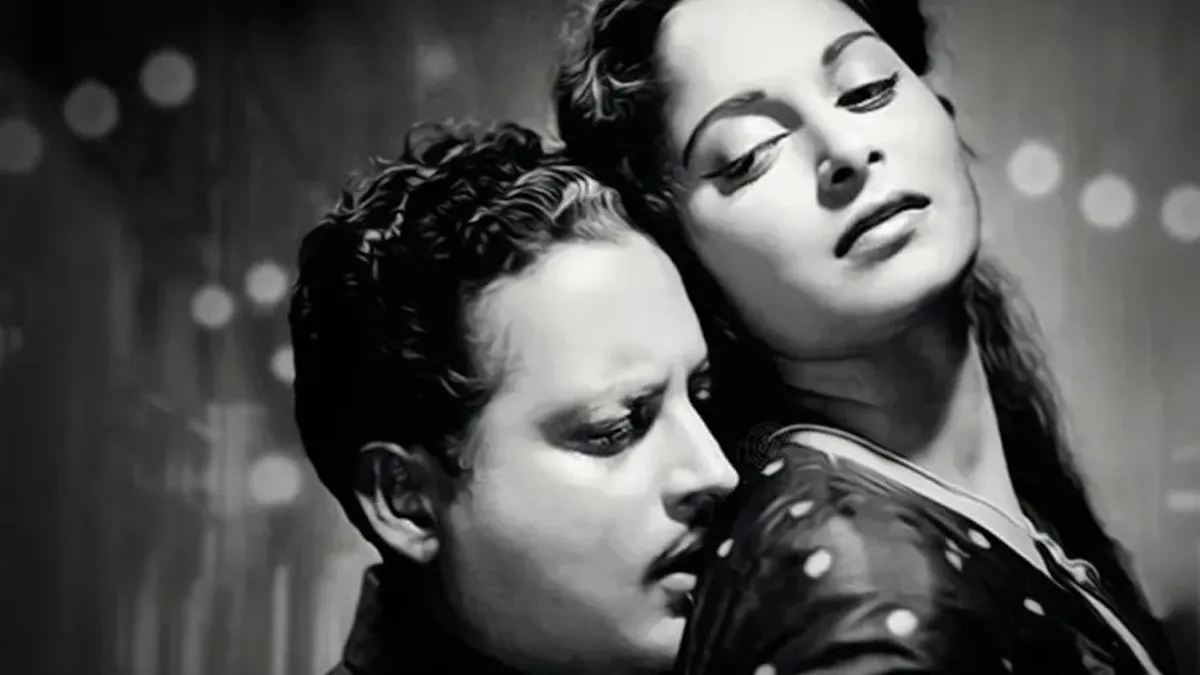
Drama, musical, by Guru Dutt, India, 1957
Thirsty is the heartbreaking story of Vijay, a young poet living in Calcutta who dreams of giving voice to the suffering and injustice of the world through his verses. Idealistic and sensitive, Vijay clashes with a society that despises his art because it is not profitable and does not cater to the tastes of the public. His brothers consider him a failure, the woman he loves leaves him for a marriage of convenience, and his poems are ignored by publishers. Only Gulabo, a prostitute with a pure heart, recognizes the beauty and truth of his words. When a misunderstanding leads everyone to believe Vijay is dead, his name and poetry suddenly become famous, exposing the hypocrisy of those who had previously rejected him.
Watching Thirsty means immersing oneself in a work that goes beyond melodrama, blending poetry, music, and imagery into a profound reflection on the human soul and the value of art. Guru Dutt, director and protagonist, creates one of the most intense and poetic films in world cinema, where black-and-white cinematography, expressive framing, and evocative lyrics produce an atmosphere of poignant melancholy. It is a film about the misunderstanding of the artist, pure love, and society’s hypocrisy, but also a universal critique of materialism and opportunism. Even today, Thirsty moves and provokes thought because it sincerely tells the story of the need to remain true to oneself in a world that measures people’s worth solely by their success.
LANGUAGE: Hindi
SUBTITLES: English, Spanish, French, German, Portuguese
Before Bankim, There Was No 'Indian Novel'
You are reading a novel right now, in the sense that the form itself is so familiar it has become invisible — the chapters, the narrator who withholds, the interior lives of characters who carry the plot forward through desire and misapprehension. You have read enough of them that the machinery disappears. But there was a moment, in Bengal, when that machine did not exist in the vernacular at all, and what filled its absence was something entirely different in shape, in purpose, in the relationship it assumed between the text and the body that received it.
Before the 1860s, Bengali literary culture operated along two dominant axes. The first was devotional: the Vaishnava padavali tradition, lyric poetry addressed to Krishna and Radha, meant not to be read silently in private but sung, heard, absorbed through the ear in community. Jayadeva’s twelfth-century Gita Govinda had set a template that Bengali poets extended through figures like Chandidas and Vidyapati — verse that moved through the body like music moves through the body, leaving no space for the kind of solitary interiority that the novel requires. The second axis was oral narrative, the kathakata tradition of public storytelling, episodes from the Puranas and the Mahabharata shaped each time by the performance context, responsive to the audience sitting in front of the speaker. Neither of these forms produces a subject who reads alone, who closes the book at night and lies in the dark thinking about what a character wanted. They produce congregations.
When English-educated Bengalis in the mid-nineteenth century began encountering the European novel — Richardson, Dickens, Scott — through the colonial education apparatus Lord Macaulay had institutionalized with his 1835 Minute on Indian Education, their initial response was mimicry in the most technically precise sense. They reproduced the external form while emptying it of any friction with their own historical situation. The results were competent and culturally dead. Alaler Gharer Dulal, published by Pyarichand Mitra in 1858 and sometimes cited as the first Bengali prose narrative, is essentially a morality tale dressed in novelistic clothes — it uses the period’s colloquial Bengali but has no genuine architecture of suspense, no epistemology of character, no sense that the form itself is a philosophical argument about how time and consciousness relate.
What Bankimchandra understood, with an intuition that was probably not fully articulated even to himself, is that Walter Scott‘s historical novel was not simply entertainment. Scott, working in the early nineteenth century across Waverley and Rob Roy and Ivanhoe, had built a narrative machine specifically designed to process the trauma of a people whose culture had been subordinated by a more powerful neighbor — the Scottish Highlands absorbed into English imperial modernity — by inserting that trauma into historical time, giving it characters whose inner lives made the loss legible. The form was an instrument for constructing national consciousness inside individual subjectivity. Bankim recognized the weapon inside the aesthetic object.
His 1865 debut Durgeshnandini deployed the historical romance scaffolding Scott had perfected, but the metaphysical interior he placed inside that structure was not European. The devotional intensity of the Vaishnava tradition, the dharmic tension between individual desire and cosmic obligation that runs through the Gita, the concept of shakti as a feminized national energy — these were not decorations applied to the surface of a borrowed form. They were the load-bearing walls. The novel’s European architecture was real, functional, structurally sound, and it made the book readable to a colonial-educated Bengali who had been trained to recognize narrative shaped that way. But what the architecture was housing had never been housed before in prose, in vernacular, in a form a single person could hold in their hands and read by lamplight with no priest and no congregation present.
The privatization of Hindu metaphysical experience through novelistic form was not adaptation. It was a kind of ambush, and the reader who walked through the door did not always see it happening.

The Invention of the Motherland as a Body
You already know what it feels like to belong to something larger than your body — you have felt it at a funeral, a stadium, a border crossing where a uniformed officer looked at your document and decided, in two seconds, whether you were real. That feeling has a history, and it was manufactured.
In 1882, Bankimchandra Chattopadhyay embedded a hymn inside a novel and changed the architecture of Indian consciousness. The hymn was Vande Mataram — “I bow to thee, Mother” — and its genius was not lyrical but ontological. Bankim did not write a national anthem in the European sense, a march meant to unify citizens already assumed to exist. He performed an act of radical condensation: he took the abstraction of a subcontinent — its river deltas, its sal forests, its millions of mutually unintelligible tongues — and collapsed them into a single female body with flesh you could almost touch. The Motherland in Anandamath is not a metaphor. She is described with the precision of a medical examination: her waters are her veins, her crops are her skin, her forests are the dark mass of her unbound hair. She breathes. She grieves. She waits to be liberated as a woman waits inside a locked room.
Benedict Anderson argued in 1983 that nations are not discovered but printed — that what holds strangers together is the simultaneous experience of reading the same words at the same moment, creating what he called an imagined community, a collectivity whose members will never meet yet carry one another inside them like a shared grammar. Anderson was right about the mechanism, but he was writing about newspapers, about the horizontal spread of secular prose. What Bankim understood was something more volatile: that the imagination requires a body to grip. Abstract solidarity fractures under pressure. A goddess with rivers for veins does not. When you give the nation a nervous system, you give it the capacity to be wounded, and a wound demands response in a way that a concept never can.
The British colonial administration understood this instinctively, which is why the partition of Bengal in 1905 produced the explosion it did. Lord Curzon divided the province along lines he described as administrative convenience — a technical adjustment of governance — and millions experienced it as vivisection, because Bankim had already taught them to feel the land as a body. The protests that followed, the Swadeshi movement’s organized boycott of British goods, the bonfires of foreign cloth: these were not spontaneous eruptions of feeling. They were responses structured by a prior act of imagination, an imagination Bankim had scripted twenty-three years earlier inside a novel that British censors had initially dismissed as romantic fiction.
There is something genuinely disturbing in this, not because it is cynical — Bankim was not a propagandist in the modern sense, and his investment in the Motherland figure was philosophically serious, rooted in his reading of Auguste Comte’s positivism and his own reconstruction of Hindu philosophical traditions — but because the technology works regardless of the sincerity of its inventor. Once the collective body exists in language, once millions have learned to feel it in their chests, the body becomes available to anyone who knows how to invoke it. The same hymn that animated anti-colonial resistance would later become a site of communal contest, its Sanskrit and its goddess-imagery rendered alien to Muslim Indians who had also lived inside the land it claimed to describe. Bankim built the most powerful affective machine in modern Indian history, and he built it without an off switch.
What he could not have anticipated, or perhaps chose not to examine, was the structural violence embedded in the act of incarnation itself — the fact that giving a nation a body means simultaneously deciding whose body it resembles, and whose it excludes by the very precision of the description.
The Colonial Mirror and the Bengali Intellectual
You sit across from your supervisor, nodding at his directives, recording his assessments in a language that is not your mother tongue, and somewhere in the locked drawer of your desk is a manuscript that would get you both fired and celebrated in the same breath. This is not a metaphor. For thirty-six years, Bankimchandra Chattopadhyay occupied exactly this position — a deputy collector and deputy magistrate under the Indian Civil Service, processing the administrative machinery of British Bengal, issuing orders, adjudicating disputes, writing legal prose in English by day, and producing the foundational texts of Bengali nationalist literature by night, in the same hand, with the same educated mind, using the same grammar of rational argument he had absorbed from his colonizers.
The paradox does not resolve itself the more closely you examine it. Frantz Fanon, writing in 1961 from the wreckage of the Algerian war, described with clinical precision how the colonized intellectual arrives at consciousness not by escaping the colonizer’s epistemological framework but by mastering it so completely that the framework itself becomes the only available lens through which liberation can be imagined. The Wretched of the Earth is not a celebration of this condition — it is a diagnosis of its structural tragedy. The native intellectual who returns to the people does not return clean. He returns carrying the colonizer’s categories, the colonizer’s aesthetics, the colonizer’s sense of what constitutes history, civilization, literature, and heroism. Bankim had read John Stuart Mill and Auguste Comte with genuine absorption. His conception of what a novel should accomplish — its moral architecture, its relationship to national character, its duty to elevate the masses — was inseparable from the European Romantic tradition he had encountered at Presidency College, the first institution in Asia to offer Western-style university education, founded in Calcutta in 1817 precisely to produce exactly the kind of administrator Bankim became.
What Fanon’s framework reveals, when placed against Bankim’s biography, is that the sedition was never external to the service — it was internal to it, structurally embedded. The very tools that made Bankim capable of imagining a modern Bengali nation — comparative history, secular critique, narrative fiction as a vehicle for collective identity — were tools furnished by the colonial education machine. When he began writing Anandamath in the early 1880s, the novel that gave India its proto-national anthem “Vande Mataram,” he was not smuggling a foreign weapon into an alien fortress. He was using the fortress’s own architecture to build a different kind of room inside it. The British noticed, eventually. The colonial government would go on to ban “Vande Mataram” in 1910, sixteen years after Bankim’s death, precisely because the administrative class had by then understood what had been incubating in those carefully filed papers.
The doubled consciousness Fanon describes — belonging fully to neither world, performing fluency in both — produces a particular kind of intellectual violence that turns inward before it can turn outward. Bankim’s relationship to Hindu tradition was never simply that of a believer returning to roots. It was reconstructed, rationalized, filtered through a comparative religious methodology he had partly absorbed from Orientalist scholarship, including Max Müller’s multi-volume Sacred Books of the East project, which began publication in 1879. He was, in other words, rediscovering Hinduism partly through the eyes of German philologists and British administrators who had organized Indian thought into legible taxonomies for imperial convenience. The nation he was inventing drew on sources that were themselves already contaminated by the colonial gaze, not because Bankim was naive or complicit, but because there was no epistemological outside available to him, no uncontaminated archive from which to retrieve an authentic pre-colonial self.
This is the wound that never closes in the colonial intellectual’s project: the very act of recovery is an act of translation, and translation always serves the tongue that owns the grammar.
Krishnacharitra and the Philosopher's Gamble
You pick up a book written in 1886 and realize, within the first twenty pages, that the man who wrote it was attempting something that should have been impossible — and knew it.
Bankimchandra Chattopadhyay sat down to write about Krishna not as a devotee arranging garlands of praise, and not as a skeptic sharpening a blade of debunking, but as something the nineteenth century had almost no vocabulary for: a historian who loved his subject without needing it to be supernatural. The result, Krishnacharitra, published when Bankim was fifty-two and already acclaimed across Bengal, detonated in every direction simultaneously. Orthodox pandits read it as desecration. Secular rationalists read it as mystification dressed in borrowed European clothing. Both were responding to something real, and both were missing the actual wager being placed.
Auguste Comte had spent the 1840s and 1850s constructing a philosophy of knowledge in which mythology represented the childhood of civilization, destined to be superseded first by metaphysics and then by positive science. By the time his ideas arrived in colonial Bengal — filtered through Macaulayan education and the reformist urgency of the Brahmo Samaj — they carried the force of not just intellectual argument but civilizational verdict. To believe in Krishna as a historical person, to treat the Mahabharata as a document worthy of the same forensic attention one gave Thucydides or Gibbon, was to invite the condescension of every modernizing Bengali who had worked hard to prove that his mind was no longer provincial. Bankim accepted that invitation and then refused to apologize for it.
What he argued, across nearly four hundred pages of dense textual analysis and comparative reasoning, was that the Krishna of devotional tradition had been systematically distorted — not by rationalism, but by centuries of accumulated theological convenience. The erotic Krishna of certain Vaishnava poetry, the cosmic trickster of popular imagination, had displaced an earlier figure whose ethical architecture Bankim believed was recoverable through careful reading. He applied the techniques of Herbert Spencer’s evolutionary sociology and the textual criticism practiced by European Orientalists at Calcutta’s own Asiatic Society, and he aimed them at Sanskrit sources, not to dissolve Krishna into myth, but to reconstruct him as a figure whose historical plausibility actually deepened rather than diminished his philosophical significance.
This is the gamble that neither his attackers nor his defenders fully grasped. He was not arguing that Krishna existed in exactly the way the Puranas described. He was arguing that the ethical core attributed to Krishna — the insistence on disinterested action, the refusal of both ascetic passivity and worldly attachment simultaneously — was not the kind of moral structure that human beings simply invent wholesale. It bore the marks of a real intellectual struggle, a real life working through real contradictions. To call this positivist is partly accurate but mostly insufficient, because Bankim was using positivist tools to reach a conclusion that positivism itself had ruled out in advance: that sacred tradition and empirical inquiry could converge on the same figure without one annihilating the other.
The secular modernists who dismissed him were defending a partition they had accepted without examination — the clean line between the verifiable and the meaningful, drawn in Europe during specific political battles between Church authority and scientific institutions, then exported to Bengal as though it were a law of nature rather than a historical settlement. Bankim was not naive about this. He had read John Stuart Mill carefully enough to cite him in his earlier essays, and he understood that the divorce between fact and value was itself a philosophical choice with philosophical consequences. What he refused to accept was that Bengal was obligated to inherit that divorce simply because London and Paris had gone through it first.
The scandal this produced was, in a precise sense, a scandal of timing — a charge that he had introduced two parties to each other before the world had agreed they were allowed to meet.
A vision curated by a filmmaker, not an algorithm
In this video I explain our vision
What the Renaissance Men Were Actually Doing

You are sitting in a colonial administrator’s drawing room sometime in the 1840s, and the Bengali intellectual across from you is agreeing with almost everything you say about reason, progress, and the reform of superstition. He quotes Locke. He praises the abolition of sati. He seems, to your eye, like precisely the kind of native the Enlightenment was designed to produce. What you cannot see, because you are not meant to, is that the conversation he is having with you is not the conversation that matters.
Ram Mohan Roy petitioned the British Crown, founded a rationalist religious society, and wrote in English with a fluency that astonished his contemporaries. Ishwar Chandra Vidyasagar marshaled Sanskrit scholarship to argue for widow remarriage and used the very authority of the tradition to crack the tradition open. Both men were genuine reformers, and reducing them to performers would be a distortion. But Partha Chatterjee, in The Nation and Its Fragments published in 1993, offers a more unsettling frame: the Bengal Renaissance was not primarily an awakening of Indian consciousness toward universal modernity. It was a carefully managed division of reality into two domains. The material domain — technology, statecraft, economics, military organization — was conceded to the West, acknowledged as superior, and strategically borrowed from. The spiritual domain — family, language, religion, femininity, the interior life of the household — was designated as the true site of the nation, and there the colonial gaze was not invited. Reform, where it happened, happened on Indian terms, justified through Indian textual authority, addressed to an Indian audience. The English-language performance was a threshold, not an interior.
Bankim occupies this divided architecture with a peculiar intensity because he wrote fiction, and fiction cannot be easily assigned to either domain. A novel travels. It is read in private. It generates feeling that does not announce its political function. When Bankim published Anandamath in 1882 and embedded within it the song that would eventually become India’s national anthem, he was not writing a treatise legible to administrators. He was rewiring the emotional circuitry of a reading public that colonial governance could not directly access. The novel was the interior domain’s most sophisticated instrument precisely because it looked, on the surface, like mere literature.
What the Renaissance men were doing, collectively, was constructing a new Bengali subject — not the rational individual of European liberalism, but something stranger and more durable: a person capable of moving between idioms without being dissolved by either. Vidyasagar could argue from Manu and from Mill in the same breath. Roy could dress monotheism in Upanishadic grammar and present it to Unitarians in Boston as ancient Indian wisdom. Bankim could write administrative reports for the colonial government in the morning and spend his afternoons constructing a fictional universe in which Hindu civilization was the protagonist of its own history. The doubling was not hypocrisy. It was survival architecture.
The celebratory version of the Bengal Renaissance, still rehearsed in textbooks, presents these figures as the men who modernized India by importing Western ideas and grafting them onto a receptive tradition. This story is flattering to everyone: to the West, which appears as the generous donor of reason; to the reformers, who appear as enlightened intermediaries; to the tradition itself, which appears as flexible and ultimately rational. What the story suppresses is the degree to which the entire performance was structured by an asymmetry of power so absolute that even resistance had to wear the costume of collaboration. Bankim did not write in English. That choice, made quietly and maintained throughout a career that spanned from 1865 to his death in 1894, was itself a declaration — not shouted, but written in every sentence of every novel he completed, aimed at a reader the empire could not fully see and therefore could not fully govern.
The Violence Bankim Could Not Disown
You are sitting in a reading room in Calcutta in 1923, a young man with ink-stained fingers and a notebook open on the scarred wooden table, and you are copying out lines from a novel published forty years before your birth. The lines concern monks who have renounced the world in order to save it, who carry weapons because love for the motherland has made ordinary life impossible. You copy them carefully, the way a novice copies scripture, and then you close the notebook and leave to join a movement whose methods would have appalled the man who wrote those lines.
This is what texts do when they survive their authors. Bankim died in 1894, before the full catastrophe of the twentieth century had arranged itself, before partition, before pogrom, before the machinery of religious nationalism had found its institutional forms. He could not have known that the wandering armed monks of Anandamath, published in 1882, would become a template that outlasted every qualification he embedded in the fiction. The novel’s ending is explicitly anti-revolutionary — the monks are instructed to lay down arms, the British administration is provisionally accepted as a necessary phase in Bengal’s spiritual recovery, and the divine vision that closes the book is one of future reconciliation rather than permanent war. None of this survived the appropriation. The template was stripped of its ambivalence the way a blade is stripped of its ornamental sheath.
The historian Tanika Sarkar, in her work on Hindu nationalism and its nineteenth-century literary roots, has traced precisely this mechanism: the way Bankim’s constructions were abstracted from their historical specificity and converted into mythological permanence. The Bharat Mata figure, the sacred geography, the idea that the land itself was a goddess violated by foreign occupation — these were Bankim’s inventions, or at least his most powerful formulations, and they proved infinitely portable. By the 1920s, organizations like the Rashtriya Swayamsevak Sangh, founded in 1925, were operating inside a conceptual universe that Bankim had substantially furnished, even if he had never imagined that particular tenant.
What is disturbing is not that Bankim was a proto-fascist — he was not, and the charge requires distorting both his biography and his actual textual complexity beyond recognition. What is disturbing is that his metaphors were precise enough and vivid enough to function as literal instructions in the hands of readers he never met, in contexts he never imagined. The armed monk is not an ambiguous figure. You cannot love him aesthetically while simultaneously neutralizing him politically, and Bankim perhaps understood this less clearly than he should have. He was writing a mythology of recovery for a humiliated people, and mythologies of recovery have an internal logic that tends toward violence, because humiliation that has been sacralized demands a sacred restoration.
Frantz Fanon understood something adjacent to this in 1961, when he wrote in The Wretched of the Earth that the colonized intellectual who reaches back toward precolonial culture to construct a counter-identity is engaged in a project that is not merely cultural but proto-military — that the imagination of past wholeness is always also the imagination of future retribution. Bankim was doing this in Bengal in the 1880s, under conditions of profound intellectual sophistication and equally profound social pain, and the result was a literary corpus of astonishing vitality that also contained, embedded in its structure, a series of charges that later hands would detonate.
The question of authorial responsibility for what a text becomes is not a question Bankim could have answered, and it is not clear that anyone can answer it cleanly. What can be said is that certain images, once released, do not remain images — they migrate into the bodies of people who have never read a single page, who have only heard the songs, and the songs have told them who they are and who their enemy is.
The Novel as Historical Fabrication
You are living inside a story someone else wrote, and the most unsettling part is that you have mistaken it for memory.
What Bankimchandra Chattopadhyay accomplished between the publication of Durgeshnandini in 1865 and Anandamath in 1882 was not the documentation of a civilization but its manufacture. He did not find India waiting in the archives, coherent and ancient and self-aware. He assembled her — from Sanskrit fragments, colonial anxieties, romantic nationalism borrowed from European literary movements, and a prose style that had never existed before he invented it. The assembly was so internally consistent, so emotionally compelling, so fluent in the grammar of longing, that readers did not experience it as construction. They experienced it as recognition.
Hayden White argued in Metahistory in 1973 that historical writing is not a transparent window onto the past but a narrative act — that the structures historians use to organize events, the emplotments of tragedy or romance or irony, do not describe reality so much as constitute it. The past does not arrive pre-narrated. Someone chooses which events count, which sequence gives them meaning, which emotional register makes them legible. White was writing about professional historians, but his argument cuts far deeper when applied to novelists who are doing history before the historians arrive. Bankim reached millions of readers who had no other framework for understanding what Bengal, what Hinduism, what India meant as a unified experience. He did not supplement their historical consciousness. He founded it.
The particular genius of his invention was its appeal to antiquity. A nation that appears to have always existed is far more durable than one that announces its own novelty. Anandamath’s warrior-monks are not fighting for a future India — they are fighting to restore a motherland they claim was eternal before colonial disruption. This temporal maneuver, the projection of a recently imagined identity backward into an immemorial past, is precisely what gives nationalist mythology its peculiar grip. People do not defend what they constructed last Tuesday. They die for what they believe they inherited from their great-grandparents. Bankim gave his readers ancestors they had never actually had, and the gift was received as recovery rather than gift.
The political consequences of this literary act are still accumulating. The cultural nationalism that his work seeded did not remain confined to the aesthetic. It migrated into institutions, into constitutional debates, into the ideological architecture of movements that shaped the subcontinent’s twentieth century in ways that cost millions of people their homes, their languages, their lives. Vande Mataram, the hymn Bankim embedded in Anandamath, became a site of communal fracture that the novel’s original readers could not have anticipated — because the religious vocabulary Bankim used to mobilize Hindu sentiment also functioned, in a pluralist polity, as a line of exclusion. He wrote a song for a motherland; others used it to draw a border inside the nation itself.
What this means for how we read him is not that he was cynical or malicious — there is no serious evidence that he was either. It means that the novel as a form carries within its narrative pleasures a structural capacity for worldmaking that exceeds any individual author’s intentions or controls. The imagined community Benedict Anderson described in 1983 as the product of print capitalism was not a metaphor. It was a literal cognitive artifact produced in the minds of thousands of readers who had never met, who shared nothing except the text moving through them simultaneously, generating the same emotional geography, the same sense of a collective self with a continuous past and a possible future. Bankim was among the earliest writers on the subcontinent to understand this, or rather to enact it before understanding it, which is the condition of all genuine literary power.
The India millions believe they inherited from time immemorial was written by a man who died in 1894, who had never read Anderson, who was working under colonial censorship with borrowed European forms and indigenous rage, and who made something so convincing that the invention and the truth became indistinguishable from each other.
🖋️ Pens That Shaped Nations: Literature as Revolt
Bankimchandra Chattopadhyay did not merely write novels — he forged a cultural identity for a people under colonial rule. To understand his legacy, one must traverse the broader landscape of South Asian literary rebellion, where language became weapon, identity, and dream all at once.
Calcutta in Indian Literature: A City of Contradictions and Dreams
Calcutta was not merely the backdrop of Bankimchandra’s fiction — it was its living breath, a city torn between colonial modernity and ancient Bengali soul. This article explores how the metropolis of Calcutta shaped and haunted Indian literature, producing contradictions as fertile as they were painful. To read Bankim is to read the city itself, in all its turbulent glory.
GO TO THE SELECTION: Calcutta in Indian Literature: A City of Contradictions and Dreams
Nazrul Islam: The Poet Who Defied an Empire With Verses
Like Bankimchandra before him, Nazrul Islam understood that poetry and prose directed at an empire carry a charge no cannon can match. His verses defied British rule with a ferocity rooted in love for his people and fury at their subjugation. Together, Bankim and Nazrul form two pillars of a literary resistance that defined the Indian subcontinent’s modern cultural consciousness.
GO TO THE SELECTION: Nazrul Islam: The Poet Who Defied an Empire With Verses
Rabindranath Tagore: Life and Works
Rabindranath Tagore inherited a literary world that Bankimchandra had helped construct, building upon its nationalist foundations while reaching toward a universal humanism. Tagore’s Gitanjali and his broader oeuvre cannot be fully understood without tracing the Bengali literary renaissance that Bankim ignited decades earlier. These two giants stand in a profound dialogue across time, shaping what it means to write in Bengali.
GO TO THE SELECTION: Rabindranath Tagore: Life and Works
Poetry as Revolt: Voices That Power Did Not Want to Hear
Bankimchandra’s novels were among the earliest to demonstrate that literature in a colonized language could become an act of defiance against imperial power. This article traces the long tradition of poetry and prose that rulers have tried to silence, from colonial Bengal to modern authoritarian regimes. The voices collected here share with Bankim a single conviction: that the word, once written, cannot be imprisoned.
GO TO THE SELECTION: Poetry as Revolt: Voices That Power Did Not Want to Hear
Discover the Cinema of Resistance and Identity on Indiecinema
If the story of Bankimchandra and the writers who followed him has stirred something in you, Indiecinema is the place to continue that journey. Our streaming platform gathers independent films that, like Bankim’s novels, dare to imagine new worlds and challenge the ones we inherit. Come explore cinema that thinks, resists, and dreams — only on Indiecinema.
👉 EXPLORE THE CATALOG: Watch Indie Films in Streaming
A vision curated by a filmmaker, not an algorithm
In this video I explain our vision

