
The Plain of Philippi and the Weight of October 42 BCE
You are standing on a plain in Macedonia, late October, and the air still carries the rot of the dead from three weeks prior. The ground beneath you has been churned by the sandals and hobnailed boots of roughly two hundred thousand men — the largest concentration of Roman military force ever assembled in a single theater. Two battles were fought here, not one, separated by twenty-two days and fought on nearly identical terrain, and that distinction matters more than most histories acknowledge. The Battle of Philippi was not a single decisive afternoon. It was a slow, grinding negotiation between geography, nerve, and the particular madness of men who believed the fate of Rome was literally embodied in their survival.

The city of Philippi itself was a colonial settlement refounded by Philip II of Macedon in 356 BCE on the site of the Thracian town of Krenides, prized originally for its gold mines on the slopes of Mount Pangaion. By 42 BCE those mines were largely exhausted, but the strategic logic of the location was not. The Via Egnatia — the great Roman road connecting the Adriatic coast to Byzantium — ran directly through the plain. Whoever held Philippi held the corridor between east and west. This was not incidental. The generals who chose this ground understood that the road itself was an argument, a physical line of supply and retreat that made the plain something close to a trap for whoever arrived first and was forced to wait.
The armies that faced each other across that flat Macedonian earth were products of a Roman Republic in its terminal convulsion. On one side stood Mark Antony and Octavian, the triumvirs, commanding forces loyal to Julius Caesar’s memory and to the legal machinery of the Second Triumvirate, formalized in 43 BCE at Bononia. On the other, Brutus and Cassius, the so-called Liberators, who had assassinated Caesar on the Ides of March 44 BCE and then spent two years watching their moral authority curdle into military necessity. Cassius had been a capable general under Crassus at Carrhae in 53 BCE and had survived that catastrophe with his reputation largely intact. Brutus carried the heavier symbolic weight — the name alone referenced Lucius Junius Brutus, the founder of the Republic — but symbolic weight does not maneuver cavalry.
The first engagement in early October ended in a strategic stalemate that masked a catastrophe on one side. Antony pushed through marshland on the southern flank with a tactical aggression that surprised Cassius, whose camp was overrun. Cassius, misreading the situation and falsely believing Brutus had also been defeated, ordered a freedman to kill him. He died on his birthday. The battle had not been lost. He simply could not see the whole field. That failure of vision — literal and political — handed the triumvirs a psychological victory they had not fully earned on the ground.
Brutus held his position for three weeks after Cassius’s death, and the waiting itself became a weapon turned against him. His army was better supplied, his defensive posture sound. Time favored him. But the men around him, officers with their own political investments and anxieties, pressed for engagement. The pressure was not military, it was social — the specific Roman social terror of appearing to lack decisiveness, of being seen to hesitate when honor demanded action. Suetonius and Plutarch both record the atmosphere of those weeks as one of mounting internal fracture. Brutus moved to battle on October 23, not because the strategic calculus demanded it, but because the cultural grammar of Roman elite masculinity left him almost no other available sentence to speak.
The second battle was brief. It lasted, by most reconstructions, a single afternoon, and by nightfall the Republic — as an idea with military enforcement behind it — was effectively finished.
Bruto
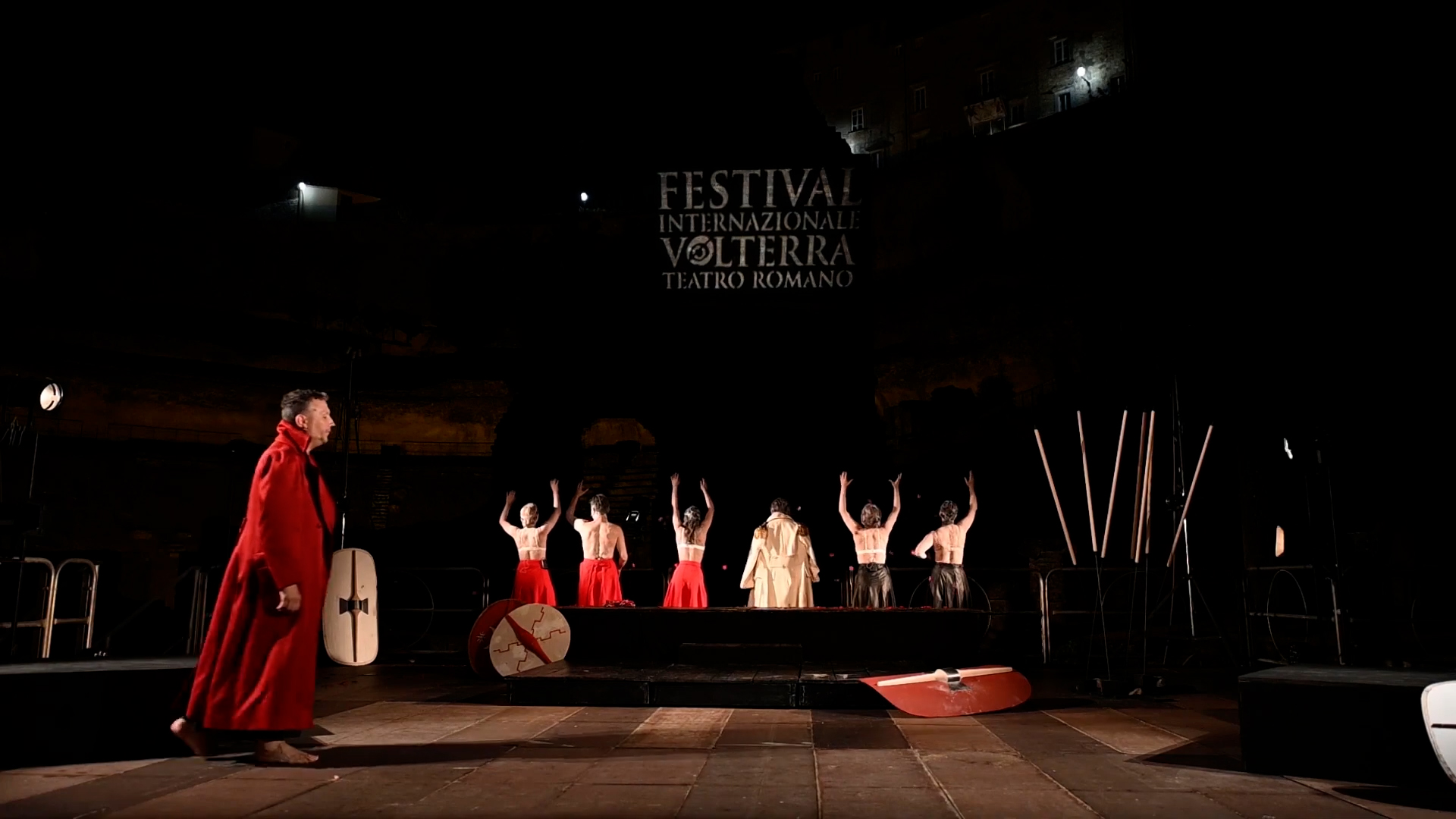
Theatrical show, by Nicola Fano e Simon Domenico Migliorini, Italy, 2022
The protagonist is Brutus, the celebrated instigator, along with Cassius, of the conspiracy of the Ides of March in 44 B.C., the assassin of Caesar. He enters the stage calling loudly for Cassius, his alter ego: we find ourselves in Philippi, where both conspirators have already fought and lost against the troops of Marcus Antonius, who has become the guarantor of justice towards Caesar and Rome. The story written in books materializes on stage with the words of Shakespeare, infinite, immortal, eternal words. The spectator listens, a symbolic battlefield and dead bodies appear before him, on which Brutus, defeated, wounded, almost dying, crawls and invokes and looks around bewildered, shocked at the appearance of the ghost of Caesar.
Brutus is Simone Migliorini, who speaks, moans, shouts, modulates those phrases of Shakespearean tragedy and makes them his own, as they have been generated, also in the adaptation from Shakespeare's "Julius Caesar" by the playwright Nicola Fano, who worked on the text focusing on the most controversial figure, that of the leader of the conspirators, the assassin of Caesar, specifically for Migliorini, who has studied and deepened the text and characters. But here Brutus, as the show unfolds, also becomes Macbeth, also Henry V, both tyrants, both assassins, soldiers, courageous or cowardly, great or infamous, in a flow of words and famous phrases, spoken, planted, recited, whispered, shouted by Simone Migliorini who with this performance confirms himself as a high-level interpreter. What strikes is the protagonist's ability to transform himself, from time to time, from Brutus into other characters, even into Marcus Antonius. A change of costume is enough for him, on stage. And it is here that Brutus looks into Antony's eyes and Antony scrutinizes Brutus, doubled by the same actor in a virtuosity that is extremely congenial to him. The actor is capable of being, at the same time, the one who kills and the one who exalts the killed; the one who is prey to doubts and remorse but is proud of his love for Rome and its freedom, and the one who exalts and celebrates the slain Caesar before the people, holding his will in his hand, in the famous Oration that has always been the flagship of the greatest actors.
LANGUAGE: Italian
SUBTITLES: English, Spanish, French, German, Portuguese
Two Armies, Two Visions of Roman Legitimacy
You are already choosing a side the moment you pick up a sword in the name of an idea, and in the autumn of 43 BC, twelve legions marched across the Via Egnatia toward Macedonia carrying two ideas that had almost nothing to do with what they claimed.
The men who followed Marcus Junius Brutus and Gaius Cassius Longinus into the plains of Philippi told themselves, and anyone who would listen, that they were the last defenders of the res publica — the republic understood not merely as a form of government but as a sacred inheritance, an ancestral architecture of shared sovereignty through which Rome had supposedly governed itself since the expulsion of the Tarquin kings in 509 BC. Brutus, who had read Plato and corresponded with Cicero and styled himself on the austere model of his ancestor Lucius Junius Brutus, the man who allegedly drove out that last king, understood his own biography as a kind of philosophical proof. The republic, in this telling, was not simply threatened by Caesar’s dictatorship — it had to be rescued from the very idea of one man’s irreplaceable genius. What Brutus could not bring himself to see, or could not admit that he saw, was that the institution he claimed to be defending had not functioned as advertised for the better part of a century. The senatorial oligarchy that Brutus invoked had already been shattered by Sulla’s proscriptions in 82 BC, rebuilt as a fiction, and then shattered again. The republic Brutus carried on his standard was a republic of memory, not of present fact, and memory, as every propagandist in history has understood intuitively, is far more useful than reality.
On the other side of the plain stood something that had been stripped of even that consolation. Gaius Octavius — who had taken the name Gaius Julius Caesar Octavianus the moment he learned of his adoption in Caesar’s will — had no philosophical tradition to invoke, no ancestral mythology to borrow without it immediately calling attention to his own political childhood. He was nineteen years old when he began assembling his army in 44 BC, and Cicero, whose Philippics are among the most brutally precise pieces of political writing to survive antiquity, initially dismissed him as a useful tool to be discarded once Antony was neutralized. Cicero wrote in a letter to Atticus in early 43 BC that the young man should be praised, honored, and then removed — laudandum adulescentem, ornandum, tollendum. It is one of history’s more satisfying ironies that Cicero would be dead before the year was out, his hands and head nailed to the Rostra by Antony’s soldiers, and that the boy he intended to discard was the one who had approved the proscription list that included his name.
What Octavian and Mark Antony brought to Philippi was not an ideology so much as a claim — the claim of pietas, of the sacred obligation to avenge a father’s murder. Roman law and Roman religion fused this obligation into something almost impossible to argue against publicly, because to oppose the avengers of Caesar was to cast yourself as complicit in the assassination, or worse, as someone who believed that killing a father figure could simply be absorbed without consequence. This framing was not incidental. It was the entire architecture of the Triumvirate’s public communication, and it worked precisely because it made the constitutional question — whether Caesar’s dictatorship had itself been legal, whether the Senate’s authority had already been forfeit before the Ides of March — unanswerable in the field. No one can argue jurisprudence when the charge against them is impiety toward the dead.
Both armies, then, were fighting for versions of Rome that required the other Rome to be erased in order to be believed.

Tactical Failures and the Myth of Heroic Command
You are sitting across from someone who has just made an irreversible decision based on information that was wrong. Not distorted, not misread — factually, verifiably, catastrophically wrong. Cassius did exactly this on the afternoon of October 3rd, 42 BCE, when he ordered a servant to kill him after watching what he believed was the complete destruction of Brutus’s cavalry wing. The cavalry had not been destroyed. It had returned victorious. Cassius died inside a false reality that had lasted perhaps twenty minutes, and with him died whatever coherent strategic intelligence the republican cause still possessed.
Adrian Goldsworthy, in his work on Roman military command, makes a point that military historians often domesticate into abstraction: Roman commanders operated at a catastrophic distance from real-time information. The command culture of the late republic was built around personal prestige and the performance of certainty, not the management of uncertainty. A general who hesitated visibly, who revised his assessment publicly, who said out loud that he did not know what was happening two ridges over — that general had already lost something more valuable than a battle. He had lost the ideological fiction that held a Roman army together, which was the belief that the man at the top could see further and feel less than everyone beneath him. This fiction was not incidental to Roman command culture. It was structural. It meant that the psychological state of one individual could become the operational reality of tens of thousands.
The logistical situation at Philippi compounds this to the point of institutional indictment. The republican forces held a fundamentally superior supply position in the early phase of the campaign. Their naval control of the Adriatic meant that Antony and Octavian’s supply lines were dangerously extended and increasingly precarious — so precarious that Goldsworthy estimates the Triumviral forces were weeks, possibly days, from a collapse driven by starvation rather than steel. Brutus understood this. His strategy was patience: hold the high ground, protect the supply corridor, wait. It was the correct strategy. It was abandoned for reasons that had nothing to do with military logic and everything to do with the social pressure of men who could no longer tolerate the dishonor they felt in refusing battle. The troops grew restless. Allied contingents threatened to withdraw. The Roman aristocratic imagination, which had been conditioned across generations to equate waiting with cowardice, began to consume the strategy from the inside.
What collapsed at Philippi was not a battle plan. What collapsed was the republican command’s capacity to insulate military decision-making from the cultural scripts that governed Roman masculine identity. Brutus, trained in Stoic philosophy, aware of the strategic calculus, knowing that time was the one resource his enemy lacked, nevertheless gave the order to engage for the second time on October 23rd because the alternative — being seen as afraid — had become psychologically unsustainable. The Stoic tradition he claimed had given him tools for enduring external catastrophe. It had given him almost nothing for resisting the internal machinery of a social code that made waiting feel like dying.
This is what Goldsworthy’s analysis of Roman command really illuminates when pressed hard enough: the mythology of heroic command is not a distortion of military reality, it is a generator of military failure. The narrative of the commander who acts decisively, who embodies the will of the army, who moves forward when others would pause — this narrative does not describe exceptional leadership. It describes the ideal conditions for turning a survivable tactical situation into a civilizational catastrophe. Every institution that rewards certainty over accuracy, resolution over revision, and visible confidence over honest assessment is cultivating the exact conditions Cassius embodied in those final twenty minutes of his life, scanning a battlefield through bad information and choosing the permanent over the provisional.
Suicide as Political Act in the Roman Moral Economy
You are standing over a body that chose to fall on its own sword, and the word that forms in your mouth is not tragedy — it is failure. That instinct, that reflex of pity mixed with incomprehension, is precisely what the Roman moral economy spent centuries engineering out of its ruling class. Cassius died first, on the third of October, 42 BCE, outside Philippi, having misread the battle entirely, believing Brutus already defeated when Brutus had in fact won his sector. He ordered his freedman Pindarus to kill him, and Pindarus obeyed, and the act was recorded not as a misunderstanding ending in death but as a Roman dying well. The error in tactical intelligence was almost irrelevant. What mattered to every Roman who would read about it for the next five centuries was the shape of the exit.
Miriam Griffin, in her Seneca: A Philosopher in Politics published in 1976, traced with extraordinary precision the ideological infrastructure that made this possible. Griffin’s argument was not simply that Stoicism validated suicide — it was that Stoic philosophy, as it was absorbed into Roman aristocratic culture across the first century BCE, created a moral grammar in which the willingness to die on one’s own terms became the final proof of inner freedom. The body was never really yours. The self was a tenant in matter, and the door out was always unlocked. What marked the honorable man was that he knew which key fit the lock, and that he used it without trembling. Cato at Utica in 46 BCE, reading Plato’s Phaedo through the night before tearing open his own wound, was not performing despair. He was performing philosophy.
Brutus died seventeen days after Cassius, on the twentieth of October, having lost the second engagement at Philippi and watched his coalition dissolve around him. He ran onto a sword held by a friend named Strato, and the story that came down through Plutarch wrapped this death in complete philosophical composure — Brutus allegedly said he found more joy in the virtue he had exercised than in the victory he had not won. Whether or not he said it is almost irrelevant. The fact that this was the story his tradition needed him to have said reveals what the culture required of his exit. It required that he mean it. The suicide of the defeated Roman nobleman was only legible as honorable if it was also, somehow, voluntary — if it could be narrated as a free choice rather than a cornered animal’s last move.
What Griffin excavates is the violence inside that requirement. The Roman Stoic framework did not merely offer suicide as an option for the defeated. It progressively closed off all other options by making survival after catastrophic political defeat into a form of moral deformity. To live after Philippi, to accept the clemency of Octavian and Antony, was to confirm that you valued your biological continuity above your integrity — and once Roman aristocratic culture accepted that equation, survival itself became the shameful act. The architecture was elegant and merciless: it produced men who genuinely believed their own annihilation was dignity, who walked into death not because they were broken but because the ideological framework they had inhabited since childhood had made self-destruction feel like the only coherent sentence in the only language available to them.
What this means is that the battlefield at Philippi was not the only place where Cassius and Brutus were killed. They were killed, incrementally and thoroughly, by every philosophical text, every aristocratic mentor, every senatorial funeral oration that had shaped their understanding of what it meant to be a man of consequence in Rome — until the moment came when the sword felt less like ending and more like punctuation.
The Erasure of the Republic as Ideological Infrastructure
You are standing in the Forum Romanum in the autumn of 44 BCE, surrounded by marble and noise and the smell of sacrificial smoke, watching men argue with tremendous passion about the fate of a political system that has not functioned as advertised for at least a generation. The gestures are correct. The togas are pressed. The Senate convenes, votes are taken, decrees are issued — and none of it corresponds to the actual distribution of power in the city, the provinces, or the armies encamped on every horizon.
Fergus Millar spent a significant portion of his scholarly career dismantling the comfortable myth that the late Roman Republic was a functioning democratic organism whose machinery was violently interrupted by ambitious strongmen. His 1998 work on popular assemblies and crowd politics in the final century of republican governance demonstrated something far more unsettling: the institutions were real, the crowds were real, the emotional investment was real — but the procedural sovereignty those institutions claimed to exercise had been progressively hollowed out by the structural impossibility of governing a Mediterranean empire through mechanisms designed for a city-state. The comitia could not govern Gaul. The Senate could not discipline armies that owed their loyalty, their pay, and their futures to individual commanders rather than to the abstraction of the res publica. What Millar identified was not corruption or personal failure but a systemic mismatch so profound that by the time Caesar crossed the Rubicon in 49 BCE, the Republic had already become a performance staged inside a collapsing theater.
This is what makes the cause Brutus died for at Philippi so philosophically vertiginous. He was not defending a living political body. He was defending a vocabulary, a ceremonial practice, a way of dressing power in familiar language so that the people administering it could still feel themselves to be citizens rather than subjects. The distinction mattered enormously to men educated on Cicero and Polybius and the ancestral examples of virtuous Roman magistrates — and it mattered almost not at all to the legions who had been eating, marching, and bleeding for their generals for years, or to the provincial populations who experienced Roman governance primarily as tax collection and military conscription.
When an institution survives only as theater, something specific happens to the people who continue performing its rituals sincerely. They become simultaneously the most dangerous and the most obsolete actors in the room. Dangerous because they are willing to kill — and die — for a form that everyone else has tacitly agreed to treat as ceremonial. Obsolete because the consensus that gives institutions their coercive reality has already migrated elsewhere, to wherever the actual resources and loyalties reside. Brutus did not murder Caesar to save the Republic. He murdered Caesar to save the idea that the Republic was still the kind of thing that could be saved by the actions of virtuous men operating through recognized political channels — which is a fundamentally different claim, and a catastrophically mistaken one.
The battle that followed twenty months later on the plains of Macedonia was therefore not a conflict between republicanism and autocracy in any straightforward sense. It was a conflict between two factions who had already accepted the new imperial logic — because Antony and Octavian were certainly not restoring the old constitutional order either — and one faction that had not. Brutus fought not to create a new political dispensation but to rewind to a condition that had never been as stable or as legitimate as its defenders remembered. Memory, as the historian Paul Connerton argued in How Societies Remember in 1989, does not preserve the past so much as it produces a usable version of it — a version shaped entirely by the needs of the present moment and the people doing the remembering.
What Philippi destroyed was not the Republic. It destroyed the social permission to pretend the Republic still existed as a governing reality rather than a rhetorical inheritance, and that permission, once revoked, could never be quietly reissued.
A vision curated by a filmmaker, not an algorithm
In this video I explain our vision
Octavian's Transformation of Defeat into Foundation

You are sick in a tent while the world is being decided outside. The dispatches arrive, the couriers blur past the entrance, and somewhere on the plain your generals are doing what you could not — standing in the open, absorbing the chaos of twenty-odd legions colliding in dust and blood. Octavian was there at Philippi in 42 BCE, technically present, medically absent, carried in a litter according to sources that were already beginning to be managed. He survived Brutus’s assault on his camp by what his own later accounts called providential instinct. The survival was real. The interpretation of it was constructed.
What makes Philippi historically decisive is not the tactical outcome, which Antony largely produced, but what Octavian did with the political raw material of victory in the decade and a half that followed. Karl Galinsky’s 1996 study of Augustan culture makes a crucial distinction that most military histories of the period flatten: the Principate was not imposed through the machinery of permanent violence but built through the patient engineering of legitimacy. Galinsky reads the Ara Pacis, the Forum of Augustus, the careful choreography of the title “Augustus” itself — granted by the Senate in 27 BCE, saturated with religious connotation, carefully distinguished from the blunter monarchical vocabulary of the Greek east — as evidence that what Octavian understood, with a sophistication none of his contemporaries matched, was that durable power required belief, not merely submission.
The soldiers who fought at Philippi expected land. They received it, violently redistributed from eighteen Italian towns — Cremona and Mantua among the most brutally stripped — in a process that produced fury, displacement, and, crucially, dependence. Veterans settled on confiscated soil became stakeholders in the regime that had confiscated it. Their loyalty was not purchased abstractly; it was anchored in the irreversibility of the transaction. To oppose Octavian now was to risk the legal basis of your own farm. Virgil’s first Eclogue, written in the immediate aftermath of these dispossessions, carries the grief of this without ever naming it directly: one shepherd keeps his land, another must leave, and between them stretches a silence that is the sound of an entire social order reorganizing around a single surviving center of power.
What Octavian grasped, and what the senatorial tradition never fully processed, was that Julius Caesar had failed not by accumulating power but by making it visible in the wrong symbolic register. The dictatorship was a recognized Roman office, but its perpetual form ruptured the fiction of Republican temporariness that held the aristocratic imagination together. Octavian never made that error. He held multiple offices simultaneously but refused the titles that would have named the accumulation honestly. The settlement of 23 BCE, in which he traded the consulship for tribunician power and proconsular imperium, was not a constitutional compromise — it was constitutional theater, designed to let the Senate feel it had negotiated when the negotiation had already concluded in his favor.
Memory itself became a material to be shaped. The celebrations following Actium in 31 BCE, which consolidated his monarchical position far more completely than Philippi ever could have, were narrated backward through Philippi’s frame: here is where the assassins were punished, here is where the Republic’s avengers were vindicated, here is where this long story of righteous restoration began. Philippi was retooled from a messy, illness-shadowed, partially accidental victory into the foundational myth of a providential career. Suetonius records that Octavian kept an image of Alexander the Great on his signet ring until he replaced it with his own portrait — the moment of substitution marking precisely when the borrowed legitimacy of martial greatness became something he believed he no longer needed to borrow.
The Senate voted him powers. The poets gave him eternity. The veterans gave him their children’s political imagination, because men who owe their land to a decision tend to raise sons who do not question the decider.
Antony's Trajectory and the Cost of Winning the Wrong Victory
You win the battle and lose the decade. Antony stood at Philippi in 42 BCE as the indisputable architect of Rome’s survival as an autocratic project — his tactical genius on the right wing, his relentless pressure against Brutus, his reading of terrain and timing that Octavian, bedridden and absent from the field on the first day of engagement, could not match and did not provide. The laurels were real. The power they conferred was real. What Antony could not see, standing among the dead of two Republican armies, was that the man who had contributed least to the killing would spend the next twelve years constructing an account of what the killing had been for.
Ronald Syme, writing in The Roman Revolution in 1939 with the cold precision of someone watching European strongmen consolidate power in real time, identified the mechanism with surgical clarity: revolutions are not won on the battlefield but in the vocabulary that follows the battlefield. Octavian understood this with an instinct that bordered on the pathological. He did not need to defeat Antony militarily at Philippi because he had already begun, quietly and without announcement, the longer work of defining what Philippi had authorized. The Ides of March had been framed as a sacrilege against the divine order of Rome; Philippi was therefore not merely a military victory but a cosmic settling of accounts. Whoever controlled the sacred narrative of Caesar’s vengeance controlled the legitimacy of everything that came after.
Antony went east. This was not a mistake of character but a consequence of the territorial division agreed at Philippi and then formalized at Brundisium in 40 BCE, where Rome’s Mediterranean world was partitioned along lines that seemed equitable and proved fatal. The eastern provinces were wealthier, more cultured, and more immediately useful for the Parthian campaign Antony believed would define his legacy the way Caesar’s Gallic wars had defined Caesar’s. He was not wrong about the wealth. He was catastrophically wrong about the ledger on which legacy was being calculated. Every month Antony spent in Alexandria, every political alliance with Cleopatra, every grain shipment and royal ceremony conducted outside the ritual geography of Rome, became material Octavian could work with — not as military threat but as cultural pollution.
The Roman aristocratic imagination in the first century BCE was obsessed with the boundary between Roman virtue and Eastern corruption, and this was not merely snobbery but a structural feature of how Roman identity had been maintained against the seductive pull of Hellenistic courts since the second Punic War. Antony did not become Eastern. He remained a Roman commander pursuing Roman strategic objectives. But Octavian’s propaganda apparatus, operating through poets, public monuments, and the deliberate staging of religious ceremony in Rome, needed only to suggest contamination, not prove it. By the time Octavian formally declared war in 32 BCE, he declared it not against Antony — a Roman citizen and triumvir — but against Cleopatra, which was a juridical masterstroke that reframed a civil war as a foreign war, a defense of Roman civilization against Oriental monarchy.
Syme observed that the genius of Augustus — the name Octavian would take after Actium — was precisely his ability to make his personal political survival appear identical with the survival of Roman tradition itself. Every institution he preserved or appeared to preserve, every Republican formula he retained in public ceremony, strengthened this identification. Antony, who had won the real war, had never been interested in the semiotics of power, only in its exercise. He was a commander in a world that had already shifted from a competition of armies to a competition of meanings, and he brought to that competition exactly the wrong set of skills, sharpened to a lethal edge that cut nothing that mattered anymore.
Philippi as Template for the Permanent State of Exception
You are standing in a voting assembly that no longer decides anything, casting a ballot whose outcome was settled before you arrived, and the ritual feels correct because the architecture of participation was preserved even as its substance was quietly removed — this is not the invention of modern managed democracy, it is the inheritance of a specific institutional moment that occurred in the autumn of 42 BCE, when two battles fought on Macedonian soil did not simply end a civil war but closed the last genuine competition over what kind of power Rome would permit itself to have.
Giorgio Agamben, in Homo Sacer published in 1995, built his central argument around a Roman legal concept that most constitutional historians had treated as a marginal curiosity: the iustitium, a suspension of juridical order declared in moments of extreme public danger, during which the normal distinctions between lawful and unlawful action ceased to apply to those entrusted with saving the state. What Agamben recognized, drawing also on Carl Schmitt’s 1922 definition that the sovereign is precisely the one who decides on the exception, is that this suspension was never truly temporary. The exception does not interrupt the rule — it reveals what the rule was always protecting: the capacity of power to place itself beyond accountability when it judges the stakes high enough. The Second Triumvirate, formalized in 43 BCE through the Lex Titia, was not a crisis measure grafted onto republican institutions. It was a crisis measure becoming institution, the exception writing itself into the constitutional fabric with a three-year mandate, renewal clauses, and the bureaucratic infrastructure of the proscription lists, which killed approximately three hundred senators and two thousand equestrians not in the heat of battle but through administrative enumeration.
What the proscriptions demonstrated was the transformation of bare life — Agamben’s homo sacer, the person who can be killed without the act constituting murder — from a theological-legal abstraction into an operational category of Roman statecraft. The proscribed man lost his name from the civic rolls before he lost his life; his death was a clerical completion of a prior political erasure. After Philippi, this logic did not retire with the emergency. Augustus spent forty years dressing the same architecture in the vocabulary of restored tradition, and Roman jurists from Ulpian to Papinian spent the following two centuries developing the doctrine of the princeps legibus solutus — the ruler unbound by the laws — which is precisely the normalized exception, given its permanent address in the palace on the Palatine Hill.
The Western transmission of this structure did not require conscious citation. Medieval canonists borrowing Roman law imported the iustitium’s logic into emergency prerogative doctrines. The state of siege codified in French law after 1791 and repeatedly invoked through the nineteenth century was its bureaucratic grandchild. When Walter Benjamin wrote in 1940 that the state of exception had become the rule, he was diagnosing something that had been developing its permanent residency since the moment Octavian returned from Macedonia having eliminated every political actor capable of contesting his interpretation of necessity.
The deeper inheritance is not institutional but psychological: a population trained by repeated emergency to accept that the ordinary protections of civic life are contingent gifts rather than structural guarantees, revocable the moment power decides the threshold has been crossed. Republics do not typically die when an army marches on the capital. They die earlier and more quietly, in the moment when enough citizens internalize the sovereign’s definition of the crisis as their own, when the suspension of norms begins to feel like responsibility rather than usurpation, when the person standing in that hollow assembly senses something is wrong but cannot locate the precise moment the assembly became hollow, because that moment was Philippi, and it happened a very long time ago.
⚔️ Power, War, and the Fate of Empires
The Battle of Philippi marked a turning point in Roman history, sealing the end of the Republic and the rise of autocratic power. These related articles explore the political, military, and cultural forces that shape civilizations at their most decisive moments.
Niccolò Machiavelli: Life and Political Thought
Niccolò Machiavelli remains one of the sharpest analysts of political power and military strategy in Western thought. His observations on how rulers gain, maintain, and lose power resonate deeply with the brutal calculations that defined the conflict at Philippi, where alliances fractured and ambition determined the fate of Rome.
GO TO THE SELECTION: Niccolò Machiavelli: Life and Political Thought
Thomas Hobbes: Life and Political Thought
Thomas Hobbes built his entire political philosophy around the terrifying reality of war and the fragility of civil order. His vision of human nature as inherently competitive mirrors the world of late Republican Rome, where competing warlords like Antony, Octavian, and Brutus plunged the ancient world into devastating civil conflict.
GO TO THE SELECTION: Thomas Hobbes: Life and Political Thought
Shakespeare’s Richard III: Meaning and Analysis
Shakespeare’s Richard III is one of literature’s most compelling portraits of a man who seizes power through cunning, ruthlessness, and the destruction of rivals. The play echoes the moral ambiguities of Philippi, where the victors rewrote history and the defeated became symbols of lost republican virtue.
GO TO THE SELECTION: Shakespeare’s Richard III: Meaning and Analysis
Jorge Luis Borges: Life and Works
Jorge Luis Borges devoted much of his literary imagination to labyrinths, mirrors, and the cyclical nature of history, themes deeply resonant with the legacy of Philippi. His meditations on fate, identity, and the infinite repetition of human conflict offer a philosophical lens through which to reread ancient battles as timeless archetypes.
GO TO THE SELECTION: Jorge Luis Borges: Life and Works
Discover History and Power on Indiecinema
If these themes of war, empire, and political destiny captivate you, Indiecinema streaming offers a curated selection of independent films that explore history, power, and the human condition with rare depth and intelligence. Step beyond the mainstream and discover cinema that truly makes you think.
👉 EXPLORE THE CATALOG: Watch Indie Films in Streaming
A vision curated by a filmmaker, not an algorithm
In this video I explain our vision

