
The Weight of a Single Frame
You are standing in front of a photograph you have seen reproduced a hundred times, on classroom walls and museum postcards and the covers of books about the Depression, and yet standing before the actual print you feel something you did not anticipate: the woman is looking at you. Not at the camera, not at the photographer, not at some abstract future audience — at you, specifically, with an expression that does not ask for your sympathy and does not offer gratitude for your attention. Dorothea Lange made this image in Nipomo, California, in March 1936, and the woman in it, Florence Owens Thompson, was thirty-two years old and had seven children and had just sold the tires off her car to buy food. That information sits in your head like a caption. What sits in your chest is something the caption cannot reach.

The absence of color is doing something to you that you have not been given the vocabulary to describe, because the entire cultural apparatus surrounding photography has trained you to experience color as presence and its absence as loss. But that framework is precisely backwards. Color, in the photographic image, functions as a form of displacement — it routes your attention through the familiar grammar of the visible world, through the reassuring information of green grass and blue sky and the warmth of skin tones, all of which serve unconsciously to remind you that what you are seeing is a representation, a document, something safely contained within the aesthetic. Strip that away and something else is exposed. Not rawness for its own sake, not the theatrical grit that black and white has since become in the hands of commercial photographers mimicking seriousness — but a structural nakedness, a removal of the image’s ability to seduce you into mere looking.
Susan Sontag argued in her 1977 work On Photography that photographs create a relation to events and to people that is fundamentally acquisitive — we collect images the way we collect the world, domesticating it through possession. What she did not fully account for is how the tonal reduction of monochrome sabotages that acquisition. The collecting impulse depends on a certain surplus of visual information, on the richness that makes an image feel like a souvenir worth keeping. A photograph that gives you only light and shadow and the geometry of a face does not let you collect it. It collects you instead.
This is not a romantic claim about the superiority of an older technology. It is a structural observation about what happens to moral attention when the decorative scaffolding of the image is removed. The French phenomenologist Maurice Merleau-Ponty spent years in his work of the late 1940s and 1950s arguing that perception is never neutral — that what we see is always already shaped by the body’s orientation toward the world, by its habits of comfort and avoidance. A color photograph operates within those habits fluently, feeding them the kind of data they were trained to process and thereby allowing the viewer to remain, perceptually speaking, at home. Black and white breaks the homeostasis. The eye has nowhere comfortable to land.
What this produces, in the presence of a genuine master of the form, is something closer to ethical exposure than aesthetic experience. You are not appreciating. You are being seen. Thompson’s gaze in Lange’s photograph has endured for nearly ninety years not because it is beautiful — though the composition is exact, the light extraordinary — but because it refuses the transaction that most images offer. It does not give you the experience of having witnessed something. It gives you the experience of having been caught in the act of witnessing, which is an entirely different moral position, and one that color, with its generous surplus of information, would have allowed you to avoid.
Simon Marsden’s Haunted Life In Pictures
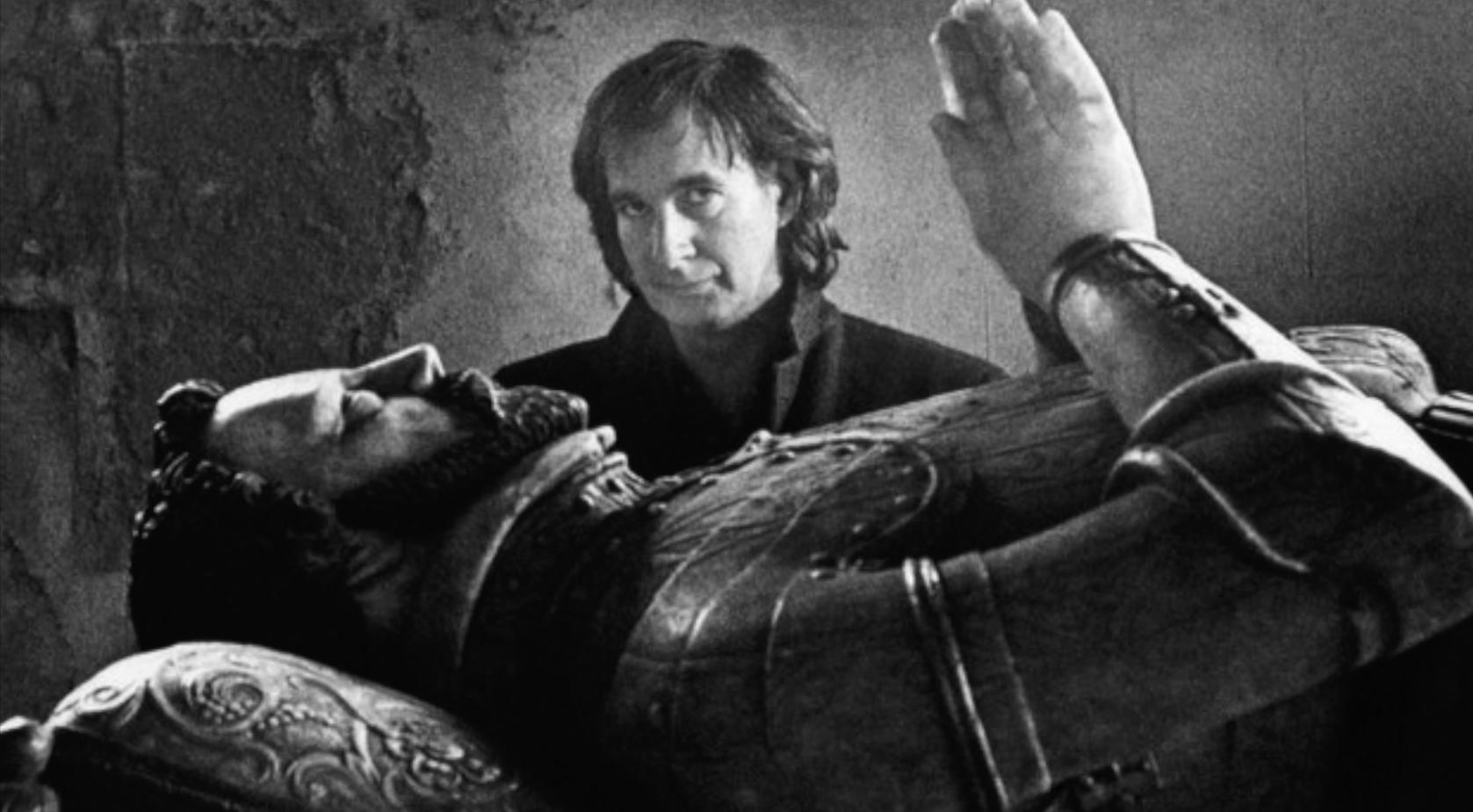
Documentary, by Jason Figgis, United States, 2019.
This documentary retraces the life and work of Simon Marsden, widely regarded as one of the foremost photographers of the supernatural. Premiered at the British Film Institute in London, the film offers a fascinating journey into his creative universe, appealing not only to photography enthusiasts but also to scholars, teachers, students, and anyone intrigued by the mysteries of the unseen. Through evocative imagery and first-hand accounts, it explores the artistic path of a photographer whose work has appeared in books, on U2 album covers, and in museum exhibitions around the world.
Although convinced of the existence of ghosts, Marsden never claimed to capture them directly with his camera. Instead, he used black-and-white infrared film to record the atmosphere and the invisible traces that, in his view, spirits left imprinted upon places. From the landscapes of Ireland to the vast expanses of Russia, passing through Venice and the American Southwest, he transformed historic buildings, ruins, and haunting locations into deeply evocative images capable of suggesting dark and unsettling stories. His photographs continue to captivate the imagination, demonstrating how the most powerful works of art can leave a lasting impression on those who behold them.
LANGUAGE: English
SUBTITLES: Spanish, French, German, Portuguese
What Color Was Always Hiding
You have looked at a photograph of a burning city and felt, almost immediately, that it was beautiful. The orange plume against the darkening sky, the way the light fractured across the water in the foreground — your eye completed its journey before your mind had finished asking what it was looking at. That satisfaction was not accidental. It was engineered by the very fact of color itself, which delivers the world to the senses in a register so biologically fluent that critical distance collapses before it can form.
Color in photography does not simply represent reality. It ratifies it. It wraps the image in the same sensory logic the eye uses every waking hour, and so the photograph stops feeling like a representation and starts feeling like an extension of ordinary perception. Susan Sontag observed in On Photography, published in 1977, that photographs generally create only the appearance of knowledge and understanding, offering something that feels like direct encounter while actually substituting for it. Color accelerates this substitution with remarkable efficiency. When the visual surface of an image resembles the visual surface of lived experience, the viewer is lulled into receptivity rather than provoked into interrogation. The image answers a perceptual question the brain was already asking — what does this look like? — and in answering it, quietly forecloses the harder question beneath it.
Sontag was tracing something deeper than aesthetic preference when she argued that photographs condition us into a mode of acquisition rather than understanding. To photograph something, she wrote, is to appropriate it. But the reverse is also quietly true: to consume a photograph too fluently is to believe you have absorbed something you have only passed over. Color photography makes this passage frictionless. It extends the logic of the advertisement, the travel brochure, the brand image — surfaces designed not to disturb but to attract, not to question but to confirm. The eye lands, feels satisfied, moves on. The image has performed its function before consciousness has fully arrived.
Strip the color away and something structurally different occurs. The image can no longer borrow its authority from the viewer’s sensory familiarity. It must construct its meaning through relationships — between brightness and shadow, between mass and absence, between what the light touches and what it refuses. The photograph becomes a formal argument rather than a sensory surrogate. And formal arguments, unlike sensory impressions, demand a reader. They require the viewer to do work, to sit inside the image long enough to feel its internal logic accumulate. This is precisely what makes certain black and white images feel heavier than the events they depict seem to warrant. The weight is not in the subject. It is in the duration of attention the image compels.
There is a reason documentary photographers working in conflict zones through the mid-twentieth century — from Spain in 1936 through Korea in the early 1950s to the American South throughout that decade — often produced images that still resist being looked at casually. The absence of color removed the aesthetic sedative at the moment it would have been most tempting to administer. A body on black and white film cannot be made picturesque by the quality of the light falling across it. There is no golden hour in monochrome, no warmth that redeems. What remains is geometry and weight, the specific arrangement of a human form in a space that no longer accommodates it. The image insists on its subject in a way color, however unintentionally, can dilute.
This is not an argument for suffering as the only legitimate subject of serious photography. It is a structural observation about what happens to the viewer’s defenses when the most immediately satisfying layer of visual information is withheld. What the eye cannot consume on contact, the mind must eventually face.

The Grammar of Shadow
You stand in front of a print — not a photograph, a print — and something in your chest tightens before your mind has processed why. The blacks are not merely dark. They have density, weight, a kind of gravitational pull that makes the whites feel earned rather than accidental. You are looking at something that was decided, not captured.
Ansel Adams spent the better part of the 1930s understanding that the camera was a liar by default. Not a malicious one, but a mechanical one — indifferent to what the eye actually perceives when it stands before a granite cliff at dusk or a snow-covered valley under flat winter light. The human eye constantly adjusts, compensates, prioritizes. The film does not. It records a single flat truth and calls it reality. Adams refused this flatness not as an aesthetic preference but as an ethical position. In 1940, working alongside the physicist and fellow photographer Fred Archer at the Art Center School in Los Angeles, he codified what he called the Zone System — a method of dividing the tonal range of any scene into eleven distinct zones, from pure black at Zone Zero to pure white at Zone Ten, with a mathematically precise middle grey anchoring Zone Five. The system allowed a photographer to visualize the final print before the shutter was ever pressed, to assign specific tonal values to specific elements of a scene, and then to expose and develop accordingly. It was, on its surface, a technical framework. Underneath, it was a declaration that every tonal choice is a moral choice.
What Adams grasped — and what most of his contemporaries either missed or deliberately sidestepped — is that neutrality in photography is a fiction maintained by people who benefit from it. When you decide that a shadow falls at Zone Three rather than Zone Two, you are deciding whether a face reads as contemplative or menacing, whether a landscape reads as sublime or threatening, whether a body reads as dignified or diminished. These are not small decisions. The history of photography is riddled with images in which certain faces were systematically rendered darker than the scene warranted, certain bodies flattened into backgrounds, certain presences made visually subordinate through choices that were presented as purely technical. The Zone System, whatever Adams intended, strips away the alibi of accident. It forces the photographer to admit they are not recording reality — they are legislating it.
This legislative quality of tonal control connects to something the philosopher Nelson Goodman argued in Languages of Art, published in 1968, where he proposed that images do not resemble the world so much as they exemplify it — they present one possible version of visual experience as if it were the only coherent one. A photograph in which Zone Eight dominates the midtones is not a brighter photograph, it is a different argument about what exists and what matters. Light in Adams’s own work does not simply illuminate. It validates. The famous 1941 print Moonrise, Hernandez, New Mexico, made during a single frantic exposure as the light was failing, achieves its power not because Adams was lucky but because he understood immediately, standing at the side of a road with seconds to spare, exactly which tonal values would transform a small New Mexican cemetery into something that felt like a confrontation between mortality and endurance. He metered the moon. He already knew where it would land in the final print.
The Zone System was eventually adopted by virtually every serious darkroom photographer working in the second half of the twentieth century, and its logic survived the transition to digital imaging in the form of histogram management and exposure compensation. But something in the original philosophical charge got diluted along the way — because when a method becomes a curriculum, it loses its urgency. Students learn to place Zone Five correctly and forget that Adams was not teaching placement; he was teaching responsibility for what the eye of the print will tell the viewer to believe.
Masters Who Refused the Obvious
You are standing at a window watching the street below, and nothing is happening — not yet. Someone crosses from left to right, a child stops, pigeons scatter, and for a fraction of a second the geometry of the world resolves into something that feels inevitable, as if it had always been pointing toward this arrangement. Then it dissolves. You either caught it or you didn’t, and no amount of cropping or retouching retrieves what was never stored.
What Henri Cartier-Bresson formalized in Images à la Sauvette in 1952 was not a technique. It was an epistemology of patience that the photographic world spent the following seven decades systematically misreading. The French title translates loosely as “images on the run,” which has always been the wrong emphasis. The decisive moment — l’instant décisif — was never a claim about speed or reflex. It was a claim about submission: the photographer’s willingness to wait without engineering, to hold the camera ready without forcing the frame, to let meaning arrive fully formed rather than manufacture its appearance. Cartier-Bresson himself used a Leica with no flash, no tripod, often no deliberate composition in the sense his contemporaries understood the term. He described his method as stalking, but the quarry was not a subject — it was coherence, the instant when content and form became indistinguishable from each other.
The culture that came after him took the vocabulary and discarded the philosophy underneath it. By the mid-2000s, the phrase “decisive moment” had migrated into the lexicon of brand strategists and social media consultants who used it to describe timing a product drop correctly or releasing a campaign at peak attention hours. The distance between those two uses of the same phrase is not merely ironic — it reveals a structural shift in what Western visual culture believes images are for. Cartier-Bresson believed the photograph was an act of recognition, a moment when the photographer’s perception aligned with the world’s own logic. The engineered image, by contrast, begins with the conclusion and works backward, constructing the visual evidence of a meaning already decided in a conference room.
This is where the psychology of vision becomes genuinely uncomfortable. Daniel Kahneman’s work in Thinking, Fast and Slow — published in 2011 but drawing on decades of research with Amos Tversky — demonstrated that human cognition consistently mistakes familiarity for truth. Images designed to trigger fast, effortless recognition are experienced as more credible than images that require a moment of genuine looking. The photograph that rewards immediate glancing feels truer than the one that asks you to stay. The economy of attention did not create this bias — it simply learned to weaponize it at industrial scale. Every algorithmic feed is, among other things, a machine for teaching your eyes to refuse the slow image.
What Cartier-Bresson’s contemporaries like Willy Ronis and Izis Bidermanas understood — and what their work from postwar Paris demonstrates in archival prints that still unsettle viewers — is that the unmanipulated photographic moment carries a specific quality of accident that the viewer senses before they can name it. There is something in the slight tilt of a figure, the half-shadow falling at an angle no set designer would have chosen, the background element that has no narrative function and yet transforms the emotional register of the whole frame. These accidents are not flaws. They are the traces of an uncontrolled world pressing itself into the image, and they function as guarantees — unconscious but felt — that what you are seeing was not planned for you.
The planned image cannot produce this sensation, no matter how sophisticated its mimicry becomes. It can produce recognition, pleasure, confirmation of what the viewer already believes. What it cannot produce is the particular unease of encountering something real that you did not expect to find beautiful, and finding that the beauty troubles you precisely because it asked for nothing from you in return.
The Lie of Objectivity
You are in a trench somewhere between two place names that will later become footnotes in a cenotaph inscription, and you have thirty-seven frames left on the roll. The man to your left is dying in a way that is photogenic — his face turned upward, his hands open, the light falling across him in a diagonal that Caravaggio would have recognized. Twenty meters further along the trench, three other men are dying in ways that are not: obscured by mud, contorted, undignified, their suffering legible only as chaos. You raise the camera. The choice you make in the next four seconds will determine which death enters the archive of human memory and which dissolves back into the anonymous earth. This is not a moral failure. It is the structural condition of every frame ever taken in a war zone, and it has been systematically obscured by the cultural authority that black and white photography has accumulated over a century of pretending to be something other than a decision.
The myth works through a displacement. Because color photography immediately signals the aesthetic — the Instagram filter, the sunset oversaturated for emotional effect — we have come to read its absence as the removal of mediation. Black and white appears to have subtracted the seductive, leaving only the real. But subtraction is not neutrality. When W. Eugene Smith produced his 1951 photo-essay “Spanish Village” for Life magazine, he spent weeks selecting, printing, and sequencing images into a coherent emotional argument about poverty and endurance under Franco. He burned and dodged in the darkroom for hours to achieve the tonal weight he wanted. The images convinced millions of readers they were witnessing unvarnished truth. What they were witnessing was one of the most deliberate aesthetic constructions in the history of photojournalism, rendered authoritative precisely because it looked undecorated.
Authority and truth are not synonyms, but the history of black and white photography has depended on the confusion between them. Roland Barthes, writing in Camera Lucida in 1980, identified what he called the photograph’s punctum — the detail that wounds the viewer personally, that pierces — but he was careful to distinguish this from any guarantee of reality. The photograph certifies that something was present in front of the lens; it certifies nothing about what surrounded that something, what was excluded, what was staged, what the printer later chose to emphasize or suppress. The camera is a frame, which means it is by definition a mechanism of exclusion, and black and white does not dissolve that exclusion — it glamorizes it.
There is a specific social history behind why Western journalism adopted monochrome as its default register of seriousness precisely between 1930 and 1970, the decades in which mass-market color printing became technically feasible but was reserved for advertising and entertainment. The visual grammar that formed in those decades taught audiences to associate color with pleasure and consumption, and the absence of color with gravity, witness, and credibility. This was not an organic development from photography’s intrinsic properties. It was a market-driven aesthetic convention that calcified into an epistemological assumption — and that assumption has consequences measured in actual human beings whose suffering failed to enter the historical record because it was not legible in the visual grammar of the authoritative frame.
The most honest photographers working in extreme conditions have always known this. Gilles Peress, whose work in Rwanda in 1994 deliberately broke from the elegiac tonal traditions of Magnum photography, has spoken about the ethical violence embedded in beautiful documentary images — the way formal mastery aestheticizes atrocity and in doing so makes it bearable, digestible, something to be appreciated rather than answered. The frame does not document the world.
A vision curated by a filmmaker, not an algorithm
In this video I explain our vision
Darkness as Social Architecture
You are standing in a grocery store in Alabama in 1956, and the shelves behind you are full. You are white, you are middle-class, you subscribe to Life magazine, and it arrives at your house every week like a small confirmation that the world is orderly and legible. Then one Tuesday it arrives and inside it is a photograph by Gordon Parks, and something in the photograph refuses to let you be a bystander.
Parks did not go to the American South to produce what the photographic tradition calls documentary neutrality. The very concept of neutral documentation is itself a kind of ideological architecture — it assumes a photographer who stands outside the social order and records it like a seismograph records tremors. Parks understood, with the precision of someone who had been refused entry to camera stores in Washington D.C. as recently as 1942, that the camera was never neutral and had never been. What he built instead, across his coverage of the Fontenelle family in Harlem and his earlier work with the Farm Security Administration under Roy Stryker, was a visual grammar that made complicity visible. The darkness in his frames was not the absence of light. It was the presence of a system.
The tonal architecture of Parks’s 1956 Life work operates through a specific mechanical logic that most viewers absorb without naming. Shadow in his compositions consistently falls across institutional space — the gap between a doorframe and the street beyond it, the unlit corner of a room where children sleep, the dim hallway that separates one world from another. Bright tonal values, by contrast, appear on skin, on faces, on hands reaching toward something. The result is that the human figure is perpetually caught between illumination and enclosure, and the enclosure is always man-made. This is not accidental composition. It is a structural argument rendered in silver halide chemistry, and it forces the viewer to ask who built the enclosure rather than why the figure has not escaped it.
The sociologist Erving Goffman, writing in 1959 in The Presentation of Self in Everyday Life, described how social performance requires an audience that agrees to play its assigned role. Parks’s photographs destroyed that agreement. The white middle-class reader of Life was accustomed to consuming images of poverty from the position Goffman would call the backstage — emotionally removed, analytically detached, morally uninvested. Parks’s tonal choices collapsed that distance by making the viewer’s gaze itself part of the image’s meaning. To look at a Parks photograph and see only poverty is to complete an act of social erasure that the photograph was specifically designed to prevent.
What makes this formally radical rather than merely politically earnest is Parks’s relationship to duration within a still image. The darkness he deployed was not static. It pressed. His use of deep shadow in middle-ground space created a visual weight that the eye keeps trying to resolve, keeps returning to, keeps failing to neutralize. The philosopher Maurice Merleau-Ponty argued in Phenomenology of Perception, published in 1945, that vision is never passive reception but always an embodied act of reaching toward the world. Parks engineered his frames so that reach would be interrupted, would land on something structural rather than something human, and the interruption would transfer its meaning backward onto the human figure it had bypassed.
By 1956, Life magazine had a weekly readership of approximately five and a half million households. Parks was not whispering into a specialized art world. He was inserting a structural argument about American racial architecture into the living rooms of people who voted, paid taxes, and in many cases directly benefited from the system his shadows were mapping. The photograph did not ask them to feel guilty. It asked something colder and more durable — whether they could look at a doorframe the same way again, knowing now who had decided where it would stand and who would remain on the wrong side of it.
The Nostalgia Trap
You apply the filter and something happens to the image — grain blooms across a street corner, contrast deepens, the afternoon light on that café table suddenly looks like it carries weight it did not carry three seconds ago. The photograph has not changed. You have dressed it.
This is the central mechanism of the contemporary monochrome revival, and it operates as a kind of aesthetic laundering. The tools are available to everyone: a slider adjusted, a preset applied, a skin smoothed and then artificially roughened to suggest the roughness of lived experience. What is being borrowed is not a technique but a moral atmosphere — the implication that the image cost something to make, that someone stood in the cold or in danger or in grief to produce it. The filter imports the shadow of ethical exposure without requiring any.
Roland Barthes, writing in Camera Lucida in 1980, made a distinction that cuts through this problem with surgical precision. He separated the studium — the cultural, political, and informational content of a photograph, what you can name and recognize and decode — from the punctum, the element that wounds. The punctum is not chosen. It rises from the image and strikes the viewer personally, involuntarily, often from a detail the photographer may not have consciously intended: a shoe, a hand’s position, the exact angle of someone’s neck. It cannot be engineered. It arrives from the real, from the fact that the person in the frame was actually there, actually alive or actually dying, actually in that room on that specific afternoon in history. The punctum is the trace of an irreducible existence pressing through the surface of the image.
What the monochrome filter does is manufacture the conditions that historically produced punctum without producing punctum itself. It creates the visual grammar of photographs that once wounded — the high contrast of a face under wartime interrogation, the grain of film pushed beyond its tolerance in low light because there was no other choice — and deploys that grammar on images that carry no such load. The aesthetic vocabulary of necessity becomes an aesthetic vocabulary of preference. And in that translation, something that was once involuntary becomes entirely deliberate, which is to say, entirely controlled, which is to say, safe.
The historical record of serious black-and-white photography is inseparable from constraint. Photographers working between the 1930s and the 1970s in documentary and photojournalistic traditions operated under material and political conditions that made the image itself a site of risk. The restriction of color was not a choice — it was a technological given, a budget reality, an editorial standard. Within that constraint, the photographer had to work harder, look harder, wait longer for the light to say something that color might have said more easily. The monochrome image as a form of pressure is a product of that history. Replicating its appearance on a digital photograph of a latte does not inherit that pressure; it quotes it, which is an entirely different act.
There is a specific variety of cultural bad faith involved when borrowed gravitas substitutes for earned weight, and it is not unique to photography. Every generation finds ways to dress its surfaces in the textures of periods it considers more serious than its own — the sepia wash, the worn leather, the vinyl record. The implicit argument is always the same: that proximity to the forms of a more demanding era confers some of the moral seriousness that era required. But seriousness is not transmissible through aesthetics. It is produced by exposure to conditions that demand it, and no filter exists that replicates that demand. The grain on a contact sheet from a photographer who spent three weeks in a field hospital is not a texture choice.
What gets lost in the confusion between style and substance is not beauty — the filtered images can be genuinely beautiful — but the capacity to be wounded by an image, which depends entirely on the viewer’s ability to believe that what they are seeing actually happened to someone.
Light That Does Not Resolve
You are standing in a gallery somewhere, looking at a photograph of twins. They are identical — same dress, same haircut, same posture — and yet something between them has already broken. One smiles faintly. The other does not. The space between their faces is only inches wide and it contains the entire problem of being human: that proximity does not mean sameness, that resemblance is not recognition, that the person standing closest to you may be the most opaque surface you will ever face.
Diane Arbus made that photograph in 1967 in Roselle, New Jersey. She was not documenting the strange or the marginal. She was documenting the fact that strangeness is structural — that it exists inside the most normalized arrangements of family, symmetry, and love. Her subjects were not oddities selected to provoke bourgeois discomfort. They were the precise locations where the social contract had become visible as a contract, where the performance of belonging had slipped just enough to reveal the seams. Her twins are disturbing not because they are unusual but because they make you aware of how much work ordinary life does to conceal its own arbitrariness.
Susan Sontag, writing in On Photography in 1977, argued that the camera is inherently predatory — that to photograph someone is to exercise a kind of power over them, to convert their existence into an object of consumption. Arbus understood this before Sontag named it, and she did not flinch from it. She did not attempt to neutralize the aggression of the lens by pretending it was absent. Her photographs hold that tension openly, almost brutally: the camera is here, the subject knows it, the transaction is visible in the frame. This transparency about the violence of looking is what separates her work from the sentimental documentary tradition that preceded her — a tradition that believed proximity to suffering could be redeemed by intention, that caring about your subjects was sufficient ethical cover for the fact of photographing them.
The history of photography contains an enormous amount of aesthetic charity — images made of people in difficulty that quietly recruit the viewer’s compassion while erasing the political conditions that produced the difficulty in the first place. Walker Evans photographed Alabama sharecroppers in 1936 for Let Us Now Praise Famous Men, and the images are luminous and precise and genuinely respectful, and they also traveled the world in museums while the people in them remained poor. The photograph circulates; the subject does not. This asymmetry is not a failure of individual photographers — it is the structural condition of the medium, and Arbus was possibly the first major figure to refuse the pretense that it could be solved through goodwill.
What she proposed instead was not cruelty but honesty about position. She placed herself inside the discomfort rather than above it. Her camera did not offer rescue or witness or testimony in the civic sense — it offered trespass acknowledged as trespass, which is a different ethical posture entirely. By 1971, before her death at forty-eight, she had produced a body of work that made it impossible to look at a photograph of another person and believe entirely in your own innocence as a viewer. You are implicated. You showed up. You are standing in the gallery, looking at the twins, and you cannot resolve that looking into something comfortable without losing what the photograph is actually doing.
The tension Arbus introduced into the medium was not resolved by her death — it was calcified by it, turned into legend, and then gradually aestheticized into a style that other photographers adopted without the underlying severity. But the original question she posed cannot be aestheticized away: whether the act of photographing someone is ever fully separable from the act of taking something from them, and whether the most honest photograph is one that keeps that theft visible in the light it chooses to let through.
🎞️ Light, Shadow, and the Art of Seeing
Black and white photography is more than a technique — it is a philosophy of vision, a way of stripping the world down to its essential contrasts. The articles below explore the aesthetic, philosophical, and artistic traditions that illuminate the masters of shadow and light.
Light in Painting: History and Symbolism
Light in painting has always been more than mere illumination — it is a symbolic language that communicates the sacred, the dramatic, and the ineffable. From Caravaggio‘s chiaroscuro to Vermeer’s quiet domestic glow, artists have used light to sculpt meaning from darkness. Understanding this tradition is essential for appreciating how black and white photography inherited and transformed these painterly impulses.
GO TO THE SELECTION: Light in Painting: History and Symbolism
Caravaggio: Life and Works
Caravaggio revolutionized Western art by using extreme contrasts of light and shadow — a technique known as tenebrism — to create scenes of startling psychological intensity. His radical approach to illumination stripped away idealization and confronted the viewer with raw, embodied humanity. The visual drama he pioneered finds a direct echo in the chiaroscuro sensibility that defines the greatest black and white photographers.
GO TO THE SELECTION: Caravaggio: Life and Works
The Relationship Between Painting and Cinema: History and Theory
The relationship between painting and cinema has long been one of mutual influence, with filmmakers borrowing compositional logic from the visual arts and photographers absorbing the grammar of the moving image. Black and white photography sits at the crossroads of these two traditions, inheriting the tonal sophistication of classical painting while anticipating cinema’s narrative power. Exploring this dialogue reveals how still images can contain entire worlds of movement and emotion.
GO TO THE SELECTION: The Relationship Between Painting and Cinema: History and Theory
Roland Barthes: Life and Works
Roland Barthes offered one of the most penetrating philosophical meditations on photography in his landmark work Camera Lucida, where he distinguished between the studium — the cultural meaning of an image — and the punctum, the detail that pierces the viewer personally. His reflections illuminate why black and white photography carries such emotional and existential weight, stripped of color’s distractions. Barthes reminds us that every photograph is also a meditation on time, loss, and the fragility of human presence.
GO TO THE SELECTION: Roland Barthes: Life and Works
Discover the Cinema of Light on Indiecinema
If these reflections on shadow, light, and visual art have stirred your curiosity, Indiecinema is the streaming platform where independent cinema becomes a form of philosophical exploration. From avant-garde visual essays to intimate documentary portraits of artists, our catalog celebrates the same spirit of uncompromising vision that defines the masters of black and white photography. Join us and let independent cinema change the way you see the world.
👉 EXPLORE THE CATALOG: Watch Indie Films in Streaming
A vision curated by a filmmaker, not an algorithm
In this video I explain our vision

