
The Moment the Machine Saw
You are standing in a museum, probably somewhere you did not expect to feel anything, and then you stop. Behind glass, mounted on a small copper plate no larger than your palm, a face looks back at you. A woman, probably. Her expression carries the particular stillness of someone who was told not to move for several minutes while a chemical process decided whether she would exist. She has been dead for over a hundred and fifty years. The light that shaped her features — the actual photons that bounced off her cheekbones and traveled through a brass lens — those photons are encoded in the silver on this plate. You are not looking at a painting of her. You are looking at her. The vertigo this produces is not aesthetic. It is ontological.

Louis Daguerre announced his process to the French Academy of Sciences on January 7, 1839, and within weeks the painter Paul Delaroche reportedly declared that from that day, painting was dead. The line is possibly apocryphal, but its persistence in historical memory is itself a document — it records the emotional temperature of the moment, the specific flavor of dread that spread through studios and academies across Europe. What had arrived was not simply a new tool. It was a new category of object in the world: an image that no human hand had drawn, traced, or composed in any conventional sense. The machine had seen. That was the scandal.
The scandal ran deeper than professional anxiety. Western culture had spent centuries building an elaborate theology around the human eye — its selectivity, its capacity for moral and aesthetic judgment, its role as the organ through which the soul encounters the world. The entire tradition of perspective, from Alberti’s 1435 treatise Della Pittura forward, was a system for encoding human vision as the measure of visible reality. Photography did not simply replicate that system. It bypassed the human entirely and produced images of terrifying, indifferent accuracy. Early critics noted with unease that a daguerreotype rendered the cobblestones of a boulevard and the face of a duchess with identical, merciless precision. It did not know what to care about. That absence of hierarchy felt, to many observers, less like neutrality than like a kind of moral vacancy.
Charles Baudelaire, writing in his 1859 Salon review, articulated what many felt but could not name: photography was the refuge of every failed painter, every bourgeois who wanted a portrait without the patience to deserve one. He called it the mortal enemy of art, not because it was ugly but because it was too accurate, because it served the modern idolatry of the real. Baudelaire understood, with the precision of someone defending a burning building, that the threat photography posed was not technical but philosophical. If the real could simply be captured, then what was the imagination for? What was the artist for? The question did not have a comfortable answer in 1859, and the discomfort it generated produced a century of defensive theorizing that still shapes how we talk about images today.
What almost no one said in those first decades — what was structurally impossible to say inside the institutions of art and science that controlled the conversation — was that the camera’s indifference might itself be a kind of vision. That the refusal to hierarchy, the brutal democracy of focus that made a cobblestone equal to a duchess, was not a defect but a perspective. The human eye is never innocent; it is always already organized by power, by habit, by the education of desire. The lens had no such education. It looked at everything with the same flat, relentless attention, and what it produced was not the absence of meaning but meaning of a kind the nineteenth century had no existing language to receive.
Simon Marsden’s Haunted Life In Pictures
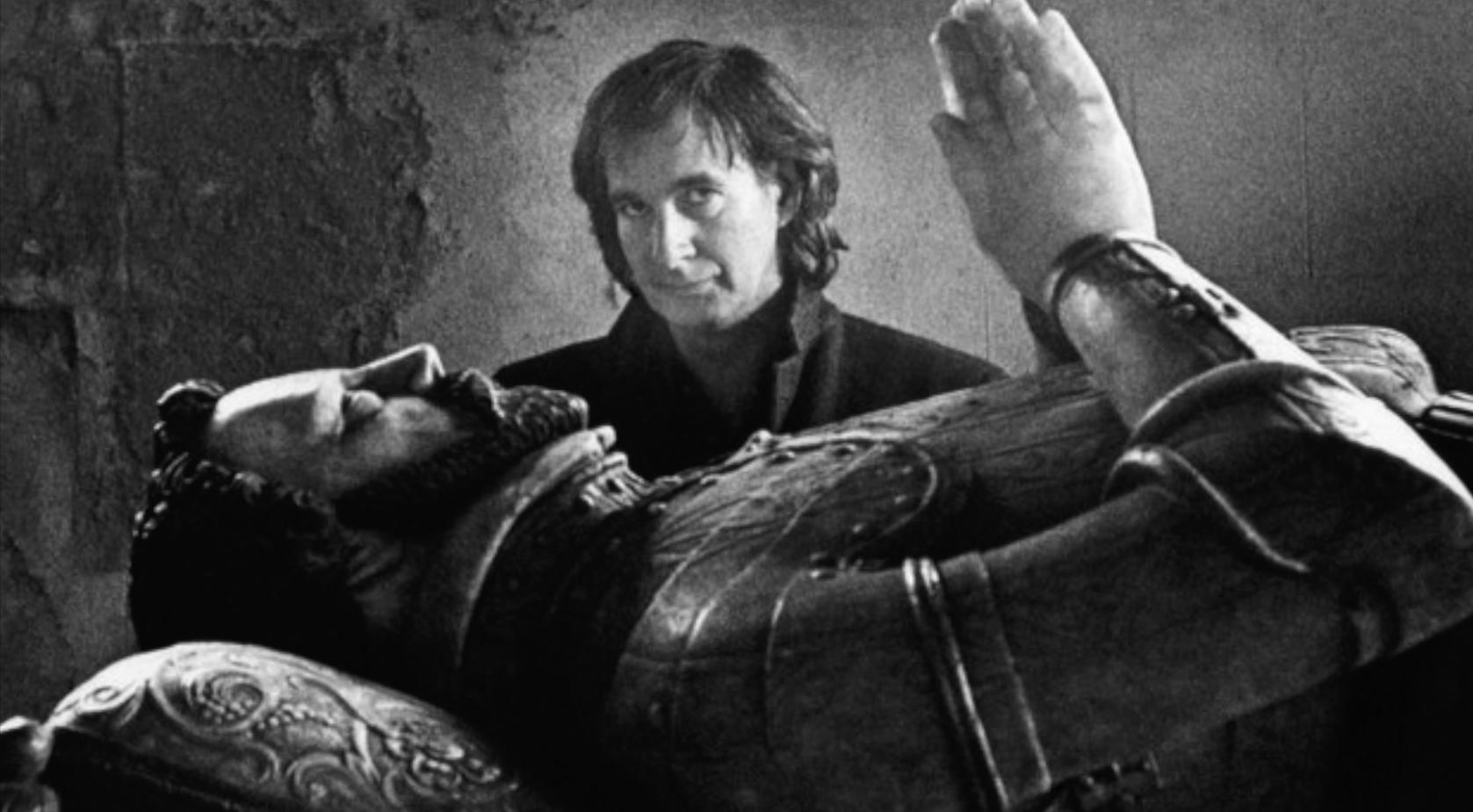
Documentary, by Jason Figgis, United States, 2019.
This documentary retraces the life and work of Simon Marsden, widely regarded as one of the foremost photographers of the supernatural. Premiered at the British Film Institute in London, the film offers a fascinating journey into his creative universe, appealing not only to photography enthusiasts but also to scholars, teachers, students, and anyone intrigued by the mysteries of the unseen. Through evocative imagery and first-hand accounts, it explores the artistic path of a photographer whose work has appeared in books, on U2 album covers, and in museum exhibitions around the world.
Although convinced of the existence of ghosts, Marsden never claimed to capture them directly with his camera. Instead, he used black-and-white infrared film to record the atmosphere and the invisible traces that, in his view, spirits left imprinted upon places. From the landscapes of Ireland to the vast expanses of Russia, passing through Venice and the American Southwest, he transformed historic buildings, ruins, and haunting locations into deeply evocative images capable of suggesting dark and unsettling stories. His photographs continue to captivate the imagination, demonstrating how the most powerful works of art can leave a lasting impression on those who behold them.
LANGUAGE: English
SUBTITLES: Spanish, French, German, Portuguese
The Painters Who Pretended Not to Panic
You are sitting in the Salon of 1859, surrounded by paintings so enormous they feel like architecture, and the conversation everyone is pretending not to have is the one about the machine in the next room.
The official position of the French academic establishment was contempt — a contempt performed with the particular ease of people who are frightened. The Académie des Beaux-Arts had spent two centuries constructing a hierarchy of skill so elaborate it functioned less as aesthetic theory and more as a closed guild. History painting sat at the apex, then portraiture, then genre scenes, then landscape, then still life. Every position on that ladder required years of atelier training, mastery of anatomy, command of compositional geometry inherited from Raphael and Poussin. What the daguerreotype demonstrated, in the blunt language of chemistry, was that the bottom half of that ladder — faithful likeness, accurate proportion, precise rendering of light on surfaces — could be accomplished in under a minute by a copper plate coated in silver iodide.
Charles Baudelaire wrote his review of that year’s Salon with a fury that reads, from sufficient distance, as the fury of a man who has already lost the argument he is making. His condemnation of photography appeared in the Revue française and was unambiguous: photography was “the refuge of every would-be painter, every painter too ill-endowed or too lazy to complete his studies.” It was the enemy of imagination, a servant of science useful only for secretaries and archivists, a technology that the stupid public was worshipping precisely because it flattered the public’s worst instinct — the desire for exact reproduction rather than transformation. The argument is internally coherent. It is also the argument of someone watching a flood and insisting that water is philosophically inferior to land.
What Baudelaire could not afford to say, and what the academic painters certainly could not afford to say, was that photography had not attacked bad painting. It had attacked the foundational premise of good painting as the culture had defined it for generations. The old defense of artistic skill rested substantially on difficulty — the idea that producing a recognizable likeness of the world required discipline, sacrifice, and talent that ordinary people could not access. That defense evaporated the moment a bourgeois merchant could walk into Nadar’s studio on the Boulevard des Capucines and emerge an hour later with a portrait more technically accurate than anything a journeyman painter could produce in a week. Difficulty had been the moral justification for the artist’s social status. The camera made difficulty optional.
The painters who did not panic — or rather, the painters who were most effective at concealing it — responded by relocating the definition of art entirely. If the machine could capture surfaces, then surfaces were no longer the point. The argument shifted, with remarkable speed, from representation toward intention, toward the inner life of the artist, toward what could not be captured by any lens. This was not a response that emerged from confident philosophy. It was a forced migration. The Impressionists who gathered through the 1860s and exploded publicly in 1874 were not simply rebels against academic style; they were a generation that understood, at some level below articulation, that painting would have to justify its existence on entirely new grounds because the old grounds had been occupied by silver and light.
Ingres, who dominated the academic world with a technical mastery that was genuinely extraordinary, reportedly used daguerreotypes as reference material for his portraits while publicly dismissing photography as irrelevant to true art. The contradiction was not hypocrisy in the ordinary sense. It was the behavior of a man renegotiating his own identity in private while defending it in public — which is precisely what the entire institution of academic painting was doing, collectively and without acknowledgment, for the next forty years.

What the Hand Could No Longer Claim
You are standing in front of a canvas from 1648, a Dutch interior by Gerard Dou, and someone near you says, almost under their breath, that you can see the thinking in it. They mean the brushwork. They mean the thousand small decisions compressed into the surface — where to thicken the impasto, where to let the ground show through, how much to blur the edge of a copper pot catching window light. They mean that the painting is not just a record of a room but a record of a mind moving through a room, and that this distinction is the whole argument.
The philosophical weight behind that whisper stretches back to Aristotle’s claim in the Poetics that art imitates not just appearances but the underlying principles of things, and was later formalized by academic doctrine into a hierarchy of difficulty: history painting at the apex because it demanded the most invention, still life at the base because it demanded the least. What unified the hierarchy was the assumption that artistic value was inseparable from the quantity and quality of human decision embedded in the work. Giorgio Vasari, writing in 1550 in his Lives of the Artists, praised disegno — the conceptual drawing beneath the painted surface — as the visible expression of the intellect’s grasp on matter. A painting was a record of a person thinking. That record was its value.
When Louis Daguerre announced in January 1839 that a silver-coated copper plate could fix a scene permanently by its own exposure to light, the academy did not immediately understand what had been threatened. The early reaction from painters was often dismissal or condescension: the daguerreotype was a mechanical curiosity, a parlor trick, perhaps useful for reference. Paul Delaroche reportedly said that from that day painting was dead, and history has found this funny, since painting manifestly did not die. But the comedy of the remark obscures its diagnostic precision. Delaroche was not describing extinction. He was describing a philosophical wound that no institution had yet found the language to treat.
The wound was this: photography produced images of staggering fidelity without the intercession of a deciding consciousness. The camera did not choose, in any sense the academy recognized as choice. It did not prefer one edge over another, did not correct the ugliness of a face out of psychological loyalty to the subject, did not build a drama by suppressing irrelevant details. It accepted everything the light presented with identical, merciless impartiality. Charles Baudelaire understood this immediately and wrote in his 1859 Salon review that photography was the refuge of every failed painter, every painter who lacked the sufficient genius for art, because it flattered the modern public’s desire for exactitude over imagination. He was wrong about the sociology but right about the provocation: photography exposed that exactitude and art had been confused for centuries, and that separating them would require dismantling assumptions so deep they had never been named as assumptions at all.
What the hand could no longer claim was exclusive authorship of the visible. Before 1839, to possess an image of something was to possess a human interpretation of it — there was no other kind. After 1839, interpretation became optional. You could have the thing itself, or close enough to the thing itself that the difference seemed metaphysical rather than practical. This did not merely challenge the painter’s market. It destabilized the ontology of the art object at its root. Walter Benjamin, writing in 1935 in his essay on the work of art in the age of mechanical reproduction, would identify this destabilization as the loss of aura — the singular presence of a thing that has existed in a particular place and time — but even Benjamin’s framework arrives late to a crisis that was already visible in the 1840s, whenever a viewer stood before a daguerreotype and felt, uncomfortably, that they were seeing more truth than any painting had ever shown them.
Pictorialism and the Lie of Imitation
You are standing in a gallery in London, 1889, and the photograph in front of you looks almost exactly like a Dutch oil painting — the soft grain of the light, the blurred edges, the carefully arranged peasants bending over a harvest field as though Millet himself had composed them. You lean closer expecting brushwork and find instead a silver gelatin surface, manipulated in the darkroom with petroleum jelly on the lens, with gum bichromate layered over the print, with every trace of mechanical precision deliberately erased. The photographer wanted you to forget what you were looking at.
Henry Peach Robinson published “Pictorial Effect in Photography” in 1869, and the book became a kind of manifesto for a generation that believed the camera could only earn dignity by subordinating itself to the rules of academic painting. Robinson himself was famous for composite photographs assembled from multiple negatives — a dying girl propped on pillows, mourning figures arranged at her bedside — each element photographed separately and then joined in the darkroom with extraordinary technical skill deployed entirely in the service of making that skill invisible. The irony was architectural: the greater the craft required to assemble the illusion, the more completely the photograph had to erase the evidence of its own construction to succeed.
Peter Henry Emerson arrived as a counter-voice and still fell into the same gravity well. His 1889 book “Naturalistic Photography for Students of the Art” attacked Robinson’s theatrical stagings and argued instead for blurred focus based on how the human eye actually perceives a scene, soft at the periphery, clear at the center. He called this scientific. He called it honest. But honesty here still meant translation into the language painting had already established as legitimate — Emerson’s Norfolk Broads landscapes were soft, melancholy, impressionistic, and they were received warmly precisely because they looked like Whistler. Within three years he issued a black-bordered pamphlet renouncing his own theory, declaring photography not an art at all, apparently unable to resolve the contradiction he had built into its foundation.
What the Pictorialists exposed without intending to is the structural violence of aesthetic hierarchies — the way a medium arriving after the hierarchy is established must pay tribute in the currency of the already-powerful. Pierre Bourdieu mapped this dynamic in “The Field of Cultural Production” (1993), showing how fields with established consecration systems force newcomers to seek legitimation through the existing gatekeepers or remain permanently marginal. Photography in the 1880s had no autonomous critical language, no curators, no institutional vocabulary that was its own. The Royal Academy did not hang photographs. Alfred Stieglitz understood this more clearly than almost anyone — his journal “Camera Notes,” launched in 1897, and later “Camera Work” beginning in 1903, were acts of institutional construction as much as aesthetic argument, creating the infrastructure through which photography might eventually judge itself by its own criteria rather than borrowed ones.
What gets lost inside this transaction is harder to name but more consequential. The camera’s native capacity — its relationship to contingency, to the unrepeatable instant, to the absolute indexical bond between image and physical reality that Roland Barthes would spend a career trying to articulate — was exactly the property being suppressed. Every petroleum jelly smear on a lens was a small act of self-mutilation performed to gain entrance to a room that had been decorated for a different body. The Pictorialists were not confused about what they were doing; Robinson’s writings are lucid and deliberate. They simply calculated, correctly for their moment, that visibility required self-erasure, that the price of being seen was agreeing not to show what you actually were.
The deeper question this raises is not about photography at all, but about what any cultural form surrenders when it asks permission from the institutions that preceded it, and whether the permission, once granted, can ever be fully taken back.
Stieglitz and the Violence of the Straight Line
You are standing on a street corner in Manhattan in 1907, and a man with a camera is waiting in the snow for three hours. He is not waiting for the light to improve or for a subject to arrange itself into something picturesque. He is waiting for the image to become inevitable — for the moment when the visual world stops pretending to be anything other than exactly what it is.
Alfred Stieglitz published “The Steerage” in Camera Work in 1911, and the photograph did something that no amount of soft-focus manipulation or platinum-toned sentimentality had managed to accomplish: it refused to apologize for being a photograph. The image showed immigrant passengers divided by a gangway, the geometry of chains and funnels and human bodies organized not by a painter’s compositional instinct but by the raw pressure of social reality pressing against a single frame. There was nothing painterly about it. That was precisely the point.
The movement Stieglitz was dismantling had dominated serious photographic culture for nearly two decades. Pictorialism, with its deliberate blurring, its chemical manipulation, its hunger for the texture of charcoal and watercolor, had been photography’s apology — a sustained argument that the medium could only earn aesthetic legitimacy by disguising what it actually was. The Photo-Secession, which Stieglitz had himself co-founded in 1902, had briefly operated within that anxiety before he grew impatient with it. His gallery at 291 Fifth Avenue, opened in 1905, became the staging ground for something more confrontational: the proposition that precision itself was a form of vision, that the sharp edge and the unmanipulated tonal range were not failures of artistic sensibility but the specific language through which photography could say things no other medium could reach.
Camera Work, which Stieglitz edited from 1903 to 1917, published 50 issues that functioned less as a magazine than as a sustained philosophical argument printed on Japanese tissue paper. The production quality was deliberate provocation — each issue a material claim that photographic reproduction deserved the same reverence given to printed reproductions of oil paintings. But the argument running beneath the aesthetics was harder. Stieglitz was insisting that the camera’s mechanical nature, its indifference to the photographer’s hand, was not a deficiency to be aesthetically compensated. The machine’s eye, precisely because it could not lie about its own process, gave access to a kind of truth that the trained hand always partially obscured.
What made this rupture culturally violent rather than merely stylistic was its implication for painting itself. The critic Clement Greenberg would later argue, writing in Partisan Review in 1939, that modernism’s essential project was the purification of each medium to its own irreducible properties. Stieglitz had arrived at a version of this logic thirty years earlier through an entirely different door. If photography’s specific property was its mechanical fidelity to the visible moment, then the photographs that most fully inhabited that property were the most authentically photographic — and therefore, by extension, more fully themselves than any Pictorialist print struggling to look like something else. The aesthetic argument had a territorial dimension: photography was not trying to occupy the same ground as painting. It was claiming ground that painting had never been able to reach.
The sociologist Howard Becker, in Art Worlds published in 1982, described how artistic legitimacy is never granted by isolated genius but constructed through networks of institutions, publications, exhibition spaces, and critical language. Stieglitz understood this with a strategist’s clarity. The gallery, the journal, the carefully cultivated relationships with European modernists including Rodin and Matisse, whose work appeared in 291’s exhibitions alongside photographs — all of it assembled an infrastructure of seriousness that forced critics and audiences to encounter photography within a frame that made dismissal more difficult. The argument was not only aesthetic. It was institutional, spatial, economic, and relentlessly deliberate.
The straight line in a Stieglitz photograph does not comfort you.
A vision curated by a filmmaker, not an algorithm
In this video I explain our vision
The Document That Accused
You are standing in a gallery in lower Manhattan, and the photograph on the wall shows a family of seven in a room the size of a closet, their faces turned toward the flash with an expression that is not quite surprise and not quite resignation but something that belongs to neither category — a look that the middle classes, who paid admission to be there, had never needed to develop.
Jacob Riis published How the Other Half Lives in 1890, and the book did something that social reform tracts had failed to do for decades: it made the argument undeniable by making it visible. The tenements of Mulberry Bend, the child laborers, the men sleeping in Bayard Street lodging houses packed shoulder to shoulder — these were not illustrations of a thesis. They were the thesis, rendered in silver and light. Riis himself was not a trained artist and did not consider himself one; he was a journalist and a reformer, and he used the newly available magnesium flash powder with the blunt instrumentality of a man who needed to show something to people who would otherwise look away. The images were coarse, spatially compressed, technically imperfect by every academic standard of the period. They were also impossible to dismiss.
What happened next is where the story gets uncomfortable. The social damage those photographs recorded — overcrowding that killed children, sanitation conditions that produced tuberculosis at rates that would now be considered a wartime catastrophe — was partially addressed, partially managed, and then largely forgotten. But the photographs entered the archive. And once inside the archive, they began to be handled differently. They became documents of a historical moment. Then artifacts of a historical moment. Then, with sufficient temporal distance, they became art objects, and the human suffering inside them became compositional information — the geometry of shadow against a wooden beam, the way a child’s hands rest against the frame.
Dorothea Lange took Migrant Mother in February 1936 in Nipomo, California, in approximately twenty minutes. Florence Owens Thompson, the woman in the photograph, was thirty-two years old, had seven children, had recently sold the tires off her car to buy food, and was eating frozen vegetables that her children had foraged from a nearby field. The photograph was published in the San Francisco News within days and helped pressure the federal government to send twenty thousand pounds of food to migrant camps. By that measure it worked: it produced a material outcome in the real world with a speed that written journalism rarely achieved. Thompson herself, however, received nothing. She spent the rest of her long life troubled by the image, not because she resented Lange personally but because the photograph had become famous in a way that had no relationship to her life, and the famous woman in the picture was someone she had briefly been in the worst weeks she could remember.
The philosopher John Berger, writing in Ways of Seeing in 1972, observed that photographs of suffering function within a social system that simultaneously requires the image and neutralizes it — the image confirms that something terrible exists, which then substitutes for the obligation to change the conditions that produced the terrible thing. The Museum of Modern Art acquired Migrant Mother into its permanent collection. The Library of Congress holds it as a national treasure. Both institutions have produced extraordinary scholarship around it. None of that scholarship fed Florence Owens Thompson’s children.
What the institutional absorption of documentary photography revealed was not hypocrisy in any simple sense but rather a structural feature of how aesthetic categories manage moral pressure. To call something art is, among other things, to assign it to a domain governed by contemplation rather than action — and contemplation, however serious, however moved, does not reorganize the conditions under which people are forced to become subjects of photographs taken by strangers who will later be celebrated for the work.
Roland Barthes in the Dark Room
You are looking at a photograph of someone who is already dead, and you do not yet know this, and then you do, and the image does not change but you do — something in the chest, not grief exactly, something more structural, like a wall you had forgotten was holding weight suddenly making itself known.
Roland Barthes published Camera Lucida in 1980, the same year he was struck by a laundry van on the rue des Écoles and died from his injuries. The book had just gone to press. It reads, in retrospect, as a man already in conversation with his own disappearance — a philosopher who spent a career decoding cultural signs finally confronting the one image that refused to be decoded: a photograph of his recently deceased mother as a young child, standing in a winter garden. He never shows the reader this photograph. He describes it, circles it, mourns it, and withholds it entirely, which is itself an argument: some images operate at a frequency that language cannot carry, only approximate from a safe distance.
What Barthes identified as the punctum — from the Latin for wound, or prick, the small piercing — was not a formal quality and not a semantic one. It was the detail that nobody planned, that the photographer did not intend and the critic cannot systematize, that reaches across the surface of the print and catches on something in the viewer with no warning and no explanation. A strap slipping off a shoulder. Shoes that are wrong for the decade. A child’s hands positioned with an adult’s carefulness. The studium, by contrast, was everything that could be culturally read and politely appreciated — composition, historical context, documentary value, the photographer’s evident intention. The studium is where criticism had been living for a century, making its bed, writing its essays, awarding its prizes. The punctum is where the viewer had always actually been, alone with something that had no name.
This distinction did something almost violent to the critical establishment’s relationship with photography, because it relocated the authority of the image away from the maker and toward the body of the person looking. Erwin Panofsky had spent decades building iconological frameworks for painting — his Studies in Iconology from 1939 offering exhaustive systems for reading symbols, programs, and intentions embedded in pictorial surfaces. That methodology assumed the image was primarily a cultural object to be decoded by a trained mind. Barthes was insisting that photography, specifically, resisted this. That training could not inoculate the viewer against the punctum, that in fact cultural sophistication might function as armor that the punctum bypassed entirely, striking harder in the unguarded place.
The reason photography could do this where painting could not came down to what Barthes called the noeme of the medium — the “that-has-been,” the Latin ça a été rendered as ontological fact. A painting shows you what someone imagined or constructed. A photograph shows you a surface that light actually touched. The referent clings to the image in a way that has no equivalent in any other visual form, and this clinging produces not aesthetic pleasure but something closer to testimony, or evidence, or haunting. Susan Sontag had already argued in On Photography in 1977 that photographs were not so much representations of reality as fragments of it, material traces rather than interpretations, and the culture had nodded politely and filed this observation under “theory.” Barthes pressed the same claim deeper into the body, refusing to let it remain a philosophical position, insisting it was a physical event.
What this meant practically was that every institutional framework constructed to legitimize photography as art — the museum, the monograph, the critical vocabulary borrowed from painting — had been, in a certain sense, building walls around something that operated through the walls, around them, or simply before the viewer could raise them.
The Museum Surrenders, Then Renegotiates
You are standing in a white room, and on the wall in front of you is a photograph mounted behind glass, labeled with a name, a date, an edition number — 3 of 10 — and a price that belongs to the vocabulary of oil paintings. The room is silent in the particular way that institutions enforce silence, and you feel, without being able to articulate it, that something has been done to the image that the image did not ask for.
What happened in that room began formally in 1940, when the Museum of Modern Art in New York established its Department of Photography under Beaumont Newhall, who had already published his canonical survey “The History of Photography” in 1937 as a companion to an exhibition that drew thirty thousand visitors. The gesture looked like recognition. It was closer to capture. The museum extended to photography the one honor it knew how to give: it treated it like painting, which meant subjecting it to the entire apparatus of authorship, rarity, and institutional consecration that painting had accumulated over four centuries. A medium whose defining ontological feature was the capacity to exist in unlimited identical copies was immediately reorganized around the fiction of the singular object.
Walter Benjamin had identified this as the central cultural stakes of mechanical reproduction in his 1935 essay — not the question of whether photographs were beautiful, but the question of what happens to the concept of authenticity when an image has no original. The museum answered that question by manufacturing originals retroactively, through edition limits, archival prints, and the curator’s act of selection, which functions less as aesthetic judgment than as a form of economic conjuring. When an institution chooses which photographs enter its collection, it does not simply recognize value that already exists; it produces value by withdrawing the image from circulation, by making it scarce, by surrounding it with the hush of the consecrated.
The deeper operation was the transformation of photographers into Authors in the Romantic sense — solitary visionaries whose inner life is legible in their formal choices, whose biography authenticates their work. This is the framework Roland Barthes would methodically dismantle in 1967, but the museum was already constructing it in the 1940s, grouping photographs by individual practitioners, mounting retrospectives, building the cult of the personal style. Dorothea Lange’s “Migrant Mother,” taken in 1936 for the Farm Security Administration as a document of federal policy and distributed freely to newspapers, became, under institutional reframing, an aesthetic monument to Lange’s vision. The woman in the photograph, Florence Owens Thompson, did not consent to this transformation and spent decades trying to escape the image that had consumed her identity. The museum’s logic had no room for that friction.
What the institutional absorption neutralized was precisely the thing that had made photography politically volatile: its promiscuity. Images that could be everywhere at once, reproduced on the front page and the protest flyer and the government report and the advertising spread, carried a kind of democratic contamination that fine art institutions are structurally allergic to. By pulling photography into the curatorial framework, MoMA did not elevate the medium so much as quarantine its most destabilizing property. The edition of ten is not a tribute to the photograph; it is a barrier against what the photograph could otherwise become.
This does not mean that the photographs hanging in those white rooms are without power, or that the practitioners who entered museum collections were complicit in something cynical. It means that the institution and the medium are engaged in a negotiation that never resolved, because what photography is — endlessly duplicable, chemically indifferent to the distinction between original and copy, capable of living simultaneously in a gallery and a tabloid and a refugee’s wallet — refuses the terms the museum requires to function.
🎨 The Eye as Witness: Art, Vision, and Representation
Photography did not emerge in a vacuum: it was born at the crossroads of aesthetic theory, the history of seeing, and the philosophy of images. These articles trace the intellectual landscape that surrounds and nourishes the visual revolution that transformed art forever.
Ernst Gombrich: Life and Works
Ernst Gombrich dedicated his life to understanding how the human eye learns to see art, arguing that perception is always shaped by cultural convention and expectation. His work on representation and illusion provides an essential theoretical foundation for understanding why photography, when it arrived, so radically disrupted established hierarchies of the image. No study of photography as art can ignore Gombrich’s profound inquiry into what it means to look.
GO TO THE SELECTION: Ernst Gombrich: Life and Works
Pierre Bourdieu and the Artistic Field
Pierre Bourdieu examined the artistic field as a social battlefield where cultural legitimacy is constantly contested and redefined. His sociological approach reveals how photography, long dismissed as mere mechanical reproduction, slowly fought for recognition within the consecrated world of high art. Understanding Bourdieu’s framework is crucial for grasping why the elevation of photography to the status of art was never a neutral aesthetic event but a deeply political one.
GO TO THE SELECTION: Pierre Bourdieu and the Artistic Field
The Relationship Between Painting and Cinema: History and Theory
The dialogue between painting and cinema illuminates how visual media have continually borrowed, challenged, and reinvented each other’s languages throughout history. Photography stands at the heart of this conversation, having directly given birth to the moving image while permanently altering how painters conceived of light, time, and composition. This article traces the shared grammar of visual arts that photography both inherited and revolutionized.
GO TO THE SELECTION: The Relationship Between Painting and Cinema: History and Theory
Roland Barthes: Life and Works
Roland Barthes offered one of the most penetrating philosophical meditations on photography ever written, exploring how the photographic image carries an irreducible trace of the real that no other art form can replicate. His concepts of the studium and punctum illuminate why certain photographs pierce the viewer with an almost existential force. Barthes remains indispensable reading for anyone seeking to understand photography not just as technique but as a profound encounter with time, death, and meaning.
GO TO THE SELECTION: Roland Barthes: Life and Works
Discover the Power of the Visual Image on Indiecinema
If these reflections on photography, art, and the history of seeing have stirred your curiosity, Indiecinema streaming is the ideal place to continue the journey. Explore a curated selection of independent and avant-garde films that push the boundaries of visual language and cinematic expression. Join the community of passionate viewers who believe that cinema, like photography, can be a true revolution of the eye.
👉 EXPLORE THE CATALOG: Watch Indie Films in Streaming
A vision curated by a filmmaker, not an algorithm
In this video I explain our vision

